
Agentic AI in Bioinformatics: 12 Use Cases, Real-World Examples, and How to Deploy Governed Agents (2026 Guide)


Agentic AI in bioinformatics means large-language-model-driven agents that plan an analysis, select the right tools, execute them, check their own results and hand back a reproducible artefact, rather than running a pipeline someone wrote in advance. Ask for differential expression on a new RNA-seq dataset and the agent decides on quality control, normalisation, DESeq2 parameters, pathway enrichment and the report, calling BLAST, Scanpy or an annotation database as needed. The research community now calls this agentic bioinformatics, and for genomics specifically, agentic genomics.
This guide covers what agentic bioinformatics is, why the field's own leading journals now argue the hard problem has moved from building pipelines to validating them, 12 concrete use cases with the real systems behind each, the failure modes that stop pilots reaching production, and a governance blueprint for running these agents on sequencing and patient data you cannot afford to expose.
Key takeaways
- Agentic bioinformatics replaces fixed pipelines with agents that plan, execute, validate and adapt; workflow managers such as Nextflow and Snakemake become tools the agent calls, not the orchestrator.
- The bottleneck has shifted. A July 2026 Cell Genomics perspective argues agentic genomics moves the constraint from pipeline construction to validation; a June 2026 benchmark found planning errors, not execution faults, are the dominant failure.
- Real systems exist today: Biomni, AutoBA, CellAgent, BioMaster, BioAgents, CellAtria, GeneGPT and CRISPR-GPT, plus general-purpose coding agents that now match or beat them on pipeline planning.
- The 12 use cases span RNA-seq, single-cell, multi-omics, variant interpretation, literature-to-analysis, reproducibility auditing, spatial transcriptomics, target prioritisation, protein workflows, pathogen genomics, pipeline engineering and the research operations around the science.
- Production use in a biotech, CRO, hospital or research institute needs permission enforcement on every action, immutable provenance, deterministic rules for release decisions, human approval gates and the option to run on infrastructure you control. That is a platform problem, not a model problem.
What is agentic AI in bioinformatics?
Agentic AI in bioinformatics is the use of autonomous or semi-autonomous AI agents, usually built on large language models, to carry out multi-step biological data analysis: choosing methods, invoking domain tools, handling errors, interpreting outputs and producing a report, with a human deciding how much of that loop to supervise.
The term agentic bioinformatics was formalised in a 2025 Briefings in Bioinformatics review, which frames it as end-to-end integration of agents that reason, plan, adapt and collaborate across the whole research process, from experiment design through data analysis to hypothesis generation, rather than the use of an LLM as a code assistant at one step. A January 2026 survey in the same journal reviewed more than 100 biological AI agent studies and organised them along five dimensions: task domain, system architecture, interaction mode, evaluation strategy and resource integration.
Agentic bioinformatics vs AI-assisted bioinformatics vs workflow managers
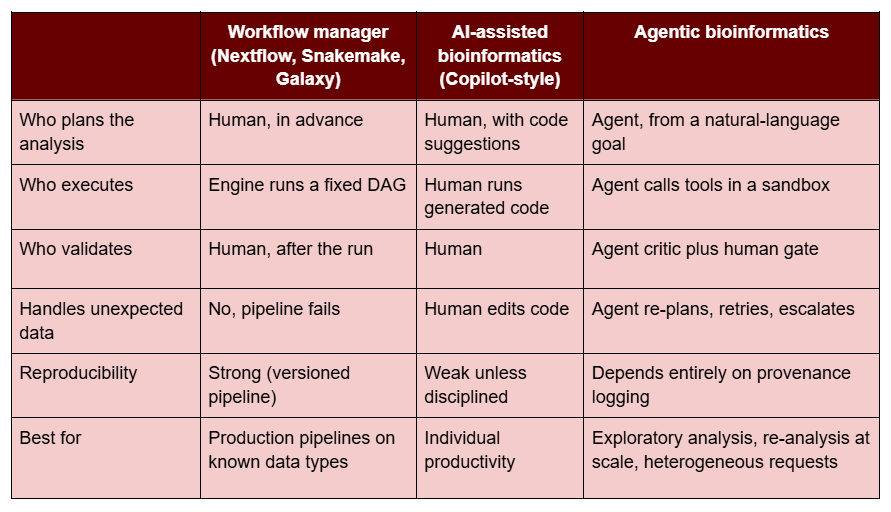
The point is not that agents replace Nextflow. The best current systems call workflow managers and native tools as first-class actions precisely to inherit their reproducibility.
Single-agent vs multi-agent systems
Single-agent systems (AutoBA is the canonical example) take a data path, a description and an objective, then plan and execute the whole analysis themselves. Multi-agent systems split the work: a planner decomposes the request, tool agents wrap BLAST, DESeq2 or Scanpy, a "domain expert" agent grounds decisions in curated biomedical knowledge through retrieval-augmented generation, a debug agent repairs failed steps, and a reviewer agent checks outputs before anything reaches the user. IBM's ISMB 2025 system built on the BeeAI framework used exactly this domain-expert pattern to reduce hallucinated workflow choices across omics tasks from differential expression to cell-type annotation and TCR-epitope binding prediction.
Dry-lab vs wet-lab agents
Almost everything in production today is dry-lab: agents operating on data. Wet-lab agents that drive sequencers, liquid handlers or microscopes are real research, but they sit behind physical safety and validation requirements that keep them at pilot stage in most organisations. This guide focuses on dry-lab agents and the operational systems around them.
Why now: the bottleneck moved from building pipelines to validating them
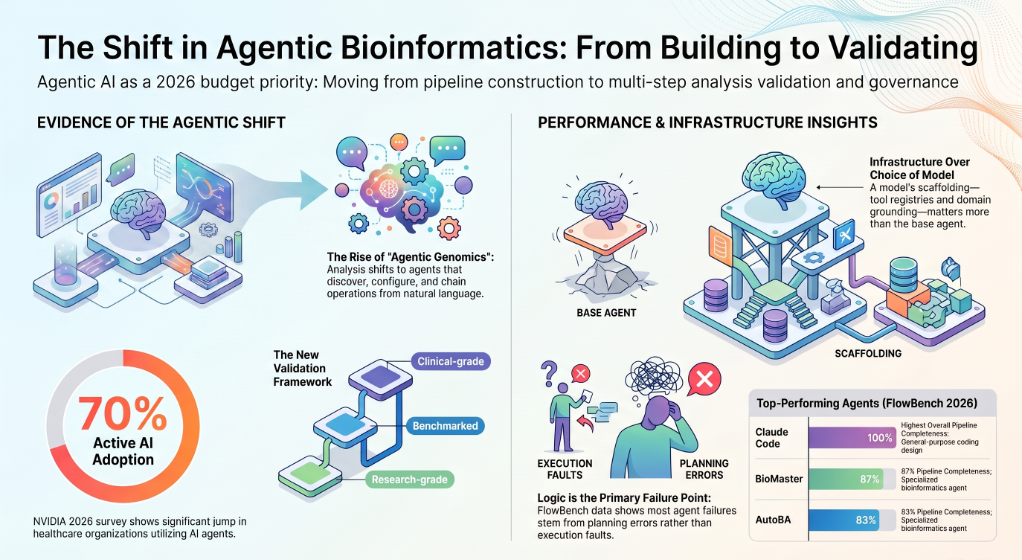
Three pieces of 2026 evidence explain why agentic AI in bioinformatics has moved from curiosity to budget line.
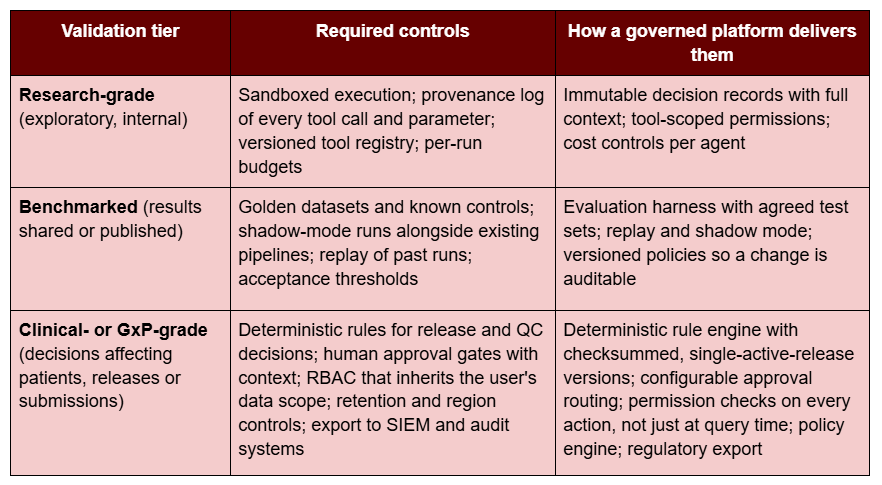
The field's own diagnosis. A July 2026 perspective in Cell Genomics coined "agentic genomics" for the delegation of multi-step genomic analyses to agents that discover, configure and chain bioinformatics operations from natural language. Its central claim is that this shifts the bottleneck in computational biology from constructing pipelines to validating what they produce, and it proposes a tiered validation framework: research-grade, benchmarked, and clinical-grade analyses, each with stricter controls.
The benchmark data. FlowBench, a June 2026 preprint, tested published bioinformatics agents on planning, fault recovery and interpretation. BioMaster, AutoBA and Biomni reached 87%, 83% and 70% pipeline completeness respectively, but plan correctness separated them more sharply, and most failures were planning errors rather than execution faults. A general-purpose coding agent with no bioinformatics-specific design (Claude Code) outperformed all three dedicated agents on both measures. The lesson for anyone buying or building: the scaffolding around the model — tool registry, domain grounding, rules and review — matters more than which agent you start with.
The adoption signal. ISMB 2026 ran multiple hands-on agentic AI tutorials covering tool registration, MCP servers, multi-agent orchestration and human-in-the-loop design; the agentic sessions sold out. NVIDIA's 2026 healthcare and life sciences survey put active AI use at 70% of organisations, up from 63% a year earlier, with a new section on agents.
Put together: the science community has accepted agents, measured where they fail, and named validation and governance as the open problem. That is the problem this guide solves in the second half.
How an agentic bioinformatics system actually works
A production-grade agentic bioinformatics architecture has seven layers. Most research prototypes have the first three; almost none have the last three, which is why they stay prototypes.
- Request interface. A scientist describes the goal in plain language, optionally attaching a paper, an accession ID or a dataset location.
- Planner. The agent decomposes the goal into steps and proposes a workflow. Domain grounding happens here: retrieval over curated protocols, ontologies and prior runs so the plan reflects how the lab actually does QC and normalisation, not generic training-data defaults.
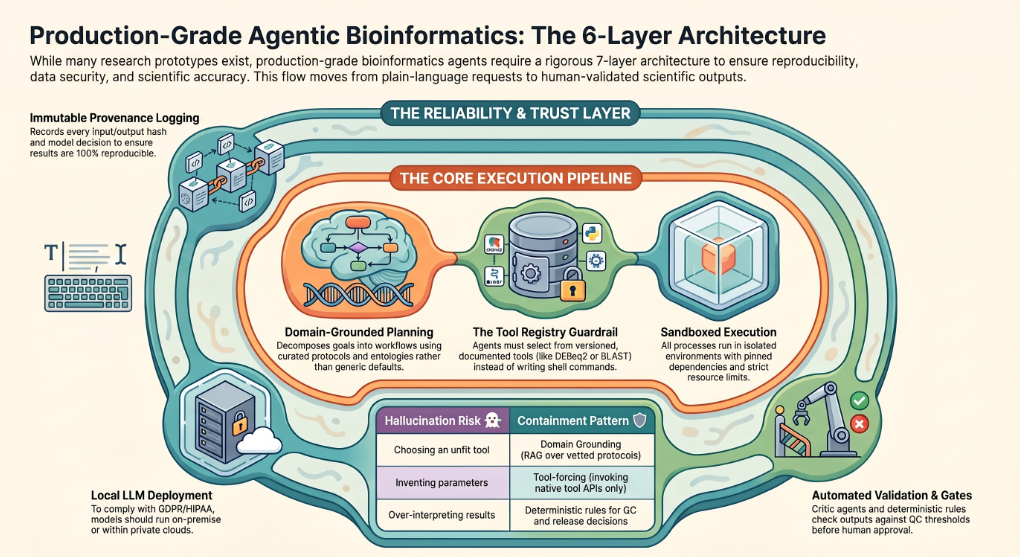
- Tool registry. Versioned, documented tools the agent may call: aligners, DESeq2, Scanpy or Seurat, variant annotators, BLAST, AlphaFold endpoints, public database APIs, Galaxy or Nextflow workflows, and MCP servers exposing internal systems. The agent selects from this registry; it does not write arbitrary shell commands against production data.
- Sandboxed executor. Steps run in isolated environments with pinned dependencies and resource limits.
- Provenance log. Every tool call, parameter, input hash, output hash and model decision is recorded immutably. This is what makes a result reproducible and auditable, and it is the layer most prototypes skip.
- Validator. A critic agent or deterministic rules check outputs against expectations: sample counts, QC thresholds, known positive controls, statistical sanity checks. Anomalies escalate.
- Human approval gate. For anything consequential — a clinical interpretation, a data release, an expensive compute job — a named person approves with full context, and that approval is itself logged.
Where hallucination enters and how to contain it
Agents hallucinate in three predictable places: choosing a tool that does not fit the data, inventing parameters, and over-interpreting results. Three containment patterns work in practice. First, domain grounding through RAG over vetted protocols (the IBM "domain expert" pattern). Second, tool-forcing: the 2025 BRC-Analytics fungal pathogen study made its agents invoke Galaxy's native tools rather than manipulate data directly, so provenance was captured automatically and the re-analysis matched published results almost perfectly despite annotation-version differences. Third, deterministic rules for anything that must not be probabilistic, such as a QC pass/fail or a release decision.
The data boundary
Sequencing data, patient-linked metadata and anything in GDPR or HIPAA scope should never leave infrastructure the organisation controls just because an agent wants to call a hosted model. AutoBA's authors made local LLM deployment a design goal for exactly this reason. Any platform you evaluate needs to run against on-premise or private-cloud models, with the model swappable without rebuilding the agents.
12 use cases for agentic AI in bioinformatics (with real examples)
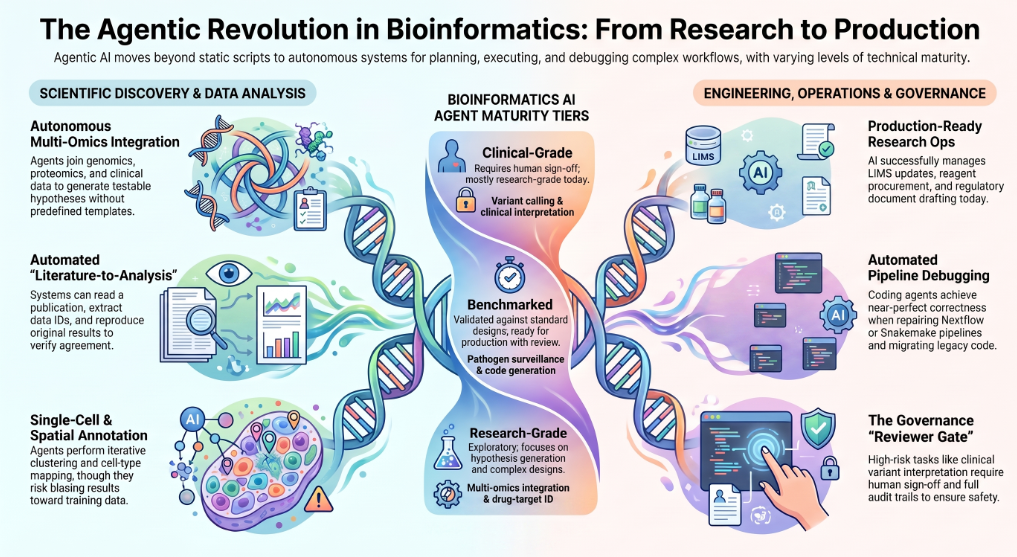
Each use case follows the same format so you can compare them: what the agent does, the data and tools involved, the real system or evidence, the governance risk, and the maturity level using the Cell Genomics tiers (research-grade, benchmarked, clinical-grade).
1. Automated bulk RNA-seq differential expression and pathway analysis
What the agent does: takes raw counts or FASTQ, plans QC, alignment or quantification, normalisation, differential expression and enrichment, then writes an interpretable report. Data and tools: bulk RNA-seq, DESeq2 or edgeR, GSEA, pathway databases. Real example: AutoBA validated across WGS, RNA-seq, single-cell, ChIP-seq and spatial data with three inputs (data path, description, objective); IBM's BeeAI-based system ran differential expression and pathway analysis with DESeq2 as a registered tool. Governance risk: silent parameter choices (filters, design formulas) that change results. Maturity: benchmarked for standard designs; research-grade for complex designs.
2. Single-cell RNA-seq processing and cell-type annotation
What the agent does: normalisation, clustering, marker detection, annotation, and iterative refinement when clusters look wrong. Data and tools: scRNA-seq matrices, Scanpy, Seurat, reference atlases. Real example: CellAgent uses a multi-agent design with dual-layer memory and self-iterative optimisation for scRNA-seq; CellVoyager autonomously explores single-cell datasets to generate new analyses; CellAtria (published in npj Artificial Intelligence, January 2026) reads a paper, retrieves the dataset and runs a standardised pipeline through a chat interface. Governance risk: annotation drift toward training-set priors; the Briefings review noted SpatialAgent tends to default to common annotation patterns rather than novel biology. Maturity: benchmarked.
3. Multi-omics integration and hypothesis generation
What the agent does: joins genomics, transcriptomics, proteomics and clinical variables, runs integration methods, proposes testable hypotheses with supporting evidence. Data and tools: multi-omics matrices, integration packages, knowledge graphs. Real example: Biomni, a generalist biomedical agent shipping with 150+ specialised tools, 105 software packages and 59 databases, executes complex workflows without predefined templates; BioMaster adds RAG-enhanced planning and a dedicated debug agent. Governance risk: plausible but unsupported hypotheses presented as findings. Maturity: research-grade.
4. Variant calling, annotation and clinical interpretation support
What the agent does: runs or orchestrates variant calling, annotates against population and pathogenicity databases, drafts interpretation notes for a geneticist to review. Data and tools: WGS/WES, GATK-style callers, ClinVar, gnomAD, ACMG-style rules. Real example: tool-forcing agents over established callers; GeneGPT-style agents that query NCBI APIs for grounded retrieval. Governance risk: the highest in this list. Any output that touches a clinical decision needs deterministic rules, a human sign-off and a full audit trail. Maturity: clinical-grade required; most systems are research-grade today.
5. Literature-to-analysis: from a paper to a reproduced result
What the agent does: reads a publication, extracts the accession IDs and methods, pulls the public dataset, reproduces the analysis and reports agreement or divergence. Data and tools: PubMed, GEO/SRA, standard pipelines. Real example: CellAtria's document-to-analysis automation; the BRC-Analytics Candidozyma auris case re-analysed two published RNA-seq studies and reached near-perfect correlation with the original results. Governance risk: version mismatch in reference genomes and annotations causing false discrepancies. Maturity: benchmarked.
6. Reproducibility and re-analysis auditing at scale
What the agent does: systematically re-runs a lab's or a field's published analyses under controlled tool and genome versions to test robustness. Data and tools: public repositories, containerised pipelines, provenance stores. Real example: the same C. auris work showed how much published variance comes from unstated versions; Prompt-to-Paper's framework grounds every generated claim in an executed experiment rather than a synthetic result. Governance risk: compute cost blow-ups on long tool chains; needs budgets per run. Maturity: benchmarked.
7. Spatial transcriptomics analysis
What the agent does: experimental design support, multimodal data analysis, niche and cell-type annotation across tissue sections. Data and tools: Visium, MERFISH, Xenium data; spatial analysis packages. Real example: SpatialAgent's adaptive reasoning and dynamic tool integration across tissue types. Governance risk: as above, over-reliance on common annotation patterns. Maturity: research-grade.
8. Drug-target identification and prioritisation
What the agent does: scans literature and omics evidence for candidate targets, scores them on biological relevance and druggability, hands a shortlist to scientists for approval, then orchestrates structure prediction and docking as tool calls. Data and tools: literature corpora, target databases, AlphaFold, docking tools. Real example: Google Cloud's life-sciences R&D framework describes an orchestrator directing a MedGemma research agent for target discovery and an AlphaFold agent for structure, with scientist approval between stages. Governance risk: confident target claims from thin evidence; expensive downstream experiments triggered on weak signals. Maturity: research-grade to benchmarked. For the disease-specific view see our guide to AI agents in cancer research and oncology and the pharma and biotech solutions page.
9. Protein structure and interaction workflow orchestration
What the agent does: chains structure prediction, docking, interface analysis and mutational scanning, managing compute and collating results. Data and tools: sequences, AlphaFold or equivalent endpoints, docking pipelines. Real example: structure-prediction endpoints registered as tools in the multi-agent frameworks above. Governance risk: compute cost; misuse boundaries on certain protein classes require policy controls. Maturity: benchmarked for orchestration; interpretation remains human-led.
10. Pathogen genomics and outbreak surveillance
What the agent does: standardises RNA-seq or metagenomic analysis across studies, tracks resistance markers, flags anomalies for epidemiologists. Data and tools: pathogen genomes, metagenomic reads, BRC-Analytics, Galaxy. Real example: the BRC-Analytics and Galaxy agentic workflow for C. auris, a multidrug-resistant fungal pathogen, standardised reference genome and tool versions to make cross-study comparison possible. Governance risk: public-health decisions on automated calls; needs a reviewer gate. Maturity: benchmarked.
11. Bioinformatics code generation, pipeline migration and debugging
What the agent does: writes and repairs Nextflow or Snakemake pipelines, migrates legacy scripts, fixes dependency and environment failures. Data and tools: repositories, containers, CI. Real example: FlowBench's finding that a general-purpose coding agent achieved full completeness and near-perfect plan correctness on bioinformatics pipeline tasks. Governance risk: unreviewed code changes reaching production pipelines; enforce pull-request review and test gates. Maturity: benchmarked; production-ready with code review.
12. Research operations around the science
What the agent does: everything a bioinformatics core or biotech runs that is not the analysis itself: extracting structured data from protocols, SOPs, certificates of analysis and regulatory PDFs; updating LIMS and ELN records; tracking samples through booking, processing and reporting; procuring reagents; monitoring QC metrics and raising exceptions; drafting citation-grounded summaries for grant and regulatory documents. Data and tools: LIMS, ELN, ERP, procurement, document stores, ticketing. Real example: this is where enterprise agent platforms already run in production in adjacent industries; see the next section. Governance risk: agents writing to systems of record without permission scoping or audit. Maturity: production-ready pattern with the right governance layer.
Real agentic bioinformatics systems compared
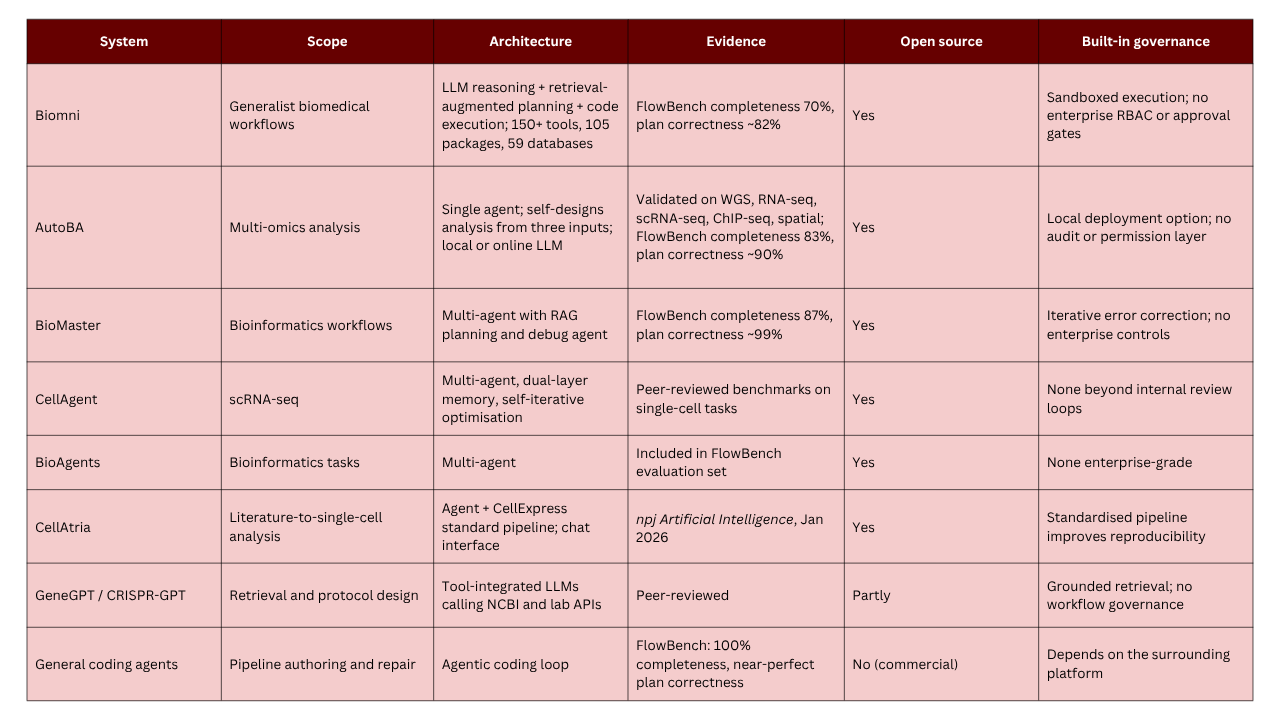
Every system in this table is excellent at the analysis and thin on enterprise governance. That is not a criticism; they were built by scientists for scientists. It is the reason a governed platform sits above them in production.
What Ampcome has delivered on adjacent problems
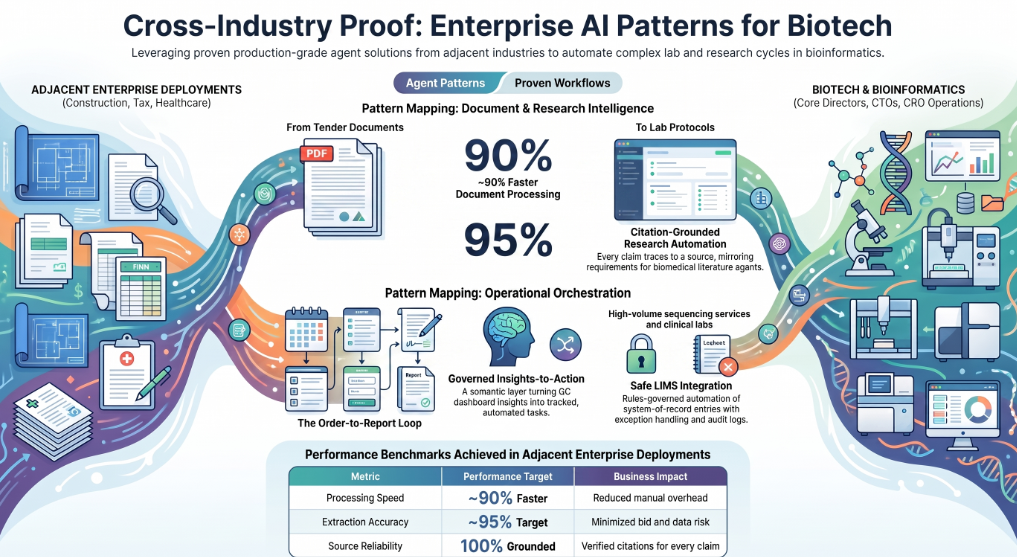
These engagements are not bioinformatics deployments, and we will not describe them as such. They are the same agent patterns a bioinformatics core, CRO or biotech needs, delivered by Ampcome in production-grade enterprise settings. Client names are withheld.
Multi-agent document workbench for a remedial-construction specialist. Autonomous agents retrieve tender documents, determine the correct workflow, extract structured data from complex PDFs using vision-LLM models, detect revisions between document versions, and write validated records into the core operational system through full create-read-update-delete integration with quote locking and audit logs. The system was engineered for up to ~90% faster document processing and a ~95% extraction-accuracy target on standard formats, with bid risk reduced through change detection and auditability. Replace "tender" with "protocol", "certificate of analysis" or "regulatory submission" and this is use case 12.
Citation-grounded research automation for a tax-technology product. Agents collect sources automatically, summarise them, draft memos and positions with citations, track workflow state and build a growing knowledge base. Results were faster research cycles, reduced manual source-hunting and more consistent outputs. It is the same shape as a biomedical literature agent, with the same requirement that every claim traces to a source.
Workflow orchestration for a UK private healthcare and testing provider. Ampcome automated the booking → processing → reporting workflow for high-volume testing services, with status monitoring, customer notifications and operational analytics. Results were more scalable operations with reduced manual overhead, faster customer communications with fewer missed handoffs, and unified service reporting. Any sequencing service or clinical lab will recognise the order-to-report loop.
Sourcing automation for a pharma excipients platform. RFQ automation, supplier matching, quality and regulatory document handling, and analytics on price, lead time and vendor performance, delivering faster procurement cycles and fewer manual vendor follow-ups. Reagent and consumables procurement for labs is the same problem.
Two further engagements are worth noting for pattern proof: a governed, insights-to-action analytics layer for a retail holding group that unified a context engine, a semantic governance layer of rules, hierarchies and formulas, and an orchestrator that turned dashboard insights into tracked tasks with standardised decision logic; and rules-governed automation of SAP sales-order creation for an engineering group, with exception handling, approvals, audit logs and reconciliation reporting. The first is what a bioinformatics QC dashboard becomes when it can act; the second is what writing to a LIMS safely looks like.
Challenges and limits of agentic AI in bioinformatics
Be suspicious of any vendor page that skips this section.
- Planning errors dominate. FlowBench found the lagging agents failed mostly at choosing the right steps, not at running them. Better grounding and review beat bigger models.
- Hallucinated parameters and tools. Contained by tool registries, domain RAG and deterministic rules, never by prompting alone.
- Reproducibility across versions. Unstated genome, annotation and tool versions produce false discrepancies; provenance logging must capture all of them.
- Regression to training priors. Agents default to common annotation patterns and can miss novel biology; keep an expert in the loop for interpretation.
- Data exposure. Calling hosted models with patient-linked or proprietary sequence data creates GDPR and HIPAA exposure; model independence and on-premise deployment are prerequisites, not features.
- Cost. Long tool chains and retries burn compute and tokens; per-run and per-agent budgets are essential.
- No standard evaluation for deployment. A May 2026 Briefings in Bioinformatics appraisal argues current evaluation practice is insufficient for biomedical deployment, especially in rare or high-stakes scenarios, and that human-agent collaboration must preserve the ability to dissent and override.
- Accountability. Someone has to own a result. A design that cannot show who approved what, with which evidence, will not survive a regulator or a reviewer.
A governance blueprint for agentic bioinformatics
Map the Cell Genomics validation tiers to concrete controls and the platform capabilities that deliver them.
Seven-step deployment checklist
- Define the data boundary. Decide which data never leaves your infrastructure and which models are allowed to see it.
- Build the tool registry. Wrap your approved pipelines, packages and databases as versioned tools; expose internal systems through MCP servers or APIs.
- Write the rules. QC thresholds, release criteria, spend limits and PII handling as deterministic rules the agent cannot override.
- Assemble the evaluation set. Golden datasets with known answers for each use case you will deploy.
- Set approval policy. Which actions run autonomously, which need a named approver, and what context the approver sees.
- Run in shadow mode. Agents run alongside bioinformaticians for a fixed period; every divergence is reviewed.
- Go live on one workflow with monitoring. Alerting on policy violations, drift and cost; quarterly review of the evaluation set.
Why assistents.ai is the right platform for agentic bioinformatics
The bioinformatics community has concluded that validation and governance, not analysis capability, are what stand between agent prototypes and production. assistents.ai, Ampcome's enterprise agentic intelligence platform, is built as exactly that layer: a context, governance, decisioning and action layer that sits above your existing data, pipelines, LIMS, ELN and ERP systems rather than replacing them.
- Every agent action is permission-checked. Agents inherit the permissions of the user who invoked them, and checks happen at action time, not just at query time. A bioinformatician's agent sees the cohorts that bioinformatician can see and nothing more. See agent governance.
- Immutable decision records. What data was accessed, why, what was decided and what was done, recorded tamper-proof for every action, with export for audit and security tooling. This is the provenance layer the research prototypes lack.
- Human approval gates with context. High-impact steps — a clinical interpretation, a data release, an expensive compute job — route to designated approvers with the full decision chain attached.
- Deterministic rules where probability is unacceptable. A rule engine with checksummed versions and single-active-release publishing handles QC pass/fail, release criteria and spend limits, so those decisions are never left to a model.
- Model independence and infrastructure you control. Agents run against LLMs from multiple providers or any OpenAI-compatible endpoint, including open-weight models hosted on-premise, so sequencing and patient-linked data stay inside your boundary. See on-premise deployment and our reference architecture for HIPAA-ready AI agents.
- A semantic layer shared by agents and dashboards. "Sample", "batch", "cohort" and "QC pass" are defined once, with formulas and thresholds, and used consistently by agents, rules and the built-in BI layer.
- Existing bioinformatics agents become tools. Biomni, AutoBA, a coding agent or your own Nextflow pipelines are registered as governed tools inside an orchestrated workflow. assistents.ai does not compete with them; it is what makes them deployable.
Connectivity to LIMS, ELN, ERP and ticketing systems is delivered through their published APIs and scoped per deployment.
Why teams choose assistents.ai over building on frameworks or buying point tools
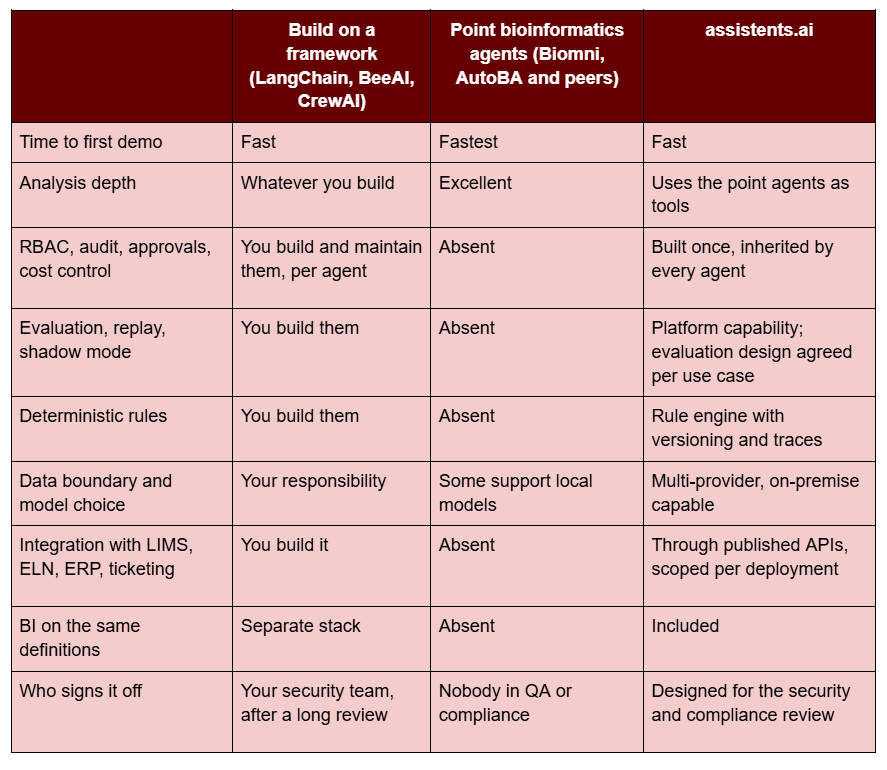
A wrapper around one model gives you a demo. A governed platform gives you something a QA lead, a data protection officer and a reviewer will sign.
Implementation roadmap: from pilot to production in a bioinformatics team
A realistic 90-day shape, with outcomes stated as targets rather than guarantees.
- Weeks 1–2: scope. Pick one use case with high volume and low validation burden: bulk RNA-seq (use case 1), literature-to-analysis (5) or research operations (12). Fix the data boundary and the model choice.
- Weeks 3–6: build the substrate. Tool registry over your approved pipelines and databases; rules for QC and release; evaluation set with known answers; approval policy.
- Weeks 7–10: shadow mode. Agents run alongside bioinformaticians on live requests. Every divergence is logged and reviewed; rules and grounding are tuned.
- Weeks 11–12: controlled go-live. One workflow, monitored, with approval gates on consequential actions. Add the second use case only after the first passes its acceptance thresholds.
Target outcomes to set for the pilot: turnaround time per standard analysis, proportion of runs passing validation without human correction, reviewer time per run, and zero policy violations. Measure them before and after; publish nothing you have not measured.
Conclusion
Agentic AI in bioinformatics is past the proof-of-concept stage. The agents exist, the benchmarks exist, and the leading journals have named the real problem: validating and governing what agents do with data that is expensive to produce and dangerous to expose. Laboratories and biotechs that treat this as a model-selection question will keep running pilots. Those that treat it as a governance and orchestration question will put agents into production on one workflow, measure them, and expand.
assistents.ai is built for that second path: permission enforcement on every action, immutable provenance, deterministic rules, human approval gates and model independence on infrastructure you control, with your existing pipelines and the best open bioinformatics agents registered as governed tools. Request a demo to see it running on your own data, or explore how Ampcome works with pharma and biotech teams.
FAQs
What is agentic AI in bioinformatics?
Agentic AI in bioinformatics is the use of LLM-driven agents that plan, execute, validate and adapt multi-step biological data analyses, such as RNA-seq differential expression, single-cell annotation, variant interpretation or literature-to-analysis reproduction, by selecting and calling domain tools autonomously, with humans supervising the level of autonomy. The research literature calls the paradigm agentic bioinformatics.
How is agentic bioinformatics different from a Nextflow or Snakemake pipeline?
A workflow manager runs a fixed pipeline a human designed in advance. An agent decides which steps to run from a natural-language goal, calls tools (including Nextflow or Snakemake workflows), recovers from failures and re-plans when data differs from expectations. Agents complement workflow managers rather than replace them, and the best systems call them to inherit reproducibility.
Which AI agents exist for bioinformatics today?
Published systems include Biomni (generalist biomedical workflows), AutoBA (multi-omics), CellAgent and CellAtria (single-cell), BioMaster and BioAgents (bioinformatics workflows), GeneGPT (NCBI retrieval), CRISPR-GPT (gene-editing design) and SpatialAgent (spatial biology). General-purpose coding agents now match or exceed several dedicated agents on pipeline planning benchmarks.
Can AI agents analyse RNA-seq and single-cell data reliably?
For standard designs, yes, when the agent is grounded in vetted protocols, restricted to a tool registry and checked against known controls. The 2026 FlowBench benchmark found completeness between 70% and 87% for leading dedicated agents, with most failures in planning rather than execution. Reliability comes from the scaffolding and review process, not the model alone.
Are agentic bioinformatics results reproducible?
Only if every tool call, parameter, input and reference version is logged immutably and the execution is sandboxed with pinned dependencies. Studies that forced agents to call native platform tools achieved near-perfect agreement with published results. Without provenance logging, agent outputs are harder to reproduce than a conventional pipeline.
How do you validate an AI agent for clinical or GxP use?
Use tiered validation: research-grade controls for exploration, benchmarked controls (golden datasets, shadow runs, replay) for shared results, and clinical-grade controls for anything affecting patients or submissions: deterministic rules for release decisions, human approval gates, role-based permissions that inherit the user's data scope, retention policies and full audit export.
Can agentic AI run on-premise with genomic and patient data?
Yes. Several research agents support local LLM backends, and enterprise platforms such as assistents.ai run against open-weight models hosted on infrastructure you control, so sequencing data and patient-linked metadata never leave your boundary. Treat model independence and on-premise deployment as prerequisites when evaluating any platform.
How much does it cost to deploy agentic AI in a bioinformatics team?
Cost is driven by five things: implementation effort to build the tool registry, rules and evaluation set; platform subscription; model inference and compute for tool chains; infrastructure if deployed on-premise; and ongoing review time. Long agent runs can multiply inference cost, so per-run and per-agent budgets are part of the design, not an afterthought.
Will agentic AI replace bioinformaticians?
No. It shifts their work from writing and re-running pipelines to designing tool registries, defining validation criteria, reviewing agent outputs and interpreting biology. The evidence to date shows agents fail in ways that require expert judgement to catch, and the field's own governance proposals keep a human able to dissent and override.
What is agentic genomics?
Agentic genomics, a term proposed in Cell Genomics in July 2026, is the delegation of multi-step genomic analyses to autonomous software agents that select tools, manage dependencies and adapt execution to intermediate results, mediated by LLMs and constrained by domain-specific skill libraries. Its authors argue this moves the bottleneck from pipeline construction to validation.

Transform Your Business With Agentic Automation
Agentic automation is the rising star posied to overtake RPA and bring about a new wave of intelligent automation. Explore the core concepts of agentic automation, how it works, real-life examples and strategies for a successful implementation in this ebook.
Sarfraz Nawaz is the CEO and founder of Ampcome, which is at the forefront of Artificial Intelligence (AI) Development. Nawaz's passion for technology is matched by his commitment to creating solutions that drive real-world results. Under his leadership, Ampcome's team of talented engineers and developers craft innovative IT solutions that empower businesses to thrive in the ever-evolving technological landscape.Ampcome's success is a testament to Nawaz's dedication to excellence and his unwavering belief in the transformative power of technology.

More insights
Discover the latest trends, best practices, and expert opinions that can reshape your perspective






.jpg)
Contact us

