
HIPAA-Compliant AI Agent Use Cases: 15 Real Healthcare Workflows Beyond the Front Desk (2026)


Most guides to HIPAA-compliant AI agents stop at the same three workflows: a chatbot that answers patient FAQs, a voice agent that books appointments, and a texting tool that sends reminders.
Those are real use cases, and they work. But they're also the easiest ones — low-stakes, patient-facing, and mostly disconnected from the parts of a healthcare organization where protected health information (PHI) actually creates risk: claims, credentialing, clinical documentation, and the growing list of departments now running more than one AI agent at once.
According to IBM's Cost of a Data Breach Report, the average healthcare data breach now costs $7.42 million — more than any other industry, for the ninth year running. That number isn't driven by a chatbot answering "what time is my appointment." It's driven by exposure inside revenue cycle systems, EHR-adjacent tools, and administrative platforms that quietly touch PHI without anyone mapping the access.
This guide covers 15 HIPAA-compliant AI agent use cases organized around where healthcare organizations are actually deploying agents in 2026 — patient access, clinical documentation, revenue cycle, workforce operations, and the governance layer that has to sit underneath all of it. For each one, we cover what the agent does, what PHI it touches, and the specific compliance control that makes it safe to run in production.
Key takeaways
- A HIPAA-compliant AI agent is judged on what it can do (query, write, act, hand off), not just what it can say — the compliance surface is architectural, not contractual.
- The highest-value use cases in production today go well beyond patient chat: staffing and credentialing, revenue cycle, program analytics, and cross-agent compliance monitoring are all live patterns.
- The single biggest risk isn't any one non-compliant agent — it's running five, ten, or fifteen agents across departments with no shared governance layer checking all of them consistently.
What Makes an AI Agent Actually HIPAA-Compliant
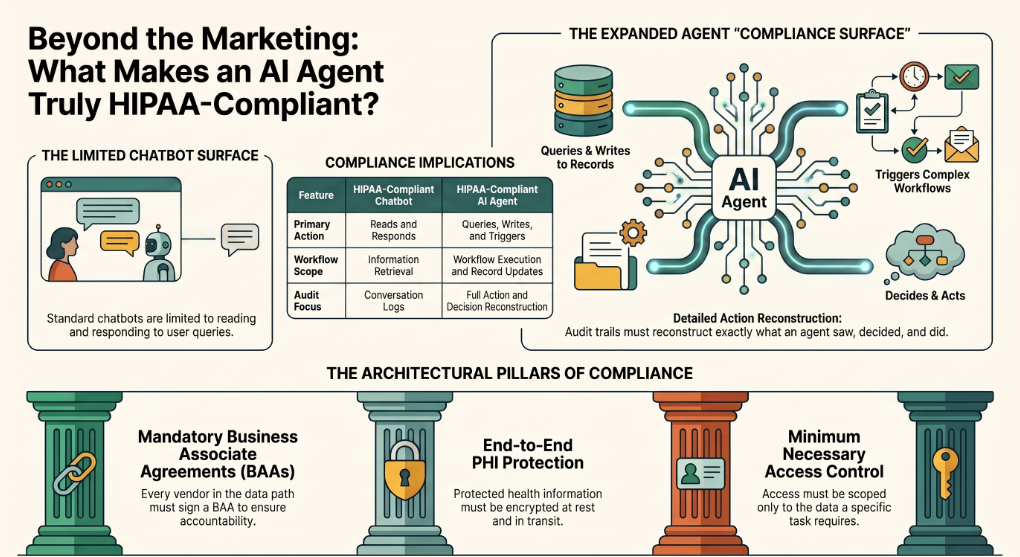
An AI agent is HIPAA-compliant when it can access, reason over, and take action on protected health information while meeting the same access-control, audit, and breach-notification requirements that apply to any employee or system handling PHI — not because a vendor's marketing page says so, but because the architecture makes it true.
That means a signed Business Associate Agreement with every vendor in the data path, PHI encrypted at rest and in transit, access scoped to the minimum data a given task requires, and an audit trail detailed enough to reconstruct exactly what the agent saw, decided, and did.
The distinction that trips up most healthcare buyers: a HIPAA-compliant chatbot and a HIPAA-compliant AI agent are not the same evaluation. A chatbot reads and responds.
An agent can query systems, write to records, trigger workflows, and hand off to other agents — which means the compliance surface isn't just "what can it say," it's "what can it do." For the full breakdown of which HIPAA Security Rule requirement maps to which technical control, see assistents.ai's HIPAA-Compliant AI Agents for Healthcare resource.
Before Any Use Case Below: The Four Things That Have to Be True
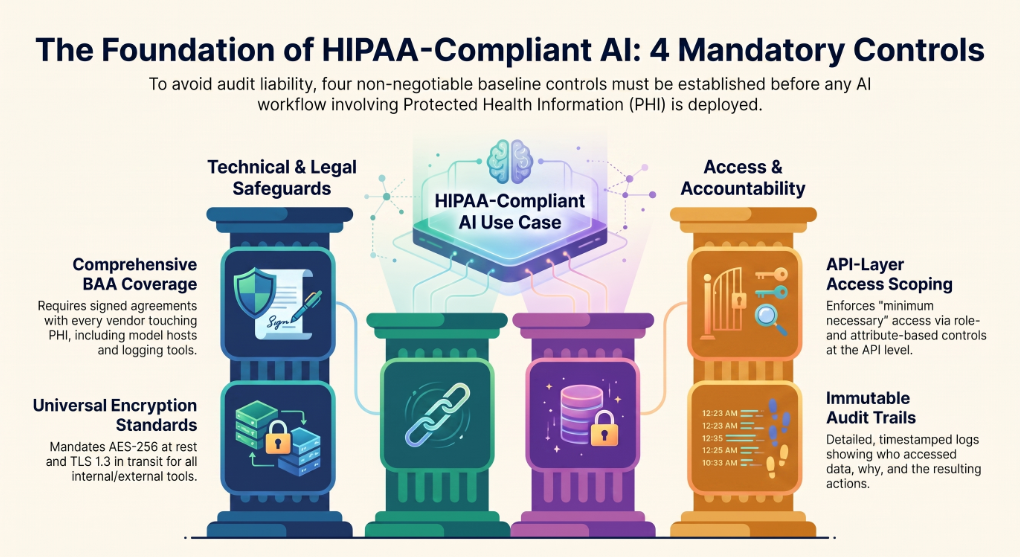
Every use case in this guide assumes four baseline controls are already in place. Skip any one of them and the workflow — however useful — isn't a compliant deployment, it's a liability waiting to surface at audit time.
- A signed BAA with every vendor that touches PHI — not just the AI platform, but the model host, any observability or logging tool, and every downstream integration.
- Encryption everywhere PHI moves or sits — AES-256 at rest, TLS 1.3 in transit, with no exceptions carved out for "internal" tools.
- Access scoped to the minimum necessary — an agent handling scheduling shouldn't be able to see a diagnosis; role- and attribute-based access enforced at the API layer, not just the UI.
- An audit trail that survives an OCR request — immutable, timestamped, and detailed enough to show who accessed what, why, and what happened next.
These aren't marketing checkboxes — they're the four things an auditor asks about first. For the complete evaluation framework, including a full vendor checklist and the deployment mistakes that create HIPAA exposure even on compliant platforms, see our HIPAA-Compliant AI Agents: Enterprise Deployment Guide.
With that foundation assumed, here's where HIPAA-compliant AI agents are actually running in production in 2026.
15 HIPAA-Compliant AI Agent Use Cases for 2026
Patient Access & Communication
These are the highest-volume, lowest-PHI-sensitivity workflows — usually the right place to start.
1. Patient intake, registration & insurance verification
An agent walks a patient through demographic updates, insurance verification, and consent capture before a visit, writing directly into the EHR instead of a paper clipboard. It needs read access to eligibility systems and write access to a narrow set of intake fields — nothing from the clinical chart.
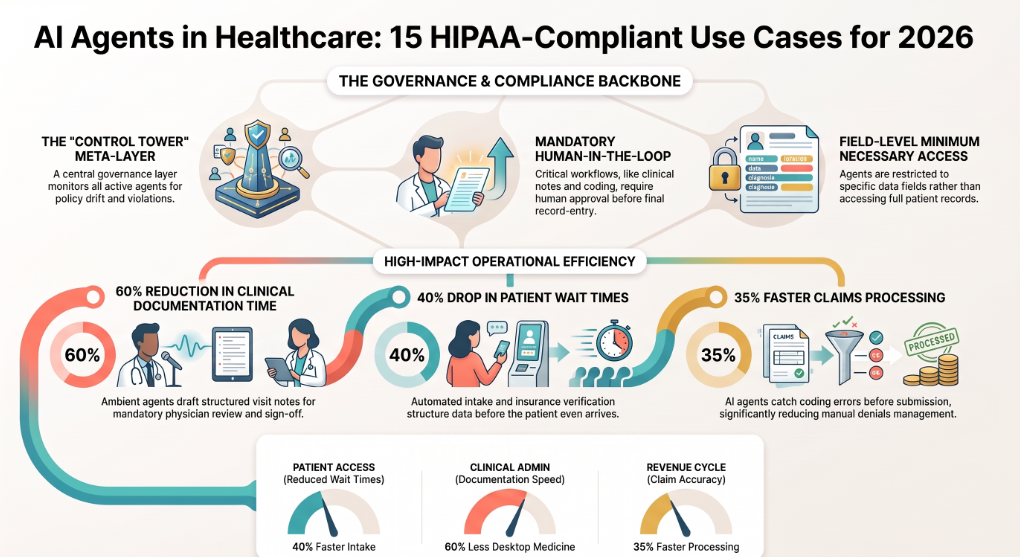
Done well, this is one of the fastest-ROI deployments in healthcare: production deployments of this pattern show patient wait times dropping by roughly 40%, largely because intake data is already structured and verified before the patient sits down. Governance checkpoint: field-level minimum-necessary access, not full-record access.
2. Appointment scheduling, reminders & no-show reduction
The agent answers inbound calls or messages, checks provider availability, books or reschedules, and sends confirmation and reminder sequences by voice, SMS, or email. The PHI footprint is narrow — name, contact details, appointment type — but every channel it touches needs its own BAA-covered infrastructure, not just the core platform.
Governance checkpoint: every communication channel needs the same audit and encryption standard as the core system, not a lighter one.
3. Post-visit follow-up & medication adherence
After a visit, the agent checks in on symptom progression, confirms the patient understood discharge instructions, and flags anything that sounds like a red flag for human review — worsening symptoms, missed doses, confusion about next steps. It should never give new clinical advice; its job is to surface information and escalate, not diagnose.
Governance checkpoint: hard-coded escalation paths for anything outside the agent's administrative scope.
Clinical & Documentation
Higher PHI sensitivity, higher time savings — and the workflows where hallucination risk has to be actively engineered against.
4. Ambient clinical documentation & visit summarization
Working alongside a clinician, an agent listens to (or reads a transcript of) an encounter and drafts a structured visit note, pre-populated fields, and suggested billing codes for physician review.
This is one of the highest-value use cases in the entire category — production deployments of this pattern have shown documentation time dropping by around 60% — but it's also one where retrieval-grounded outputs and mandatory physician sign-off matter more than almost anywhere else, since a fabricated clinical detail in a note is a patient-safety issue, not just a compliance one. Governance checkpoint: human sign-off required before any note enters the permanent record.
5. Prior authorization drafting & submission
The agent pulls the relevant clinical notes and payer policy, drafts the prior-authorization request, submits it through the payer portal, and tracks status — flagging anything ambiguous for a human coder rather than guessing.
Prior auth is one of the most PHI-dense workflows an agent can touch, since it typically needs diagnosis codes, treatment history, and payer-specific medical necessity criteria all at once. Governance checkpoint: full audit trail of which clinical fields were read to justify the request, not just the final submission.
6. Diagnostic and lab test workflow automation
For labs, imaging centers, and diagnostic testing providers, an agent can manage the full booking-to-report chain — scheduling the test, tracking sample or scan status, and routing the finished report to the ordering provider and patient portal.
This is a pattern that works particularly well for high-volume testing operations, where the biggest compliance risk isn't any single step, it's the handoffs between them. A result that gets lost between processing and reporting is both an operational failure and a potential unauthorized-disclosure risk if it lands in the wrong queue. Governance checkpoint: chain-of-custody logging at every handoff, not just at the start and end.
Revenue Cycle & Financial Operations
Some of the fastest, most measurable ROI in healthcare AI — and some of the densest PHI exposure, because billing touches almost every clinical data element.
7. Claims processing & coding validation
The agent reviews a claim, checks it against payer requirements, identifies a missing or mismatched diagnosis code, and flags it for provider or billing-manager review before submission. In production, this pattern processes claims roughly 35% faster, mostly by catching errors before submission instead of after a denial comes back.
A complete audit trail here — which fields were read, what rule triggered the flag, who approved the fix — is what turns "the AI changed a code" into a defensible, reviewable decision. Governance checkpoint: every code change needs a logged rationale and a human approval step.
8. Denials management & appeals drafting
When a claim is denied, an agent identifies the denial reason, pulls the supporting clinical documentation, drafts an appeal letter, and tracks the resubmission.
This workflow is valuable precisely because it's tedious and error-prone for humans doing it at volume — but it also means the agent is assembling and transmitting some of the most sensitive documentation in the record (full clinical justification) to an external payer. Governance checkpoint: outbound transmission logging — what left the organization, to whom, and when.
9. Eligibility & benefits verification
Before a visit or procedure, the agent checks a patient's insurance eligibility, co-pay, and prior-authorization requirements in real time, so front-desk staff and patients both know the financial picture before service is rendered.
The PHI footprint here is comparatively narrow — identifiers and coverage data, not clinical detail — which makes this one of the better second or third use cases once a first deployment is proven. Governance checkpoint: scope the agent to coverage data only; no clinical fields are needed for this task.
Programs, Workforce & Care Operations
Less discussed than patient-facing use cases, but where a lot of real operational and compliance value is sitting untouched.
10. Healthcare staffing & credentialing compliance workflows
For staffing platforms and healthcare organizations managing a contingent clinical workforce, an agent can handle credential capture and verification at onboarding, match clinicians to facility shift requirements, manage scheduling and notifications, and maintain a fill-rate and compliance-documentation trail.
This exact pattern has been deployed across nursing and allied-health staffing operations, where the biggest win isn't speed alone — it's that every staffing decision becomes auditable by default, because the agent can't query fields outside its assigned task in the first place. Governance checkpoint: attribute-based scoping so a scheduling task can't pull certification or clinical detail it doesn't need.
11. Program and service-line operations & utilization analytics
Multi-facility clinical enterprises — hospitalist groups, geriatric care networks, specialty practices — often have census, utilization, billing, and denial data scattered across systems that don't talk to each other. An agent layer can ingest from all of them and surface a governed analytics view: revenue leakage drivers, utilization variance, and performance dashboards by program, without giving any single analyst broader access than their role requires.
This is the pattern behind some of the fastest wins seen in physician-led enterprises moving off manual, spreadsheet-built reporting. Governance checkpoint: row-level security so an agent answering one program's question can't surface another program's data.
12. Population health & care-management risk stratification
An agent can continuously monitor claims, clinical, and social-determinant data to flag patients trending toward a preventable admission, a care gap, or a rising-risk category — surfacing the list to care managers rather than acting on it directly.
This is one of the more sensitive use cases on this list because it touches longitudinal clinical history across a whole population, not a single encounter, so the minimum-necessary standard has to be enforced at the cohort level, not just the individual query level. Governance checkpoint: purpose-limited access — risk-stratification agents shouldn't have write access to anything.
Governance, Risk & Compliance
The category almost no other "HIPAA compliant AI agent" guide covers — because it's not about what an agent does for a patient, it's about what keeps the other 14 use cases safe once you're running more than one of them.
13. Cross-agent compliance monitoring — a control tower for your AI workforce
Once an organization has five, ten, or twenty agents running across departments, "is this compliant" stops being a per-agent question and becomes a fleet question. A governance layer can continuously check every other agent's actions against policy in real time — every permission check, every data-access request, every write action — and surface violations, near-misses, and drift before they become an incident instead of after.
This is less a single workflow than a meta-layer sitting over all the others, and it's the difference between managing AI compliance as twenty separate risks and managing it as one governed system. Governance checkpoint: this use case is the checkpoint — a policy engine evaluating every other agent's every action.
14. Breach detection & anomalous-access alerting
An agent, or the governance layer underneath one, can watch for access patterns that deviate from baseline — a scheduling agent suddenly querying diagnosis codes, a volume spike outside business hours, an agent touching a patient it has no assigned relationship to — and alert compliance staff in real time rather than during a quarterly log review.
Given HIPAA's 60-day breach notification clock, the gap between "an anomaly occurred" and "someone noticed" is often the single biggest determinant of whether an incident stays small or becomes reportable. Governance checkpoint: real-time alerting, not scheduled log review.
15. Employee and HR-adjacent PHI workflows
Workers' compensation case management, occupational health screening, and short-term disability administration all involve PHI, but they usually sit inside HR rather than clinical operations — which means they're often the least governed PHI workflows in the entire organization.
An agent handling intake, documentation routing, and status updates for these programs needs the same access controls and audit trail as any clinical workflow, even though the "patient" here is an employee. Governance checkpoint: don't let HR-adjacent PHI workflows inherit weaker access controls just because they sit outside clinical systems.
The Governance Layer That Makes All 15 Use Cases Safe at Once
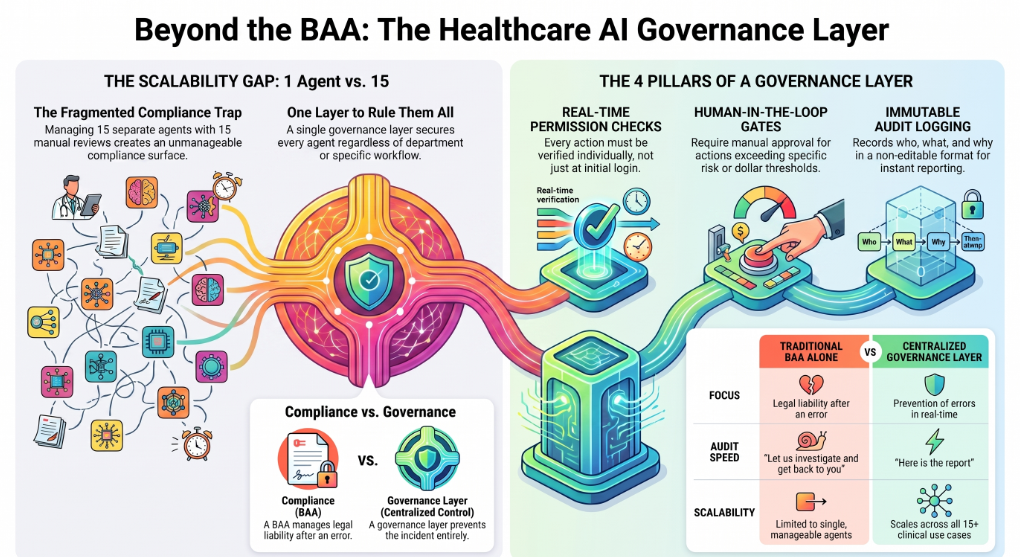
Look back across those 15 use cases and a pattern shows up: none of them are safe because of what the AI model knows. They're safe because of what sits around the model — the permission check that runs before every action, the policy engine that evaluates every request against a rule, the audit log that survives an OCR request, and the human approval gate on anything consequential.
That's the part most "HIPAA compliant AI agent" content skips, because it's genuinely easier to write about a scheduling chatbot than about a governance layer. But it's also the part that determines whether an organization can run one compliant agent or fifteen. A single well-configured scheduling agent is a manageable compliance surface.
Fifteen agents across intake, documentation, revenue cycle, staffing, and population health — each potentially built by a different team, on a different tool, with a different owner — is not a compliance surface you can manage with fifteen separate reviews. It's a compliance surface you manage with one governance layer that every agent runs through, regardless of which department deployed it or what workflow it performs.
In practice, that layer needs to do four things consistently, no matter which of the 15 use cases above it sits under: check permissions before every single action, not just at login; evaluate every action against business and compliance policy in real time; require human approval above a defined risk or dollar threshold; and log the full decision — who asked, what was accessed, what was decided, who approved it — in a form that can't be edited after the fact.
This is the part of "is this AI agent HIPAA compliant" that a BAA alone can't answer. A signed agreement tells you who's liable if something goes wrong. A governance layer is what keeps something from going wrong in the first place — and it's what lets an audit conversation become "here's the report" instead of "let us investigate and get back to you."
Why assistents.ai
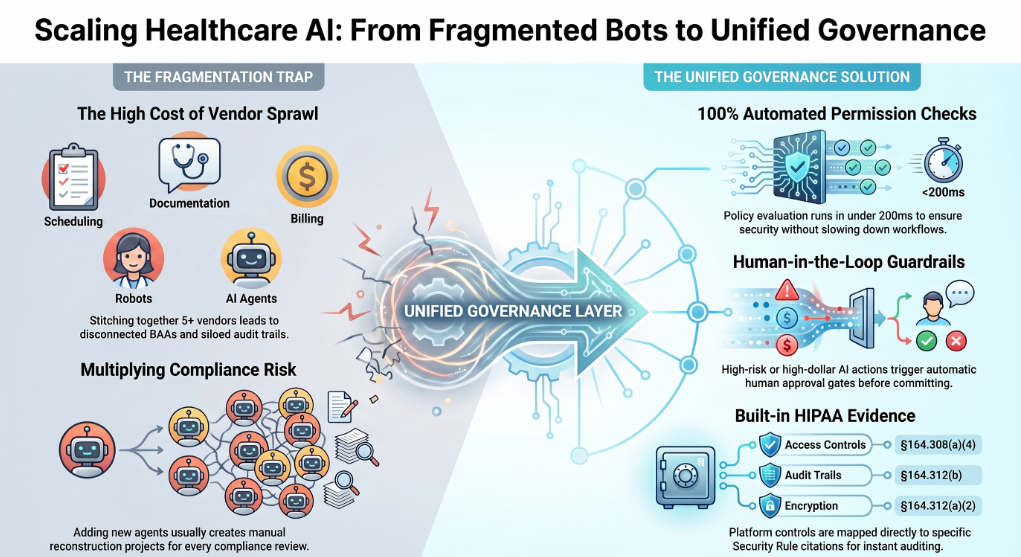
Most platforms in this space solve one piece of what's above. A voice-AI vendor is very good at HIPAA-compliant scheduling calls. A documentation vendor is very good at ambient clinical notes. A staffing-automation tool is very good at credentialing workflows.
Almost none of them are built to run all fifteen use cases in this guide under one governance model — which means a healthcare organization that wants to cover intake, documentation, revenue cycle, staffing, and cross-agent oversight ends up stitching together five or six vendors, five or six BAAs, and five or six separate audit trails that don't talk to each other.
assistents.ai is built around the opposite assumption: the hard part of enterprise healthcare AI isn't building one good agent, it's governing many of them consistently. On the platform, every agent action — whether it's a scheduling agent booking an appointment or a revenue-cycle agent flagging a coding error — runs through the same permission and policy layer. In practice, that means:
- 100% of agent actions are permission-checked, not spot-checked, with policy evaluation running in under 200 milliseconds — fast enough that governance doesn't slow the workflow down.
- Immutable, tamper-proof decision records for every action: what was accessed, what was decided, and why — exportable for OCR review without a manual reconstruction project.
- Human approval gates that trigger automatically above a configured risk or dollar threshold — the agent proposes, a person confirms, the platform re-checks before anything commits.
- On-premise or VPC-isolated deployment, so PHI never shares infrastructure with another customer's data, with BAAs available as a standard part of onboarding rather than a custom negotiation.
- Controls mapped directly to specific HIPAA Security Rule citations — access controls to §164.308(a)(4), audit trails to §164.312(b), encryption to §164.312(a)(2) — so a compliance review has evidence built in rather than assembled after the fact.
That combination — one governance layer, applied consistently across every department's agents — is what makes it realistic to go from "we have one compliant chatbot" to "we run fifteen governed workflows across the organization" without the compliance risk multiplying with every new agent added. You can see the full control-by-control mapping on the HIPAA-Compliant AI Agents for Healthcare page, and the governance architecture itself — permission enforcement, policy engine, audit trails, and approval gates — on the AI Agent Governance product page.
Picking Your First Use Case
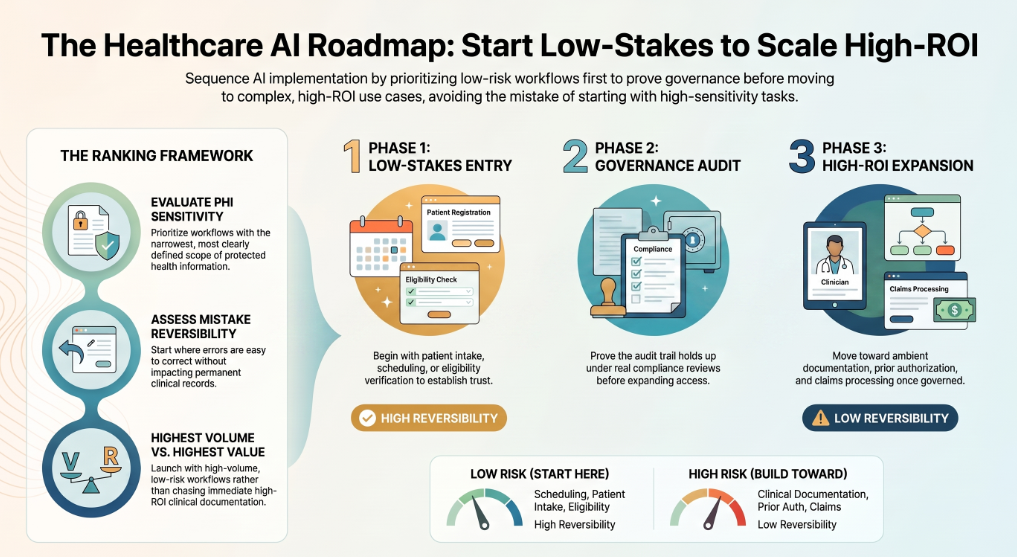
Not every use case on this list is a reasonable starting point, and trying to launch with the highest-value one is usually a mistake. The organizations that get this right tend to start with the lowest-PHI-sensitivity, highest-volume workflow — usually patient intake or scheduling — prove the audit trail actually holds up under a real compliance review, and only then move toward higher-stakes workflows like clinical documentation or claims processing.
A simple way to sequence it: rank the 15 use cases above along two dimensions — how much PHI the agent needs to touch, and how reversible a mistake would be.
Scheduling and eligibility verification score low on both (limited PHI, easy to correct a scheduling error). Clinical documentation and prior authorization score high on both (dense PHI, harder to unwind a mistake once it's in the record). Start at the low end of that scale, not the high end — even if the high-end use case has the bigger ROI number attached to it. A governance layer that's been proven on a low-stakes workflow is a lot easier to trust with a high-stakes one than the reverse.
Across the five categories above — patient access, clinical documentation, revenue cycle, workforce operations, and governance — the workflows with the fastest path to production are almost always the ones with the narrowest, most clearly defined PHI scope. The ones with the biggest headline ROI — ambient documentation, prior authorization, population health — are worth building toward, not starting with.
Ready to see how a governed AI agent handles any of the 15 workflows above? Schedule a HIPAA architecture review with assistents.ai.
FAQs
What can a HIPAA-compliant AI agent actually do in a hospital or clinic?
In production today, agents handle patient intake and scheduling, insurance and benefits verification, clinical documentation drafting, prior authorization, claims and denials management, staffing and credentialing workflows, and compliance monitoring across other agents. The common thread is administrative and operational work, not clinical decision-making.
Which healthcare workflows should stay human-only?
Diagnosis, treatment decisions, and any judgment call that requires weighing clinical risk against a specific patient's circumstances should stay with a licensed clinician. Agents can prepare information, draft documentation, and flag red flags for review — they shouldn't be the final decision-maker on anything clinical.
Do HIPAA-compliant AI agents replace front-desk or billing staff?
Mostly no — they remove the repetitive, high-volume parts of those roles (booking, reminders, eligibility checks, first-pass claims review) so staff spend more time on the exceptions and the in-person interactions that actually need a person. Most production deployments describe reclaimed hours, not eliminated roles.
What's the difference between a HIPAA-compliant chatbot and a HIPAA-compliant AI agent?
A chatbot reads a message and generates a response — the compliance surface is limited to what it can say. An agent can query systems, write to records, and coordinate with other agents — the compliance surface expands to everything it can do, which is why governance (permissions, policy, approval gates) matters more for agents than for chat alone.
How long does it typically take to deploy one of these use cases?
Lower-PHI workflows like scheduling or eligibility verification are usually the fastest to production. Higher-PHI, higher-stakes workflows like clinical documentation or prior authorization take longer, mostly because of the additional review and sign-off steps that should be built in from day one, not added after a near-miss.
Can one platform govern multiple HIPAA-compliant AI agents across departments?
Yes, and it's increasingly the more practical approach — a single governance layer (identity, permissions, policy, audit) applied consistently across every agent, regardless of which department deployed it, rather than a separate compliance review for each new agent added.
What's a realistic first use case for an organization new to AI agents?
Patient intake, scheduling, or eligibility verification. They touch the least sensitive PHI, mistakes are easiest to catch and correct, and they let a compliance team validate that the audit trail and access controls actually work before extending the same agent architecture into higher-stakes clinical or financial workflows.

Transform Your Business With Agentic Automation
Agentic automation is the rising star posied to overtake RPA and bring about a new wave of intelligent automation. Explore the core concepts of agentic automation, how it works, real-life examples and strategies for a successful implementation in this ebook.
Sarfraz Nawaz is the CEO and founder of Ampcome, which is at the forefront of Artificial Intelligence (AI) Development. Nawaz's passion for technology is matched by his commitment to creating solutions that drive real-world results. Under his leadership, Ampcome's team of talented engineers and developers craft innovative IT solutions that empower businesses to thrive in the ever-evolving technological landscape.Ampcome's success is a testament to Nawaz's dedication to excellence and his unwavering belief in the transformative power of technology.

More insights
Discover the latest trends, best practices, and expert opinions that can reshape your perspective

.jpg)





Contact us

