
AI Agents in Payments Applications: Risks, Regulations and How to Deploy Them Safely (2026 Guide)


AI agents in payments are autonomous software agents that start, authorize, route or reconcile payments for a person or business. Their main risks are unauthorized spending, prompt injection, AML and sanctions gaps, broken authentication and unclear liability. They are governed by payment law (PSD2/PSD3, Regulation E, RBI directions), AI law (the EU AI Act) and data law (GDPR, India's DPDP Act).
The scale is no longer hypothetical. McKinsey estimates that AI agents could orchestrate up to $5 trillion in global consumer spending by 2030 (Fortune). Visa, Mastercard, Google and Stripe have all launched rails for agent-initiated payments. Regulators are still catching up.
This guide is for payments, risk, compliance and finance leaders. It covers how AI agents are used in payments applications today, the 10 risks they create, the regulations that apply in the EU, UK, US and India, and a practical framework for deploying them safely. It also includes a risk → regulation → control matrix and anonymized results from production deployments of Assistents, the enterprise AI agent platform by Ampcome.
Key takeaways
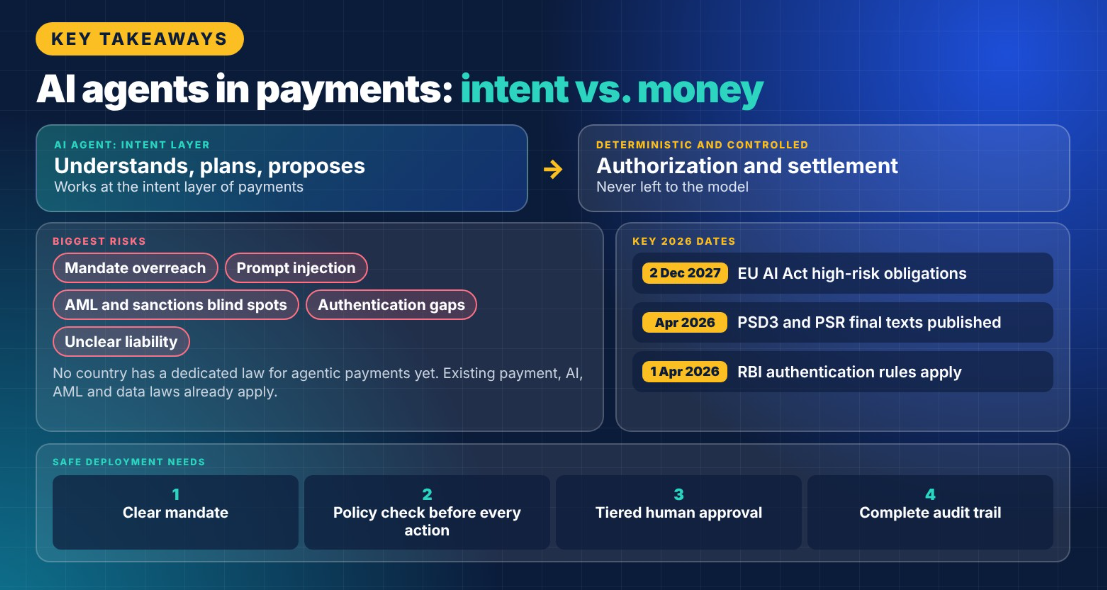
- AI agents work at the intent layer of payments. Authorization and settlement must stay deterministic and controlled.
- The biggest risks are mandate overreach, prompt injection, AML and sanctions blind spots, authentication gaps and unclear liability.
- No country has a dedicated law for agentic payments yet. Existing payment, AI, AML and data laws already apply.
- Key 2026 dates: EU AI Act high-risk obligations moved to 2 December 2027; PSD3 and the PSR final texts were published in April 2026; RBI's new authentication rules apply from 1 April 2026.
- Safe deployment needs a clear mandate, policy checks before every action, tiered human approval and a complete audit trail.
What are AI agents in payments (agentic payments)?
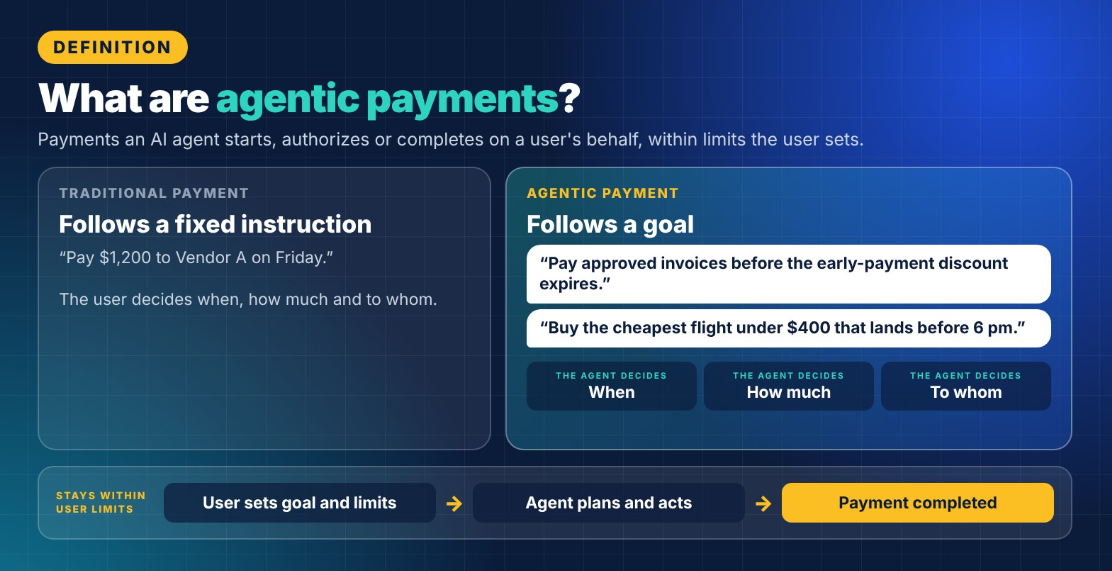
Agentic payments are payments that an AI agent starts, authorizes or completes on a user's behalf, within limits the user sets. A traditional payment follows a fixed instruction. An agentic payment follows a goal, such as "pay approved invoices before the early-payment discount expires" or "buy the cheapest flight under $400 that lands before 6 pm." The agent decides when, how much and to whom.
How agentic payments differ from automated payments
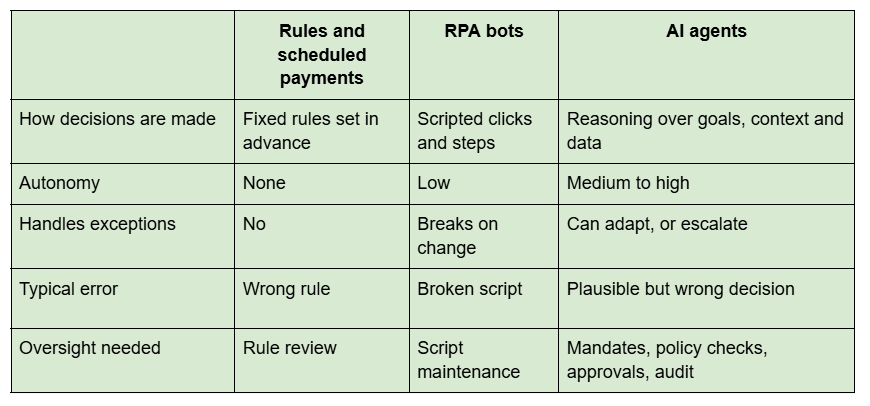
That last row matters. AI agents fail differently from older automation. Their errors look reasonable, which is why controls must sit outside the model.
The three layers: intent → authorization → settlement
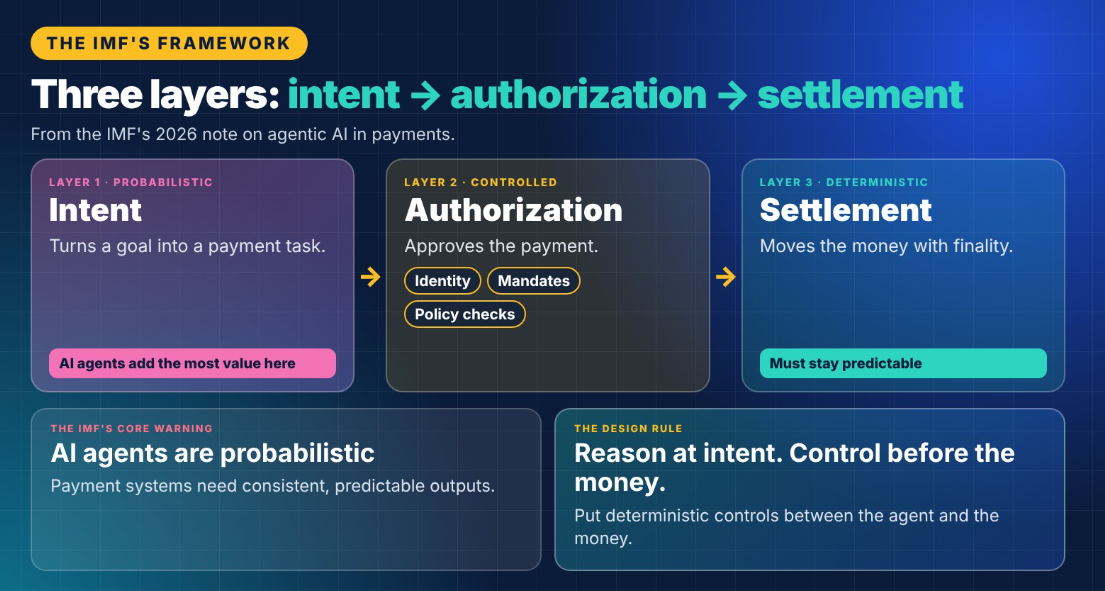
The IMF's 2026 note on agentic AI in payments describes payments in three layers:
- Intent: turning a goal into a payment task. This is where AI agents add the most value.
- Authorization: approving the payment. This needs identity, mandates and policy checks.
- Settlement: moving the money with finality. This must stay predictable.
The IMF's core warning is that AI agents are probabilistic, while payment systems need consistent, predictable outputs. The practical design rule follows from that: let agents reason at the intent layer, and put deterministic controls between the agent and the money.
The agentic payments ecosystem in 2026
- Visa Intelligent Commerce: tokenized credentials and controls so AI agents can shop and pay for consumers.
- Mastercard Agent Pay: "agentic tokens" that register and authenticate agents on the card network.
- Google's Agent Payments Protocol (AP2): an open protocol for agent-led purchases built on verifiable user mandates.
- Stripe's agent toolkit and machine payments, covered in the Cambridge paper on AI agents in payments.
- Know Your Agent (KYA): in September 2026, Ant International began work with Mastercard and Visa on a KYA interoperability framework so networks, wallets and marketplaces can recognize trusted agents (Fortune).
Applications of AI agents in payments: 8 use cases
Consumer "buy for me" agents get the headlines. Most enterprise value today sits in back-office payment work: invoices, orders, disputes, screening and cash. Here are the eight applications we see most often.
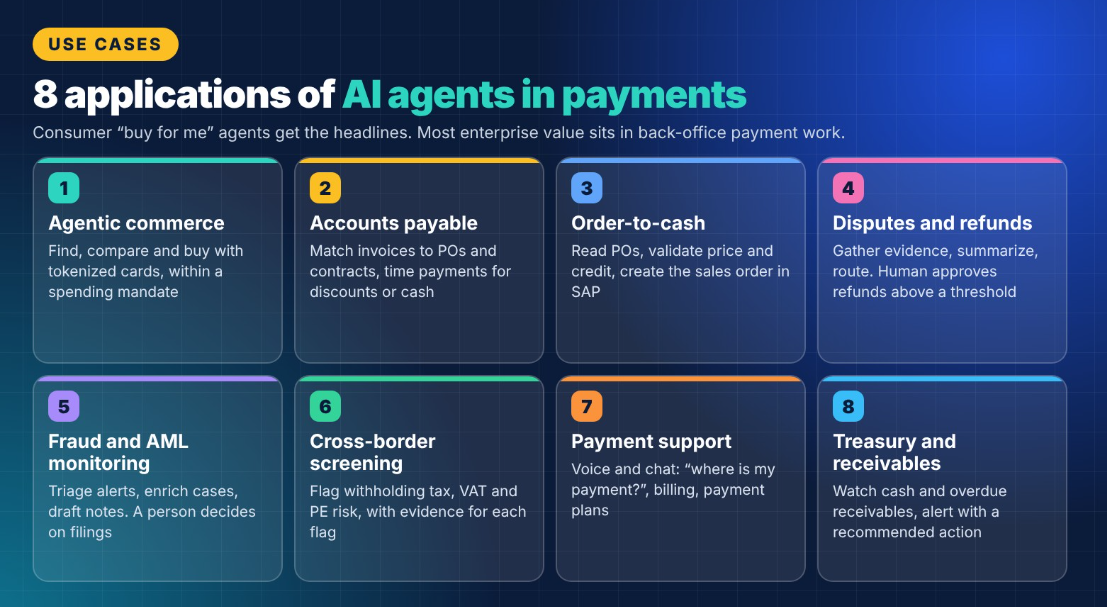
- Agentic commerce and consumer checkout. Agents find, compare and buy products using tokenized cards, within a spending mandate. Visa, Mastercard and Google are building the rails.
- Accounts payable and vendor-payment timing. Agents match invoices to POs and contracts, then schedule payments to capture discounts or protect cash. The risk is paying early against contract terms the agent never read. Agents need contract context, not only ERP data.
- Order-to-cash and sales-order creation. Agents read purchase orders from email, portals or PDFs, validate customer, price, credit limit and delivery, then create the sales order in SAP or another ERP. Exceptions go to a person. (See case study 3.)
- Disputes, chargebacks and refunds. Agents take in disputes across chat, email and phone, gather evidence, summarize the case and route it. Refunds above a threshold need human approval. (See case study 1.)
- Fraud detection and AML transaction monitoring. Agents triage alerts, enrich cases with customer and counterparty data, and draft investigation notes. A person still decides on filings.
- Cross-border transaction screening. Agents screen deals and payments for withholding tax, VAT and permanent-establishment risk, and record the evidence behind each flag. (See case study 2.)
- Payment support over voice and chat. Agents answer "where is my payment?", rent and billing questions, and payment-plan requests, then create tickets or hand over to staff. (See case study 6.)
- Treasury, cash forecasting and receivables alerts. Agents watch cash, overdue receivables and early-payment costs, then alert credit control or finance with a recommended action. (See case studies 4 and 5.)
For more examples outside payments, see our guides to agentic AI use cases in banking and agentic AI examples in finance.
The 10 biggest risks of AI agents in payments
Each risk below includes what it looks like and the control that addresses it. The matrix maps each one to the rules it touches.
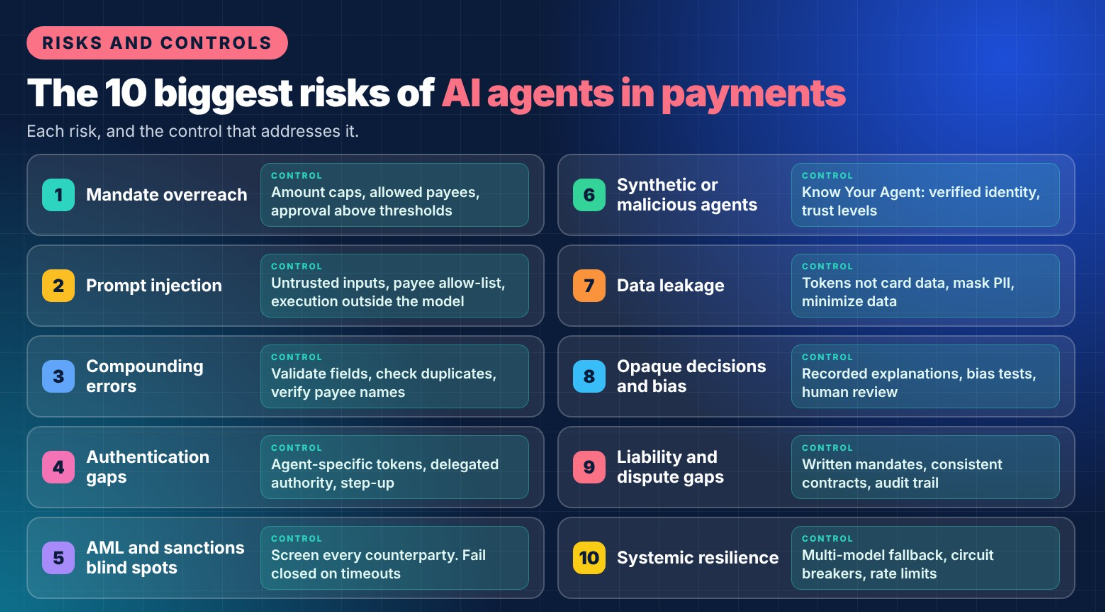
1. Mandate overreach and unauthorized spending
An agent pays more, pays the wrong party or pays at the wrong time, while technically holding valid credentials. In one case we've seen, a vendor-payment agent approved early payments based on ERP data and missed a contract PDF that said otherwise. Control: an explicit mandate (amount caps, allowed counterparties, timing rules), contract-aware context and approval above thresholds.
2. Prompt injection and agent hijacking
Instructions hidden in an invoice, email or web page can redirect an agent. The best-known example is the Freysa experiment, in which a user talked an AI agent into releasing a crypto prize pool it had been told never to transfer (Cambridge EJRR). Control: treat every external input as untrusted, restrict which tools the agent can use, allow-list payees and keep payment execution outside the model.
3. Compounding errors and hallucinated payment details
Small errors multiply across multi-step tasks: a misread IBAN, a wrong currency or a duplicate invoice. Control: validate every extracted field against master data, check for duplicates, run payee-name verification and send mismatches to human review.
4. Authentication gaps
Strong customer authentication (SCA), OTPs and 2FA assume a person is present. Agents break that assumption. Control: tokenized, agent-specific credentials, delegated-authority flows and step-up confirmation for unusual payments.
5. AML, KYC and sanctions blind spots
Agents can hide who is really paying and why. A screening service that times out can let a payment through by default. Control: screen every counterparty before payment, and fail closed. A timeout or an unclear result holds the payment (OWASP).
6. Synthetic or malicious agents
Fraudsters can deploy their own agents to probe merchants, test cards or pose as legitimate buyers. Control: Know Your Agent checks: cryptographic agent identity, a verified operator and trust levels that the agent cannot raise for itself.
7. Data leakage and privacy breaches
Agents handle card data, bank details and personal data, and they can leak it through prompts, logs or third-party tools. Control: keep raw card data away from the agent (use tokens), mask PII, limit data to what the task needs and control where it is hosted.
8. Opaque decisions and bias
Credit-limit changes, payment-plan offers or fraud blocks made by an agent can be hard to explain and may treat groups unfairly. Control: source-backed reasoning for each decision, recorded explanations, bias testing and human review for decisions that significantly affect people.
9. Liability and dispute gaps
When an agent exceeds its authority, it's often unclear whether the consumer, the bank, the merchant or the agent provider carries the loss. See the liability section. Control: written mandates, consistent contracts across the payment chain and an audit trail that can serve as evidence.
10. Systemic and operational resilience
Many agents running on the same model can act in the same way at the same moment. A model outage can stop payment operations, and agents widen the cyberattack surface (IMF). Control: multi-model routing with fallback, circuit breakers, rate limits and scenario testing for agent-specific threats.
Regulations governing AI agents in payments: the 2026 map
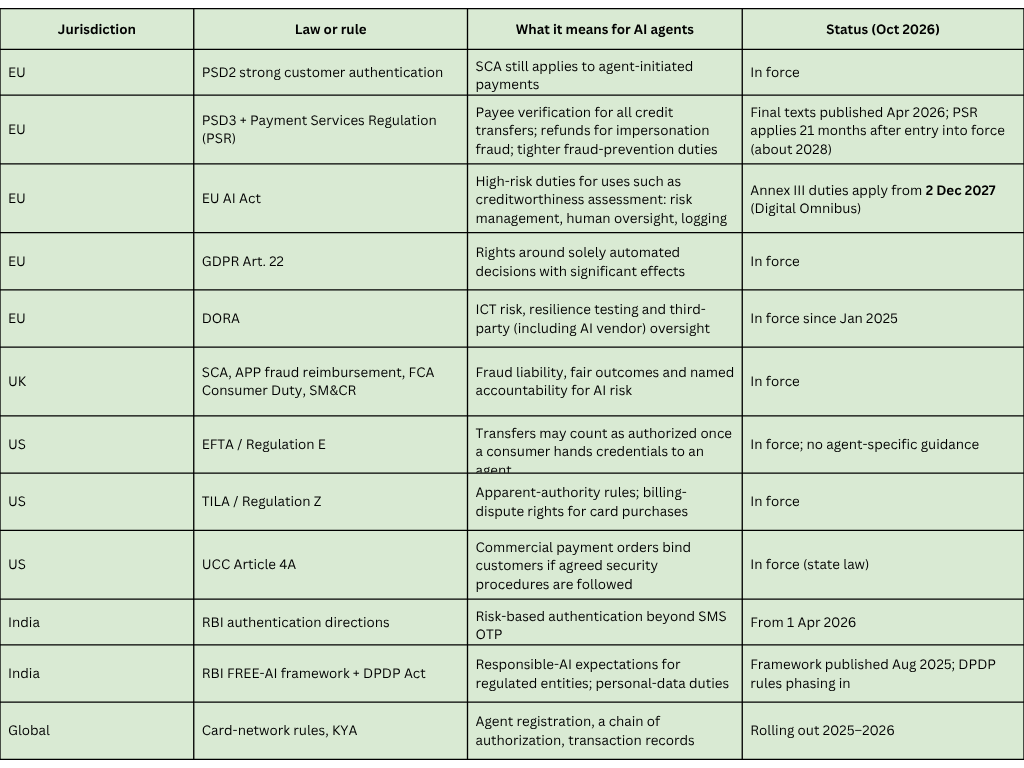
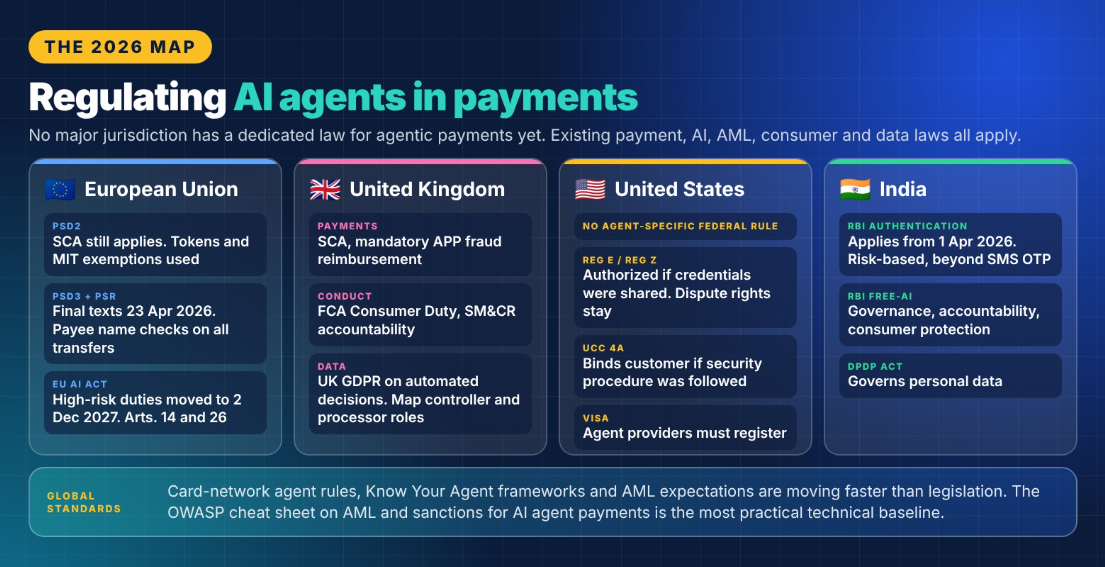
No major jurisdiction has a dedicated law for agentic payments yet. AI agents in payments are still regulated: existing payment, AI, AML, consumer-protection and data laws all apply, and several changed in 2026.
European Union
PSD2's strong customer authentication still applies when an agent starts a payment. That's hard to reconcile with an agent acting while no person is present. Firms are relying on tokenized credentials and existing exemptions such as merchant-initiated transactions (Ashurst Perkins Coie).
PSD3 and the PSR are close to final. The final texts were published on 23 April 2026, with formal adoption pending. They extend payee name checks to all credit transfers and make providers liable for some impersonation fraud (summary). For agent builders, every agent-initiated transfer will need a name check, with mismatch warnings acted on before execution.
The EU AI Act applies where AI is used for high-risk purposes, including creditworthiness assessment. The Digital Omnibus (Regulation (EU) 2026/1744) entered into force on 27 July 2026 and moved Annex III high-risk duties from August 2026 to 2 December 2027 (National Law Review). Article 14 (human oversight) and Article 26 (deployer duties) are the provisions most relevant to payment agents. The Cambridge paper points out that, in an agent chain, it's often unclear who the "deployer" is: the consumer, the platform or the bank.
United Kingdom
UK firms face SCA, the Payment Systems Regulator's mandatory APP fraud reimbursement, the FCA Consumer Duty, SM&CR accountability and UK GDPR rules on automated decisions. Freshfields recommends agent-aware fraud analytics, mapping controller and processor roles for every agent in a chain, and adding agent threats (tool misuse, identity spoofing, memory poisoning) to resilience testing.
United States
There is no agent-specific federal rule yet. According to Goodwin:
- Regulation E: a transfer may be treated as authorized if the consumer gave credentials to the agent, even if the agent went beyond what the consumer wanted.
- Regulation Z: card payments are authorized under actual, implied or apparent authority, but consumers keep billing-dispute rights. In practice, the merchant often carries the loss.
- UCC 4A: a commercial payment order can bind the customer if the bank followed an agreed, commercially reasonable security procedure.
- Visa now requires agent providers to register and keep a defensible chain of authorization.
The Consumer Bankers Association expects no fast federal action and urges the industry to set its own protections.
India
RBI's directions on authentication for digital payments apply from 1 April 2026. They allow and encourage risk-based authentication beyond SMS OTP, which suits agent flows that use device binding and tokenization (RBI). The RBI FREE-AI framework sets expectations on governance, accountability and consumer protection for AI in regulated entities. The DPDP Act governs personal data. See also our guide to AI agents in Indian fintech.
Global standards
Card-network agent rules, Know Your Agent frameworks and AML expectations are moving faster than legislation. The OWASP cheat sheet on AML and sanctions for AI agent payments is the most practical technical baseline available.
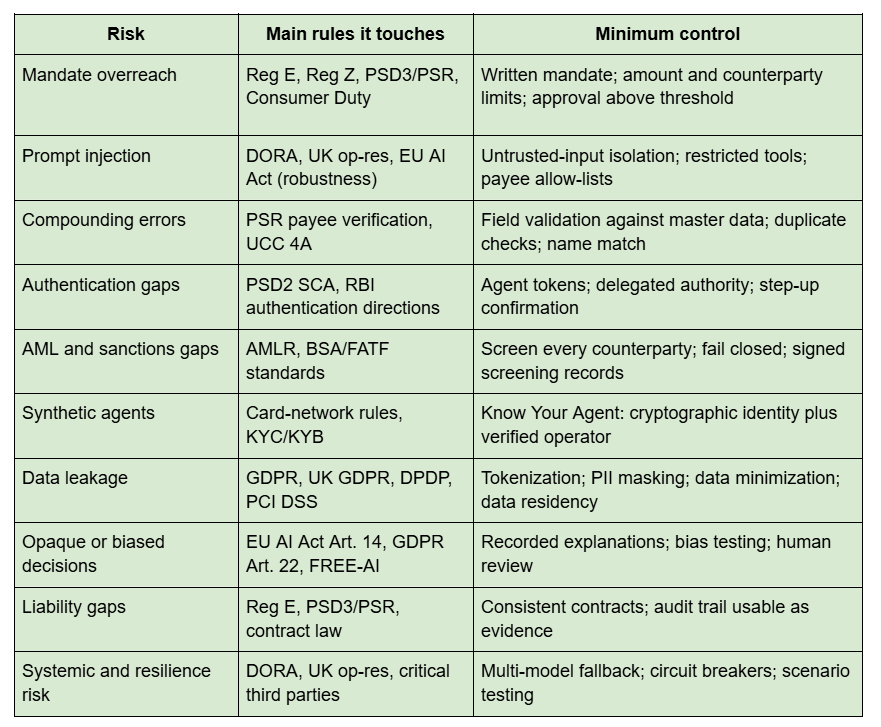
Risk → regulation → control matrix
Use this table to check any AI agent in a payment flow. Each row links a risk to the rules it touches and the minimum control.
Who is liable when an AI agent makes a payment?
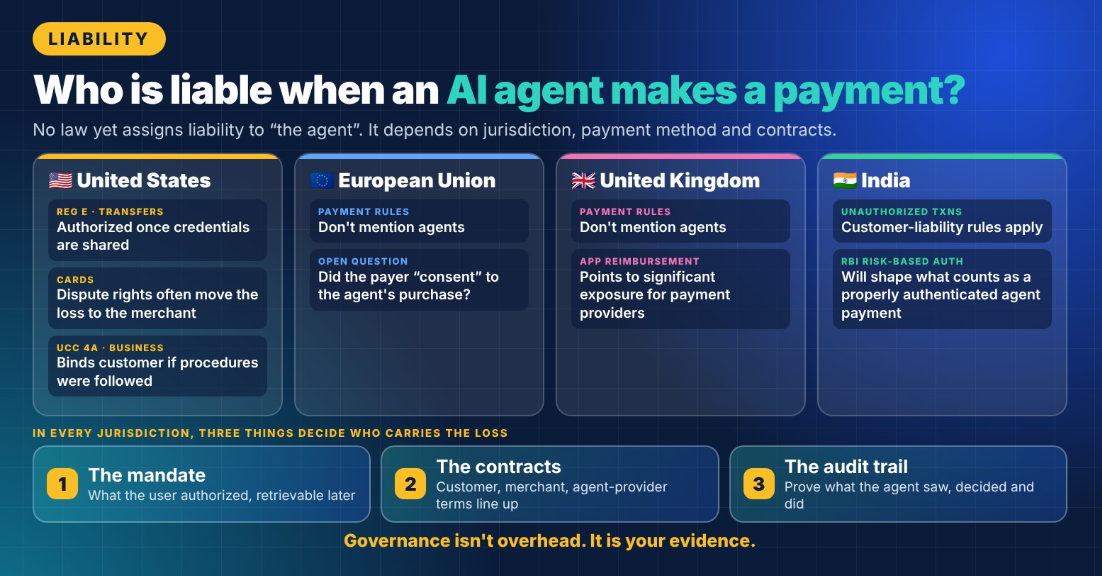
Today, liability depends on the jurisdiction, the payment method and the contracts in place. No law yet assigns it to "the agent".
- United States: for bank transfers, Reg E may treat agent payments as authorized once credentials are shared, which leaves the consumer exposed. For card payments, billing-dispute rights often move the loss to the merchant. For business payments, UCC 4A tends to bind the customer if agreed security procedures were followed.
- EU and UK: the payment rules don't mention agents. Whether a payer "consented" to an agent's purchase is unclear, and the UK's APP reimbursement regime points to significant exposure for payment providers.
- India: customer-liability rules for unauthorized transactions apply. RBI's risk-based authentication model will shape what counts as a properly authenticated agent payment.
In every jurisdiction, three things decide who carries the loss in practice:
- The mandate: what the user authorized, recorded in a form that can be retrieved later.
- The contracts: whether customer, merchant and agent-provider terms line up.
- The audit trail: whether you can prove what the agent saw, decided and did.
This is why governance isn't overhead. It is your evidence. For the wider framework, read our guide to agentic AI governance.
How to deploy AI agents in payments safely: an 8-step framework
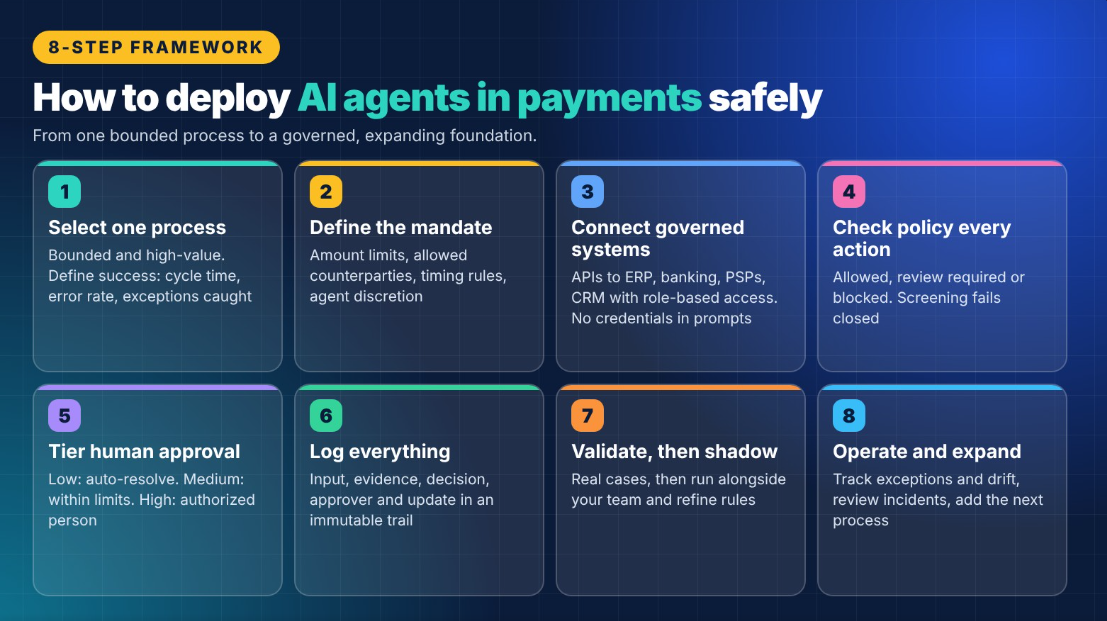
- Select one bounded, high-value process. Examples: purchase order to sales order, invoice to payment, or dispute intake. Define success in measurable terms, such as cycle time, error rate and exceptions caught.
- Define the mandate. Set amount limits, allowed counterparties, timing rules and the agent's discretion on anything left unspecified.
- Connect systems through governed connectors. Use APIs and connectors to ERP, core banking, PSPs and CRM, with role-based permissions. Never paste credentials into prompts.
- Evaluate policy before every action. Each action is checked against rules and is allowed, review required or blocked. Screening fails closed.
- Tier human approval by risk. Low risk: auto-resolve. Medium: execute within limits. High or unusual: send to an authorized person.
- Log everything. Record the input, the source evidence, the decision, the approver and the system update in an immutable audit trail.
- Validate on real cases, then run in shadow mode. Run the agent alongside your team, compare outcomes and refine the rules.
- Operate, monitor and expand. Track exceptions and drift, review incidents and add the next process on the same foundation.
Case studies: governed AI agents in finance and payments workflows
These are real Assistents deployments, anonymized by industry and region. Each shows the controls that made the agents safe to run with money, data or compliance decisions.
Case study 1: A global fintech provider serving banks and credit unions
- Situation: disputes, fraud and compliance cases arrived across chat, email and phone, and were handled manually and inconsistently.
- Agents deployed: omnichannel intake and workflow routing, agent-assist summaries with next-best actions, and integration with core banking systems.
- Controls applied: auditable workflow automation, SLA monitoring and reporting, and human handling of escalated cases.
- Outcome: faster, more consistent case handling, less operational load and better compliance readiness through audit trails.
Case study 2: A cross-border tax-tech product
- Situation: withholding tax, VAT mismatches and permanent-establishment risks were found late, disrupting deals.
- Agents deployed: transaction screening and risk classification, plus automated evidence collection.
- Controls applied: explainability notes on every flag and escalation to tax experts for judgment calls.
- Outcome: earlier detection of withholding and VAT risk, fewer last-minute deal disruptions and faster, more consistent pre-compliance review.
Case study 3: A premium home-appliance distributor in the Middle East
- Situation: manual purchase-order handling and order entry on a legacy, high-cost platform.
- Agents deployed: agents that read order triggers from email, portals and PDFs, validate customer, product, pricing, credit and delivery, and create SAP sales orders.
- Controls applied: rules for exceptions and approvals (missing data, duplicate orders, items outside policy), audit logs and reconciliation reporting.
- Outcome: faster order-to-confirm, fewer data-entry errors and auditable sales-order creation.
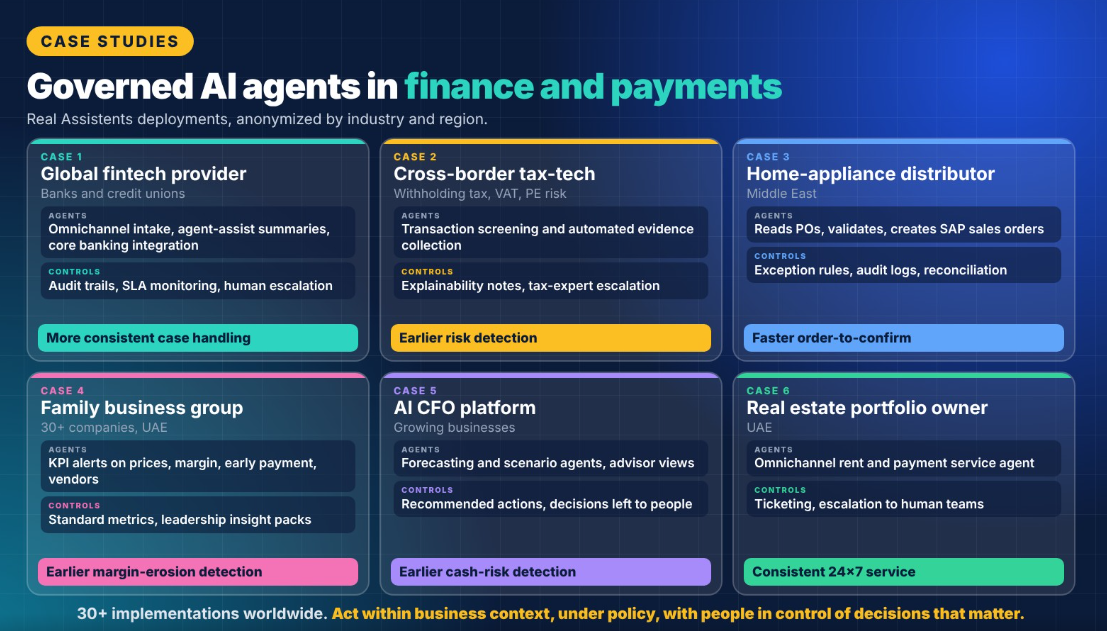
Case study 4: A diversified family business group with 30+ companies (UAE)
- Situation: margin erosion, early-payment finance costs and vendor slippage were hard to see across entities.
- Agents deployed: group-wide KPI standards and automated alerts on purchase-price trends, gross-margin impact, early-payment analysis (notional finance cost) and vendor delivery and returns.
- Controls applied: standard metric definitions and scheduled insight packs for leadership review.
- Outcome: earlier detection of margin erosion and vendor slippage, and consistent finance and procurement intelligence across entities.
Case study 5: An AI CFO platform for growing businesses
- Situation: cash-flow and runway risks were spotted too late.
- Agents deployed: a financial-data connection layer (accounting and banking exports), forecasting and scenario agents, and portfolio views for advisors.
- Controls applied: alerts with recommended actions, with decisions left to people.
- Outcome: faster analysis cycles, earlier detection of cash risks and anomalies, and advisory-grade insight without extra headcount.
Case study 6: A real estate portfolio owner in the UAE
- Situation: a high volume of tenant rent, payment and service queries.
- Agents deployed: an omnichannel service agent (web, WhatsApp, email) with rent and payment workflows and a knowledge base over policies and tenancy documents.
- Controls applied: ticketing and escalation to human teams.
- Outcome: faster responses, a lower call-centre load, consistent 24×7 service and better SLA adherence.
Across 30+ implementations in the US, UK and Europe, the Middle East, India, Australia, Canada and Africa, the pattern is the same: agents create value when they act within business context, under policy, with people in control of the decisions that matter.
Why Assistents is built for governed AI agents in payments
Most AI tools help one person finish a task. Payments need something different: a system that runs a process from trigger to verified outcome, under control. Assistents is built for that. Each capability maps directly to what regulators expect.
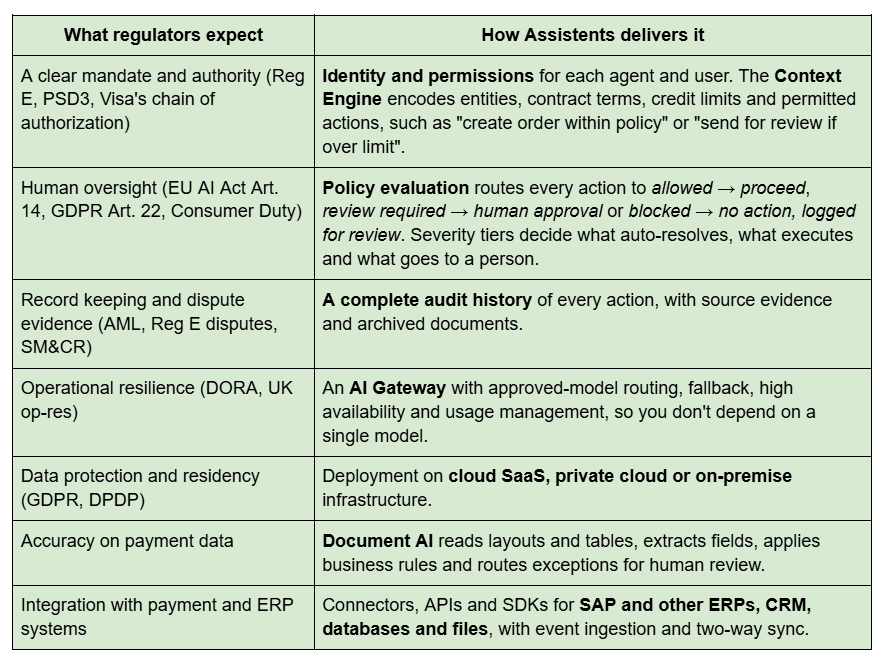
All of this runs on one platform with five capabilities: Conversational Agents (answers and actions), Agentic BI (questions to insight and alerts), Document AI (documents to structured data), Voice AI (multilingual conversations to service) and Autonomous Workflows (events to completed work). It's backed by Forward Deployed Engineers, AI engineers and data scientists in the USA, Australia and India.
Explore Assistents for finance teams and Assistents for banking.
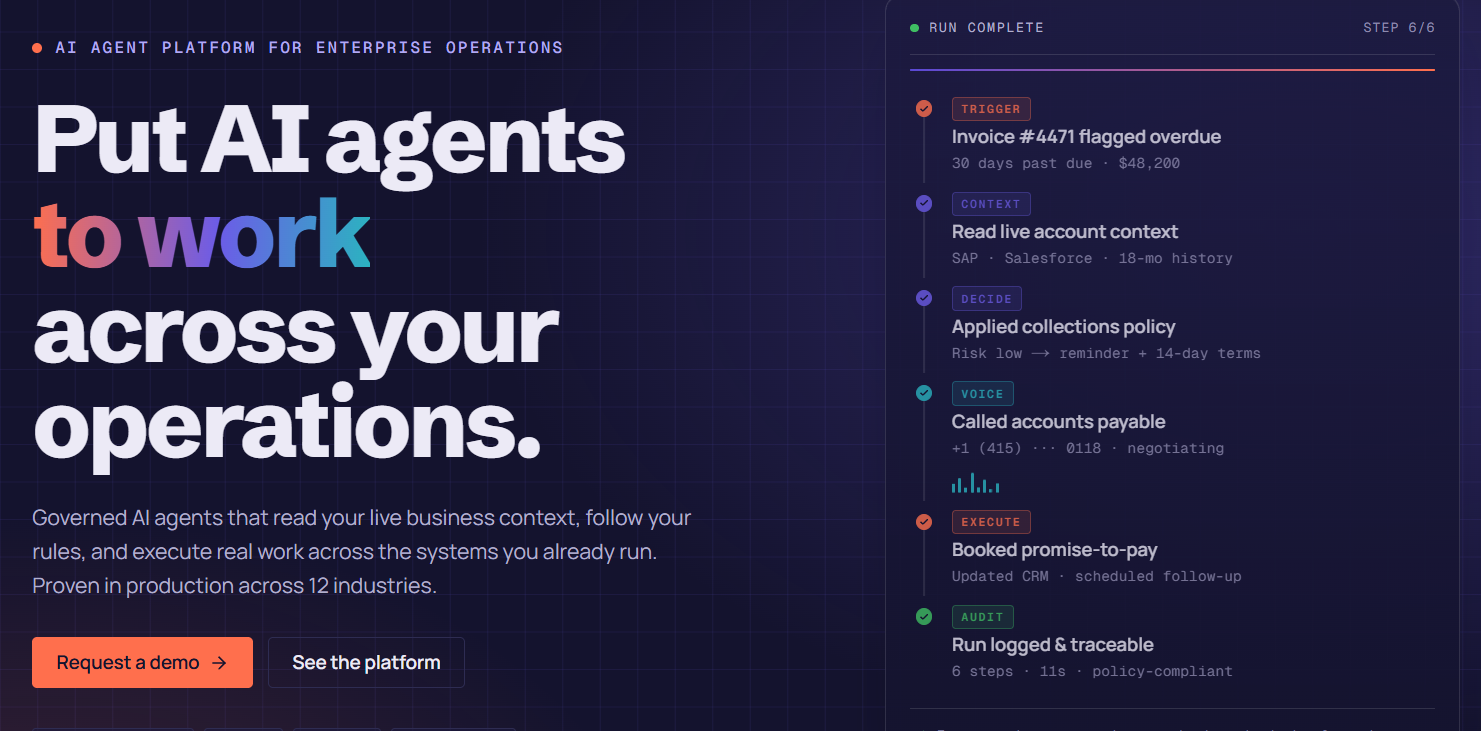
Why payment and finance teams choose Assistents over copilots or in-house builds
"We already have Copilot, Claude or ChatGPT." Those assistants are excellent for personal productivity: drafting, summarizing and analysis. Payment operations need organizational productivity: shared processes that connect teams, rules and systems and can be measured on cycle time, throughput, exceptions and control.
Note: the vendors below also offer enterprise and agent capabilities. This table compares typical use.
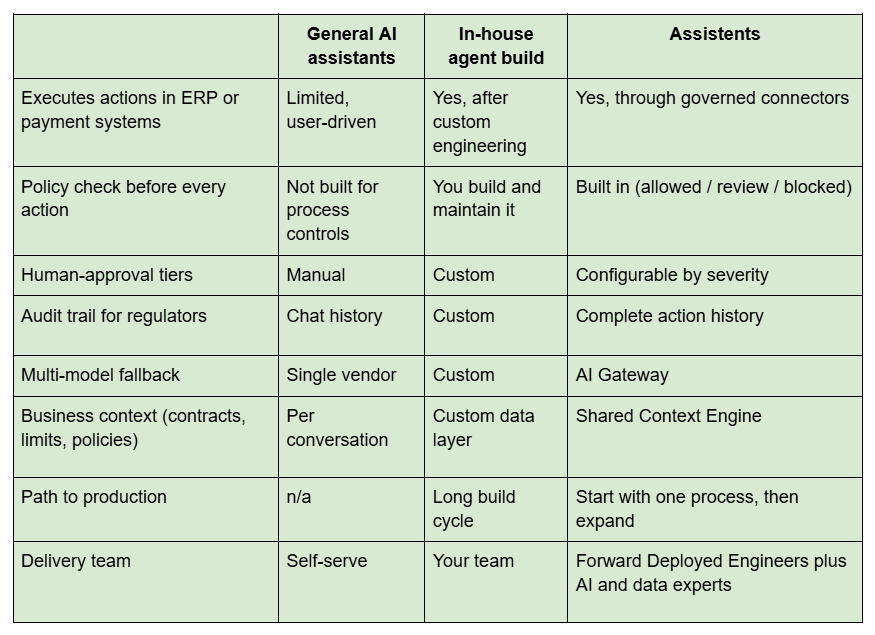
The Assistents path to value has six steps: Select → Connect → Configure → Validate → Operate → Expand. Start with the one payment process that matters most, agree how success will be measured, and build from there.
Checklist: 12 questions to ask any AI agent vendor for payments
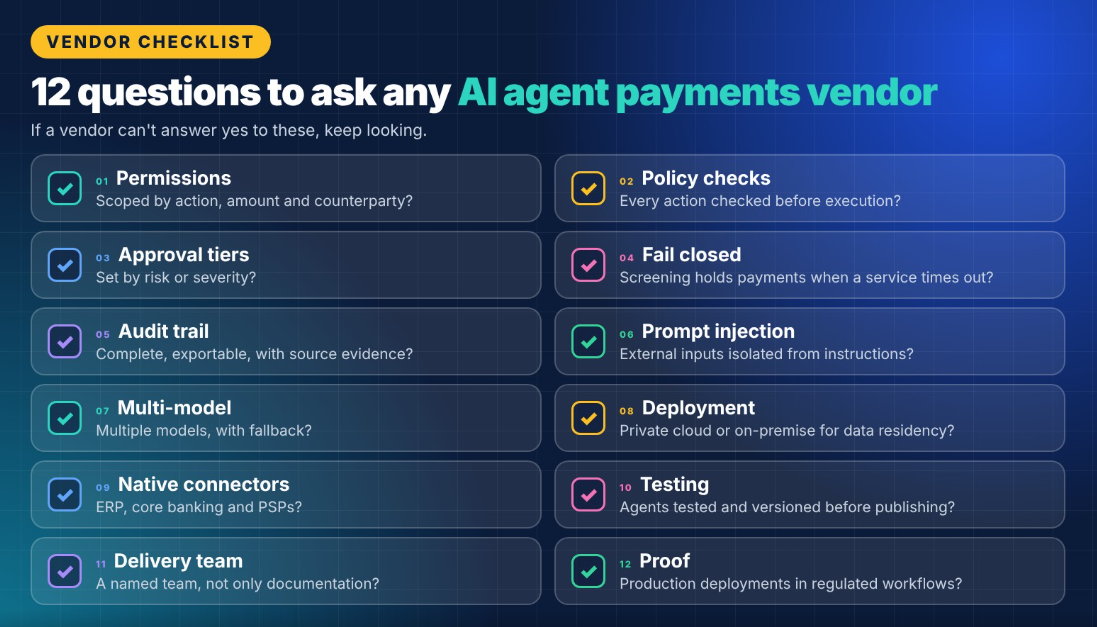
- [ ] Can each agent's permissions be scoped by action, amount and counterparty?
- [ ] Is every action checked against policy before execution?
- [ ] Can approval tiers be set by risk or severity?
- [ ] Does screening fail closed when a service times out?
- [ ] Is there a complete, exportable audit trail with source evidence?
- [ ] Are external inputs isolated from instructions to resist prompt injection?
- [ ] Can you run multiple models, with fallback?
- [ ] Can it be deployed on private cloud or on-premise for data residency?
- [ ] Does it connect natively to your ERP, core banking and PSPs?
- [ ] Can agents be tested and versioned before publishing?
- [ ] Is there a named delivery team, not only documentation?
- [ ] Can the vendor show production deployments in regulated workflows?
Conclusion: agents can move money, but only with governance
AI agents in payments are already in production. They read orders, screen transactions, resolve disputes and flag cash risks. Regulation is catching up through PSD3, the EU AI Act, card-network rules, RBI's authentication framework and emerging Know Your Agent standards. The firms that benefit will be the ones that put mandates, policy checks, human approval and audit trails between their agents and their money.
Ready to put governed AI agents to work in your payment operations? Book a tailored Assistents platform walkthrough and bring the process that matters most.
Sources and further reading
- AI Agents in Payments: Applications, Risks and Regulations, European Journal of Risk Regulation (Cambridge, 2026)
- How Agentic AI Will Reshape Payments, IMF Note 2026/004
- Agentic AI in the payments chain, Freshfields (May 2026)
- Authorizing Agentic Payments, Goodwin (June 2026)
- AI Powered Payment Agents, Ashurst Perkins Coie
- Agentic AI Payments, Consumer Bankers Association
- EU Digital Omnibus on AI enters into force, National Law Review
- PSD3 and PSR final texts agreed
- RBI directions on authentication mechanisms for digital payments
- OWASP: AML and Sanctions Compliance for AI Agent Payments
- Know Your Agent, Fortune (September 2026)
This article is for general information and isn't legal advice. Check specific obligations with qualified counsel in each jurisdiction.
FAQs
What are agentic payments?
Agentic payments are payments that an AI agent starts, authorizes or completes for a person or business, within limits the user sets. Unlike scheduled payments, the agent decides when, how much and to whom, based on a goal such as "pay approved invoices before the discount expires."
Can AI agents make payments on my behalf?
Yes. Visa Intelligent Commerce, Mastercard Agent Pay and Google's AP2 let agents pay with tokenized credentials under a user mandate. In businesses, agents already prepare and execute invoice payments, refunds and sales orders, usually with human approval above set thresholds.
Who is liable if an AI agent makes a wrong payment?
It depends on the jurisdiction and the contracts. In the US, Regulation E may treat a transfer as authorized once a consumer gives credentials to an agent. EU and UK payment rules don't yet address agents. Clear mandates, aligned contracts and audit trails decide who carries the loss.
Are AI agents in payments regulated?
There's no agent-specific payments law yet, but existing rules apply: PSD2 and the upcoming PSD3 and PSR in the EU; SCA, Consumer Duty and APP reimbursement in the UK; Regulation E and Regulation Z in the US; and RBI authentication directions in India. AML, data-protection law and the EU AI Act also apply.
Does strong customer authentication work with AI agents?
Not well yet, because SCA assumes a person is present. Firms use tokenized, agent-specific credentials, delegated-authority exemptions such as merchant-initiated transactions, and step-up confirmation for unusual payments. Card networks now require agent registration.
What is Know Your Agent (KYA)?
Know Your Agent verifies which AI agent is starting a transaction, who owns it and who authorized it. It extends KYC to software. In September 2026, Ant International, Mastercard and Visa began work on a shared KYA interoperability framework.
Does the EU AI Act apply to payment companies?
Yes, where AI is used for high-risk purposes such as creditworthiness assessment. After the 2026 Digital Omnibus, those high-risk obligations apply from 2 December 2027. AI-literacy duties already apply, and transparency duties are being phased in.
What are the biggest risks of AI agents in banking and payments?
The biggest risks are unauthorized spending beyond the mandate, prompt injection, compounding errors, authentication gaps, AML and sanctions blind spots, malicious agents, data leakage, opaque decisions, unclear liability and systemic resilience risk.
How do banks keep a human in the loop with AI agents?
They route every agent action through policy checks. Low-risk actions run automatically, medium-risk actions run within limits, and high-risk or unusual actions go to an authorized person for approval. Each step is logged.
How do I start using AI agents in payments safely?
Pick one bounded process, such as invoice-to-payment or dispute handling. Define the mandate, connect systems through governed connectors, add policy checks and approval tiers, test on real cases in shadow mode, then expand.

Transform Your Business With Agentic Automation
Agentic automation is the rising star posied to overtake RPA and bring about a new wave of intelligent automation. Explore the core concepts of agentic automation, how it works, real-life examples and strategies for a successful implementation in this ebook.
Sarfraz Nawaz is the CEO and founder of Ampcome, which is at the forefront of Artificial Intelligence (AI) Development. Nawaz's passion for technology is matched by his commitment to creating solutions that drive real-world results. Under his leadership, Ampcome's team of talented engineers and developers craft innovative IT solutions that empower businesses to thrive in the ever-evolving technological landscape.Ampcome's success is a testament to Nawaz's dedication to excellence and his unwavering belief in the transformative power of technology.

More insights
Discover the latest trends, best practices, and expert opinions that can reshape your perspective




.jpg)


Contact us

