
AI Agents for Business Leaders: ROI, Real Use Cases & How to Start in 2026


If you are a business leader or entrepreneur reading this in 2026, you have probably heard more about AI agents in the last six months than in the previous five years combined. There is a reason for that — and it is not hype.
The shift happening right now is not about AI getting smarter in a lab. It is about AI becoming operational inside real businesses, across real industries, executing real workflows without waiting for a human to click a button. That distinction — between AI that assists and AI that acts — is the defining business divide of this decade.
This guide is written for the leader who does not have time to read academic papers or sit through hour-long vendor demos, but who needs to understand what AI agents actually do, where they deliver measurable returns, and how to make a first move that is defensible, low-risk, and fast.
We have included real deployment outcomes across industries — from luxury hospitality to energy infrastructure to healthcare — drawn from live implementations. No theoretical use cases. No vendor promises. Just what is actually working, and what the numbers look like.
What AI agents actually are — and what they are not
Before we get into ROI and deployment, let us clear up a definition that is thrown around loosely enough to mean almost anything.
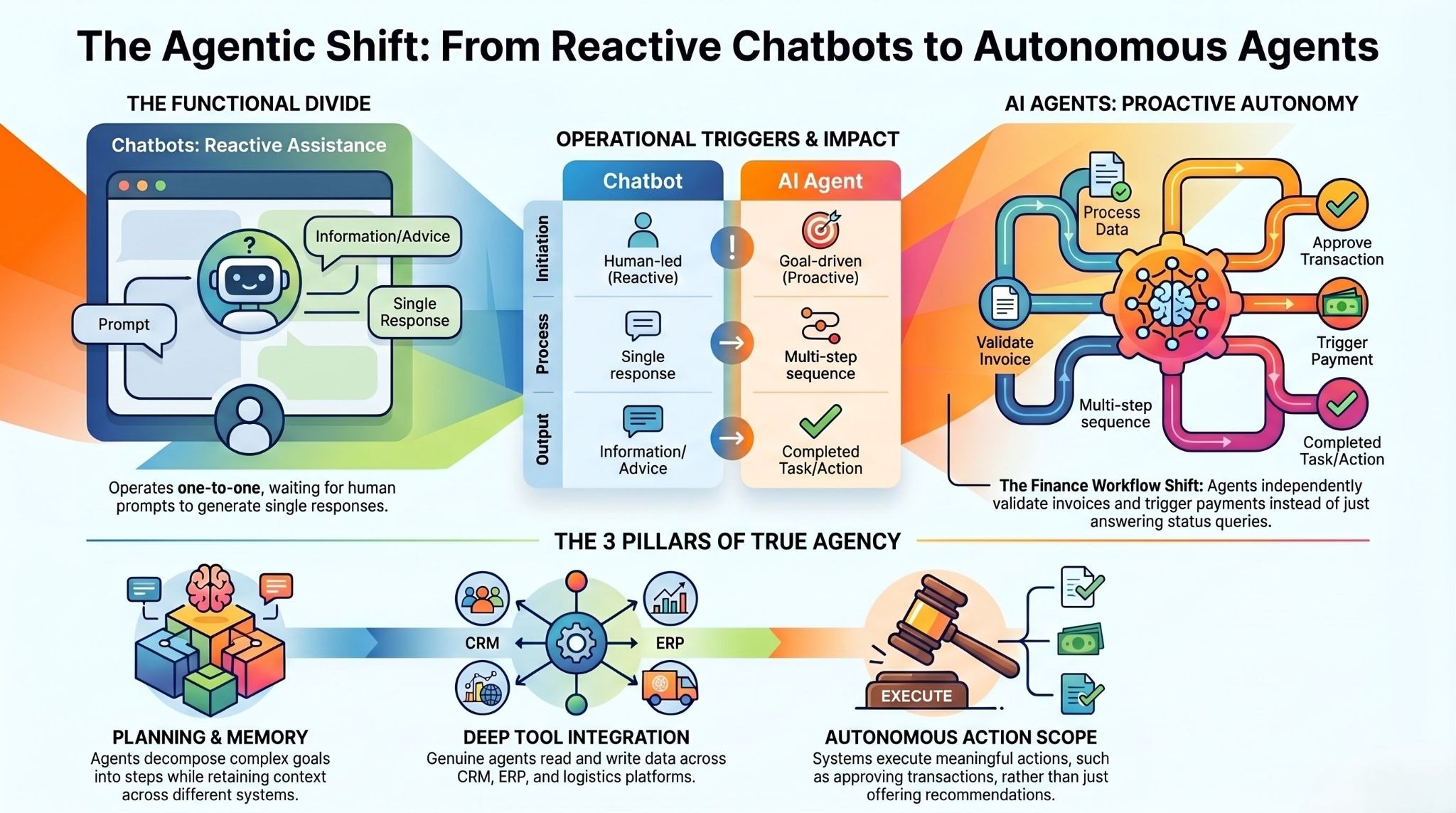
From chatbot to agent: the key difference
A chatbot waits for you to ask something. It generates a response. That is the end of its action.
An AI agent receives a goal, breaks it into a sequence of steps, queries the systems it needs to query, makes decisions based on what it finds, takes action in other systems, and reports back — or, in more advanced deployments, simply completes the task without reporting at all until it is done.
The practical difference for a business leader: a chatbot helps one person at a time, reactively, when they remember to use it. An AI agent runs continuously, proactively, across entire workflows, at a scale no human team can match.
Here is a concrete illustration. A chatbot version of a finance assistant answers questions about invoice status when someone asks. An AI agent for finance monitors every invoice that enters the system, validates it against purchase orders, flags discrepancies, routes exceptions to the right approver, triggers payment runs for clean invoices, and logs every action with a full audit trail — without any human initiating the process.
Same domain. Completely different category of impact.
What makes a system genuinely agentic
Not everything marketed as an "AI agent" is genuinely agentic. For a business leader evaluating a platform, four capabilities separate a real agent from a dressed-up chatbot:
Planning. The agent can take a high-level goal and decompose it into specific steps. It does not need to be told exactly what to do at each stage.
Memory. The agent retains context across a workflow and across time. It remembers that a customer had an unresolved issue last week, or that a supplier missed a delivery window twice in the last quarter.
Tool use. The agent can connect to and operate within your actual systems — your CRM, your ERP, your logistics platform, your communication channels — not just read data from them but write to them, trigger them, and move information between them.
Action scope. The agent can take meaningful action: create a record, send a notification, approve a transaction, schedule a follow-up, escalate an exception. It does not just produce a recommendation for a human to then execute.
If the system you are evaluating cannot do all four of these things, it is a tool, not an agent. Useful, possibly — but a different category of investment with a different category of return.
Why 2026 is the year business leaders have to act
This is not a section about AI urgency as a marketing device. The data is specific enough to be worth looking at closely.
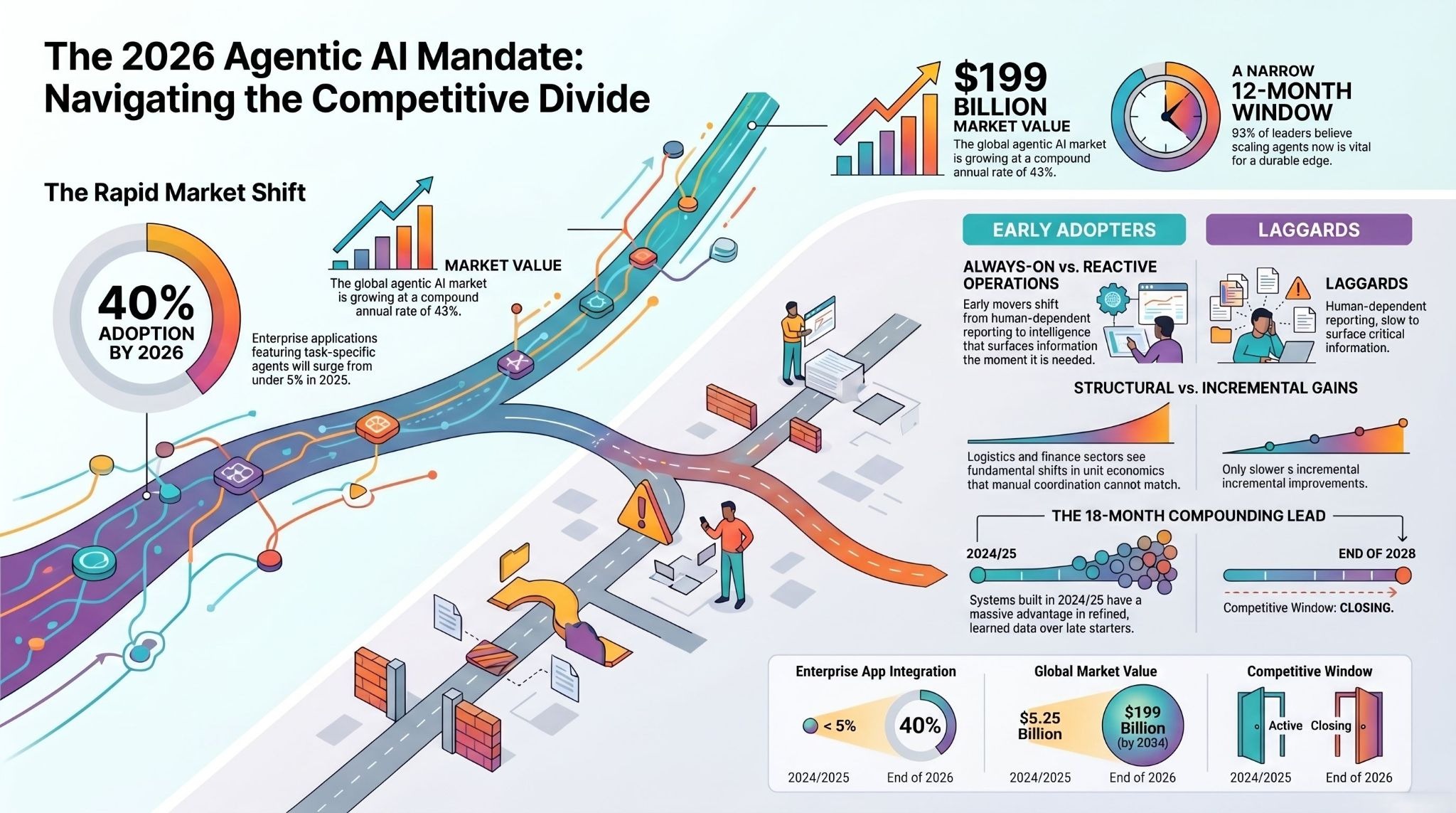
Market data: where agentic AI is right now
Gartner forecasts that 40% of enterprise applications will include task-specific AI agents by the end of 2026, up from less than 5% in 2025. The global agentic AI market is growing at a compound annual growth rate of over 43%, from $5.25 billion in 2024 to a projected $199 billion by 2034.
More immediately relevant for business leaders: 93% of business leaders in a recent Capgemini survey believe that organizations that successfully scale AI agents in the next 12 months will gain a durable competitive edge. That window is not measured in years. It is measured in quarters.
And the adoption curve is steeper than most leaders realize. When 40% of enterprise applications embed agents by the end of this year, the companies without agent infrastructure will not just be behind — they will be operating at a structural disadvantage in speed, cost, and decision quality against competitors who are running continuously while they are not.
The competitive divide forming between early adopters and everyone else
Here is what the early-mover advantage actually looks like in practice, based on live deployments across industries:
In retail, an organization with 700+ stores nationally deployed AI agents for inventory intelligence, store support, and knowledge access. The result was not incremental efficiency. It was a fundamental shift in how store-level decisions get made — from reactive, human-dependent reporting to always-on intelligence that surfaces the right information at the moment it is needed.
In logistics, a global operator digitized terminal and rail management workflows with agentic systems handling operational alerts, scheduling, and exception management. Higher predictability of throughput. Faster coordination between terminal and inland operations. The competitive gap against a logistics provider still running manual coordination is not 10% — it is structural.
In financial services, agentic omnichannel systems now handle banking support intake, triage, workflow routing, and audit trail generation, with integration into core banking systems. That is a capability that previously required headcount at a scale that transformed unit economics.
The organizations building these capabilities in 2024 and 2025 now have systems that have been learning, refining, and compounding for 12-18 months. An organization starting today is not starting at the same line.
AI agent use cases for business leaders — by function
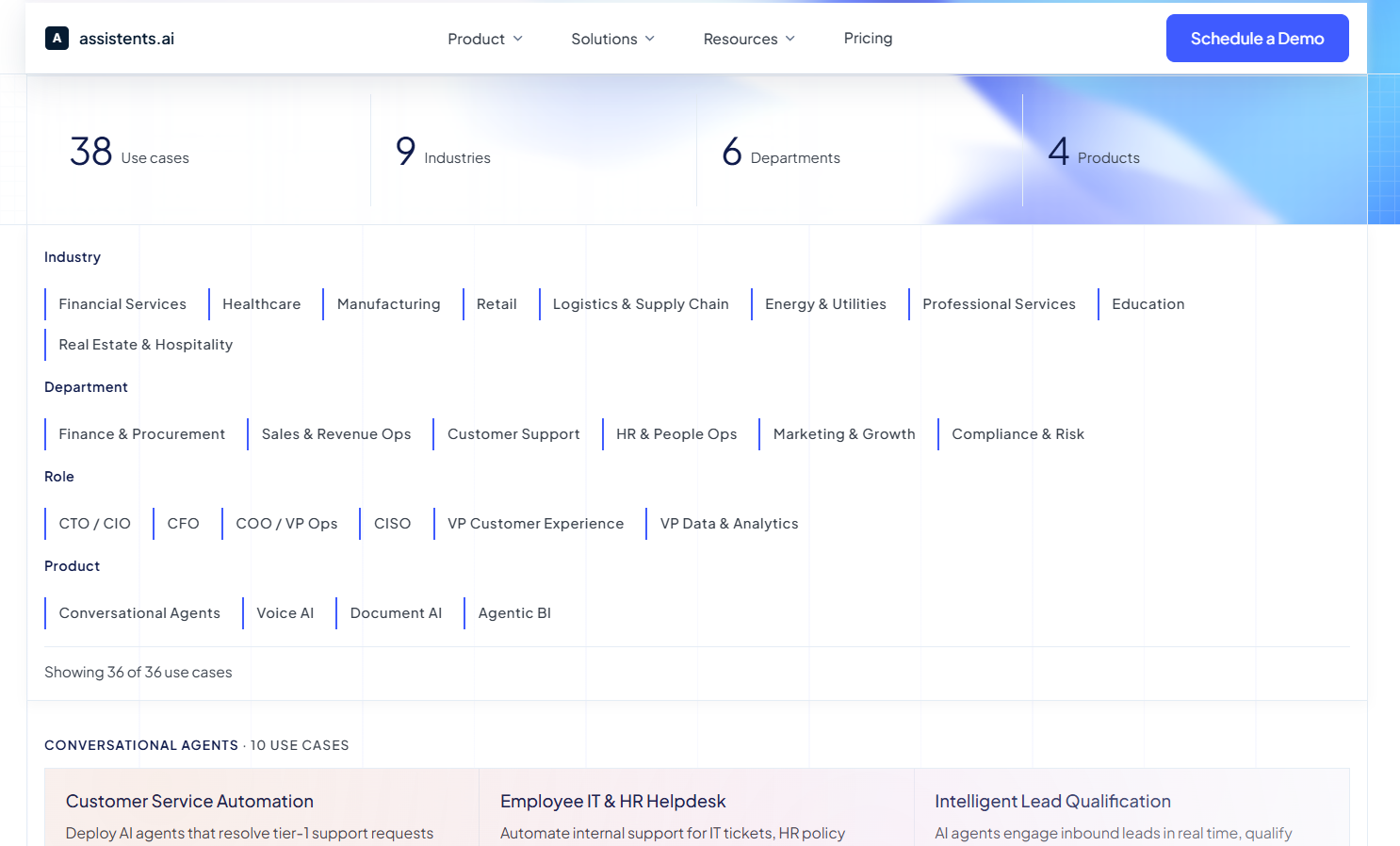
The most useful frame for a business leader evaluating AI agents is not technology-first. It is workflow-first. Where in your business do things slow down, require manual coordination, produce inconsistent outputs, or depend on a small number of people holding institutional knowledge?
Those are your highest-ROI starting points.
Finance and operations
Finance functions are among the highest-ROI deployment areas for AI agents, because they combine high transaction volume, structured data, clear rules, and significant consequences for errors or delays.
Live deployment examples from real organizations:
- Invoice processing and order creation: An agent interprets incoming order triggers, validates data against business rules, creates records in core ERP systems (including SAP), handles exceptions with a defined approval workflow, and produces a full audit log. Manual order processing is eliminated. The order-to-confirm cycle shortens. Data-entry errors decrease significantly. This was deployed as a direct replacement for a legacy system approaching end-of-life — delivering both capability improvement and cost reduction simultaneously.
- Finance KPI monitoring and alerts: Across a multi-entity group, agents standardize procurement and finance KPIs, monitor continuously against thresholds, and push automated alerts on purchase price trends, gross margin impacts, early-payment analysis, and vendor performance. Leadership receives scheduled insight packs rather than waiting for analysts to compile reports.
- Cash flow intelligence for growing businesses: An AI CFO agent connects to accounting and banking data, runs continuous forecasting and scenario modeling, detects early warning signs for cash risks, and delivers advisory-grade insight at a cost that scales with the business. For entrepreneurs and growing companies, this is the first time that kind of continuous financial intelligence has been accessible outside a CFO salary.
Sales and customer support
Sales is the most commercially advanced AI agent use case in 2026. The workflow is well-structured, the data is available, and the ROI is fast and attributable.
- Account monitoring and pipeline management: An agent monitors assigned accounts continuously, captures engagement signals, identifies opportunities and renewal risks based on defined criteria, drafts personalized outreach, integrates with CRM systems, and triggers follow-up tasks for the relevant sales rep. Higher account coverage without increasing headcount. Faster response cycles on opportunities. More consistent execution across the team.
- Customer support resolution: Agentic support systems handle end-to-end case resolution — intake across channels (chat, email, phone, WhatsApp), triage, context retrieval, response generation, escalation to human agents when needed, and SLA monitoring. The shift is from containment metrics ("how many tickets did we deflect?") to outcome metrics ("what business result did we deliver?"). One deployment in real estate reduced call-centre load while delivering consistent 24×7 tenant experience and improved SLA adherence through automated routing.
- Healthcare staffing: A staffing platform used agentic systems for talent onboarding, credential capture, staffing request intake, matching logic, scheduling, compliance workflows, and fill-rate reporting. Faster fill cycles. Better workforce utilization. Improved staffing responsiveness for facilities.
Supply chain and logistics
Supply chain is where AI agents deliver some of their highest operational leverage, because the coordination complexity is enormous and the cost of exceptions — delayed shipments, inventory mismatches, vendor failures — compounds across the entire chain.
- Terminal and rail management: A global ports and logistics operator deployed agents for terminal workflow digitization, yard and rail operational dashboards, rail scheduling and visibility, and executive operational alerts. The outcome: higher predictability of terminal-to-rail throughput and more efficient coordination across terminal and inland logistics — at an operation reporting over $20 billion in annual revenue.
- Procurement intelligence: An agent monitors supplier performance, automates RFQ processes, handles supplier matching workflows, and delivers analytics on price, lead-time, and vendor performance. Faster procurement cycles. Reduced vendor coordination overhead. Better price competitiveness through continuous market intelligence.
- Inventory and store intelligence: A national retailer deployed agents covering inventory pricing and stock visibility per store, knowledge access for store teams, and an admin console integrating with ticketing systems. The result was a measurable reduction in manual helpdesk burden and improved store-level operational visibility — at a scale (700+ stores) where manual coordination was never viable.
HR and compliance
HR and compliance are high-value agent territories because they involve document-heavy workflows, regulatory requirements, structured decision logic, and significant human time spent on coordination rather than judgment.
- Document processing and compliance: An agent handles multi-format document ingestion, extracts structured data with high accuracy, determines workflow routing based on content, detects revisions and changes, and produces a full audit trail. One deployment targeting complex tender documents achieved extraction accuracy targets of around 95% for standard formats, with engineered processing time reductions of up to 90% versus manual workflows.
- Tax research and pre-screening: An agent automates source collection and summarization for cross-border transaction screening, drafts memo and position outputs with citations, tracks workflow status, and builds a searchable knowledge base. Earlier detection of withholding and VAT risk. Faster, more consistent pre-compliance review. Fewer last-minute deal disruptions.
- Teacher and educator community support: A platform serving over one million teachers across 131 countries deployed agents for competency insights, learning guidance, and automated support workflows — making personalized, scalable support possible at a community size where human support alone would be economically unviable.
Real results: what AI agents have delivered across industries
The following outcomes are drawn from live deployments across multiple sectors. No client names are used. The numbers and operational outcomes are real.
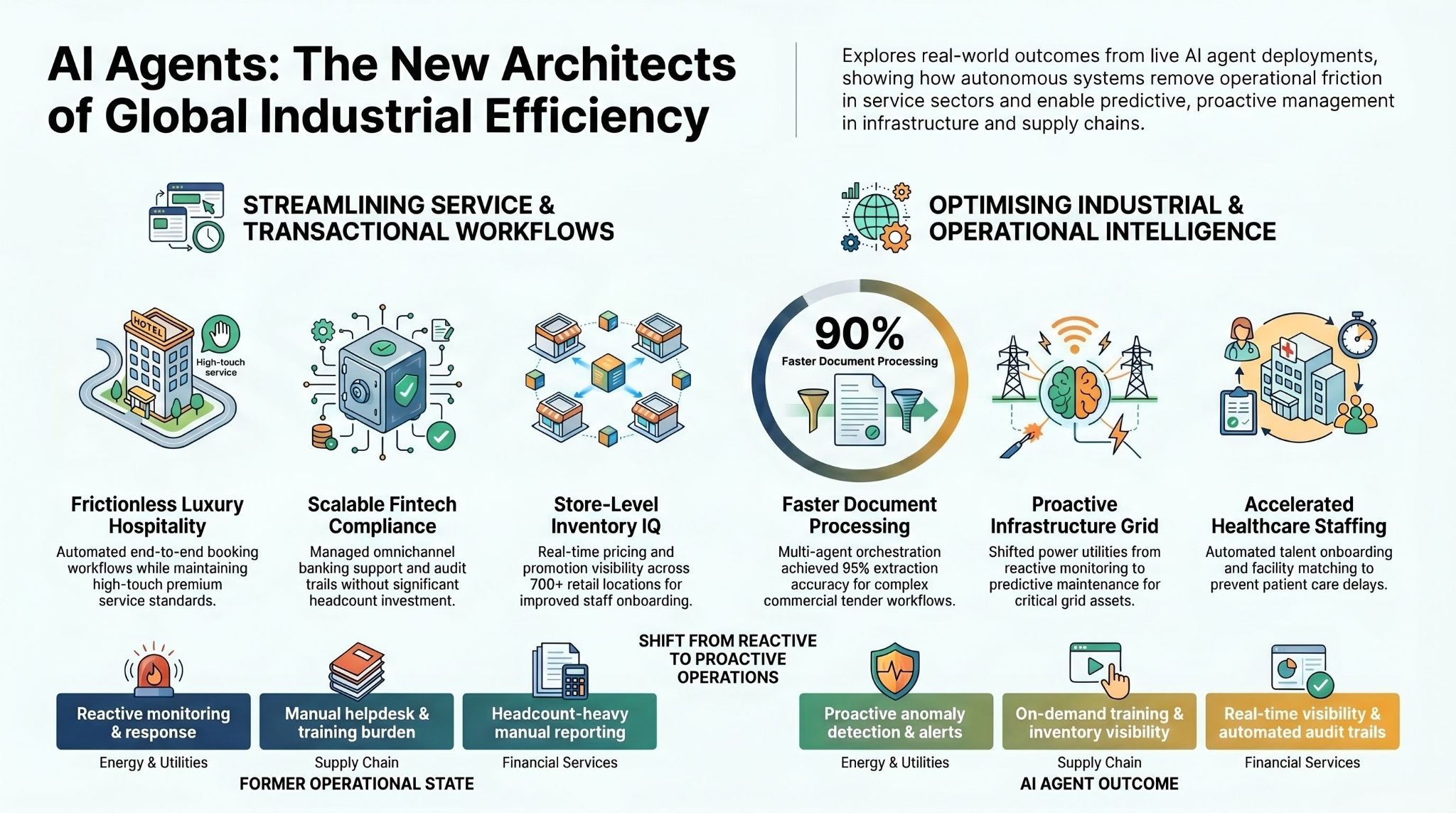
Luxury and hospitality
A luxury safari collection operating 16 boutique lodges and camps across multiple countries deployed a digital booking agent to automate end-to-end travel booking workflows — handling email intake, intent classification, data extraction, real-time inventory checks, alternative date negotiation, and automated invoice generation. The result: faster booking turnaround with significantly reduced back-and-forth communication, higher accuracy on complex guest requirements, and scalable operations without compromising the luxury service standard that defines the brand.
The key insight: even in a premium, high-touch service category, AI agents do not replace the human experience — they remove the operational friction that prevents humans from delivering it.
Financial services
A global fintech provider delivering cloud-based automation for banks and credit unions deployed omnichannel AI agents for banking support — covering intake, workflow routing, agent-assist summarization, next-best actions, auditability, reporting, and SLA monitoring. Voice support was added in multiple languages. The outcome: faster case handling, reduced operational load, and better compliance readiness through a full audit trail — capabilities that previously required significant headcount investment to maintain at scale.
A separate deployment for a financial analytics platform built agentic data analysis with a natural language query interface, automated KPI monitoring, and exception alerting — shifting leadership from reactive reporting cycles to proactive operational visibility.
Retail and supply chain
A value retail operation with 700+ stores deployed enterprise AI agents covering store support, inventory intelligence, and knowledge access — with a voice support agent, per-store inventory pricing and promotions visibility, and a knowledge and training agent drawing on point-of-sale and standard operating procedure documentation. The deployment reduced manual helpdesk burden, improved store-level inventory visibility, and accelerated staff onboarding through on-demand training guidance.
A separate waterproofing and commercial works specialist deployed intelligent document processing for complex tender workflows — multi-agent orchestration for document retrieval, workflow determination, revision analysis, vision-based extraction from complex PDFs, and deep integration with core operational systems including full audit logs. Engineered for up to 90% faster tender document processing with approximately 95% extraction accuracy for standard formats.
Healthcare and professional services
A physician-led clinical enterprise and a geriatric care services provider both deployed analytics systems for revenue management, operational performance, and care-program visibility — delivering revenue cycle transparency, faster identification of operational bottlenecks, and improved decision support for leadership.
A healthcare staffing platform used agentic systems for the full staffing workflow: talent onboarding, credential capture, facility request intake, matching, scheduling, notifications, and compliance reporting. Faster fill cycles, better workforce utilization, and improved responsiveness for facilities — in a market where staffing delays have direct patient care consequences.
Energy and infrastructure
A state power transmission utility monitoring critical grid infrastructure deployed agents for transmission KPI monitoring, anomaly detection, loss and outage analytics, predictive maintenance indicators, and automated alerts for field operations. A smart city infrastructure operator running 25+ smart city operation centres and connecting over two million assets deployed a smart grid analytics layer with predictive analytics for outages, automated alerts, and workflow routing for resolution.
In both cases the outcome was the same structural shift: from reactive monitoring to proactive operations — catching exceptions before they become failures rather than responding after the fact.
A research institute in astronomy and astrophysics deployed AI for campus-scale energy management — monitoring, forecasting, and optimizing energy consumption across complex research facilities. Improved energy visibility. Faster detection of inefficiencies. More predictable operations through early alerting.
How to calculate your AI agent ROI before you deploy
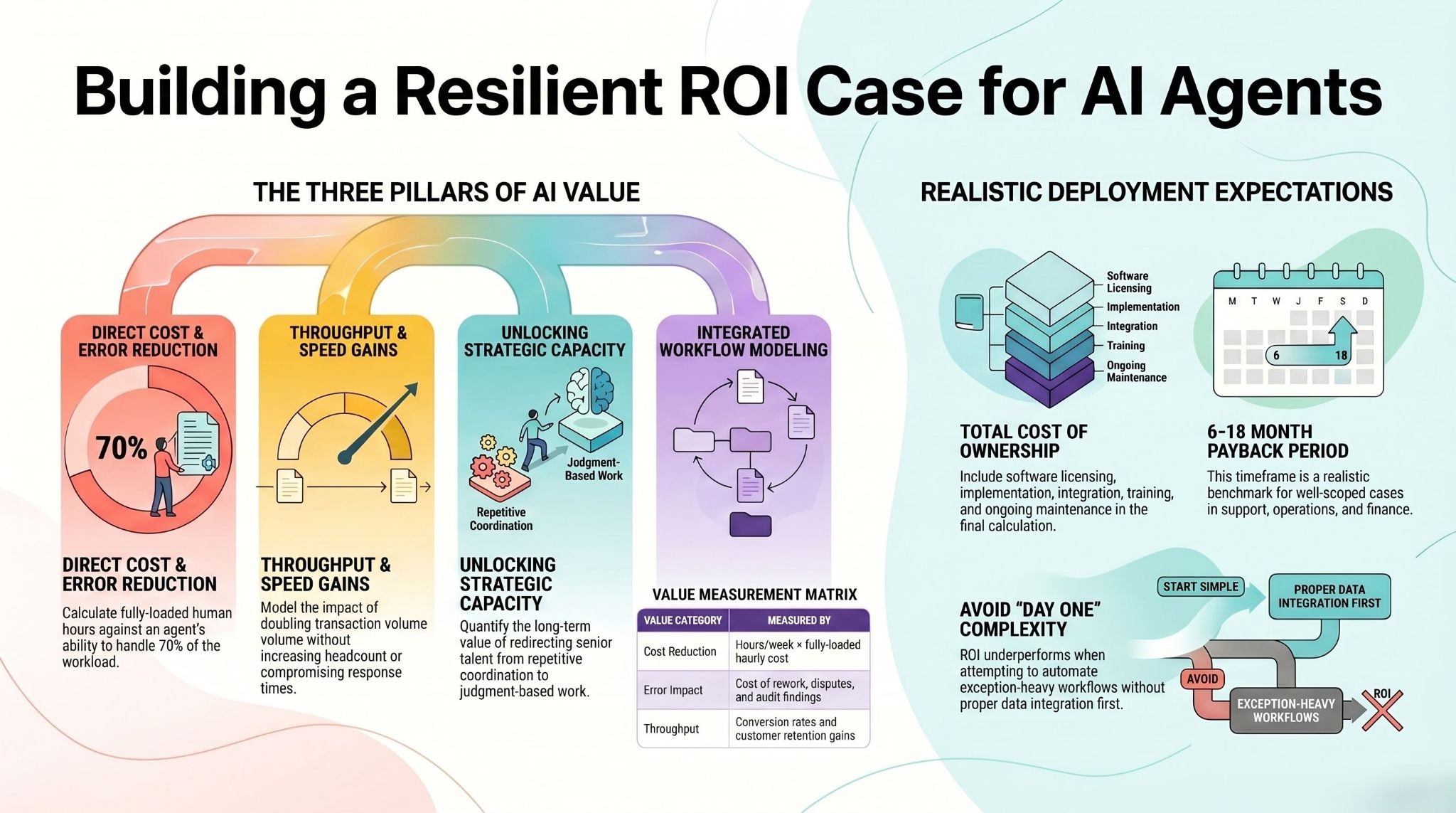
The most common failure mode for AI agent projects is not technical. It is a business case that cannot survive a CFO review because it was built on vendor-provided numbers rather than workflow-level modeling.
Here is how to build a business case that holds.
The ROI formula business leaders actually use
ROI from AI agents comes from four value categories. Model each one separately:
1. Direct cost reduction. What is the fully-loaded cost of the human time currently spent on this workflow? Calculate hours per week × fully-loaded hourly cost. An agent handling 70% of that workload at a fraction of the cost is your baseline saving.
2. Error reduction and rework elimination. What does a mistake in this workflow cost? In invoice processing, a data-entry error can cascade into payment delays, vendor disputes, and audit findings. In compliance workflows, an error has regulatory consequences. Model the cost of your current error rate and the reduction an agent delivers.
3. Speed and throughput gains. How many decisions or transactions does the workflow handle per day? What happens if you double or triple that throughput without adding headcount? In sales, faster lead response translates directly to conversion rate. In support, faster resolution translates to customer retention.
4. Strategic capacity. What would your best people do with the time currently spent on repetitive coordination? This is harder to quantify but often represents the highest long-term value — redirecting senior talent from process management to judgment work.
Then calculate against full costs: software licensing, implementation, integration, training, and ongoing maintenance. A payback period of 6-18 months is realistic for well-scoped use cases in support, operations, and finance.
What realistic returns look like by function
Based on live deployments and published benchmarks:
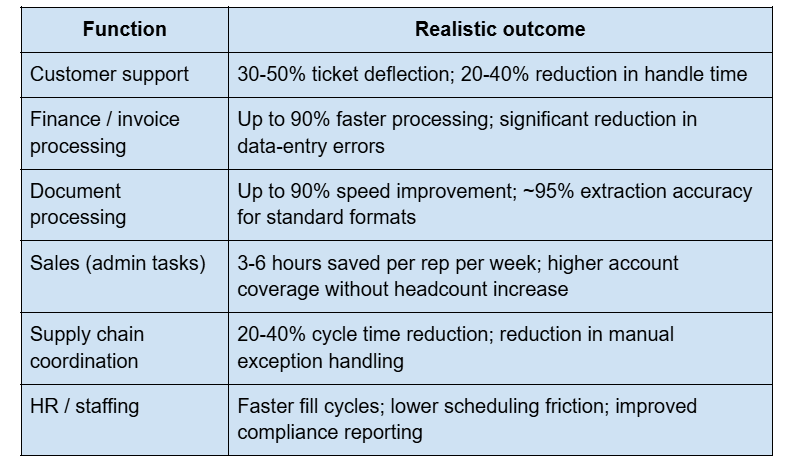
Important note: these are realistic ranges for well-scoped deployments, not cherry-picked best cases. Poorly scoped deployments — those that attempt to automate complex, exception-heavy workflows on day one, or that deploy without proper data integration — underperform. The ROI is real. It requires disciplined execution to capture.
The 5 mistakes business leaders make when adopting AI agents
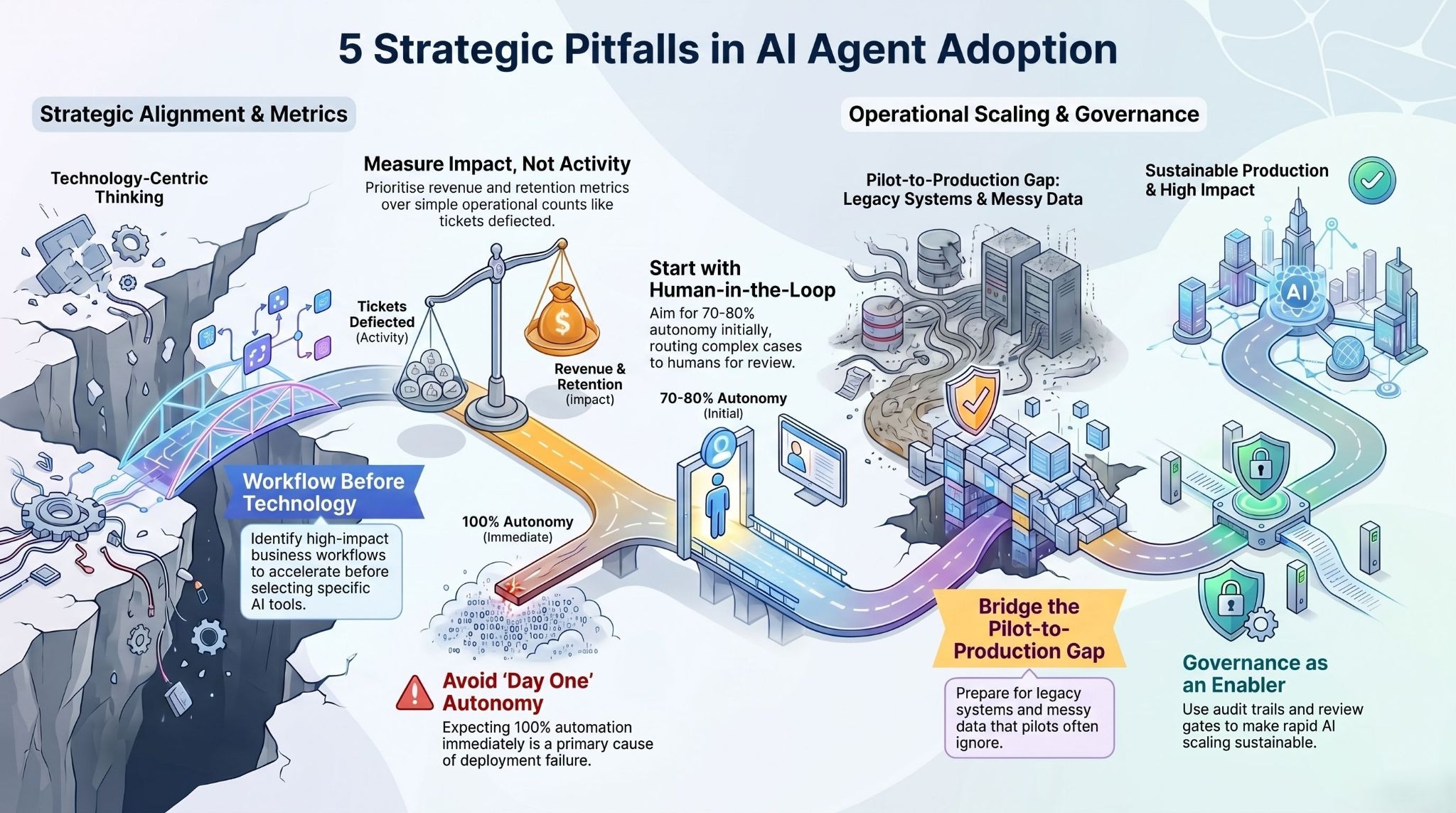
1. Starting with the technology instead of the workflow.
The question is never "what can AI agents do?" The question is "which workflow in my business, if accelerated and made error-free, would have the highest impact on our outcomes?" Start there. The technology follows the use case.
2. Treating a pilot as proof.
A pilot that succeeds in a controlled environment with clean data and an isolated workflow is not evidence that the same agent will succeed in production at scale. Production means legacy systems, messy data, edge cases, and compliance requirements. Bridge that gap before declaring success.
3. Measuring the wrong things.
Counting tickets deflected or invoices processed tells you operational efficiency. It does not tell you business impact. Define outcome metrics before deployment: what happens to revenue, customer retention, or decision speed as a result of this agent working well?
4. Underinvesting in governance.
The organizations that scale AI agents successfully are not the ones with the most advanced models. They are the ones with clear governance frameworks — defined action scope for each agent, audit trails, exception handling protocols, and human review gates for high-stakes decisions. Governance is not a blocker to speed. It is what makes speed sustainable.
5. Expecting full autonomy on day one.
The most successful deployments start with human-in-the-loop workflows where the agent handles 70-80% of cases autonomously and routes the rest to humans with full context. Autonomous rates increase as the system learns and as your team builds confidence in its outputs. Starting with 100% automation expectations produces 100% failure rates.
How to choose the right AI agent platform

Not all enterprise AI agent platforms are equivalent. The architecture underneath determines what is actually possible — and what the limitations are.
What to look for: integrations, governance, and deployment speed
Integration breadth. An agent is only as useful as the systems it can act within. A platform that integrates deeply with your actual tech stack — your ERP, your CRM, your communication channels, your data warehouse — delivers real workflow automation. A platform that connects to three tools via basic API calls is not enterprise-ready. Look for 300+ integrations with enterprise-grade connectors, not surface-level read-access.
Governance and compliance architecture. For enterprise deployment, this is non-negotiable. You need SOC 2, GDPR, HIPAA, and ISO 27001 compliance built into the platform, not bolted on. You need audit trails for every agent action. You need explainability — the ability to see why the agent made a specific decision — and the ability to define minimum necessary scope so agents cannot act outside their defined workflow boundaries.
Deployment speed. Enterprise software implementations traditionally take months. The AI agent market moves on a different timescale. A platform that can take you from procurement to live deployment in four weeks — rather than the eight to twelve weeks typical of legacy enterprise software — is not a nice-to-have. It is a strategic variable in how quickly you realize ROI and how quickly you can adapt when your first deployment reveals what your second deployment should be.
Industry depth. A platform with genuine deployment experience across your industry — not just generic enterprise use cases — brings workflow knowledge that saves months of scoping. Ask for specifics: what deployments have they done in your sector, what were the integration patterns, what were the failure modes?
Multi-agent architecture. The highest-value deployments in 2026 do not use single agents. They use orchestrated networks of specialized agents — a research agent, a scoring agent, a writing agent, and an orchestration agent all working together toward a goal. A platform that supports multi-agent coordination is building toward a fundamentally different capability ceiling than one that deploys single agents in isolation.
Your 30-day plan to get started with AI agents
The most dangerous response to this guide is deciding to "explore AI agents further" with no specific commitment. Exploration without a deadline produces no output. Here is a concrete 30-day starting framework for a business leader who wants to move from understanding to action.
Days 1-5: Identify your highest-value workflow
Pick one. Not your most complex workflow. Not the one where AI agents would be most impressive if they worked. The one where: the volume is high, the data is structured, the rules are relatively clear, and the cost of the current manual process is directly measurable. Common first deployments: customer support triage, invoice processing, lead enrichment and scoring, document data extraction, or operational KPI monitoring and alerting.
Days 6-10: Map the current workflow in detail
Document every step of the workflow as it exists today. Who does what, in which system, triggered by what, with what error rate and what cycle time. This is not an AI exercise — it is a process documentation exercise. You cannot automate a workflow you have not mapped. This mapping also gives you your baseline for ROI measurement.
Days 11-15: Define your success metrics
Before you deploy anything, write down what success looks like. Not "the agent should work well." Specifically: what volume of cases do you expect the agent to handle autonomously? What is your target accuracy rate? What is the human review threshold? What cycle time improvement are you targeting? What is your 90-day ROI target? Get leadership alignment on these numbers before deployment.
Days 16-25: Select your platform and configure your first agent
Evaluate platforms against integration breadth, governance architecture, deployment speed, and industry experience. A platform with enterprise-grade governance, 300+ integrations, and a four-week deployment track record is the benchmark. Configure your first agent against your mapped workflow with a human-in-the-loop design — the agent handles what it is confident about, routes the rest to humans with full context.
Days 26-30: Run your pilot and measure against baseline
Deploy to a defined subset of your workflow volume. Measure against your pre-defined metrics. Identify the failure modes — the edge cases where the agent routes incorrectly or produces outputs that require human correction. Use those failure modes to refine the routing logic. At day 30, you have real data for a full business case, a working deployment to build on, and the organizational confidence that comes from seeing agents work inside your actual systems.
The bottom line for business leaders in 2026
The window to build an early-mover advantage with AI agents is not measured in years. It is measured in months. The gap between organizations that have agents running in production — learning, refining, compounding — and those still running pilots is widening every quarter.
But the path to that advantage is not complicated. It is disciplined. Pick one workflow. Map it. Define what success looks like. Choose a platform with genuine enterprise depth — the integrations, the governance, the industry experience, and the deployment speed to get you from signed contract to live agent in weeks, not quarters. Measure rigorously. Then scale what works.
Across luxury hospitality, global logistics, financial services, national retail, energy infrastructure, healthcare, and professional services — the evidence from live deployments in 2024 and 2025 is consistent: the organizations that committed early, scoped intelligently, and built governance from the start are now operating at a structural advantage their competitors cannot close quickly.
The question for every business leader reading this in 2026 is not whether AI agents will transform your industry. It is whether you will lead that transformation, or follow it.
Ready to see what AI agents can do inside your business?
assistents.ai deploys enterprise-grade AI agents across finance, operations, sales, customer support, and more — with 300+ integrations, built-in governance, and a four-week path from first conversation to live production.
Whether you are a founder running a lean team or a business leader managing operations at scale, we will help you identify the right workflow, scope a deployment that delivers measurable ROI within 90 days, and build from there. No six-month implementation timelines. No vague pilots. Just agents that work inside your actual systems, doing real work, from week one.
Frequently asked questions: AI agents for business leaders
What is the difference between an AI agent and a chatbot?
A chatbot generates a response to a question. An AI agent plans, decides, and acts across a multi-step workflow — querying systems, taking action within them, and completing tasks without requiring a human at every step. The practical difference is the difference between a tool that assists one person reactively and a system that runs workflows continuously and proactively.
How long does it take to deploy an AI agent in an enterprise?
A well-structured deployment with a clearly scoped use case and proper integration support takes four to six weeks from procurement to live production. Poorly scoped deployments — those that attempt to automate complex workflows without mapping them first — can take significantly longer and frequently fail. Start narrow and specific.
What is a realistic ROI timeline for AI agents?
For well-scoped use cases in customer support, finance, document processing, or operational monitoring, payback periods of 6-18 months are realistic. Some deployments — particularly high-volume, rule-heavy workflows like invoice processing or support ticket triage — show positive ROI within the first quarter. The key variable is workflow volume: higher volume means faster payback.
Do AI agents work for smaller businesses and entrepreneurs, not just enterprises?
Yes — and the relative impact is often higher for smaller organizations. An entrepreneur deploying AI agents for customer support, lead qualification, and financial monitoring is effectively operating with the leverage of a team several times larger. The barrier to deployment has dropped significantly: modern platforms deploy in weeks, not months, and pricing models scale with usage rather than requiring enterprise-scale upfront commitment.
What industries have seen the most AI agent deployment success?
Financial services, retail, logistics, healthcare, and energy infrastructure have the most mature live deployments in 2026, driven by high transaction volumes, structured data, and clear workflow rules. Luxury hospitality, professional services, and education are emerging deployment areas where the workflow complexity is higher but the efficiency gains are significant.
How do I know which workflow to start with?
The best starting point is the workflow with the highest combination of: volume (many transactions or cases), structure (clear rules, defined inputs and outputs), measurable cost (you can calculate what it costs today), and low exception rate (most cases follow the standard path). Customer support triage, invoice processing, lead scoring, document data extraction, and operational monitoring are the most common successful first deployments.
What governance do I need before deploying AI agents?
At minimum: defined action scope for each agent (what systems it can access, what actions it can take), a human review gate for high-stakes or low-confidence decisions, full audit logging of every agent action, and escalation protocols for exceptions. Enterprise deployments in regulated industries additionally require compliance certification (SOC 2, GDPR, HIPAA, ISO 27001 depending on sector) at the platform level.
Will AI agents replace my team?
The most successful deployments do not reduce headcount — they redirect it. Agents handle high-volume, repetitive, rule-following work. People handle judgment, relationships, creativity, and the exceptions that genuinely require human decision-making. The organizations realizing the highest returns from AI agents are those that treat agent deployment as a way to make their existing team more effective, not as a mechanism for reducing it.

Transform Your Business With Agentic Automation
Agentic automation is the rising star posied to overtake RPA and bring about a new wave of intelligent automation. Explore the core concepts of agentic automation, how it works, real-life examples and strategies for a successful implementation in this ebook.
Sarfraz Nawaz is the CEO and founder of Ampcome, which is at the forefront of Artificial Intelligence (AI) Development. Nawaz's passion for technology is matched by his commitment to creating solutions that drive real-world results. Under his leadership, Ampcome's team of talented engineers and developers craft innovative IT solutions that empower businesses to thrive in the ever-evolving technological landscape.Ampcome's success is a testament to Nawaz's dedication to excellence and his unwavering belief in the transformative power of technology.

More insights
Discover the latest trends, best practices, and expert opinions that can reshape your perspective







Contact us

