
AI Sales Agent for Lead Generation: The Governed Enterprise Playbook for 2026


An AI sales agent for lead generation is an autonomous software system that executes multi-step revenue workflows — signal capture, enrichment, qualification, scoring, routing, outreach, CRM write-back and account monitoring — without requiring a human instruction at each step. Unlike a chatbot, it acts between conversations rather than only during them.
That definition is the easy part. The hard part is that most of these systems do not survive their first year.
In this playbook:
- Why Gartner expects over 40% of agentic AI projects to be cancelled by the end of 2027 — and what that means for revenue teams specifically
- The Lead-to-Revenue Leakage Map — the seven places pipeline actually disappears
- The Six-Layer Sales Agent Stack — the architecture that separates a production agent from a demo
- The Revenue Autonomy Ladder — how much authority to grant, per action, with a publishable autonomy contract
- The Agent-Washing Test — ten questions to ask any vendor before you sign
- What governed deployments look like in production, across five real enterprise environments
- Costs, ROI modelling, deployment options, and a 30/60/90 rollout
What is an AI sales agent for lead generation?
An AI sales agent for lead generation is an autonomous system that owns a defined slice of the revenue process end to end. It monitors signals across your accounts and inbound channels, enriches and qualifies leads against your ideal customer profile, scores and routes them, executes governed follow-up, writes the result back into your CRM, and keeps watching the account after the handoff.
The word doing the work in that sentence is owns. A tool that waits to be asked is an assistant. A tool that fires a fixed sequence on a trigger is automation. An agent perceives a situation, decides what should happen next within a bounded mandate, acts, and records what it did.
That distinction has become commercially urgent, because the market is now full of products using agent language for capabilities that are neither autonomous nor bounded. Gartner named this directly in its June 2025 analysis, describing "agent washing" — the rebranding of existing assistants, chatbots and robotic process automation without substantial agentic capability. Gartner's estimate at the time was that of the thousands of vendors positioning themselves as agentic AI, only around 130 were real.
So the practical question for a revenue leader in 2026 is not "should we use AI for lead generation." That argument is settled. The question is how to tell a genuine agent from a repackaged sequencer, and how to deploy the genuine one so that it is still running in twelve months.
AI sales agent vs AI SDR vs chatbot vs marketing automation
These four categories are used interchangeably in vendor marketing and they are not the same thing.
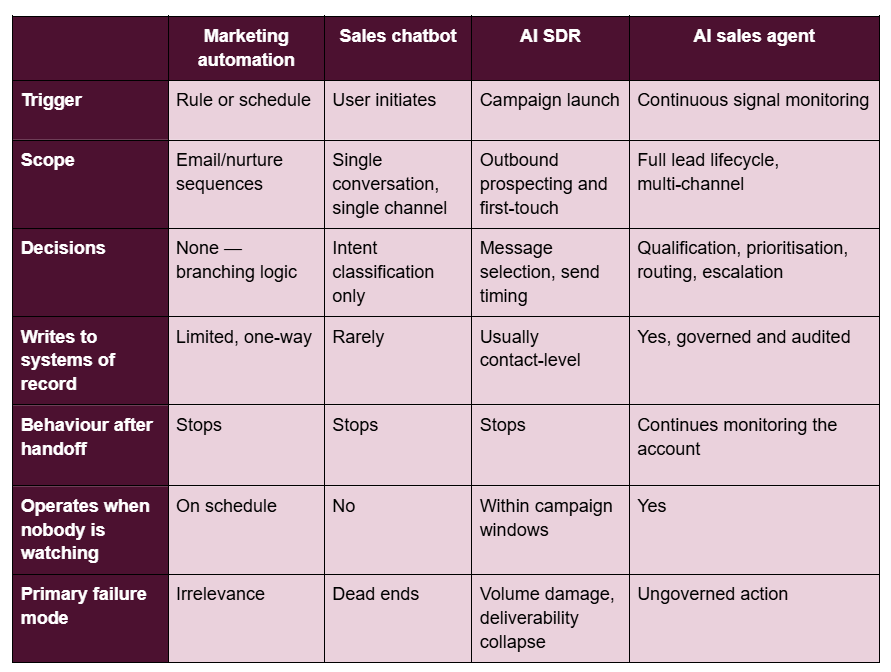
The critical row is the last one. An AI SDR fails loudly — reply rates fall, domains degrade, prospects complain. An AI sales agent fails quietly — it updates a deal stage nobody approved, sends a message that contradicts a live negotiation, or acts on account data it should not have been able to read. Loud failures get fixed. Quiet ones get discovered during an audit.
That asymmetry is why governance is not a compliance afterthought in this category. It is the thing that determines whether the deployment survives.
The 2026 reality check: why most AI sales agents get switched off
Here is the data the rest of the category tends not to publish.
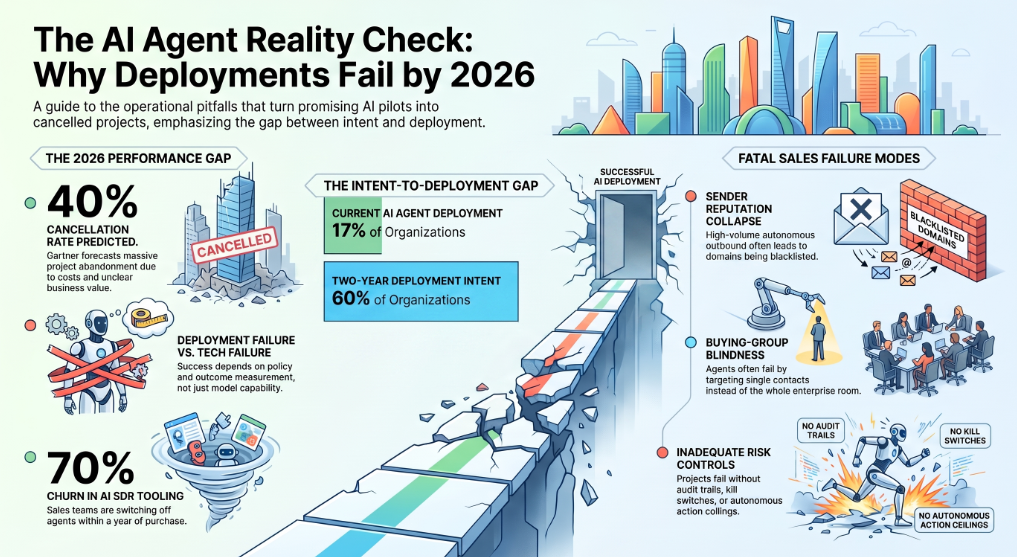
Gartner predicts that over 40% of agentic AI projects will be cancelled by the end of 2027. The stated causes are escalating costs, unclear business value, and inadequate risk controls. That prediction was published on 25 June 2025 and it has been widely resurfaced since — including a Forbes analysis in July 2026 — but the underlying diagnosis has not changed. (Gartner)
Read the three causes again, because they are not technology failures. They are deployment failures. Gartner's analyst commentary made the point explicitly: most agentic projects are early-stage experiments driven by hype and often misapplied, which blinds organisations to the real cost and complexity of running agents at scale.
Gartner's 2026 Hype Cycle for Agentic AI places the category at the Peak of Inflated Expectations, with roughly 17% of organisations having deployed AI agents and more than 60% intending to within two years. That intent-to-deployment gap is precisely the structural condition that produces a high cancellation rate.
In sales specifically, the pattern is further along. Through the first half of 2026, practitioners reported AI SDR tooling churning at 50–70% within three to twelve months of purchase. The teams that kept their deployments were not the ones who bought more capable tools. They were the ones who stopped treating an agent as a set-and-forget replacement for judgement.
The five failure modes, named
1. Volume damage and sender-reputation collapse. Autonomous outbound optimises for output, and output is the wrong target. Cumulative send volume crosses a reputation threshold quietly — there is no alarm, just a gradual decline in reply rates that looks like a messaging problem and is actually a deliverability problem. By the time it is diagnosed, the domain needs months to recover. Any agent without a configured per-inbox daily ceiling is a liability with a subscription attached.
2. Buying-group blindness. Enterprise deals involve a room, not a person. The economic buyer, the technical evaluator and the quiet blocker usually sit in three different functions. An agent built to pursue a single contact never learns the room has more people in it — because nobody configured it to notice. This is a design omission, not a model limitation, and it is one of the most consistent reasons agent-sourced meetings fail to convert.
3. Dirty data amplified. CRM contacts decay at roughly 30% per year — titles change, companies get acquired, people move. Automation amplifies whatever it is pointed at. Running an agent against an unaudited CRM does not produce mediocre results; it produces confident, high-volume wrong results, at a scale a human team could never have achieved.
4. No agreed qualification bar. If sales development and account executives never wrote down what "qualified" means before the pilot launched, the agent will simply move the existing disagreement downstream, faster. Meetings appear on calendars. Nobody can close them. Trust in the system collapses within a quarter.
5. Inadequate risk controls — the one Gartner names first. No audit trail on writes. No ceiling on autonomous action. No escalation path for the reply the agent was not built to handle. No kill switch anyone has tested. These are not enterprise-buyer paranoia items. They are the specific gaps that turn a working pilot into a cancelled project.
The pattern across all five: none of them are failures of model capability. Every single one is a failure of the layer above the model — policy, controlled action, and outcome measurement. That is what the rest of this playbook is about.
The Lead-to-Revenue Leakage Map
Before deploying an agent, it is worth being precise about where pipeline actually disappears. Most teams assume the problem is at the top of the funnel — not enough leads. In practice, the losses are distributed across seven distinct points, and only two of them are volume problems.
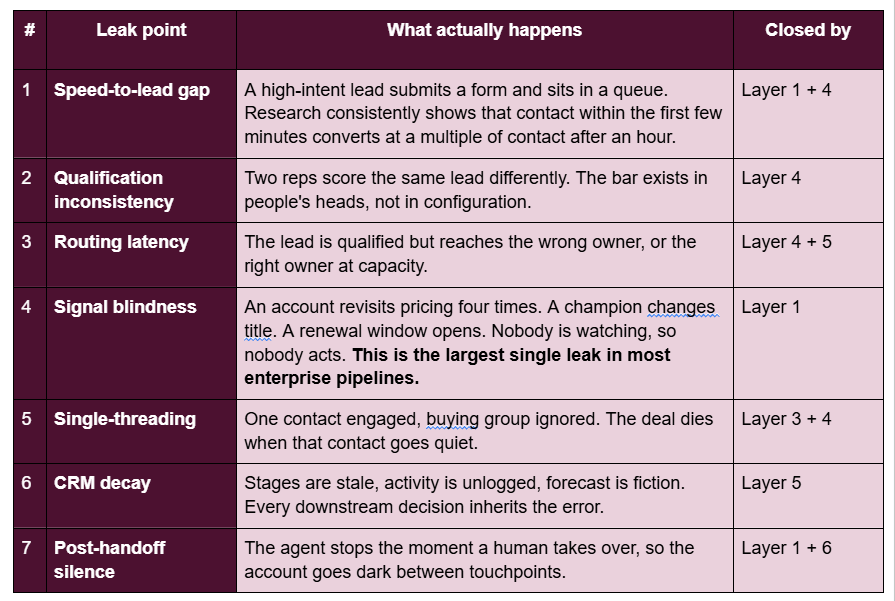
Notice that leaks 2 through 7 are consistency and attention problems, not volume problems. Adding SDR headcount addresses leak 1 and marginally improves leak 4. It does nothing for the rest — and it introduces more variance into leak 2.
This is the honest case for an AI sales agent for lead generation. Not that it generates more leads. That it holds attention and consistency across a surface area no human team can cover.
The Six-Layer Sales Agent Stack
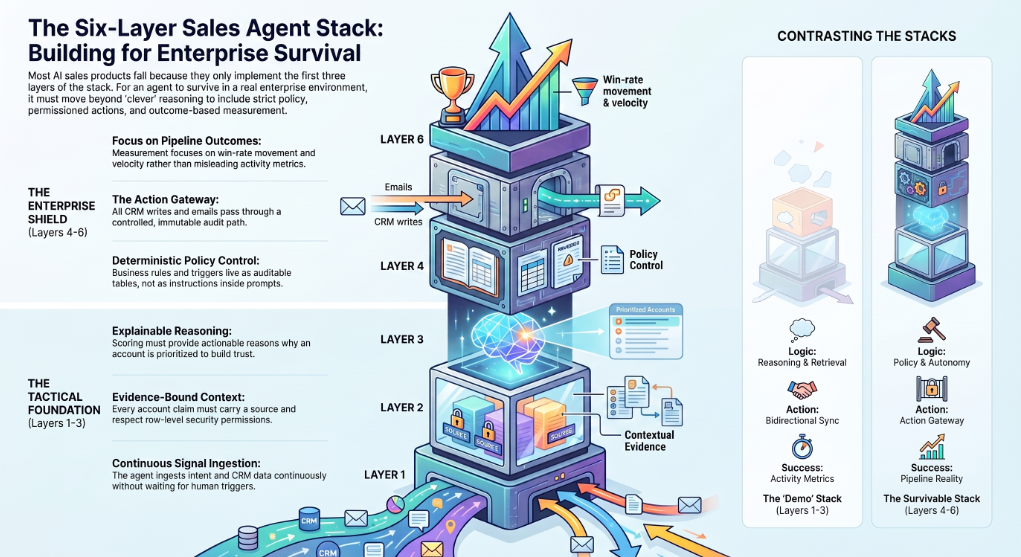
Every AI sales agent that survives contact with a real enterprise has six layers. Most products in this market have three.
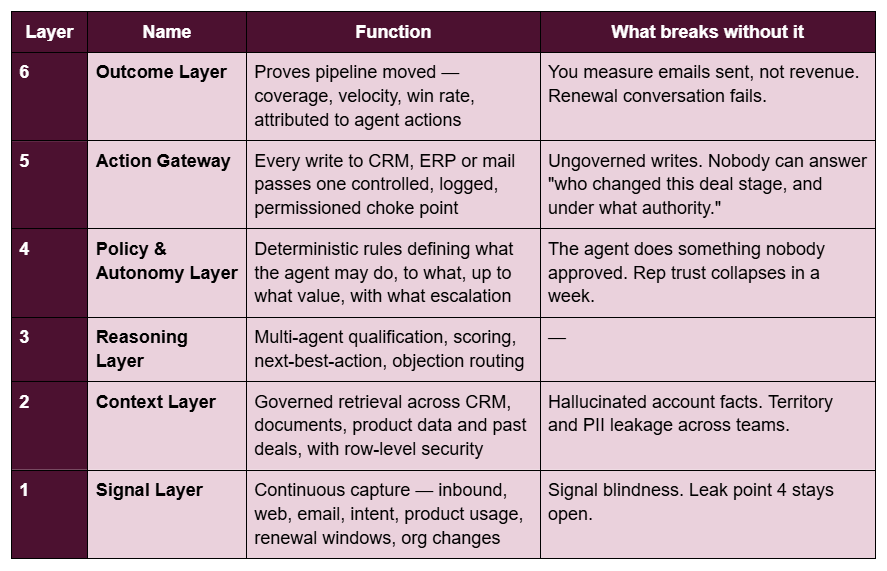
Layer 1 — Signal
The agent must ingest continuously, not on a schedule and not on request. Inbound form submissions, CRM activity, email engagement, web behaviour, third-party intent data, product usage, renewal calendars, and org-change signals. The design principle: the agent does not wait for signals to be routed to it. If a human has to notice something before the agent sees it, you have built a faster assistant, not an agent.
Layer 2 — Context
This is where most deployments quietly fail, because it looks solved. Retrieval-augmented generation over a document store is not enterprise context. Enterprise context means the agent can answer where did this fact come from and was this actor permitted to see it.
Two controls are non-negotiable. Row-level security, so a rep's agent cannot read accounts outside their territory and a regional team's agent cannot surface another region's pricing. And evidence binding, so every account claim the agent makes carries a source. An agent that asserts a renewal date it inferred is worse than an agent that says it does not know.
Layer 3 — Reasoning
Qualification against ICP criteria, lead and account scoring, next-best-action selection, objection classification, and buying-group mapping. In practice this is rarely one model — it is a set of coordinated agents with different jobs, because a model tuned for extraction is not the model you want deciding escalation.
The requirement that matters commercially: scoring must be explainable. "This account scores 87 because firmographic fit is strong, three separate contacts have visited pricing this month, and the technical evaluator opened the security documentation twice" is actionable. "Score: 87" is a number a rep will ignore by the second week.
Layer 4 — Policy and Autonomy
Here is where a governed agent diverges permanently from a clever one.
Qualification thresholds, routing logic, send ceilings, value limits, escalation triggers and approval requirements should live as deterministic business policy — configurable rules and decision tables — not as instructions inside a prompt. There are three reasons, and all three are operational rather than philosophical.
First, policy expressed as rules is auditable: you can show a regulator, a CRO or a security reviewer exactly what the agent was permitted to do on a given date. Second, it is changeable by the business: a sales operations lead can raise an approval threshold without a prompt-engineering cycle. Third, it is deterministic: the same input produces the same authority decision every time, which is the property that makes rep trust possible.
Prompts are for reasoning. Rules are for authority. Systems that conflate the two are the ones that produce the quiet failures described earlier.
Layer 5 — Action Gateway
Every write the agent performs — CRM stage change, contact enrichment, activity log, email send, task creation, order creation — should pass through a single controlled path that checks permission, applies the policy from Layer 4, executes, and records an immutable audit entry.
"Bidirectional CRM sync" is the phrase every vendor uses. It is not the same claim. Bidirectional sync says the agent can write. An Action Gateway says the agent can write only what it was authorised to write, and you can prove it afterwards.
Layer 6 — Outcome
The agent must be measured against pipeline reality, not activity. Account coverage ratio, lead response time, qualification precision measured at opportunity conversion, pipeline velocity by stage, and win-rate movement over rolling 90-day windows. Activity metrics — emails sent, contacts touched, sequences run — are diagnostic at best and actively misleading at worst, because they are exactly the metrics an ungoverned agent will optimise into a deliverability incident.
The rule worth remembering: most failed deployments have Layers 1, 2 and 3 and nothing above them. The layers that make an agent survivable are 4, 5 and 6 — and they are the ones vendors skip in demos, because policy configuration and audit logs do not demo well.
The Revenue Autonomy Ladder
The most common question from revenue leaders evaluating this category is some version of: how much should we let it do on its own?
The category answers this badly, because it treats autonomy as a switch. It is not a switch. Effective autonomy is a contract across multiple dimensions — the agent, the work type, the business scope, the specific capability, the object affected, the monetary limit, the time window, the risk class, the evidence required and the confidence threshold.
Practically, that resolves into six operating modes. Agents should climb this ladder by earning each rung, not by being configured at the top on day one.
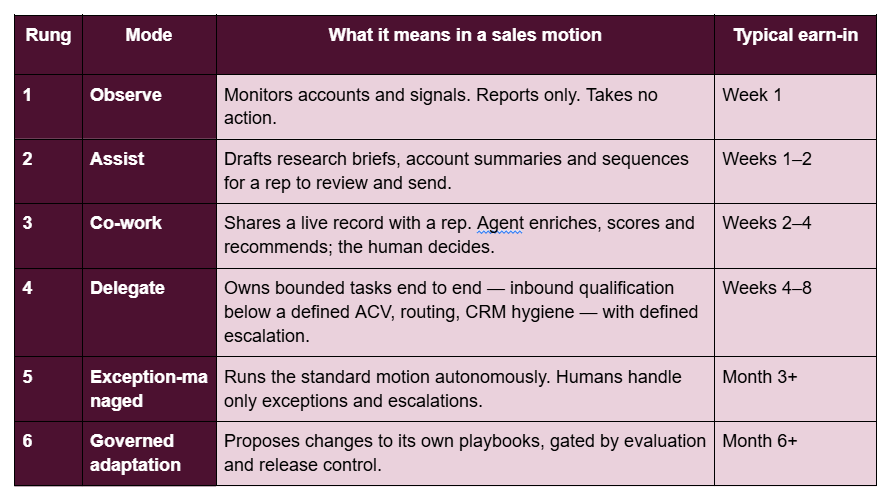
Two things to note. Rung 4 is where most of the value is, and most teams never get there because they attempted rung 5 in week one and lost organisational trust. And rung 6 should never be reached without release discipline — an agent that changes its own behaviour without an evaluation gate is not autonomous, it is unsupervised.
What an autonomy contract actually looks like
This is the artefact that turns the ladder from a diagram into an operating control. It should be readable by a sales operations lead, reviewable by security, and versioned like code.
agent: inbound-qualification-agent
work_type: standard_inbound_lead
scope:
segment: mid_market
regions: [IN, AE, UK]
acv_band: 0-75000
permissions:
enrich_lead_record: true
score_and_route: true
send_templated_first_touch: true
update_crm_stage: true
send_custom_pricing: false
offer_discount: false
book_meeting_with_exec_sponsor: false
limits:
touches_per_contact_per_week: 3
contacts_per_account: 4 # buying-group aware, not single-threaded
daily_send_ceiling_per_inbox: 40 # sender-reputation guardrail
autonomous_acv_ceiling: 75000
escalate_when:
- acv_estimate_above_ceiling
- competitor_named_in_reply
- negative_sentiment_detected
- procurement_or_legal_involved
- pricing_or_contract_question
- confidence_below_0_80
evidence_required:
- source_for_every_claimed_account_fact
review:
owner: revenue_operations
valid_until: 2026-12-31
kill_switch: enabled
Read that file and you can answer, in thirty seconds, every question a security reviewer or a CRO will ask. That is the point. If your vendor cannot produce an equivalent artefact for their agent, the authority model does not exist — it is distributed across prompts and defaults, which means nobody can state it and nobody can audit it.
Note the three lines that specifically address the failure modes in the previous section: contacts_per_account closes buying-group blindness, daily_send_ceiling_per_inbox closes reputation damage, and autonomous_acv_ceiling closes the risk-control gap Gartner names first.
The Agent-Washing Test
Gartner's estimate that only around 130 of thousands of self-described agentic vendors are genuine creates an obvious buyer problem: the marketing is indistinguishable. These ten questions are not.
They are deliberately vendor-neutral. Ask them of everyone, including us.
- Show me the audit log for a single CRM write your agent made last week — who authorised it, under which policy, at what time?
- Where does prospect PII physically reside, and can it stay inside our VPC or on our own infrastructure?
- What can the agent do without a human, and what is the configured monetary and risk ceiling on that authority?
- Show me the escalation path when a reply contains an objection the agent was not built to handle.
- When the lead score says 87, show me the reasons — not the number.
- How many contacts per account will it touch, and how does it avoid single-threading a buying group?
- What is the per-inbox daily send ceiling, and what component enforces it?
- If we switch model providers next quarter, what breaks?
- Show me the metric that proves pipeline moved — not activity volume.
- What happens in the first 60 seconds after we hit the kill switch, and when did you last test it?
A genuine agentic platform answers all ten with a demonstration. A repackaged sequencer answers questions 5 and 8 with a roadmap and the rest with a change of subject.
What governed deployments look like in production
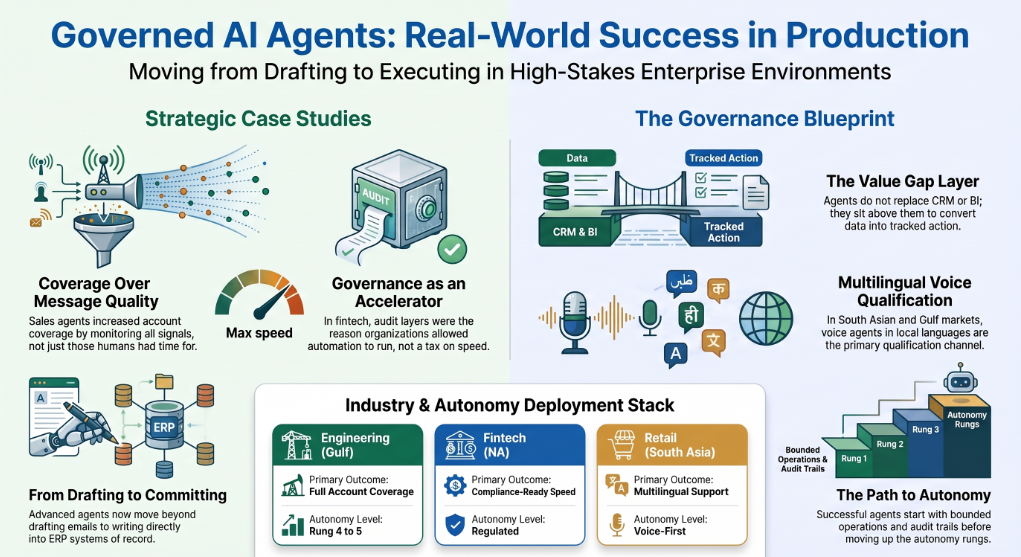
Frameworks are cheap. What follows are five production environments where governed agentic systems are running today. Client identities are withheld; each is described by industry, region band and scale band only, and outcomes are stated directionally rather than as headline percentages.
1. Agentic sales agent across enterprise accounts
Environment: A Gulf-region multi-division engineering and technology solutions provider, selling into enterprise and infrastructure accounts across several business lines.
Deployed: Always-on account monitoring with continuous signal capture · rule-governed opportunity identification and follow-up orchestration · CRM-integration-ready workflows with pipeline hygiene · sales dashboards and leadership alerts.
Outcome: Higher account coverage without increasing headcount. Faster response cycles on opportunities and renewals. More consistent execution across the sales organisation through governed playbooks — the variance between how different teams handled the same signal narrowed materially.
Stack layers: 1, 4, 5, 6. Autonomy rung: started at 4, moved to 5 on standard motions.
This is the closest analogue to the canonical "AI sales agent for lead generation" use case, and it is worth noting what drove the result. It was not better message generation. It was coverage — the organisation went from watching the accounts a human had time to watch, to watching all of them.
2. Omnichannel qualification in a regulated environment
Environment: A North America–focused cloud fintech serving banks and credit unions.
Deployed: Omnichannel intake across chat, email and phone with workflow routing · agent-assist summarisation and next-best-action recommendations · auditability, reporting and SLA monitoring · integration-ready connection to core systems.
Outcome: Faster case handling with improved consistency. Reduced operational load through automation. Improved compliance readiness through complete audit trails.
This deployment is the clearest proof that governance and speed are not opposed. The audit layer was not a tax on the automation — it was the reason the organisation was willing to let the automation run.
3. Agent-created sales orders under governance
Environment: A Gulf-region premium consumer-durables retail and distribution business.
Deployed: Agentic automation that interprets order triggers, validates them and creates ERP sales orders · rules and governance for exceptions and approvals · audit logs and reconciliation reporting · a replacement path for a legacy end-of-life document workflow system carrying high licensing cost.
Outcome: Reduced manual order processing and legacy dependency. Faster order-to-confirm cycle with fewer data-entry errors. Improved auditability for order creation and exceptions.
This one matters disproportionately to the argument in this article, because it is a concrete instance of Layer 5. An agent writing into a system of record — the most consequential action in the entire lead-to-cash chain — under explicit rules, with reconciliation reporting attached. Most of this category demonstrates agents that draft. This is an agent that commits.
4. Signals to governed action, on top of existing dashboards
Environment: A privately held multi-format retail holding group.
Deployed: Unified context engine across structured and unstructured data · semantic governance layer defining rules, hierarchies and formulas · active orchestrator integrating with core systems · insights-to-action agents layered on top of existing dashboards.
Outcome: A shift from reactive reporting to proactive execution loops. Standardised decision logic across teams. Automated task creation and completion tracking.
Worth highlighting for a specific objection: we already have BI, we already have a CRM. This deployment did not replace either. The agents sat above the existing dashboard estate and converted insight into governed, tracked action — which is where the value gap actually was.
5. Multilingual voice as a qualification channel
Environment: A national value-retail chain in South Asia operating across a large multi-city footprint.
Deployed: Voice agent built on a speech-to-text, LLM and text-to-speech pipeline operating in two languages · knowledge agent over operational documentation · admin console, analytics and ticketing integration.
Outcome: Reduced manual support burden. Faster issue resolution. Faster onboarding through on-demand guidance.
Included here because voice is the fastest-growing qualification channel outside North America and it is where most of this category has no answer. In India, the Gulf and much of Southeast Asia, the first qualifying conversation is a phone call in a language that is not English — and an agent that cannot hold that conversation is not a lead generation agent in those markets.
The pattern across all five: in every case the agent was given a bounded operation, a policy layer and an audit trail before it was given autonomy. None of these started at rung 5.
AI sales agent vs human SDR: the honest task split
The replacement framing is wrong, and it is wrong in a specific and useful way.
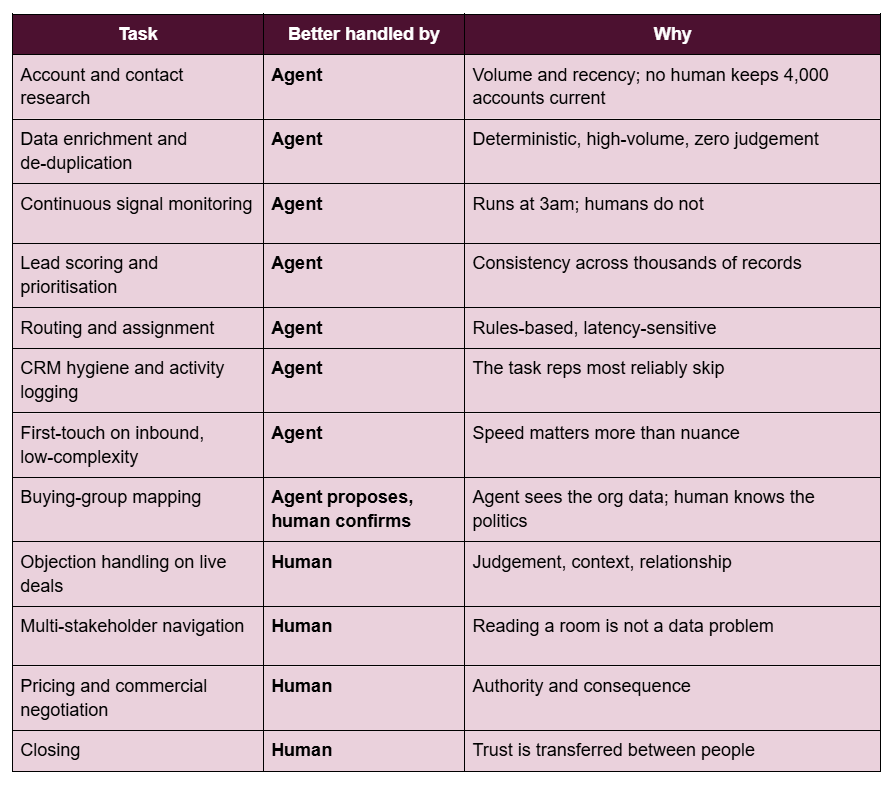
The correct framing is reallocation, not replacement. Agents absorb the volume, consistency and attention layer. Humans keep the judgement, relationship and commitment layer.
There is a harder truth underneath. The value of a strong SDR was never grinding a contact list — it was knowing when a message is wrong, when a sequence should be paused, when a reply needs a real person. Agents make that judgement more leveraged, not less necessary. Deployments that removed the judgement layer entirely are heavily represented in the churn statistics from earlier in this article.
Deploying a Revenue Workcell: the 30/60/90
You are not buying an agent. You are buying the reliable performance of a revenue operation.
We call that unit a Revenue Workcell: a governed human–agent team configured to own a defined revenue operation and its outcomes. A Workcell packages the business objective and scope, work intake and prioritisation, playbooks, digital roles and human roles, context bindings, capabilities and integrations, autonomy policy, dashboards, and an outcome contract.
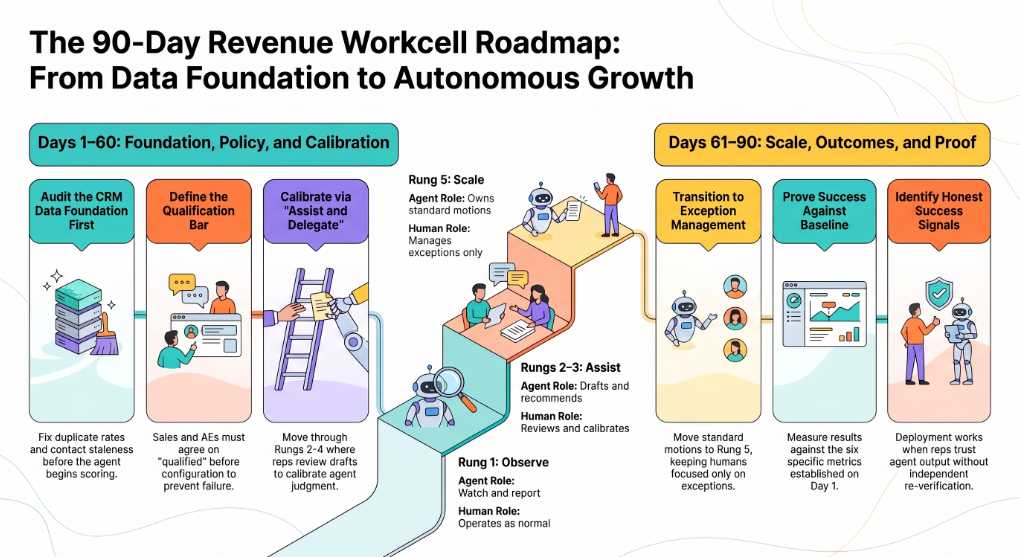
This reframing matters commercially. "Deploy an AI SDR" has no defined success condition, which is precisely why so many pilots end without anyone being able to say whether they worked. "Stand up an inbound qualification Workcell for mid-market, owning speed-to-lead and qualification precision, at autonomy rung 4 by day 60" has an unambiguous one.
Days 1–30 — Foundation and Observe
- Audit the CRM before anything else. Duplicate rate, contact staleness, field completeness on the fields the agent will score on. This is not preparation for the project; on a bad data foundation, it is the project.
- Write down the qualification bar. Sales development and account executives agree what qualified means, in configuration, before the agent runs. Skipping this is the single most reliable predictor of failure.
- Connect signal sources — inbound forms, CRM activity, email engagement, web behaviour, intent providers, renewal calendar.
- Bind governed context with row-level security applied by territory and team.
- Run the agent at rung 1 (Observe). It watches and reports. It touches nothing.
- Baseline six metrics you will be judged on in 90 days.
Days 31–60 — Policy, Assist and Delegate
- Author the autonomy contract. Permissions, limits, escalation triggers, evidence requirements, review owner, expiry, kill switch.
- Configure the policy layer as deterministic rules — thresholds, routing, ceilings, approvals.
- Stand up the Action Gateway so every write is permissioned and logged.
- Move to rung 2, then 3. The agent drafts and recommends. Reps review. You are calibrating scoring explanations against rep judgement, and the calibration is the deliverable.
- Run a governed shadow period on live inbound: the agent qualifies in parallel, nobody acts on it, you measure agreement.
- Then move to rung 4 on a bounded slice — one segment, one ACV band, one region.
- Test the kill switch. Actually test it.
Days 61–90 — Exception management and outcome proof
- Widen scope by segment or region, one dimension at a time.
- Move standard motions to rung 5, humans on exceptions only.
- Turn on outcome measurement against the day-1 baseline.
- Review the autonomy contract with the data you now have and adjust ceilings deliberately.
- Decide expansion — a second Workcell, or depth in the first.
The honest signals that a deployment is working at day 90: reps act on agent output without independently re-verifying it; CRM data quality has visibly improved rather than degraded; and leadership has pipeline visibility without requesting a report. If none of those are true, the problem is almost always in the data foundation or the policy configuration — not the model.
What it costs, and how to model ROI honestly
Published pricing in this category spans three orders of magnitude, which tells you the category label is doing very little work. The useful breakdown is by pricing model, because that determines your exposure.
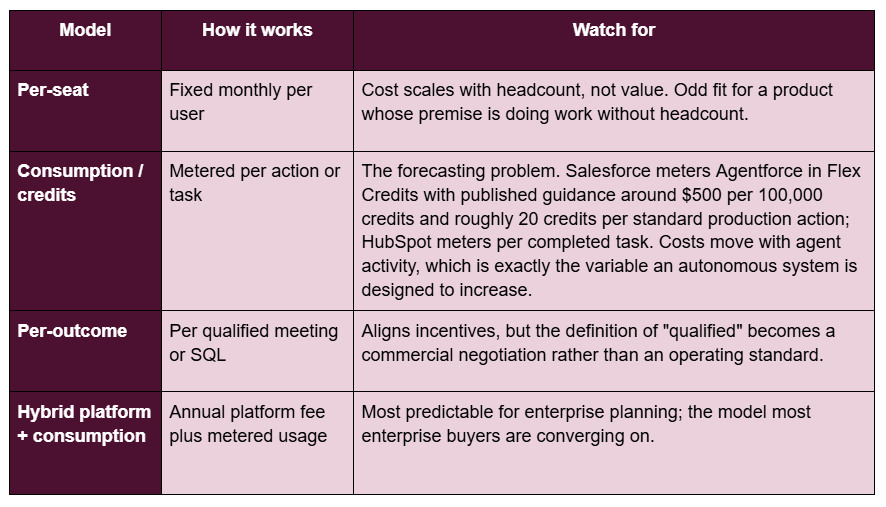
The line items that get missed
Platform fee is rarely more than half of total cost of ownership. Budget for: data enrichment and verification credits · integration build and ongoing maintenance · CRM data remediation before go-live · model inference costs if consumption-metered · governance and policy configuration · deliverability infrastructure · and the internal revenue-operations time to own the autonomy contract. That last one is a real role, not a rounding error.
The six metrics that matter
Measure these, and nothing else, from day one:
- Lead response time — baseline it, then track weekly
- Qualification precision — of agent-qualified leads, what share reached opportunity? Compare to your historical manual rate
- Pipeline velocity — days in stage, before and after
- Account coverage ratio — accounts actively monitored ÷ total accounts in CRM. This is usually where the largest movement occurs, and it is the metric almost nobody baselines
- Win-rate movement — rolling 90-day windows, to absorb deal-cycle variance
- CRM data quality — completeness and staleness on scored fields, before and after
Deliberately excluded: emails sent, contacts touched, sequences run, meetings booked before qualification is verified. Those are the metrics an ungoverned agent will optimise directly into a deliverability incident.
A useful rule of thumb: if there is no measurable movement in coverage ratio or qualification precision within 90 days of production, the cause is almost certainly the data foundation or the policy configuration. It is very rarely the model.
Compliance, data residency and deployment models
This section is short because the category ignores it entirely, and it is the first gate for a large share of enterprise buyers.
Where does prospect data live? An AI sales agent for lead generation processes personal data by definition — names, roles, contact details, behavioural signals, recorded conversations. For sellers in regulated sectors, and for buyers bound by EU, UK or Indian data-protection regimes, a US-hosted multi-tenant SaaS deployment is frequently not an option regardless of feature quality. The question of whether the platform can run inside your own VPC, private cloud or on-premise environment is not an advanced requirement. It is often the qualifying one.
Who can the agent read? Row-level security applied to the context layer, so agents inherit the same data boundaries as the humans they work alongside. Territory isolation is a data control, not a UI preference.
What can the agent prove? An immutable audit record of every action — what was done, to which object, under which policy, on whose authority. This is what converts "the agent did something unexpected" from an incident into a five-minute investigation.
Consent, sending rules and regional variation. Automated outreach is subject to the same consent, suppression, quiet-hours and regional sending requirements as human outreach. Deploying an agent does not transfer that obligation to the vendor. Configure suppression and quiet-hours enforcement in the policy layer, keep the consent record queryable, and take qualified legal advice for your jurisdictions — this article is not it.
Model neutrality. Regulatory posture, pricing and capability across model providers are all moving. An architecture that routes across multiple providers, rather than binding to one, is the difference between a procurement conversation and a re-platforming project.
Why Assistents by Ampcome
Most AI sales agents fail at Layers 4, 5 and 6 — policy, controlled action, and outcome. assistents.ai, built by Ampcome, was designed starting from those layers. It is a System of Agency: a governed platform for orchestrating and running AI agents on infrastructure you control, with an audit record attached to what they do.
Governed context, not raw retrieval. Natural-language analytics and text-to-SQL over governed data, with semantic metrics and row-level security, so an agent's account facts are sourced and territory-scoped rather than inferred. Hybrid retrieval with evidence-backed responses across ingested documents means the agent can show where a claim came from.
Deterministic policy, not prompt-hope. Rules and decision tables run alongside the agents, so qualification thresholds, routing logic, approval requirements and action limits are configurable business policy that a revenue operations lead can change and a reviewer can audit — not model behaviour hidden inside a prompt.
Human-in-the-loop as a first-class primitive. A workflow engine with human tasks and approvals, so escalation is a designed state in the process rather than an exception handler bolted on afterwards.
Deploy where your data lives. Private cloud, VPC and on-premises deployment. For regulated sellers and data-residency-bound regions, this is the gate that most of this category cannot pass.
Model and system neutral. Model routing across multiple providers, warehouse and BI connectivity, more than 80 workflow integrations and generic REST connectivity. No binding to a single model vendor or a single CRM.
Built for more than chat. Agent building and multi-agent coordination, document ingestion with extraction, validation and review, and voice agents connected to live business data — which is what makes non-English, voice-first qualification viable in markets where that is the primary channel.
The experience behind it. Ampcome has production experience in voice-based field-sales assistance and receivables follow-up, agentic sales-agent deployments across enterprise accounts in the Gulf, and analytics-to-governed-action deployments across South Asia, the UK, ANZ and North America — spanning logistics, financial services, retail, energy, healthcare and professional services.
A note on candour, since this article has spent several thousand words arguing for it: the Enterprise Operating Graph, the formal Capability Registry and Action Gateway as productised primitives, the Digital Workforce system of record and the Operations Control Tower described in our platform thesis are directional — they are the architecture we are building toward, and where they appear in the frameworks above they describe the operating model we deploy, not a shipped SKU. The capabilities listed in this section are shipped today. We would rather you knew the difference before the demo than after the contract.
FAQs
What is an AI sales agent for lead generation?
An AI sales agent for lead generation is an autonomous system that executes multi-step revenue workflows — signal capture, enrichment, qualification, scoring, routing, outreach, CRM write-back and account monitoring — without a human instruction at each step. It acts between conversations, not only during them, and continues monitoring accounts after handoff to a rep.
How is an AI sales agent different from an AI SDR?
An AI SDR is a narrower category focused on outbound prospecting and first touch — sourcing, sequencing and initial qualification. An AI sales agent covers the full lead lifecycle including inbound qualification, routing, CRM hygiene and ongoing account monitoring, and typically writes into systems of record under governance. Most AI SDRs stop at the reply; agents do not.
How is an AI sales agent different from a chatbot?
A chatbot responds reactively within a single conversation on a single channel. An AI sales agent proactively monitors signals across all connected sources, executes multi-step workflows, updates the CRM, routes leads, alerts reps and escalates exceptions — operating continuously whether or not anyone is talking to it.
Do AI sales agents actually work?
Governed ones do. Ungoverned ones frequently do not: Gartner predicts over 40% of agentic AI projects will be cancelled by end of 2027, citing escalating costs, unclear business value and inadequate risk controls, and AI SDR tooling has been churning at 50–70% within the first year. The differentiator in production deployments is consistently the policy, action-control and outcome layers rather than model quality.
Why do AI SDR deployments fail?
Five recurring causes: sender-reputation collapse from uncapped volume, buying-group blindness from single-threading, dirty CRM data amplified at scale, no agreed qualification bar between SDR and AE before launch, and absent risk controls — no audit trail, no autonomy ceiling, no tested escalation path. None of these are model failures.
Can an AI sales agent replace human SDRs?
Not entirely, and the strongest deployments are not designed to. Agents absorb research, enrichment, scoring, routing, CRM hygiene and continuous monitoring. Humans retain objection handling, multi-stakeholder navigation, pricing and closing. Teams running this split consistently outperform teams running either approach alone.
How does an AI sales agent qualify and score leads?
It evaluates firmographic fit, behavioural signals and historical conversion patterns simultaneously and continuously, updating scores as new signals arrive rather than once at form submission. In production-grade systems the score is explainable — the agent surfaces the specific factors driving it, which is what makes reps willing to act on it.
How much does an AI sales agent cost?
Published pricing spans from roughly $200 per month for lightweight tools to six-figure annual enterprise deployments. Model matters more than headline price: per-seat, consumption or credit-metered, per-outcome, or hybrid platform-fee-plus-consumption. Consumption models are hardest to forecast because cost rises with the agent activity the system is designed to increase.
What ROI should I expect and how do I measure it?
Measure six metrics from day one: lead response time, qualification precision at opportunity conversion, pipeline velocity, account coverage ratio, win-rate movement over rolling 90-day windows, and CRM data quality. Account coverage typically moves most and is the metric teams most often fail to baseline. Ignore emails sent and sequences run.
How long does it take to deploy an AI sales agent?
A bounded, governed deployment reaches meaningful autonomy in about 90 days: roughly 30 days for CRM audit, signal connection and observe-only running; 30 days for policy configuration, autonomy contract authoring and delegated operation on a narrow slice; 30 days for widening scope and proving outcomes. Timelines beyond that usually indicate a customisation project rather than a platform deployment.
Which CRMs do AI sales agents integrate with?
Production-grade agents integrate bidirectionally with Salesforce, HubSpot, Microsoft Dynamics, Zoho and other major platforms, alongside warehouse, BI and workflow systems, with generic REST connectivity for everything else. The question that matters more than the logo list is whether writes pass through a permissioned, audited path.
Can an AI sales agent run on-premise or in our own VPC?
Some can; most cannot. Multi-tenant SaaS is the default in this category, which rules it out for many regulated sellers and for buyers bound by regional data-residency requirements. assistents.ai supports private cloud, VPC and on-premises deployment. Ask any vendor where prospect PII physically resides before evaluating features.
Is AI-driven outreach compliant with GDPR and regional data rules?
Automated outreach is subject to the same consent, suppression, quiet-hours and regional requirements as human outreach — deploying an agent does not transfer that obligation to the vendor. Configure suppression and quiet-hours enforcement in the policy layer and keep consent records queryable. Take qualified legal advice for your jurisdictions.
What is the best AI sales agent for B2B lead generation?
Judge on criteria rather than category rankings: explainable scoring, a configurable autonomy model with defined ceilings, a permissioned and audited action path, buying-group-aware contact limits, deployment options matching your data-residency requirements, model neutrality, and outcome metrics tied to pipeline rather than activity. Run the ten-question Agent-Washing Test above on every shortlisted vendor, including us.

Transform Your Business With Agentic Automation
Agentic automation is the rising star posied to overtake RPA and bring about a new wave of intelligent automation. Explore the core concepts of agentic automation, how it works, real-life examples and strategies for a successful implementation in this ebook.
Sarfraz Nawaz is the CEO and founder of Ampcome, which is at the forefront of Artificial Intelligence (AI) Development. Nawaz's passion for technology is matched by his commitment to creating solutions that drive real-world results. Under his leadership, Ampcome's team of talented engineers and developers craft innovative IT solutions that empower businesses to thrive in the ever-evolving technological landscape.Ampcome's success is a testament to Nawaz's dedication to excellence and his unwavering belief in the transformative power of technology.

More insights
Discover the latest trends, best practices, and expert opinions that can reshape your perspective



.jpg)

.jpg)

Contact us

