
Agentic AI for Network Engineers: 15 Real-World Use Cases (2026 Guide)


At 2 a.m., a monitoring dashboard lights up with three hundred alerts. Somewhere in that noise — spread across routers, firewalls, load balancers, and a dozen SaaS integrations — is one real problem. Everything else is a symptom. A senior engineer could probably find it in twenty minutes. The problem is there's only one senior engineer on call, and this happens four nights a week.
That's the exact gap agentic AI for network engineers is built to close. Not by replacing the engineer's judgment, but by doing the twenty minutes of correlation, log-reading, and hypothesis-testing before the engineer even opens a terminal — and, in more mature deployments, by taking the next safe step itself, inside guardrails a human defined in advance.
This guide is a practical, vendor-neutral walkthrough of what agentic AI actually does in network operations today: how it differs from the automation you already have, fifteen concrete use cases organized by category, a maturity model for rolling it out without breaking anything, and an honest look at where the risk actually sits.
One quick disambiguation before we start: this article is about IT and telecom network engineering — routers, switches, WANs, NOCs, SD-WAN, cloud networking. If you're looking for agentic AI applied to the electrical grid or utility infrastructure, that's a related but distinct field; see our companion piece on agentic AI for power grid optimization.
What Is Agentic AI for Network Engineers?
Agentic AI for network engineers refers to AI systems that can perceive the state of a network, reason about what's happening, decide on a next step, and take action — across multiple tools and multiple turns — with only as much human involvement as the organization chooses to require. It's the difference between a system that tells you CPU is high on a switch, and one that checks whether that's actually the cause of the outage, pulls the relevant change log, drafts a fix, and asks for approval before pushing it.
The important word is "agentic." A chatbot answers one question. A script executes one predefined action. An agentic system plans a sequence of steps, adapts that plan as it learns new information, and only stops when the goal is met or it hits a boundary it isn't allowed to cross.
Agentic AI vs. Scripts, AIOps, and Copilots
Network teams already have automation. It helps to be precise about what's actually new.
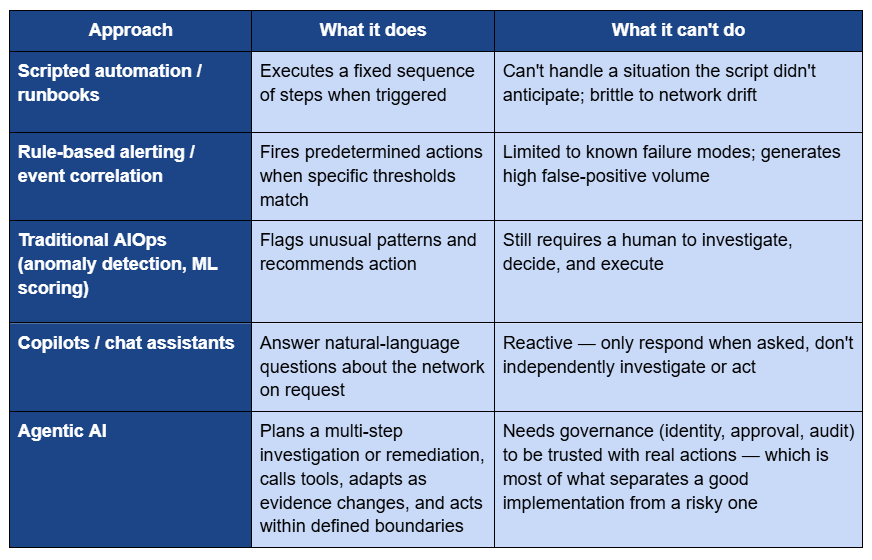
Agentic AI generally sits on top of the tools above rather than replacing them — it's the reasoning and orchestration layer that decides when to run a diagnostic, which runbook applies, and whether the fix is safe to apply automatically.
Why Agentic AI Is Showing Up in NOCs Now
Three things converged at the same time:
- Network complexity outgrew human bandwidth. Multi-vendor hardware, hybrid cloud, SD-WAN overlays, and containerized workloads mean a single incident can span physical, data-link, network, transport, and application layers — a combinatorial troubleshooting problem that scales faster than headcount ever will.
- LLMs got good at tool use. The technical unlock is that large language models can now reliably call APIs, read structured and unstructured data (logs, tickets, PCAPs, vendor documentation), and reason step-by-step about what to try next — instead of just summarizing text.
- Tribal knowledge is walking out the door. Root-cause expertise is concentrated in a handful of senior engineers. Agentic systems that can be taught an organization's runbooks, standards, and past incident history are one of the few scalable ways to preserve and distribute that expertise.
Industry commentary from Cisco, telecom AIOps vendors, and enterprise IT leaders converges on the same list of early wins: faster mean time to resolution (MTTR), fewer manual ticket-handling hours, and — most importantly for adoption — a system engineers actually trust because it shows its evidence rather than just handing down a verdict.
How Agentic AI Actually Works in Network Operations
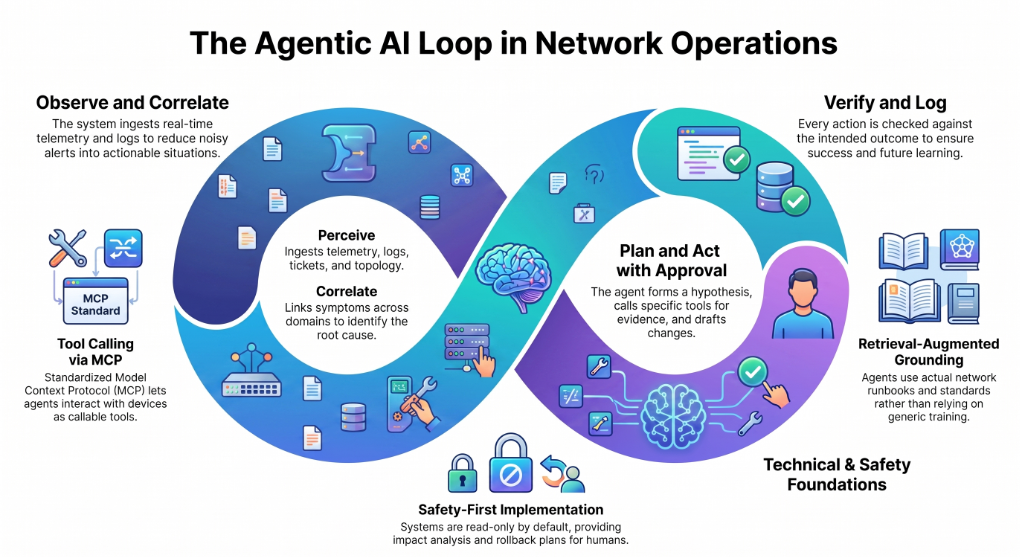
Most production-grade agentic network systems follow a version of the same loop:
Perceive → Correlate → Plan → Act (with approval) → Verify
- Perceive — the system ingests telemetry, logs, tickets, topology, and change history in real time.
- Correlate — it links symptoms across domains (is this a network problem, an app problem, or both?) and reduces noisy alerts down to a smaller number of real situations.
- Plan — it forms a hypothesis, decides what evidence would confirm or rule it out, and calls the right tools (a topology query, a config diff, a historical-ticket search) to get that evidence.
- Act, with approval where required — depending on the risk level, it either executes directly, drafts a change for a human to approve, or simply hands the engineer a structured summary.
- Verify — after any action, it checks whether the intended outcome actually happened, and logs the result for future learning.
Two technical patterns make this loop work in practice. The first is tool calling, often standardized today through the Model Context Protocol (MCP) — a way of exposing network devices, ticketing systems, and telemetry platforms to an AI agent as callable tools rather than as documents the model has to guess about. The second is retrieval-augmented context: the agent is grounded in your actual runbooks, network standards, and topology — not generic training data — so its recommendations reflect how your network is actually built.
The safest implementations are read-only by default. Proposed changes come back as a draft with a diff, an impact analysis, and a rollback plan — a human approves, the system executes, and it verifies the change actually did what was intended.
15 Real-World Agentic AI Use Cases for Network Engineers
Monitoring & Detection
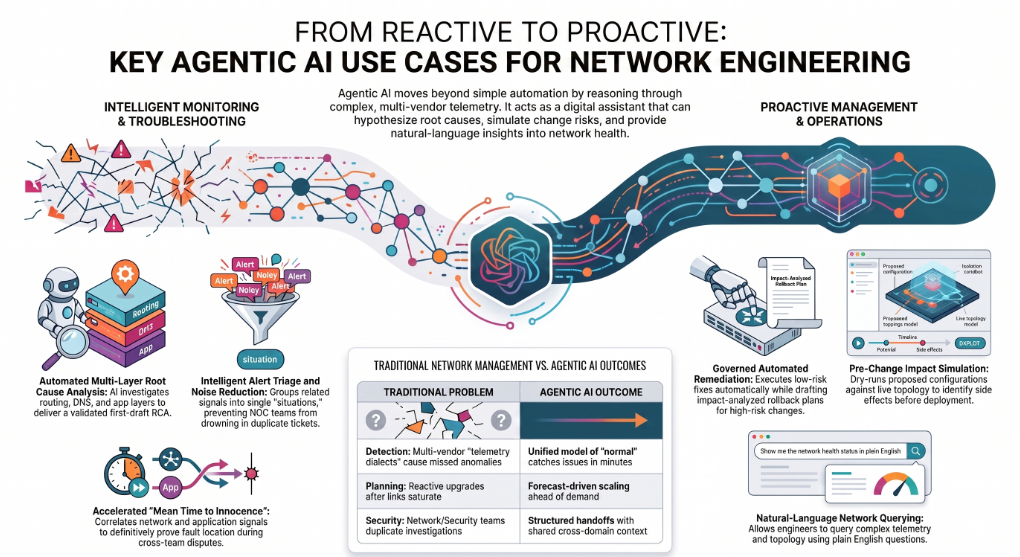
1. Continuous, cross-vendor anomaly detection Problem: Multi-vendor networks each speak a different telemetry dialect, so anomalies get missed at the seams. What agentic AI does: Ingests metrics, syslogs, and flow data across vendors into one model of "normal," and flags deviations — a change-point in latency, a traffic pattern shift, a slow memory leak — before they become outages. What good looks like: Issues get caught in the minutes-to-hours range instead of surfacing as a customer-facing incident.
2. Automated alert triage and noise reduction Problem: NOCs drown in alert volume, and most of it is duplicate or low-value noise. What agentic AI does: Groups related alerts into a single "situation," suppresses known-noisy signals, and assigns a severity and confidence score before a human ever sees it. What good looks like: Engineers work a shortlist of real situations instead of a firehose of tickets.
3. Proactive risk detection before an outage Problem: By the time a threshold breach fires, the problem is often already customer-facing. What agentic AI does: Watches trend lines and forecast deviations (not just static thresholds) to flag a device or link trending toward failure, and opens a proactive investigation. What good looks like: A meaningful share of incidents get addressed as scheduled maintenance instead of emergency response.
Troubleshooting & Root Cause Analysis
4. Multi-step root cause analysis across layers Problem: A single outage can implicate the physical layer, routing, DNS, or the application — and finding out which one takes real investigative work. What agentic AI does: Forms a hypothesis, pulls evidence (interface counters, BGP state, recent changes, related tickets), rules hypotheses in or out, and iterates until it lands on a well-supported root cause with the evidence attached. What good looks like: Investigations that used to take a senior engineer 30–60 minutes are reduced to a first-draft RCA in minutes, for the engineer to validate rather than build from scratch.
5. Auto-generated incident timelines and summaries Problem: Post-incident write-ups are valuable but time-consuming, so they often don't get written well — or at all. What agentic AI does: Assembles a structured, evidence-based summary of what happened, what was checked, what was ruled out, and what action was taken — without inventing new conclusions the evidence doesn't support. What good looks like: Every incident produces a consistent, audit-ready record regardless of which engineer was on call.
6. "Mean time to innocence" for cross-team escalations Problem: When an app team blames the network (or vice versa), proving where the fault actually sits eats hours. What agentic AI does: Correlates network telemetry with application and infrastructure signals to show definitively whether the network was, or wasn't, the cause — with evidence, not opinion. What good looks like: Faster, less political cross-team escalations.
Change & Configuration Management
7. Configuration drift detection and compliance auditing Problem: Manual changes accumulate, and configurations drift from the intended baseline in ways that are hard to track across hundreds of devices. What agentic AI does: Continuously compares live configuration against policy and golden baselines, flags drift, and explains the operational or security risk of each deviation. What good looks like: Drift is caught during routine scans, not during the next outage or audit.
8. Governed automated remediation Problem: Auto-remediation sounds great until an autonomous system pushes a bad change to production. What agentic AI does: For low-risk, well-understood issues (a known misconfiguration, a stuck service, a routine reboot) it can execute a pre-approved remediation automatically. For anything higher-risk, it drafts the fix — with a diff, an impact analysis, and a rollback plan — and waits for a human to approve. What good looks like: Routine fixes stop consuming engineer time; risky changes still get a human's eyes, but with the analysis already done.
9. Pre-change impact simulation Problem: Change windows are stressful because the blast radius of a config push isn't always obvious until it's live. What agentic AI does: Simulates or dry-runs a proposed change against current topology and traffic patterns to flag likely side effects before the change window opens. What good looks like: Fewer change-related incidents, and faster, more confident change approvals.
Capacity & Performance
10. Capacity planning and forecast-driven scaling Problem: Capacity decisions are often reactive — you upgrade a link after it's already saturated during peak hours. What agentic AI does: Forecasts utilization trends per link, device, or region and recommends upgrades or rebalancing ahead of the constraint, factoring in seasonality and planned traffic growth. What good looks like: Capacity spend gets ahead of demand instead of chasing it.
11. SLA and carrier circuit performance monitoring Problem: Tracking whether every carrier and circuit is actually meeting contracted SLAs across a large footprint is tedious and easy to under-invest in. What agentic AI does: Continuously monitors circuit performance against SLA terms, flags breaches with evidence, and can draft the documentation needed for a carrier dispute or credit claim. What good looks like: SLA violations get caught and acted on, not lost in a spreadsheet nobody updates.
Knowledge & Operations Support
12. Natural-language querying of network state Problem: Getting an answer like "which sites are affected by the outage in Region A" often means jumping across three dashboards and a topology tool. What agentic AI does: Lets an engineer ask in plain language and get a synthesized, evidence-backed answer pulled from live telemetry and topology — including for junior engineers who don't yet know every tool's syntax. What good looks like: Faster on-call ramp-up and fewer "who do I ask" delays during an incident.
13. Runbook and network-standards knowledge assistant Problem: Institutional knowledge about why the network is built the way it is often lives in a few people's heads, not in a wiki anyone can search well. What agentic AI does: Uses retrieval over runbooks, design standards, and past incident history so the agent — and the engineers it supports — can answer "how have we handled this before?" accurately, with sources. What good looks like: New team members and after-hours on-call engineers operate closer to senior-engineer proficiency, faster.
Security & Cross-Domain
14. Anomalous traffic detection and SecOps handoff Problem: Network anomalies and security incidents often look identical at first — is that traffic spike a misconfiguration or an attacker? What agentic AI does: Flags anomalous traffic patterns, gathers the relevant context (source, destination, historical baseline, related identity signals), and routes a structured handoff to the security team rather than a raw alert. What good looks like: Faster, better-informed triage between NetOps and SecOps instead of duplicated investigation.
15. Full-stack correlation across network, app, and cloud Problem: Modern outages rarely respect team boundaries — a "network" incident might actually be a cloud provider issue or a misbehaving microservice. What agentic AI does: Correlates signals across network telemetry, application performance monitoring, and cloud infrastructure events into a single incident view, rather than three separate investigations run in parallel. What good looks like: One root cause, one timeline, one team no longer arguing about whose dashboard is right.
How This Looks Inside a Governed Platform
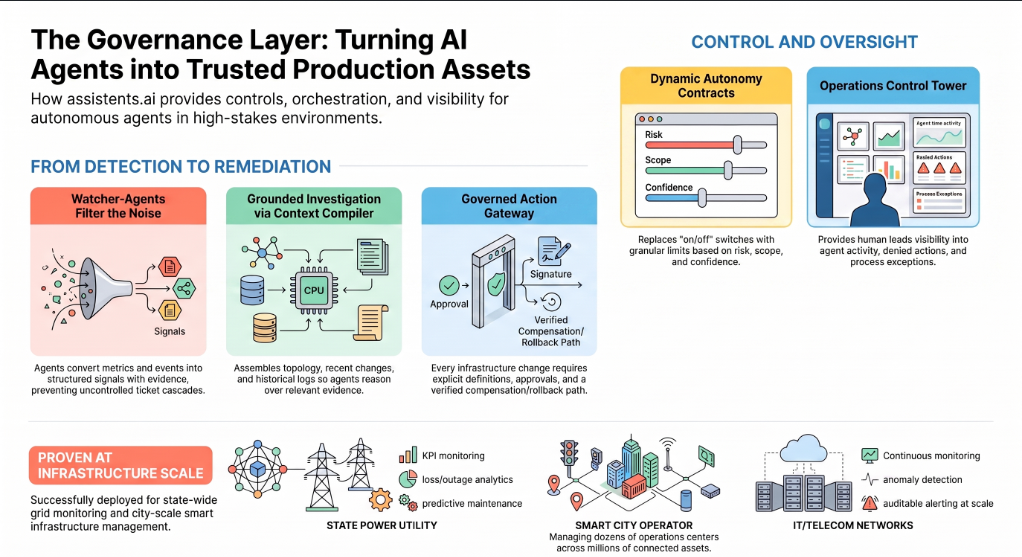
The fifteen use cases above are consistent in one respect: none of them work safely without governance. An agent that can "just fix it" is a liability the moment it's wrong about what "it" is. This is where a purpose-built agentic AI platform earns its place — as the layer that makes the difference between a promising demo and something a NOC actually trusts in production.
assistents.ai, built by Ampcome, is designed as a governed platform for exactly this kind of work — an operating layer for a hybrid workforce of humans and AI agents, rather than a single-purpose network tool. Mapped against the use cases above:
- Continuous monitoring and detection (use cases 1–3, 10–11) are handled by the platform's watcher-agent model: agents that observe metrics, events, and documents, then create structured signals — with evidence, confidence, severity, and the affected object attached — instead of opening an uncontrolled cascade of tickets for every blip.
- Investigation and RCA (use cases 4–6, 14–15) are handled through multi-agent orchestration grounded in a Context Compiler — the mechanism that assembles the right evidence (topology, recent changes, related tickets, historical incidents) for an agent to reason over, instead of dumping raw data and hoping the model figures it out.
- Change and remediation (use cases 7–9) run through a Capability Registry and Action Gateway: every capability an agent can invoke — "restart service," "push config," "create a ticket" — is explicitly defined with required approvals, financial or operational limits, dry-run behavior, and a compensation/rollback path. No agent holds a shared, ungoverned credential to your infrastructure. Every state-changing action is authenticated, policy-checked, executed with an idempotency key, verified against the real outcome, and logged as an auditable receipt.
- How much autonomy an agent has (across all fifteen) isn't a blanket on/off switch. It's expressed as an explicit autonomy contract — scoped by work type, business scope, affected objects, monetary/operational limits, time window, and required confidence — so a team can let an agent auto-remediate a known, low-risk issue while requiring human approval for anything touching production routing.
- Knowledge and on-call support (use cases 12–13) are grounded through the platform's enterprise knowledge layer — a semantic layer over documents, runbooks, and standards that agents (and the humans working alongside them) both draw from, so answers are sourced rather than guessed.
- Visibility for the NOC lead (all fifteen) comes from an Operations Control Tower view: which agents exist, what they're working on, which actions were denied or failed verification, and which processes keep generating repeat exceptions — the same questions a good NOC manager already asks about their human team, now answered for the AI workforce too.
- The platform is also built to be model-neutral and system-neutral, and to support both MCP (for agent-to-tool connections like device APIs and ticketing systems) and A2A (for agent-to-agent handoffs, such as the NetOps-to-SecOps handoff in use case 14) — without treating either protocol as a substitute for identity and policy controls.
It's worth being precise about where this evidence actually comes from: assistents.ai's production track record is in governed, multi-agent enterprise operations generally — including, notably, monitoring and alerting deployments for a state power transmission utility (transmission KPI monitoring, anomaly detection, loss/outage analytics, and predictive maintenance alerting across a state-wide grid) and a city-scale smart infrastructure operator running dozens of operations centers across millions of connected assets.
Those are utility/infrastructure networks, not IT/telecom networks — but the underlying problem is the same shape: continuous multi-source monitoring, anomaly detection, and governed, auditable alerting and action at scale. It's the same platform mechanics applied to a different wire.
The Agentic AI Maturity Curve for Network Teams
The biggest adoption mistake is treating autonomy as binary — either the AI just watches, or it "runs the network." In practice, mature organizations move through stages, and a good platform should let a team operate at whatever stage it's actually ready for:
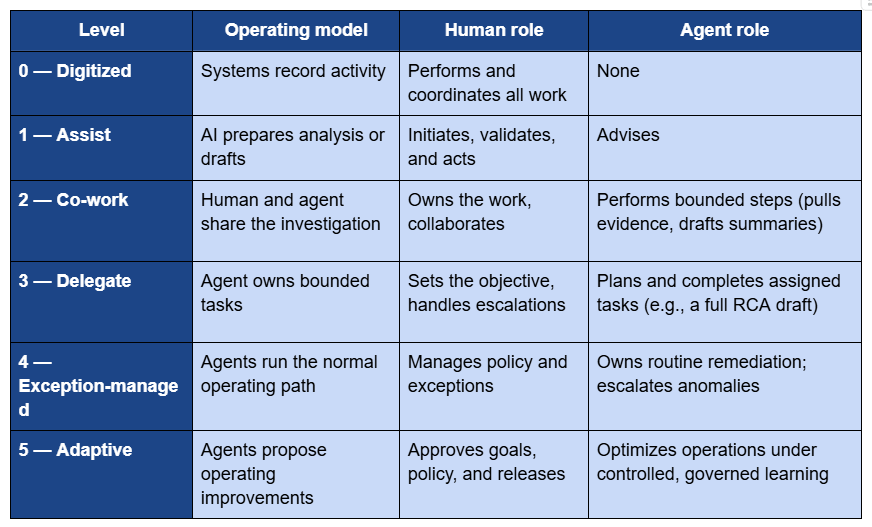
A sensible rollout sequence for any single use case looks like: offline evaluation → historical replay → simulation/shadow mode → recommendation-only → human-approved execution → limited autonomous canary → wider bounded operation → continuous monitoring with rollback. Most NOCs should expect to run different use cases at different maturity levels simultaneously — level 4 for "restart a known-flapping interface," level 1 for "reconfigure core routing," for a long time.
The Real Risks (and How Governed Platforms Handle Them)
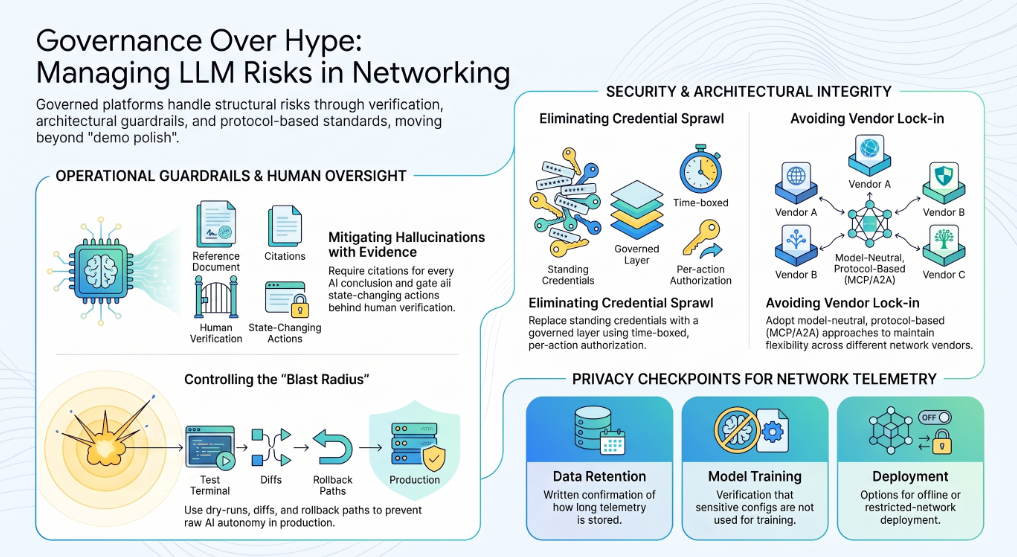
It's worth being direct about this, because vendor pages rarely are.
- Hallucination. An LLM can confidently propose a fix based on a misread log line. The mitigation isn't "trust the model less" — it's structural: require evidence citations for every conclusion, and gate any state-changing action behind verification.
- Blast radius. The scariest failure mode isn't a wrong diagnosis; it's a wrong action. This is exactly why dry-run, diffs, approval gates, and rollback paths matter more than raw autonomy for anything touching production configuration.
- Credential sprawl. Giving an agent direct, standing credentials to network devices recreates the exact security problem enterprises spent a decade trying to eliminate with shared admin accounts. Route everything through a governed action layer with per-action, time-boxed authorization instead.
- Vendor lock-in. Tooling built entirely around one network vendor's ecosystem is fast to start and expensive to leave. A model-neutral, protocol-based (MCP/A2A) approach avoids re-architecting every time you add a vendor.
- Data privacy. Network telemetry and configs are sensitive. Confirm — in writing, not just in a sales deck — how data is retained, whether it's used for model training, and what your offline or restricted-network deployment options are.
None of this means "don't do it." It means the adoption sequence above exists for a reason, and the platform decision should weight governance capability at least as heavily as demo polish.
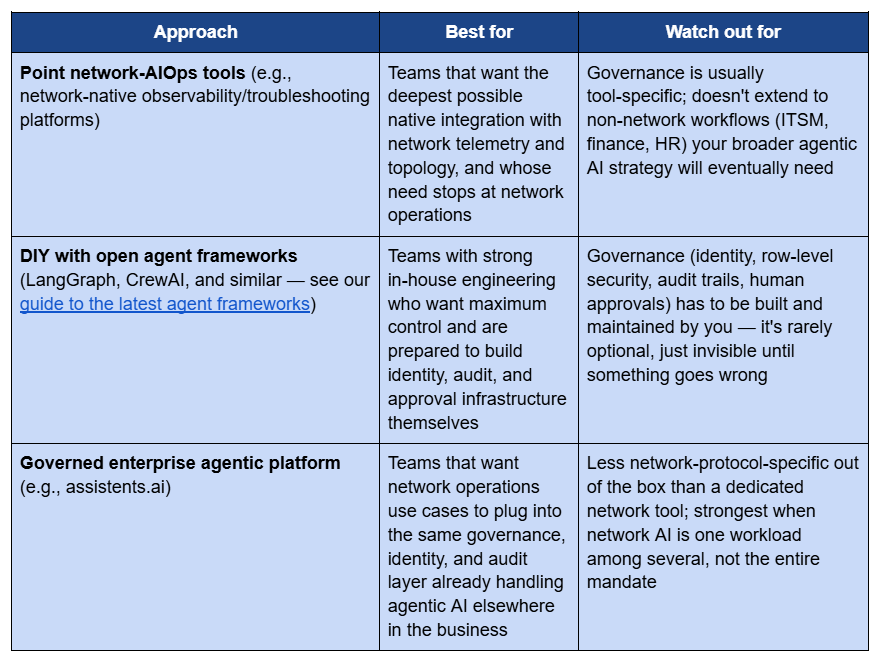
Build, Buy, or Platform? Comparing Your Options
Why Network Teams Are Choosing assistents.ai
If you're evaluating platforms rather than point tools, here's the honest checklist worth applying — and where assistents.ai fits on each:
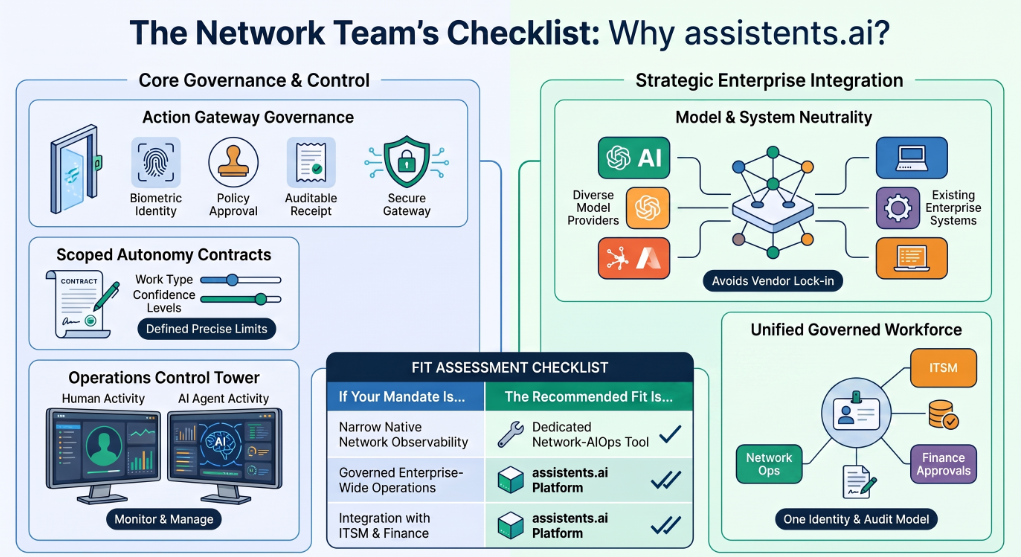
- Does every state-changing action go through a governed gateway — with identity, policy checks, approval, limits, and an auditable receipt — rather than a direct, standing credential? assistents.ai's Action Gateway is built specifically around this pattern.
- Can autonomy be scoped precisely — by work type, affected system, financial/operational limit, and required confidence — instead of a single "autonomous mode" toggle? This is a first-class object in the platform (an explicit autonomy contract per agent, per task type), not an afterthought.
- Is the platform model- and system-neutral? assistents.ai is designed to avoid locking a customer into one model provider or one set of enterprise systems, and to support both MCP (agent-to-tool) and A2A (agent-to-agent) so it can sit alongside your existing network tooling rather than replace it wholesale.
- Is there a single control tower view across every agent — human and AI — working a given operation, so a NOC lead can see what's running, what's stuck, and what's been denied? That's the explicit purpose of the platform's Operations Control Tower.
- Does the vendor have production experience with this class of problem — continuous monitoring, anomaly detection, and governed alerting at real operational scale — even if not under a network-engineering label specifically? Yes, via the utility and smart-infrastructure deployments referenced above.
The honest fit statement: assistents.ai is the strongest option for a network team that wants its agentic AI investment to be one governed workforce spanning network operations and the rest of the enterprise — ITSM, finance approvals, customer operations — under one identity, policy, and audit model, rather than a fragmented set of single-purpose AI tools.
If your mandate is narrowly "the best possible native network observability AI" and nothing beyond it, a dedicated network-AIOps tool may still be the tighter fit for that specific job. Most enterprise network teams, in practice, are part of a larger organization already asking the second question — which is where a platform like assistents.ai earns its place.
Related Reading
- Enterprise Agentic AI Platform Architecture: The 2026 Complete Guide
- Latest AI Agent Frameworks in 2026: Ranked + Enterprise Guide
- assistents.ai: Enterprise Agentic AI Platform | 12 Industries, 300+ Integrations
- Agentic AI in Action: 30+ Real Production Systems (2026)
- AI for Smart Grid Optimization: Agentic Systems That Cut Grid Losses
- Top 20 Agentic AI Use Cases With Real-Life Examples
FAQs
What is agentic AI for network engineers?
It's AI that can investigate and act on network issues across multiple steps and tools — correlating telemetry, forming a root-cause hypothesis, and either executing or proposing a fix — rather than just answering a question or firing a static alert.
How is agentic AI different from network automation scripts?
Scripts execute a fixed sequence when triggered and can't adapt to a situation they weren't written for. Agentic AI plans its own sequence of steps, adapts as it gathers new evidence, and can decide when a situation doesn't match any known pattern and needs a human.
Can agentic AI replace network engineers?
No — it changes what engineers spend time on. Routine triage, evidence-gathering, and first-draft RCA move to the agent; engineers spend more time on judgment calls, design, and anything the agent escalates. Every credible implementation keeps a human in the loop for meaningful-risk actions.
Is agentic AI safe for making production network changes?
It can be, but safety comes from the platform's guardrails, not the model itself — dry-run simulation, explicit approval gates, rollback plans, and verified outcomes. Avoid any implementation that gives an agent standing, ungoverned write access to production devices.
How do I get started with agentic AI in my NOC?
Start with a low-risk, high-volume use case (alert triage or RCA drafting), run it in shadow mode alongside your current process, and only move to human-approved execution once the agent's output is consistently trustworthy. Expand autonomy use case by use case, not network-wide.
What is MCP and why does it matter for network engineers?
The Model Context Protocol is a standard way of exposing tools, devices, and data sources to an AI agent as callable actions. For network engineers, it's the mechanism that lets an agent query device state or pull topology data without a custom integration for every tool.
Which vendors offer agentic AI for network operations?
The category includes network-native AIOps platforms (e.g., NetBrain, LogicMonitor's Edwin AI), networking vendors building agentic features into their own ecosystems (e.g., Cisco), and governed enterprise agentic AI platforms like assistents.ai that extend the same approach across network operations and the rest of the business.

Transform Your Business With Agentic Automation
Agentic automation is the rising star posied to overtake RPA and bring about a new wave of intelligent automation. Explore the core concepts of agentic automation, how it works, real-life examples and strategies for a successful implementation in this ebook.
Sarfraz Nawaz is the CEO and founder of Ampcome, which is at the forefront of Artificial Intelligence (AI) Development. Nawaz's passion for technology is matched by his commitment to creating solutions that drive real-world results. Under his leadership, Ampcome's team of talented engineers and developers craft innovative IT solutions that empower businesses to thrive in the ever-evolving technological landscape.Ampcome's success is a testament to Nawaz's dedication to excellence and his unwavering belief in the transformative power of technology.

More insights
Discover the latest trends, best practices, and expert opinions that can reshape your perspective

.webp)


.jpg)


Contact us

