

AI for Smart Grid Optimization: Agentic Systems in Action (2026 Guide)


Modern power grids are under pressure they were never designed to handle. Renewable energy sources create unpredictable supply fluctuations. Ageing infrastructure generates thousands of sensor signals per minute. Field teams are expected to respond to faults faster than ever — often with fewer resources. Traditional grid management tools were built for a more predictable world.
AI for smart grid optimization changes this equation fundamentally. Agentic AI systems — designed to monitor, reason, and act continuously — are enabling utilities and transmission operators to move from reactive firefighting to proactive grid intelligence.
This guide covers what that looks like in practice, with real deployment outcomes, implementation steps, and answers to the questions grid operators ask most.
What Is AI Optimization for Smart Grids?
AI optimization for smart grids refers to the use of artificial intelligence — specifically machine learning, predictive analytics, and increasingly, agentic AI — to improve how electrical grids are monitored, managed, and operated.
Unlike traditional automation, which executes fixed rules, AI systems learn from operational data, detect patterns humans cannot see at scale, and generate recommendations or automated actions without waiting for a human to notice a problem.
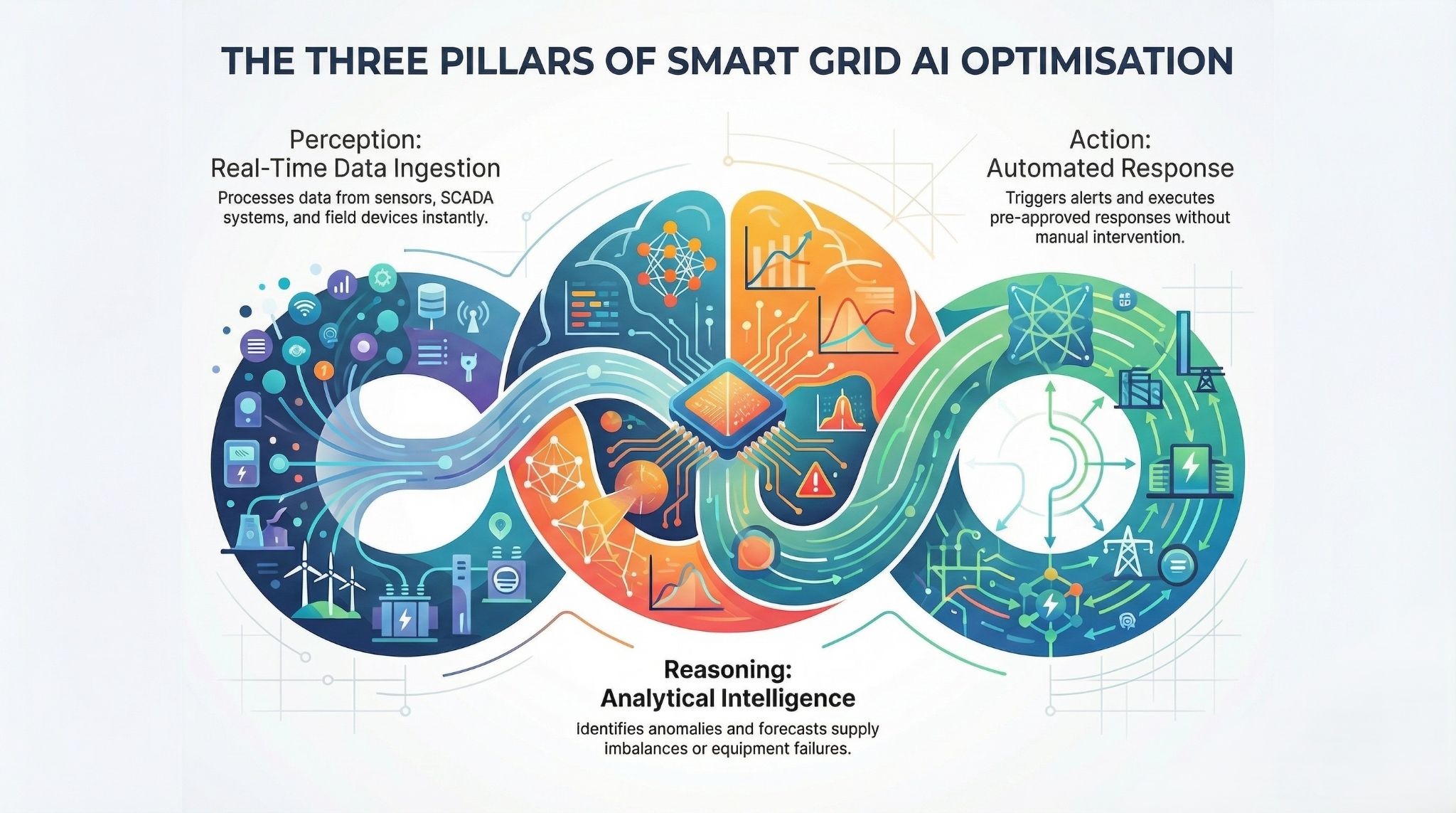
Smart grid AI optimization works across three primary layers:
- Perception — Ingesting and making sense of data from sensors, SCADA systems, meters, and field devices in real time.
- Reasoning — Identifying anomalies, forecasting demand and supply imbalances, and predicting equipment failures before they occur.
- Action — Triggering automated alerts, routing work orders to field teams, and executing pre-approved responses without manual intervention.
The newest category within this space is agentic AI — systems built from AI agents that can orchestrate multi-step workflows autonomously. An agentic system doesn't just detect that a transformer is running hot; it cross-references historical failure patterns, checks maintenance logs, calculates the risk of continued operation, and dispatches an alert with a recommended action — all within seconds and without a human in the loop.
This is the meaningful distinction between "AI in the smart grid" (dashboards, predictions) and "AI for smart grid optimization" (autonomous operational intelligence that drives outcomes).
How Agentic AI Transforms Grid Operations: Anomaly Detection and Automated Alerting
The most immediate and measurable impact of agentic AI on smart grid operations is in anomaly detection and alerting — the ability to find exceptions in real time and route them to the right person or system automatically.
The Problem with Traditional Grid Monitoring
Conventional grid monitoring relies on threshold-based alarms: when a value exceeds a preset limit, an alarm fires. These systems generate enormous volumes of alerts — many of them false positives — that overwhelm operations centre teams. Operators develop alarm fatigue, critical signals get buried, and genuine faults are missed or caught too late.
SCADA systems provide data visibility but not intelligence. They tell operators what is happening; they do not explain why, predict what will happen next, or recommend what to do about it.
What Agentic AI Does Differently
Agentic AI systems for smart grid optimization are built to do what SCADA cannot: reason across multiple data streams simultaneously, distinguish meaningful anomalies from noise, and trigger governed responses automatically.
In practice, this means:
- Continuous monitoring of transmission KPIs — voltage stability, line loading, power factor, frequency deviation — with AI models that understand what "normal" looks like for each specific grid segment, not just generic thresholds.
- Anomaly detection that learns — models trained on historical fault data that can identify the early signatures of failures before they escalate, including patterns that no human engineer would spot across thousands of simultaneous data points.
- Automated alert routing — when an anomaly is confirmed, the system determines the severity, identifies the appropriate response team, and dispatches a structured alert with context, recommended action, and supporting evidence — without any manual triage.
- Workflow automation for resolution — in governed deployments, the system doesn't just alert; it initiates the resolution workflow, creates a field task, and tracks completion.
Real-world deployment outcome: A state-level power transmission utility deployed an agentic AI system covering transmission KPI monitoring, anomaly detection, loss and outage analytics, predictive maintenance indicators, and dashboards with automated field alerts. The results: faster identification of grid exceptions and operational risks, improved reliability through proactive monitoring, and better operational transparency for leadership — replacing a monitoring posture that was almost entirely reactive.
The shift from reactive to proactive is the defining outcome of agentic AI in grid operations. Teams stop responding to failures and start preventing them.
Smart Grid AI Examples: Real Deployments Across Utilities and Transmission
One of the most searched questions in this space is "smart grid technology examples" — and for good reason. The enterprise AI industry is full of impressive claims and short on grounded evidence. Here are concrete deployment patterns drawn from real implementations.
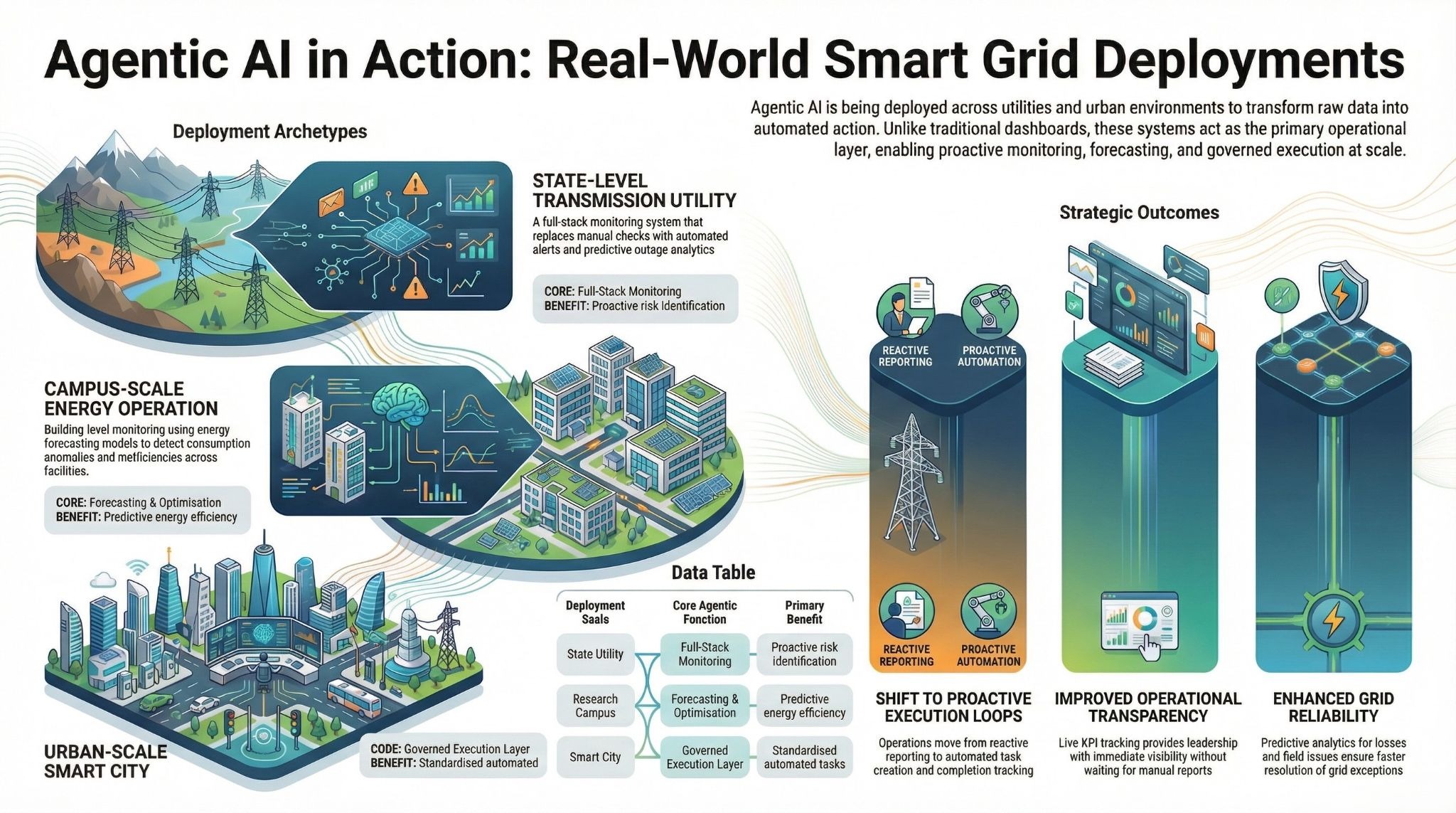
Example 1: State Transmission Utility — Full Agentic Monitoring Stack
Context: A state power transmission utility responsible for operating and maintaining transmission systems across a large geography, with field operations teams distributed across multiple zones.
What was deployed:
- Smart grid data ingestion from sensors and operational systems
- Operational dashboards with live KPI tracking across the transmission network
- Predictive analytics for outages, losses, and field issues
- Automated alerts with workflow routing for resolution
Outcomes:
- Faster identification of grid exceptions and operational risks
- Improved reliability through proactive monitoring replacing manual checks
- Better operational transparency for leadership teams who previously waited for reports
Why this matters for other utilities: This deployment demonstrates a full-stack agentic approach — from raw data ingestion through to automated action. It is not a dashboard project with AI added as an afterthought. The agentic layer is the operational system.
Example 2: Campus-Scale Energy Operation — Monitoring, Forecasting, and Optimization
Context: A premier research institution with campus-scale operations requiring reliable infrastructure monitoring and energy optimization across multiple facilities.
What was deployed:
- Utility and sensor data ingestion with anomaly detection
- Energy forecasting models tied to campus usage patterns
- Optimisation recommendations delivered through dashboards
- Proactive alerting when consumption deviates from forecast
Outcomes:
- Improved energy visibility and faster detection of inefficiencies
- Reduced manual monitoring effort across the facilities team
- More predictable operations through early warning alerts
- Measurable progress toward energy efficiency targets
Why this matters: This shows AI for smart grid optimization working at the building and campus level — not just in utility-scale transmission networks. The same agentic principles apply whether you are managing a national grid or a 50-building campus.
Example 3: Smart City Grid Intelligence — Operations at Urban Scale
Context: A smart infrastructure operation running at city scale, managing 25+ smart city operation centres and connecting millions of connected assets and applications across urban environments.
What was deployed:
- Data analytics for smart grid operations and performance management
- Agentic data analysis layer that converts dashboard insights into governed, auditable actions and tasks
- Automated task creation and completion tracking
- Standardised decision logic across teams
Outcomes:
- Shift from reactive reporting to proactive execution loops
- Standardised decision logic across distributed operations teams
- Automated task creation and completion tracking
- Improved operational visibility and exception response at scale
Why this matters: At city scale, the coordination problem is as significant as the technical one. Agentic AI creates a governed execution layer that ensures the right action happens at the right time — without requiring a central controller to orchestrate every decision manually.
Predictive Analytics: Forecasting Outages, Losses, and Field Issues
Predictive analytics is the capability that most separates AI-powered smart grid optimization from conventional monitoring. Instead of telling operators what just happened, predictive models tell them what is likely to happen — giving teams time to intervene before a fault becomes an outage.
How Predictive Grid AI Works
Predictive analytics for smart grids ingests multiple data streams simultaneously:
- Real-time sensor data from substations, transformers, lines, and meters
- Historical operational data — fault logs, maintenance records, weather events, load patterns
- External signals — weather forecasts, planned outages, demand projections
Machine learning models trained on this data learn the conditions that precede failures. A transformer that is about to fail typically shows subtle signatures — small temperature variations, minor increases in harmonic distortion, changes in load response — weeks or days before catastrophic failure. Predictive AI detects these signatures early.
Key Predictive Capabilities in Deployed Systems
Outage forecasting: Models predict which assets are at elevated risk of failure within a given time window, allowing maintenance teams to prioritise interventions before outages occur rather than after.
Loss analytics: AI systems continuously calculate and forecast transmission and distribution losses, identifying line segments or substations where losses are trending above expected levels — enabling targeted investigation and remediation.
Predictive maintenance indicators: Rather than calendar-based or run-to-failure maintenance, AI-driven systems flag assets based on their actual condition and predicted trajectory. This optimises maintenance spend and reduces unplanned outages simultaneously.
Field issue prediction: By combining asset health data with field team performance data and weather forecasts, advanced systems can predict where field issues are most likely to emerge, enabling proactive crew positioning.
The operational impact is significant: utilities running predictive AI report faster detection of impending failures, reduced emergency maintenance costs, and measurable improvements in grid reliability metrics including SAIDI (System Average Interruption Duration Index) and SAIFI (System Average Interruption Frequency Index).
Agentic Analytics vs. Traditional SCADA: Key Differences
For grid operators evaluating AI investment, one of the most important questions is: what does agentic AI actually add beyond what SCADA already provides? This is a fair question — SCADA systems represent decades of investment and institutional knowledge.
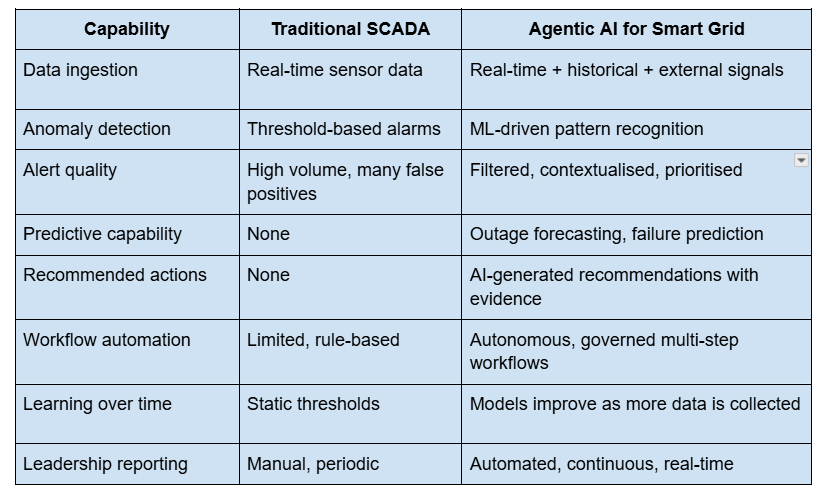
The critical point: agentic AI is not a replacement for SCADA. It is an intelligence layer that sits on top of existing systems — ingesting SCADA data along with every other operational data source — and turns that data into governed, automated operational intelligence. Most enterprise deployments of agentic smart grid AI are integration projects, not replacement projects. Existing SCADA infrastructure stays in place; the agentic layer adds the reasoning, prediction, and automation capabilities that SCADA was never designed to provide.
This is why implementation timelines for agentic AI in grid environments are measured in weeks, not years. There is no rip-and-replace. The AI agents connect to existing data sources and operational systems through APIs and standard integrations.
How to Implement AI for Smart Grid Optimization: A Step-by-Step Framework
For grid operators and infrastructure leaders evaluating an AI implementation, here is the structured approach that successful deployments follow.
Step 1: Define the Operational Problem, Not the Technology
Start with the specific operational pain point you need to solve: Are you losing too many hours to manual monitoring? Are outage response times too slow? Is leadership asking for real-time visibility you cannot currently provide?
The clearest implementations begin with a well-defined problem: "We want to reduce unplanned outages in our northern transmission corridor by 30% within 12 months." That specificity determines what data you need, what models to build, and what success looks like.
Step 2: Audit Your Data Landscape
AI systems for smart grid optimization are only as good as the data they ingest. Before any model is built, conduct a structured audit of available data sources:
- What SCADA data is available and at what granularity?
- How far back does historical fault and maintenance data go?
- What external data sources (weather, planned outages, load forecasts) are accessible?
- What are the data quality issues — gaps, inconsistencies, format problems — that need to be resolved?
This step is often underestimated. Data readiness is the single most common reason AI grid projects run over schedule.
Step 3: Start with Monitoring and Alerting Before Automation
The most successful implementations follow a progressive adoption model:
- Phase 1: Deploy the data ingestion layer and operational dashboards. Give operations teams real-time visibility they did not have before.
- Phase 2: Add AI-powered anomaly detection and prioritised alerting. Let humans validate the system's judgement before automating responses.
- Phase 3: Introduce governed automation — automated workflow routing, task creation, escalation — with full audit trails and human override at every step.
This sequence builds organisational trust in the system alongside technical capability. Teams that skip to Phase 3 without going through Phases 1 and 2 often face adoption resistance, even when the technology works correctly.
Step 4: Build the Governance Layer Before Going Live
Agentic AI systems operating in grid environments must have explicit governance frameworks in place before they take autonomous actions. This means:
- Defining which actions the system can take autonomously versus which require human approval
- Building complete audit logs for every AI-generated alert, recommendation, and action
- Establishing override and escalation procedures for every automated workflow
- Conducting tabletop exercises simulating edge cases before production deployment
Governance is not a constraint on AI capability — it is what makes autonomous grid operation safe and regulatorily defensible.
Step 5: Measure, Learn, and Expand
Define KPIs before deployment and measure them rigorously after. Core metrics for smart grid AI deployments typically include:
- Mean time to detection (MTTD) for grid anomalies
- Alert precision rate (proportion of alerts that represent genuine issues)
- Reduction in unplanned outages over a rolling 90-day period
- Mean time to resolve (MTTR) for field issues routed through the system
- Reduction in manual monitoring hours per operations centre per week
Use these metrics to refine models, improve alert quality, and build the evidence base for expanding the system to additional grid segments or use cases.
The Business Case: Why Utilities Are Investing in AI Now
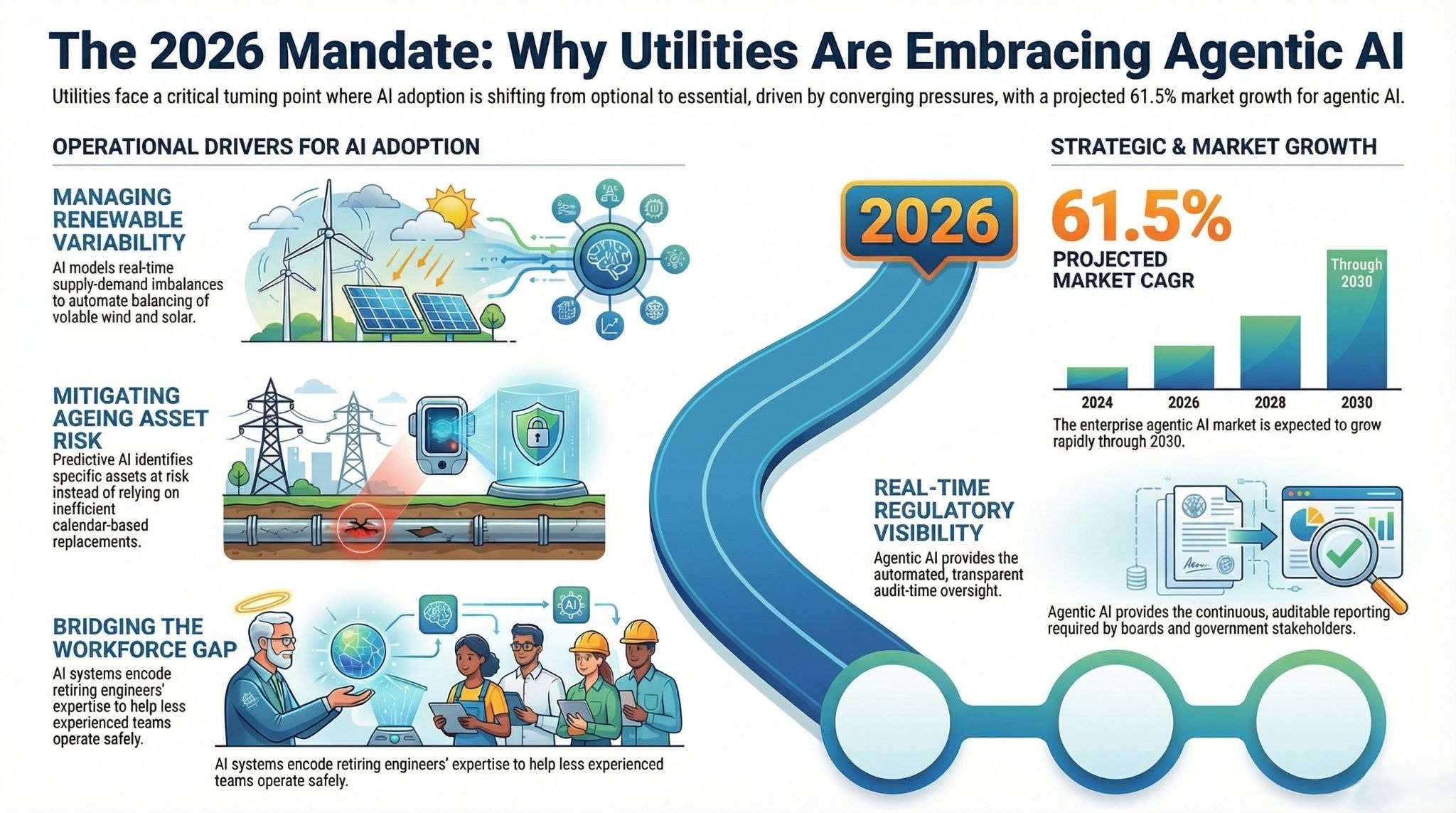
The timing of AI adoption in smart grid environments is not accidental. Several converging factors are making 2026 the decisive year for utilities that want to maintain operational leadership:
Renewable integration pressure. Solar and wind generation create supply-side variability that conventional grid management tools cannot handle at scale. AI systems that can forecast renewable output, model supply-demand imbalances in real time, and trigger automated balancing actions are moving from nice-to-have to operationally essential.
Ageing asset risk. Many transmission and distribution assets in operation today are approaching or past their design lifetimes. Predictive AI that can identify which assets are genuinely at risk — rather than replacing everything on calendar schedules — is one of the most cost-effective risk management tools available to asset-intensive utilities.
Leadership visibility expectations. Grid operators are under increasing pressure from regulators, boards, and government stakeholders to demonstrate real-time operational awareness. Agentic AI produces the continuous, auditable, leadership-ready reporting that manual processes cannot sustain.
Workforce constraints. Experienced grid engineers are retiring faster than they are being replaced. AI systems that encode operational expertise — knowing what a healthy transformer looks like, recognising the early signature of a developing fault — help less experienced teams operate safely and effectively.
The enterprise agentic AI market is projected to grow at 61.5% CAGR through 2030. For utilities and grid operators, the question is no longer whether AI will transform grid operations — it is whether your organisation will be leading that transformation or scrambling to catch up.
The Grid Is Getting Smarter — The Question Is When You Join It
AI for smart grid optimization is no longer a future capability under development in research labs. It is in production at utilities, transmission operators, and smart city infrastructure organisations right now — delivering measurable improvements in outage rates, operational efficiency, leadership visibility, and field response times.
The deployments covered in this guide share a common architecture: agentic AI systems that ingest operational data continuously, detect anomalies intelligently, forecast failures predictively, and route automated responses through governed workflows. They also share a common adoption path: starting with monitoring and visibility, building organisational trust in the system's judgement, and then progressively introducing automation where the evidence supports it.
For utilities and grid operators evaluating this space, the most important decision is not which AI vendor to choose — it is whether to build the operational intelligence foundation now, when the technology is proven and the competitive window is open, or later, when the market has consolidated and the early movers have built insurmountable operational advantages.
The grid is getting smarter. Agentic AI is the reason why.
See Agentic AI for Smart Grids in Action
Assistents.ai helps utilities and grid operators move from reactive dashboards to autonomous operational intelligence — in weeks. 300+ integrations. Governance built in. Real deployments across transmission, energy management, and smart city infrastructure. [Book a demo →]
Frequently Asked Questions
What is AI optimization for smart grids? AI optimization for smart grids is the application of artificial intelligence — including machine learning, predictive analytics, and agentic AI — to improve how electrical grids are monitored, managed, and operated. AI systems ingest data from sensors, SCADA systems, and external sources to detect anomalies, forecast failures, and automate operational responses in real time.
How does agentic AI differ from traditional smart grid AI? Traditional smart grid AI typically provides dashboards and predictions that humans then act on. Agentic AI goes further: it can autonomously execute multi-step workflows — detecting an anomaly, cross-referencing historical data, generating a recommended action, routing a field alert, and tracking resolution — without waiting for human triage at each step. The key difference is autonomous, governed action, not just insight generation.
What are the best examples of AI in smart grid technology? Real-world deployments include: state-level transmission utilities using agentic AI for KPI monitoring, outage forecasting, and automated field alerting; campus-scale energy operations using AI for consumption forecasting and anomaly detection; and smart city infrastructure organisations using agentic analytics to convert dashboard insights into automated operational tasks across millions of connected assets.
How long does it take to implement AI for smart grid optimization? Timeline varies by scope, but enterprise deployments of agentic smart grid AI typically follow a phased model. An initial monitoring and alerting layer can be live within four to eight weeks. Predictive analytics and governed automation layers typically follow in subsequent phases over three to six months. Unlike legacy SCADA replacements, agentic AI implementations integrate with existing systems rather than replacing them.
What data does smart grid AI require? Core data inputs include real-time sensor and SCADA data, historical fault and maintenance logs, weather and demand forecasts, and external operational signals. Data quality and historical depth are the primary factors determining model accuracy. Most enterprise implementations include a data audit and preparation phase before model development begins.
Can AI for smart grid optimization work alongside existing SCADA infrastructure? Yes — this is the standard deployment model. Agentic AI for smart grid optimization is an intelligence layer that sits on top of existing SCADA and operational systems, ingesting their data through APIs and standard integrations. There is no requirement to replace SCADA infrastructure. The AI adds reasoning, prediction, and automation capabilities that SCADA was not designed to provide.
What governance is required for autonomous grid AI? Enterprise grid AI deployments require explicit governance frameworks covering: which actions the system can take autonomously versus which require human approval; complete audit logs for every AI-generated alert, recommendation, and action; human override procedures; and escalation workflows for edge cases. Governance frameworks should be established and tested before any autonomous capabilities go live.

Transform Your Business With Agentic Automation
Agentic automation is the rising star posied to overtake RPA and bring about a new wave of intelligent automation. Explore the core concepts of agentic automation, how it works, real-life examples and strategies for a successful implementation in this ebook.
Sarfraz Nawaz is the CEO and founder of Ampcome, which is at the forefront of Artificial Intelligence (AI) Development. Nawaz's passion for technology is matched by his commitment to creating solutions that drive real-world results. Under his leadership, Ampcome's team of talented engineers and developers craft innovative IT solutions that empower businesses to thrive in the ever-evolving technological landscape.Ampcome's success is a testament to Nawaz's dedication to excellence and his unwavering belief in the transformative power of technology.

More insights
Discover the latest trends, best practices, and expert opinions that can reshape your perspective







Contact us

