
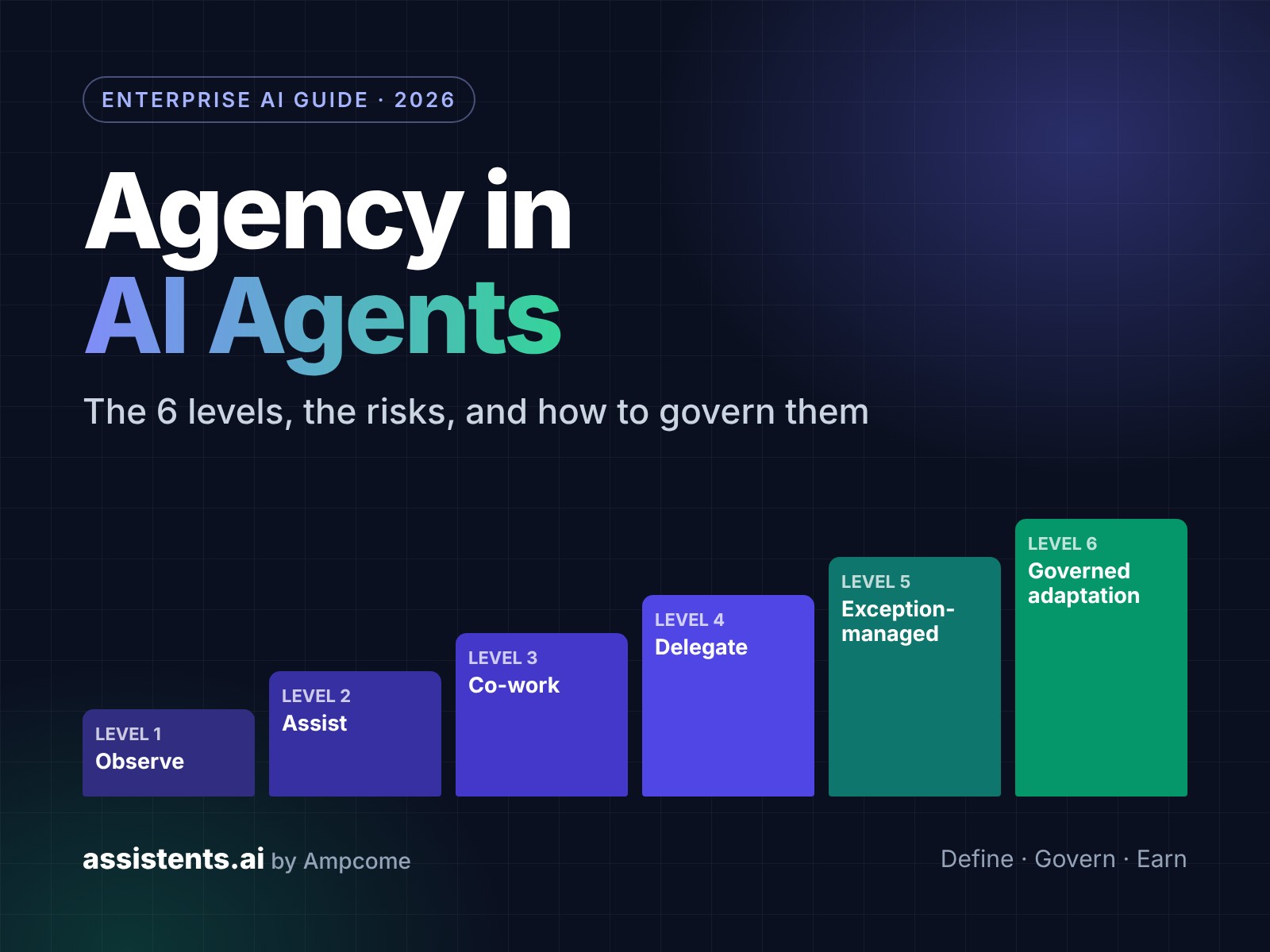
Agency in AI Agents: What It Is, the 6 Levels, and How to Govern It (2026)


Agency in AI agents is the degree of authority an AI agent has to pursue a goal on its own: to decide what to do next, use tools, and take real actions in business systems. More agency means fewer human checkpoints. In the enterprise, agency should be granted in bounded levels, governed by permissions, policies and approvals, and expanded only as the agent proves itself.
TL;DR
- Agency is authority, not intelligence. A smart model with no permissions has low agency. A simple agent that can change records in your ERP has high agency.
- Agency comes in levels. We use a 6-level model, from Observe to Governed adaptation. Most enterprise value today sits at Levels 3–5.
- Agency must be governed and earned. The winning pattern is exception-managed operations. Agents run the normal path inside a defined authority envelope, and humans handle the exceptions.
Note: this guide is about agency as a property of AI agents, not about "AI agencies" that build agents for clients.
What is agency in AI agents?
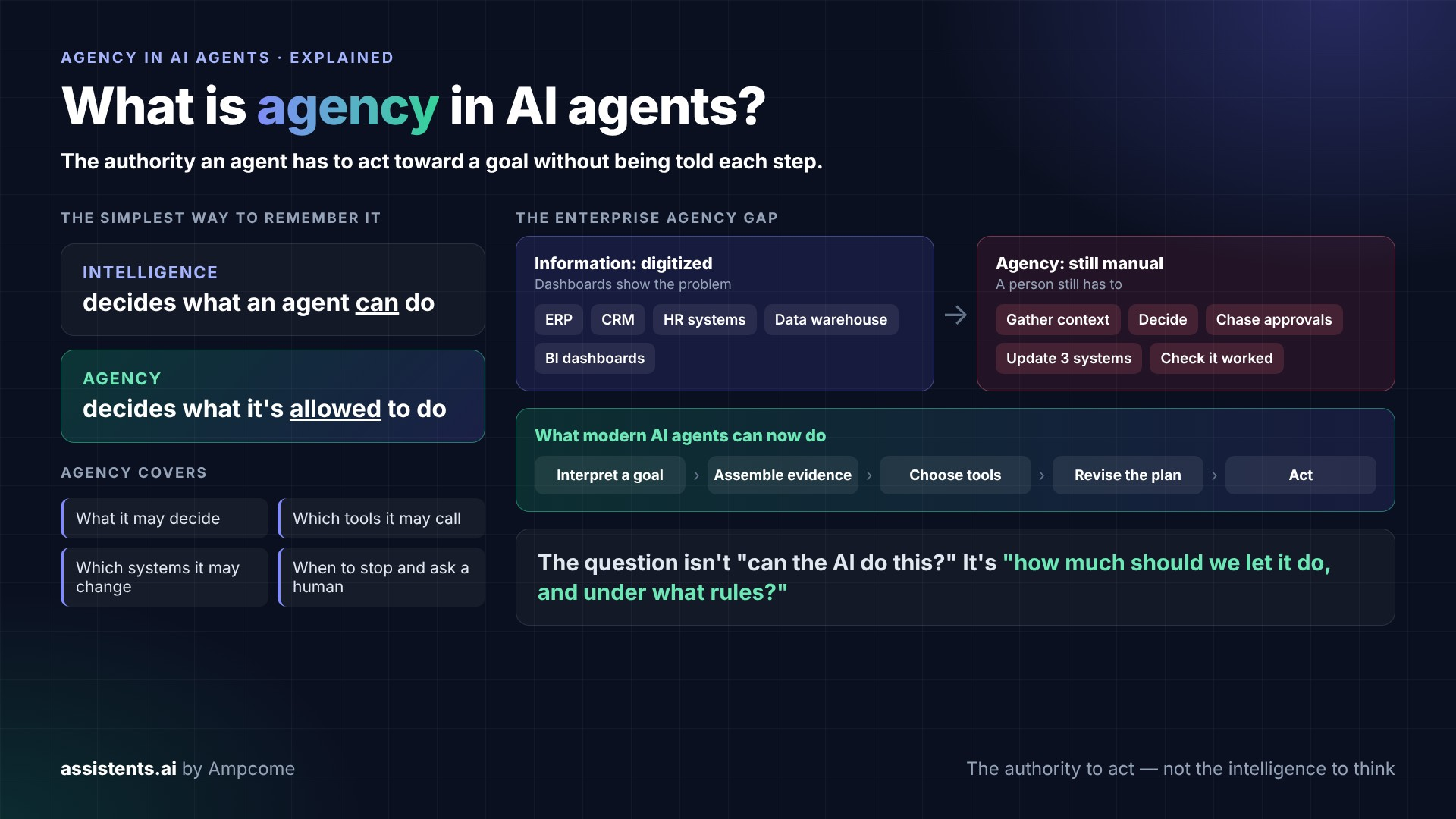
Agency in AI agents is the authority an agent has to act toward a goal without being told each step. It covers what the agent may decide, which tools it may call, which systems it may change, and when it must stop and ask a human.
The simplest way to remember it:
Intelligence decides what an agent can do. Agency decides what it's allowed to do.
This distinction matters because most enterprises have an agency gap. Over the last two decades, companies digitized their information: ERP, CRM, HR systems, data warehouses and BI dashboards. But they never digitized their agency. A dashboard can show that collections are slipping or a stockout is coming. A person still has to gather the context, decide what to do, chase approvals, update three systems and check whether it worked.
Modern AI agents change that. For the first time, software can interpret an ambiguous goal, assemble evidence, choose tools, revise its plan and act. The question is no longer "can the AI do this?" It's "how much should we let it do, and under what rules?" That is the question of agency.
The four ingredients of agency
Every AI agent's agency is made of four parts:
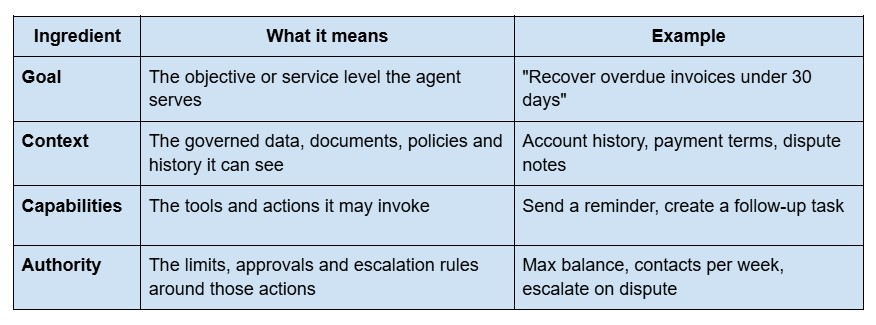
Change any one of these and you change the agent's agency, even if the underlying model stays the same.
Agency vs autonomy vs agentic AI
Agency is what an agent can act on. Autonomy is how much it acts without a human. Agentic AI is the class of systems that plan and act. The three terms are often used interchangeably, but they answer different questions.
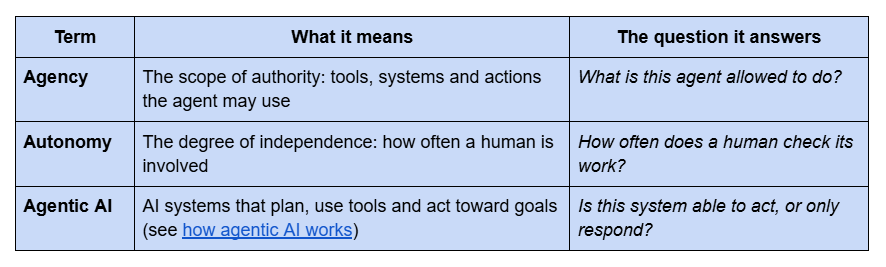
Researchers at the University of Washington draw the same line in their paper Levels of Autonomy for AI Agents: agency is tied to an agent's capacity to act (especially its tool access), while autonomy is a design choice about how much the user is involved.
That means the two can move independently:
- High agency, low autonomy: an agent with access to ERP, CRM and email, but every action needs approval.
- Low agency, high autonomy: an agent that runs unsupervised 24×7, but can only read data and send alerts.
Enterprises need to set both deliberately. In practice, they're set together through levels.
The 6 levels of agency in AI agents
The 6 levels of agency in AI agents are Observe, Assist, Co-work, Delegate, Exception-managed and Governed adaptation. Each level shifts more of the operational work to the agent while humans keep strategic and accountable authority.
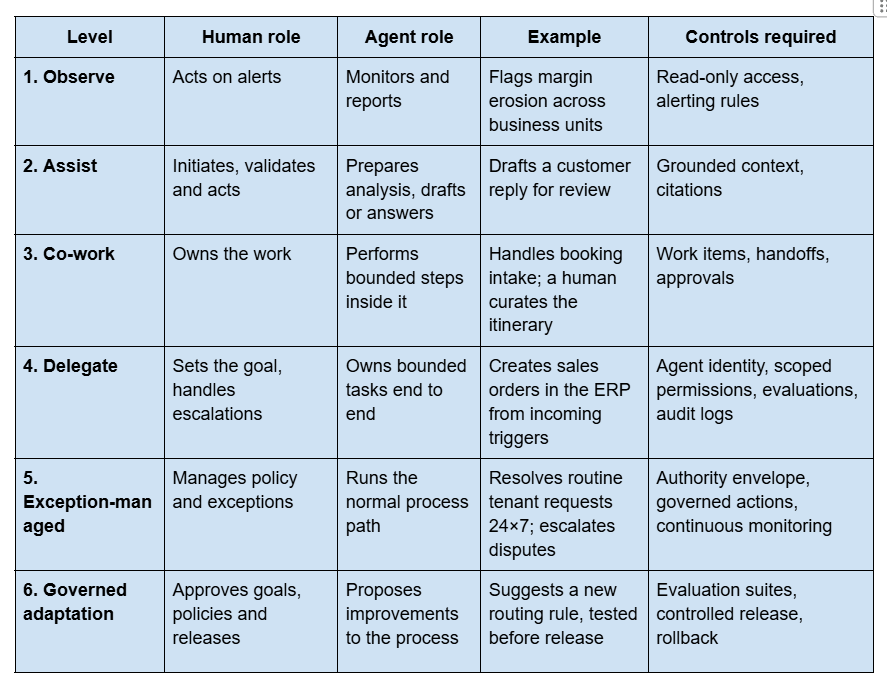
How this maps to other popular frameworks:
- Human-in-the-loop roughly equals Levels 2–3, where a human makes the final call.
- Human-on-the-loop roughly equals Levels 4–5, where the agent acts and a human supervises and steps in.
- The UW / Knight Columbia framework's five user roles (Operator, Collaborator, Consultant, Approver, Observer) describe the same progression from the user's side.
The difference in this model is that each level is defined by the controls it requires, not just the human's role. That makes it something you can actually implement and audit.
Two practical notes:
- Level 2 is where most "AI assistants" live. If you're unsure where an assistant ends and an agent begins, see AI agents vs AI assistants.
- Level 5 is what most people mean by autonomous agents. It doesn't mean "no humans." It means humans manage the envelope and the exceptions, not every step.
Most enterprise value today sits at Levels 3 to 5. You don't need to go further to get ROI, and a good platform shouldn't force you to.
Why agency decides whether AI agent projects succeed
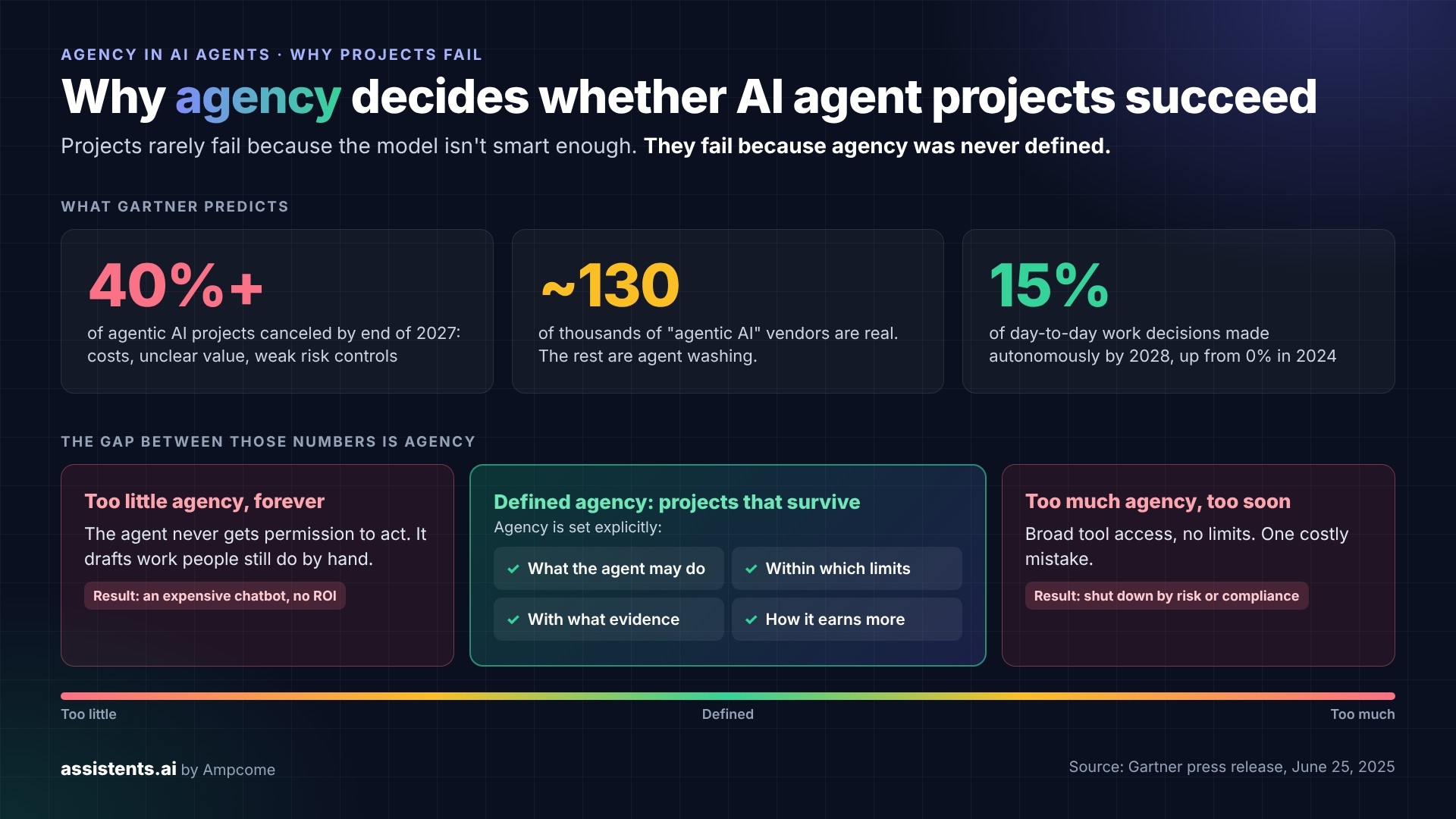
AI agent projects rarely fail because the model isn't smart enough. They fail because agency was never defined.
Gartner predicts that over 40% of agentic AI projects will be canceled by the end of 2027, citing escalating costs, unclear business value and inadequate risk controls. The same research estimates that only about 130 of the thousands of vendors claiming "agentic AI" are real; the rest are "agent washing" existing chatbots and RPA.
Yet the upside is large. Gartner also expects agentic AI to make at least 15% of day-to-day work decisions autonomously by 2028, up from 0% in 2024.
The gap between those two numbers is agency. Projects fail in one of two directions:
- Too much agency, too soon. An agent gets broad tool access with no limits, makes one costly mistake, and the program is shut down by risk or compliance.
- Too little agency, forever. The agent never gets permission to act. It becomes an expensive chatbot that drafts things people still have to do by hand, so the business value never shows up.
The projects that survive define agency explicitly: what the agent may do, within which limits, with what evidence, and how it earns more.
The risks of too much (and too little) agency
The biggest risk of agency in AI agents is "excessive agency": an agent that can take damaging actions because it has more functionality, permissions or autonomy than its task needs.
Excessive agency
The OWASP Top 10 for LLM Applications lists Excessive Agency (LLM06:2025) as a top risk. It happens when an LLM-based system acts on unexpected, ambiguous or manipulated output, for example from a hallucination or a prompt injection. OWASP names three root causes, and each one has a direct enterprise control:
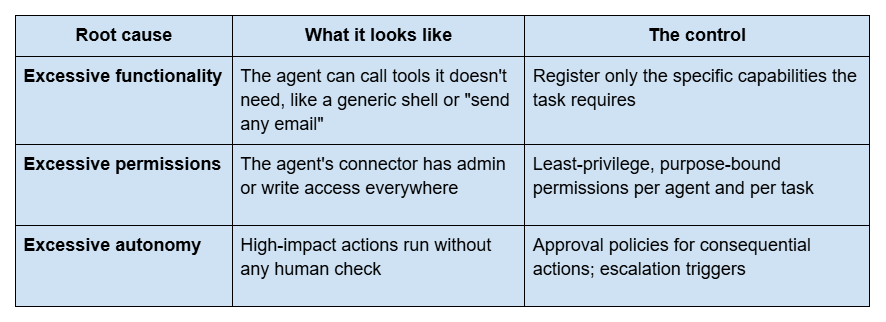
OWASP also stresses enforcing authorization in the downstream system, not trusting the LLM to decide what's allowed. That principle is the foundation of governed agency.
Too little agency
The opposite failure is quieter but just as costly. If every step needs human approval, you keep the old bottleneck and add a new one. Reviewers start rubber-stamping, which gives you the appearance of control without the substance.
The target is exception-managed operations:
Agents perform the normal path inside a defined authority envelope. Humans define the envelope and manage material exceptions. The platform continuously observes both.
How to govern agency in AI agents
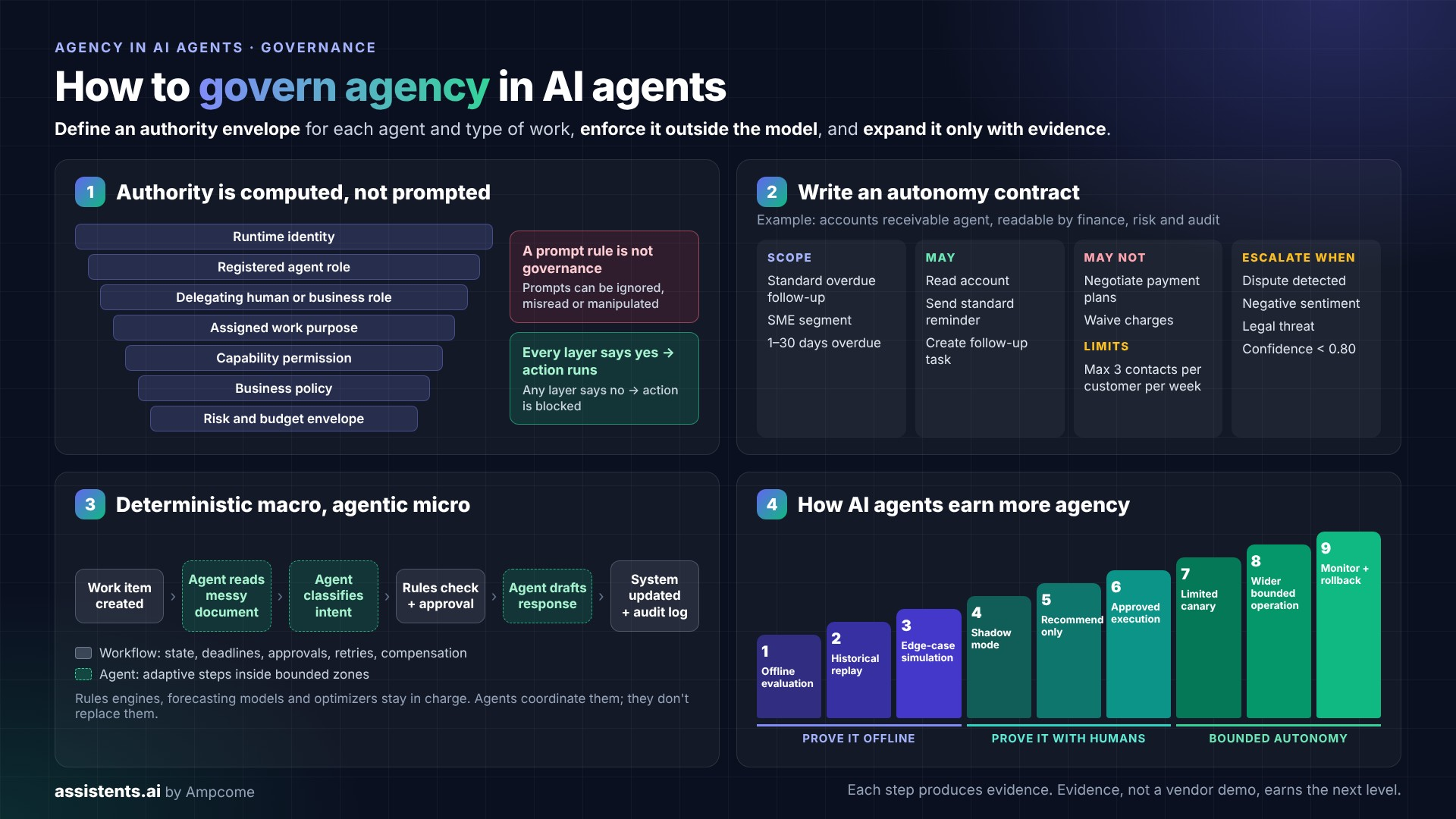
You govern agency in AI agents by defining an authority envelope for each agent and each type of work, enforcing it outside the model, and expanding it only with evidence. Here's how that works in practice.
Authority is computed, not prompted
Telling an agent "don't issue refunds over $500" in a system prompt is not governance. Prompts can be ignored, misread or manipulated. In a governed platform, an agent's effective authority is computed at runtime:
Effective authority =
runtime identity
∩ registered agent role
∩ delegating human or business role
∩ assigned work purpose
∩ capability permission
∩ business policy
∩ risk and budget envelope
If any layer says no, the action doesn't happen, no matter what the model "wants" to do.
Write an autonomy contract
Autonomy is not a single switch like agent.autonomous = true. It's a contract across several dimensions: work type, business scope, capabilities, value limits, time window, risk class, confidence threshold and approval policy.
Here's an example for an accounts receivable agent:
agent: receivables-digital-employee
work_type: standard_overdue_followup
scope:
segment: SME
overdue_days: 1-30
permissions:
read_account: true
send_standard_reminder: true
create_followup_task: true
negotiate_payment_plan: false
waive_charge: false
limits:
balance_max: 1000000
contacts_per_customer_per_week: 3
escalate_when:
- dispute_detected
- negative_sentiment
- legal_threat
- confidence_below_0_80
valid_until: 2026-12-31
Anyone in finance, risk or audit can read this and understand exactly what the agent may and may not do. That's what makes agency governable.
Deterministic macro, agentic micro
The most reliable enterprise pattern splits responsibilities:
- Durable workflows (deterministic) own process state, deadlines, approvals, retries and compensation.
- Agents (adaptive) choose the steps inside bounded zones where interpretation and reasoning add value, such as reading a messy document, classifying intent or drafting a response.
Business rules engines, forecasting models and optimizers stay in charge of what they're good at. Agents coordinate them; they don't replace them.
How AI agents earn more agency
Agency should be earned, not granted on day one. Every material agent should move through this rollout:
- Offline evaluation against test cases
- Historical replay on real past work
- Simulation of edge cases
- Shadow mode: the agent works alongside humans, but its output isn't used
- Recommend only: the agent prepares; a human acts
- Human-approved execution: the agent acts after approval
- Limited autonomous canary: a small slice of real work, unsupervised
- Wider bounded operation inside the autonomy contract
- Continuous monitoring and rollback if performance or risk drifts
Each step produces evidence. That evidence, not a vendor demo, is what justifies moving an agent up a level.
Agency in AI agents: enterprise examples by level
Across 30+ deployments in North America, Europe, the Middle East, Africa, India and Australia, the pattern is consistent: the agents that deliver value have clearly scoped agency and clear guardrails. Here's how agency was set in a selection of real assistents.ai deployments. Client names are withheld.
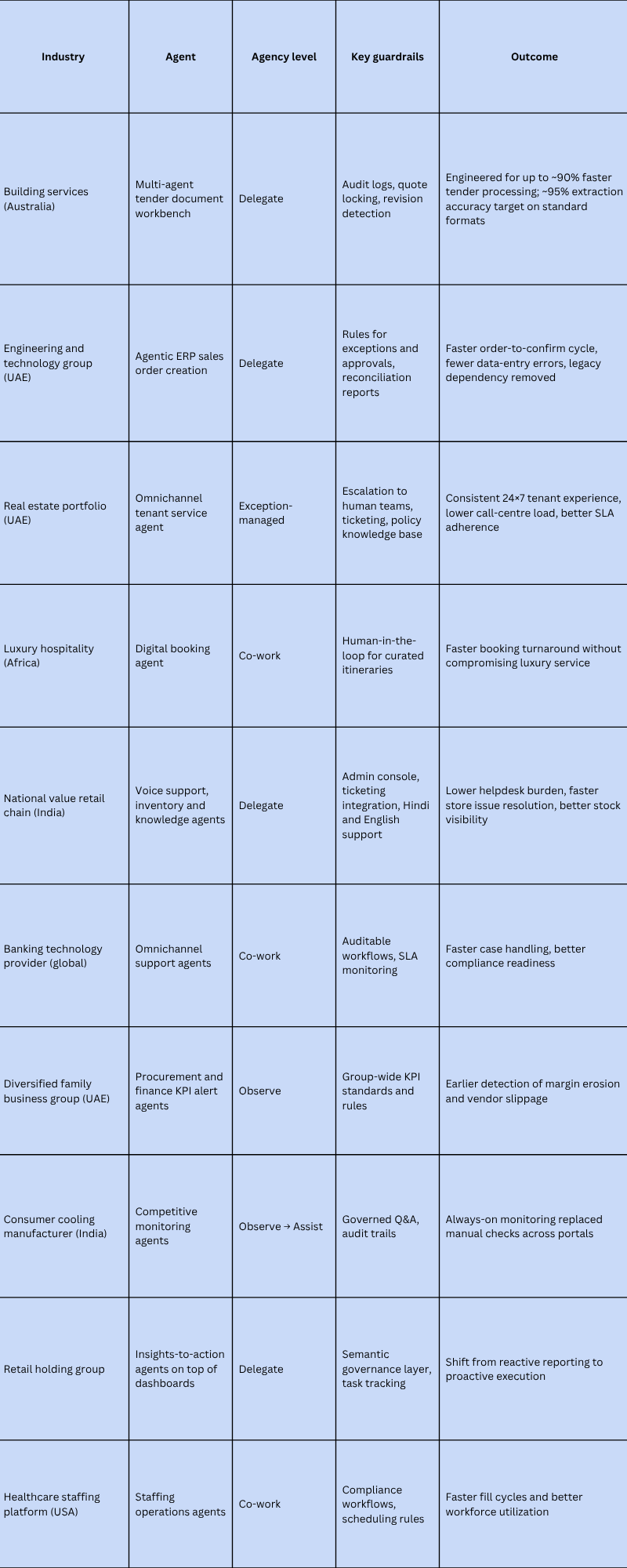
Three of these show how agency, guardrails and outcomes fit together.
Example 1: Tender documents (Level 4, Delegate)
The problem: An Australian building services specialist handled complex tender packages as large, inconsistent PDFs. Staff spent hours extracting scope, tracking revisions and re-keying data into their job management system, and a missed revision could put a bid at risk.
The agency granted: A team of agents retrieves tenders, determines the workflow, extracts data with vision models, compares revisions, and syncs results into the core operations system through full create, read, update and delete access.
The guardrails: Quote locking, full audit logs and revision detection. Agents can write to the system, but only through defined actions, and every change is traceable.
The outcome: The solution was engineered for up to ~90% faster tender document processing, with a ~95% extraction accuracy target for standard formats and lower bid risk through change detection.
Example 2: ERP sales orders (Level 4, Delegate with approvals)
The problem: A UAE engineering and technology group relied on an end-of-life, expensive legacy tool to capture orders and create sales orders in SAP. Manual handling slowed the order-to-confirm cycle and introduced data-entry errors.
The agency granted: An agent interprets order triggers, validates them and creates SAP sales orders directly.
The guardrails: Business rules decide which exceptions need approval. Every order creation is logged and reconciled.
The outcome: Less manual processing, a faster order-to-confirm cycle with fewer errors, better auditability, and no more dependency on the legacy tool.
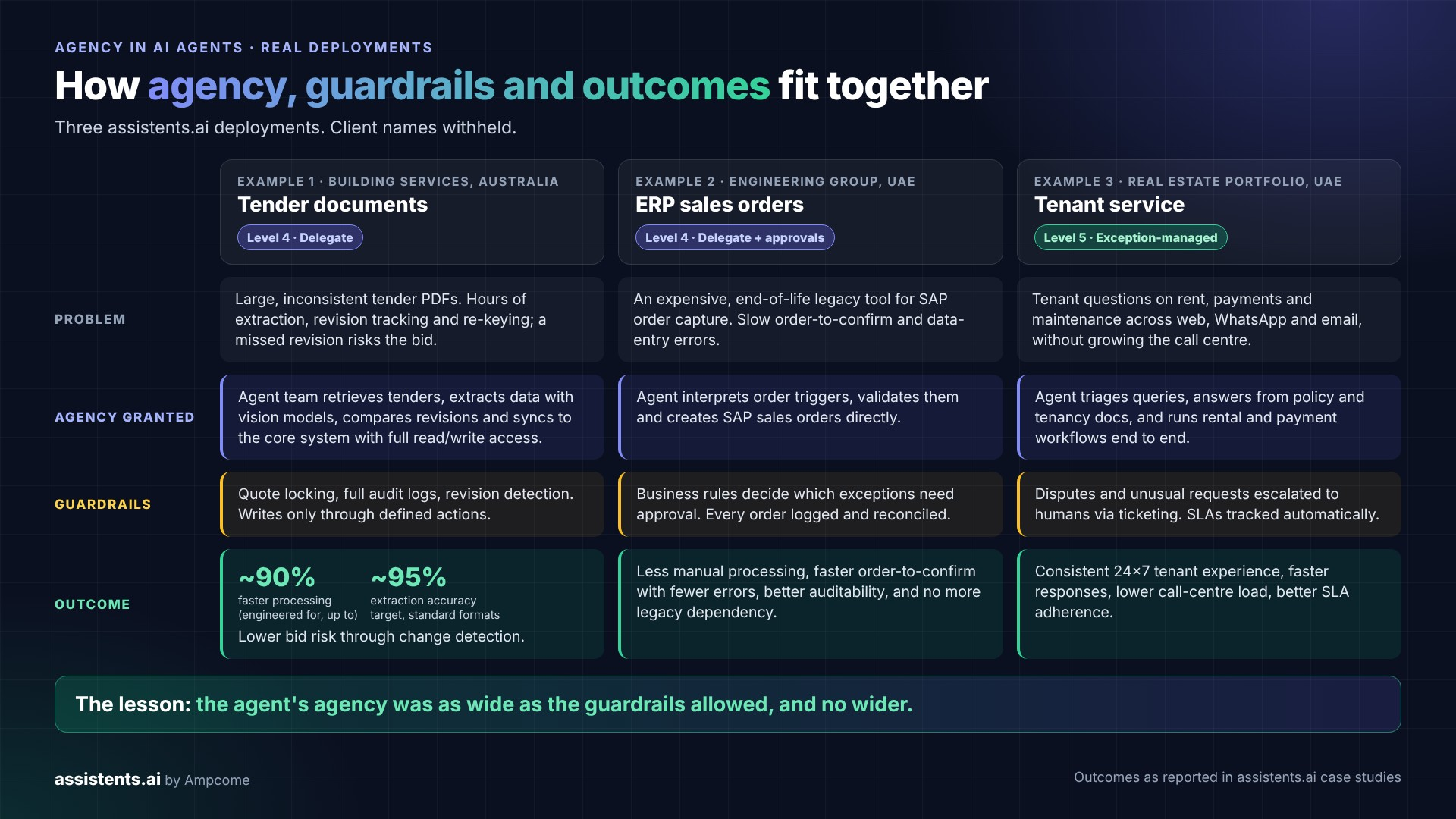
Example 3: Tenant service (Level 5, Exception-managed)
The problem: A major UAE real estate portfolio owner needed to handle tenant questions about rent, payments and maintenance across web, WhatsApp and email, without growing the call centre.
The agency granted: A service agent triages tenant queries, answers from policy and tenancy documents, and handles rental and payment workflows end to end.
The guardrails: Anything outside the normal path, such as disputes or unusual requests, is escalated to the right human team through ticketing, with SLAs tracked automatically.
The outcome: A consistent 24×7 tenant experience, faster response times, lower call-centre load and better SLA adherence.
The lesson from all three: the agent's agency was as wide as the guardrails allowed, and no wider. For more examples of how this scales across an organization, see AI agents for the autonomous enterprise.
How much agency should your AI agent have? A 5-question checklist
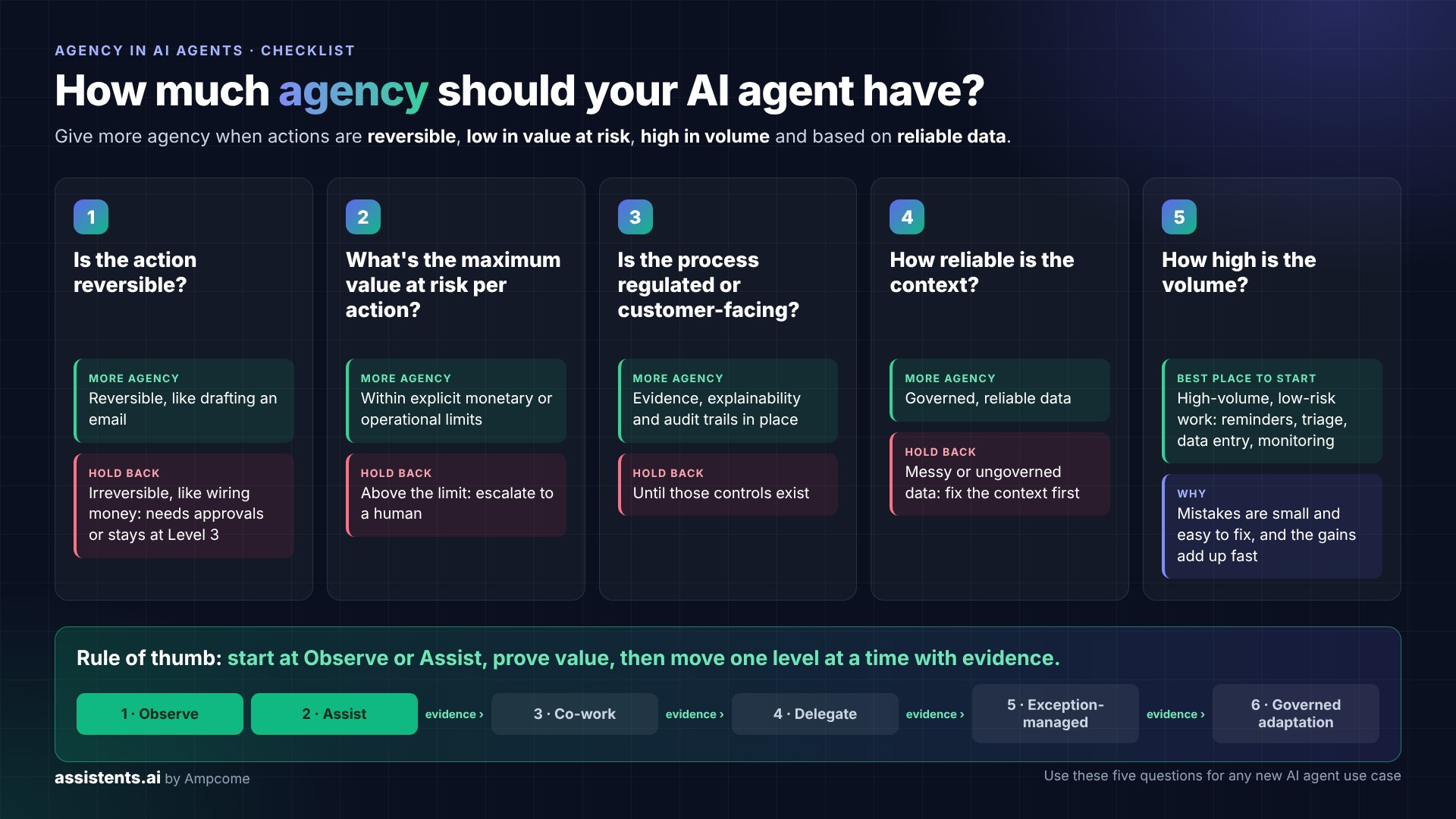
Give an AI agent more agency when its actions are reversible, low in value at risk, high in volume and based on reliable data. Use these five questions for any new use case:
- Is the action reversible? Drafting an email is reversible. Wiring money isn't. Irreversible actions need approvals or should stay at Level 3.
- What's the maximum value at risk per action? Set explicit monetary or operational limits, and escalate above them.
- Is the process regulated or customer-facing? Regulated steps need evidence, explainability and audit trails before agency increases.
- How reliable is the context? If the underlying data is messy or ungoverned, fix the context before you grant more authority.
- How high is the volume? High-volume, low-risk work (reminders, triage, data entry, monitoring) is the best place to start expanding agency.
Rule of thumb: start at Observe or Assist, prove value, then move one level at a time with evidence.
Why assistents.ai leads on governed agency
Most platforms help you build AI agents. assistents.ai helps you govern how much they're allowed to do.
assistents.ai, the governed agentic AI platform by Ampcome, is built around a simple idea: enterprises don't just need more agents. They need a System of Agency: a layer that decides what work needs doing, who or what should do it (a human, an agent or both), what context they need, what authority applies, and whether the outcome was achieved.
What that means in practice today:
- Human approvals and human-in-the-loop controls built into workflows, so you can set agency per action, not per agent.
- Deterministic business rules and decision tables that enforce policy outside the model.
- Full audit trails for what agents saw, decided and did.
- Governed context: natural-language analytics over governed data, semantic metrics, row-level security and permission-aware retrieval, so agents only see what they're allowed to see.
- Multi-agent orchestration and a workflow engine with human tasks, approvals and retries: deterministic at the macro level, agentic at the micro level.
- Document intelligence and voice agents connected to live business data, so agents can work where enterprise work actually happens.
And instead of selling isolated agents, assistents.ai delivers Agentic Workcells: governed human–agent teams that own a defined business operation, such as accounts receivable, procurement or store operations, and are measured on its outcomes.
You can start at any level. Land at Observe or Assist with analytics or document processing, then expand agency as your agents prove themselves. You never have to accept broad autonomy to get value.
See how assistents.ai governs AI agent agency
Why enterprises choose assistents.ai over DIY frameworks and suite vendors
Enterprises choose assistents.ai because it governs agency across all their systems, deploys where their data lives, and has proof in production.
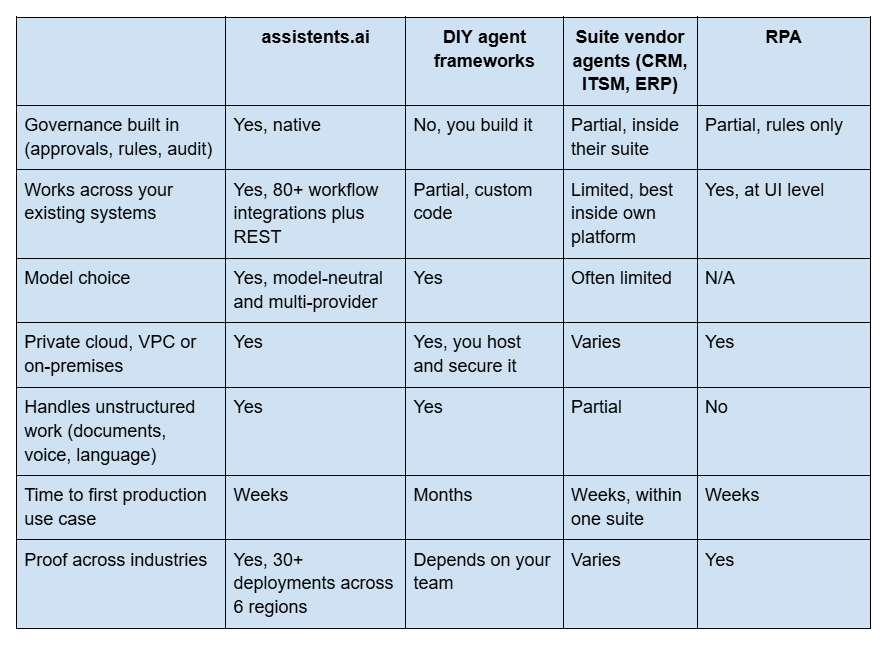
Three reasons this matters:
- Your work spans many systems. Suite vendors govern agents well inside their own walls. Real enterprise work crosses ERP, CRM, email, documents and spreadsheets. assistents.ai is the governance layer across them, and your systems of record stay authoritative.
- Regulated and infrastructure-heavy businesses need control of deployment. Private cloud, VPC and on-prem options, plus model choice, mean your data and your agents' authority stay under your control.
- Proof beats demos. assistents.ai is in production across retail, logistics, utilities, real estate, financial services, healthcare and professional services, from Observe-level monitoring to exception-managed customer service.
If you're comparing vendors, our guide to top agentic AI companies covers the wider market.
Book a 30-minute agency assessment with the assistents.ai team
Conclusion: define, govern and earn agency
Agency in AI agents is the difference between an AI that talks and an AI that works. But agency without governance is a risk, and governance without agency is a cost. The enterprises getting real value from agents are the ones that set agency deliberately: they choose a level, write the autonomy contract, enforce it outside the model, and expand it only with evidence.
The question isn't whether your AI agents have agency. It's whether that agency is defined, governed and earned.
assistents.ai gives you the platform to do exactly that, from your first monitoring agent to fully exception-managed operations.
Talk to the assistents.ai team about governing agency in your AI agents
FAQs
What is agency in AI?
Agency in AI is a system's capacity and authority to act toward a goal on its own: deciding next steps, using tools and taking actions in other systems. A chatbot that only answers questions has little agency. An AI agent that can update records, send messages or trigger workflows has much more.
What is the difference between agency and autonomy in AI?
Agency is what an AI agent is able and allowed to act on, such as its tools, data and permissions. Autonomy is how much it acts without human involvement. An agent can have broad agency but low autonomy (every action approved) or narrow agency but high autonomy (unsupervised, read-only monitoring).
Do AI agents have agency?
Yes, in a functional sense. AI agents can form plans, choose tools and act toward goals. But their agency is granted and bounded by humans through permissions, policies and approvals. In the enterprise, an agent's agency should always be defined, limited and auditable.
What are the levels of AI agent autonomy?
A practical model uses six levels: Observe, Assist, Co-work, Delegate, Exception-managed and Governed adaptation. Each level moves more operational work to the agent and requires stronger controls. Academic frameworks use similar scales, such as Operator, Collaborator, Consultant, Approver and Observer.
What is excessive agency in AI?
Excessive agency is a risk listed by OWASP (LLM06:2025) in which an AI system can take damaging actions because it has more functionality, permissions or autonomy than its task requires. It's mitigated with least-privilege permissions, narrowly scoped tools, human approval for high-impact actions and authorization enforced outside the model.
What is a high-agency AI agent?
A high-agency AI agent can take meaningful real-world actions with limited human input, such as creating orders, resolving support cases or updating financial records. High agency is valuable for high-volume work, but it should only be granted after evaluation, shadow testing and with clear limits and escalation rules.
How do you control what an AI agent is allowed to do?
Define an autonomy contract for each agent: the work types it handles, the actions it may take, value limits, confidence thresholds and escalation triggers. Then enforce it through the platform with identity, permissions, business rules, approvals and audit logs, not through prompt instructions alone.
Is human-in-the-loop required for AI agents?
Not for every step, but humans must stay accountable. Human-in-the-loop (approving each action) suits high-risk or new agents. As agents prove reliable, most enterprises move to human-on-the-loop or exception-managed operations, where humans supervise, set policy and handle only the exceptions.

Transform Your Business With Agentic Automation
Agentic automation is the rising star posied to overtake RPA and bring about a new wave of intelligent automation. Explore the core concepts of agentic automation, how it works, real-life examples and strategies for a successful implementation in this ebook.
Sarfraz Nawaz is the CEO and founder of Ampcome, which is at the forefront of Artificial Intelligence (AI) Development. Nawaz's passion for technology is matched by his commitment to creating solutions that drive real-world results. Under his leadership, Ampcome's team of talented engineers and developers craft innovative IT solutions that empower businesses to thrive in the ever-evolving technological landscape.Ampcome's success is a testament to Nawaz's dedication to excellence and his unwavering belief in the transformative power of technology.

More insights
Discover the latest trends, best practices, and expert opinions that can reshape your perspective





Contact us

