

15 Agentic AI Use Cases in DevOps That Are Redefining Software Operations in 2026


Agentic AI in DevOps refers to autonomous AI agents that observe your systems, diagnose problems, plan multi-step fixes, and act on them — within guardrails — instead of waiting for a human to run a script.
The highest-impact agentic AI use cases in DevOps today are: autonomous CI/CD pipeline diagnosis, intelligent incident triage and root cause analysis, self-healing infrastructure, automated rollback decisions, predictive deployment risk scoring, Kubernetes resource optimization, release readiness checks, alert noise reduction, security vulnerability triage, cloud cost optimization, infrastructure-as-code governance, governed runbook execution, legacy workflow migration, SLA monitoring with automated escalation, and post-incident documentation.
That is the short answer. The long answer — how each use case actually works, what results real enterprises are seeing in production, and why most agentic DevOps pilots quietly fail — is what this guide covers.
One thing before we start. This article is about the operations side of the software lifecycle: pipelines, infrastructure, incidents, releases, and monitoring. If you are looking for agentic AI in coding, testing, and application development, we cover that separately in our guide to AI agent use cases in software development. Keep the two distinct. The buyer, the risk profile, and the workflows are different.
What Is Agentic AI in DevOps? (Quick Answer)
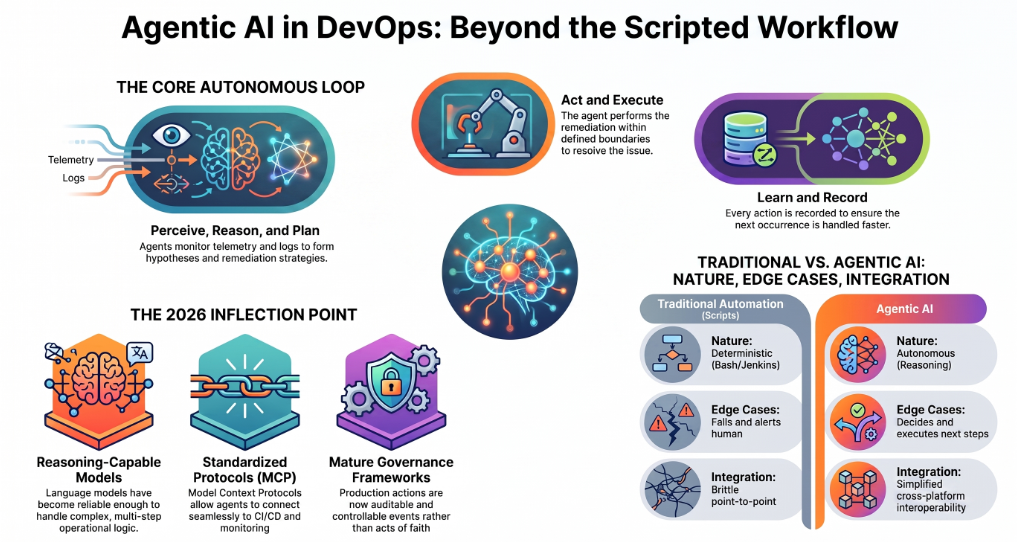
Agentic AI in DevOps is the use of autonomous AI agents — systems that can perceive their environment, reason about what they observe, plan a course of action, and execute it — to run software operations workflows that previously required a human engineer at the keyboard.
The core loop looks like this:
Perceive → Reason → Plan → Act → Learn
An agent watches telemetry, logs, pipeline states, and system metrics. When something breaks or drifts, it does not just fire an alert. It reasons through the evidence, forms a hypothesis about the root cause, plans a remediation, executes that plan within the boundaries you have given it, and records what worked so the next occurrence is handled faster.
This is fundamentally different from the automation DevOps teams have relied on for a decade. A Bash script, a Jenkins job, or a Terraform pipeline is deterministic: it does exactly what it was told, and the moment it hits an edge case nobody scripted for, it fails and pages a human at 3 AM. An agent, by contrast, can look at unexpected output and decide what to do next.
Why is 2026 the inflection point? Three things converged. Reasoning-capable language models became reliable enough for multi-step operational logic. Standardized protocols like the Model Context Protocol (MCP) and agent-to-agent (A2A) communication made it practical for agents to connect to CI/CD systems, monitoring stacks, and ticketing tools without brittle point integrations. And — most importantly for enterprises — governance frameworks matured to the point where an agent touching production is an auditable, controllable event rather than an act of faith. That last part is where most of this article will keep returning, because it is the difference between a demo and a deployment.
Agentic AI vs. Traditional DevOps Automation vs. AIOps
These three terms get blended together constantly, and the confusion costs teams real money when they buy the wrong category of tool. Here is the clean separation:
Traditional automation (scripts, pipelines, IaC):
- Nature: Deterministic. Follows predefined instructions exactly.
- Handles the unexpected: No. Unhandled errors break the run and page a human.
- Decision-making: None. Humans made every decision when they wrote the script.
- Example: A Terraform pipeline that plans, waits for approval, applies, and exits.
AIOps (monitoring intelligence):
- Nature: Reactive and analytical. Detects anomalies, correlates events, surfaces insights.
- Handles the unexpected: Partially. It can detect novel anomalies, but it stops at recommendation.
- Decision-making: Suggests. A human still has to act on every finding.
- Example: An observability platform that correlates a latency spike with a recent deploy and raises a prioritized alert.
Agentic AI (autonomous operations):
- Nature: Goal-directed. Observes, diagnoses, plans, and acts within guardrails.
- Handles the unexpected: Yes. Reasons through edge cases the way an on-call engineer would.
- Decision-making: Decides and executes bounded actions, escalating when confidence is low or the action exceeds its authority.
- Example: An agent that detects a failed deployment, traces it to a broken database migration, rolls back the release, opens a ticket with full diagnostic context, and notifies the team — all before anyone is paged.
The simplest way to remember it: automation executes, AIOps detects, agentic AI resolves. AIOps tells you the house is on fire. An agentic system picks up the extinguisher — and logs every step it took so you can audit the response afterward.
The 15 Agentic AI Use Cases in DevOps
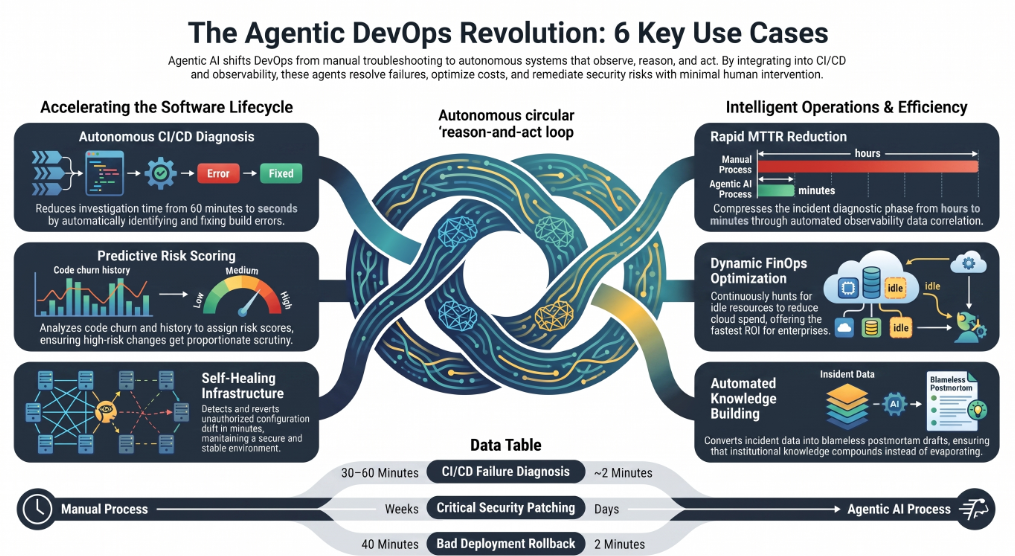
Each use case below follows the same structure: what the agent does, how it works in practice, and the measurable outcome teams should expect.
1. Autonomous CI/CD Pipeline Diagnosis and Repair
What it does: When a build or deployment fails, the agent reads the pipeline logs, identifies the root cause, and either fixes the configuration issue or hands a precise, evidence-backed diagnosis to an engineer.
How it works: The agent operates on a reason-and-act loop. It observes the build error, analyzes the stack trace or configuration diff, forms a hypothesis (a broken migration, a dependency version conflict, a misconfigured environment variable), plans the fix, and executes it — then verifies the pipeline goes green. For higher-risk changes, it proposes the fix and waits for a one-click human approval.
The outcome: Pipeline failures that used to consume 30–60 minutes of engineer investigation get resolved in minutes. More importantly, the interruptions stop. Engineers stay in flow instead of context-switching into pipeline archaeology.
2. Intelligent Incident Triage and Root Cause Analysis
What it does: The agent receives alerts, pulls the relevant logs, metrics, and traces, correlates them against recent changes, and produces a root cause hypothesis with supporting evidence — before the on-call engineer has even opened their laptop.
How it works: Instead of a human manually grepping through log aggregators, the agent queries observability data programmatically, cross-references deploy timestamps, configuration changes, and dependency health, and assembles an incident narrative: what broke, when, probably why, and what similar past incidents looked like.
The outcome: Mean time to resolution (MTTR) drops sharply because the diagnostic phase — usually the longest part of any incident — is compressed from hours to minutes. On-call engineers start from a hypothesis instead of from zero.
3. Self-Healing Infrastructure and Drift Remediation
What it does: The agent continuously compares the actual state of your infrastructure against its declared state, detects drift, and remediates it — either by reverting unauthorized manual changes or by updating the infrastructure-as-code to reflect approved reality.
How it works: Running on a continuous schedule, the agent evaluates every detected change against a risk profile. Low-risk drift gets corrected automatically and committed back through GitOps. High-risk or unexplained drift triggers incident-responder behavior: collect diagnostics, open a ticket with full context, escalate to a human.
The outcome: Configuration drift — one of the most common silent causes of production surprises — is caught in minutes instead of discovered during the next outage. Audit posture improves too, because every correction is logged and attributable.
4. Automated Rollback Decisions with Error-Threshold Reasoning
What it does: After a deployment, the agent watches error rates, latency, and business metrics. If they breach defined thresholds, it decides whether to roll back — and executes the rollback without waiting for a human to notice the dashboard.
How it works: This is more than a static "if error rate > X, revert" rule. The agent reasons about context: is the error spike caused by the deploy or by an upstream dependency? Is it affecting all traffic or one region? Is a rollback safe given in-flight database migrations? It makes the call a senior engineer would make, at machine speed, and documents its reasoning.
The outcome: Change failure impact shrinks dramatically. Bad deploys that would have burned through an error budget over 40 minutes of human reaction time get reverted in 2.
5. Predictive Deployment Risk Scoring
What it does: Before a release ships, the agent analyzes the changeset — code churn, files touched, historical failure patterns, test coverage deltas, author history — and assigns a risk score that determines how carefully the release gets rolled out.
How it works: The agent learns from your deployment history which patterns precede failures. A risky commit might trigger a slower canary, extra smoke tests, or a mandatory human review. A routine dependency bump sails through.
The outcome: Deployment safety stops being one-size-fits-all. Low-risk changes ship faster; high-risk changes get proportionate scrutiny. Overall release velocity goes up while change failure rate goes down — the combination every DORA-metrics-driven team is chasing.
6. Kubernetes Resource Optimization and Dynamic Scaling
What it does: The agent continuously right-sizes workloads — adjusting resource requests, scaling pods ahead of predicted traffic, and rebalancing clusters — based on observed behavior rather than static thresholds.
How it works: Where a horizontal pod autoscaler reacts to CPU crossing a line, an agent anticipates: it has learned your traffic patterns, knows Monday morning looks different from Saturday night, and scales proactively. When a pod crash-loops, it correlates the failure with recent config changes and memory limits, and proposes — or applies — the fix.
The outcome: Fewer performance incidents from under-provisioning, significantly less waste from over-provisioning, and an end to the manual tuning ritual that eats platform engineers' weeks.
7. Release Readiness Checks and Canary Orchestration
What it does: The agent runs the pre-release checklist autonomously — test status, open blockers, dependency health, compliance requirements — then orchestrates the canary rollout, monitoring each stage and deciding whether to proceed, pause, or abort.
How it works: Release readiness is usually a human ritual of checking six dashboards and three Slack channels. The agent consolidates it: verifies every gate, documents the evidence, launches the canary at 5% traffic, evaluates real-user signals against the baseline, and progressively widens exposure only when the data supports it.
The outcome: Releases become boring — in the best possible way. The judgment calls that made release management stressful are now data-driven decisions with a full audit trail.
8. Observability Noise Reduction and Alert Correlation
What it does: The agent sits between your monitoring stack and your on-call rotation, deduplicating alerts, correlating symptoms to a shared root cause, suppressing known-benign noise, and escalating only what genuinely needs a human.
How it works: When forty alerts fire in three minutes, the agent recognizes they are all downstream of one failed database node. It collapses them into a single enriched incident, attaches the probable cause, and pages one engineer with context — instead of paging six teams with fragments.
The outcome: Alert fatigue, the silent killer of on-call quality, drops sharply. Engineers trust their pager again, and real incidents get faster attention because they are no longer buried in noise.
9. Security Vulnerability Triage and Patch Orchestration
What it does: When a CVE lands, the agent determines whether your systems are actually exposed, prioritizes based on exploitability and blast radius, and orchestrates the remediation workflow — creating tickets, preparing patches, and coordinating the rollout.
How it works: Rather than dumping a 400-item vulnerability scan on a security team, the agent cross-references each finding against what is actually deployed and reachable. For confirmed exposures, it drafts the remediation, routes it through approval, and tracks the patch to completion — closing the loop that most vulnerability programs leave open.
The outcome: Mean time to remediate critical vulnerabilities drops from weeks to days. Security stops being a spreadsheet of guilt and becomes a managed pipeline.
10. Cloud Cost Optimization (FinOps Agents)
What it does: The agent continuously hunts for waste — idle resources, oversized instances, orphaned volumes, inefficient storage tiers — and either flags the savings or executes the optimization within pre-approved boundaries.
How it works: FinOps agents combine usage telemetry with pricing knowledge. They identify that a development environment runs 24/7 but is only used 45 hours a week, that a workload would be cheaper on a different instance family, or that a forgotten cluster has been billing quietly for months. Low-risk changes execute automatically; structural changes go to humans with a quantified business case.
The outcome: Enterprises running mature agentic FinOps report meaningful cloud spend reduction — often the single fastest ROI of any use case on this list, because savings show up on the very next invoice.
11. Infrastructure-as-Code Generation, Validation, and Governance
What it does: The agent generates and reviews infrastructure code against your organization's standards — security baselines, tagging policies, naming conventions, cost guardrails — before anything reaches production.
How it works: When an engineer requests new infrastructure, the agent drafts the IaC, validates it against policy-as-code rules, flags violations with explanations, and routes the final artifact for human approval. It also reviews human-written IaC in pull requests, acting as a tireless, consistent reviewer.
The outcome: Policy compliance stops depending on which senior engineer happened to review the PR. Standards get enforced uniformly, and infrastructure provisioning accelerates because the back-and-forth review cycles shrink.
12. Automated Runbook Execution with Human-in-the-Loop Approvals
What it does: The agent executes operational runbooks — certificate rotations, failovers, capacity expansions, data restoration procedures — pausing at defined checkpoints for human approval on consequential steps.
How it works: This is the maker-checker pattern applied to operations: the agent proposes and prepares each action, a human confirms the critical steps with one click, and the system re-validates before executing. Every step, every approval, and every outcome lands in an immutable audit trail.
The outcome: Runbook execution becomes fast, consistent, and fully documented. The 2 AM procedure gets performed identically to the 2 PM one, and compliance teams get evidence instead of tribal knowledge.
13. Legacy System Workflow Migration via Agentic Automation
What it does: The agent replaces brittle, end-of-life middleware and manual swivel-chair workflows — interpreting triggers from one system, validating the data, and executing the corresponding transaction in another.
How it works: Where legacy integration platforms hard-coded every mapping, an agent interprets incoming documents and events, validates them against business rules, handles exceptions through governed approval flows, and writes clean transactions into the target system with reconciliation reporting. It is integration that reasons instead of merely routing.
The outcome: Organizations escape expensive legacy licensing and eliminate error-prone manual data entry simultaneously. One real-world example of this pattern appears in the case studies below.
14. SLA Monitoring and Automated Escalation Routing
What it does: The agent tracks every service commitment — internal SLOs and customer-facing SLAs — predicts breaches before they happen, and routes escalations to the right team with full context automatically.
How it works: Instead of discovering an SLA breach in the monthly report, the agent watches burn rates in real time. When a ticket queue or error budget trends toward violation, it escalates proactively, reassigns priority, notifies stakeholders, and documents the intervention.
The outcome: SLA adherence improves not through heroics but through earlier awareness. Escalations arrive with diagnosis attached, so the receiving team acts instead of investigating.
15. Post-Incident Documentation and Knowledge Base Building
What it does: After an incident closes, the agent assembles the timeline, drafts the postmortem, extracts the action items, and updates runbooks and knowledge bases — turning every incident into institutional memory.
How it works: The agent already has the evidence: the alerts, the diagnostic steps, the remediation actions, the chat transcripts. It structures them into a blameless postmortem draft for human refinement, then feeds the confirmed learnings back into its own future triage logic.
The outcome: The postmortem backlog — the one every team swears they will get to — disappears. Knowledge compounds instead of evaporating, and repeat incidents get resolved faster because the last resolution is on file.
Real-World Results: Agentic AI in Production Operations
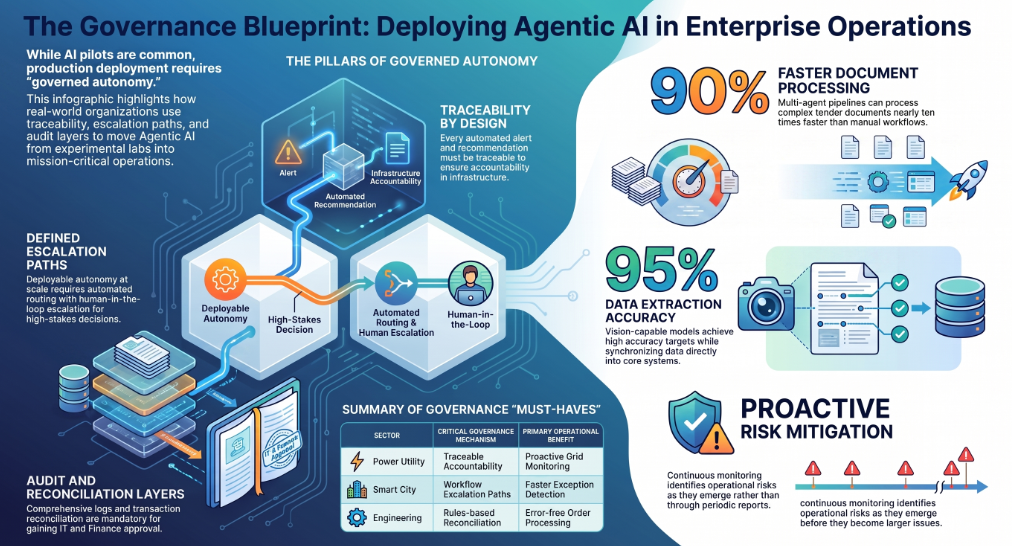
Use case lists are easy. Production deployments are hard. Here is what governed agentic AI looks like when it is actually running inside enterprise operations — drawn from real Assistents.ai deployments, anonymized by industry and scale.
A state power transmission utility: from reactive reporting to proactive grid operations
A state-level power transmission utility responsible for delivering reliable electricity across its region deployed agentic analytics on top of its grid operations. The system continuously monitors transmission KPIs, detects anomalies, surfaces loss and outage analytics, and generates predictive maintenance indicators — with automated alerts routed directly to field operations.
The operational shift was the point: instead of engineers discovering grid exceptions in periodic reports, the agents identify them as they emerge and coordinate the response. The utility saw faster identification of grid exceptions and operational risks, improved reliability through proactive monitoring, and better operational transparency for leadership.
The governance takeaway: critical infrastructure demands that every automated alert and recommendation be traceable. Autonomy here shipped with accountability built in — not bolted on.
A city-scale smart infrastructure operator: agentic alerting across millions of connected assets
A smart infrastructure unit operating at city scale — running more than 25 smart city operation centres and connecting over 2 million assets and applications — layered agentic analytics and automated operational alerting on top of its smart utility systems.
The agents ingest smart grid data, run predictive analytics for outages, losses, and field issues, and automatically route alerts and resolution workflows to the right operational teams. The results: higher operational visibility across grid operations, faster exception detection and response coordination, and a shift to genuinely proactive operations through continuous monitoring.
The governance takeaway: at this scale, ungoverned automation would be a liability measured in millions of urban lives affected. Workflow routing with defined escalation paths is what made autonomy deployable.
A flagship Middle East engineering group: replacing end-of-life middleware with governed agentic automation
A major engineering and technology solutions provider — established for over five decades and serving enterprise and infrastructure clients — faced a classic DevOps modernization problem: its sales order processing ran on legacy middleware that had reached end-of-life, with high licensing costs and brittle workflows.
Rather than replatforming onto another rigid integration suite, the company deployed agentic automation that interprets order triggers, validates the data, and creates sales orders directly in SAP. The critical part is how it does this: rules-based governance for exceptions, approval workflows for edge cases, comprehensive audit logs, and reconciliation reporting on every transaction.
The results: reduced manual order processing and legacy dependency, a faster order-to-confirm cycle with fewer data-entry errors, and improved auditability for order creation and exceptions. This is use case #13 from the list above, running in production at enterprise scale.
The governance takeaway: the audit and reconciliation layer was not a compliance afterthought — it was the reason the finance and IT organizations approved the project at all.
An Australian remedial construction specialist: multi-agent document pipelines with full audit trails
A waterproofing diagnostics and commercial works specialist with over two decades in remedial building services deployed an intelligent document workbench built on multi-agent orchestration. Autonomous agents retrieve tender documents, determine the correct workflow, analyze revisions between document versions, extract structured data from complex PDFs using vision-capable models, and synchronize everything into the company's core operational system with full create-read-update-delete integration, quote locking, and audit logs.
The system was engineered for up to roughly 90% faster tender document processing, with an extraction accuracy target of around 95% for standard formats — and, critically, reduced bid risk through revision and change detection with complete auditability.
The governance takeaway: this is the template for any agentic pipeline that writes into production systems. Deep integration, yes — but with locking, validation, and an audit trail on every mutation. That combination is what separates an agent you can trust from an agent you have to babysit.
Across all four deployments, notice the pattern: the impressive part is not that the agents act autonomously. It is that they act autonomously with controls — approvals where stakes are high, audit trails everywhere, and escalation paths when confidence drops. That pattern is the subject of the next section, because its absence is why most agentic DevOps initiatives never leave the pilot stage.
The Governance Problem: Why Most Agentic DevOps Pilots Fail

Here is the uncomfortable truth the vendor demos skip: the technology to run agents against your infrastructure has existed for a while. The reason most enterprises still have not deployed them is not capability. It is trust.
An ungoverned agent with production access is an incident waiting to happen. Consider the failure modes:
The runaway agent. An agent whose remediation keeps failing retries the same broken action sixteen times, amplifying the outage it was meant to fix. Without circuit breakers — automatic fail-safes that pause the agent and escalate to humans after repeated failures — autonomy cascades small problems into large ones.
The unauditable action. An agent modifies production configuration during an incident. The incident resolves. Three weeks later, an auditor asks what changed, who approved it, and why. If the answer is a shrug, you have a compliance finding — and in regulated industries, potentially much worse.
The over-scoped agent. An agent provisioned with broad credentials "to keep things simple" now represents a single compromise away from full infrastructure access. Non-human identities need the same least-privilege discipline as human ones — arguably more, because they act at machine speed.
The confident hallucination. A reasoning model misdiagnoses a root cause and executes a "fix" for a problem that does not exist. Without confidence thresholds and human checkpoints on consequential actions, plausible-sounding wrongness ships to production.
The enterprises succeeding with agentic DevOps in 2026 all converged on the same control set:
- Immutable audit trails on every agent observation, decision, and action — so post-incident analysis and compliance evidence are automatic, not archaeological.
- Maker-checker approval flows (human-in-the-loop) where the agent proposes, a human confirms, and the system re-validates before execution — applied proportionately to the risk of the action.
- Circuit breakers and escalation thresholds that stop an agent after consecutive failures and hand off to humans with full context.
- Scoped, role-based access so each agent holds only the permissions its function requires, with row-level and attribute-based controls on the data it can see.
- Defined autonomy boundaries — an explicit contract of what the agent may do unilaterally, what needs approval, and what it must never touch.
If a platform cannot demonstrate all five, it is a proof-of-concept toy, not an operations tool. This is the single most important evaluation lens for the build-vs-buy decision coming up — but first, the question of how to actually roll this out.
How to Implement Agentic AI in DevOps: A Phased Roadmap
The teams that succeed do not "turn on" autonomy. They climb a maturity ladder — the same one Assistents.ai formalizes as Ask → Execute → Autonomous — expanding agent authority only as trust is earned and evidence accumulates.
Phase 1 — Ask: Read-only intelligence (weeks 1–4)
Deploy agents in observe-and-diagnose mode only. They analyze pipeline failures, triage incidents, correlate alerts, and produce root-cause hypotheses — but every action remains human-executed. This phase does three things: it proves diagnostic accuracy on your real workloads, it trains your team in supervising agents, and it builds the observability foundation (logs, metrics, traces, deploy history) that all later phases depend on.
Start with the highest-friction, lowest-risk workflows: pipeline investigation, alert correlation, release readiness checks, post-incident documentation. Measure hypothesis accuracy and time saved per investigation.
Phase 2 — Execute: Bounded action with human approval (months 2–3)
Graduate the agents that proved themselves to proposing and executing actions behind approval gates. The agent prepares the rollback, the drift correction, the patch ticket — a human clicks approve, the system re-validates, the agent executes, and everything lands in the audit trail. This is the maker-checker pattern in daily practice.
The metric that matters here is approval rate: when engineers are approving 95%+ of an agent's proposals without modification, that workflow is a candidate for the next phase.
Phase 3 — Autonomous: Guardrailed self-operation (months 3–6 and beyond)
For workflows with a proven track record, remove the approval gate — but never the guardrails. The agent now acts unilaterally within explicit boundaries: rollbacks below a defined blast radius, drift corrections on non-critical infrastructure, alert suppression for validated-benign patterns. Circuit breakers, escalation thresholds, and immutable audit logging stay permanently. Consequential and irreversible actions keep their human checkpoints indefinitely.
Autonomy is granted per-workflow, not platform-wide — and it is revocable. The ladder runs in both directions, and that is a feature.
Build vs. Buy: Choosing an Agentic AI Platform for DevOps

You have two honest paths, and the right answer depends on what you are optimizing for.
Building on open frameworks (LangGraph, CrewAI, AutoGen, and similar) makes sense when you have a strong platform engineering team, highly bespoke workflows, and the appetite to own the full stack. The frameworks are genuinely capable for agent orchestration. What they do not give you is everything around the agent: the governance layer, the audit infrastructure, the approval workflows, the access controls, the connector maintenance, and the operational hardening. Teams routinely underestimate this — the agent logic is perhaps 20% of a production system; the governance and integration scaffolding is the other 80%, and you will be building and maintaining it yourself.
Buying a governed platform makes sense when you need enterprise controls from day one, when compliance and auditability are non-negotiable, and when your engineers should be defining workflows rather than building agent infrastructure.
Whichever path you take, evaluate against this checklist:
- Governance layer: Are maker-checker approvals, audit trails, and access controls native — or a roadmap slide?
- Audit depth: Can you reconstruct any agent action after the fact — what it observed, decided, did, and who approved it?
- Human-in-the-loop controls: Can approval requirements be set per-workflow and per-risk-level, not just globally on or off?
- Model flexibility: Is the platform model-agnostic with routing across providers, and can you bring your own keys — or are you locked to one vendor's model?
- Integration architecture: Does it support open protocols like MCP and agent-to-agent communication, or only proprietary connectors?
- Multi-agent orchestration: Can specialized agents coordinate on multi-step workflows with defined handoffs?
- Data grounding: Do agents reason over a governed semantic layer of your actual operational data, or over whatever context got stuffed into a prompt?
- Maturity path: Does the platform support graduated autonomy, or is it all-or-nothing?
Any vendor that stumbles on the governance questions is selling you a pilot, not a platform.
Why Assistents.ai by Ampcome for Agentic DevOps

Assistents.ai, built by Ampcome, is a governed enterprise agentic AI platform — and that word order is deliberate. Governance is not a feature we added to an agent framework. It is the architecture everything else is built on. For DevOps and operations leaders evaluating agentic AI, here is what that means concretely:
Governed by design. Every consequential action flows through a maker-checker model: the agent proposes, a human confirms, the server re-validates before execution. Every observation, decision, and action lands in an immutable audit trail. Data access is controlled with row-level security and attribute-based access controls, so each agent sees exactly what its function requires and nothing more. When your auditor asks what an agent did last quarter, the answer is a report, not an investigation.
The Ask → Execute → Autonomous maturity ladder is native. You do not choose between a chatbot and full autonomy. You start with read-only diagnostic agents, graduate proven workflows to approval-gated execution, and grant guardrailed autonomy only where the evidence supports it — per workflow, revocable at any time.
Multi-agent orchestration and a visual Workflow Builder. Specialized agents coordinate across your toolchain — monitoring, ticketing, CI/CD, core systems — with defined handoffs and escalation paths, composed through a workflow engine your team can actually see and modify rather than a pile of framework code.
Open integration architecture. Assistents.ai supports the Model Context Protocol (MCP) and agent-to-agent (A2A) communication, alongside deep data connectivity across Postgres, MSSQL, BigQuery, ClickHouse, Athena, and DuckDB. Your agents plug into the stack you have, not the stack a vendor wishes you had.
Model-agnostic with BYOK. Route across leading model providers based on task, cost, and policy — and bring your own keys for full control over model access. No single-vendor lock-in at the intelligence layer.
Grounded decisions, not confident guesses. Agents reason over a semantic layer and Context Engine built on your organization's own data, metrics, and business rules. The same architecture that gives our analytics products their no-hallucinated-numbers guarantee grounds operational agent decisions in trusted data.
Proven in production, not just in demos. The deployments described earlier in this article — grid operations for a state power utility, agentic alerting across a city-scale infrastructure operator with 2M+ connected assets, governed SAP automation replacing end-of-life middleware for a five-decade-old engineering group, and multi-agent document pipelines engineered for up to ~90% faster processing — are Assistents.ai deployments running in production today.
If your organization is serious about agentic AI in operations — serious enough to care what happens after the pilot — that combination of governance, maturity laddering, and production evidence is the shortest path from evaluation to value.
Final Takeaway
The agentic era of DevOps has already started — the question is no longer whether AI agents will run parts of your operations, but under whose rules they will do it.
The teams winning in 2026 are not the ones with the most autonomous agents. They are the ones whose agents act inside a framework of approvals, audit trails, and earned trust — because autonomy without governance is a liability, and autonomy with governance is a compounding competitive advantage.
Assistents.ai by Ampcome was built for exactly that: agentic AI that analyzes, decides, and acts on your operational data — with the governance layer that makes your engineering, security, and compliance teams say yes.
See governed agentic workflows in action. Book a demo at assistents.ai.
FAQs
What is agentic AI in DevOps?
Agentic AI in DevOps is the use of autonomous AI agents that observe systems, diagnose problems, plan remediations, and execute actions within defined guardrails. Unlike scripts that follow fixed instructions or monitoring tools that only alert, agents reason through unexpected situations and resolve them — escalating to humans when confidence is low or stakes are high.
How is agentic AI different from AIOps?
AIOps detects and analyzes: it correlates events, spots anomalies, and recommends actions for humans to take. Agentic AI closes the loop: it acts on those findings — rolling back deployments, correcting drift, executing runbooks — within governed boundaries. In short, AIOps tells you what is wrong; agentic AI fixes it and documents what it did.
Can AI agents replace DevOps engineers?
No. Agents absorb repetitive operational work — triage, investigation, routine remediation, documentation — while engineers shift to architecture, resilience, and supervising agent behavior. Human accountability remains essential, especially for consequential production actions. The realistic outcome is not fewer engineers; it is engineering time redirected from firefighting to higher-value work.
What is the best first use case for agentic AI in DevOps?
Start with low-risk, high-friction, highly visible workflows: CI/CD pipeline failure diagnosis, incident triage and root cause analysis, alert correlation, or post-incident documentation. These deliver measurable time savings within weeks without granting agents write access to production, and they build the trust needed for graduated autonomy.
How do you keep autonomous agents safe in production?
Five controls, together: immutable audit trails on every action; maker-checker human approvals for consequential changes; circuit breakers that pause agents after repeated failures; least-privilege access scoping with row-level and attribute-based controls; and explicit autonomy boundaries defining what agents may, must not, and must ask before doing.
What is agentic DevOps versus traditional automation?
Traditional automation is deterministic — scripts and pipelines execute predefined steps and fail on unhandled edge cases. Agentic DevOps is goal-directed — agents reason about unexpected states, adapt their plans, and take context-appropriate action. Automation executes instructions; agentic systems pursue outcomes.
Which platform is best for agentic AI in DevOps?
The best platform depends on your governance requirements. Enterprises should prioritize platforms with native maker-checker approvals, immutable audit trails, granular access controls, model-agnostic routing with BYOK, open protocols like MCP, and a graduated autonomy model. Assistents.ai by Ampcome is built specifically around those requirements, with production deployments across utilities, infrastructure, and enterprise operations.
How long does it take to see ROI from AI agents in DevOps?
Most teams see measurable value within weeks when starting with a focused, low-risk use case — typically through faster triage, reduced manual investigation, and quicker documentation. Broader value from execution and autonomy phases typically materializes over three to six months as governance matures and agent authority expands workflow by workflow.

Transform Your Business With Agentic Automation
Agentic automation is the rising star posied to overtake RPA and bring about a new wave of intelligent automation. Explore the core concepts of agentic automation, how it works, real-life examples and strategies for a successful implementation in this ebook.
Sarfraz Nawaz is the CEO and founder of Ampcome, which is at the forefront of Artificial Intelligence (AI) Development. Nawaz's passion for technology is matched by his commitment to creating solutions that drive real-world results. Under his leadership, Ampcome's team of talented engineers and developers craft innovative IT solutions that empower businesses to thrive in the ever-evolving technological landscape.Ampcome's success is a testament to Nawaz's dedication to excellence and his unwavering belief in the transformative power of technology.

More insights
Discover the latest trends, best practices, and expert opinions that can reshape your perspective







Contact us

