
.png)
Agentic Analytics in 2026: How India’s Banks & NBFCs Use AI Agents to Cut Compliance Risk


The Head of Compliance at a large private bank stares at her dashboard. Loan delinquencies are trending up in three metro clusters. Customer complaints about foreclosure notices have doubled. An RBI circular from last week changed disclosure requirements for restructured assets.
She knows all this. The dashboard told her two weeks ago.
What the dashboard didn't do: flag which loan products are affected, calculate the compliance gap, draft the revised disclosure template, or alert the legal and operations teams.
By the time her team manually connects these dots, the bank is already playing catch-up.
This isn't a BI problem. It's an action problem.
And it's why financial institutions across India are moving beyond dashboards and conversational AI toward something fundamentally different: Agentic Analytics.
Why Compliance, Risk & Audit Teams Are Drowning in Data But Still Missing Risk?
Indian banks, NBFCs, and insurers operate under some of the world's most dynamic regulatory regimes. RBI issues 150+ circulars annually. SEBI updates disclosure norms quarterly. IRDAI rewrites product filing guidelines with little warning.
Each circular arrives as a PDF. Each advisory lands in an email. Each policy change lives in a document repository somewhere.
Meanwhile, compliance teams are expected to:
- Interpret regulatory changes across lending, treasury, investments, and operations
- Map impact to dozens of internal products, processes, and systems
- Calculate exposure, remediation costs, and timelines
- Coordinate across risk, legal, IT, and business units
- Document everything for internal audit and regulatory inspection
All of this happens while managing day-to-day monitoring: transaction surveillance, complaint analysis, vendor due diligence, policy exception tracking.
The result? Reactive compliance.
By the time a risk surfaces in a dashboard, it's already materialized. By the time manual analysis is complete, the window for proactive action has closed. By the time coordination happens across teams, the regulator is already asking questions.
Traditional BI gives you visibility. But visibility without execution is just expensive hindsight.
The penalties prove it: Hundreds of crores in RBI fines across the banking sector in 2023 alone, most for late detection and delayed remediation of issues that were visible in data months earlier.
Enterprise AI promised to solve this. Conversational analytics promised to make insights accessible.
Neither delivered action.
What Is Agentic Analytics? (And How It's Different from BI or Conversational Analytics)
Agentic Analytics represents the next evolution in enterprise intelligence—one where AI doesn't just report or explain, but acts.
Here's how the three paradigms differ:
.png)
Traditional BI tells you loan delinquencies rose 12% last quarter. You open Tableau, filter by region, export to Excel, and manually investigate.
Conversational Analytics lets you ask "Why did delinquencies spike in Mumbai?" and get a natural language answer—though you still can't verify if it's grounded in actual data or hallucinated patterns.
Agentic Analytics detects the spike, correlates it with external economic indicators (monsoon disruption, local job losses), checks current collection policies, identifies affected loan officers, and drafts a targeted intervention plan—all before you ask.
The difference isn't incremental. It's categorical.
Where traditional BI reports, and conversational AI explains, Agentic Analytics executes.
Why Conversational AI Alone Fails in Regulated Financial Institutions
The promise of conversational analytics was seductive: talk to your data like you'd talk to an analyst. Ask questions in plain English. Get instant answers.
For regulated financial institutions, this promise collapsed under three critical failures:
1. The Hallucination Problem
Large language models are trained to sound confident, not to be accurate. Ask a conversational AI tool "How many customers breached their credit limit last month?" and you might get a number—but no reliable way to verify if it queried the right tables, applied the right filters, or invented the figure entirely.
In compliance and risk, "looks right but is wrong" is catastrophic. You can't present unverifiable AI outputs to an RBI inspection team.
2. The Unstructured Data Gap
Conversational AI tools work well with structured databases. They fail spectacularly with the data formats that matter most in financial compliance:
- PDF circulars with dense regulatory language
- Email chains documenting policy decisions
- Scanned audit reports from branch inspections
- Complaint logs in free-text format
These aren't edge cases. They're where regulatory risk lives.
A conversational AI might summarize a circular, but it can't reliably map its 47 provisions to your 200+ internal processes, flag conflicts with existing policies, and calculate remediation costs.
3. The Action Governance Problem
Even when conversational AI generates correct insights, it stops at insight.
If the AI detects a compliance breach, what happens next? Who gets notified? What's the escalation protocol? What evidence needs to be logged? What approvals are required before remediation?
Conversational analytics has no concept of workflow, role-based access, or audit trails. It's a question-answering system, not an operating system for compliance.
For a bank managing billions in assets under RBI scrutiny, this isn't just limiting—it's disqualifying.
How Agentic Analytics Works: Inside an AI Agent–Driven Analytics System
Agentic Analytics isn't a single AI model. It's an orchestrated system of specialized AI agents, each designed for specific analytical or operational tasks, coordinated by a governance layer that ensures trust, explainability, and auditability.
Here's the architecture that makes it work:
Analytical Agents: The Metrics Intelligence Layer
These agents continuously monitor structured data—transactions, customer records, portfolio metrics—and detect patterns that matter:
- Anomaly detection agents flag deviations from expected behavior (unusual transaction volumes, complaint spikes, policy exception clusters)
- Forecasting agents project trends and trigger alerts when thresholds will be breached
- Cohort analysis agents segment customers, products, or geographies to identify concentrated risk
Unlike static dashboards, analytical agents don't wait for you to check. They actively hunt for issues.
Knowledge Agents: The Unstructured Intelligence Layer
These agents ingest and interpret the documents where compliance risk actually lives:
- Regulatory monitoring agents read RBI/SEBI/IRDAI circulars, extract key provisions, and map them to internal policies
- Policy comprehension agents parse internal SOPs, audit reports, and committee minutes to understand current operating procedures
- Contract intelligence agents analyze loan agreements, vendor contracts, and partnership terms for compliance clauses
Knowledge agents transform unstructured text into queryable, actionable intelligence—with source citations and confidence scores.
Agentic Workflow Engine: The Execution Layer
This is where insight becomes action. When analytical and knowledge agents detect an issue, the workflow engine:
- Orchestrates multi-step reasoning: "This regulatory change affects product X, which is governed by policy Y, which requires approval from committee Z"
- Executes coordinated actions: notify stakeholders, draft remediation plans, schedule review meetings, update audit logs
- Applies business rules: ensure actions comply with internal controls, approval hierarchies, and segregation of duties
Workflows can be fully autonomous (e.g., auto-flagging transactions for review) or human-in-the-loop (e.g., drafting reports for compliance officer approval).
Governance Layer: The Trust Infrastructure
This is what separates enterprise-grade Agentic Analytics from experimental AI tools:
- Schema grounding: Every data claim is traceable to source tables and query logic
- Explainability: Every agent decision includes reasoning chains, not just outputs
- Role-based access control: Agents respect the same data permissions as human users
- Audit trails: Every action, query, and recommendation is logged with timestamps and agent provenance
- Model-agnostic design: Swap out LLMs without rewriting workflows, avoiding vendor lock-in
This architecture ensures that agentic systems are not just powerful, but safe for regulated enterprises.
.png)
Agentic Analytics Use Cases in Banking, Insurance & NBFCs
Let's move from architecture to application. Here's how Agentic Analytics solves real compliance, risk, and audit challenges in Indian financial institutions.
Regulatory Change Detection & Impact Analysis
The Problem: When RBI issues a circular on loan provisioning norms, compliance teams spend days manually reading the 40-page document, interpreting each clause, and mapping it to affected loan products, IT systems, and operational processes.
How Agentic Analytics Solves It:
- A regulatory monitoring agent ingests the circular within minutes of publication
- A knowledge agent extracts key provisions: new provisioning thresholds, revised restructuring criteria, enhanced disclosure requirements
- An analytical agent queries internal systems to identify affected loan accounts (e.g., all MSME loans restructured in the last 18 months)
- A workflow agent calculates the compliance gap: "2,847 accounts need re-classification; estimated provisioning impact ₹124 crore; disclosure updates required in 6 quarterly reports"
- The system drafts a compliance action plan with task assignments, timelines, and escalation triggers
- The Chief Compliance Officer receives a structured brief—not a raw PDF—ready for board presentation
Why Traditional BI Fails Here: Dashboards can't read PDFs. Conversational AI might summarize the circular but can't map it to your specific loan portfolio and calculate financial impact.
Continuous Compliance Monitoring
The Problem: Banks must monitor hundreds of operational metrics daily—ATM cash availability, loan disbursement turnaround, complaint resolution times, KYC renewal rates—to stay within regulatory thresholds. Manual monitoring is slow; static alerts are noisy.
How Agentic Analytics Solves It:
- Analytical agents track real-time metrics across branches, products, and channels
- When a metric approaches a breach threshold (e.g., complaint resolution time hitting 85% of the 30-day SLA), agents analyze why: staff shortage, system downtime, process bottleneck?
- Knowledge agents check if this breach type has precedents—what happened last time, what remediation worked, what RBI guidance applies
- The system auto-escalates to the relevant regional manager with context: "15 complaints at risk of SLA breach in Mumbai North; root cause: 3 officers on leave; suggested action: temporary staff reallocation"
- If no action is taken within 48 hours, escalation climbs to the CCO automatically
Why Traditional BI Fails Here: Static dashboards show you breaches after they happen. Agentic systems detect drift early and prescribe corrective action before thresholds are crossed.
Internal Audit Automation
The Problem: Internal audit teams spend 60–70% of their time on manual evidence gathering—pulling transaction logs, reviewing policy documents, correlating data across systems—before they can even begin substantive analysis.
How Agentic Analytics Solves It:
- When an audit is scheduled (e.g., branch lending compliance review), an audit preparation agent automatically:
- Pulls all loan disbursements in the audit period
- Flags exceptions: loans above approval authority, missing documentation, incomplete KYC
- Cross-references with policy SOPs to identify deviations
- A knowledge agent fetches relevant regulatory guidelines, previous audit findings, and management responses
- The system generates a preliminary audit memo with evidence packs, deviation summaries, and risk ratings
- Auditors review and refine findings—but start with 70% of the work already done
- All agent queries and data sources are logged in an immutable audit trail, satisfying regulatory documentation requirements
Why Traditional BI Fails Here: BI tools visualize data; they don't gather evidence, interpret policies, or draft audit-ready reports. Conversational AI might answer questions but can't orchestrate multi-step investigation workflows.
Fraud Detection & Investigation
The Problem: Transaction monitoring systems generate thousands of alerts daily. Most are false positives. Investigating each manually is impossible; ignoring them creates regulatory risk.
How Agentic Analytics Solves It:
- Anomaly detection agents flag suspicious transactions (unusual transfer patterns, velocity anomalies, merchant mismatches)
- Investigative agents enrich each alert:
- Customer's full transaction history
- Related party transfers
- Historical fraud patterns in similar cases
- External data (merchant reputation, device fingerprints)
- Agents assign fraud risk scores based on corroborating evidence
- High-risk cases are auto-escalated to investigators with complete case files; low-risk alerts are auto-closed with documented reasoning
- If fraud is confirmed, a remediation workflow triggers: account freeze, regulatory filing (STR/CTR), legal documentation—all with audit logs
Why Traditional BI Fails Here: Rule-based fraud systems generate noise. Conversational AI might explain why a transaction looks suspicious but can't autonomously investigate, triage, or execute remediation.
Why Agentic Analytics Is Safe for Regulated Enterprises
The biggest objection to AI in financial services isn't capability—it's trust.
Regulators, boards, and CXOs ask the same questions: Can we audit it? Can we explain it? Can we control it?
Agentic Analytics is designed specifically to answer "yes" to all three.
Explainability: Every Decision Has a Paper Trail
Unlike black-box AI, agentic systems expose their reasoning:
- Data lineage: "This metric comes from table X, filtered by condition Y, as of timestamp Z"
- Logic chains: "I flagged this account because it meets criteria A, B, and C from policy document D (section 4.2)"
- Confidence scores: "I'm 87% confident this is a compliance breach; here's the evidence that supports and contradicts"
When an RBI inspector asks "How did you identify this issue?", you present agent reasoning—not a hand-wavy "the AI said so."
Role-Based Access Control: Agents Respect Hierarchy
In traditional AI tools, everyone with access can ask anything. That's unacceptable in banking.
Agentic Analytics enforces the same access controls as your core systems:
- Branch managers see only their branch data
- Product heads see only their product portfolios
- Auditors get read-only access with full history
- Compliance officers can trigger workflows; analysts cannot
Agents don't bypass security—they inherit it.
Human-in-the-Loop Approvals: AI Proposes, Humans Decide
Not every action should be autonomous. For high-stakes decisions—loan restructuring, regulatory filings, customer communications—agentic systems use approval workflows:
- The AI drafts the action plan
- The human reviews, edits, and approves
- The system executes post-approval and logs the authorization
This isn't AI replacing judgment. It's AI accelerating it.
Model-Agnostic Architecture: No Vendor Lock-In
Today's best LLM is obsolete in 18 months. Agentic Analytics platforms don't hardcode a single model:
- Analytical agents might use specialized time-series models
- Knowledge agents might use domain-tuned LLMs
- Workflow logic is model-independent
You can swap GPT-4 for Claude, Claude for Gemini, or deploy open-source alternatives—without rewriting your entire analytics stack.
Audit Logs: Every Query, Every Action, Every Decision
For regulated enterprises, documentation isn't optional. Agentic systems maintain immutable audit trails:
- Which agent performed which action
- What data was accessed
- What reasoning led to which conclusion
- Who approved or overrode which recommendation
- When each step occurred
These logs meet RBI, SEBI, and IRDAI audit standards—because they're designed for regulatory scrutiny from day one.
Agentic Analytics vs BI Tools vs AI Copilots
Still unclear how Agentic Analytics differs from existing tools? Here's the head-to-head comparison:
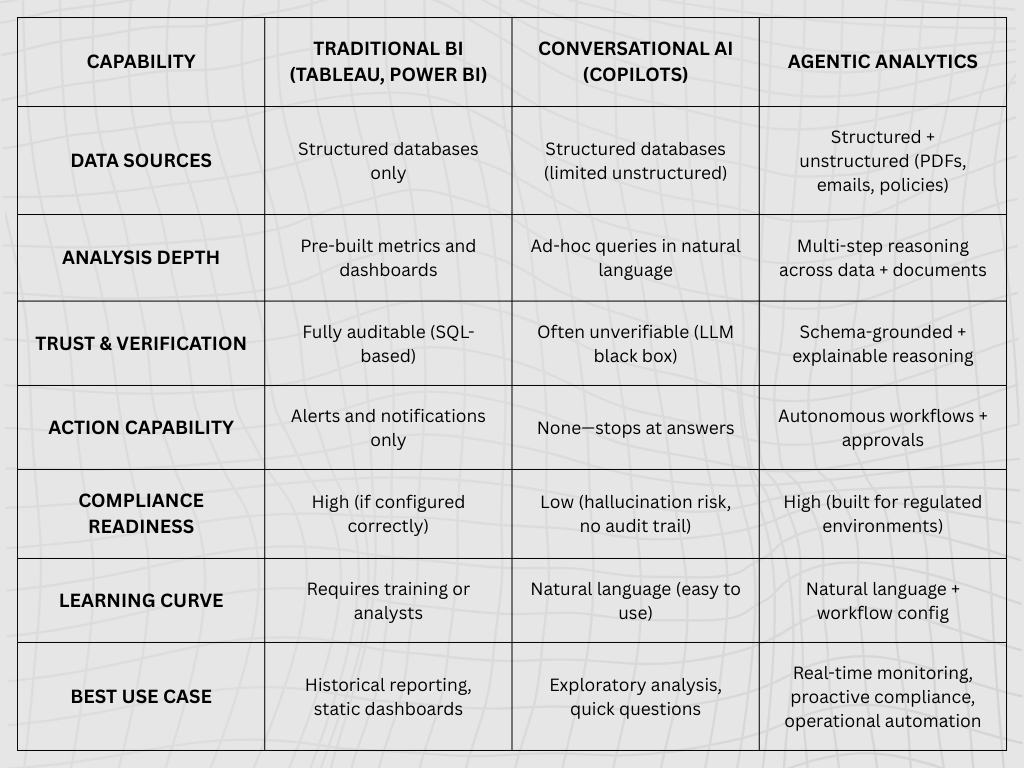
The Bottom Line: If you need to visualize historical data, use BI. If you need to explore data with questions, use conversational AI. If you need to detect, decide, and act in real time—especially in compliance-heavy workflows—you need Agentic Analytics.
How Leading Financial Institutions Are Preparing for Agentic Analytics
The shift to Agentic Analytics isn't theoretical. Banks, NBFCs, and insurers across India are already piloting agent-driven systems—starting small, proving value, then scaling.
Here's the pattern successful institutions follow:
Start with One High-Risk Workflow
Don't boil the ocean. Pick a single, painful compliance workflow where manual effort is high and error cost is catastrophic:
- Regulatory change monitoring and impact analysis
- Branch audit preparation and evidence gathering
- Fraud alert triage and investigation
- Customer complaint analysis and SLA tracking
Pilot for 90 days. Measure time-to-decision reduction, error rate improvement, and compliance officer satisfaction.
Build Trust Through Transparency
Introduce agents gradually. Let compliance teams see the reasoning, question the outputs, and override recommendations. Trust comes from repeated accuracy, not marketing promises.
Run agents in "shadow mode" first: they analyze and recommend, but humans execute. Once confidence builds, flip to agent execution with human review.
Integrate with Existing Systems—Don't Rip and Replace
Agentic Analytics shouldn't require replacing your core banking system, data warehouse, or BI stack. It should augment them:
- Agents query your existing databases
- Workflows trigger existing approval systems
- Outputs feed existing dashboards and reports
The goal is to amplify your current infrastructure, not replace it.
Measure Business Outcomes, Not AI Metrics
Success isn't "agent accuracy" or "query response time." Success is:
- Compliance decisions made 10x faster without sacrificing quality
- Regulatory breaches prevented before they occur
- Audit preparation time cut by 60%
- Penalties avoided through proactive remediation
These are the metrics that boards and regulators care about.
The Moment for Agentic Analytics Is Now
The regulatory environment isn't getting simpler. Data volumes aren't shrinking. Compliance teams aren't getting bigger.
The only variable you can change is how fast you turn insight into action.
Traditional BI showed you what happened. Conversational AI explained why it happened. Agentic Analytics does something about it—at the speed of software, with the oversight of humans, and the auditability regulators demand.
If you're a Chief Compliance Officer, Chief Risk Officer, or Head of Internal Audit at an Indian bank, NBFC, or insurer, this is the moment to evaluate AI that doesn't just explain risk—it acts on it.
Because in regulated financial services, the cost of being reactive isn't just inefficiency.
It's existential.
Frequently Asked Questions About Agentic Analytics
1. Is Agentic Analytics safe for banks and regulated financial institutions?
Yes—when architected correctly, Agentic Analytics is safer than unverified conversational AI tools.
Enterprise-grade agentic systems include four critical safety layers:
- Schema grounding: Every data point traces back to source tables with query logic you can audit—no hallucinations
- Explainable reasoning: Agents show their work with logic chains, confidence scores, and source citations
- Role-based access control: Agents inherit your existing security permissions and can't bypass data governance policies
- Immutable audit trails: Every agent action, query, and decision is logged with timestamps for regulatory inspection
The key difference from consumer AI tools: Agentic Analytics platforms are built from the ground up for regulatory scrutiny, not just user convenience. You can present agent reasoning to RBI, SEBI, or IRDAI auditors with full documentation—something impossible with black-box LLMs.
2. How is Agentic Analytics different from AI copilots or ChatGPT?
AI copilots (like Microsoft Copilot or ChatGPT) are question-answering tools. Agentic Analytics is an execution platform. Here's the fundamental difference:
AI Copilots:
- You ask a question → AI gives an answer
- Stops at insight (you still manually act)
- Can't verify if answers are grounded in real data or hallucinated
- No workflow orchestration or multi-step reasoning
- No audit trails or approval mechanisms
Agentic Analytics:
- AI proactively detects issues → analyzes root causes → executes coordinated actions
- Moves from insight to execution (with governance controls)
- Schema-grounded with full data lineage
- Orchestrates multi-agent workflows (e.g., detect compliance gap → calculate impact → notify stakeholders → draft remediation plan)
- Built-in approval workflows and comprehensive audit logs
Example: If a new RBI circular is issued, a copilot might summarize it when you ask. Agentic Analytics automatically reads the circular, maps it to your loan products, calculates compliance gaps, and prepares a remediation plan—before you even know the circular exists.
Think of it this way: copilots are like having a smart assistant who answers questions. Agentic Analytics is like having a team of specialists who continuously monitor your business and take action.
3. Can AI agents take autonomous actions in regulated environments, or do humans always need to approve?
Both—depending on the risk level of the action. Agentic Analytics uses risk-calibrated autonomy:
Fully Autonomous (No Human Approval Required):
- Monitoring and detection (flagging anomalies, tracking metrics)
- Evidence gathering (pulling transaction logs, compiling audit documents)
- Alert triage (prioritizing fraud alerts, routing complaints)
- Report generation (creating compliance summaries, audit memos)
Human-in-the-Loop (Requires Approval):
- Regulatory filings (STRs, CTRs, compliance certifications)
- Customer communications (loan restructuring offers, penalty waivers)
- Policy changes (updating SOPs, modifying approval limits)
- Financial transactions (disbursements, refunds, adjustments)
The system is configurable: you decide which actions require approval based on your risk appetite and internal controls. All actions—whether autonomous or approved—are logged in audit trails with full context.
Real-world pattern: Most institutions start with agents in "recommend-only" mode (100% human approval), build trust over 3–6 months, then selectively enable autonomy for low-risk, high-volume actions like alert triage and evidence gathering.
4. What happens if an AI agent makes a wrong decision or recommendation?
Agentic Analytics systems include multiple safeguards against errors:
Before Execution:
- Confidence scoring: Agents flag low-confidence decisions for human review (e.g., "I'm 65% confident this is fraud—below the 80% threshold for auto-escalation")
- Cross-validation: Multiple agents analyze the same issue from different angles; conflicts trigger human arbitration
- Business rule enforcement: Hard-coded guardrails prevent agents from violating compliance policies (e.g., can't approve loans above authority limits)
During Execution:
- Approval workflows: High-risk actions require human sign-off—agents propose, humans decide
- Rollback mechanisms: Reversible actions can be undone if errors are detected
After Execution:
- Audit trails: Full documentation of agent reasoning allows post-mortem analysis
- Feedback loops: Humans can mark agent decisions as incorrect, which improves future performance
- Alert mechanisms: Anomalous agent behavior (unusual query patterns, unexpected outputs) triggers system-level notifications
Critical point: Agent errors in regulated environments are traceable and fixable, unlike black-box AI where you can't determine what went wrong or why. When an agent makes a mistake, you can see exactly which data it queried, which rules it applied, and where the logic failed—then correct it systematically.
5. Do we need to replace our existing BI tools and data infrastructure to implement Agentic Analytics?
No—Agentic Analytics is designed to augment, not replace, your existing stack.
What You Keep:
- Core banking systems / insurance platforms
- Data warehouses (Oracle, Snowflake, Databricks)
- BI dashboards (Tableau, Power BI, Looker)
- Existing databases (PostgreSQL, SQL Server, etc.)
What Agentic Analytics Adds:
- Agent layer that sits on top of your existing data infrastructure
- Workflow orchestration that connects data insights to operational actions
- Unstructured data processing (PDFs, emails, documents) that traditional BI can't handle
- Real-time monitoring and execution that dashboards don't provide
Integration Pattern:
- Agents query your existing databases using standard SQL/APIs (no data migration required)
- Knowledge agents ingest documents from your current repositories (SharePoint, email systems, DMS)
- Analytical insights feed back into your BI dashboards for visualization
- Workflow actions integrate with existing approval systems (ticketing, email, collaboration tools)
Timeline: Most implementations take 8–12 weeks for initial pilot (one workflow), with phased rollout to additional use cases over 6–9 months. You're not replacing infrastructure—you're adding intelligence and automation on top of what already works.
Bottom line: If you have data in databases and documents in repositories, you can implement Agentic Analytics without ripping out existing systems.

Transform Your Business With Agentic Automation
Agentic automation is the rising star posied to overtake RPA and bring about a new wave of intelligent automation. Explore the core concepts of agentic automation, how it works, real-life examples and strategies for a successful implementation in this ebook.
Sarfraz Nawaz is the CEO and founder of Ampcome, which is at the forefront of Artificial Intelligence (AI) Development. Nawaz's passion for technology is matched by his commitment to creating solutions that drive real-world results. Under his leadership, Ampcome's team of talented engineers and developers craft innovative IT solutions that empower businesses to thrive in the ever-evolving technological landscape.Ampcome's success is a testament to Nawaz's dedication to excellence and his unwavering belief in the transformative power of technology.

More insights
Discover the latest trends, best practices, and expert opinions that can reshape your perspective







Contact us

