
Agentic Workflow Automation- The New Operating System for Enterprise Decision-Making (2026 Guide)


By 2026, enterprises generate 10× more data than they can act on, while decision latency continues to rise. That mismatch, not lack of data, now defines competitive failure.
Boards expect faster answers. Markets punish delay. Yet most enterprises still rely on dashboards that report after outcomes are locked in. Teams review numbers, debate causes, and manually trigger actions long after opportunities pass.
Modern businesses no longer run on isolated metrics. They operate on signals flowing from CRM systems, support chats, contracts, logs, supplier emails, competitor moves, and market news. Human teams cannot continuously synthesize this volume at speed.
Agentic systems can.
They ingest mixed data, reason across multiple steps, evaluate scenarios, and trigger governed actions. This behavior mirrors how strong operators think, but at machine scale and speed.
Organizations that adopt this model early gain a structural edge. Those that delay will still analyze yesterday while competitors act on today.
The Enterprise Data Reality: Why BI Is Failing in 2026
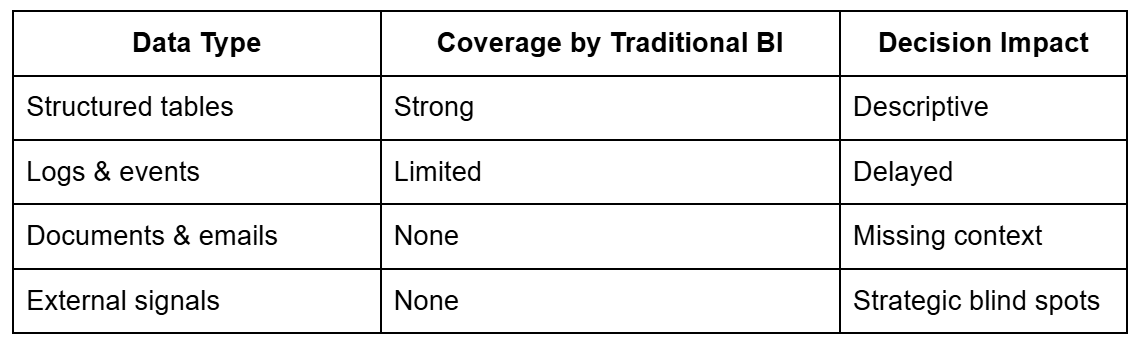
Here is the uncomfortable truth most leadership teams underestimate: the majority of enterprise data never enters analytics workflows at all. This includes contracts, emails, chat conversations, call transcripts, PDFs, operational logs, media files, and external market signals .
Traditional BI platforms were never designed for this reality. They depend on predefined schemas and clean tables. Anything that cannot fit rows and columns remains invisible. As a result, decision systems operate with a partial view of reality while critical context sits unused.
This creates a silent risk. Executives believe they are data-driven, yet their decisions rely on a narrow slice of available intelligence. Important signals arrive too late or not at all.
Traditional BI Covers Only the Structured Slice
Business Intelligence tools perform well within a limited boundary. They aggregate metrics, track KPIs, and compare historical trends.
BI answers questions like:
- What happened last quarter
- Which region missed targets
- How costs moved month over month
BI struggles with:
- Why customers changed behavior
- Which document triggered operational risk
- How competitor actions influenced outcomes
This limitation explains why BI adoption plateaus inside enterprises. Teams look at dashboards, then move to emails, Slack threads, spreadsheets, and meetings to fill gaps manually.
The Context Gap That Breaks Decisions
The most damaging failure of BI lies in context separation. Numbers move, but explanations live elsewhere. Customer churn appears in dashboards, yet the reason hides inside support chats. Supply delays surface in metrics, yet warnings sat in vendor emails weeks earlier.
Traditional BI cannot:
- Read documents or conversations
- Correlate metrics with narrative signals
- Detect causes beyond predefined models
- Trigger downstream actions automatically
This gap forces humans to act as translators between systems. Every translation adds delay, interpretation risk, and inconsistency. At enterprise scale, that delay becomes a competitive disadvantage.
Why Conversational Analytics Wasn’t Enough
Conversational analytics entered the enterprise with a clear promise: remove friction between people and data. Business users could finally type questions instead of navigating dashboards or writing queries. That shift improved accessibility and reduced dependence on analysts for simple requests.
Yet access alone never solved decision speed.
Conversational systems responded only after someone asked a question. They waited for direction. They returned answers in isolation. The burden of connecting insights, validating accuracy, and deciding next actions still sat squarely with humans.
As a result, conversational analytics shortened query time but left the overall decision cycle largely unchanged.
1. Schema Complexity Broke Accuracy
Enterprise data environments rarely resemble clean demos. They contain hundreds of tables, nested joins, historical logic, and business-specific definitions layered over years. Raw large language models struggle inside this complexity.
Without deep grounding, conversational tools frequently:
- Misinterpret joins across tables
- Apply incorrect aggregations
- Miss filters tied to business logic
- Produce confident but wrong answers
These failures eroded trust quickly. Leaders cannot rely on systems that sound correct but collapse under scrutiny. Accuracy matters more than fluency at executive levels.
This limitation surfaced repeatedly in enterprise pilots, where conversational tools performed well on simple datasets but failed under real operational conditions.
2. Single-Turn Answers Couldn’t Handle Real Questions
Business questions rarely end after one response. A revenue dip leads to follow-ups. A churn spike demands investigation. A supply issue raises scenario planning.
Conversational analytics handled questions one at a time. Context broke between turns. Each follow-up required rephrasing and reorientation. That friction pushed teams back to manual analysis and meetings.
Real decision work requires:
- Multi-step reasoning
- Hypothesis testing
- Evidence comparison
- Iterative refinement
Conversational tools lacked memory and planning depth to support this flow.
3. No Bridge from Insight to Action
The most critical failure remained execution. Conversational analytics stopped at explanation. Once an answer appeared, humans still needed to:
- Notify teams
- Update systems
- Trigger workflows
- Track follow-through
That gap preserved latency. Insight without action holds little value in fast-moving environments. Until analytics systems could act within governed boundaries, they remained advisory tools rather than operational assets.
4. Enter Agentic Workflow Automation (Definition + Market Moment)
Agentic Workflow Automation represents a clear break from how analytics systems behaved in the past. Instead of waiting for users to ask questions, these systems operate with intent. They ingest data continuously, reason through situations step by step, decide on next actions, and execute those actions within defined boundaries.
A precise definition fits best here:
Agentic Workflow Automation refers to AI agents that ingest structured, semi-structured, unstructured, and external data, reason across multiple steps, detect situations, decide responses, and execute actions autonomously with enterprise governance.
This definition matters because it highlights four capabilities working together, not separately:
- Full-spectrum data intake
- Multi-step reasoning
- Decision logic
- Execution with control
Without all four, automation stalls.
1. How This Differs Fundamentally from Conversational Analytics
Conversational analytics improved how people talk to data. Agentic Workflow Automation changes how data behaves.
The difference becomes obvious in practice.
Conversational systems follow a pattern:
- Ask a question
- Receive an answer
- Human decides next steps
Agentic systems follow a different pattern:
- Define an objective
- Break it into tasks
- Analyze across sources
- Compare scenarios
- Trigger actions
This shift removes humans from the middle of routine decision loops while keeping them in control of policy and oversight.

This table explains why conversational tools stalled at productivity gains, while agentic systems unlock operational leverage.
2. Why the Market Shifted Now
The timing of Agentic Workflow Automation aligns with three converging changes.
First, data volume and diversity crossed a threshold. Enterprises no longer manage just databases. They manage conversations, documents, signals, and external intelligence at scale.
Second, AI models matured beyond text generation. Modern systems can plan, reason, retrieve evidence, and coordinate tasks reliably.
Third, enterprises demanded governance. Early AI tools failed trust tests. New platforms embed access controls, audit logs, and traceability from the ground up.
Industry analysts now describe this phase as agentic analytics, marking the transition from AI-assisted insight to autonomous decision support .
3. Competitive Momentum Confirms the Direction
Established analytics vendors publicly signal movement toward agent-based execution. New platforms build natively around agents rather than dashboards. The consistency of this direction across the market confirms one thing: analytics without action no longer satisfies enterprise needs.
Agentic Workflow Automation did not appear as an experiment. It emerged as a response to systemic limits that every large organization now feels.
The Full Agentic Workflow: How It Actually Works (Step-by-Step)
Agentic Workflow Automation works because it follows a disciplined execution path, not a vague AI conversation. Each stage builds on the previous one, forming a closed loop from signal to action. Below is the full workflow used by agentic systems designed for enterprise scale.
Step 1: Data Intake Through a Unified Fusion Layer
Everything starts with data fusion. Agentic systems ingest information from all operational surfaces, not just databases.
This includes:
- Structured data from ERP, CRM, finance, POS systems
- Semi-structured data from logs, APIs, event streams, IoT feeds
- Unstructured data from documents, emails, chats, tickets, call transcripts
- External data from market news, competitor pricing, regulatory updates
The key difference from BI lies in parallel ingestion. Data does not need to be pre-modeled before use. Agents access it on demand, preserving raw context while applying structure only where needed.
This fusion layer removes the artificial boundary between “analytics data” and “operational context.”
Step 2: Contextual Reasoning via Agent Planning
Once a signal appears, the orchestrator agent takes over.
Instead of answering immediately, it plans the investigation.
Example objective:
“Explain why revenue declined last week and propose corrective actions.”
The orchestrator breaks this into tasks:
- Query revenue by segment
- Read customer complaints from the same period
- Check competitor promotions
- Compare logistics delays by region
This planning step separates agentic systems from reactive tools. The system decides how to think before it decides what to say.
Step 3: Analytical Agents Perform Deep Analysis
Analytical agents execute quantitative work in parallel:
- Detect anomalies in metrics
- Identify drivers behind deviations
- Run short-term forecasts
- Rank contributing factors by impact
These agents behave like focused specialists. Each one handles a specific analytical function, ensuring depth without overload.
Step 4: Knowledge Agents Add Business Context
Numbers alone rarely explain outcomes. Knowledge agents fill the gap by:
- Reading documents and emails
- Running semantic search across conversations
- Pulling relevant external intelligence
They attach meaning to metrics, turning fluctuations into explanations leadership can trust.
Step 5: Decide and Execute
Finally, the system evaluates options, projects outcomes, and executes approved actions:
- Notify teams
- Trigger workflows in CRM, ERP, marketing, or procurement systems
- Log every step for audit and review
This execution layer marks the decisive break from BI. Insight no longer stops at understanding. It moves directly into action.
Why Agentic Workflow Automation Solves the BI Gaps
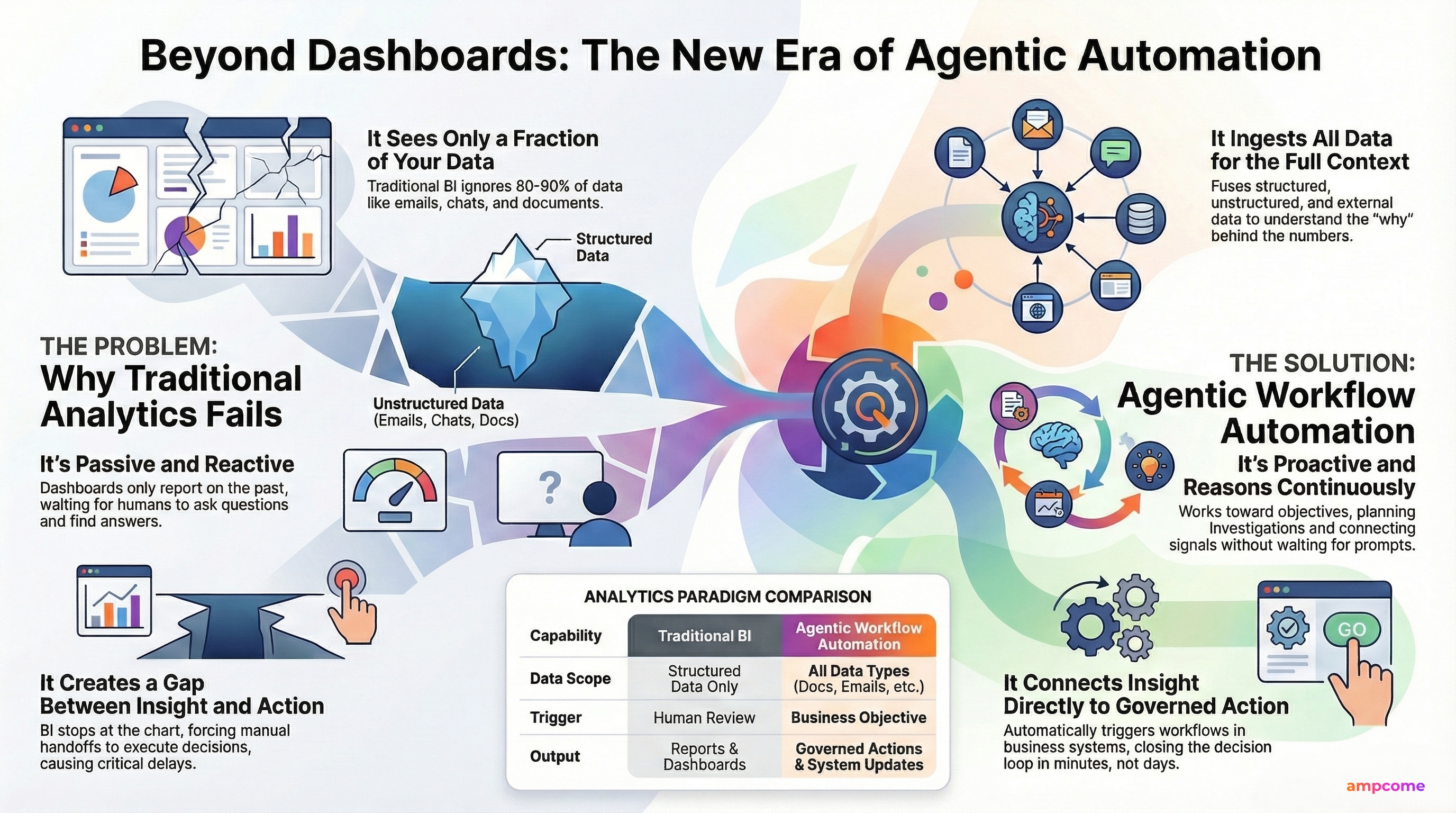
Traditional BI did not fail because teams used it poorly. It failed because it was built for a simpler data and decision environment. Agentic Workflow Automation succeeds because it directly addresses each structural gap that BI could never close.
1. Gap One: Missing Context → Solved by the Fusion Engine
BI systems rely on curated tables. Anything outside that boundary stays invisible. Agentic Workflow Automation removes this boundary by design.
A fusion engine ingests structured records, operational logs, documents, conversations, and external signals together. Context no longer sits in separate tools. Signals that once required human stitching now appear connected automatically.
This matters because causes rarely live where metrics live. Revenue drops connect to shipping delays buried in emails. Churn spikes trace back to tone shifts in support chats. Fusion turns scattered clues into a coherent narrative.
2. Gap Two: No Reasoning → Solved by Multi-Agent Orchestration
Dashboards summarize. They never reason.
Agentic systems reason by coordinating specialized agents. Analytical agents handle metrics, trends, and forecasts. Knowledge agents interpret language and intent from text-heavy sources. An orchestrator agent plans how these agents work together.
This architecture mirrors how skilled teams operate, but removes handoffs and delays. Instead of humans asking one question at a time, the system investigates continuously and holistically .
3. Gap Three: No Action → Solved by the Execution Layer
BI stops at insight. Agentic Workflow Automation continues to execute.
Once decisions are evaluated, the system triggers downstream workflows. That might involve updating CRM records, launching retention playbooks, adjusting spend, or alerting operators. Actions follow policy rules and approval thresholds set by leadership.
This shift eliminates the last-mile problem that stalled analytics value for decades.
4. Gap Four: No Trust → Solved by Enterprise Governance
Automation without control creates risk. Agentic systems embed governance at every layer.
Access rules define who sees what. Audit logs capture every query, decision, and action. Data lineage shows how conclusions were formed. Privacy controls mask sensitive fields where required.
These controls transform AI from a black box into a system leadership can inspect, validate, and trust.
C-Level Use Cases Across the Enterprise
Agentic Workflow Automation shows its true power at the executive layer, where decisions cut across functions and delays carry material cost. Unlike BI tools that serve individual teams, agentic systems operate horizontally, supporting leadership priorities tied to growth, risk, and operational control.
For CFOs: Financial Control Without Latency
Finance leaders face constant variance. Revenue shifts, cost spikes, and forecast drift require explanation fast enough to act.
Agentic workflows monitor financial metrics continuously, detect deviations, and then investigate causes automatically. Structured financial data connects with vendor emails, procurement notes, and macroeconomic signals to explain why margins moved, not just that they did.
Use cases include:
- Automated variance explanation across cost centers
- Forecast adjustments based on external market and policy signals
- Early detection of budget overruns tied to operational behavior
Instead of monthly post-mortems, finance teams gain rolling insight with immediate corrective options .
For CMOs: Market Awareness at Machine Speed
Marketing decisions depend on timing. Campaign overlap, sentiment shifts, and competitor moves punish delay.
Agentic systems fuse internal performance data with external signals such as competitor pricing, campaign launches, and customer sentiment from reviews and social channels. The system flags conflicts or opportunities as they emerge, not after conversion drops.
High-impact workflows include:
- Competitor promotion overlap detection
- Sentiment-driven campaign adjustment
- Attribution analysis enriched with customer feedback
This removes reliance on weekly reviews and manual monitoring, giving CMOs live market intelligence.
For COOs: Operational Stability Through Early Signals
Operations break quietly before they break loudly. Shipping delays, supplier risk, and infrastructure stress often appear first in logs, tickets, or emails.
Agentic workflows read these early indicators, correlate them with operational metrics, and surface risk before service degradation reaches customers.
Key use cases:
- Supply chain risk alerts using vendor communication and IoT data
- Autonomous issue detection from system and equipment logs
- Proactive workload rebalancing based on demand patterns
This turns operations from reactive to anticipatory.
For CHROs: People Risk Without Guesswork
Workforce issues rarely appear in HR dashboards first. They show up in support chats, internal tickets, exit interviews, and policy documents.
Agentic systems analyze these signals to detect burnout risk, compliance exposure, and engagement decline.
Practical applications include:
- Early employee risk detection from communication patterns
- Policy impact analysis across documents and feedback
- Talent retention alerts tied to workload and sentiment
Leadership gains visibility into human risk before attrition becomes unavoidable.
Tangible Business Impact (What Changes After Adoption)
Agentic Workflow Automation delivers impact not through abstract AI capability, but through measurable operational shifts that compound over time. Enterprises adopting agentic systems report a clear pattern: faster decisions, fewer manual interventions, and tighter control across functions.
1. Faster Time-to-Decision
The most immediate gain appears in decision velocity. Traditional BI workflows depend on sequential handoffs between systems and people. Agentic workflows collapse those handoffs.
Instead of waiting for:
- Data extraction
- Manual analysis
- Cross-team interpretation
Agentic systems investigate continuously and surface decisions while conditions remain actionable. Enterprises see decision cycles compress from days to minutes, especially in revenue, risk, and operations workflows .
2. Automation Rate Increases Across Core Processes
Once execution becomes part of analytics, automation expands naturally. Repetitive decisions move out of meetings and into governed workflows.
Common automation outcomes include:
- Automatic alerting with context
- Policy-driven action triggers
- System updates without human intervention
This does not remove oversight. It removes friction.
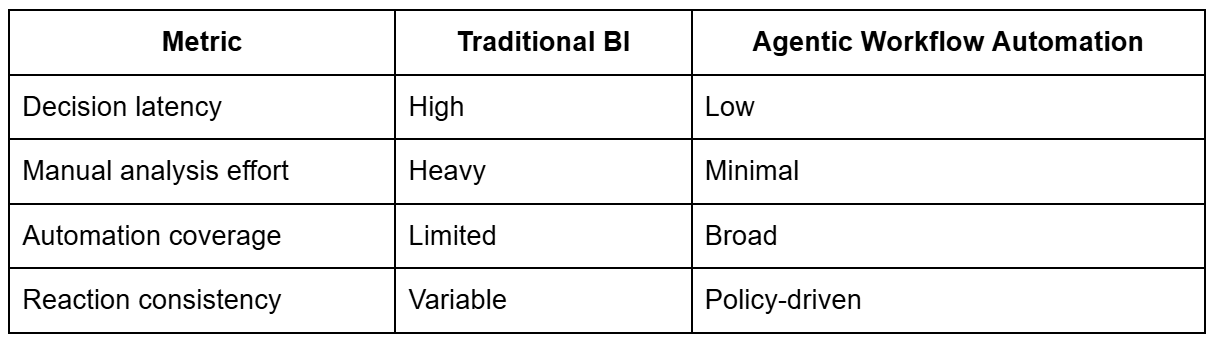
3. Manual Effort Drops Without Losing Control
Analysts and operators spend less time gathering inputs and more time evaluating outcomes. Agentic systems perform the legwork: reading documents, correlating signals, and assembling explanations.
This reduction in manual effort does not reduce accountability. It improves it. Every decision carries:
- Traceable inputs
- Logged reasoning
- Recorded actions
Teams gain clarity instead of noise.
4. Consistency and Compliance Improve
Human-driven processes vary by experience, attention, and urgency. Agentic workflows apply the same logic every time.
This consistency matters in regulated and high-risk environments. Audit trails show what happened, why it happened, and who approved it. Privacy controls apply uniformly. Access boundaries remain enforced across all workflows.
Organizations reduce compliance risk while increasing speed, a combination previously considered unrealistic.
5. Unlocking the Hidden Majority of Data
Perhaps the largest impact comes from scope. Traditional tools operate on roughly 10–20 percent of enterprise data. Agentic systems unlock the remaining majority by reading unstructured and external sources alongside core systems .
That shift changes what leaders see and how early they see it.
Why Agentic Workflow Automation Wins Over Legacy & First-Gen AI
Agentic Workflow Automation outperforms earlier analytics approaches because it changes how decisions get made, not just how data gets accessed. The difference becomes clear when comparing it directly with legacy BI and first-generation AI tools.
1. Agentic Workflow Automation vs Traditional BI
Traditional BI systems center on visibility. They collect structured data, apply models, and present charts. This worked in slower environments where decisions followed reporting cycles.
Agentic Workflow Automation operates differently. It treats analytics as an active system, not a reporting layer.
Key distinctions:
- BI waits for human review; agentic systems monitor continuously
- BI summarizes history; agentic systems evaluate emerging situations
- BI depends on manual follow-through; agentic systems execute actions
2. Agentic Workflow Automation vs Chat-to-Data Tools
First-generation AI analytics focused on natural language querying. Users could ask questions in plain English and receive answers quickly. This improved accessibility but exposed deeper limitations.
Chat-based tools struggle with:
- Complex enterprise schemas
- Multi-step reasoning across systems
- Persistent context across investigations
- Execution beyond explanation
Large language models alone lack business grounding. Without semantic context and orchestration, they produce responses that sound confident but break under scrutiny. This accuracy gap erodes trust, especially at executive levels .
3. Agentic Workflow Automation vs AI Add-ons from Big Vendors
Large analytics vendors added AI features to existing platforms. These additions improved usability but remained constrained by legacy architectures.
Add-on AI typically:
- Operates only on pre-modeled structured data
- Remains tied to dashboards and reports
- Lacks native execution engines
- Inherits rigidity from older systems
Agentic platforms, by contrast, are built AI-first. They assume unstructured data, external signals, and workflow execution from the start. This design allows faster innovation and deeper automation.
4. Strategic Implication for Founders and Boards
Choosing agentic workflows over incremental AI upgrades represents a strategic decision. Incremental tools improve efficiency at the margins. Agentic systems change operating models.
Organizations that adopt agentic automation early build:
- Faster decision loops
- Higher signal coverage
- Lower operational drag
The Future of Agentic Workflow Automation
Agentic Workflow Automation does not represent a feature upgrade. It signals a structural shift in how enterprises operate. The future belongs to organizations that treat decision systems as living infrastructure rather than static tools.
1. From Tools to Autonomous Operating Layers
Early analytics platforms functioned like instruments. Leaders checked them, interpreted results, and acted. Agentic workflows behave more like an operating layer running continuously in the background.
These systems monitor signals, reassess conditions, and adjust actions without waiting for prompts. Over time, enterprises will rely less on scheduled reviews and more on always-on intelligence that keeps operations within guardrails automatically.
2. Multi-Agent Systems Become the Norm
Single-model intelligence cannot handle enterprise complexity alone. The future favors collaborating agents, each optimized for a role.
Expect enterprises to deploy:
- Financial reasoning agents
- Risk and compliance agents
- Market intelligence agents
- Operational monitoring agents
An orchestration layer will coordinate these agents, decide which ones to activate, and synthesize outcomes. This structure scales naturally as organizations grow. New agents plug in without redesigning the system.
3. Decision Automation Becomes Standard Practice
Automation will expand gradually, not recklessly. Enterprises will begin with low-risk, high-frequency decisions and extend autonomy as confidence builds.
Common patterns will include:
- Automatic remediation of operational anomalies
- Policy-driven financial adjustments
- Real-time marketing and pricing corrections
Human oversight remains, but shifts upward. Leaders review strategy and exceptions, not routine adjustments.
4. Competitive Pressure Forces Adoption
As more enterprises adopt agentic workflows, laggards face structural disadvantages. Slower reaction time compounds into lost revenue, higher risk exposure, and operational drag.
Agentic Workflow Automation therefore moves from innovation to expectation. Vendors, partners, and boards will increasingly assume its presence as part of modern enterprise architecture.
Why Agentic Workflow Automation Becomes the Enterprise Standard
Enterprise decision-making reached a breaking point. Data volumes exploded. Signals multiplied. Reaction windows shrank. Yet most organizations still rely on systems built to report, not to respond.
Agentic Workflow Automation resolves that mismatch.
It connects all data types, reasons across steps, evaluates options, and executes actions under governance. Decisions no longer wait for dashboards, meetings, or manual handoffs. They move as fast as the business itself.
For founders and CXOs, the implication stays clear. Competitive advantage no longer comes from having more data or better charts. It comes from shorter decision loops and controlled autonomy.
Why Assistents.ai Fits This Moment
Assistents.ai was built specifically for this new operating model. It does not bolt AI onto dashboards. It starts with agentic architecture.
- Unified data fusion across structured, unstructured, and external sources
- Multi-agent reasoning that mirrors how real teams investigate problems
- A workflow engine that moves from insight to execution
- Enterprise governance that supports trust, audit, and control
If your organization still relies on dashboards to drive decisions, you are operating with built-in delay.
Agentic Workflow Automation removes that delay.
See how Assistents.ai turns analytics into an execution engine. Experience what happens when insights stop waiting and decisions start moving.
FAQs
1. Why traditional BI tools no longer support enterprise decision-making
Traditional BI tools focus on reporting structured data and summarizing past events. Modern enterprises operate on conversations, documents, logs, and external signals that BI cannot process. This creates delayed understanding and reactive decisions. Agentic Workflow Automation addresses this by reasoning across all data types and acting within governed boundaries.
2. How Agentic Workflow Automation differs from conversational analytics
Conversational analytics improves how users ask questions but still depends on humans to interpret answers and trigger actions. Agentic Workflow Automation works toward objectives instead of questions. It plans investigations, coordinates analytical and knowledge agents, evaluates scenarios, and executes actions automatically under enterprise rules. This removes manual handoffs and shortens decision cycles.
3. Can agentic systems be trusted with sensitive enterprise data
Yes, when designed correctly. Enterprise-grade agentic platforms include role-based access control, audit logs, data lineage, and privacy safeguards. Every decision and action remains traceable. Leaders can inspect how conclusions were formed and approve or restrict automated execution.
4. What types of decisions should be automated first
Organizations begin with low-risk, high-frequency decisions. Examples include alerting, routine workflow triggers, inventory adjustments, operational remediation, and campaign optimizations. As trust grows, agentic automation can extend to more complex decisions while reserving strategic judgment for human leadership.
5. How Assistents.ai supports agentic workflow automation at scale
Assistents.ai provides a unified platform that fuses structured, unstructured, and external data, applies multi-agent reasoning, and executes governed workflows. Its architecture supports continuous monitoring, contextual analysis, and enterprise governance.

Transform Your Business With Agentic Automation
Agentic automation is the rising star posied to overtake RPA and bring about a new wave of intelligent automation. Explore the core concepts of agentic automation, how it works, real-life examples and strategies for a successful implementation in this ebook.
Sarfraz Nawaz is the CEO and founder of Ampcome, which is at the forefront of Artificial Intelligence (AI) Development. Nawaz's passion for technology is matched by his commitment to creating solutions that drive real-world results. Under his leadership, Ampcome's team of talented engineers and developers craft innovative IT solutions that empower businesses to thrive in the ever-evolving technological landscape.Ampcome's success is a testament to Nawaz's dedication to excellence and his unwavering belief in the transformative power of technology.

More insights
Discover the latest trends, best practices, and expert opinions that can reshape your perspective





Contact us

