
15 Best AI Tools for Civil Engineers in India (2026 Rankings)


India is running one of the largest infrastructure build-outs in the world right now — highways, metro rail, smart cities, renewable energy, and water systems, often on compressed timelines and thin margins. It's exactly the kind of environment where AI tools for civil engineers in India stop being a nice-to-have and start being the difference between a firm that wins bids and one that's still buried in paperwork when the deadline hits.
But "AI tools for civil engineers" actually covers two very different shopping lists. If you're a student or a solo practitioner, you probably want a free calculator that checks an RCC beam design against IS 456. If you're running an engineering, EPC, or infrastructure-owning firm, you need something that can read a 300-page tender document, catch a revision before it costs you a bid, or watch a power grid for anomalies at 2 a.m.
This guide covers both — ranked, compared, and backed by real deployment data instead of marketing copy. You'll get a quick comparison table, all 15 tools broken down, three real (anonymized) case studies of AI agents running in Indian and global infrastructure environments today, and a framework for picking the right one for where you actually are.
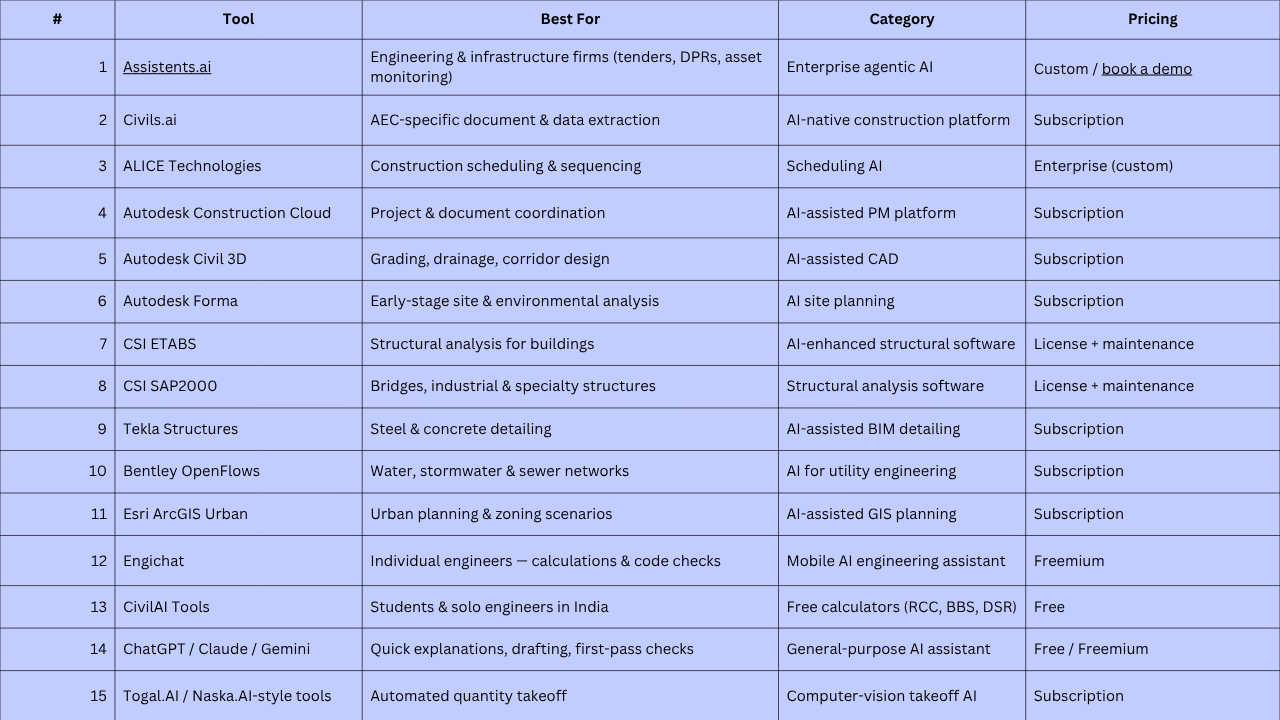
Quick Comparison: Best AI Tools for Civil Engineers in India at a Glance
What Actually Counts as an "AI Tool" for Civil Engineers?
An AI tool for civil engineers is any software that uses machine learning, computer vision, or large language models to help with design, analysis, documentation, or infrastructure operations — but there's a real split within that category. An AI assistant answers questions and drafts content; a human still has to read every output and take every downstream action. An AI agent is given a goal — "process this tender," "flag this grid anomaly" — and executes the multi-step workflow to get there, including exceptions and audit logging, largely without hand-holding.
That distinction matters more than most "best AI tools" lists let on, which is why this ranking spans both categories deliberately: free calculators and assistants for individual, task-level work, and governed AI agents for firm- and asset-level operations.
The 15 Best AI Tools for Civil Engineers in India
1. Assistents.ai — Best Overall for Engineering & Infrastructure Firms
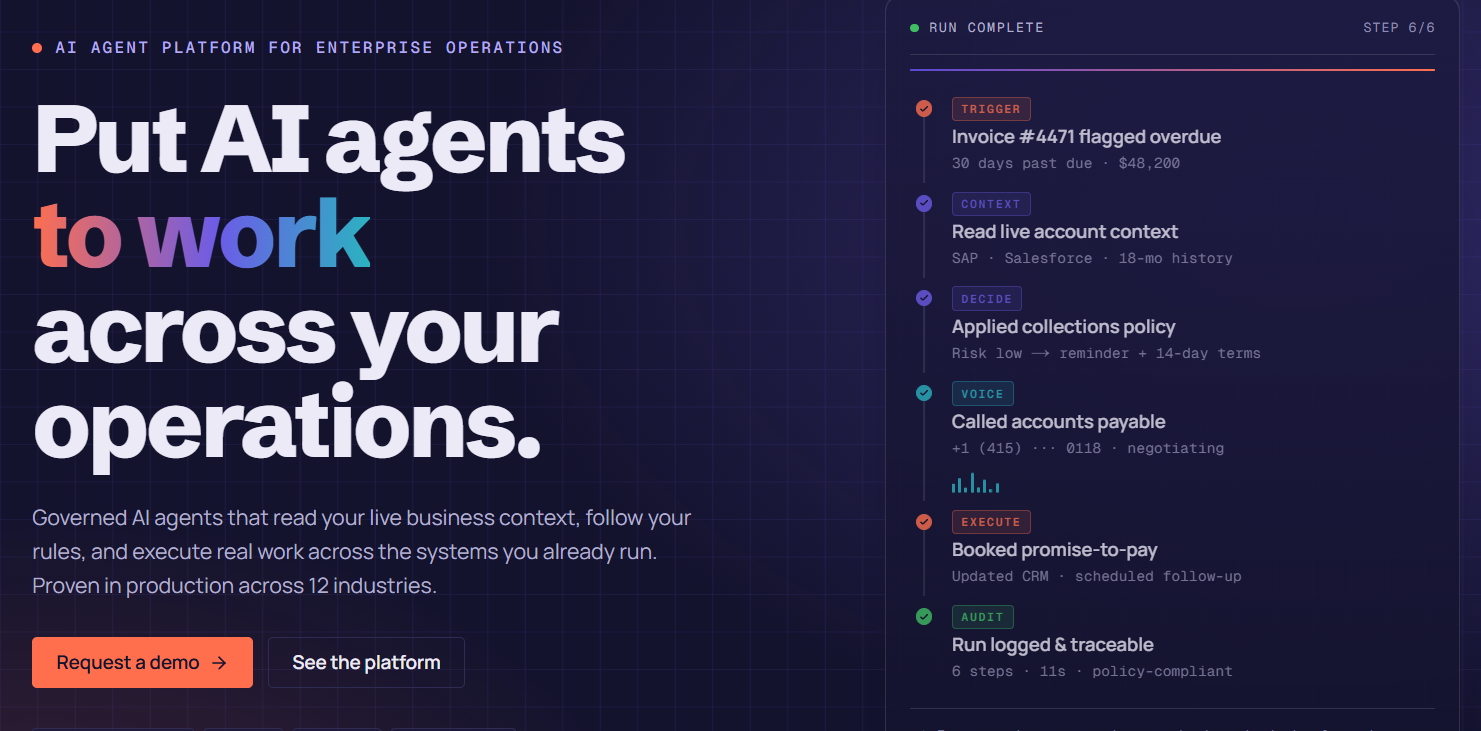
Assistents.ai is an enterprise agentic AI platform built by Ampcome that connects to the systems engineering and infrastructure firms already run — ERPs, field-service platforms, document stores — and executes governed, auditable work rather than just answering questions.
For civil engineering specifically, the two most relevant capabilities are the Document AI Agent, which parses tender documents, DPRs, BOQs, and contracts (including scanned PDFs) with full extraction into your operational system, and Autonomous Agents for continuous asset and infrastructure monitoring. It's also the only entry on this list with a public, verifiable production deployment specifically in construction document processing — covered in the case studies section below.
Best for: Engineering firms, EPC contractors, and infrastructure owners who need governed execution, not another chatbot.
Not ideal for: A student who just wants a free beam calculator — see #13 for that.
Pricing: Custom, based on scope — request a demo.
2. Civils.ai — AEC-Focused Document & Data Extraction
Civils.ai is built specifically for the AEC (architecture, engineering, construction) sector, with tools for AutoCAD data extraction and no-code AI workflows aimed at civil engineers and general contractors.
Best for: Firms wanting an AEC-native tool with a lower setup lift than a full enterprise platform.
Caveat: Less depth on cross-system integration (ERP/field-service writes) than a governed agent platform.
3. ALICE Technologies — Construction Scheduling AI
ALICE generates and evaluates thousands of construction sequencing options for complex infrastructure — highways, bridges, large civil works — optimizing time, cost, and resource use simultaneously.
Best for: Large, sequencing-heavy infrastructure projects where schedule risk is the dominant cost driver.
4. Autodesk Construction Cloud — AI-Assisted Project Coordination
Autodesk Construction Cloud has layered AI features into RFI handling, submittal review, and document coordination across large project teams.
Best for: Firms already inside the Autodesk ecosystem who want incremental AI lift without switching platforms.
5. Autodesk Civil 3D — AI-Assisted Grading & Drainage Design
Civil 3D remains the workhorse for road, grading, and drainage design, now with AI-assisted alignment suggestions and cut-and-fill optimization built in.
Best for: Transportation corridors, residential subdivisions, and municipal infrastructure design work.
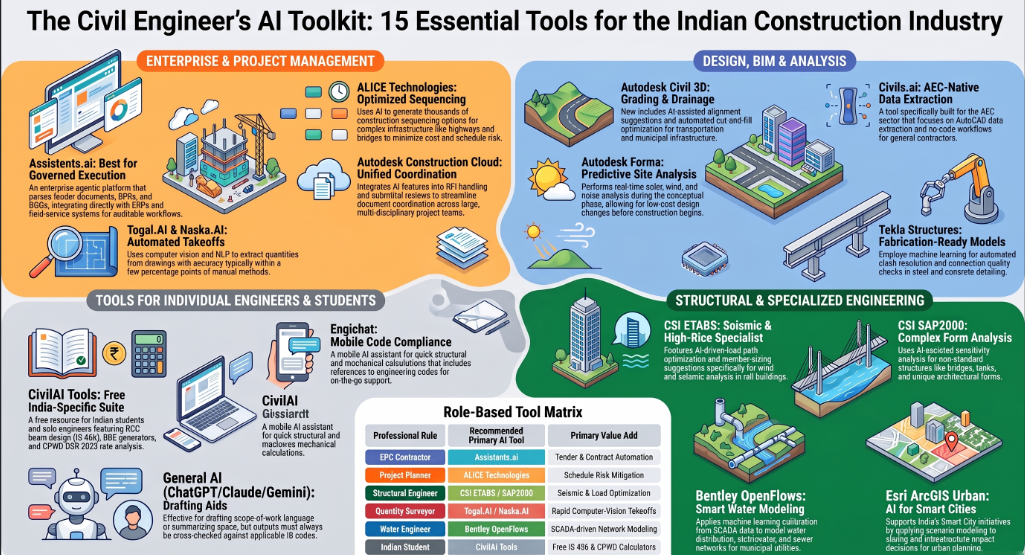
6. Autodesk Forma — AI for Early-Stage Site Analysis
Forma runs real-time solar, wind, and noise analysis during conceptual design, when changes are still cheap to make, and feeds directly into Civil 3D and Revit.
Best for: Master-planned communities and mixed-use developments where site performance decisions happen early.
7. CSI ETABS — AI-Enhanced Structural Analysis
ETABS uses AI-driven load-path optimization and member-sizing suggestions for seismic and wind analysis on multi-storey and high-rise buildings.
Best for: Structural engineers working in seismic zones or on tall buildings.
8. CSI SAP2000 — Versatile Structural Analysis
SAP2000 pairs parametric modelling with AI-assisted sensitivity analysis for bridges, tanks, and non-building structures.
Best for: Complex or unusual structural forms outside standard building typologies.
9. Tekla Structures — AI-Assisted Detailing
Tekla uses machine learning for clash resolution and connection quality checks in steel and concrete detailing, feeding directly into fabrication.
Best for: Detailing teams working toward fabrication-ready models.
10. Bentley OpenFlows — AI for Water & Utility Engineering
The OpenFlows suite (WaterGEMS, SewerGEMS, StormCAD) uses machine-learning calibration from SCADA data for water distribution, stormwater, and sewer network modelling.
Best for: Municipal water utilities and water/wastewater infrastructure design.
11. Esri ArcGIS Urban — AI for Urban Planning
ArcGIS Urban applies scenario modelling to zoning, density, and infrastructure-impact decisions — relevant to India's ongoing Smart Cities and urban-development work.
Best for: Municipal planning departments and long-range development review.
12. Engichat — Mobile AI Assistant for Calculations & Code Checks
Engichat positions itself as an AI engineering assistant for structural, electrical, and mechanical calculations with code-compliance references, aimed at individual engineers who want quick answers without switching between AutoCAD, STAAD, and Excel.
Best for: Individual engineers who want fast, code-referenced calculation support on the go.
Caveat: Always verify outputs against the current IS code edition before sign-off — no AI assistant replaces engineering judgment on a stamped drawing.
13. CivilAI Tools — Free India-Specific Calculators
CivilAI Tools is a free suite built specifically for Indian engineers and students: an RCC beam design calculator against IS 456, a bar bending schedule (BBS) generator, a CPWD DSR 2023 rate-analysis tool, and an AI floor-plan generator.
Best for: Students and solo engineers who need quick, India-specific calculations at zero cost.
Caveat: These are single-task tools — there's no firm-level workflow, tender processing, or asset monitoring here.
14. General-Purpose AI Assistants (ChatGPT, Claude, Gemini)
A lot of individual engineers already use general-purpose assistants for drafting scope-of-work language, summarizing specifications, or getting a first-pass explanation of a code clause. That's a legitimate use — but treat the output as a draft, not a verified calculation, and always cross-check against the applicable IS code or contract document.
Best for: Drafting, summarizing, and quick conceptual explanations.
Caveat: Not a substitute for domain-specific structural calculation tools.
15. Computer-Vision Quantity Takeoff Tools
Tools in the Togal.AI / Naska.AI category use computer vision and NLP to extract quantities directly from drawings and grading plans, typically within a few percentage points of manual takeoff accuracy.
Best for: Estimating teams doing high-volume public-works bidding.
Real Deployments: How AI Agents Are Already Running Infrastructure Work
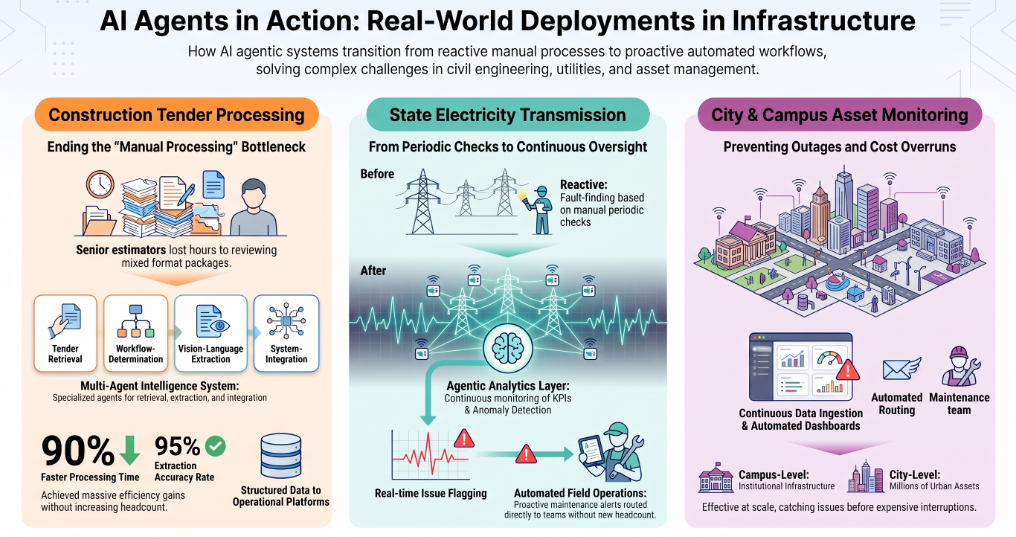
Rankings and feature lists are useful, but the honest test of any AI tool for civil engineers is whether it holds up in production. Here are three anonymized deployments — no client names, per standard practice — that show what this actually looks like at the firm and asset-operator level.
Tender document processing for a specialist construction and remediation firm. A commercial construction and remedial works firm was losing senior estimator time to manually processing tender packages that ran to hundreds of pages, in mixed digital and scanned formats, with revisions that were often missed until they had already affected pricing. A multi-agent document intelligence system — a tender retrieval agent, a workflow-determination agent, a vision-language extraction agent, and a system-integration agent — was deployed to read, classify, and write structured data directly into the firm's operational platform, with full revision detection and audit logging. The deployment was engineered to a target of roughly 90% faster tender processing, with an extraction accuracy target of around 95% for standard document formats. More detail on how this architecture works is covered in Ampcome's construction industry deep-dive and in 10 real-world document AI agent examples.
Continuous monitoring for a state electricity transmission utility. A state-owned power transmission utility responsible for keeping electricity flowing reliably across its network needed a way to move from periodic manual checks to continuous oversight of its grid. An agentic analytics layer was deployed on top of the utility's existing smart-grid systems to monitor transmission KPIs, flag anomalies, run loss and outage analytics, and generate predictive-maintenance indicators — with automated alerts routed directly to field operations teams. The result was a shift from reactive fault-finding to proactive detection, without adding headcount. Assistents.ai's Energy & Utilities solutions are built around exactly this kind of continuous monitoring use case.
Asset and energy monitoring at city and campus scale. A large infrastructure operator running dozens of city-scale operations centres and connecting millions of urban assets and applications needed a way to catch field issues and energy inefficiencies before they became outages or cost overruns. Sensor and utility data was ingested continuously into dashboards with automated anomaly detection, forecasting, and workflow routing for resolution — a pattern that also applies at a smaller scale, such as campus-level energy monitoring for institutional infrastructure. Faster exception detection and more proactive operations replaced what had previously been a reactive, manual-checking process.
Why Assistents.ai Is the Right AI Partner for Civil Engineering & Infrastructure Firms in India
The tools in positions #2 through #15 above are genuinely useful — most engineers will end up using two or three of them. But if you're running a firm rather than a single project, the calculation stops being "which tool is smartest" and starts being "which tool can I actually trust to touch my operational systems."
That's the gap Assistents.ai is built for, and it's worth spelling out why:
- It's an agent platform, not a chatbot layer. Assistents.ai's architecture — a context engine, a semantic layer, and a permission-checked action engine — means it reads your live operational data, reasons over it, and executes multi-step work, rather than answering a question and leaving the follow-through to a person.
- It's proven specifically on construction and infrastructure documents, not just generic enterprise use cases — the tender-processing deployment above is public, with engineered targets you can scrutinize rather than take on faith.
- It's built for governance from the start. SOC 2 Type II, ISO 27001, and full audit trails matter for firms bidding on government and PSU contracts where compliance documentation is part of the tender itself.
- It connects to what you already run. With 300+ system integrations, it sits on top of your existing ERP, field-service, or document-management stack instead of asking you to replace it.
- It deploys in weeks, not quarters. Ampcome's implementation process targets a pilot-to-production timeline of around four weeks for standard document and monitoring workflows.
If any of the three scenarios above sound familiar — buried in tender documents, flying blind on asset health, or manually reconciling data across systems that don't talk to each other — Assistents.ai's ROI calculator is a reasonable next step before a full conversation.
How to Choose the Right AI Tool for Your Work
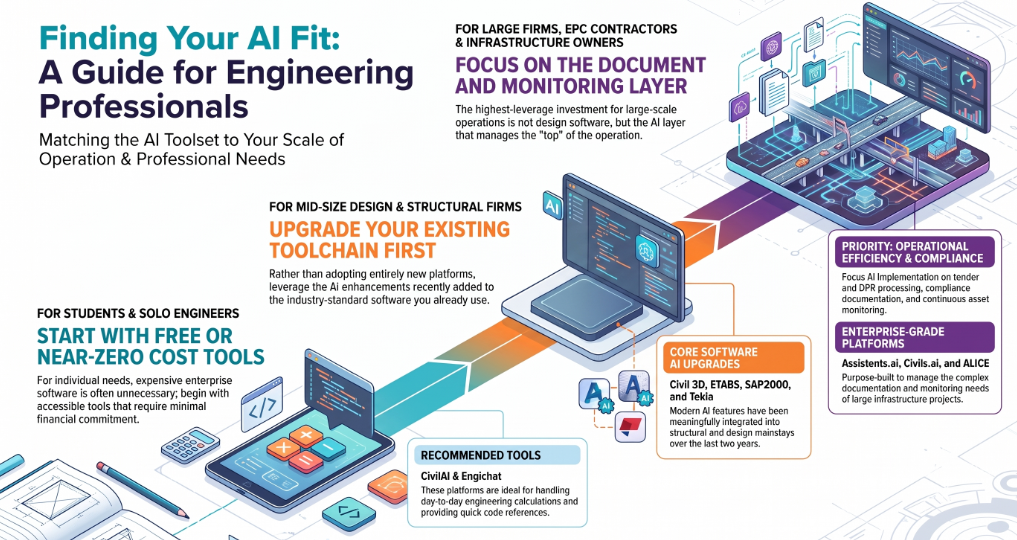
If you're a student or solo engineer: start free. CivilAI Tools or Engichat will cover most day-to-day calculation and code-reference needs at zero or near-zero cost.
If you're running design or structural work for a mid-size firm: the software you already use — Civil 3D, ETABS, SAP2000, Tekla — has meaningfully improved its AI features in the last two years. Upgrade within your existing toolchain before adding a new platform.
If you're an engineering firm, EPC contractor, or infrastructure owner: the highest-leverage AI investment usually isn't design software at all — it's the document and monitoring layer sitting on top of your operations: tender and DPR processing, compliance documentation, and continuous asset monitoring. That's the category Assistents.ai and platforms like Civils.ai and ALICE are built for.
Will AI Replace Civil Engineers in India?
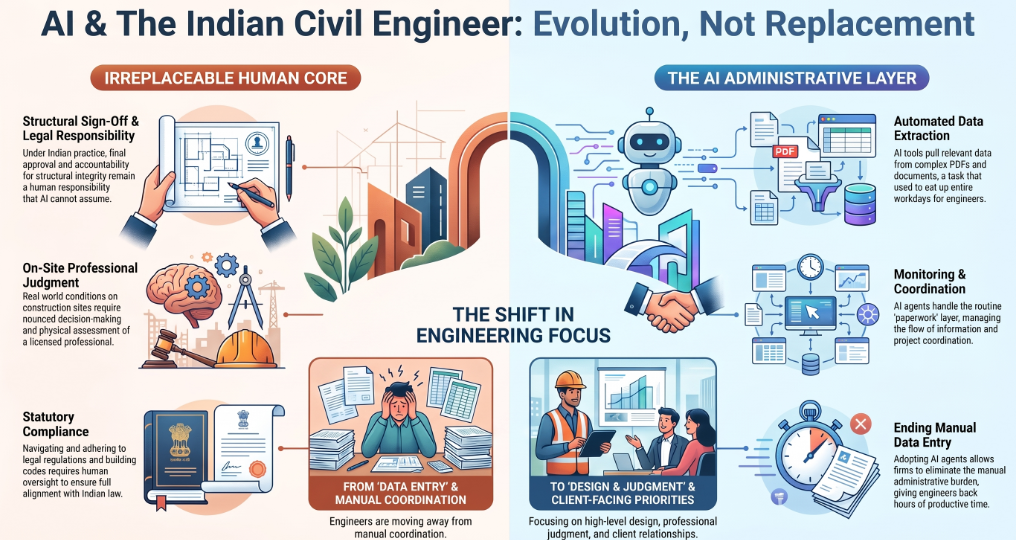
No — and this is worth saying plainly rather than hedging. Structural sign-off, statutory compliance, and on-site judgment remain human responsibilities under Indian engineering practice, and that isn't changing because a tool got better at extracting data from a PDF.
What is changing is where engineers spend their time: AI is absorbing the manual extraction, monitoring, and coordination work that used to eat entire workdays, freeing engineers for the design, judgment, and client-facing work that actually needs a licensed professional. Firms that adopt AI agents for the administrative layer aren't replacing engineers — they're giving their engineers back the hours that were going to data entry.
Conclusion
The best AI tools for civil engineers in India in 2026 aren't one tool — they're a stack that changes depending on who you are. Free calculators and mobile assistants cover individual, task-level work well. Design and structural software has genuinely useful AI features now baked in. And for firms and infrastructure owners, governed AI agents — led by platforms like Assistents.ai — are already running production workloads: processing tenders roughly 90% faster, monitoring power grids continuously, and catching asset issues before they become outages.
If you're evaluating this for a firm rather than a single project, the fastest way to find out what's realistic is a direct conversation: book a discovery call with Ampcome or run the numbers on the ROI calculator first.
FAQs
What are the best free AI tools for civil engineers in India?
CivilAI Tools covers RCC beam design, bar bending schedules, and CPWD DSR rate analysis at no cost. General assistants like ChatGPT or Claude are useful for drafting and quick explanations but should always be checked against the current IS code before use in a design.
Can AI do structural design and RCC calculations?
AI tools can run and check calculations against codes like IS 456, IS 800, and IS 1893, and can flag potential issues in a design. Final structural design decisions and sign-off still require a licensed engineer's review — this is both a professional-judgment issue and, in most cases, a regulatory requirement.
What's the difference between an AI tool and an AI agent for civil engineering firms?
An AI tool or assistant answers questions and drafts content that a person then reviews and acts on. An AI agent is given a goal — process this tender, monitor this asset — and executes the full multi-step workflow itself, including exception handling and audit logging, with a person reviewing only the exceptions.
How much time can AI save on tender or DPR document processing?
In one production deployment for a specialist construction firm, a multi-agent document system was engineered to a target of roughly 90% faster processing versus the manual baseline, with an extraction accuracy target of around 95% for standard formats. Actual results depend on document volume, format consistency, and integration depth.
What AI tools do infrastructure and EPC firms in India use for asset monitoring?
Agentic platforms like Assistents.ai are increasingly used for continuous monitoring of power transmission networks, water utilities, and smart-city infrastructure — flagging anomalies and routing alerts to field teams automatically rather than relying on periodic manual checks.
Is AI use compliant with IS codes and Indian engineering standards?
Yes — AI use isn't restricted by Indian standards, but final designs, assessments, and decisions still need to comply with the applicable IS codes and be approved by a qualified, licensed engineer. AI tools support the process; they don't substitute for the statutory sign-off.
Do enterprise AI agents integrate with existing construction and ERP software?
Reputable platforms are built to connect to the systems firms already run rather than requiring a replacement. Assistents.ai, for example, integrates with 300+ enterprise systems including ERP, field-service, and document-management platforms.

Transform Your Business With Agentic Automation
Agentic automation is the rising star posied to overtake RPA and bring about a new wave of intelligent automation. Explore the core concepts of agentic automation, how it works, real-life examples and strategies for a successful implementation in this ebook.
Sarfraz Nawaz is the CEO and founder of Ampcome, which is at the forefront of Artificial Intelligence (AI) Development. Nawaz's passion for technology is matched by his commitment to creating solutions that drive real-world results. Under his leadership, Ampcome's team of talented engineers and developers craft innovative IT solutions that empower businesses to thrive in the ever-evolving technological landscape.Ampcome's success is a testament to Nawaz's dedication to excellence and his unwavering belief in the transformative power of technology.

More insights
Discover the latest trends, best practices, and expert opinions that can reshape your perspective


.jpg)


.jpg)

Contact us

