
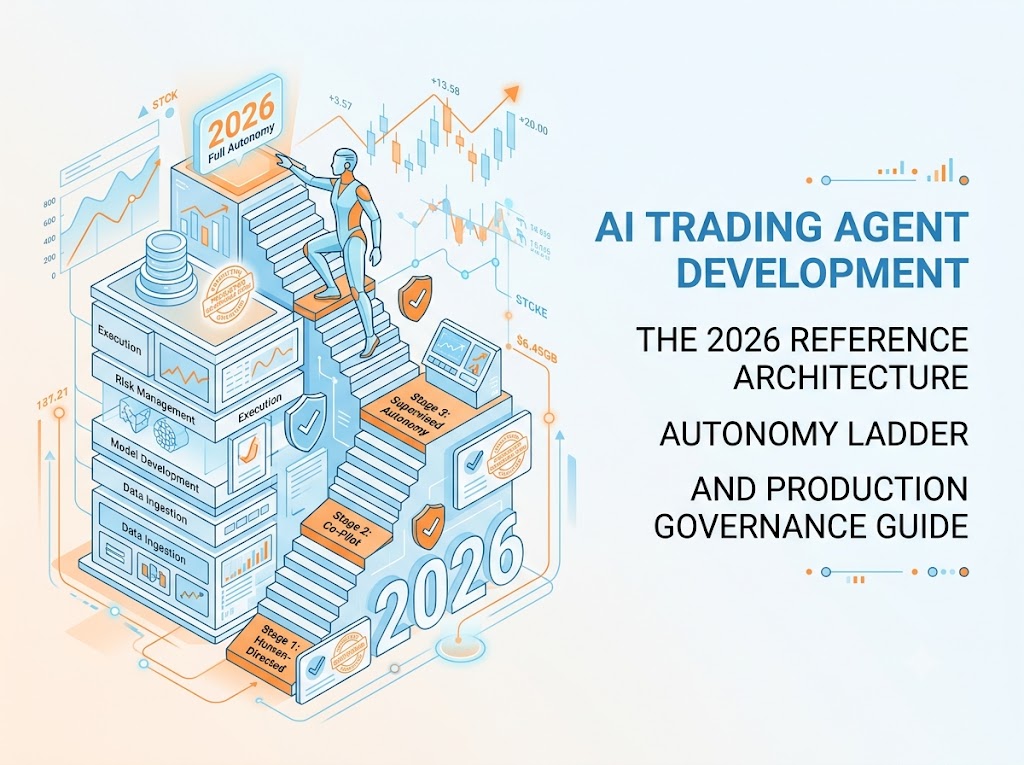
AI Trading Agent Development: The 2026 Reference Architecture, Autonomy Ladder and Production Governance Guide


Most AI trading agents do not fail in backtests. They fail in compliance review.
Engineering is no longer the hard part. Open-source frameworks will give you a multi-agent system that reads earnings transcripts, scores sentiment, debates a position and produces a trade recommendation — in an afternoon. Reference implementations of adversarial agent desks are public, well documented and heavily forked.
What stops that system from touching a live order book is a different class of problem entirely: who authorised the agent to send that order, what envelope was it operating inside, which guardrails were evaluated before execution, and can you produce that evidence eighteen months later when a regulator asks?
That is the gap this guide addresses. Not another feature list. A working architecture for AI trading agent development that survives risk review, compliance sign-off and live markets — covering the seven-layer reference architecture, a graded autonomy model, execution authority contracts, the 2026 regulatory landscape, honest cost figures including inference spend, and what production deployments have actually delivered.
This is engineering and governance guidance. It is not investment advice, legal advice or regulatory advice.
What is an AI trading agent?
An AI trading agent is an autonomous software worker that perceives market state across structured and unstructured sources, reasons over competing signals, selects an action within a bounded authority envelope, executes or escalates that action through governed capabilities, and records the evidence supporting every decision.
The definition matters because three different things are currently sold under the same name.
AI trading bot vs AI trading agent vs algorithmic strategy
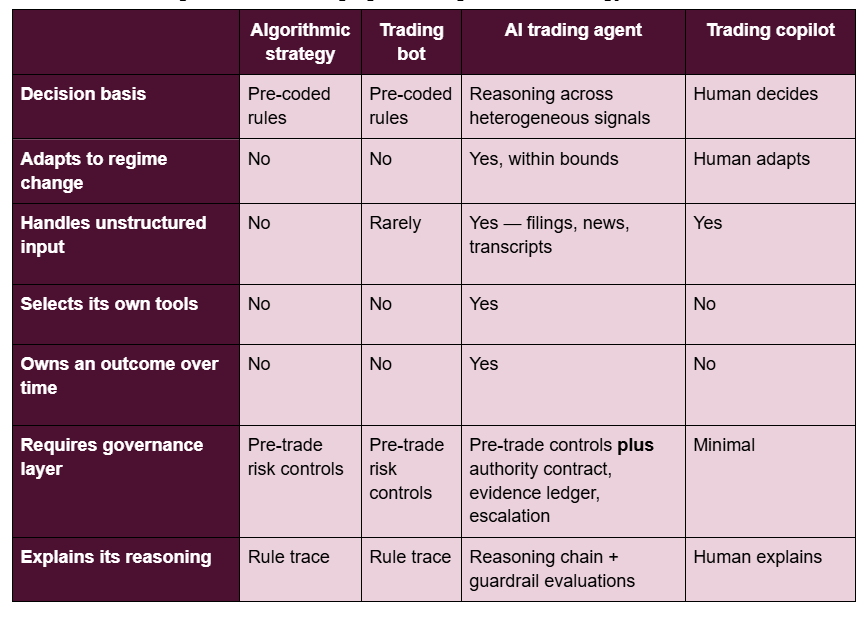
A bot executes the strategy you wrote yesterday. An agent participates in discovering, testing, sizing and executing strategy continuously — and therefore needs a control structure a bot never did.
The three properties that make it an agent
Adaptive planning. The agent decomposes an objective into steps and revises the path as evidence changes. A momentum bot fires on a crossover. An agent notices the crossover, checks whether the volatility regime still supports momentum, finds it does not, and stands down.
Tool invocation. The agent selects which capability to call — pull an options chain, retrieve a filing, run a scenario, query positions — rather than following a fixed sequence.
Durable responsibility. The agent holds an outcome across time and events, not a single request. It remembers it opened a position, monitors the thesis, and acts when the thesis breaks.
That third property is the one with governance consequences. Software that holds responsibility over time needs identity, authority, limits, supervision and a performance record — the same things a human trader needs. This is why AI trading agent development is not a modelling exercise. It is an operating model design exercise.
The 2026 state of play: what actually changed
Three shifts made this a different problem than it was even eighteen months ago.
Multi-agent debate moved from research to reference implementation
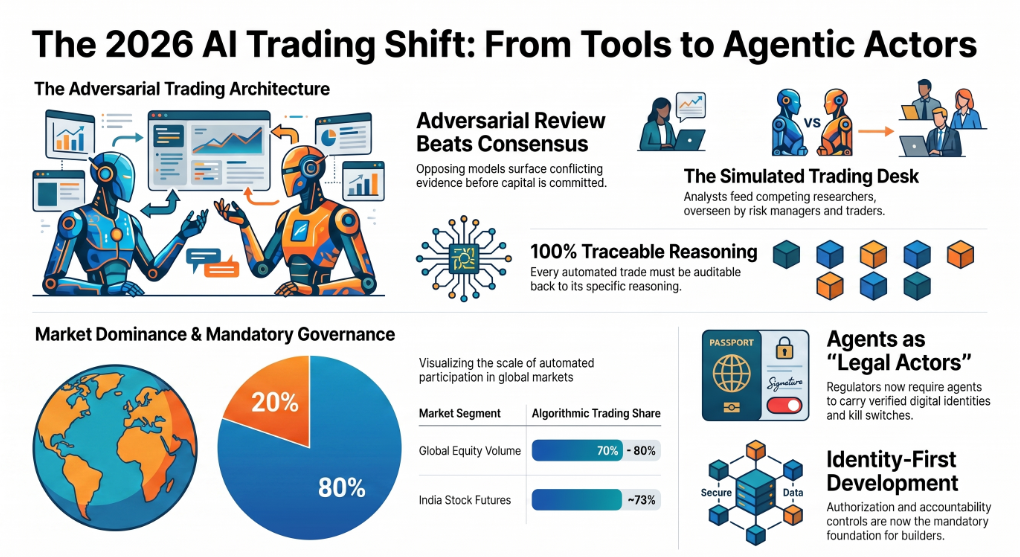
The dominant pattern is now a simulated trading desk. Four analyst agents work in parallel across fundamentals, technicals, sentiment and news. Their reports flow simultaneously to two researcher agents — one arguing the long case, one arguing against — which do not collaborate but compete. A risk manager agent reads both arguments, applies position sizing rules, and passes a final instruction to a trader agent that executes. Every step is logged so any trade can be audited back to its reasoning.
The structural insight is that adversarial review outperforms consensus. A single model asked to evaluate a trade tends to confirm its own framing. Two models assigned opposing mandates surface conflicting evidence before capital moves.
Automation is now the majority of the market
Between 70% and 80% of global equity trading volume is algorithmic. In India, automated participation in stock futures has reached roughly 73% and continues rising. Discretionary execution is now the exception in liquid markets, not the norm.
Regulators stopped treating agents as tools and started treating them as actors
This is the change most content on this topic has not caught up with. Through late 2025 and into 2026, multiple regimes converged on the same requirement: automated order flow must be traceable to an identified originator, must sit behind a functioning kill switch, and must produce a retrievable audit trail.
Singapore's IMDA published a Model AI Governance Framework for Agentic AI in January 2026 requiring each agent to carry a verifiable digital identity and an audit trail of which agent acted under whose authorisation. NIST launched an AI Agent Standards Initiative in February 2026, with associated work framing the core gap plainly: agents are commonly deployed as generic service accounts without dedicated identity, authorisation or accountability controls.
If you are building an AI trading agent in 2026, identity and authority are not features you add later. They are the foundation.
AI trading agent architecture: the seven layers
Most architecture diagrams for trading agents show three boxes: data in, model, orders out. That diagram is why projects stall at proof of concept.
Below is the Seven-Layer Trading Agent Reference Architecture — the structure a system needs to move from notebook to live capital.
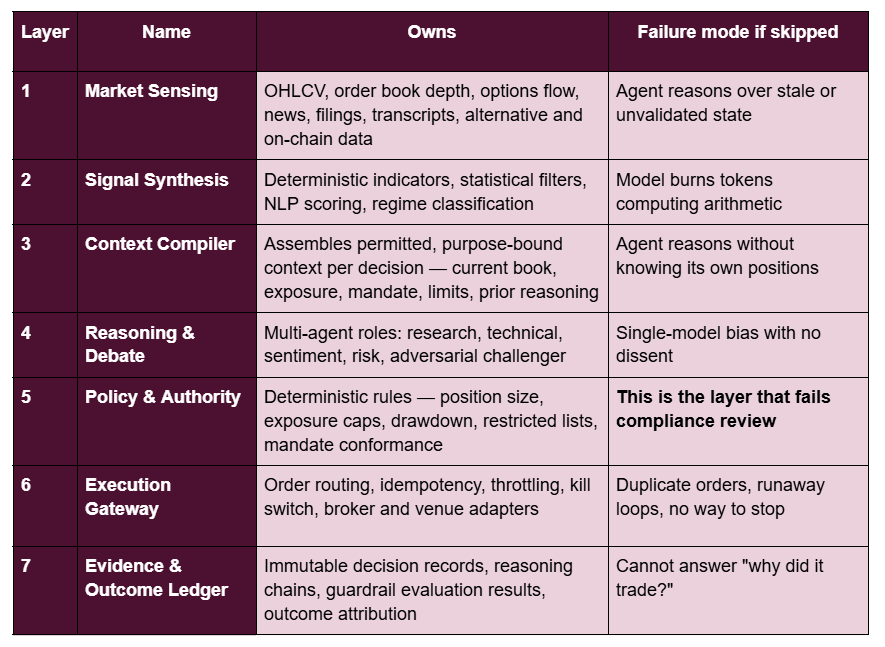
Why layers 5 to 7 are where projects actually die
Teams build layers 1 to 4 because they are the interesting part. Then risk asks three questions and the project stops.
What prevents this from taking a position larger than mandate? If the answer is "the prompt says not to," that is not a control. Language models are probabilistic. Position limits are not negotiable. Layer 5 must be deterministic — a rules engine or decision table evaluated after the model proposes and before the gateway executes, with no model in the enforcement path.
What happens if it goes wrong at 2am? Layer 6 needs a kill switch with named human owners, defined triggers and tested activation — not a documented intention.
Show me why it made that trade in March. Layer 7 needs to reconstruct the decision: which signals fired, what each agent argued, which guardrails were evaluated and what each returned, who or what approved it. Logging the output is not enough. Log the reasoning and the checks.
Deterministic before probabilistic
The single highest-leverage architectural decision in AI trading agent development is running cheap mathematics before expensive inference.
Technical indicators are arithmetic. Correlation matrices are arithmetic. Volatility regimes are statistics. None of it should be billed per token. A well-designed layer 2 runs multi-timeframe statistical analysis, scores each candidate signal, and only promotes high-confidence candidates to the reasoning layer. Everything below threshold never reaches a model.
Practitioners who have restructured around this pattern report inference cost reductions on the order of 80%, with a secondary benefit that matters more: the model spends its context on genuine ambiguity rather than on recomputing an RSI.
The principle generalises. Never let a model compute what you can calculate. Each layer should reduce the workload of the next.
Latency budget by strategy class
The most common architectural mistake is assuming LLM reasoning fits every strategy. It does not.
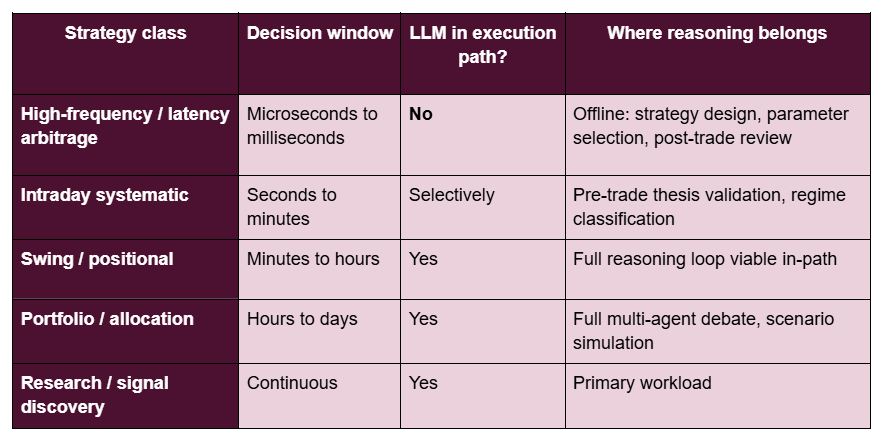
If your strategy needs sub-millisecond execution, the agent designs and supervises the strategy — a deterministic engine executes it. Any architecture that puts an API call to a frontier model inside a microsecond loop is a prototype, not a system.
Multi-agent trading system design
A multi-agent trading system distributes functions across specialised agents that communicate and cross-check before a decision is finalised, mirroring how a real desk operates.
The desk pattern
Analyst tier (parallel). Fundamental, technical, sentiment and news agents each produce a structured report from their domain. Parallelism matters — they must not see each other's conclusions, or they anchor.
Researcher tier (adversarial). Two agents receive all four reports. One builds the case for the position. One builds the case against. They compete rather than collaborate, which is the point.
Risk tier (arbitration). A risk manager agent reads both arguments, weighs evidence quality rather than argument confidence, applies position sizing, and issues an instruction or declines.
Execution tier. A trader agent converts the instruction into orders and routes them through the gateway.
When a single agent is the right answer
Most teams over-engineer here. Multi-agent systems multiply API calls, latency and cost. Every additional role is another failure surface.
Use a single agent when the decision space is narrow, the signals are homogeneous, or you are still establishing behavioural baselines. Add roles when you can name the specific bias a role removes. "A dissent agent because our single agent confirms its own framing 80% of the time" is a reason. "Multi-agent is more advanced" is not.
Ship single-agent. Get comfortable with its behaviour on paper trading. Add the challenger agent first, because dissent buys more than specialisation.
Orchestration framework selection
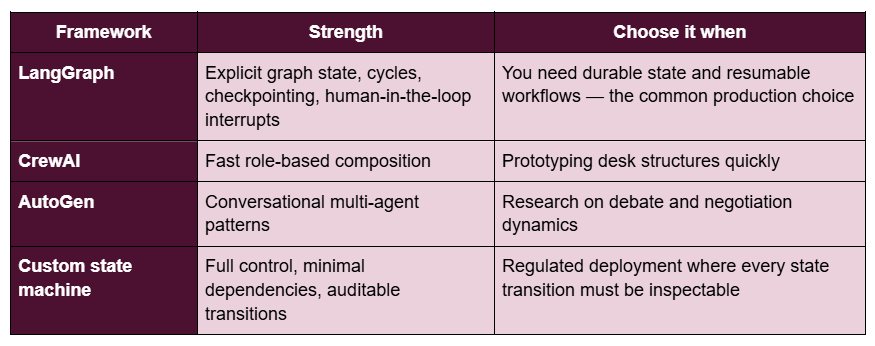
All four give you layer 4. None gives you layers 3, 5, 6 or 7. That distinction drives the build-versus-buy decision later in this guide.
How to build an AI trading agent: the 9-stage build path
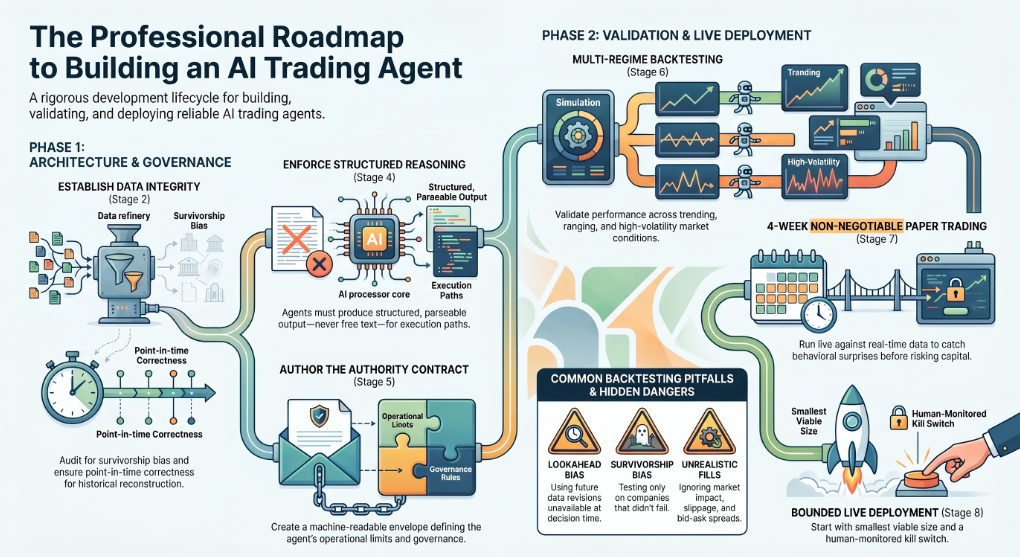
A realistic sequence, with exit criteria. Durations assume a small dedicated team.
Stage 1 — Mandate definition (≈2 weeks)
Define instruments, capital, risk appetite, jurisdiction, benchmark and the specific inefficiency you are targeting. Exit criterion: a written mandate a risk officer would sign.
Stage 2 — Data contract and ingestion (3–4 weeks)
Vendor selection, SLA definition, point-in-time correctness, survivorship-bias audit, corporate action handling, gap detection and staleness alarms. Exit criterion: you can reconstruct exactly what the agent would have seen at any past timestamp.
Stage 3 — Deterministic signal layer (2–3 weeks)
Indicators, statistical filters, regime classification, confidence scoring, and the promotion threshold that decides which candidates reach the model. Exit criterion: the pre-filter is measurably reducing candidate volume without discarding known good setups.
Stage 4 — Reasoning layer and role design (3–4 weeks)
Agent roles, prompts, tool definitions, inter-agent protocol, output schemas. Exit criterion: structured, parseable output every time — never free text into an execution path.
Stage 5 — Authority contract authoring (1–2 weeks)
The stage almost nobody documents. Write the machine-readable envelope the agent operates inside. Detailed in the governance section below. Exit criterion: compliance has reviewed and signed the contract.
Stage 6 — Backtest and walk-forward validation (4–6 weeks)
Test across regimes — trending, ranging, high-volatility, crisis, low-volatility grind. Walk-forward, out-of-sample, with realistic fills. Exit criterion: performance holds out-of-sample across at least three distinct regimes.
Stage 7 — Paper trading with shadow execution (4+ weeks, non-negotiable)
The agent runs live against real-time data, generating orders that are logged but not sent. Compare intended fills against actual market prints. Exit criterion: no unexplained divergence between backtest and shadow behaviour.
Stage 8 — Bounded live deployment (≈2 weeks to first order)
Smallest viable size, tightest limits, kill switch tested, human on watch. Expand the envelope only on evidence. Exit criterion: kill switch demonstrated under live conditions.
Stage 9 — Outcome attribution and drift monitoring (ongoing)
Attribute P&L to signals and decisions, monitor for model and data drift, define retraining cadence. Exit criterion: you can distinguish a strategy that stopped working from a market that changed.
The backtesting mistakes that make bad agents look profitable
- Lookahead bias. Using information unavailable at decision time. The most common source is a data vendor that silently backfills revisions.
- Survivorship bias. Testing on today's index constituents. The failures were removed.
- Unrealistic fills. Assuming mid-price execution. Model spread, slippage and market impact or your backtest is fiction.
- Single-regime fitting. Excellent performance in one market condition, undefined behaviour in every other.
- Overfitting through iteration. Running fifty variants and shipping the best one is selecting for noise.
Why paper trading duration is the most-cut corner
Paper trading is where behavioural surprises appear: the agent that trades far more frequently than intended, the reasoning loop that stalls on ambiguous news, the signal that fires reliably at 09:15 because a data feed updates then. None of these appear in backtest. All of them appear in week three of shadow execution.
The Trading Agent Autonomy Ladder
Every guide on this topic treats autonomy as binary: either a human approves each trade or the bot runs unattended. Production systems do not work that way.
Autonomy is a graded operating contract, defined per strategy, per instrument, per notional band and per market regime.
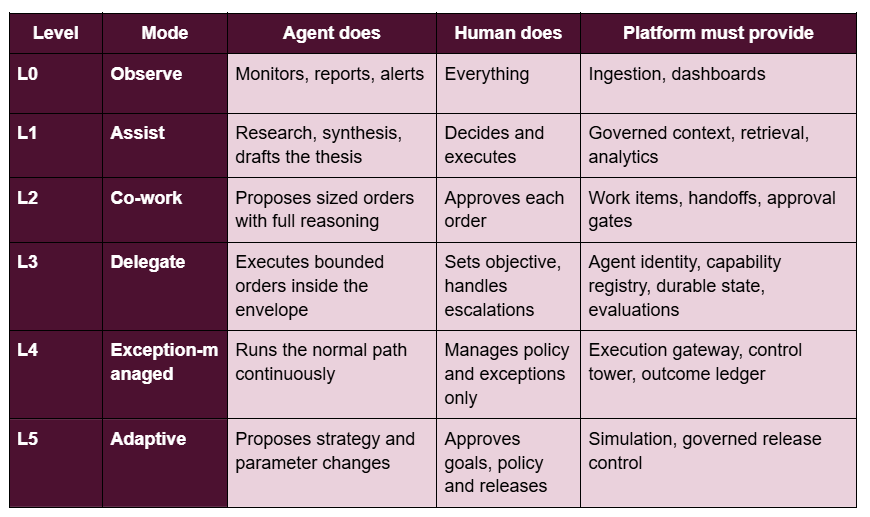
Why most trading agents should ship at L2 and earn L3
L2 is not a limitation. It is the fastest route to a system anyone will trust with size.
At L2 the agent produces the complete artefact — the thesis, the sizing, the risk check, the order — and a human clicks approve. You get the full speed benefit on the analytical work, which is where the bottleneck actually is, while building the performance record that justifies L3.
Firms that skip to L3 without that record usually end up back at L2 after the first surprise, having lost the trust needed to climb again.
Autonomy is per-instrument, per-notional, per-regime
A single global autonomy switch is an anti-pattern. The same agent might run at:
- L4 for large-cap equities under 0.5% of book in normal volatility
- L3 for the same names at larger size
- L2 for mid-caps in any condition
- L1 for anything during an earnings window or an unrecognised regime
The envelope contracts as risk rises. That is the entire design.
Escalation triggers that should always force a human
- Notional above threshold
- Regime classifier confidence below threshold
- Conflicting verdicts between researcher agents that the risk agent cannot resolve
- Data quality degradation or feed staleness
- Consecutive-loss circuit breaker
- Any instrument on a restricted or watch list
- Any action the agent has not previously performed in this mandate
Governance, compliance and the execution authority problem
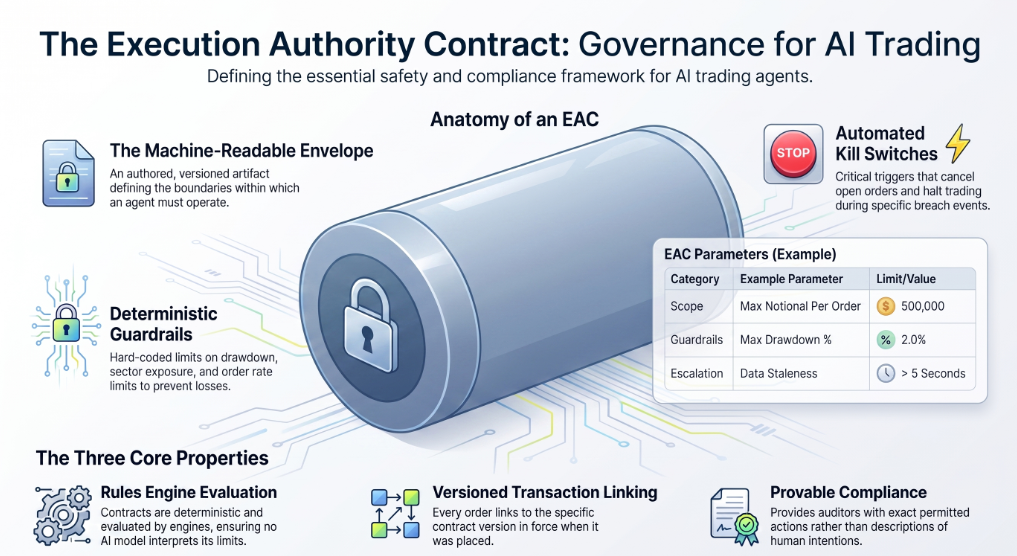
This is where AI trading agent development separates from every other agent build. Ordering the wrong lunch is recoverable. Sending the wrong order is not.
The Execution Authority Contract
Every guide says "risk guardrails." Almost none defines a guardrail as an artefact — something authored, versioned, reviewed, stored and provable.
An Execution Authority Contract (EAC) is the machine-readable envelope an agent operates inside. It is authored by risk, reviewed by compliance, version-controlled alongside code, and evaluated deterministically at layer 5 on every proposed action.
agent: momentum-equity-agent
version: 4.2.0
mandate: intraday_momentum_largecap
owner:
business: head_of_systematic_trading
technical: platform_engineering
risk_approver: cro_delegate
scope:
instrument_universe: [LARGECAP_TOP100]
restricted_list: enforced
max_notional_per_order: 500000
max_daily_notional: 5000000
max_open_positions: 12
trading_hours: [09:30-15:15]
permissions:
read_market_data: true
read_positions: true
place_order: true
modify_order: true
cancel_order: true
place_order_outside_scope: false
modify_own_authority: false
guardrails:
max_drawdown_pct: 2.0
max_position_concentration_pct: 15
max_sector_exposure_pct: 30
volatility_circuit_breaker: enabled
order_rate_limit_per_minute: 20
escalation:
notional_above: 500000
consecutive_losses: 3
regime_confidence_below: 0.60
researcher_disagreement_unresolved: true
data_staleness_seconds_above: 5
evidence:
log_reasoning_chain: true
log_guardrail_evaluations: true
log_input_snapshot: true
retention_years: 5
kill_switch:
triggers: [drawdown_breach, latency_breach, data_staleness, rate_limit_breach, manual]
action: cancel_open_orders_and_halt
authorised_operators: [head_of_trading, cro_delegate, on_call_platform_engineer]
Three properties make this work:
It is deterministic. No model interprets it. A rules engine evaluates it.
It is versioned. Every order links to the exact contract version in force when it was placed.
It is provable. When an auditor asks what the agent was permitted to do on a given date, you produce the contract, not a description of your intentions.
The 2026 regulatory landscape
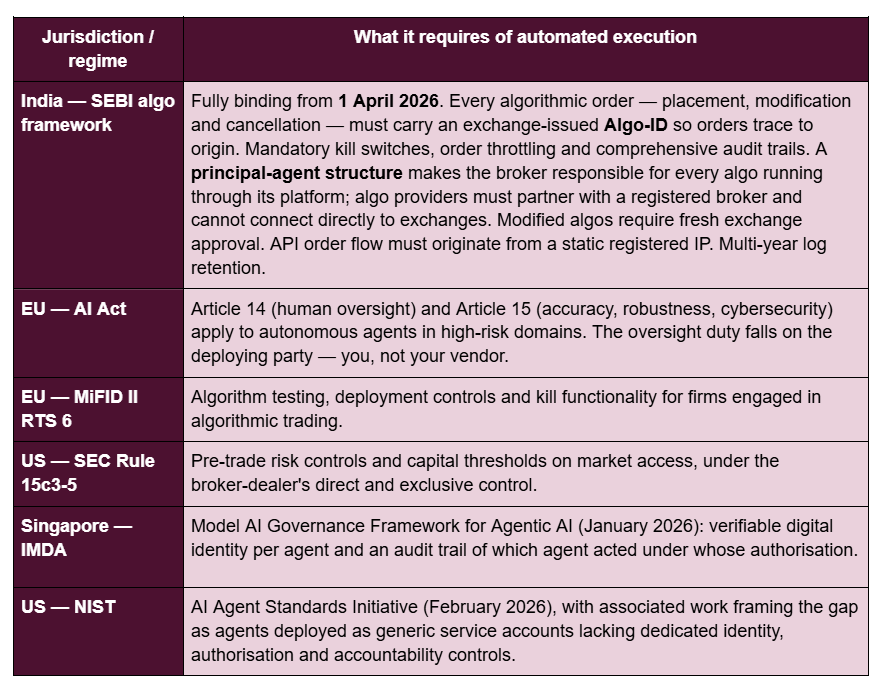
Verify current requirements against primary regulator sources before deployment. Rules in this area are moving quickly.
The common thread across every regime is the same three requirements: identity, traceability, stoppability. Build for those and you are close to compliant in most jurisdictions.
What an auditor actually asks for
Design layer 7 so you can produce all seven of these on demand, per order:
- Which agent placed it, under which identity credential
- Which authority contract version was in force
- What market state the agent observed at decision time
- What each agent in the chain concluded, and why
- Which guardrails were evaluated and what each returned
- Whether a human approved, and who
- What happened afterwards — fill, P&L, whether the thesis held
If you cannot generate that record in minutes, the system is not deployable in a regulated market regardless of how well it performs.
Agent identity: why a shared service account will not do
The most common shortcut in agent deployments is running every agent through one API credential. In trading this fails immediately. You cannot attribute an order to an originator, you cannot revoke one agent's authority without revoking all of them, and you cannot answer the identity question every 2026 framework now asks.
Each agent needs its own credential, its own scoped permissions, its own rate limits, and its own revocation path. Treat agents as workforce members with identity, not as scripts with a key.
Real deployments: what trading and market-intelligence agents have delivered
The following are anonymised production deployments. Industry, geography and scale only.
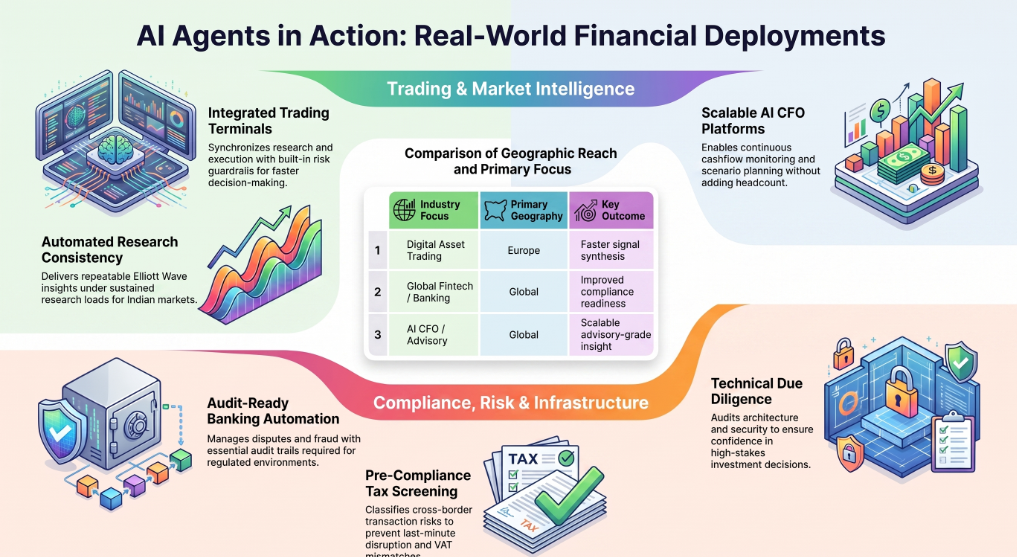
An AI-first trading terminal (Europe, digital asset markets)
A trading terminal positioned around a network of specialised agents combining research, analysis, signals and execution in one workflow.
Delivered: market data ingestion with indicator and pattern analysis; strategy simulation with risk guardrails; alerting and recommendation summaries; execution-ready workflow integration.
Outcomes: faster synthesis of fragmented market signals; more disciplined decision-making through governed workflows; reduced manual monitoring effort.
Demonstrates layers 1 through 6 — and specifically that simulation and guardrail evaluation sit between reasoning and execution, not after it.
A market research and technical analysis platform (India)
A forecasting platform applying Elliott Wave theory and related indicators to publish actionable insight for Indian markets.
Delivered: data ingestion and indicator pipelines; research automation and insight generation; alerts and thematic dashboards.
Outcomes: faster production of market insight packs; more repeatable and consistent research workflows; better signal visibility through automated analytics.
Demonstrates layer 2 under sustained research load — where consistency of method matters more than any single call.
A global fintech serving banks and credit unions
Cloud-based automation across disputes, fraud, compliance and operational efficiency, deployed as omnichannel agents with auditable workflow automation.
Delivered: omnichannel intake across chat, email and phone with workflow routing; agent-assist summarisation and next-best-action recommendations; auditability, reporting and SLA monitoring; integration-ready connection to core systems.
Outcomes: faster case handling and improved consistency; reduced operational load through automation; better compliance readiness via audit trails.
Demonstrates layer 7 in a regulated environment. In banking the audit trail is not a reporting feature — it is the condition of operating.
A cross-border tax technology product (UK / Europe)
Early screening of cross-border transactions for withholding tax, VAT mismatch and permanent establishment risk.
Delivered: transaction screening workflows with risk classification; evidence collection and explainability notes; escalation workflow to human experts.
Outcomes: earlier detection of withholding and VAT risk; reduced last-minute disruption; faster, more consistent pre-compliance review.
The closest structural analogue to pre-trade compliance screening: classify, attach evidence, escalate what exceeds confidence. Transposes directly onto order flow.
An AI CFO platform (global)
Continuous cashflow monitoring, forecasting and scenario planning for growing businesses and their advisors.
Delivered: financial data connection layer across accounting and banking exports; forecast and scenario modelling agents; alerting for cash risks with recommended actions; portfolio views for advisors managing multiple books.
Outcomes: faster analysis cycles and improved decision cadence; earlier detection of cash risks and anomalies; scalable advisory-grade insight without added headcount.
Demonstrates scenario simulation and portfolio-level oversight — the same machinery a risk agent needs to reason about a book rather than a position.
Technical due diligence for a long-term holding company (US / Europe)
Architecture, scalability and security assessment of a mobile banking platform ahead of an investment decision.
Delivered: code and architecture review; infrastructure and security assessment; scalability, resilience and integration readiness analysis; risk register with remediation roadmap.
Outcomes: faster investment decisions with structured technical risk visibility; reduced post-deal surprises; improved confidence in scalability and security posture.
Included deliberately: the same discipline that audits somebody else's trading stack is the discipline that should audit your own before it goes live.
AI trading agent development cost in 2026
Published cost figures for this keyword cover build cost only. Build cost is the part you can plan for. Running cost is the part that surprises people.
Build cost drivers
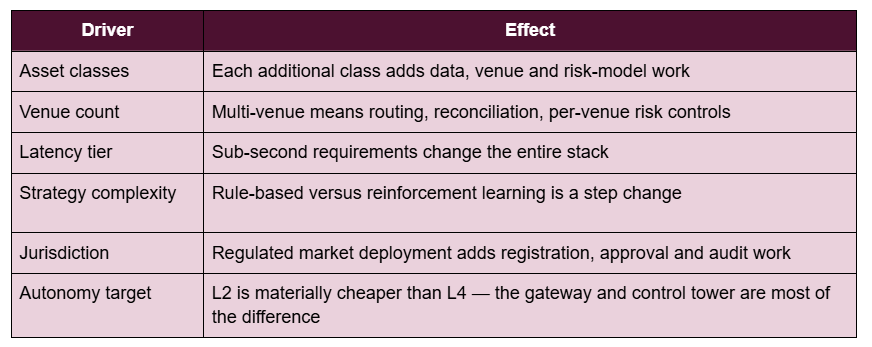
Running cost — the figure nobody publishes
A full multi-agent analysis cycle for a single instrument typically costs $0.10 to $0.50 in model inference at current frontier pricing, because each cycle makes multiple calls across analyst, researcher, risk and trader roles.
Do the arithmetic before you commit to an architecture:
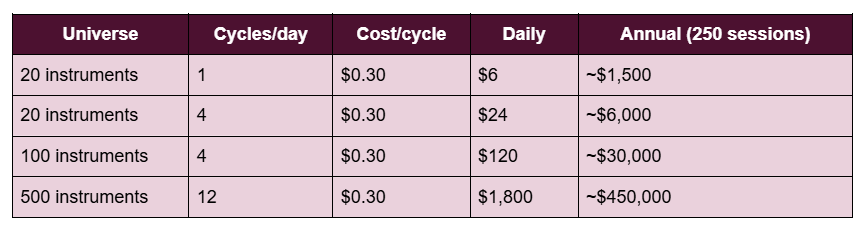
The last row is why the pre-filter is an architectural requirement rather than an optimisation. Route only high-confidence statistical candidates to the reasoning layer and the same universe costs a fraction of that, because most instruments on most days produce nothing worth reasoning about.
Hidden costs
- Market data licensing — frequently exceeds development cost in year one, particularly for real-time and depth-of-book
- Point-in-time historical data — significantly more expensive than the adjusted series most teams start with, and non-negotiable for honest backtesting
- Retraining cadence — model drift is continuous, not annual
- Audit log retention — multi-year retention of reasoning chains at volume
- Compliance review and approval — the exchange approval path where applicable
- Kill switch infrastructure and on-call — a kill switch nobody can activate at 2am is not a control
Realistic timelines
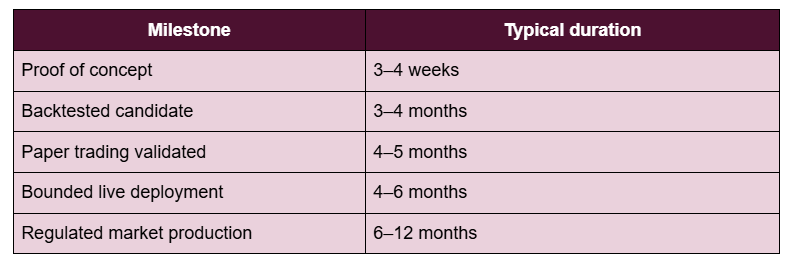
Anyone quoting live regulated deployment in under three months is quoting the model, not the system.
Build vs buy vs platform
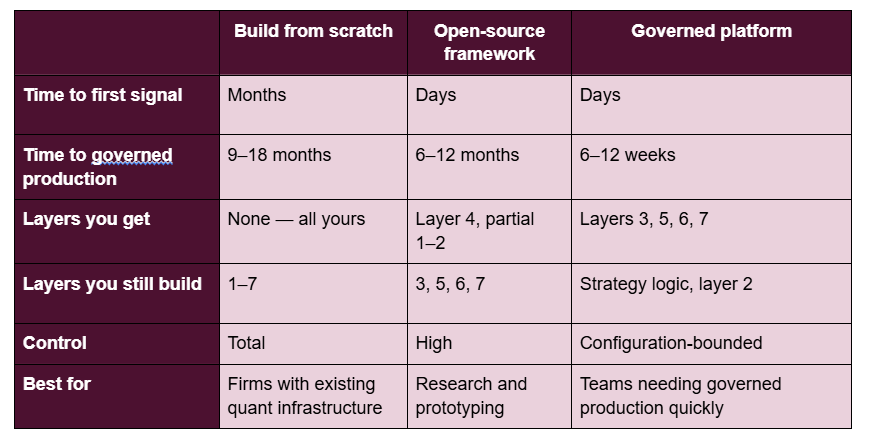
The critical point: open-source frameworks give you the reasoning layer, which is the part that was already easy. Context governance, deterministic policy, execution safety and the evidence ledger remain yours to build — and they are roughly 70% of the effort and 100% of the reason a system does or does not go live.
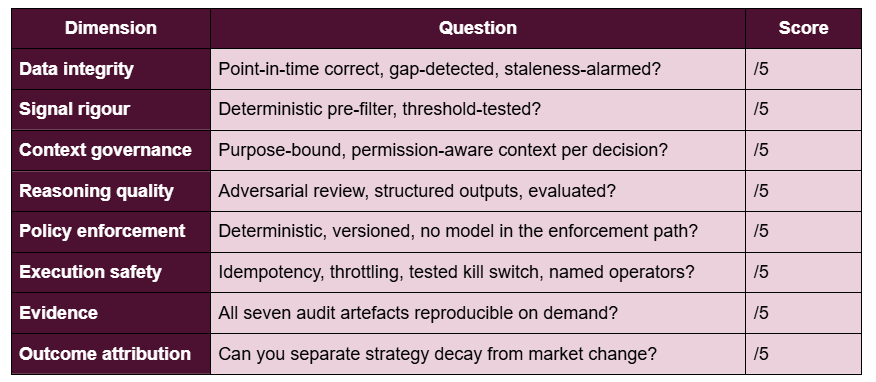
The Trading Agent Production Readiness Scorecard
Score each dimension 0–5. Below 24 out of 40, do not deploy live capital.
Ten questions to ask any AI trading agent development company
- Show me your policy enforcement layer. Is a model anywhere in it?
- How is the authority envelope stored, versioned and reviewed?
- Reproduce the full decision record for an arbitrary past order.
- What triggers your kill switch, who can activate it, and when was it last tested?
- How does each agent authenticate, and how do you revoke one agent's authority?
- What is the per-signal inference cost at my universe size and frequency?
- How do you handle point-in-time data and survivorship bias in backtests?
- What is your minimum paper trading duration before live capital?
- Which jurisdictions have you deployed into, and what did approval require?
- What happens when a data feed goes stale mid-session?
Vague answers to questions 1, 3 and 4 mean the system is a prototype.
Why assistents.ai by Ampcome
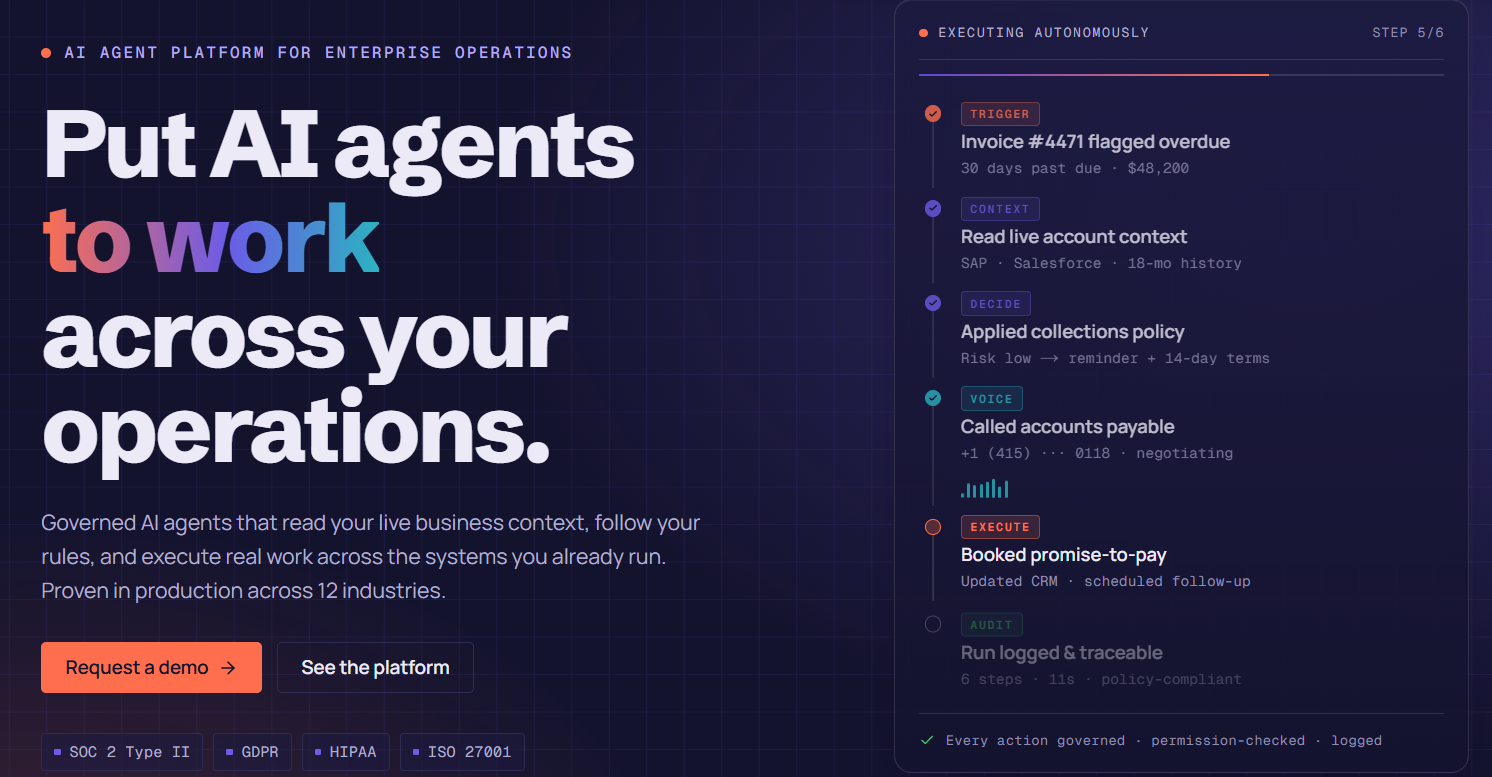
Most AI trading agent development engagements deliver a model. The hard part is everything around it — the authority contract, the deterministic policy layer, the execution gateway, the evidence ledger. assistents.ai exists because that surrounding system is the majority of the work and the entire reason an agent reaches production instead of staying in a notebook.
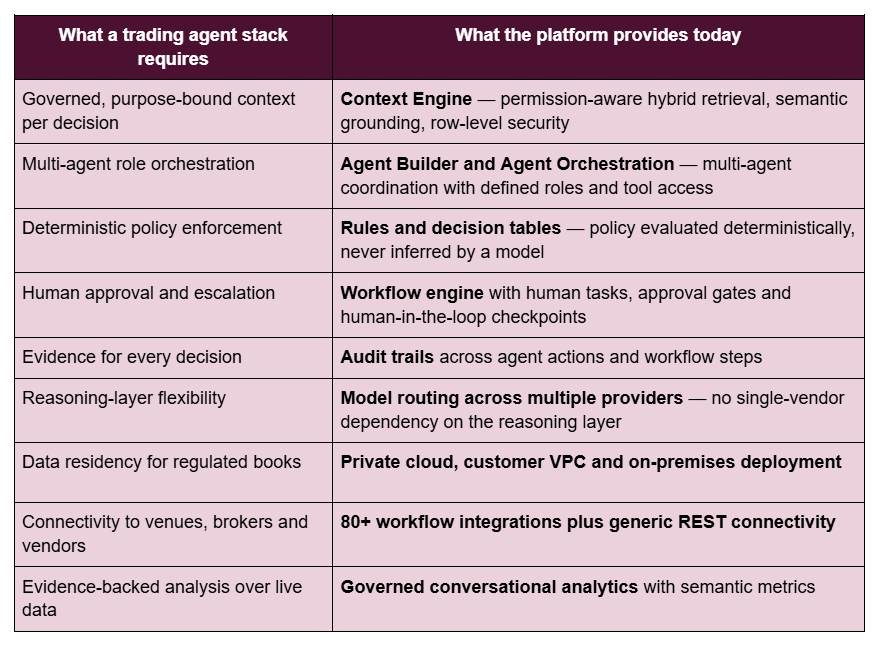
Beyond current capability, the platform direction is toward a governed System of Agency — agent identity and lifecycle management, a capability registry mediating every production action, autonomy policy services and an operations control tower. These are the direction of travel, not shipped features, and are described here as roadmap.
Where the evidence comes from. Ampcome has delivered agentic and analytics deployments across fintech, capital markets, banking operations, logistics, retail, energy, healthcare and professional services on four continents — including a multi-agent trading terminal, a market research and technical analysis platform, an auditable banking operations deployment, and cross-border transaction screening with explainability and expert escalation.
That last capability matters most for trading. Classify, attach evidence, escalate what exceeds confidence — the same pattern that makes tax pre-screening defensible is the pattern that makes pre-trade compliance screening defensible.
Failure modes: how AI trading agents actually break
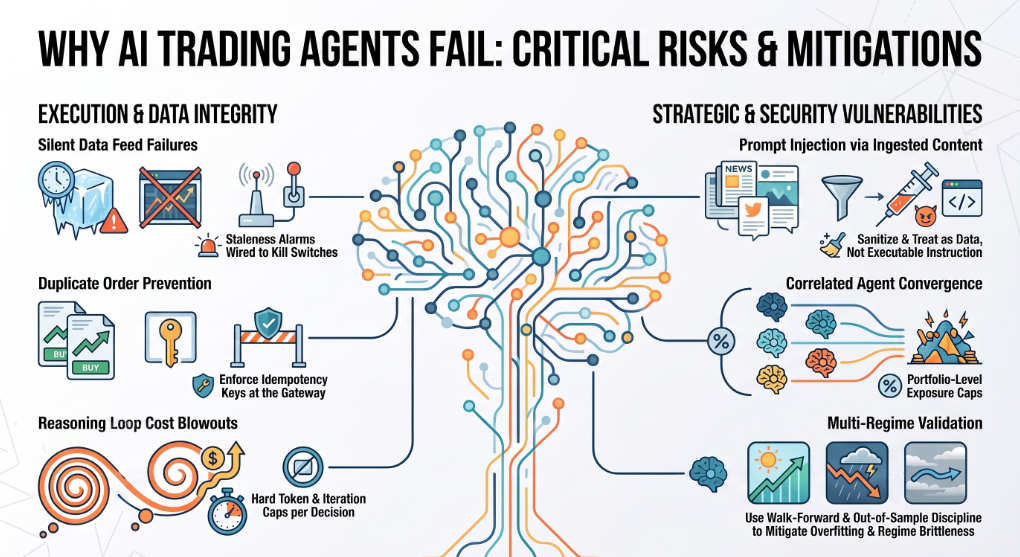
Overfitting and regime brittleness. Excellent backtest, undefined live behaviour. Mitigation: multi-regime validation, walk-forward, out-of-sample discipline.
Silent data feed failure. The feed does not error; it stops updating. The agent trades confidently on a frozen picture. Mitigation: staleness alarms wired to the kill switch, not to a dashboard.
Reasoning loop cost blowouts. An ambiguous input sends agents into extended debate. Mitigation: hard token and iteration caps per decision, with a defined fallback action.
Duplicate order submission. A retry after a timeout sends the order twice. Mitigation: idempotency keys on every order, enforced at the gateway.
Correlated agent convergence. Multiple agents trained on similar data reach the same conclusion simultaneously, concentrating risk exactly when you thought you were diversifying. Mitigation: portfolio-level exposure caps that agents cannot individually breach.
Prompt injection via ingested content. Your agent reads news, filings and social content — untrusted text. Adversarial content embedded in that stream can attempt to influence agent behaviour. Mitigation: treat all ingested content as data, never as instruction; sanitise before it reaches the reasoning layer; ensure no ingested text can reach the policy or execution layers. This is a genuine and under-discussed attack surface for any agent that reads the open internet.
Over-trust in backtest Sharpe. A high Sharpe on a fitted period is a measure of fitting, not edge.
Missing kill switch authority. Documented but never tested, or activatable only by someone asleep. Mitigation: named operators across time zones, tested quarterly under live conditions.
Build a trading agent that survives compliance review
Most AI trading agent demos look impressive. Production is a different problem — deterministic policy enforcement, execution gateways with tested kill switches, evidence ledgers that satisfy an auditor, and integration with the systems you already run.
assistents.ai has built and deployed governed AI agents across fintech, capital markets and banking operations globally, on infrastructure customers control.
Book a 30-minute discovery call — bring the workflow that is costing you the most time and risk right now. No preparation needed.
FAQs
What is an AI trading agent?
An AI trading agent is autonomous software that perceives market conditions across structured and unstructured data, reasons across competing signals, selects an action within a bounded authority envelope, executes or escalates through governed capabilities, and logs evidence for every decision. Unlike a bot, it adapts to changing conditions rather than following fixed rules.
How is an AI trading agent different from a trading bot?
A trading bot executes pre-coded rules and cannot adapt. An AI trading agent reasons across heterogeneous signals, selects its own tools, adjusts as evidence changes, and holds responsibility for an outcome over time. That third property is why agents require identity, authority contracts and evidence ledgers that bots never needed.
How much does AI trading agent development cost?
Build cost depends on asset classes, venue count, latency tier, strategy complexity, jurisdiction and target autonomy level. The commonly overlooked figure is running cost: a full multi-agent analysis cycle typically costs $0.10 to $0.50 in model inference per instrument, which compounds quickly across a large universe. Market data licensing frequently exceeds development cost in year one.
How long does it take to build an AI trading agent?
A proof of concept takes three to four weeks. A backtested candidate takes three to four months. Bounded live deployment typically takes four to six months, and regulated market production six to twelve. Timelines under three months describe the model, not the surrounding system.
Can an AI trading agent execute trades autonomously?
Yes, within a defined envelope. Production agents operate inside authority contracts specifying instrument universe, notional limits, exposure caps, drawdown thresholds and escalation triggers. Anything outside the envelope routes to a human. Autonomy is graded per instrument, notional band and market regime — not enabled globally.
Are AI trading agents legal?
Automated trading is legal in major markets but increasingly regulated. In India, SEBI's framework has been fully binding since 1 April 2026, requiring exchange-issued Algo-IDs on every order, kill switches, throttling and audit trails, with brokers accountable for algos on their platforms. The EU AI Act, MiFID II RTS 6 and SEC Rule 15c3-5 impose parallel obligations. Verify current requirements with your compliance function.
What is a multi-agent trading system?
A multi-agent trading system distributes functions across specialised agents — fundamental, technical, sentiment and news analysts feeding opposing bull and bear researchers, arbitrated by a risk manager before a trader executes. The adversarial structure surfaces conflicting evidence before capital moves, reducing single-model bias.
Which framework is best for building AI trading agents?
LangGraph is the common production choice for its explicit state graph, checkpointing and human-in-the-loop interrupts. CrewAI suits rapid prototyping; AutoGen suits debate research; a custom state machine suits regulated deployments needing fully inspectable transitions. All provide the reasoning layer only — context governance, policy enforcement, execution safety and evidence remain yours to build.
How do you backtest an AI trading agent properly?
Use point-in-time data, test the full historical universe including delisted names, model spread, slippage and market impact, and validate across at least three distinct regimes with walk-forward analysis. Then run shadow execution against live data for at least four weeks before committing capital.
Do AI trading agents actually make money?
No architecture guarantees returns, and any provider promising them should be treated with suspicion. What a well-designed architecture guarantees is that losses are bounded by enforced limits, decisions are explainable to risk and regulators, failures are detectable early, and the reasons a strategy stopped working can be identified. Those properties are what make automated trading survivable, which is a precondition for it being profitable.

Transform Your Business With Agentic Automation
Agentic automation is the rising star posied to overtake RPA and bring about a new wave of intelligent automation. Explore the core concepts of agentic automation, how it works, real-life examples and strategies for a successful implementation in this ebook.
Sarfraz Nawaz is the CEO and founder of Ampcome, which is at the forefront of Artificial Intelligence (AI) Development. Nawaz's passion for technology is matched by his commitment to creating solutions that drive real-world results. Under his leadership, Ampcome's team of talented engineers and developers craft innovative IT solutions that empower businesses to thrive in the ever-evolving technological landscape.Ampcome's success is a testament to Nawaz's dedication to excellence and his unwavering belief in the transformative power of technology.

More insights
Discover the latest trends, best practices, and expert opinions that can reshape your perspective


.jpg)




Contact us

