
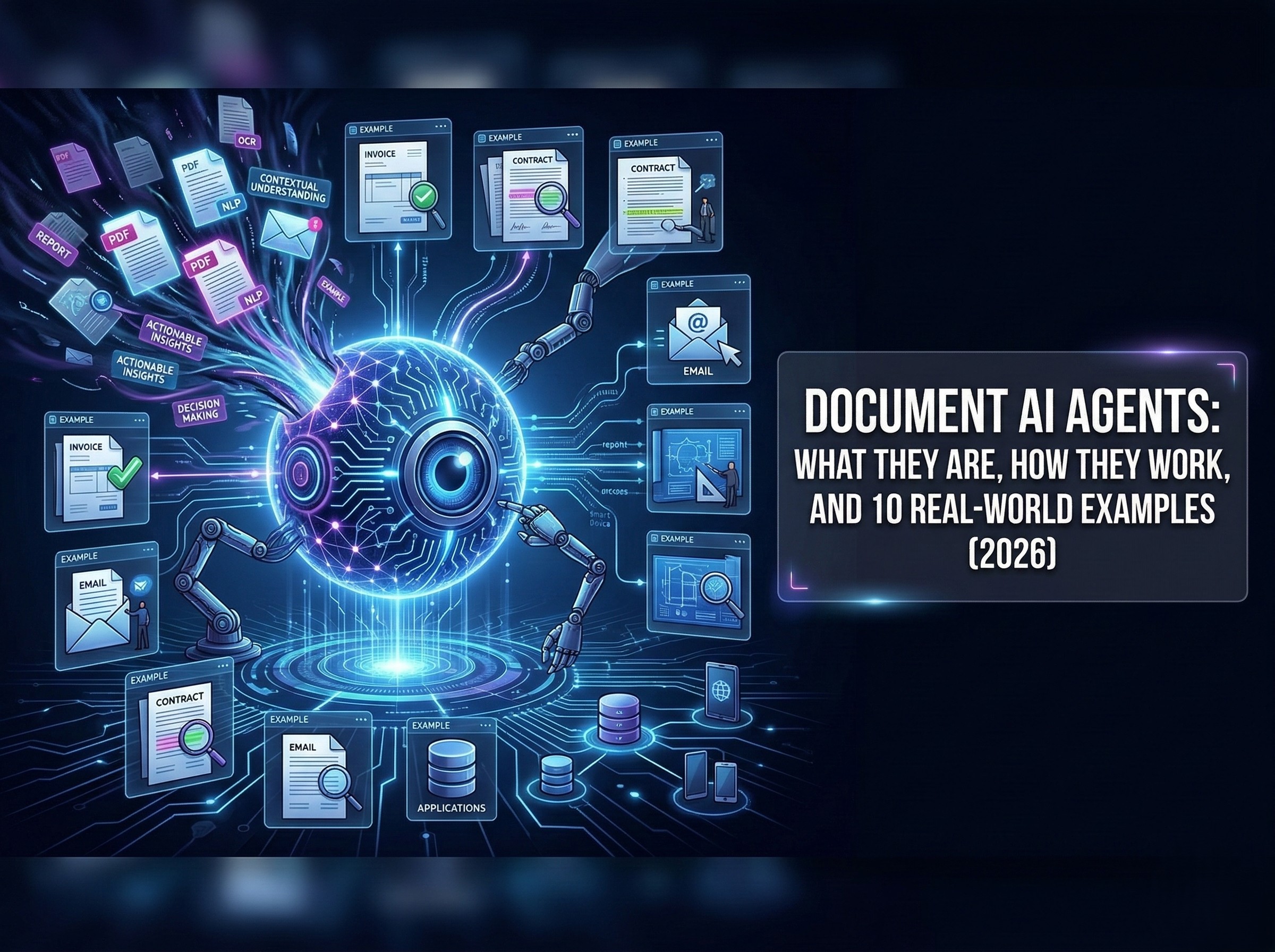
Document AI Agents: What They Are, How They Work, and 10 Real-World Examples (2026)


Every enterprise runs on documents. Contracts, invoices, tenders, RFQs, lease agreements, compliance filings, sales orders — the list never ends. Yet for most organizations, the process of handling these documents still depends on people manually reading, extracting, reviewing, and re-entering data across systems.
That is exactly the problem document AI agents are built to solve.
This guide covers what document AI agents are, how they work under the hood, and — critically — ten real production deployments across industries that show what these agents actually deliver when they go live. If you are evaluating document AI for your organization, or simply trying to understand what separates genuine AI agents from glorified OCR tools, this is the resource you need.
What Is a Document AI Agent?
A document AI agent is an autonomous software system that can ingest, understand, process, and act on documents without requiring a human to manage each step. Unlike a basic automation rule or a static extraction script, a document AI agent reasons about document content, handles variability and exceptions, integrates with downstream systems, and produces outputs — whether that is structured data, a generated document, a verified record, or a triggered workflow.
The "agent" distinction matters. An agent does not just extract text. It classifies the document type, applies the right processing logic, validates outputs against business rules, routes exceptions to humans when confidence thresholds are not met, and completes the task end-to-end — with a full audit trail on every step.
Document AI Agents vs. Traditional OCR
Traditional OCR converts printed or handwritten text into machine-readable characters. It is a single-function tool: it reads pixels and returns strings. It has no understanding of what the document means, no ability to handle layout variation across different suppliers or counterparties, and no capacity to act on what it finds.
Document AI agents go far beyond this. They handle complex table layouts, understand document structure and context, extract from handwritten text, parse embedded images and diagrams, assign field-level confidence scores, provide source citations for every extraction, adapt to format variations, and perform multi-page cross-referencing. Traditional OCR does none of these things. The gap is not incremental — it is architectural.

Document AI Agents vs. RPA
Robotic Process Automation automates repetitive clicks and keystrokes across systems. It is brittle by design: change the UI of one connected system and the robot breaks. RPA also cannot handle unstructured inputs — it needs data to already be structured before it can move it anywhere.
Document AI agents handle unstructured inputs as their starting point. They make sense of messy, variable, real-world documents across 90+ file formats and produce structured, validated outputs that flow into any downstream system — ERP, CRM, finance platform, or compliance tool — without manual handling.
The Five Core Capabilities of Document AI Agents
Document extraction — pulling structured fields, tables, and entities from unstructured documents with field-level confidence scores and source citations, across formats including PDF, scanned images, email attachments, spreadsheets, and more.
Document review — reading and reasoning over document content to flag risks, anomalies, compliance gaps, or required actions. The agent's value here is consistency: every document is reviewed against the same criteria, with no fatigue-driven misses.
Document verification — cross-checking extracted data against authoritative records in connected systems to confirm accuracy before any action is taken. This is the step between extraction and execution where errors are caught.
Document generation — producing new documents from structured inputs: invoices, contracts, memos, SAP sales orders, compliance reports, and research position papers — all governed by defined templates and approval workflows before dispatch.
Document management — classifying, routing, storing, versioning, indexing, and surfacing documents across enterprise systems so the right document reaches the right person or workflow at the right time.
How Document AI Agents Work
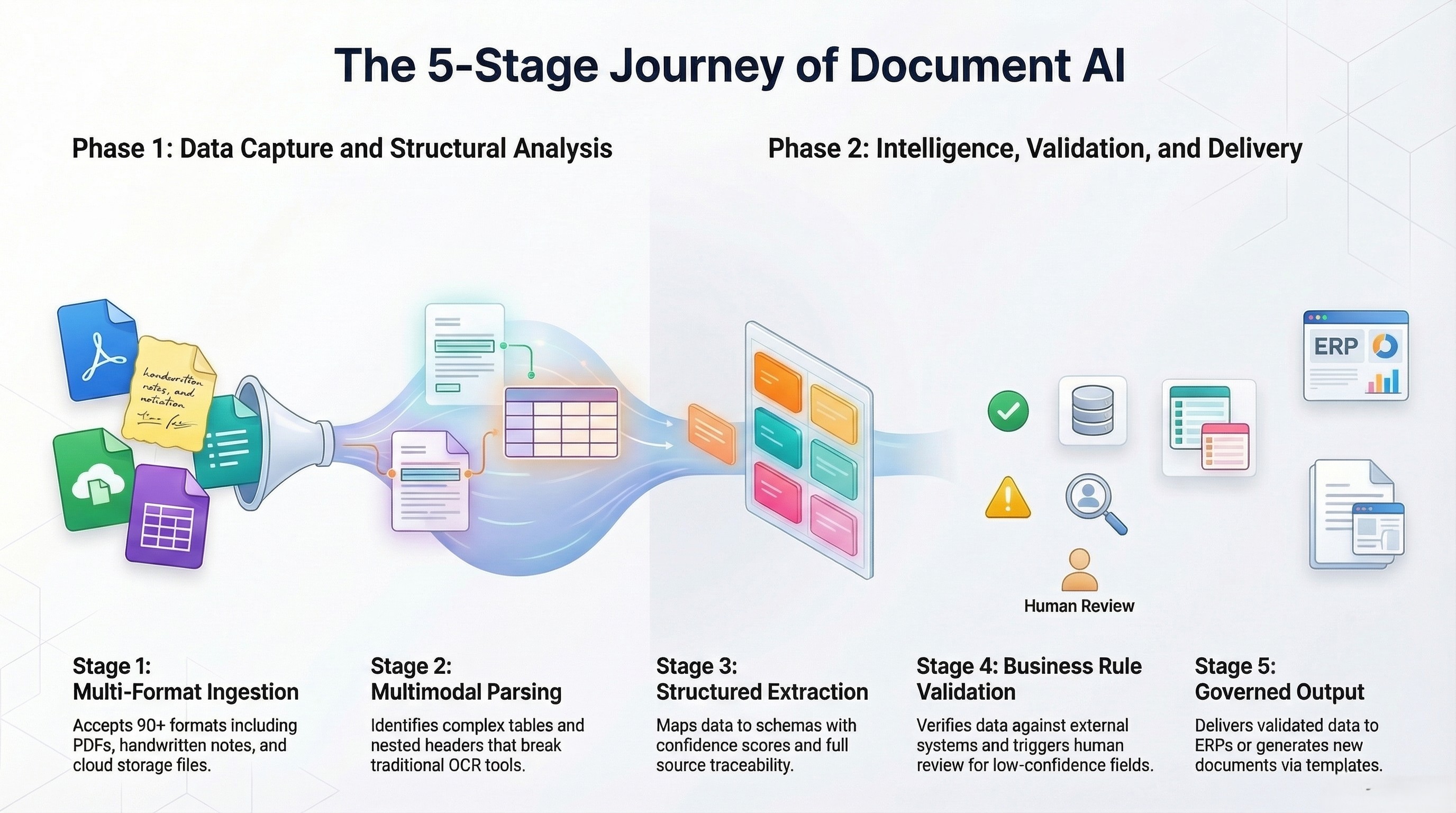
Understanding the mechanics helps distinguish platforms that genuinely deliver from those that repackage older automation with an AI label. A well-architected document AI platform transforms raw documents into structured, actionable data through five stages.
Stage 1: Ingest
The agent receives a document via email intake, API push, cloud storage connection, file upload, or system event. It accepts 90+ formats out of the box — PDFs, scanned images, Word files, Excel sheets, structured data exports, handwritten notes, and more. Multi-format support is non-negotiable in enterprise environments where documents arrive in every format simultaneously.
Stage 2: Parse
Layout-aware, multimodal parsing handles the structural complexity that breaks conventional tools: complex tables, nested headers, handwriting, embedded images, and multi-page documents where meaning spans across page boundaries. This is the stage that determines whether extracted data is reliable or not — and it is where the capability gap between document AI agents and traditional OCR is widest.
Stage 3: Extract
Structured extraction maps parsed content to a defined schema, producing field-level outputs with confidence scores and source citations for full traceability. Schemas can be defined manually or suggested by the AI from sample documents. Every extracted field carries its confidence score, enabling downstream logic to treat high-confidence and low-confidence outputs differently.
Stage 4: Validate
Extracted data is validated against business rules and verified against records in connected systems. An invoice line item is checked against the corresponding purchase order. A credential is verified against authoritative records. A sales order trigger document is validated against customer master data in the ERP. Fields below confidence thresholds trigger human-in-the-loop review rather than silent failure or incorrect automation.
Stage 5: Output
Validated, structured data is delivered as output — flowing into connected systems, generating new documents, triggering downstream workflows, or surfacing in analytics dashboards. Where the workflow requires a new document, governed generation follows defined templates with approval routing before dispatch. Every output is logged with full provenance for audit and compliance purposes.
10 Real-World Document AI Agent Examples (2026)
The following examples are drawn from production deployments across a range of industries. Client names are not disclosed.
1. Tender Document Processing — Construction and Remediation Industry

A specialist remediation and commercial works company operating across complex infrastructure projects faced a significant operational bottleneck: tender documents arrived in variable formats, ran to hundreds of pages, and required precise data extraction before any bid could be priced or submitted.
The document AI agent used multi-agent orchestration across the full tender lifecycle. Layout-aware, multimodal parsing extracted structured data from complex PDFs, handling format variation across different issuing authorities. The agent detected revisions and changes between document versions — a critical capability when tenders are updated mid-cycle. All extracted data was integrated directly into the company's core operational system with full CRUD capability, quote locking, and audit logs.
Results: Engineered for up to approximately 90% faster tender document processing, with a 95% extraction accuracy target for standard formats. Bid risk was reduced through automated revision detection. The team's capacity to pursue more tenders simultaneously increased without adding headcount.
2. Automated SAP Sales Order Creation — Home Appliances Distribution Industry

A major home appliances distributor had built its order intake process around a third-party document management platform that was approaching end-of-life, carrying high licensing costs and no viable upgrade path. The business needed a replacement that could interpret incoming order documents, validate them, and create sales orders in SAP automatically.
The document AI agent received order trigger documents, interpreted their content, validated fields against business rules and customer master data in SAP, and created confirmed sales orders without manual data re-entry. Governance logic handled exceptions and approval routing. Every SAP transaction was logged with a reconciliation record for full auditability.
Results: Reduced manual order processing and eliminated legacy platform dependency. Faster order-to-confirm cycles with significantly fewer data-entry errors. Full auditability for every sales order created through the agent — replacing a workflow that had previously generated compliance risk through manual handling.
3. Multi-Entity Document Analytics Consolidation — Global Logistics and Supply Chain

A multinational logistics and warehousing enterprise operating across multiple geographies ran into a problem familiar to large organizations: each regional entity managed its own document and data workflows, making consolidated operational reporting nearly impossible without significant manual effort.
The document AI agent created a cross-entity standardisation layer. It ingested operational documents, reports, and data exports from multiple entities, harmonised definitions and metrics, and produced consolidated dashboards with variance explanations. Data quality checks and a governance layer ensured consistency across geographies — and across document formats that varied by region.
Results: A single operational view across entities for the first time. Faster leadership reporting and quicker identification of cross-regional issues. Operational metrics became consistent across the group, replacing a patchwork of locally maintained spreadsheets and reports.
4. RFQ and Supplier Document Automation — Pharma Sourcing Industry

A pharma sourcing platform managing thousands of excipient SKUs and hundreds of supplier relationships was spending significant manual effort on request-for-quotation workflows. Each RFQ required sourcing suppliers, sending structured requests, handling returned supplier documents in varying formats, and comparing price and lead-time data — a process that did not scale at the volume the business required.
The document AI agent automated RFQ creation and dispatch, ingested and structured supplier response documents regardless of format, flagged quality and regulatory compliance documents for review, and produced price and lead-time comparison analytics for procurement decision-making.
Results: Faster procurement cycles and improved sourcing visibility. Reduced vendor coordination overhead and manual document handling. Better price and lead-time competitiveness through systematic supplier document analytics replacing ad hoc manual comparison.
5. Lease and Lending Document Analytics — Automotive Finance Industry

An independent automotive leasing provider needed better visibility into portfolio performance and risk — and the intelligence was locked in lease documents, dealer agreements, and performance data distributed across systems.
The document AI agent ingested lease portfolio documents and extracted structured data for portfolio KPI monitoring: risk metrics, delinquency rates, maturity profiles, and residual values. Dealer network performance data was layered in. Automated alerts flagged exceptions and early risk signals before they became portfolio-level problems.
Results: Better portfolio visibility and faster risk identification. More proactive management through automated exception alerts. Improved decision support for program operations without requiring additional analyst capacity.
6. Tax Research and Document Drafting — Tax-Tech and Cross-Border Finance

A tax-tech product focused on cross-border transaction risk faced a research-intensive workflow: analysts needed to retrieve source documents, screen transactions for withholding tax exposure, VAT mismatches, and permanent establishment risks, and produce written assessments for clients and internal review.
The document AI agent automated source retrieval and summarisation, produced draft memos and position papers with citation support, and built a structured knowledge base from completed research workflows. Transaction screening logic classified risk levels and generated explainability notes for escalation to senior tax professionals.
Results: Faster research cycles with better documentation hygiene. Reduced manual source-hunting time. More consistent research outputs across the team. Earlier detection of cross-border risk, reducing last-minute deal disruptions.
7. Real Estate Tenant Document and Support Workflows — Real Estate Industry
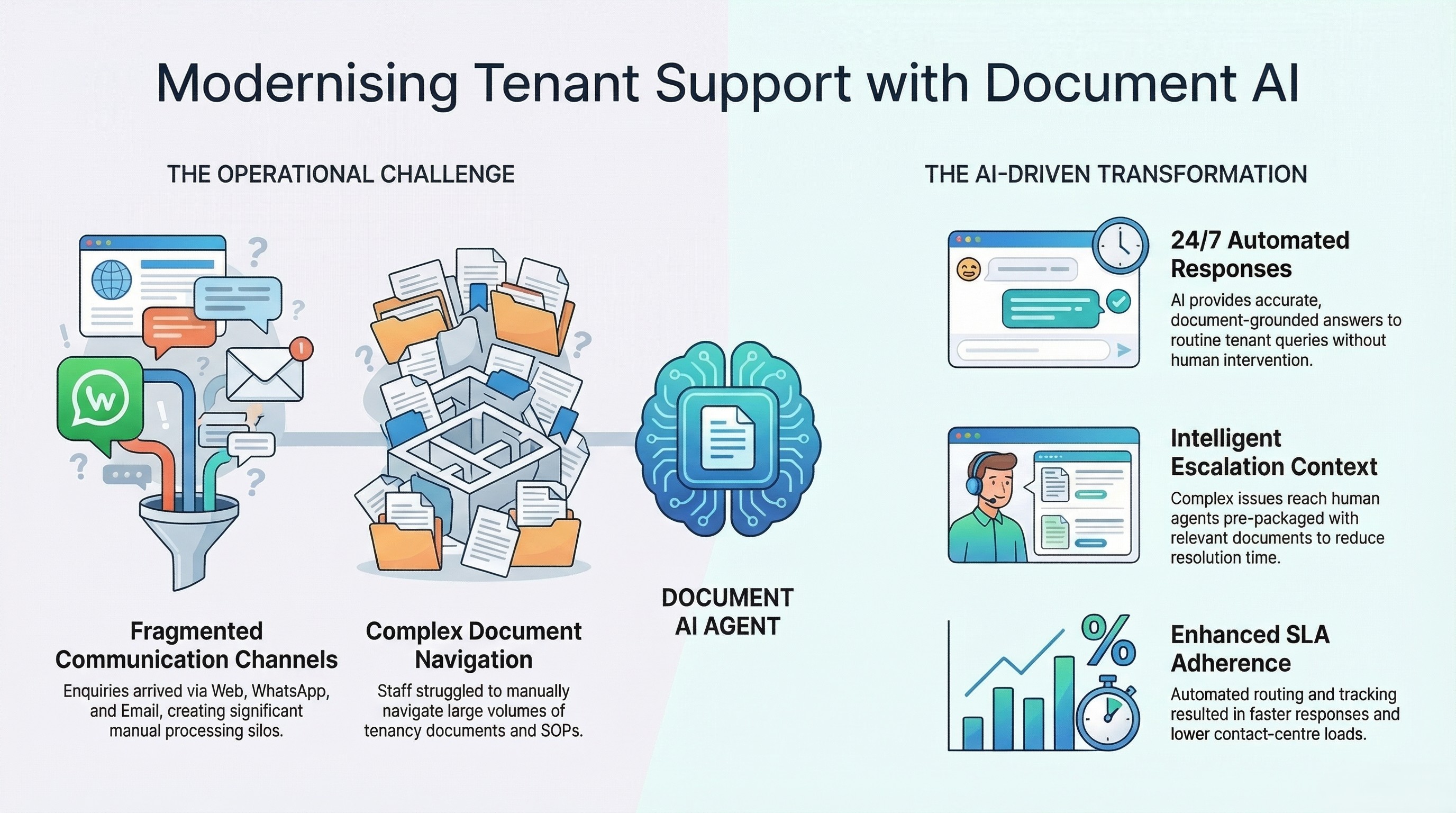
A major real estate portfolio owner managing diversified office, retail, industrial, and residential assets across multiple emirates needed to modernise tenant support. Queries came in across web, WhatsApp, and email — covering rental terms, payment queries, maintenance requests, and policy questions — each requiring navigation of a large body of tenancy documents, SOPs, and policy files.
The document AI agent maintained a knowledge base over all tenancy documents, policy files, and SOPs — enabling accurate, document-grounded responses to tenant queries without human intervention for routine requests. The same agent indexed and surfaced relevant documents for human agents handling complex escalations, arriving pre-packaged with document context to reduce handling time.
Results: Faster response times and lower contact-centre load. Consistent 24×7 tenant experience across channels. Better SLA adherence through automated routing and tracking. Escalations arrived pre-packaged with relevant document context, significantly reducing resolution time.
8. Clinical Documentation and Compliance Workflows — Healthcare Industry

A physician-led clinical enterprise operating hospitalist and geriatric care programs needed better control over the documentation underpinning revenue cycle management, staffing compliance, and care program reporting.
The document AI agent handled credential capture and verification for clinical staff onboarding, supported facility staffing request intake with compliance workflow automation, and produced revenue cycle visibility reports with exception alerts for billing workflow optimisation. Program operations dashboards gave leadership consistent visibility into service delivery performance grounded in document-level data.
Results: Faster fill cycles and lower scheduling friction. Improved staffing responsiveness for facilities. Better visibility into revenue leakage drivers. More reliable performance tracking across care programs — replacing manual report compilation with continuous document-driven intelligence.
9. Smart Grid and Utility Reporting Automation — Energy and Infrastructure
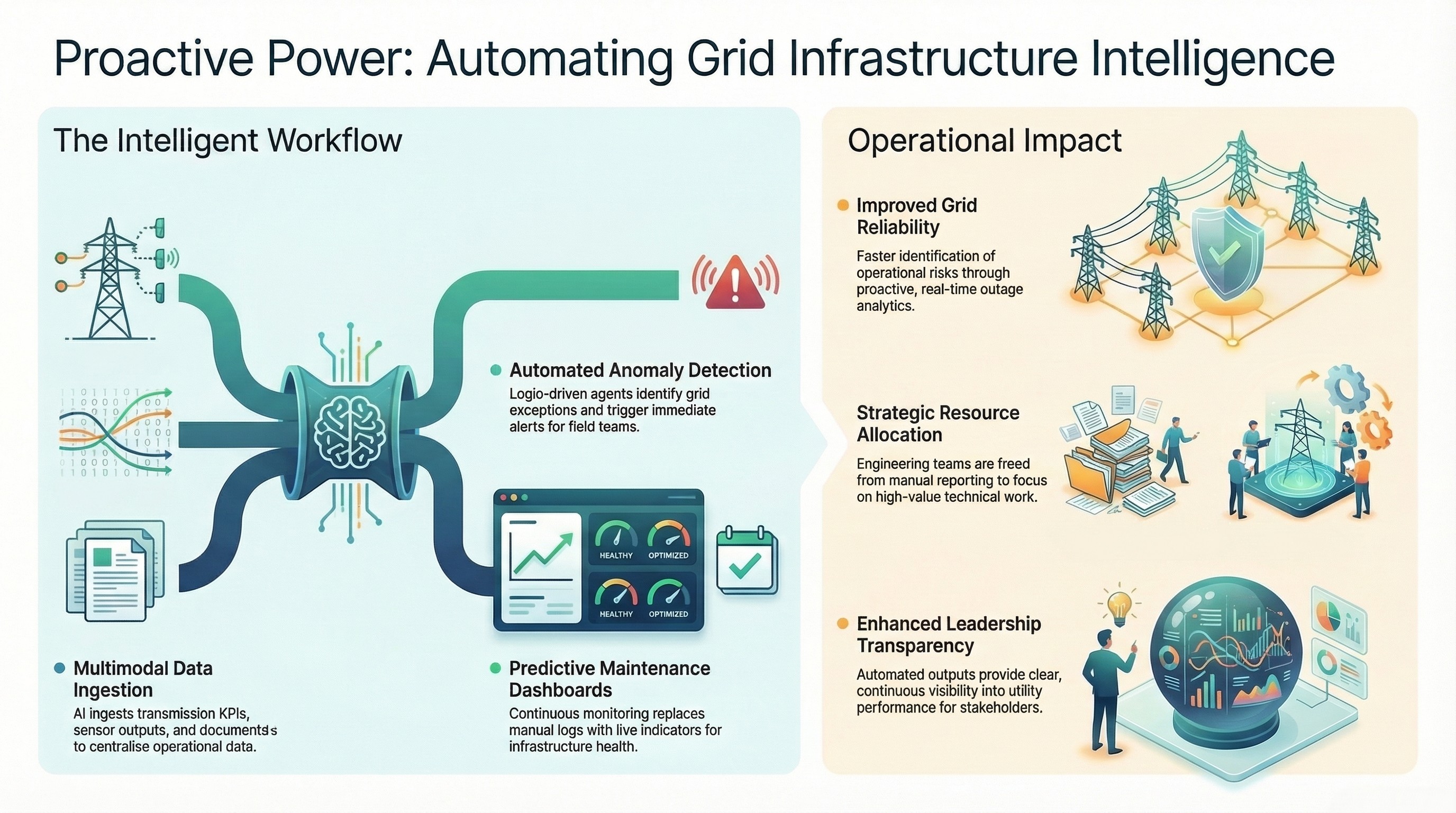
A state power transmission utility responsible for managing high-voltage transmission infrastructure across a large geography needed to move from reactive, manual reporting to proactive, document-driven operational intelligence.
The document AI agent ingested transmission KPI data, utility sensor outputs, and operational documents, applied anomaly detection logic, and generated automated alerts for field operations teams. Predictive maintenance indicators were surfaced in operational dashboards. Loss and outage analytics were automated, replacing manually compiled reports with continuous monitoring outputs.
Results: Faster identification of grid exceptions and operational risks. Improved reliability through proactive monitoring. Better operational transparency for leadership. Engineering teams were freed from manual report compilation for higher-value work.
10. Technical Due Diligence Documentation — Investment and Private Equity

A long-term holding company conducting technical due diligence on acquisition targets needed a structured, repeatable process for generating architecture reviews, risk registers, and remediation roadmaps from complex technical documentation packages.
The document AI agent ingested code, architecture documentation, infrastructure specifications, and security assessments, and produced structured outputs: architecture review summaries, scalability and resilience assessments, integration readiness evaluations, and prioritised risk registers with remediation recommendations.
Results: Faster investment decisions with clear, structured tech risk visibility. Reduced post-deal surprises through systematic remediation planning. Improved confidence in scalability and security posture of acquisition targets — with a repeatable, auditable process replacing ad hoc manual review.
Key Use Cases for Document AI Agents
Document Extraction AI Agents
Document extraction agents specialise in pulling structured data from unstructured sources with field-level confidence scores and source citations. Common applications include invoice extraction, contract clause extraction, identity document verification, and structured data capture from regulatory filings. Pre-built extraction agents — such as invoice parsers that validate against PO data and flag discrepancies automatically — can reach 95% straight-through processing rates in production.
Document Review AI Agents
Document review agents read and reason over document content, flagging issues rather than just extracting data. Legal contract review, compliance document scanning, tender revision detection, and supplier document screening all fall into this category. Purpose-built contract analyzer agents, for example, identify key obligations, renewal dates, termination clauses, liability caps, and indemnification terms — and compare across document versions automatically.
Document Verification AI Agents
Verification agents cross-reference extracted or submitted document data against authoritative records in connected systems. An invoice is verified against a purchase order. A credential is verified against a licensing database. A sales order trigger document is verified against customer master data in the ERP. Verification is the step between extraction and action — skipping it is where costly errors originate, and where audit trails become critical for compliance.
Document Generation AI Agents
Generation agents produce new documents from structured inputs: SAP sales orders, compliance memos, RFQ responses, client-facing PDFs, and research position papers. Governed generation — where outputs follow defined templates and pass through approval workflows before dispatch — is the enterprise standard. Compliance review agents, for instance, scan regulatory filings and policy documents, identify gaps, and generate compliance summary reports ready for human sign-off.
Document Management AI Agents
Management agents handle the operational layer: classifying incoming documents, routing them to the right workflows and systems, maintaining version control, and building searchable knowledge bases from organisational document repositories using context-aware chunking that preserves meaning across tables, sections, and page breaks. Support knowledge agents that index product manuals, FAQs, and SOPs — answering queries with citations and escalating when confidence is low — are a common enterprise deployment pattern.
How to Choose a Document AI Agent Platform
Accuracy and Confidence Scoring
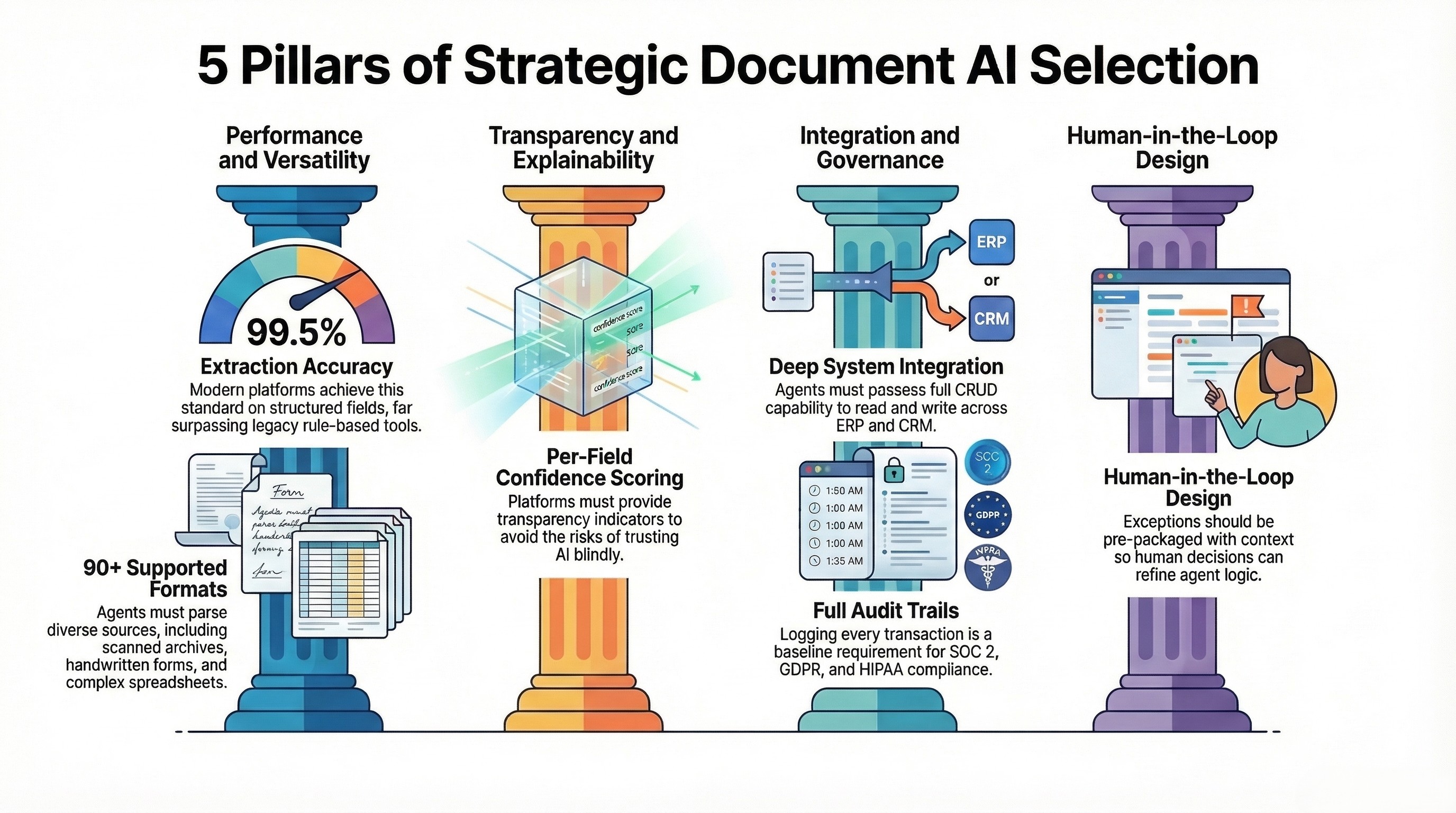
Extraction accuracy is the foundational metric. Look for platforms that publish accuracy benchmarks by document type and provide per-field confidence scores in their outputs. Production-grade document AI platforms achieve 99.5% extraction accuracy on structured fields at scale — a standard that rule-based tools and first-generation OCR platforms cannot approach. A platform that returns extracted data without confidence indicators is asking you to trust it blindly.
Format Breadth and Parsing Depth
Your documents do not arrive in one tidy format. Enterprise document environments include digital PDFs, scanned archives, handwritten forms, spreadsheets, and multi-page reports — often simultaneously. The platform you choose needs to handle 90+ formats with layout-aware, multimodal parsing that understands structure and context, not just characters.
System Integration Depth
Document AI only delivers value when extracted data flows into the systems where decisions are made: ERP, CRM, finance platforms, compliance systems, operational tools. Evaluate the depth of integration — not just whether a connector exists, but whether the agent can read from and write to the system with full CRUD capability, handle authentication and permissions correctly, and maintain audit logs of every system interaction.
Governance, Audit Trails, and Compliance
Every document transaction processed by an AI agent should be logged: what document was received, what was extracted, what validation logic was applied, what system actions were taken, and which human reviewers touched exceptions. Full audit trails on every document processed are a baseline requirement for SOC 2, GDPR, HIPAA, and ISO 27001 compliance — and in practice, they are what makes internal compliance and security teams comfortable approving AI agent deployments at all.
Human-in-the-Loop Design
The best document AI platforms are designed around the assumption that some documents will always require human judgment. The question is not whether to include human-in-the-loop controls, but how well they are designed. Escalation should arrive pre-packaged with context. Human decisions should feed back into the agent's logic. The audit trail should cover human and automated steps equally.
Final Thoughts
Document AI agents are not a future capability. They are in production today — across construction, logistics, healthcare, real estate, energy, finance, pharma, and more — delivering 99.5% extraction accuracy, processing hundreds of millions of documents, and replacing workflows that previously required teams of people with manual effort.
The gap between enterprises that have deployed document AI agents and those still running document workflows on spreadsheets and manual review is widening every quarter.
If you want to see how document AI agents work in practice — across invoice parsing, contract analysis, tender processing, sales order automation, compliance review, and more — explore the assistents Document AI platform or request an architecture review to see a live deployment scoped to your document workflows within 48 hours.
Frequently Asked Questions
What is a document AI agent?
A document AI agent is an autonomous system that ingests, understands, processes, and acts on documents end-to-end — handling extraction, review, verification, generation, and management tasks across 90+ file formats, with field-level confidence scores, source citations, human escalation for exceptions, and a full audit trail throughout.
How is a document AI agent different from OCR?
OCR converts document images into raw text characters. A document AI agent uses parsing as one step in a much larger pipeline that classifies documents, extracts structured data with semantic understanding, validates outputs against business rules and connected systems, generates new documents, and integrates with downstream workflows — all autonomously. Document AI handles complex tables, cross-page references, handwriting, embedded images, and format variation that break traditional OCR entirely.
What industries use document AI agents?
Document AI agents are in production across financial services, insurance, healthcare, manufacturing, legal, government, logistics and supply chain, pharma, automotive finance, tax and legal, energy and utilities, and retail. Industry-specific results include 70% faster due diligence in financial services, 85% claims auto-processing in insurance, 60% reduction in form processing in healthcare, and 80% faster contract review in legal. Any industry where operations depend on high volumes of variable documents is a strong candidate.
Can document AI agents integrate with SAP or other ERP systems?
Yes. Purpose-built enterprise document AI agents are designed to integrate with SAP, Oracle, Salesforce, ServiceNow, and other core enterprise platforms — reading from and writing to these systems as part of end-to-end document workflows, including full CRUD operations and transaction-level audit logging. Production deployments have demonstrated automated SAP sales order creation from incoming document triggers, replacing manual data-entry workflows entirely.
What is document extraction AI?
Document extraction AI refers to AI systems that pull structured fields, tables, entities, and data points from unstructured documents with field-level confidence scores and source citations. Modern document extraction AI uses layout-aware, multimodal parsing to handle format variation, multi-page structures, and complex layouts that rule-based extraction tools cannot process reliably — achieving 99.5% extraction accuracy on structured fields at enterprise scale.
What are the best document AI agent examples?
Real-world production examples include automated tender document processing in construction (90% faster processing, 95% extraction accuracy), SAP sales order creation from order documents in distribution, RFQ automation in pharma sourcing, lease document analytics in automotive finance, tenant document management in real estate, clinical documentation and compliance workflows in healthcare, and technical due diligence documentation generation in private equity.
How long does it take to deploy a document AI agent?
With a well-architected platform, deployment follows three steps: connecting document sources (approximately one day), defining extraction schemas and validation rules (two to three days), and deploying and activating automation (approximately one week). From concept to production in under two weeks is achievable for standard document workflows.

Transform Your Business With Agentic Automation
Agentic automation is the rising star posied to overtake RPA and bring about a new wave of intelligent automation. Explore the core concepts of agentic automation, how it works, real-life examples and strategies for a successful implementation in this ebook.
Sarfraz Nawaz is the CEO and founder of Ampcome, which is at the forefront of Artificial Intelligence (AI) Development. Nawaz's passion for technology is matched by his commitment to creating solutions that drive real-world results. Under his leadership, Ampcome's team of talented engineers and developers craft innovative IT solutions that empower businesses to thrive in the ever-evolving technological landscape.Ampcome's success is a testament to Nawaz's dedication to excellence and his unwavering belief in the transformative power of technology.

More insights
Discover the latest trends, best practices, and expert opinions that can reshape your perspective



.jpg)


Contact us

