
Marketing Analytics for Growth Engine: How Agentic Analytics Turns Data into Revenue in 2026


Most founders and marketing leaders search for marketing analytics because they want growth, not charts. They want answers fast. They want to know why campaigns slow down, why conversions drop, and what to do next before the moment passes.
Traditional marketing analytics was built to explain the past. It shows what happened after the fact. Dashboards look impressive, but they wait for someone to study them, interpret them, and decide what action to take. By then, the opportunity is often gone.
This is why marketing teams feel stuck. They collect more data every year, but growth does not keep pace. The problem is not data volume. The problem is how insights move into action.
Agentic analytics changes this completely. It turns marketing analytics into a living growth engine. One that observes, reasons, and responds continuously using AI in marketing analytics. This shift is defining how strong teams will operate in 2026.
What Is Marketing Analytics and Why It No Longer Works Alone
Marketing analytics began as a way to track activity. Clicks, impressions, leads, conversions. It helped teams understand what worked and what failed.
The traditional meaning of marketing analytics
At its core, marketing analytics measures campaign results across channels like search, social, email, and ads. It connects activity to outcomes such as leads or sales.
Why KPI tracking became the default
Dashboards made metrics visible. Teams began chasing numbers because numbers were easy to report. Over time, success became tied to hitting KPIs instead of improving growth outcomes.
Campaign data sits in ad tools. Customer behavior sits in product systems. Feedback lives in chats and emails. Traditional analytics tools struggle to connect these pieces together.
Analytics reports wait for humans to review them. This slows response time. Marketing moves faster than reports can keep up. Analytics tells you what happened. Growth requires knowing what to do next while it still matters.
What Does a Marketing Growth Engine Actually Mean
A growth engine is not a single campaign. It is a system that learns continuously and improves results over time.
1. Campaigns versus growth engines
Campaigns start and stop. Growth engines run continuously. They learn from every interaction and apply that learning forward.
2. The learning loop behind growth
A true growth engine follows a loop. Inputs create signals. Signals create intelligence. Intelligence leads to action. Action feeds back into learning.
3. Revenue and retention work together
Growth is not just acquisition. It includes keeping customers and increasing value over time.
4. Why speed matters more than volume
Fast learning beats big budgets. Teams that react quickly gain advantage.
5. The simple growth engine flow
Inputs → Intelligence → Action → Feedback
Agentic analytics makes this loop automatic.
Why Dashboards and Reports Fail to Drive Marketing Growth
Dashboards and reports are not useless. They help teams see what happened. But growth requires more than visibility. Growth needs speed, reasoning, and action. This is where dashboards fall short.
They were designed for review, not response. In a fast-moving marketing environment, that limitation becomes costly.
1. Static Views Limit Response Time
Dashboards refresh on schedules. Some updates daily. Some weekly. Some only when someone opens them. Meanwhile, customer behavior can change within hours.
By the time a dashboard shows a problem, the damage may already be done. Marketing teams end up reacting late instead of adjusting early. Growth suffers when timing is off.
2. Manual Reading Slows Everything Down
Dashboards depend on humans to do the hard work. Someone must open the report, scan charts, compare trends, and decide what matters.
This process takes time and attention. When teams are busy, insights sit unread. Growth slows not because data is missing, but because interpretation takes too long.
3. Action Lives Outside Analytics
Even when dashboards reveal an issue, the next step happens elsewhere. Teams move from analytics tools to spreadsheets, meetings, or messages to decide what to do.
This handoff creates delays. Insight loses urgency as it passes through people and systems. Growth needs action to follow insight quickly, not after multiple steps.
4. No Built-In Reasoning
Dashboards show numbers, not explanations. A drop in conversions appears as a line going down, but the reason stays unclear.
Teams start guessing. Is it the audience, the message, the channel, or the timing. Without reasoning, decisions rely on assumptions rather than understanding.
5. Growth Requires Movement, Not Observation
Watching metrics does not change outcomes. Growth comes from adjusting campaigns, refining messages, and responding to behavior early.
Dashboards encourage observation. Agentic dashboards encourage movement. The difference between watching and acting is where growth either stalls or accelerates.
What Is Agentic Analytics in Marketing
Marketing analytics has traditionally been about watching numbers. Reports, charts, and dashboards help teams see what already happened. Agentic analytics changes this role completely by allowing analytics to take part in the process instead of just observing it.
Instead of waiting for people to analyze data and decide next steps, agentic analytics supports thinking, investigation, and action together. It works alongside marketing teams rather than sitting quietly in the background.
1. A Simple Definition of Agentic Analytics
Agentic analytics uses AI agents to watch marketing data as it changes, study patterns, and reason through what those patterns mean. It does not wait for someone to open a report or ask a question. It stays active and aware.
When something changes, the system looks across connected data sources, forms an explanation, and supports the next action. This reduces delays and helps teams respond while the situation is still manageable.
2. How It Differs From BI Tools
BI tools are built to show information. They turn data into charts and tables so humans can study them. The responsibility to interpret and act stays fully with the team.
Agentic analytics goes further. Instead of stopping at visualization, it reasons through the information. It helps explain why changes happened and what they mean for marketing activity.
3. How It Differs From Predictive Tools
Predictive tools look ahead. They estimate what might happen based on past patterns. This can be helpful, but it often lacks explanation.
Agentic analytics not only looks ahead but also explains current changes. It connects predictions with context, helping teams understand both what may happen and why it matters right now.
4. How It Differs From Automation Tools
Automation tools follow predefined instructions. If a rule is triggered, an action happens. This works well for simple, repeatable tasks.
Agentic analytics is not limited to fixed rules. It adjusts based on changing patterns and context. This makes it more useful when marketing conditions shift unexpectedly.
5. Why Autonomous Marketing Analytics Matters
Marketing no longer moves in cycles. Customer behavior, platforms, and competition change constantly. Systems that only work during reviews or reports fall behind quickly.
Agentic analytics stays active all the time. It supports marketing teams continuously, helping them notice changes early and respond with confidence instead of urgency.
How Agentic Analytics Turns Marketing into a Growth Engine
Understanding agentic analytics is useful, but value appears when it is applied. This is where marketing moves from theory into action.
A growth engine depends on learning, response, and improvement happening together. Agentic analytics supports this flow naturally.
1. Unified Data Creates Contextual Intelligence
Marketing signals come from many places. Ads show interest. CRM data shows movement. Chats and reviews reveal sentiment. External signals show market shifts.
Agentic analytics brings these sources together so insights are based on context, not isolated numbers. This helps teams see the full picture instead of fragments.
2. Reasoning Over Metrics
When a metric changes, numbers alone do not explain the cause. Agentic analytics looks deeper. It checks sentiment shifts, channel behavior, and audience changes together.
This helps teams understand why conversions drop or rise. Decisions become clearer because they are based on explanation, not assumption.
3. From Insight to Autonomous Action
Insights lose value when they sit unused. Agentic analytics helps close the loop. Once actions are approved, the system supports execution without delay.
Campaign budgets adjust, alerts reach the right teams, and forecasts update automatically. Marketing moves forward without waiting for manual follow-up.
Key Use Cases of Agentic Analytics in Marketing
Agentic analytics becomes powerful when applied to real marketing problems. Instead of looking at reports after something goes wrong, teams can respond early and act with confidence. These use cases show how marketing shifts from reacting late to adjusting at the right time.
1. Customer Journey Optimization
Agentic analytics looks at the full customer journey instead of isolated touchpoints. It connects visits, engagement, feedback, and actions to understand where people slow down or drop off. The system spots these friction points early and highlights where customers feel confused, frustrated, or unsure.
What makes this useful is timing. Instead of waiting for drop-off numbers to grow, teams get suggestions while the issue is still small. Changes can be tested quickly, which helps keep more customers moving forward without heavy manual analysis.
2. Campaign Performance Improvement
Traditional campaign reviews happen after budgets are spent. Agentic analytics watches campaign signals continuously and notices underperforming segments early. This includes audience response, message fatigue, and changes in engagement quality.
Once a weak pattern appears, the system suggests adjustments. This may involve shifting targeting, adjusting messaging, or reallocating spend. Marketing teams respond faster and avoid letting small issues turn into expensive mistakes.
3. Churn Prediction and Retention
Churn rarely happens suddenly. There are early signs hidden in behavior and communication. Agentic analytics connects usage patterns, support conversations, and feedback to detect these warning signals.
Teams can step in before customers leave. Instead of reacting after churn occurs, they respond with timely outreach, improved onboarding, or better support. This keeps more customers engaged and reduces surprise losses.
4. Marketing Spend and ROI Control
Many teams struggle to understand where money truly delivers value. Agentic analytics tracks how to spend links to customer outcomes, not just clicks or leads. It connects spending patterns to revenue movement.
This allows budgets to move toward channels that actually contribute to growth. Over time, marketing spend becomes easier to explain and easier to defend because it ties directly to business results.
5. Personalization at Scale
Personalization often relies on fixed rules that quickly become outdated. Agentic analytics adjusts messaging based on live behavior patterns instead of static segments. It observes how people interact and responds accordingly.
As behavior changes, messages change too. This keeps communication relevant without constant manual updates. Teams deliver personalized experiences without managing endless rules or segments.
Business Impact How Agentic Analytics Improves ROI
When marketing teams move faster and think with better context, the impact shows up quickly. Agentic analytics does not just improve reports. It changes how teams react, spend, and connect their work to revenue. Here are the main outcomes businesses see.
1. Faster Responses to Change
Markets shift quickly. Customer behavior changes without warning. Waiting days for analysis often means missing the moment.
- Agentic analytics monitors signals continuously instead of waiting for reports.
- When something changes, teams get alerts immediately.
- Marketing teams can act within minutes instead of reacting after damage is done.
- This speed helps businesses stay competitive when conditions shift suddenly.
2. Reduced Wasted Spend
Marketing budgets are often lost due to slow reactions.
- Poorly performing campaigns are identified early.
- Spend is adjusted before large amounts are wasted.
- Teams stop pouring money into channels that are clearly not working.
- The budget moves toward areas showing healthier signals.
This keeps spend under control without constant manual checks.
3. Better Conversion Quality
High traffic does not always mean high value. Quality matters more than volume.
- Agentic analytics looks beyond surface metrics like clicks.
- It considers behavior, feedback, and journey patterns together.
- Teams understand why people convert, not just how many did.
- Campaigns improve in relevance instead of chasing empty numbers.
This leads to conversions that last longer and deliver more value.
4. Stronger Link Between Marketing and Revenue
Many teams struggle to prove how marketing supports revenue.
- Insights connect marketing actions directly to customer outcomes.
- Teams see which efforts actually contribute to sales and retention.
- Reporting becomes clearer and easier to explain to leadership.
- Marketing earns trust as a revenue-driving function, not just a support role.
Agentic Analytics vs Traditional Marketing Analytics
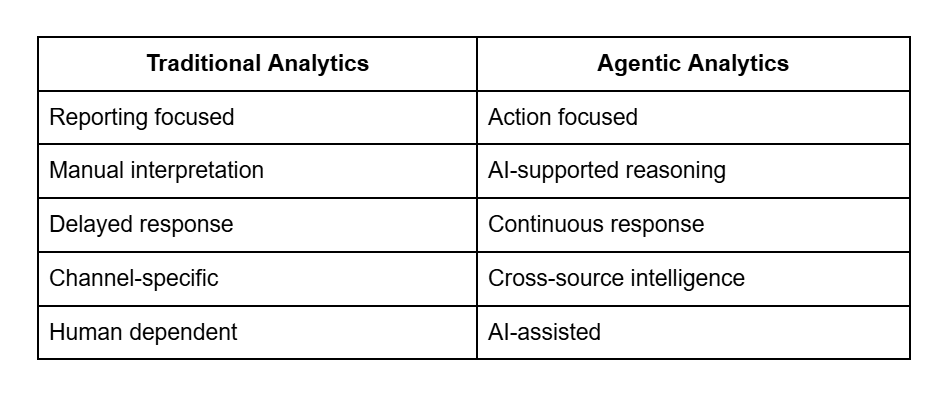
How to Get Started with Agentic Analytics for Marketing
Getting started with agentic analytics does not require a massive overhaul. The smartest teams begin small, build confidence, and expand gradually. The key is to move in a clear order so teams understand what is happening and why it matters.
Here is a simple, practical way to begin.
1. Start With Data Readiness
The first step is making sure your data is usable. This does not mean perfect data. It means data that shows how marketing activity connects to customer behavior.
- Identify the data that matters most. This usually includes ad platforms, website activity, CRM records, and customer feedback.
- Check that the data is accessible and consistent. Even basic structure is enough to start.
- Avoid connecting everything at once. Too many sources early on can create confusion instead of clarity.
- Make sure the data reflects the full customer journey, not just one part of it.
The system can reason better when it sees both marketing actions and customer responses together.
2. Connect Core Marketing and Customer Sources First
Once data readiness is clear, the next step is connection. Start with sources marketing already trusts.
- Connect paid media data to understand campaign activity.
- Link email and content engagement to see how people respond.
- Add CRM and lead data to track movement from interest to conversion.
- Include customer feedback or support data to capture sentiment.
When these sources are connected, patterns begin to appear naturally. This creates context instead of isolated numbers.
3. Build Trust Through Governance
Trust decides whether teams will rely on agentic analytics or question it constantly. Governance builds that trust.
- Define who can view insights and who can approve actions.
- Set clear access levels so teams feel safe using the system.
- Make sure the system explains how conclusions are reached.
- Allow teams to trace insights back to the data that informed them.
When people understand why a recommendation exists, they stop resisting it.
4. Begin With One Clear Use Case
Trying to apply agentic analytics everywhere at once often fails. One focused use case works far better.
- Choose a problem teams already care about, such as campaign spend.
- Alternatively, start with churn signals to catch early warning signs.
- Keep the scope narrow so learning stays manageable.
- Let teams observe how insights turn into suggested actions.
Early success builds confidence and creates demand for expansion.
5. Expand Across Teams Gradually
After one use case proves its value, expansion becomes natural rather than forced.
- Invite other marketing functions to use the same insights.
- Share early wins to build interest instead of pushing adoption.
- Extend coverage to sales or product teams once trust is established.
- Maintain clarity as the system grows so it never feels overwhelming.
Growth works best when teams feel ownership, not pressure.
The Future of Marketing Is Agentic
Marketing teams will look very different in the next few years. Analysts will spend less time preparing reports. Marketers will spend more time shaping strategy. AI agents will monitor signals continuously and surface actions proactively.
Growth will belong to teams that act faster, not those that report better.
Agentic analytics is the bridge between data and revenue.
Get Help In Your Marketing Analytics With Assistents.ai
If your marketing analytics still waits for dashboards and manual reviews, you are already behind. Assistents.ai helps marketing teams turn analytics into action using agentic AI built for real business environments.
It connects structured data, conversations, documents, and market signals into one reasoning system that supports decisions and actions.
Book a call with Assistents.ai and see how agentic analytics can turn your marketing into a true growth engine.
FAQs
- What is marketing analytics in simple terms?
Marketing analytics means looking at marketing data to understand what is working, what is not, and why. It helps teams connect actions like ads, emails, or content with outcomes such as leads, sales, or retention. Instead of relying on intuition, marketing analytics guides future actions using evidence from past and current behavior.
- Why do dashboards fail to create growth?
Dashboards show numbers, but growth requires decisions and action. Most dashboards depend on people to notice changes, interpret trends, and decide what to do next. This slows response time. They also lack explanation, which forces teams to guess causes. Growth stalls when insight stays passive instead of turning into timely action.
- What is agentic AI for marketing?
Agentic AI for marketing uses AI agents that actively watch marketing signals, reason through changes, and suggest or support actions. Instead of waiting for reports, the system stays alert, investigates shifts, and responds continuously. This helps marketing teams move from analysis to action without delays or constant manual effort.
- Is agentic analytics only for large enterprises?
No. Agentic analytics benefits teams of all sizes. Smaller teams often gain even more value because they lack time for manual analysis. Agentic systems reduce the need for constant monitoring and interpretation, allowing lean teams to react quickly and make informed decisions without adding headcount.
- How does Assistents.ai differ from BI tools?
BI tools focus on reporting and visualization. Assistents.ai goes further by reasoning across structured data, unstructured information, and external signals. It explains why changes happen and supports action through agentic workflows. This shifts analytics from passive reporting to active decision support across the organization.

Transform Your Business With Agentic Automation
Agentic automation is the rising star posied to overtake RPA and bring about a new wave of intelligent automation. Explore the core concepts of agentic automation, how it works, real-life examples and strategies for a successful implementation in this ebook.
Sarfraz Nawaz is the CEO and founder of Ampcome, which is at the forefront of Artificial Intelligence (AI) Development. Nawaz's passion for technology is matched by his commitment to creating solutions that drive real-world results. Under his leadership, Ampcome's team of talented engineers and developers craft innovative IT solutions that empower businesses to thrive in the ever-evolving technological landscape.Ampcome's success is a testament to Nawaz's dedication to excellence and his unwavering belief in the transformative power of technology.

More insights
Discover the latest trends, best practices, and expert opinions that can reshape your perspective







Contact us

