

AI Agents in Journalism: 12 Real Use Cases and Newsroom Examples (2026)


Three-quarters of the news leaders surveyed by the Reuters Institute expect agentic AI tools to have a "large" or "very large" impact on the news industry. Yet only 12% of the public say they are comfortable with news made entirely by AI, against 62% for news made entirely by people.
That gap is the whole story of AI agents in journalism. Agents can take on more of the work — monitoring sources, searching archives, checking claims, packaging stories — but the newsroom still owns what reaches the audience.
This guide covers 12 use cases, each with a real newsroom example, where the human must stay in control, what the EU AI Act now expects from AI-assisted publishing, and a 90-day plan to deploy your first agent.
Key takeaways
- An AI agent in journalism is software that pursues a newsroom goal across several steps using tools and newsroom systems, while editors set the rules and approve what gets published.
- The strongest early use cases are behind the byline: archive research, document analysis, verification evidence packs, metadata and packaging, and multi-format distribution.
- Real deployments already exist at the Associated Press, The New York Times, India Today Group, DMG Media, dpa, Schibsted and The Philadelphia Inquirer.
- The safest design is "deterministic rules around agentic reasoning": style, legal and publishing policy run as fixed rules; agents handle the ambiguous work in between.
- Since 2 August 2026, EU rules require AI-generated public-interest text to be labelled unless a human reviewed it and someone holds editorial responsibility. A logged approval step is now a compliance record, not just good practice.
What are AI agents in journalism?
AI agents in journalism are software systems that pursue a newsroom goal across several steps — monitoring sources, gathering and checking evidence, drafting, packaging or routing work — by using tools and newsroom systems, while editors set the rules and approve what reaches the audience.
The difference from earlier newsroom AI is scope. A chatbot answers one prompt. An agent works through a task: it decides which source to check next, calls a tool, reads the result, and either continues, asks a person, or stops.

The last cell matters most. The capability that makes agents useful — acting across systems — is the same one that makes governance non-negotiable in a newsroom.
Why newsrooms are turning to AI agents in 2026
The pressure is commercial as much as editorial.
- Distribution is shifting away from publishers. The Reuters Institute's 2026 Digital News Report found social and video networks are now the most widely used news source globally (54%), and weekly use of AI chatbots for news rose from 7% to 10% in a year.
- Search traffic is expected to fall. News leaders in the Reuters Institute's 2026 trends survey expect search referrals to decline by around 40% over three years.
- Confidence is low. Only 38% of news executives said they felt confident about journalism's prospects, down from 60% four years earlier.
- Readers now have agents too. Agentic products such as ChatGPT Pulse and Huxe generate personalised news briefings, which means a growing share of a publisher's "readers" may be software.
Doing more with the same newsroom, while protecting the trust that distinguishes journalism from content, is the job agents are being asked to do.

12 AI agent use cases in journalism, with real examples
The use cases below follow the news value chain: newsgathering, verification, production, distribution and newsroom operations. For each one: what the agent does, a real example, and where the human stays in charge.
Newsgathering
1. Beat-monitoring and alert agents
What it does: Watches the sources a beat reporter would check if they had unlimited time — court dockets, council agendas, regulatory filings, company disclosures, wire feeds and social channels. It detects what changed, groups related signals, and sends the desk an alert with the evidence attached.
Real example: German publisher Ippen Digital is cited as one of the pioneers of AI agents in editorial workflows in the German-speaking market. Newsroom-AI vendor Retresco describes the pattern as a self-learning "topic radar": editors' decisions on which suggested topics to accept or reject tune how the agent weights and clusters future topics.
Where the human stays: The editor decides whether a signal is a story. The agent recommends; it does not assign.
2. Tip-line and inbox triage agents
What it does: Reads the newsroom's shared inboxes and web forms, classifies each message (tip, correction request, press release, reader complaint, legal notice), extracts names, dates and documents, and routes it to the right desk. It can send an approved acknowledgement and ask for missing details on low-risk items.
Real example: Published newsroom deployments are still rare, which makes this an early-mover opportunity. The underlying pattern — email intake, intent classification, data extraction, a follow-up loop for missing details, and handoff to a person — is well proven in other industries, including in work Ampcome has delivered (see the proof section below).
Where the human stays: Anything involving a confidential source, personal safety or legal exposure goes straight to a named editor. The agent never negotiates with a source. Treat every inbound attachment as untrusted input, because documents can carry hidden instructions aimed at AI systems.
3. Document and records analysis agents
What it does: Ingests document dumps, freedom-of-information responses, court filings and budgets. It extracts entities, dates and amounts, builds timelines, flags what changed between versions, and cites the page every fact came from.
Real example: The Colonist Report, an independent Nigerian newsroom, used ChatGPT and Gemini to analyse and visualise data from more than 3,000 government documents for a flooding investigation.
Where the human stays: The reporter verifies every extracted fact against the cited page before it enters a story. Our document processing AI agent guide covers how the extraction pipeline works.
4. Data journalism agent teams
What it does: Splits data analysis across specialist roles. An analyst agent runs the numbers, a reporter agent pushes for newsworthy follow-up questions, and an editor agent challenges the method. The output is a tip sheet of leads, not a finished story.
Real example: Researcher Joris Veerbeek, writing in Generative AI in the Newsroom, built a prototype in which three agents emulating a data analyst, an investigative reporter and a data editor generate a "tip sheet" of newsworthy observations from a dataset. The Financial Times' Martin Stabe has argued that newsrooms need editorial-facing data engineering functions to collect fresh data, not just mine archives.
Where the human stays: Agents produce leads. Journalists decide which are worth reporting and do the reporting.
Verification
5. Fact-checking and verification agents
What it does: Extracts check-worthy claims from a draft, transcript or viral post, searches primary sources, runs provenance and reverse-image checks, and assembles an evidence pack with sources and open questions.
Real example: India Today's fact-checking team is among the testers of Google's Backstory, which automates provenance checks, reverse image searches and context tracing. It is currently available only through Google's Trusted Testers programme.
Where the human stays: The verdict, the rating and the wording are editorial decisions. The agent assembles evidence; it does not rule.
6. Archive and institutional-knowledge agents
What it does: Searches the newsroom's own archive and returns cited answers: previous coverage, background, who said what and when. During breaking news, it can pull together a cited background package while reporters focus on the new facts.
Real examples: German news agency dpa introduced a research assistant based on retrieval-augmented generation that draws exclusively on dpa content and returns source-backed summaries instead of lists of links. The New York Times built Echo, an in-house tool for summarising Times articles, briefings and interactives. And Ernest Kung, senior AI product manager at the Associated Press, has described an "institutional knowledge agent" as one of the largest opportunities for newsrooms — a way to keep knowledge from walking out the door when journalists leave.
Where the human stays: Archive answers are a starting point for reporting, with a link to every source article. For the architecture behind this, see our guides to agentic RAG and the deep research agent.

Production
7. Style, standards and copy-desk agents
What it does: Checks drafts against the style guide and house standards: name spellings, titles, numbers, attribution rules, sensitive-subject guidance and legal red flags such as unattributed allegations. It suggests changes with the rule it applied.
Real example: DMG Media, publisher of the Daily Mail, built Mail iQ on a multi-agent architecture that includes an editorial style guide agent reviewing drafts against the group's guidelines. The AP's Kung makes the key design point: a copyeditor agent applying AP Style "must behave consistently and predictably."
Where the human stays: The copy editor accepts or rejects each suggestion. Design tip: put style and legal rules in a deterministic rules engine, not in a prompt, so the same draft always gets the same result.
8. Structured-data and notes-to-draft story agents
What it does: Turns structured data — earnings, sports results, election counts, market moves, weather — into templated briefs, and turns a reporter's notes into a first draft.
Real examples: The AP has automated corporate earnings stories since 2014, reportedly growing output from about 300 stories a quarter to nearly 4,000. More recently, Cleveland's The Plain Dealer began using an AI writing agent so reporters can feed in notes and context to create stories; every story is edited and the reporter has final say. The move also triggered a public debate about jobs, skill-building and career paths.
Where the human stays: A named editor approves publication. Where AI-generated public-interest text is published without human review, EU rules now require it to be labelled (see the EU AI Act section below).
9. Metadata, SEO and packaging agents
What it does: Produces headline variants, SEO and search-answer fields, tags, summaries, kickers, image alt text and related links — the fields reporters fill in under deadline pressure.
Real examples: India Today Group built Pragya with Google, adding AI-assisted keyword generation, highlights, kickers and draft story creation to its content management system. The group reports a 30% reduction in content creation and publishing turnaround, a 10% increase in content production and a two-fold rise in user engagement. DMG Media's Mail iQ includes a metadata agent for SEO headlines, tags and URLs, and The New York Times has encouraged staff to use approved AI tools for SEO headlines and summaries.
Where the human stays: An editor signs off the headline. Packaging agents draft; they do not decide how a story is framed.
Distribution and audience
10. Repurposing and multi-format agents
What it does: Turns one story into many formats: social posts per platform, newsletter blurbs, video scripts, audio briefs and translations.
Real examples: DMG Media's social teams now produce more than 300 assets a day, with each post taking under a minute instead of five, according to a case study reported by Twipe citing WAN-IFRA. Schibsted's Videofy creates video automatically from articles.
Where the human stays: Audience-facing output passes an approval step, especially anything involving real people's images or voices. (For the social side of this workflow, see our social media manager AI agent guide.)
11. Audience and editorial insight agents
What it does: Answers questions such as "which stories drove subscriptions last month?" or "why did search referrals to the business section fall?", explains anomalies and flags coverage gaps.
Real example: Tess Jeffers of The Wall Street Journal has predicted that newsrooms will deploy synthetic audience models that let reporters test story ideas instantly, plus data chatbots that open audience insight to everyone in the newsroom.
Where the human stays: Data informs editorial priorities; it does not set them. Make sure every agent and dashboard uses one agreed definition of metrics such as "engaged reader" — otherwise the agent confidently quotes the wrong number.
Newsroom operations
12. Workflow orchestration and newsroom-operations agents
What it does: Tracks story status, assignments, deadlines, embargoes, rights clearance and corrections; chases handoffs across the CMS, planning tools and asset library; and escalates what is stuck.
Real examples: India Today's Pragya gives editors real-time visibility of story status and includes a Journalist App that lets field reporters file text, audio, video and documents directly into broadcast and publishing systems. On the product side, The Philadelphia Inquirer's engineering team built an agent that picks up Jira tickets flagged for AI, pulls the spec from Confluence and designs from Figma, creates a branch and writes the code — and comments on the ticket when something is unclear.
Where the human stays: The managing editor owns the plan. The agent keeps it moving and says when it cannot.
The 12 use cases at a glance

The Newsroom Autonomy Ladder: what AI agents should and should not decide
"Should we use AI agents?" is the wrong question. The useful question is: for this decision, how much authority does the agent get? Different decisions inside the same story can sit on different rungs.

The publish gate. Whatever rung an agent operates on, publishing news to an audience should pass a recorded human decision by default. Exceptions — such as templated sports scores or weather — should be written down as policy, limited to structured formats, and labelled where rules require it.
Red lines: what an AI agent should never do alone in a newsroom
- Decide to publish, correct or retract a news story
- Identify, contact or characterise a confidential source
- Make a legal-risk judgement on defamation, privacy or contempt
- Publish a verification verdict
- Generate or alter images, audio or video of real people for news use
- Change its own permissions, rules or instructions
Risks and ethics of AI agents in journalism
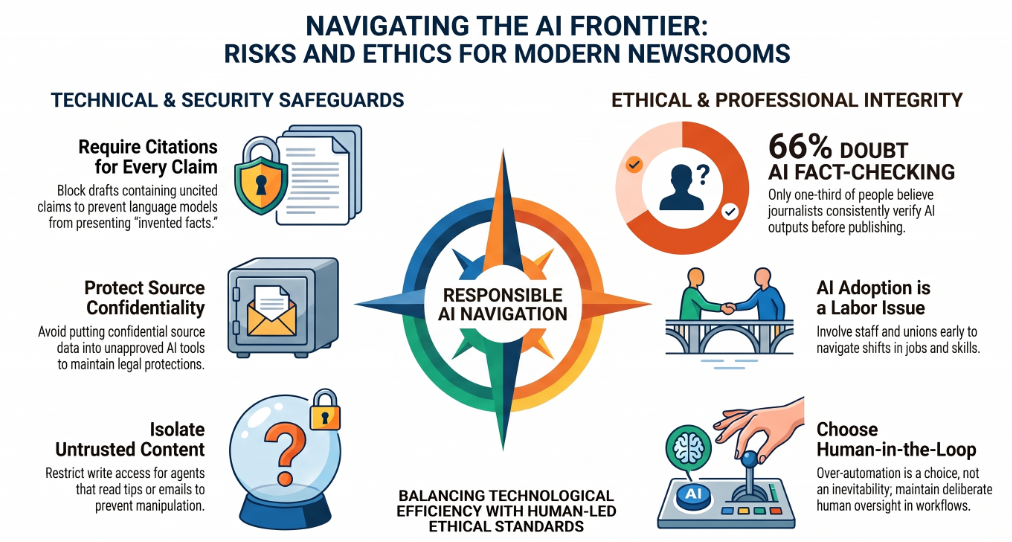
- Invented facts. Language models can produce fluent, wrong statements. Ground agents in named sources, require a citation for every factual claim, and have rules block drafts that contain uncited claims.
- Source confidentiality. Confidential material should never go to an unapproved tool. The New York Times' internal guidance, as reported by Semafor, bars staff from putting confidential source information into AI tools and warns that improper use could waive the paper's right to protect sources and notes.
- Prompt injection. An agent that reads tips, emails and documents can be manipulated by instructions hidden inside them. OWASP's agentic-security guidance lists goal hijacking, tool misuse and privilege abuse as distinct risks. Keep agents that read untrusted content away from write access.
- Audience trust. Only a third of people believe journalists always or often check AI outputs before publishing, according to the Reuters Institute. Visible, consistent human oversight is part of the product.
- Jobs and skills. The Plain Dealer's writing agent and the NYT Guild's pushback over a test of AI-generated search summaries show that newsroom adoption is also a labour question. Involve staff and unions early.
- Over-automation. Some experts expect the "human in the loop" to be quietly retired as agents spread through newsroom workflows. That is a choice, not an inevitability — make it deliberately, decision by decision.
The EU AI Act and AI-generated news: why human review is now a record

Since 2 August 2026, Article 50 of the EU AI Act has required deployers who publish AI-generated or AI-manipulated text to inform the public on matters of public interest to disclose that it is AI-generated. The exemption applies when the text has undergone human review or editorial control and a natural or legal person holds editorial responsibility for the publication.
For a newsroom using agents, the practical consequence is simple. If you intend to rely on the human-review exemption, you need to be able to show the review happened: who reviewed the text, what they changed and when they approved it. An editor glancing at a draft in a chat window leaves no record. An approval step that is logged against the story does.
This section is general information, not legal advice. Confirm your obligations with counsel, particularly if you publish to audiences in the EU from outside it.
How to deploy AI agents in your newsroom: a 90-day plan
Start with one recurring, measurable workflow — not a newsroom-wide AI strategy.

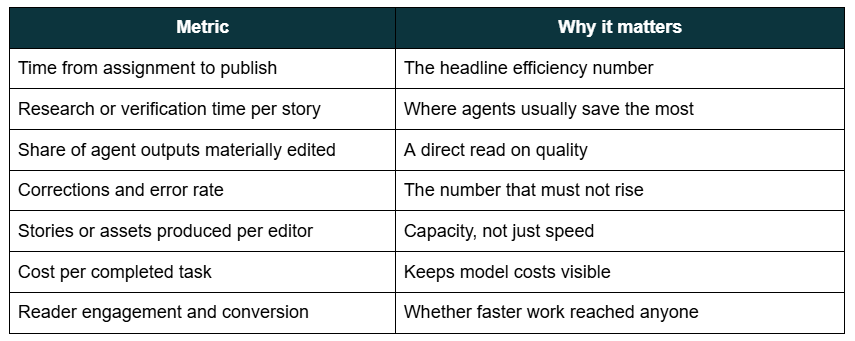
Metrics worth tracking
How to choose AI agent software for journalism
Before comparing vendors, check any platform against eight newsroom requirements (our guide to choosing an AI agent platform covers the general criteria):
- Cited retrieval: every answer traceable to a source document or archive article
- Deterministic policy: style, legal and publishing rules applied the same way every time
- Approval gates: which decisions need a human is configurable per decision type, and every approval is recorded
- Audit trail: what the agent read, did and produced for each story
- Source protection: deployment options that keep sensitive material inside your control
- Model choice: freedom to switch or mix model providers, including self-hosted models
- System connectivity: integration with your CMS, archive, wires, inboxes and analytics through their APIs
- Testing before trust: evaluation, replay against past stories and shadow mode before go-live
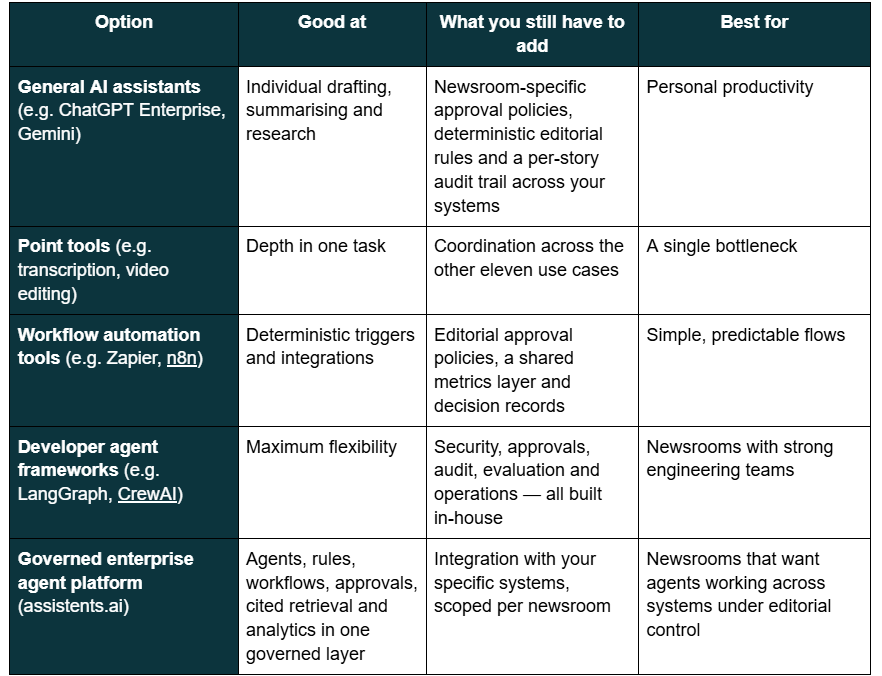
For a newsroom that wants more than individual productivity — agents working across its archive, CMS, wires and inboxes with editorial control — the governed platform category is the right fit. That is the category assistents.ai was built for.
Why assistents.ai for AI agents in journalism

assistents.ai is Ampcome's governed enterprise AI platform. It sits above the systems a newsroom already runs — CMS, archive, wires, analytics, inboxes — and lets agents work across them under the newsroom's rules. Your existing systems remain authoritative; assistents.ai adds the layer that decides what work needs doing, which agent or person does it, what it may touch, and who approves it.
Every claim traces back to a source
assistents.ai retrieves from document repositories and archives using semantic search — the same foundation behind its deep research capability — with configurable relevance thresholds, and returns citations so an editor can trace an answer to its source. Ingestion is configured per source during implementation.
Editorial policy runs as rules, not prompts
Style rules, legal-review triggers and publishing policies run in a deterministic decision engine, separate from the language model. Every change is a new checksummed version — there is no mechanism to alter a published one — and every execution records its inputs, outputs and trace. The language model reads the draft and flags what it finds; the rule engine decides what happens next — pass, fix or escalate to an editor. This is the consistency the AP's Kung describes for a copyeditor agent.
The publish gate is a policy, not a habit
Which decisions require human approval is set per decision type. When approval is required, the editor receives the work with the evidence, the applicable rule and the recommendation already assembled, and the approval is recorded. That record is what a newsroom needs if it relies on the EU AI Act's human-review exemption.
Specialist agents, coordinated
A research agent, a document agent, a style check and a human editor can work on the same story, coordinated through workflows. Agents do not negotiate their own permissions: what each may read, call and change is set outside the agent.
Work starts when something happens
Workflows can be triggered by a webhook, a schedule, an incoming email, a change in a source system or a user request — so a new court filing or a message to the tip line starts the process without anyone remembering to check.
Your sources and models stay under your control
assistents.ai supports deployment patterns for private, dedicated, on-premise and customer-controlled environments; the specific architecture is defined during solution design. It is model-independent: agents run on models from several providers with an ordered fallback, and any OpenAI-compatible endpoint — including a model you host yourself — can be configured.
One definition of an "engaged reader"
A governed semantic layer holds metric definitions, thresholds and terminology that every agent consults, and a built-in analytics layer uses the same definitions. The number an agent quotes and the number on the audience dashboard are the same number.
Test before you trust
Workflows are versioned and draft versions cannot run. Agent behaviour can be evaluated, replayed against past cases and run in shadow mode before it touches a live story. The evaluation design — which stories form the test set and what "good" means — is agreed with your editors at the start of a pilot.
What assistents.ai is not
It is not a CMS and does not replace your editors. Connecting to your CMS, asset library or wire services is an integration through their APIs, scoped for each newsroom. Deployments start read-only, and write access is an explicit configuration decision.
Proof from adjacent work: what Ampcome has delivered
We have not published a newsroom case study, and we will not invent one. What we can show is work Ampcome has delivered in other industries where the underlying pattern is the same one a newsroom needs. Client names are withheld, and not all of these engagements were built on assistents.ai.

Outcomes in these engagements were qualitative — faster research cycles, less manual monitoring, fewer missed handoffs. The tender workbench was engineered for up to roughly 90% faster document processing, with a target of around 95% extraction accuracy on standard formats; these are design targets, not guaranteed results.
Start with one workflow
AI agents in journalism are already doing real work at wire services, national publishers and regional newsrooms. The newsrooms getting value share a pattern: one workflow at a time, agents grounded in sources, editorial policy enforced as rules, and a recorded human decision before anything reaches the audience.
If you want to test that pattern on one of your own workflows — archive research, verification evidence packs, tip triage or metadata — talk to the Ampcome team about a scoped pilot on assistents.ai.
FAQS
What are AI agents in journalism?
AI agents in journalism are software systems that complete multi-step newsroom tasks — monitoring sources, researching archives, checking claims, drafting, packaging and routing work — by using tools and newsroom systems. Editors set the rules they follow and approve what gets published.
How is AI used in journalism today?
Newsrooms use AI for transcription, archive research, document analysis, verification support, style checks, SEO and metadata, repurposing stories into other formats, audience analysis and workflow tracking. Examples include the AP's automated earnings stories, The New York Times' Echo summarisation tool and India Today's Pragya platform.
Will AI agents replace journalists?
Agents replace tasks, not the core of the job. Reporting, source relationships, news judgement and accountability stay human. Roles built mainly on repetitive production work are the most exposed, which is why adoption is also a workforce and skills question.
Can AI agents fact-check news reliably?
They can speed up verification by finding claims, sources, image provenance and prior fact-checks, and by assembling evidence packs. They should not issue verdicts on their own. Final rulings need a human fact-checker.
What is the difference between an AI agent and an AI tool for journalists?
An AI tool answers a prompt or performs one function, such as transcription. An AI agent works towards a goal across several steps and systems — for example, spotting a new court filing, summarising it with citations, checking the archive and routing a brief to the right editor.
Do newsrooms have to label AI-generated content?
In the EU, since 2 August 2026, AI-generated or manipulated text published to inform the public on matters of public interest must be disclosed, unless it has undergone human review or editorial control and a person or organisation holds editorial responsibility. Rules differ elsewhere; many newsrooms also follow their own disclosure policies.
What are the main risks of AI agents in newsrooms?
The main risks are invented facts, exposure of confidential sources, prompt injection through untrusted documents, loss of audience trust, inconsistent application of standards and over-automation. Cited retrieval, deterministic rules, approval gates and audit trails reduce each of them.
How should a small or local newsroom start with AI agents?
Pick one repetitive workflow with a measurable baseline — for example, council meeting summaries or metadata on every story — run the agent read-only alongside the desk, compare its output with past work, and expand only when quality holds.
Which AI agent platform is best for newsrooms?
It depends on scope. General AI assistants suit individual productivity. For agents that work across the archive, CMS, wires and inboxes with editorial controls, a governed platform such as assistents.ai is the stronger fit, because it combines cited retrieval, deterministic rules, approval gates and audit trails.
Are AI agents safe to use with confidential sources?
Only under strict conditions: approved tools, deployment inside the newsroom's own controlled environment where needed, access limited to what each agent requires, and no confidential material sent to consumer AI services.

Transform Your Business With Agentic Automation
Agentic automation is the rising star posied to overtake RPA and bring about a new wave of intelligent automation. Explore the core concepts of agentic automation, how it works, real-life examples and strategies for a successful implementation in this ebook.
Sarfraz Nawaz is the CEO and founder of Ampcome, which is at the forefront of Artificial Intelligence (AI) Development. Nawaz's passion for technology is matched by his commitment to creating solutions that drive real-world results. Under his leadership, Ampcome's team of talented engineers and developers craft innovative IT solutions that empower businesses to thrive in the ever-evolving technological landscape.Ampcome's success is a testament to Nawaz's dedication to excellence and his unwavering belief in the transformative power of technology.

More insights
Discover the latest trends, best practices, and expert opinions that can reshape your perspective




-min.jpg)


Contact us

