
Social Media Manager AI Agent: The Complete 2026 Guide to Autonomous, Governed Social Operations


Social media stopped being a scheduling problem years ago. It's now a coordination problem — thousands of posts, comments, DMs, mentions, ad signals, and crisis triggers moving faster than any human team can keep up with. In 2026, the enterprises winning on social have stopped hiring their way out of it and started deploying something new: a social media manager AI agent.
Not a chatbot. Not a scheduler with an AI caption button. A governed, multi-agent system that owns the workflow end-to-end — from trend detection to publishing to engagement to executive reporting — with a full audit trail behind every action.
This guide covers what a social media manager AI agent actually is, how the underlying multi-agent architecture works, the 15 workflows it can automate, the governance controls enterprise buyers now demand, and how to evaluate one properly. It's built for CMOs, heads of social, marketing ops leaders, and agency principals deciding whether to keep stacking tools or move to a governed AI platform.
What is a social media manager AI agent?
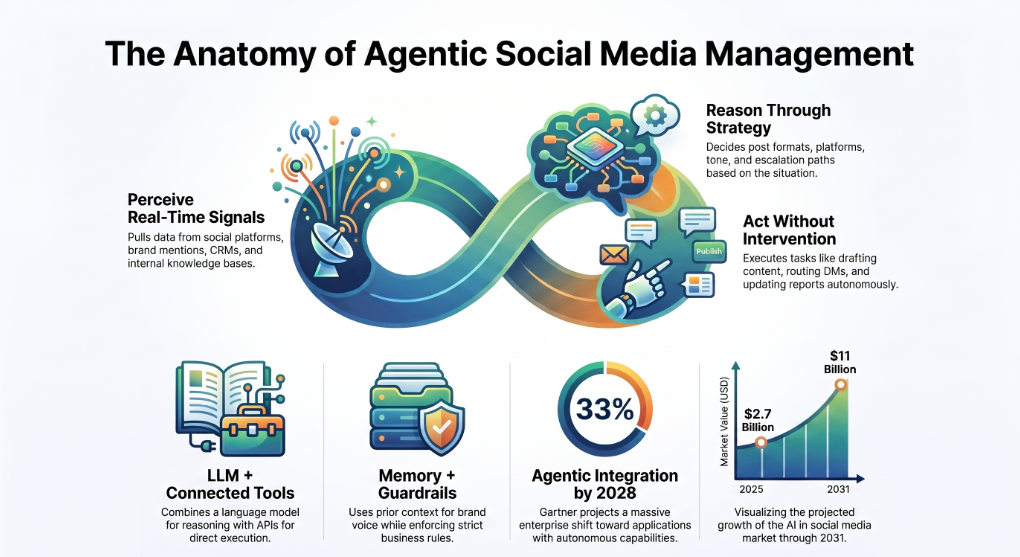
A social media manager AI agent is an autonomous software system that perceives signals from social platforms and business systems, reasons about what action to take, and executes that action across the social workflow — without needing step-by-step human instructions. It combines a large language model, a set of connected tools, memory of prior context, and guardrails that keep it operating within defined business rules.
The three-part definition: perceive, reason, act
Every genuine AI agent does three things a traditional tool cannot. It perceives — pulling data from social platforms, brand mentions, CRM, analytics, and internal knowledge bases in real time. It reasons — deciding which post format, which platform, which tone, which escalation path fits the situation. And it acts — drafting content, scheduling posts, routing DMs, escalating crises, and updating reports. Tools that only do one of the three are automation with an AI label, not agents.
What a social media manager AI agent is not
It is not a chatbot answering FAQs. It is not a scheduler that queues posts for later. It is not a caption generator that writes one Instagram line at a time. Most tools branded as "AI agents" in 2026 still operate at these levels. A genuine agent handles the workflow between those tasks — the reasoning, the handoffs, the decisions — not just the tasks themselves.
The core architecture: LLM plus tools plus memory plus guardrails
Underneath the branding, every real agent has four parts. A large language model provides reasoning. A set of tools — social APIs, ad platforms, analytics, CRM connectors — provides the ability to act. A memory layer holds brand voice, past performance, campaign context, and unresolved conversations. And a guardrail layer enforces what the agent can and cannot do without human approval. Remove any one of these four and you're back to automation.
Why enterprises are moving from tools to agents in 2026
The AI in social media market is projected to grow from around 2.7 billion in 2025 to over 11 billion by 2031. But the driver isn't cost savings on captions. It's execution capacity — the ability to run coordinated, cross-platform, always-on social operations without proportionally scaling headcount. Gartner projects that by 2028, 33% of enterprise software applications will include agentic capabilities. Social is one of the earliest, highest-volume workflows where that shift is already happening.
How a social media manager AI agent actually works: the multi-agent architecture
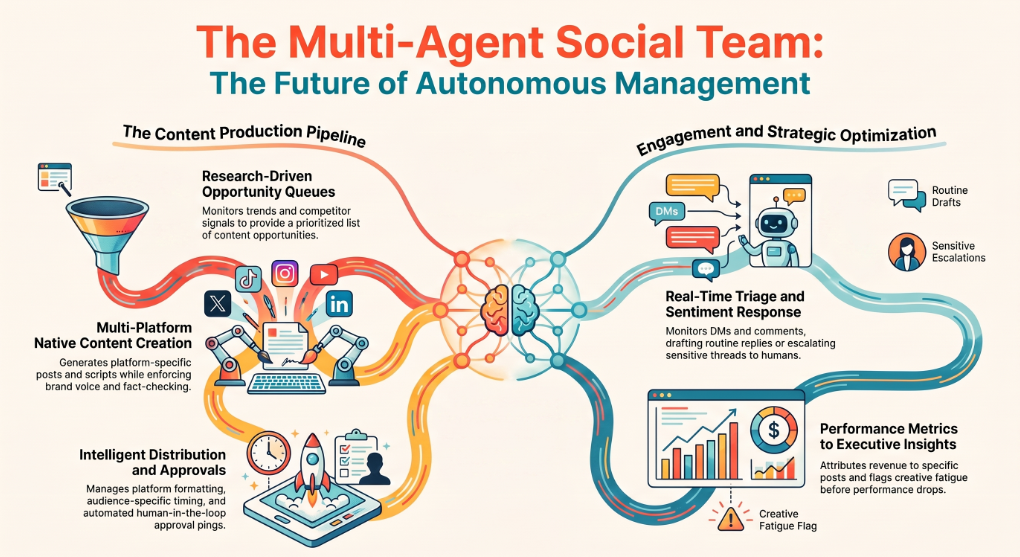
The best social media AI agents in 2026 are not single agents. They are teams of specialized agents coordinated by an orchestrator, each responsible for one part of the workflow. This is what makes them different from a monolithic "AI social media manager" that tries to do everything through one prompt.
The Research Agent
The Research Agent is the always-on ears of the operation. It monitors trending topics in your industry, tracks competitor content and performance, captures audience signals from platform analytics, and pulls in news and cultural events that could inform reactive posts. Its output is not a report — it is a prioritized queue of opportunities and risks handed to the next agent in the chain.
The Content Agent
The Content Agent takes a brief, a trend signal, or a campaign instruction and produces platform-native content. That means a LinkedIn thought-leadership post, an Instagram carousel outline, an X thread, a TikTok script, and a YouTube description — all from a single input, all in the brand's voice, all respecting the tonal rules of each platform. Under governance, it also runs internal fact checks against your product knowledge base before submitting for review.
The Publishing Agent
The Publishing Agent handles distribution: platform-specific formatting, timing based on your actual audience data (not generic best-time tables), UTM tagging, and cross-platform coordination for launches. When approvals are required, it holds the post in queue and pings the right approver based on content type, spend level, or risk score.
The Engagement Agent
The Engagement Agent monitors comments, DMs, mentions, and tagged content in real time. It triages by intent and sentiment, drafts on-brand replies for routine interactions, escalates complex or sensitive threads to human community managers, and creates support tickets when a social conversation needs to become a CRM case. Every interaction is logged.
The Insights Agent
The Insights Agent watches performance across all platforms and turns raw metrics into decisions. It attributes pipeline, revenue, and engagement to specific posts and campaigns, flags creative fatigue before it hits paid spend, and produces natural-language executive summaries answering questions like "which content drove the most qualified traffic last quarter?"
The Orchestrator
The Orchestrator is the layer that makes the team work as a team. It routes work between agents, enforces the sequence, applies governance rules, holds shared memory, and escalates to humans at the exact points where judgment is required. Without an orchestrator, you have five agents doing five things. With one, you have a coordinated social operation.
What a social media manager AI agent can automate: 15 high-leverage workflows
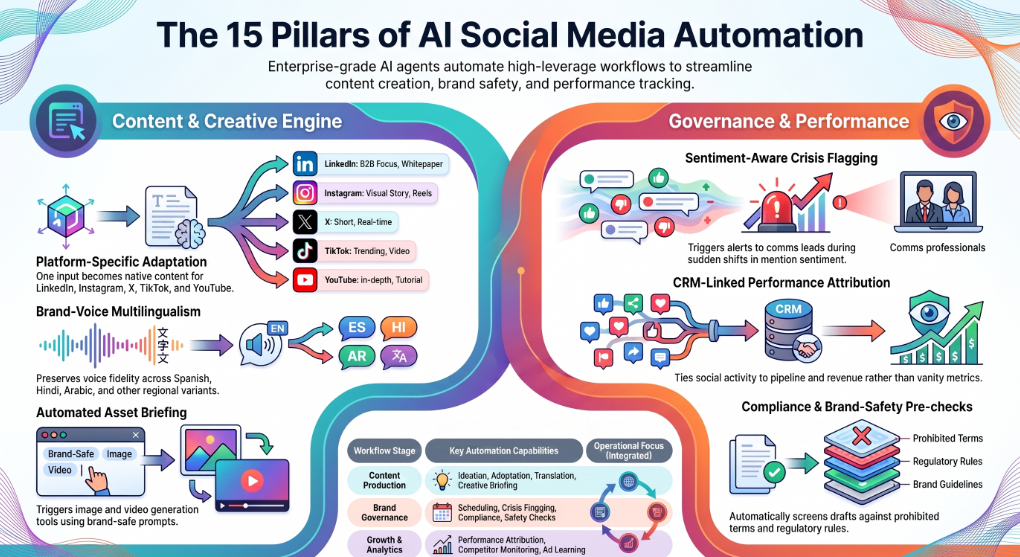
Below are the workflows enterprise teams are actually deploying agents against in 2026. The best platforms handle all fifteen. Most tools handle three or four.
- Content ideation from trend and audience signals — the agent analyzes what your audience is engaging with and drafts topic queues weekly.
- Platform-specific content adaptation — one input becomes native content for LinkedIn, Instagram, X, TikTok, YouTube, and Threads.
- Brand-voice-consistent copy across languages — voice fidelity is preserved when translating to Spanish, Hindi, Arabic, or any regional variant.
- Visual and video asset briefing — the agent generates creative briefs for designers or triggers image and video generation tools with brand-safe prompts.
- Cross-platform scheduling with governance — posts are queued, formatted, and released with approval workflows enforced.
- Real-time comment and DM triage — every incoming interaction is classified by intent and routed to the right response path.
- Sentiment-aware crisis flagging — sudden shifts in mention sentiment trigger alerts to comms leads with a summary of what's happening and why.
- Competitor monitoring and gap alerts — always-on tracking of competitor content, offers, and messaging with automated leadership briefings.
- Influencer discovery and vetting — the agent screens creators against brand-safety, audience-authenticity, and past-performance criteria before recommending shortlists.
- User-generated content surfacing — mentions and tagged content are surfaced daily with usage rights context and reshare candidates.
- Campaign performance attribution — social activity is tied to CRM opportunities, pipeline, and revenue, not just likes and shares.
- Automated executive reports — natural-language weekly and monthly reports delivered to leadership with drill-down capability.
- Ad creative to organic learning loops — winning organic content is flagged for paid amplification; failing paid creative is refreshed from organic signals.
- Community FAQ and support routing — social inquiries that should be tickets become tickets, with full conversation context handed off to service teams.
- Compliance and brand-safety pre-checks — every draft is screened against prohibited terms, regulatory rules, and brand guidelines before it reaches a human reviewer.
Enterprise governance: what separates a real AI agent from a content generator
This is the section most social media AI blogs skip. It is also the section enterprise buyers care about most. An agent that can post to LinkedIn is easy. An agent that can post to LinkedIn while satisfying legal, compliance, brand, and IT is the actual product.
The semantic layer: brand voice as data
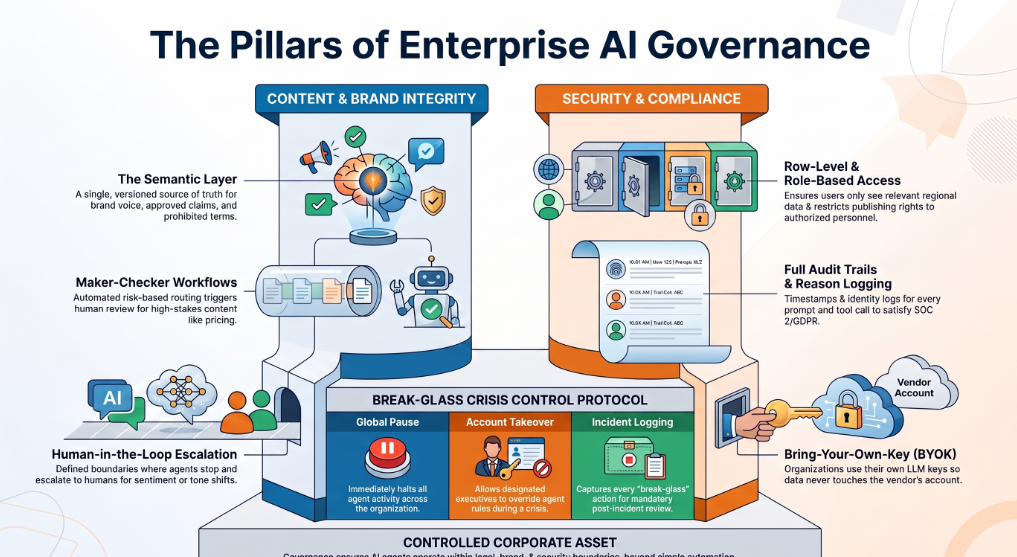
A governed AI agent does not learn your brand voice from a prompt. It reads it from a semantic layer — a structured, versioned representation of your brand voice rules, product taxonomy, approved claims, prohibited terms, tonal variations by platform, and escalation triggers. Every agent in the system reads this layer before generating output. When brand guidelines change, they change in one place, and every agent updates.
Maker-checker workflows for high-risk posts
Not every post needs human review. But some do — competitor mentions, pricing claims, regulated-industry content, executive quotes, crisis responses. Maker-checker workflows let you define the risk criteria that trigger review, route drafts to the right approver, and enforce the check without slowing down the 90% of content that is low-risk.
Row-level security and role-based access
In an enterprise, not every user should see every account, every brand, every region. Row-level security ensures that a marketer for the APAC business sees only APAC data, an agency partner sees only their assigned brands, and executives see the aggregate view. Role-based access controls who can draft, who can approve, and who can publish — enforced at the agent level, not just the UI.
Full audit trails and reason logging
Every prompt, tool call, output, and human decision is logged with timestamps and identity. When a post goes viral for the wrong reason, or a regulator asks how a compliance-adjacent claim was approved, the audit trail answers the question. This is a hard requirement for SOC 2, GDPR, and industry-specific regulations, and it is missing from most consumer social AI tools.
Bring-your-own-key and data residency
Enterprise-grade platforms let you bring your own model keys — OpenAI, Anthropic, Azure OpenAI, or a self-hosted open model. That means your prompts and data never touch the vendor's LLM account. Combined with regional data residency options, this is how enterprise IT teams get to yes on AI adoption.
Human-in-the-loop escalation patterns
The best agents are not the most autonomous. They are the ones that know when to stop. Human-in-the-loop patterns define the boundaries: post drafts flow through the agent, but sentiment shifts, unfamiliar entities, or unclear tone escalate to a human immediately. The agent works quickly; the human decides on the edges.
Crisis-mode "break-glass" controls
When something goes wrong — a viral complaint, a PR incident, a hijacked hashtag — leadership needs immediate control. Break-glass controls let designated executives pause all agent activity, take over specific accounts, or override standing rules — while still logging every action for post-incident review.
Real-world case studies: how enterprises are deploying social media AI agents
The following case studies are drawn from live enterprise deployments. Names are anonymized; outcomes and scope are real.
Case study one: a global creator-economy platform automates influencer marketing operations at scale
A global creator-economy platform serving brands and creators needed to move from manual campaign coordination to always-on operations. The challenge was volume — thousands of creator profiles, hundreds of active campaigns, and constant back-and-forth on brief approvals, content review, and performance reporting.
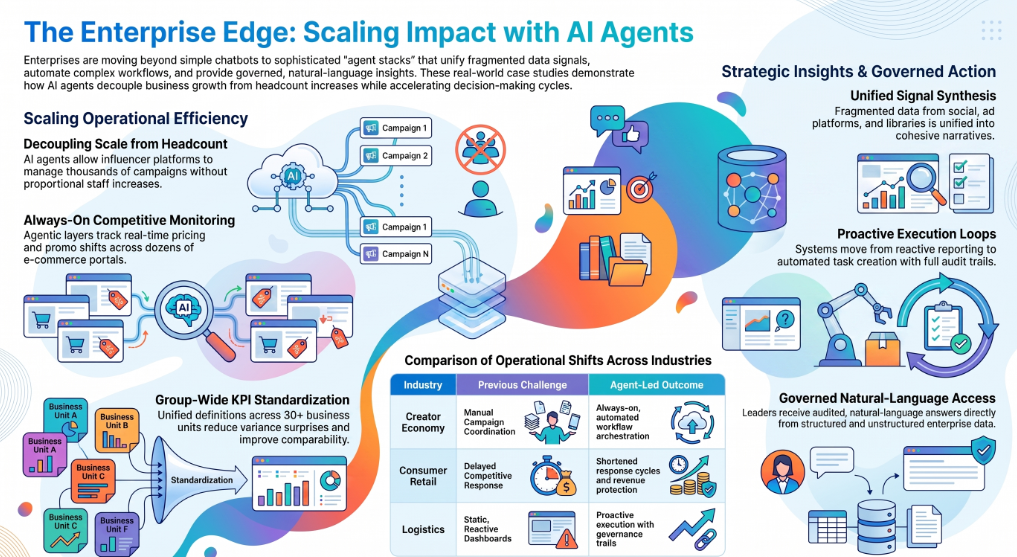
The deployment combined creator discovery enrichment, automated campaign workflow orchestration, content KPI monitoring, brand-safety checks on every creator asset, and campaign ROI analytics into a coordinated agent stack. Manual campaign operations dropped substantially, performance visibility became near real-time, and reporting became consistent across every brand program running on the platform. What used to require a fast-growing operations team could now scale without a matching headcount curve.
Case study two: a brand insights studio unifies signals and generates campaign narratives
A brand insights and creative execution studio — founded by leaders with deep experience at a major tech platform — needed to synthesize creative, performance, and audience signals into strategic direction for its marketing clients. The problem was fragmentation: signals lived in ad platforms, analytics tools, social listening dashboards, and creative libraries that never talked to each other.
The deployment brought multi-source ingestion into a unified insight engine. Insight agents produced themes, narratives, and campaign recommendations directly for account leads, and reporting packs were auto-generated for client leadership. Creative strategy cycles compressed. Signal synthesis went deeper. Most importantly, teams stopped debating what the data said and started debating what to do about it.
Case study three: a national retailer runs always-on competitive monitoring across major digital channels
A major consumer electronics manufacturer competing in highly price-sensitive markets needed continuous visibility into competitor pricing, promotional shifts, and channel presence. The manual approach — analysts checking dozens of portals daily — could not keep up with the pace of promotional changes during peak seasons.
The team deployed an agentic monitoring layer that continuously watched competitor pricing, MRP and discount movement, offers, availability, ratings, and messaging shifts across e-commerce and marketplace channels. Agentic question-answering was mapped directly to leadership questions, so a category head could ask "where are we losing share on inverter ACs this week?" and get a governed answer. Manual monitoring effort dropped dramatically, competitive response cycles shortened, and pricing gaps were identified before they became lost revenue.
Case study four: a global logistics leader gives leadership natural-language answers over enterprise data
A global ports and logistics leader with operations across dozens of countries needed to move leadership from static dashboards to governed, natural-language access to enterprise data. Reports told them what happened. The team wanted an agentic layer that could tell them what to do next — and log every recommendation for audit.
The deployment built a unified context engine combining structured and unstructured data, a semantic governance layer enforcing definitions, hierarchies, and formulas, and insights-to-action agents layered on top of existing dashboards. The shift was from reactive reporting to proactive execution loops. Standardized decision logic applied across teams. Automated task creation flowed to the right owners with completion tracking. Every action carried a governance trail.
Case study five: a UAE family conglomerate standardizes marketing intelligence across 30-plus businesses
One of the region's most prominent family business groups — spanning 30-plus companies across retail, industrial, and services portfolios — needed group-wide standardization of marketing and commercial intelligence. Every business unit had its own tools, its own dashboards, and its own definitions of the same metrics, making cross-portfolio decisions slow and inconsistent.
The team deployed group-wide KPI standardization with automated alerts on purchase price trends, gross margin impact, vendor performance, and portfolio movement. Dashboards and scheduled insight packs went directly to leadership. Definitions were unified. Variance surprises dropped because monitoring was continuous rather than periodic. Finance and marketing intelligence became genuinely comparable across the group for the first time.
Social media manager AI agent vs traditional tools: the head-to-head
The distinction matters because the value gap is structural, not incremental.
Traditional tools — Buffer, Hootsuite, Sprout Social, and their peers — handle publishing at a set time, offer caption suggestions, and centralize inboxes. You still write the strategy, decide the mix, brief the creative, review every draft, and interpret the analytics. The tool saves you the click of "publish."
A social media manager AI agent researches, drafts, adapts, publishes, engages, measures, and reports. It saves you the strategy work, the drafting hours, the response drafting, the reporting cycles, and much of the coordination overhead. Governance layers make the autonomy accountable rather than risky.
When a scheduler is still the right call: solo creators, small teams with fewer than five posts per week, and organizations that treat social as a nice-to-have rather than a growth or reputation channel.
When you've outgrown the scheduler approach: multi-brand operations, high-volume engagement, regulated industries, global rollouts, or any team where social has become a full workflow rather than a set of posts.
How to evaluate a social media manager AI agent for enterprise deployment
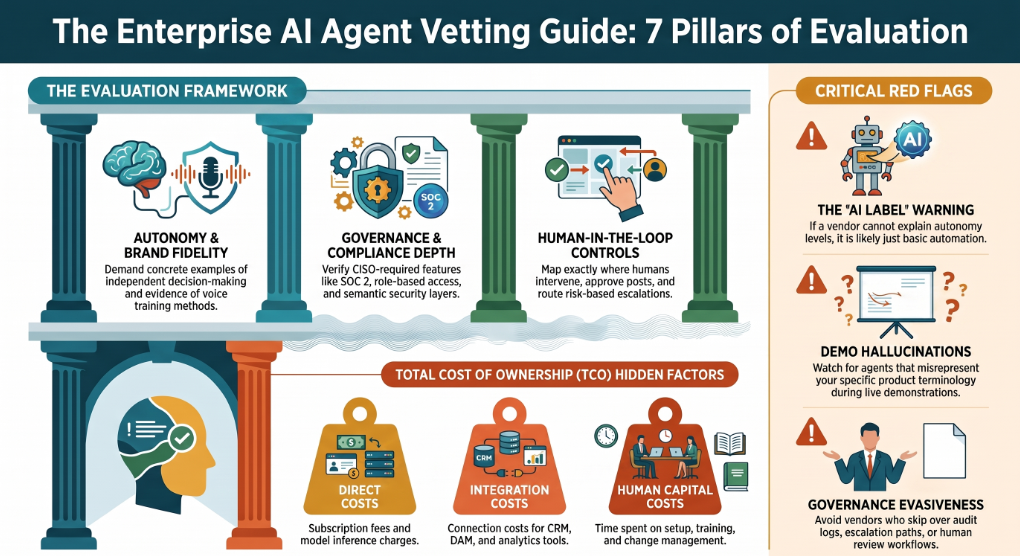
Use this seven-part evaluation framework on every vendor demo. If a platform cannot answer these clearly, it is likely automation with an AI label.
1. Autonomy level
Does the platform operate at AI-assisted, autonomous-with-guardrails, or fully autonomous level? Push for concrete examples of decisions the agent makes without human input.
2. Governance depth
Ask about semantic layers, maker-checker workflows, row-level security, role-based access, and audit logging. A vendor without a clear answer here is a vendor whose product will be blocked by your CISO.
3. Integration surface
How many platforms does it publish to natively? Which CRM, DAM, ad, and analytics tools does it connect to? Does it support MCP or open standards, or is it a walled garden?
4. Brand-voice fidelity
How is voice trained — a prompt, an upload, a versioned semantic layer? Ask to see output on your actual brand and compare it to human-written examples.
5. Human-in-the-loop controls
Where exactly can humans intervene? Which post types require approval? How are escalations routed? Can you configure the risk criteria yourself?
6. Audit trail and compliance readiness
Is every action logged with identity and reasoning? Does the platform support SOC 2, GDPR, HIPAA, and regional residency? Can compliance teams export audit reports without engineering help?
7. Total cost of ownership
Look beyond the subscription. Include setup, integration, model inference costs, training time, and change management. Cheap tools with expensive workflows are more expensive than they look.
Red flags to watch for: vendors who cannot explain their autonomy level, agents that hallucinate on your product terminology in demos, platforms with no visible audit log, and any "AI agent" marketing that avoids the words governance, escalation, or human review.
How to build vs buy a social media manager AI agent
Three paths exist. The right one depends on your technical capacity, data sensitivity, and how much customization you actually need.
The custom-build path
You wire an LLM API to social platform APIs, add an orchestration layer, build a memory layer, and design governance from scratch. Maximum flexibility, maximum cost, longest time-to-value. Realistic only for organizations with mature AI engineering teams and workflows too unique to fit any platform.
The vertical-tool path
You extend an existing scheduler with AI add-ons — Buffer with an AI assistant, Hootsuite with OwlyWriter, Sprout with AI Assist. Fastest to start, cheapest in the first year, but the agent-level capabilities remain thin. You hit the ceiling quickly on autonomy and governance.
The governed-platform path
You deploy a purpose-built agentic AI platform designed for enterprise governance from the start — one that ships with multi-agent orchestration, a semantic layer, maker-checker workflows, BYOK, RLS, and full audit trails. Assistents by Ampcome is built for this path. Faster than a custom build, deeper than a vertical tool, safer than either.
Why Assistents by Ampcome is the enterprise-grade social media manager AI agent
Most tools added AI to a scheduling product. Assistents by Ampcome was built from the ground up as a governed, multi-agent platform for enterprises that need autonomy and accountability in the same system. Here is what that means concretely for social media operations.
Multi-agent orchestration out of the box
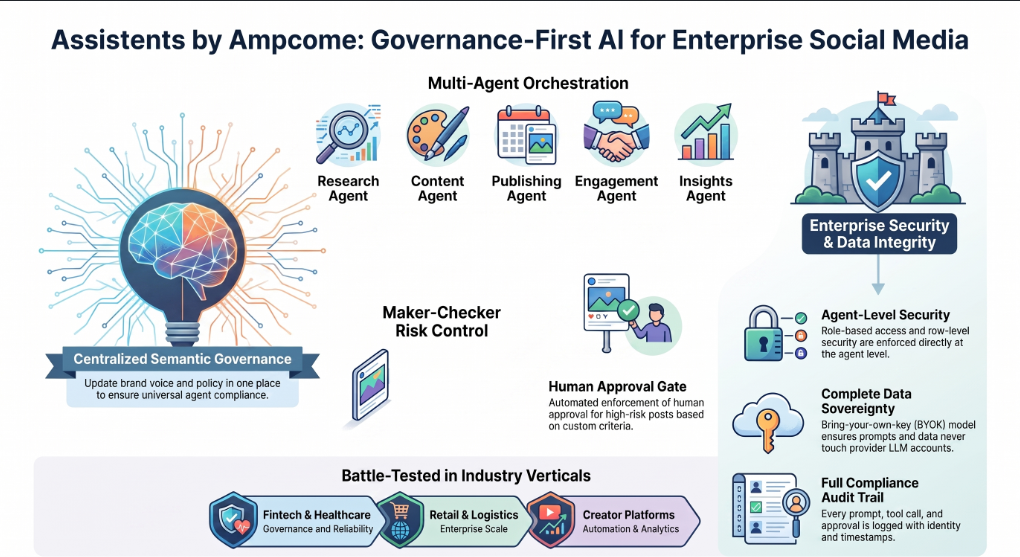
Research, Content, Publishing, Engagement, and Insights agents ship as a coordinated team, not a checkbox. The orchestrator routes work between them, holds shared context, and enforces governance at every handoff — so no single agent is making decisions in isolation.
Semantic governance layer
Your brand voice, product taxonomy, approved claims, prohibited terms, tonal variations, and escalation rules live in a versioned semantic layer that every agent reads before acting. Update policy in one place; every agent updates. This is how brand consistency stops depending on prompt engineering.
Maker-checker for high-risk posts
Define the exact risk criteria that require human approval — content type, spend level, sentiment threshold, competitor mention, executive quote — and Assistents enforces the check without holding up routine content.
Row-level security and role-based access
APAC marketers see APAC data. Agency partners see their assigned brands. Approvers approve; drafters draft; publishers publish. Security is enforced at the agent level, not just the UI.
Bring-your-own-key and data residency
Use your own OpenAI, Anthropic, Azure, or self-hosted model keys. Choose your data region. Your prompts and data never touch our LLM accounts. CISO approval becomes possible, not painful.
Full audit trail
Every prompt, tool call, output, and approval decision is logged with identity and timestamp. Compliance and legal teams get the evidence they need without engineering help.
Text-to-SQL analytics across your marketing stack
Ask "which LinkedIn posts drove the most qualified pipeline in Q3?" or "how did organic Instagram engagement correlate with paid ROAS this quarter?" in plain English. The agent generates governed queries against your data warehouse, returns the answer, and shows its work.
Deep enterprise integrations
Assistents plugs into your CRM, DAM, ad platforms, BI stack, and ticketing system. It is designed to fit into your workflow, not to replace it.
Built by Ampcome for enterprise scale
Ampcome has delivered agentic AI, analytics, and automation deployments for global brands across retail, logistics, fintech, healthcare, creator-economy platforms, and family-owned conglomerates. The platform is battle-tested in environments where governance and reliability are non-negotiable.
Closing: the shift from tools to teammates
The choice enterprises face in 2026 is not which social media scheduler to buy. It is whether to keep executing social manually while competitors deploy agent teams that never stop working.
The pattern is consistent across every enterprise deployment: teams that treat AI as a tool see incremental gains. Teams that treat AI agents as governed teammates — with real workflows, real handoffs, and real accountability — see structural gains in speed, consistency, and coverage.
Assistents by Ampcome is built for the second path. Multi-agent orchestration, semantic governance, maker-checker workflows, BYOK, RLS, and full audit trails are not add-ons. They are the platform. If social media has become one of your organization's most complex, highest-volume workflows, it is time to run it like one.
Ready to see a social media manager AI agent built for enterprise governance? [Book a demo of Assistents by Ampcome →]
FAQs
What is a social media manager AI agent?
A social media manager AI agent is a governed, autonomous software system that perceives signals from social platforms, reasons about the right action, and executes across the social workflow — from content creation to engagement to reporting — without step-by-step human direction.
How is a social media AI agent different from a traditional social media tool?
Traditional tools handle isolated tasks: scheduling, caption generation, inbox centralization. A social media AI agent owns the workflow end-to-end — research, drafting, publishing, engagement, and analytics — with governance controls that keep humans in charge of judgment calls.
Can an AI agent fully replace a human social media manager?
No, and it should not. The best agents handle execution — drafting, adapting, scheduling, triaging, reporting — while humans focus on strategy, creative direction, relationships, and judgment on sensitive content. Fully autonomous social with no human oversight is a brand-safety risk, not a maturity milestone.
What tasks can a social media manager AI agent automate?
Content ideation, platform-specific adaptation, brand-voice-consistent drafting, cross-platform scheduling, real-time comment and DM triage, sentiment-aware crisis flagging, competitor monitoring, influencer vetting, campaign performance attribution, executive reporting, and compliance pre-checks — among others.
How does a social media AI agent handle brand voice?
Governed agents read brand voice from a versioned semantic layer, not a prompt. The layer includes tone rules, prohibited terms, approved claims, platform-specific variations, and escalation triggers. Every agent references it before generating output, so voice consistency does not depend on who wrote the last prompt.
Is it safe to let an AI agent post on my company's social accounts?
Safe when deployed with governance. Look for maker-checker workflows on high-risk content, sentiment-aware escalation, break-glass controls for crises, role-based access, and full audit trails. Autonomy without governance is risky; autonomy with governance is scalable.
How much does a social media AI agent cost?
Costs vary widely — vertical AI add-ons on schedulers start under $100 per month per user, while enterprise agentic platforms typically run on annual contracts scaled to workflow complexity, integrations, and volume. Total cost of ownership matters more than sticker price; include setup, integration, and change management.
What are the risks of using an AI agent for social media?
The main risks are hallucination, brand-voice drift, unintended tone in sensitive situations, and posting on high-risk topics without human review. Every risk has a governance control: fact-checking, semantic layers, sentiment escalation, and maker-checker workflows. Deploy the controls and the risks become manageable.
How do you evaluate a social media manager AI agent for enterprise use?
Use a seven-part framework: autonomy level, governance depth, integration surface, brand-voice fidelity, human-in-the-loop controls, audit and compliance readiness, and total cost of ownership. Push vendors for concrete examples on every dimension.
Can a social media AI agent handle multiple brands or clients?
Yes, when built for it. Look for multi-workspace architecture, row-level security separating brand data, per-brand semantic layers, and role-based access that prevents cross-client data exposure. Consumer tools rarely handle this well; enterprise platforms are built around it.
How does a social media AI agent measure performance?
By connecting social activity to business outcomes — pipeline, revenue, retention, share of voice — not just likes and shares. The Insights Agent attributes results back to specific posts, campaigns, and channels, then delivers natural-language executive summaries that answer strategic questions.
What is a multi-agent system for social media management?
A multi-agent system uses specialized agents — Research, Content, Publishing, Engagement, and Insights — coordinated by an orchestrator. Each agent handles one part of the workflow. The orchestrator routes work between them and enforces governance at every handoff.
Do social media AI agents work with LinkedIn, Instagram, X, and TikTok?
The best platforms publish natively to LinkedIn, Instagram, X, TikTok, YouTube, Facebook, Threads, and Pinterest, adapting format, copy length, and media for each channel. Verify native API integration versus third-party workarounds during evaluation.
How long does it take to deploy a social media AI agent?
Enterprise-grade deployments typically move through discovery, semantic-layer configuration, integration, pilot, and rollout across 6-to-12 weeks depending on scope. First-workflow pilots can go live in 4-to-6 weeks; full multi-brand rollouts take 8-to-12.
What governance controls should an enterprise social media AI agent have?
At minimum: a semantic governance layer, maker-checker workflows for high-risk content, row-level security, role-based access, full audit logs, bring-your-own-key support, data residency options, human-in-the-loop escalation, and break-glass crisis controls. Anything less is not enterprise-grade.

Transform Your Business With Agentic Automation
Agentic automation is the rising star posied to overtake RPA and bring about a new wave of intelligent automation. Explore the core concepts of agentic automation, how it works, real-life examples and strategies for a successful implementation in this ebook.
Sarfraz Nawaz is the CEO and founder of Ampcome, which is at the forefront of Artificial Intelligence (AI) Development. Nawaz's passion for technology is matched by his commitment to creating solutions that drive real-world results. Under his leadership, Ampcome's team of talented engineers and developers craft innovative IT solutions that empower businesses to thrive in the ever-evolving technological landscape.Ampcome's success is a testament to Nawaz's dedication to excellence and his unwavering belief in the transformative power of technology.

More insights
Discover the latest trends, best practices, and expert opinions that can reshape your perspective

.jpg)





Contact us

