
Best AI Agents for Trading Forex in 2026: How Autonomous Agents Outperform Bots, Signals, and Manual Analysis


The foreign exchange market now moves $9.6 trillion every single day. That figure, confirmed by the Bank for International Settlements' 2025 Triennial Survey, represents a 28% increase from 2022. It is the largest, most liquid, most continuously active financial market on the planet — operating 24 hours a day, five days a week, across every time zone simultaneously.
And most traders are still trying to navigate it with tools that were designed for a different era.
Static trading bots executing pre-programmed rules. Signal services delivering lagging alerts. Manual analysis workflows that cannot possibly keep pace with the speed at which macro conditions shift, sentiment turns, and central bank language moves markets.
Something fundamentally different is now in production: AI agents for trading forex. Not bots. Not scripts. Not signal feeds. Autonomous, reasoning-capable systems that ingest multi-source market data, simulate strategy, apply risk guardrails, and execute or escalate — all within a governed, auditable workflow.
This guide explains exactly what these systems are, what separates them from everything that came before, what capabilities to look for, and what real deployments have actually been delivered. If you are evaluating AI agents for forex trading in 2026, this is the most operationally grounded resource you will find.
What Are AI Agents for Trading Forex? (And Why They Are Not Bots)
The word "agent" gets used loosely in trading contexts, so it is worth being precise.
An AI trading agent is an autonomous software system that perceives its environment, reasons about what to do, acts on that reasoning, and learns from the outcome. It is not executing a fixed rule. It is running a continuous loop: observe market conditions, reason through strategy options, act by placing, adjusting, or escalating a position, and update its model based on what happened next.
This is architecturally different from a traditional trading bot in every way that matters.
A traditional Expert Advisor or rule-based bot sees an RSI reading below 30 and buys. It does not know whether a central bank just raised rates. It does not know whether that signal has been reliable in the current volatility regime. It does not know that the same setup failed seventeen times in the past three months under similar macro conditions. It follows the rule. The rule does not change.
An AI agent, by contrast, ingests real-time price feeds, macroeconomic indicators, news sentiment, and cross-pair correlations simultaneously. It builds a probabilistic picture of what is happening in the market and why. It simulates the likely outcomes of different responses. It applies risk guardrails — not as hard-coded stops, but as governed constraints that can account for context. And it produces a decision with a reasoning trail that can be reviewed, audited, and improved.
The Observe-Reason-Act loop is the architectural foundation of agentic trading, and it is what makes these systems capable of adapting to market regime changes that would cause a static bot to fail catastrophically.
The Critical Distinction: Bots vs. Agents vs. Agentic Systems
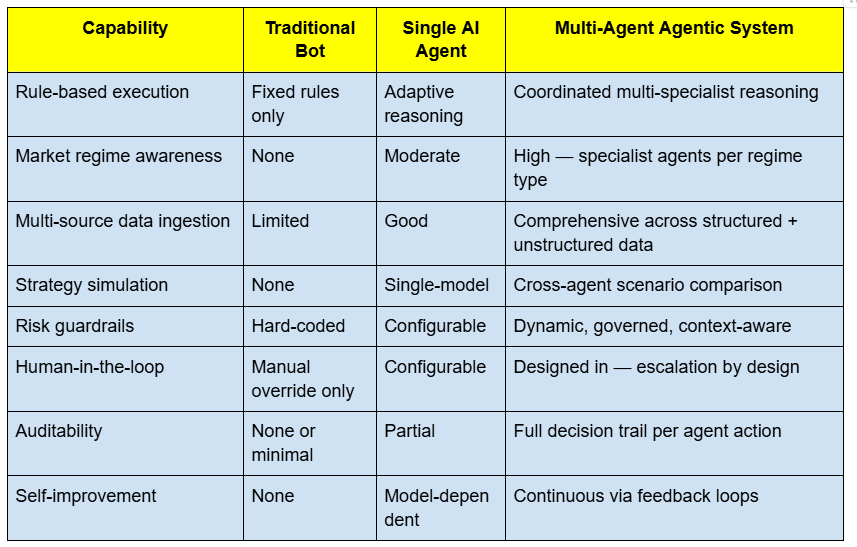
The multi-agent architecture — where a research agent, an analysis agent, a risk agent, and an execution agent each operate in their domain of specialisation and then coordinate — is what produces the reliability that neither individual bots nor single-model AI systems can match. This is how real trading firms operate: multiple specialists reviewing and challenging each other before a position is taken. The multi-agent approach replicates that structure in software.
Why 2026 Is the Inflection Point for Agentic Forex Trading
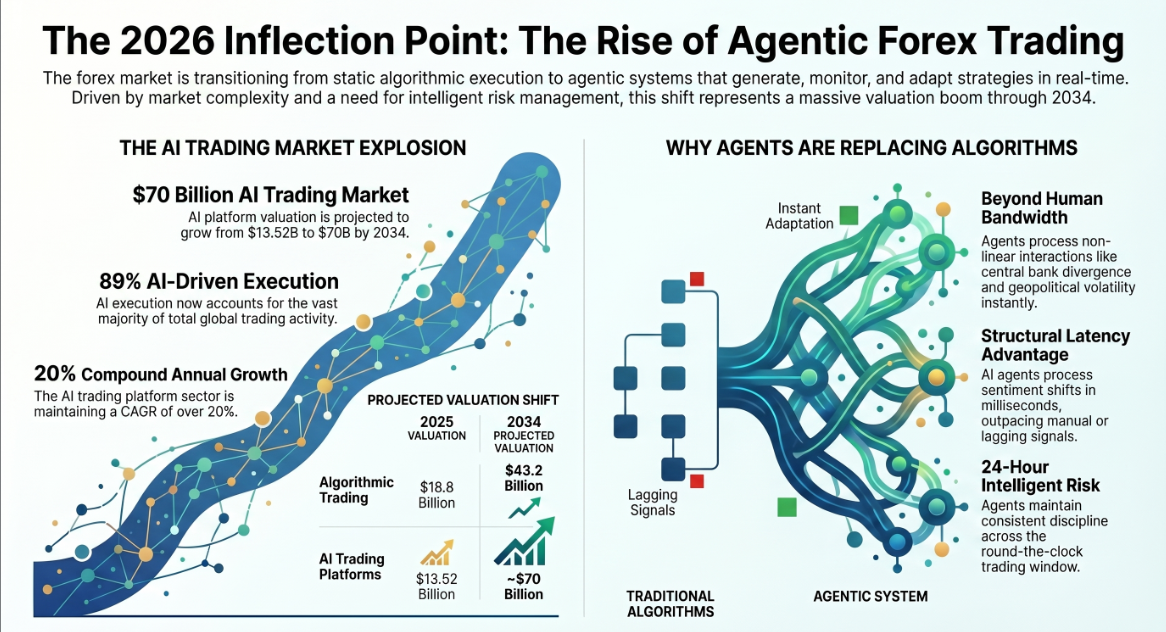
The shift from algorithmic trading to agentic trading did not happen overnight, but it is happening now, and the data makes the direction clear.
The global algorithmic trading market was valued at $18.8 billion in 2025 and is projected to reach $43.2 billion by 2034. Algorithmic systems already handle the vast majority of global trading volume, with estimates suggesting AI-driven execution now accounts for close to 89% of total trading activity across global markets. The AI trading platform market alone is expected to grow from $13.52 billion in 2025 to nearly $70 billion by 2034 — a compound annual growth rate of over 20%.
Within that broader shift, the move specifically toward agentic systems — multi-agent, reasoning-capable, governance-embedded — represents the next structural layer. Institutional desks that spent 2022–2024 deploying algorithmic execution are now deploying agent layers on top of that execution infrastructure: systems that do not just run strategies but generate them, evaluate them, monitor them, and adapt them.
For forex specifically, three factors are accelerating this transition:
Market complexity has outpaced human analytical bandwidth. The forex market in 2025 is driven by overlapping forces — aggressive central bank divergence, geopolitical volatility, tariff policy shifts — that interact in non-linear ways. No human analyst, and no static algorithm, can process those interactions fast enough or comprehensively enough to trade them well consistently.
Latency asymmetry has become structural. Institutions using AI agents are processing news, sentiment shifts, and price anomalies in milliseconds. Traders using manual analysis or lagging signals are responding to conditions that have already been traded by the time they see them.
The cost of unstructured risk has become intolerable. The same volatility that creates opportunity in forex creates catastrophic downside for positions without intelligent risk management. AI agents can maintain consistent risk discipline across a 24-hour trading window — something human traders and rule-based bots structurally cannot do.
The Problem with Every Alternative
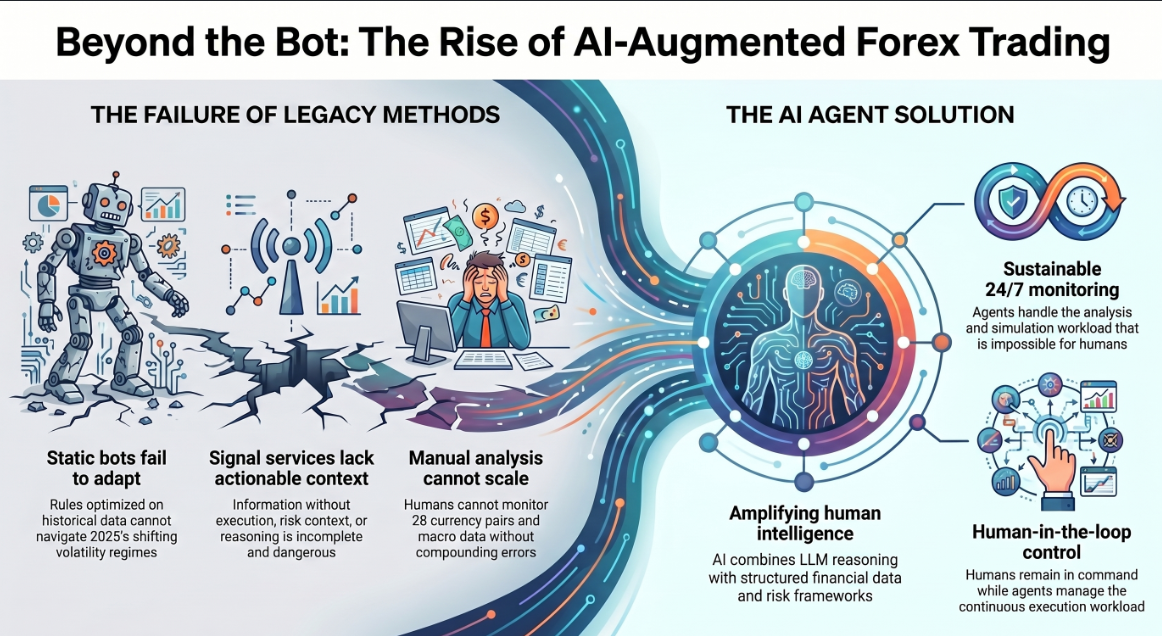
Before getting into what makes a good AI agent for forex trading, it is worth being direct about why the alternatives fall short.
Trading bots fail because markets are not stationary. A bot optimised on historical data is, at best, a map of where the market used to be. When volatility regimes shift — and in 2025, they shifted dramatically, multiple times — bots do not adapt. They execute their rules into conditions the rules were never designed for.
Signal services fail because they deliver information, not execution. A signal that arrives at market close or during low-liquidity windows is not actionable. A signal without position sizing, risk context, and real-time monitoring is incomplete at best and dangerous at worst. And a signal service that cannot explain its reasoning gives a trader no basis for trust or improvement.
Manual analysis fails at scale. Even the most skilled analyst cannot monitor 28 major currency pairs across five sessions, track macro calendars across twelve central banks, process real-time sentiment from news and social sources, and maintain consistent risk discipline across a full trading week. The cognitive load is prohibitive. The human error rate compounds.
AI agents for forex trading do not replace trading intelligence — they amplify it. The best deployments in production today combine the reasoning capabilities of large language models with structured financial data pipelines, risk governance frameworks, and human-in-the-loop escalation design. The human remains in control; the agent handles the continuous monitoring, analysis, simulation, and alerting workload that would otherwise be impossible to sustain.
Key Capabilities to Look for in a Forex AI Agent
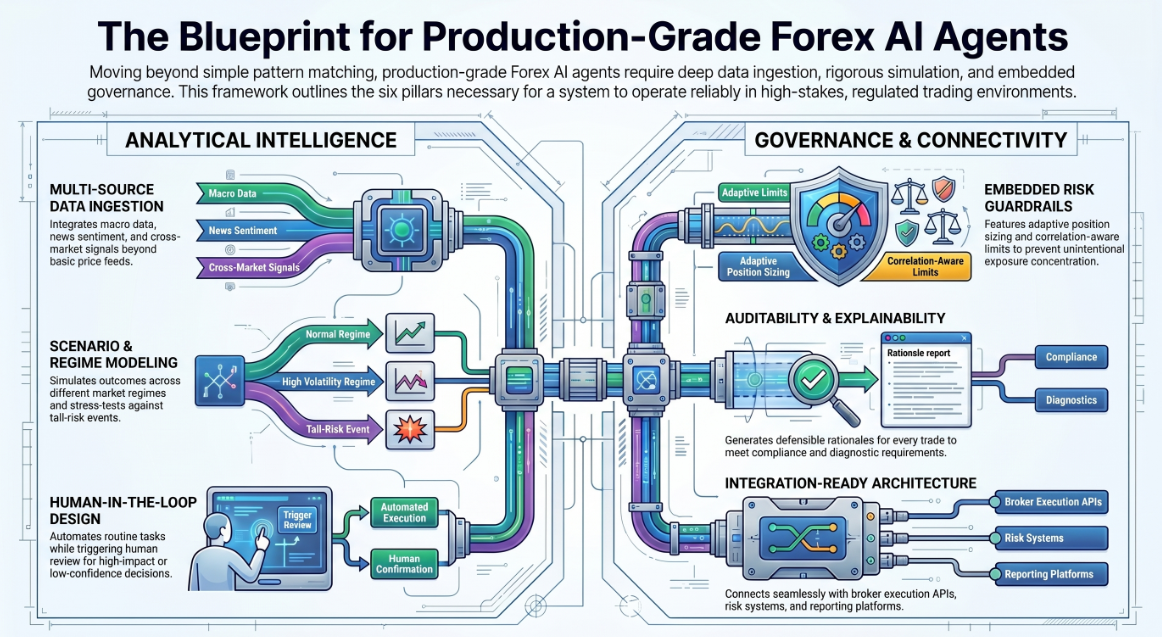
Not all AI agents for trading forex are equal. Here is what separates production-grade systems from tools that look impressive in demos but underdeliver in live environments.
1. Multi-Source Data Ingestion
A forex AI agent that only reads price feeds is not doing analysis — it is doing pattern matching. Production-grade agents ingest:
- Real-time price feeds across major, minor, and exotic pairs
- Macroeconomic data streams (interest rate differentials, GDP releases, CPI data, employment figures)
- Central bank communications and forward guidance analysis
- News sentiment across financial media sources
- Cross-market signals (equities, commodities, bonds) that correlate with currency movements
- Social and positioning data (COT reports, retail sentiment indicators)
The depth of data ingestion determines the quality of the signal. Agents operating on thin data produce thin decisions.
2. Strategy Simulation and Scenario Modelling
The best AI agents for forex trading do not just identify what the market is doing — they simulate what is likely to happen next under different scenarios. This includes:
- Backtesting candidate strategies against historical data segmented by market regime
- Forward simulation of position outcomes under multiple macro scenarios
- Probability-weighted scenario comparison before execution decisions
- Stress testing against tail-risk scenarios (flash crashes, sudden liquidity withdrawal, correlated drawdowns)
Strategy simulation is what separates an agent that acts on information from one that acts on judgement.
3. Risk Guardrails and Position Governance
Risk management in a forex AI agent should not be a set of stop-loss rules appended to a strategy. It should be governance logic embedded throughout the decision-making pipeline:
- Position sizing rules that adapt to current volatility and account equity
- Correlation-aware exposure limits that prevent unintentional concentration (holding multiple positions that are effectively the same directional bet)
- Drawdown circuit breakers that reduce size or pause trading during adverse conditions
- Time-based risk rules that account for low-liquidity windows and event risk around major data releases
- Escalation triggers that pull a human into the loop before high-impact decisions
Rule-governed execution with dynamic risk context is the difference between a system you can trust to run overnight and one you have to babysit.
4. Human-in-the-Loop Design
The best agentic trading systems are not fully autonomous black boxes. They are designed with specific points at which human review is built into the workflow:
- High-confidence, low-impact decisions execute autonomously
- Medium-confidence or high-impact decisions trigger human review alerts
- Decisions outside defined parameters require explicit approval before execution
This design is not a limitation — it is a competitive advantage. It means the system can run at machine speed for routine execution while preserving human judgement for the decisions that actually require it. And it produces an audit trail that is essential for risk management, compliance, and continuous improvement.
5. Auditability and Explainability
In regulated environments, every trade needs a defensible rationale. In professional trading environments, every decision needs to be reviewable so losing streaks can be diagnosed and corrected. In enterprise deployments, every agent action needs to be logged for compliance and governance purposes.
Audit trails are not optional features. They are infrastructure. An AI agent that cannot explain its decisions is an agent that cannot be improved, cannot be trusted, and cannot operate in any environment with accountability requirements.
6. Integration-Ready Architecture
A forex AI agent that operates in isolation from your existing infrastructure is a toy, not a tool. Production-grade systems connect to:
- Broker execution APIs (MetaTrader 4/5, proprietary FIX connections, REST APIs)
- Portfolio and risk management systems
- Analytics and reporting platforms
- Data vendors and market data aggregators
- CRM and client management systems (for managed account operators)
The integration layer is where most agent deployments actually succeed or fail. Systems built on flexible, integration-ready architecture scale from proof of concept to full production without requiring infrastructure replacement.
What Real AI Agent Deployments in Trading Have Delivered
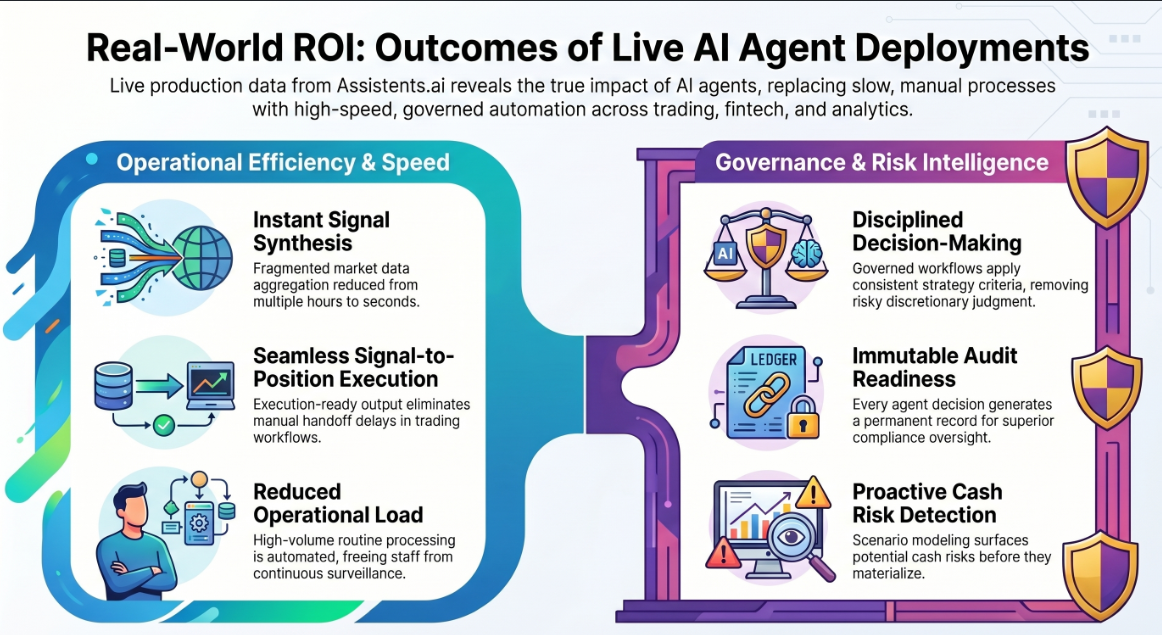
The most useful data for evaluating AI agents for forex trading is not benchmark performance on historical backtests. It is what happens when these systems run in production environments, on real capital, under real market conditions.
Assistents.ai has been deployed in live financial and trading environments across multiple markets. Without identifying specific clients, here is what production deployments have demonstrated.
In a live trading intelligence deployment, an AI agent system was built to handle market signal research, strategy analysis, and execution-ready workflow integration across a complex multi-instrument environment. The system ingested market data, ran indicator and pattern analysis pipelines, simulated strategies with risk guardrails, generated alerting and recommendation summaries, and connected output directly to execution workflows.
The outcomes: faster synthesis of fragmented market signals that previously required multiple hours of manual aggregation; more disciplined decision-making through governed workflows that applied consistent strategy criteria rather than discretionary judgement; reduced manual monitoring effort as the agents handled continuous market surveillance; and execution-ready output that moved from signal to position without manual handoff delays.
In a fintech financial operations deployment, AI agents were built to handle omnichannel banking support workflows including disputes, fraud monitoring, and compliance operations. The system processed intake across multiple channels, routed cases through auditable workflows, generated next-best-action recommendations, and maintained compliance-ready audit trails.
The outcomes: faster case handling with improved consistency; reduced operational load via automation of high-volume routine processing; and better compliance readiness through immutable audit records of every agent decision.
In a financial analytics deployment for a portfolio management operation, agents were built to connect financial data across accounting and banking sources, generate continuous cashflow monitoring and forecasting, and surface scenario-modelled alerts before cash risks materialised.
The outcomes: faster analysis cycles, earlier detection of cash risks and anomalies, and scalable advisory-level insight without added headcount.
The pattern across deployments is consistent: AI agents deliver speed, consistency, and scale that manual workflows cannot match — while governance frameworks ensure that the speed does not come at the cost of control.
Top Use Cases for AI Agents in Forex Trading in 2026
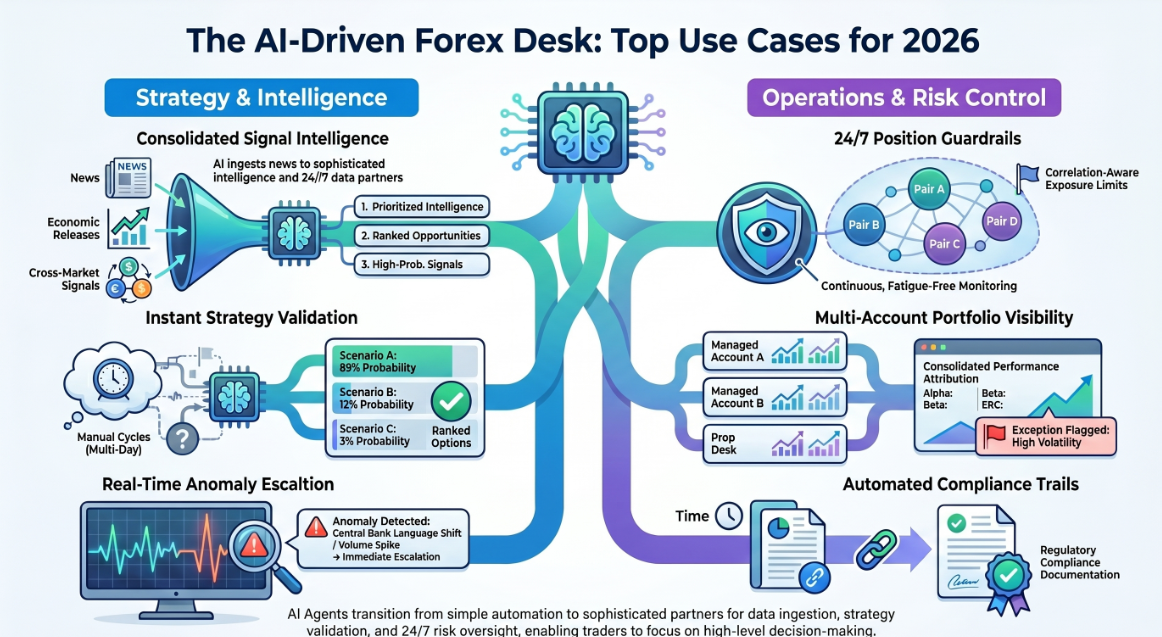
Understanding where AI agents add the most value helps prioritise deployment for both individual traders and institutional teams.
Signal research and aggregation.
The average professional forex trader monitors multiple information sources simultaneously. An AI agent handles this continuously, ingesting price data, news, economic releases, and cross-market signals, then presenting consolidated, prioritised intelligence rather than raw data streams.
Automated strategy generation and validation.
AI agents can generate candidate strategies based on current market conditions, validate them against historical regimes, and present ranked options with probability-weighted outcome scenarios — replacing the manual strategy development cycle that typically takes days.
Risk management and position guardrails.
Real-time position monitoring across multiple pairs, with correlation-aware exposure limits and dynamic stop logic, is a task that no human trading desk can perform perfectly across a 24-hour window. Agents do this continuously without fatigue.
Real-time alerting on anomalies and macro events.
Agents monitor for predefined conditions — unusual spread widening, central bank language shifts, sudden volume anomalies, correlated drawdowns across positions — and escalate immediately rather than waiting for a scheduled review.
Portfolio-level monitoring across multiple pairs and accounts.
For managed account operators and prop trading desks, agents provide consolidated visibility across an entire portfolio, flagging exceptions and generating performance attribution analysis without requiring manual aggregation.
Compliance and audit trail generation.
In regulated environments, agents produce the documentation trail that demonstrates regulatory compliance for every executed decision — a workload that manual processes struggle to sustain at scale.
AI Agents for Forex vs. Other Asset Classes: Key Differences
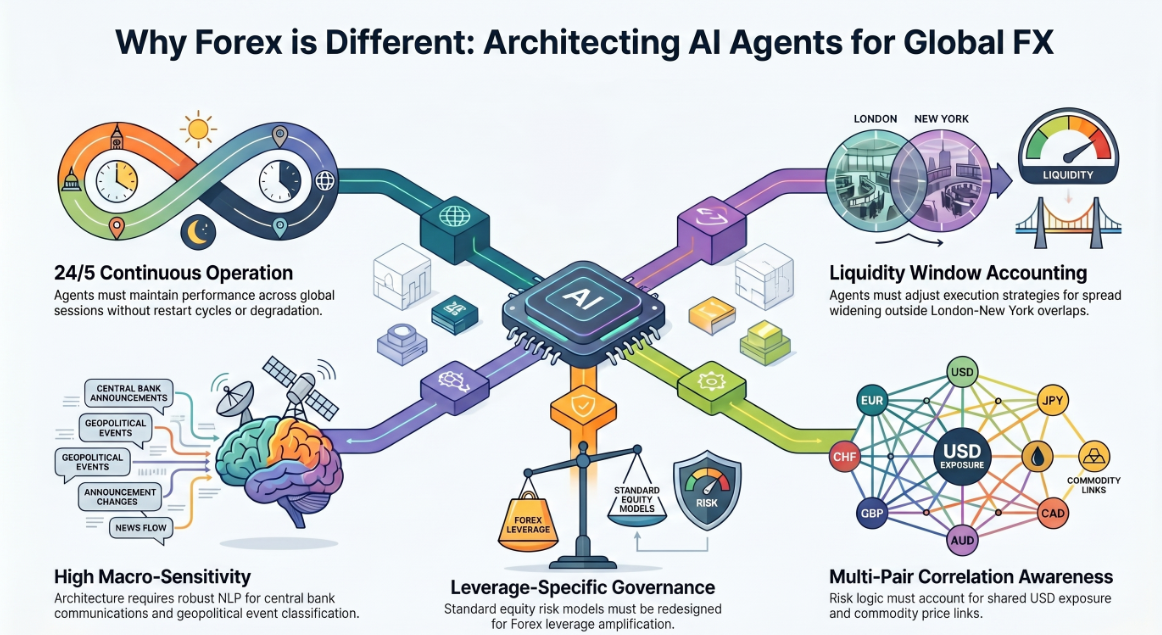
AI agents are being deployed across equities, crypto, commodities, and fixed income, but forex presents specific deployment characteristics that shape how agents should be configured.
24/5 market operation.
Forex trades continuously from Monday open in Wellington through Friday close in New York. This means an agent must be capable of continuous operation without degradation — no overnight gaps in coverage, no session-start restart cycles. Architecture and infrastructure reliability requirements are higher than for equity-market agents.
Macro sensitivity.
Currency movements are more directly driven by macroeconomic policy than most other asset classes. An effective forex AI agent needs robust natural language processing for central bank communications, economic release interpretation, and geopolitical event classification — capabilities that are less central to equity momentum or crypto sentiment agents.
Liquidity windows.
Forex liquidity is not uniform across the trading day. Spreads widen dramatically outside London-New York overlap hours, and execution conditions around major data releases require special handling. Agents that do not account for liquidity windows will achieve worse execution quality than those designed around them.
Multi-pair correlation complexity.
Major currency pairs are not independent. EUR/USD, GBP/USD, and USD/JPY share common USD exposure. AUD and NZD correlate strongly with commodity price movements. An agent managing positions across multiple pairs without accounting for these correlations is building unintentional concentrated risk. Correlation-aware position management is non-negotiable in a multi-pair forex agent.
Leverage amplification.
Standard forex leverage amplifies both returns and losses in ways that equity positions do not. This makes risk governance logic more consequential in forex than in most other asset class deployments. Agents built for equity markets cannot be directly ported to forex without significant risk governance redesign.
How to Deploy an AI Agent for Forex Trading: Build vs. Buy
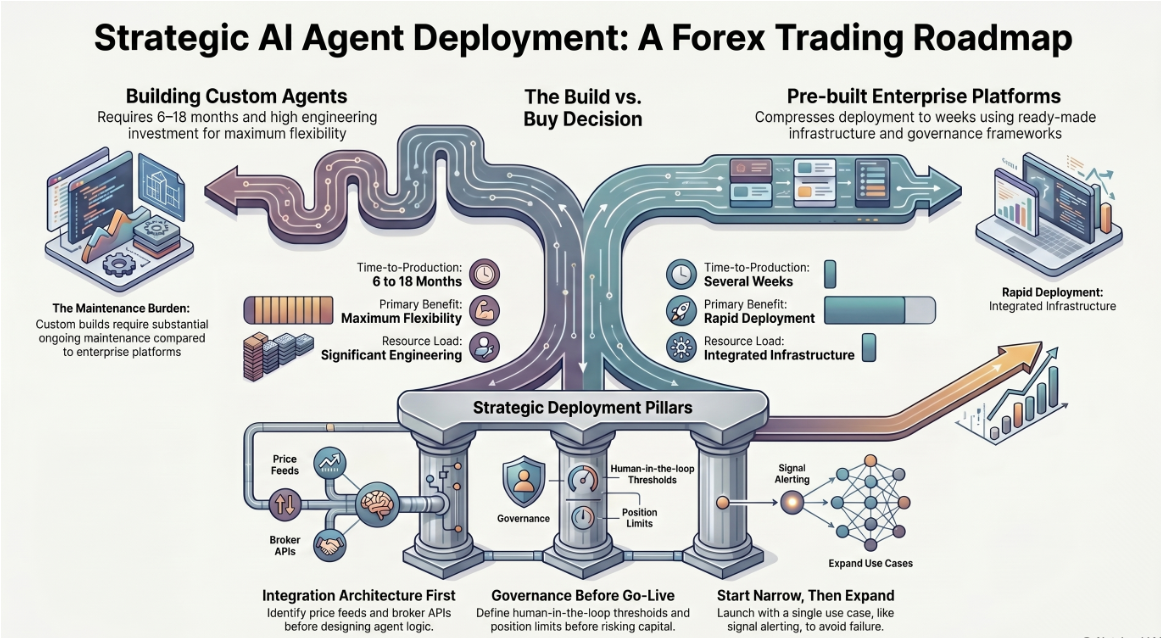
If you have reached the conclusion that AI agents represent a genuine capability upgrade for your forex trading or fintech operation, the next question is how to deploy one. The build-versus-buy decision depends on your technical resources, integration requirements, and timeline.
Building a custom agent from components — LLM APIs, vector databases, orchestration frameworks, broker API connectors, custom risk logic — gives maximum flexibility but requires significant engineering investment. For most trading firms and fintech operators, the time-to-production is six to eighteen months, and the ongoing maintenance burden is substantial.
Deploying on a pre-built agent platform compresses that timeline dramatically. Purpose-built enterprise agent platforms with pre-built integrations, governance frameworks, and deployment infrastructure can move from proof of concept to production in weeks rather than months. The trade-off is some degree of customisation constraint — but for the majority of use cases, the constraint is smaller than the build cost.
Regardless of approach, the key deployment decisions are:
Integration architecture first. Identify your data sources (price feeds, economic calendars, news APIs), your execution connections (broker APIs, FIX connections), and your downstream systems (risk dashboards, portfolio management) before designing the agent. The integration layer determines what the agent can see and what it can do.
Governance design before go-live. Define your human-in-the-loop thresholds, your escalation triggers, your position limits, and your audit trail requirements before any capital is at risk. Retrofitting governance onto a running agent is significantly harder than designing it in from the beginning.
Start narrow, then expand. The most successful agent deployments begin with a single, well-defined use case — signal aggregation and alerting, or automated risk monitoring, or post-trade analytics — and expand from there. Attempting to build a fully autonomous end-to-end trading system in the first deployment phase is the most reliable way to fail.
Measure against a baseline. Define your current performance on the target use case — time to identify signals, accuracy of risk flag detection, hours spent on manual monitoring — before deploying the agent. Without a baseline, you cannot demonstrate ROI, and you cannot identify where the agent is underperforming.
Assistents.ai is built specifically for organisations that need production-grade AI agents deployed against real operational workflows, with full integration support, governance frameworks embedded by default, and a track record of deployments across financial services, fintech, and trading environments globally.
Common Mistakes When Deploying AI Agents for Forex Trading
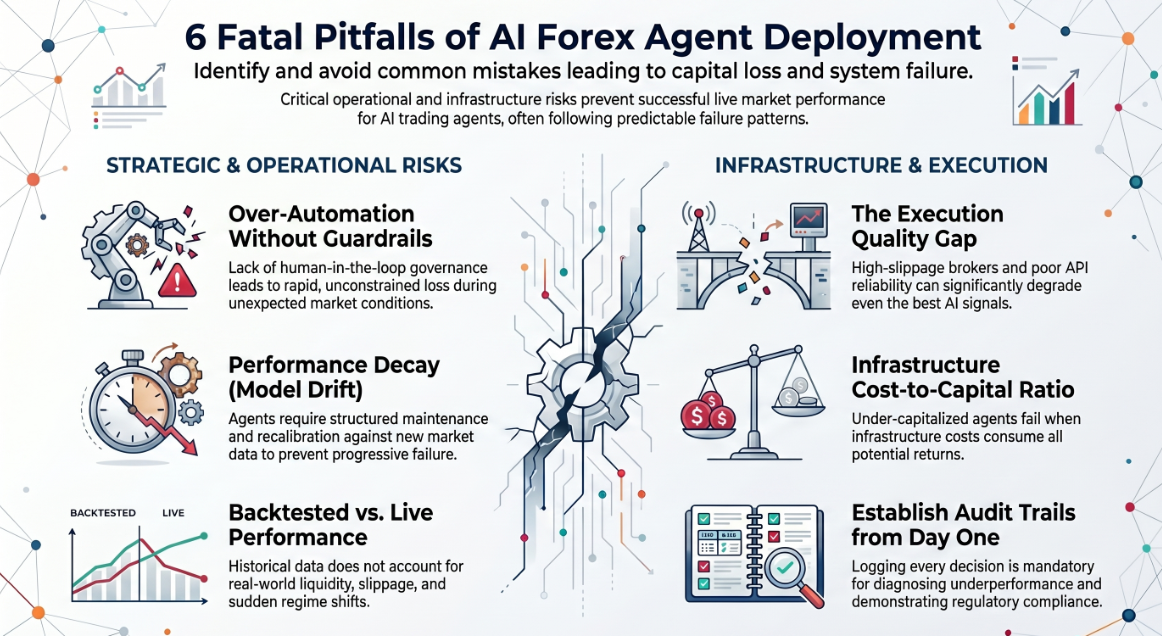
Deployment failures in AI trading agents follow predictable patterns. Understanding them in advance prevents the most costly errors.
Over-automating without sufficient guardrails.
The appeal of full automation is understandable, but agents operating without governance constraints will eventually encounter market conditions they were not designed for. The result is not graceful degradation — it is rapid, unconstrained loss. Human-in-the-loop design is not optional for live capital deployment.
Treating an AI agent like a static bot.
An agent that is deployed and then left to run without monitoring, feedback, and periodic recalibration will drift. Models that are not updated against new market regime data will perform progressively worse as conditions evolve. Agents require maintenance cycles — not constant intervention, but structured review and recalibration.
Ignoring execution quality.
Signal generation and execution are separate problems. An agent that generates excellent signals but routes them through a high-slippage broker with poor API reliability will underperform its simulated results significantly. Execution infrastructure matters as much as agent intelligence.
Under-capitalisation.
AI agents for forex trading have infrastructure costs — API access, data feeds, hosting, LLM inference. Running an agent on insufficient capital means infrastructure costs consume a disproportionate share of potential returns. Size requirements vary by strategy and execution frequency, but viability requires realistic capital allocation.
No audit trail from day one.
Teams that deploy agents without logging agent decisions from the beginning lose the data they need to diagnose underperformance, demonstrate compliance, and improve the system over time. Audit infrastructure should be in place before the first live decision is made.
Conflating backtested performance with live performance.
This is the most common disappointment in trading agent deployments. A model that achieves impressive historical performance has been optimised on historical data. Live markets contain regime shifts, liquidity conditions, and execution frictions that backtests do not capture. Treat backtested performance as directional evidence, not performance prediction.
The Shift That Is Already Underway
The forex market does not wait. The $9.6 trillion that trades every day moves at a speed and complexity that outpaces every analytical tool that was designed for a previous era of markets.
The transition from manual analysis to algorithmic execution already happened. The transition from algorithmic execution to agentic systems — autonomous, reasoning-capable, governance-embedded AI agents — is happening now. The firms and traders who are deploying these systems are not experimenting. They are operating at a structural advantage over those who are not.
The question is not whether AI agents will define the next era of forex trading. They already are. The question is whether your operation is building that capability now or planning to catch up later.
Assistents.ai has been deployed in production financial environments across fintech, banking, trading intelligence, and financial operations — delivering speed, consistency, and governance that manual workflows cannot match. Every feature on the platform was proven in real deployments before it was productised. There is no guesswork in the architecture.
If you are evaluating AI agents for forex trading, or building the case for agentic deployment in your financial operation, the most useful next step is a direct conversation about your specific integration environment, risk governance requirements, and target workflows.
Book a demo with Assistents.ai →
Frequently Asked Questions About AI Agents for Forex Trading
What is the best AI agent for trading forex in 2026?
The best AI agent for trading forex depends on your deployment context. For institutional and enterprise environments that require governance, auditability, multi-system integration, and production reliability, platform-built agents like those deployed through Assistents.ai represent the most operationally mature option. For individual traders, the priority is finding a system with transparent reasoning, configurable risk guardrails, and genuine adaptability to market regime changes — not simply a bot with an AI branding layer.
How do AI trading agents differ from forex trading bots?
A forex trading bot executes pre-programmed rules without adaptation. An AI trading agent observes market conditions, reasons about strategy options, applies risk governance logic, and acts — then learns from outcomes and updates its approach. The architectural difference is fundamental: bots execute rules, agents exercise judgement within governed parameters. When market conditions change in ways the original rules did not anticipate, bots fail. Agents adapt.
Can AI agents trade forex automatically without human oversight?
Yes, AI agents can execute trades autonomously within defined parameters. In production deployments, fully autonomous execution is appropriate for high-confidence, low-impact, routine decisions. For higher-impact decisions, well-designed agentic systems include human-in-the-loop checkpoints that trigger review before execution. Complete removal of human oversight from all decisions is inadvisable for live capital deployment — the value of agentic systems comes from combining machine speed and consistency with human judgement at the right moments.
Are AI trading agents profitable in forex?
AI agents provide structural advantages — speed, consistency, continuous operation, multi-source analysis — that increase the probability of profitable outcomes relative to manual trading or static bots. However, no AI system guarantees profitability. Markets are adversarial environments. The value of a well-designed agent is improved decision quality and risk discipline over time, not guaranteed positive returns. Treat AI agents as operational infrastructure that amplifies trading capability, not as an autonomous profit machine.
What data sources do AI forex agents use?
Production-grade AI agents for forex trading ingest real-time price feeds, economic data releases, central bank communications, news sentiment analysis, cross-market signals from equities and commodities, positioning data from COT reports, and in some cases, social sentiment indicators. The breadth and quality of data ingestion directly determines the quality of agent output.
Is it safe to use AI agents for live forex trading?
Safety in live forex trading comes from governance design, not from the absence of AI. An AI agent with well-designed risk guardrails, human-in-the-loop escalation points, position limits, and audit trails is significantly safer than discretionary manual trading, which is subject to emotional decision-making, fatigue, and inconsistent risk discipline. Safety is a design property, not a feature of any particular technology.
Can I build my own AI forex trading agent without coding?
Yes. No-code enterprise agent platforms allow traders and trading firms to configure, deploy, and manage AI agents without software development resources. Platforms like Assistents.ai provide pre-built integrations, configurable governance frameworks, and deployment infrastructure that compress the time from concept to production to a matter of weeks.
What is agentic trading?
Agentic trading is the use of autonomous AI agents — systems capable of perceiving their environment, reasoning about strategy, acting on decisions, and learning from outcomes — to perform trading workflows. Unlike algorithmic trading, which executes pre-defined rules, agentic trading involves genuine reasoning: evaluating multiple options, applying contextual risk logic, and producing decisions with explainable rationales. Agentic trading systems are the current frontier of AI deployment in financial markets.

Transform Your Business With Agentic Automation
Agentic automation is the rising star posied to overtake RPA and bring about a new wave of intelligent automation. Explore the core concepts of agentic automation, how it works, real-life examples and strategies for a successful implementation in this ebook.
Sarfraz Nawaz is the CEO and founder of Ampcome, which is at the forefront of Artificial Intelligence (AI) Development. Nawaz's passion for technology is matched by his commitment to creating solutions that drive real-world results. Under his leadership, Ampcome's team of talented engineers and developers craft innovative IT solutions that empower businesses to thrive in the ever-evolving technological landscape.Ampcome's success is a testament to Nawaz's dedication to excellence and his unwavering belief in the transformative power of technology.

More insights
Discover the latest trends, best practices, and expert opinions that can reshape your perspective






Contact us

