
AI Agents for Game Development: 20 Use Cases, Real Examples & How to Deploy Them


To Summarize
- AI agents for game development are software that plans, uses tools and completes multi-step studio work. Examples include triaging crashes, answering LiveOps questions and resolving player tickets, without needing a new prompt at every step.
- Adoption is mainstream. Measurement is not. Most developers already use agents, but a large minority cannot yet prove their return.
- Most published lists cover only code and art. The largest ongoing costs sit elsewhere, in LiveOps, player support, moderation, user acquisition and studio finance.
- Judge every agent with the Agent Job Card. It has seven fields: trigger, data, action, human gate, starting autonomy, KPI and fit. If you can't fill it in, the agent isn't ready.
- Start with reversible, boring problems. Crash triage, analytics Q&A and tier-1 player support deliver value fastest with the least risk.
What Are AI Agents in Game Development?
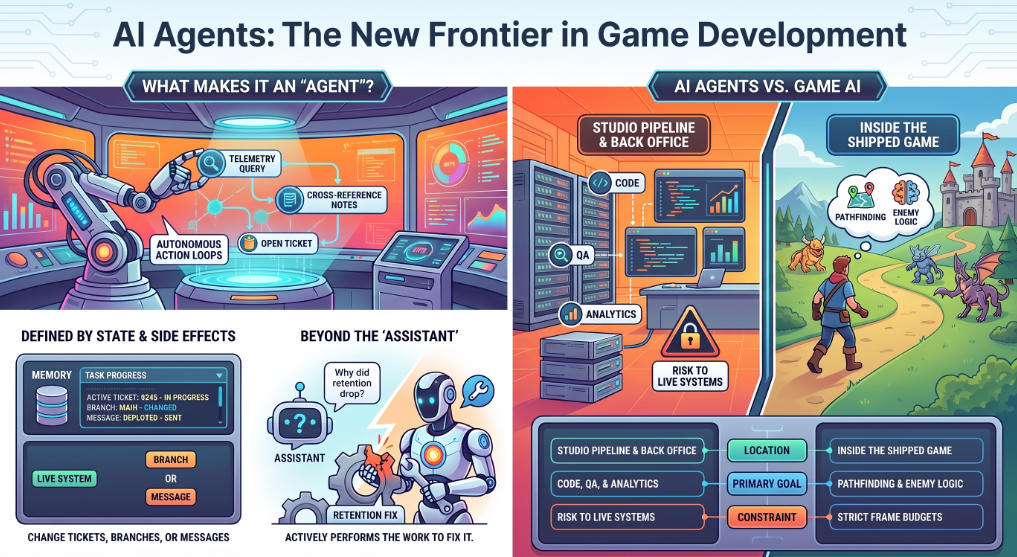
An AI agent in game development is a system that holds context across several steps, calls external tools, plans a sequence of actions and works toward a goal inside a studio's pipeline, back office or game. A model that answers "why did retention drop?" is an assistant. An agent is one that does all of the following:
- queries telemetry
- cross-references the patch notes
- clusters the crash reports
- opens a ticket
- tells you what it did
Two properties separate agents from ordinary AI features: state and side effects. An agent remembers where it is in a task, and it can change things, such as a ticket, a branch, a refund or a player message. That is why agents need controls that a chat assistant never did.
AI agents vs. game AI
The terms get confused constantly, so here is the distinction:
- Game AI controls behaviour inside the shipped game: pathfinding, behaviour trees, enemy logic and difficulty systems. It runs within a frame budget on the player's device.
- AI agents mostly build and operate the game around the player: code, QA, localisation, LiveOps, support and analytics. They have no frame budget, but they can do real damage if they act wrongly, because they touch live systems.
The overlap is runtime character agents, such as AI companions and conversational NPCs. They are agentic in design but execute inside the game loop, so they inherit both sets of constraints.
For a vendor-by-vendor comparison of tools in each category, see our ranking of the best agentic AI tools for game development. This guide focuses on the jobs agents do, not the vendors.
Why Game Studios Are Adopting AI Agents Now
The pressure is economic. Development costs keep rising, production cycles keep lengthening, and live-service games never stop needing people.
The clearest data point comes from a Google Cloud survey conducted with The Harris Poll. 87% of videogame developers reported using AI agents to streamline and automate tasks, as the industry focuses on optimizing costs after a wave of record layoffs. The study surveyed 615 game developers in the U.S., South Korea, Norway, Finland and Sweden in late June and early July 2025 (Silicon UK coverage).
Where they use them is revealing. 47% of developers said AI significantly boosts playtesting and game-mechanics balancing, 45% cited localisation and translation, and 44% use it for code generation and script support.
The caution in the same data is just as important. 94% of developers expect AI to reduce overall development costs in the long term, yet about one in four find it difficult to accurately measure the return on their AI investments. 63% also expressed concerns over data ownership.
That gap between adoption and measurable return is the real story. Most studios have agents. Far fewer have agents with clear owners, clear KPIs and a record of what they did. The rest of this guide is about closing that gap.
The Agent Job Card: How to Evaluate Any Game-Dev Agent
Before a studio deploys an agent, it should be able to describe the agent in seven fields. We call this the Agent Job Card. Every use case below uses it.
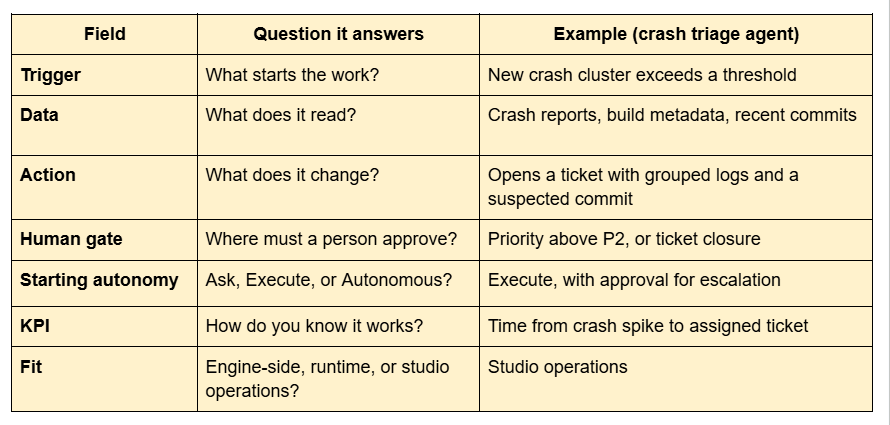
The Fit field matters most when you choose tools. Engine-side agents live in your editor and repository. Runtime agents live in your game. Studio operations agents sit above your data and business systems. These three are different products, and treating them as one buying decision is how studios end up with a dozen subscriptions and no policy. The three autonomy levels are explained in our Studio Autonomy Ladder.
20 AI Agent Use Cases Across the Game Lifecycle
The 20 use cases are grouped into five stages: Build, Test, In-Game, Run and Grow. Most published lists stop after the first two.
Build: Pre-Production and Production
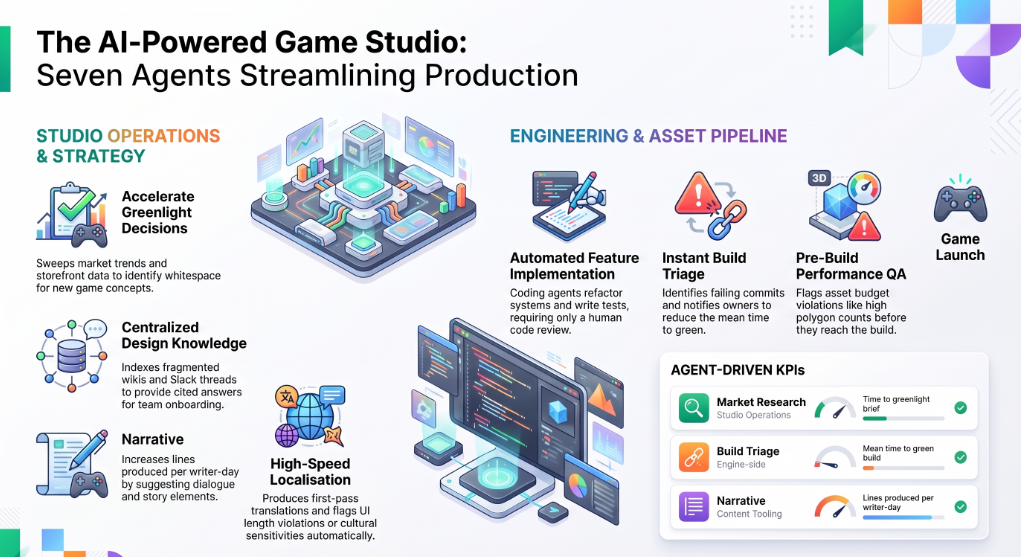
1. Market and concept research agent
Before greenlight, this agent sweeps genre trends, comparable titles, storefront rankings, review sentiment and pricing. It then produces a cited brief: what's working, what's saturated, and where the whitespace is. It doesn't replace creative judgement. It replaces the two weeks a producer spends assembling a spreadsheet nobody fully trusts.
Job card: Trigger: concept review or portfolio planning · Action: cited market brief · Gate: none (read-only) · KPI: time to greenlight-ready brief · Fit: studio operations
2. Design-document knowledge agent
Game design knowledge is spread across wikis, design docs, Slack threads, patch notes and lore bibles. A knowledge agent answers questions such as "what's the current stamina regen formula and when did it last change?" with citations back to the source document. This matters most for onboarding and for teams with high contractor turnover.
Job card: Trigger: team question · Action: cited answer · Gate: none · KPI: time-to-answer, repeat questions to leads · Fit: studio operations
3. Gameplay coding agent
Coding agents implement features across several files, refactor systems, write tests and debug. Tools like Claude Code and Cursor lead here. Their main limitation in games is engine-managed assets. Prefabs, scenes and serialized references are invisible to text-level tools, so a clean-looking refactor can quietly break a scene.
Job card: Trigger: developer task · Action: feature-branch commits · Gate: human code review before merge · KPI: cycle time per feature, regression rate · Fit: engine-side
4. Build and CI failure triage agent
When a nightly build breaks, this agent reads the logs, identifies the failing step and finds the likely commit. It then pings the right owner with a summary. It turns "the build is red" into "Priya's shader change broke the Android pipeline at step 14" before stand-up.
Job card: Trigger: failed build · Action: diagnosis and owner notification · Gate: none for notifying, human for reverting · KPI: mean time to green build · Fit: engine-side / studio operations
5. Asset pipeline QA agent
This agent checks incoming assets against technical rules: naming conventions, polygon budgets, texture sizes, compression settings and missing LODs. It flags violations before they reach the build. It's unglamorous, and it prevents a class of performance bugs that usually surfaces three weeks before certification.
Job card: Trigger: asset commit · Action: violation report · Gate: artist fixes · KPI: asset-related performance bugs caught pre-build · Fit: engine-side
6. Dialogue and narrative variation agent
Writers set the voice, rules and canon. The agent generates variants such as barks, ambient lines and quest-text alternatives, and checks them against the lore bible for contradictions. The human writer stays the editor of record.
Job card: Trigger: writer request · Action: draft variants with lore checks · Gate: writer approval · KPI: lines produced per writer-day, lore errors caught · Fit: engine-side content tooling
7. Localisation agent
Localisation agents produce first-pass translations using a glossary, a style guide and character context. They flag strings that exceed UI length limits and send culturally sensitive lines to human reviewers. This is one of the most widely adopted uses in the survey data above, and the one where a glossary pays for itself fastest.
Job card: Trigger: new or changed strings · Action: draft translations and length or sensitivity flags · Gate: native reviewer sign-off · KPI: localisation turnaround per patch · Fit: studio operations / specialist tools
Test: QA, Balance and Certification
8. Automated playtesting agent
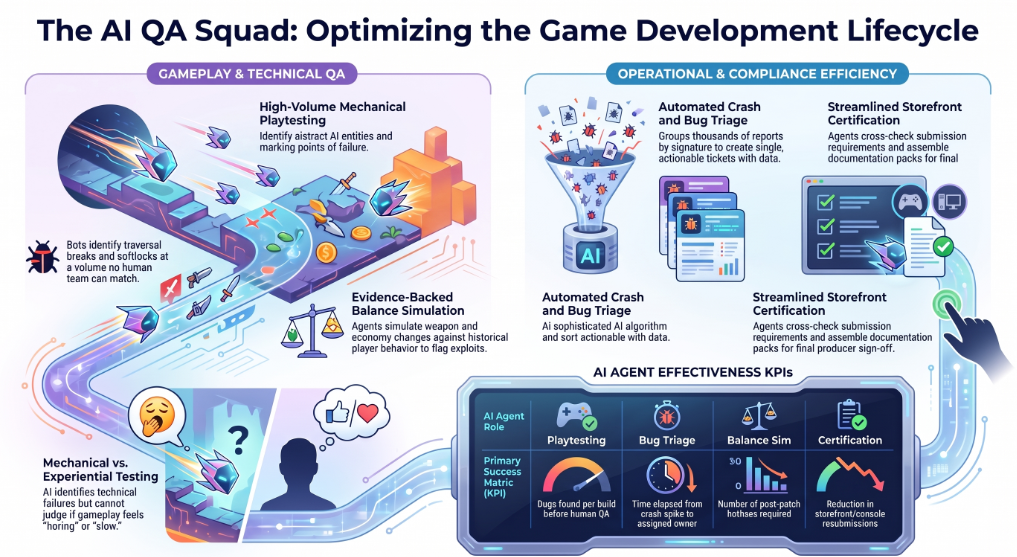
Bots play your game at a volume no QA team can match. They find traversal breaks, softlocks, unreachable areas and crash conditions on every build. modl.ai and in-house reinforcement-learning setups (for example with Unity ML-Agents) are common choices. Their limitation is that they find mechanical failures, not experiential ones. A bot will never tell you the second act drags.
Job card: Trigger: new build · Action: exploration runs and bug reports · Gate: QA verification · KPI: bugs found per build before human QA · Fit: engine-side / specialist
9. Crash and bug triage agent
After a patch, thousands of crash reports and player bug tickets arrive in a few hours. The triage agent does the following:
- groups them by crash signature
- enriches each group with device, OS and build data
- removes duplicates
- opens one well-formed ticket per real issue, with reproduction clues attached
A wave of identical crashes from one device model should be one urgent incident, not five hundred tickets.
Job card: Trigger: crash-rate or ticket spike · Action: clustered tickets · Gate: limited tickets per run; a human sets priority above a threshold · KPI: time from spike to assigned owner · Fit: studio operations
10. Balance simulation agent
The agent simulates proposed changes, such as a weapon's damage, a drop rate or a crafting cost, against historical player behaviour before they ship. It reports which cohorts are affected and flags exploitable combinations. It gives designers a second opinion backed by evidence, not a replacement for their feel.
Job card: Trigger: proposed tuning change · Action: impact simulation report · Gate: designer decision · KPI: post-patch hotfixes caused by balance changes · Fit: studio operations
11. Certification and submission-pack agent
Console certification and storefront submission involve checklists, ratings questionnaires, AI-content disclosures and documents that change between versions. This agent compares document versions, spots what changed, checks requirements against the checklist and assembles the submission pack for human sign-off.
Job card: Trigger: submission milestone · Action: diff report and compiled pack · Gate: producer sign-off before submission · KPI: certification resubmissions · Fit: studio operations
In-Game: Runtime Agents
12. NPC and co-playable character agents
This is the most visible use case and the hardest to ship well. The best public example is Krafton's PUBG Ally, built with NVIDIA ACE. PUBG Ally uses automatic speech recognition, a 2B-parameter small language model, and text-to-speech to understand player voice, reason through game context and dynamic events, and respond in real time. It entered public beta on June 17 and was available in PUBG: BATTLEGROUNDS Arcade Mode until June 30. (NVIDIA technical blog)
Notice that it runs on the device. For runtime agents, inference cost and latency are design constraints from day one. You pay each time a player talks to a character. Inworld, Convai and NVIDIA ACE are the main platforms here.
Job card: Trigger: player interaction · Action: dialogue and in-world actions · Gate: authored fallbacks for narrative-critical moments · KPI: engagement vs. cost per session · Fit: runtime
13. Onboarding and tutorial coach agent
Most players who churn do so in the first session. An onboarding agent can work on two levels:
- In game: it notices a player stuck at the same step and offers contextual help.
- Around the game: it analyses the onboarding funnel (install → tutorial → first match → day-one return) to find exactly where players drop off, and recommends fixes.
Job card: Trigger: stall pattern or funnel drop · Action: in-game hint or funnel report · Gate: designer approves changes · KPI: tutorial completion, day-1 retention · Fit: runtime (hints) / studio operations (funnel)
Run: LiveOps and Player Operations
14. Economy watch agent
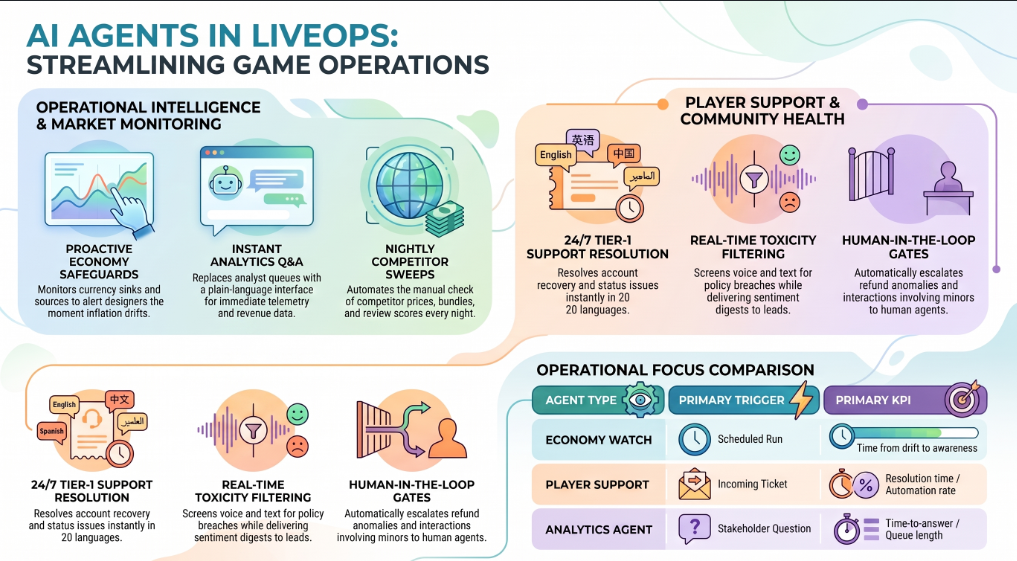
Live economies drift. A new event adds a currency faucet, a sink loses its appeal, and within two weeks inflation is visible in the marketplace. An economy watch agent monitors sources and sinks, currency balances and conversion rates continuously. It escalates only when drift crosses thresholds your designers set.
Job card: Trigger: scheduled run · Action: anomaly alert with supporting data · Gate: no write access at all · KPI: time from drift to designer awareness · Fit: studio operations
15. LiveOps analytics agent (plain-language Q&A)
"Why did paying users fall 11% in Southeast Asia after Tuesday's patch?" In most studios that question joins an analyst queue for two days. An analytics agent answers it in minutes by querying telemetry, revenue and patch data, with citations.
The prerequisite is a single agreed definition for every metric. If three teams define "active player" differently, the agent will confidently give three different answers.
Job card: Trigger: stakeholder question · Action: cited answer or chart · Gate: none (read-only) · KPI: time-to-answer, analyst queue length · Fit: studio operations
16. Storefront and competitor monitoring agent
This agent runs a nightly sweep across storefronts and competitor titles: prices, discounts, bundles, events, review scores and rank changes. It reports only what moved and what it might mean. It replaces the manual check every LiveOps team intends to do and skips under deadline.
Job card: Trigger: schedule · Action: "what changed" digest and alerts · Gate: none · KPI: time to respond to competitor events · Fit: studio operations
17. Player support agent
Player support scales with player count, spikes around every patch and never ends. A support agent resolves tier-1 issues end to end, including account recovery, purchase status, known bugs and gameplay questions. It hands everything else to humans with full context.
There is a public benchmark. Global game operations company PTW's support platform, REACT, combines an AI chatbot that classifies issues and evaluates urgency with RPA that connects to internal systems to complete actions such as account resets and compensation delivery, running 24/7 in 20 languages (source).
Two design rules matter. First, anything involving money sits inside a defined policy band. Second, any sign that the player may be a minor goes straight to a human.
Job card: Trigger: incoming ticket or chat · Action: resolve, or route with a summary · Gate: refunds outside the policy band, minor-account signals · KPI: resolution time, tier-1 automation rate, CSAT · Fit: studio operations
18. Community moderation and sentiment agent
Moderation agents screen chat, forums and user-generated content for toxicity, scams and policy breaches, and escalate edge cases to humans. Activision's ToxMod rollout for Call of Duty is the best-known example. In 2023, Activision rolled out ToxMod, an AI-powered tool that monitors online chat for toxic and hate speech (Decrypt).
A second job, often overlooked, is sentiment. Community reaction to a patch should reach the LiveOps lead as a summarised signal within hours, not as a Reddit thread discovered on Monday.
Job card: Trigger: new content or message volume · Action: flag, hide, or escalate; sentiment digest · Gate: human review for bans and appeals · KPI: time to action on reports, false-positive rate · Fit: specialist tools (real-time voice and chat) / studio operations (sentiment)
Grow: User Acquisition and the Studio Business
19. User acquisition and creative performance agent
This agent brings together ad network data, creative performance, influencer campaigns and cohort revenue. It explains which creatives and channels bring players who actually pay and stay, not just installs. It can also pre-screen influencer partners for brand safety before a campaign goes live.
Job card: Trigger: daily or weekly cycle · Action: channel and creative insight narrative, budget recommendations · Gate: human approves budget changes · KPI: return on ad spend by cohort, time to kill a losing creative · Fit: studio operations
20. Studio finance, royalties and vendor agent
Games are a business, and the back office is where agents quietly pay off. This agent covers:
- Cash and runway: forecasts with alerts before a launch slip becomes a cash problem.
- Platform royalties: reconciling storefront and app-store payouts, including cross-border withholding tax exposure.
- Outsourcing vendors: art and QA vendor spend, delivery slippage and the request-for-quote process.
- Multi-studio reporting: one consolidated view for publishers running several studios.
- Acquisitions: technical due diligence packs when a publisher is buying a studio.
Job card: Trigger: schedule or event · Action: forecasts, alerts, reconciliations · Gate: finance approval for anything posted to the books · KPI: close cycle time, forecast variance, vendor overrun detection · Fit: studio operations
Where assistents.ai Fits Across the 20 Use Cases
assistents.ai is a governed enterprise agentic platform built by Ampcome. It sits above a studio's data and business systems, not inside the engine. Here is our honest fit assessment:
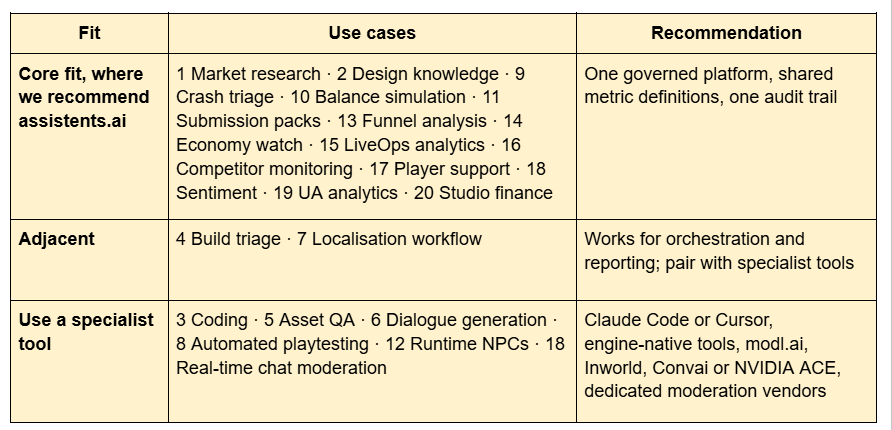
Thirteen of the twenty use cases are studio operations, and that is not a coincidence. Asset production is front-loaded and tied to a project. Support, moderation, economy tuning and revenue analysis are permanent and grow with player count. The work with the least tooling attention carries the most sustained cost.
Proof: The Same Agent Patterns, Already Delivered Outside Gaming
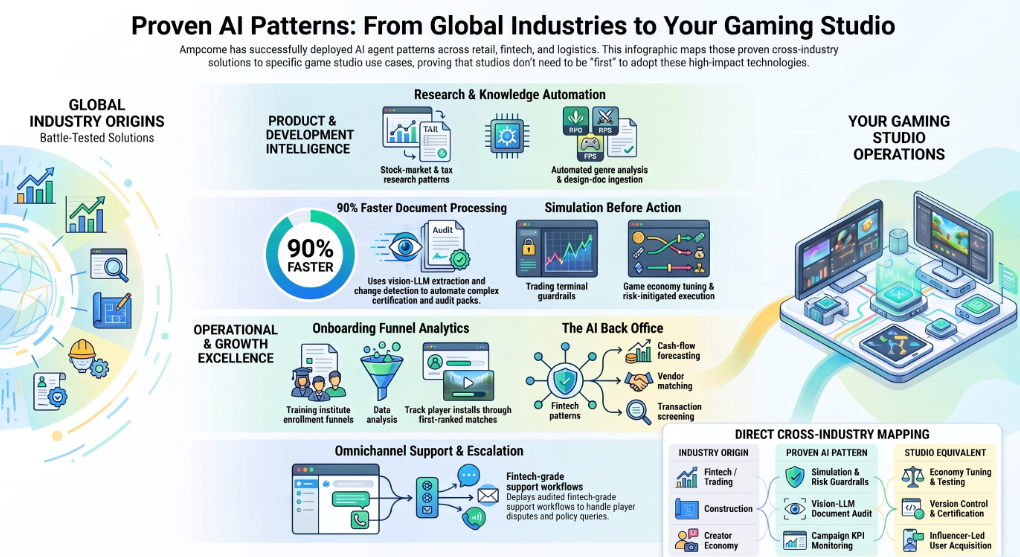
No studio needs to be the first to try these patterns. Ampcome has built them across retail, logistics, fintech, energy, real estate, healthcare and the creator economy. The mapping below shows how each translates to a studio. Clients are described by industry only.
Research with citations → Use cases 1 and 2.
- For a stock-market research platform, we automated data ingestion, indicator pipelines and the production of insight packs.
- For a tax-research product, agents collect sources, summarise them and draft cited memos.
Swap market data for genre data, or tax sources for design docs, and you have a studio's research and knowledge agents.
Document revision tracking → Use case 11. For an Australian remedial construction specialist, we built a multi-agent document workbench. It uses vision-LLM extraction from complex PDFs, change detection between document revisions, and audit logs. It was engineered to target up to roughly 90% faster document processing and about 95% extraction accuracy on standard formats. Those are design targets for that deployment, not guaranteed outcomes. Certification packs are the same kind of problem: comparing versions and checking requirements.
Funnel analytics → Use case 13. For a multi-branch training institute, we built analytics across the enrolment → lessons → tests funnel, plus instructor utilisation and customer-experience alerts. Change "enrolment" to "install" and "tests" to "first ranked match", and it is an onboarding funnel.
Simulation before action → Use cases 10 and 14. For an AI-first trading terminal, a network of specialised agents combines research, signals and strategy simulation, with explicit risk guardrails before anything executes. An economy-tuning agent should work the same way: simulate against history first, and never let an agent past a guardrail, however confident it is.
Anomaly watch on continuous signals → Use case 14. For a power transmission utility and a research campus, agents ingest continuous sensor data, detect anomalies and route alerts to the teams who resolve them. The hard part is never detection. It is tuning thresholds so that alerts are still read three months later.
Plain-language analytics → Use case 15. For a US analytics startup and a UK e-commerce distributor, we delivered data agents that give self-serve, governed answers in natural language. A semantic layer keeps every metric definition consistent.
Price and competitor monitoring → Use case 16. For a consumer-durables manufacturer in a price-sensitive market, agents continuously monitor pricing, discounts, offers, availability and ratings across channels. Leadership asks questions in plain language instead of checking portals by hand.
Omnichannel support with escalation → Use case 17.
- For a UAE real-estate portfolio manager, a service agent triages tenant queries across channels, answers from policy and SOP documents, and escalates to human teams with ticket tracking.
- For a global fintech serving banks and credit unions, support workflows were built with audit trails and SLA monitoring. Every automated decision there had to survive a banking audit, which is a higher bar than any refund dispute.
Creator and campaign intelligence → Use case 19. For a creator-economy platform, we automated creator discovery, campaign workflows, content KPI monitoring and brand-safety checks, with campaign ROI analytics on top. That is influencer-led user acquisition without an analyst for every channel.
The finance back office → Use case 20.
- An AI CFO agent for cash-flow forecasting and runway alerts.
- Group-wide procurement and vendor-performance alerts for a diversified family business group.
- Request-for-quote automation and supplier matching for a sourcing platform.
- Consolidated analytics across a multinational logistics group's entities.
- Cross-border transaction screening for a tax-technology product.
- Technical due diligence for a long-term holding company's acquisitions.
Each one maps directly to a studio or publisher's finance function.
Want to see how these patterns map to your studio? Talk to Ampcome.
Which AI Agents Should a Studio Deploy First?
Sort candidate agents by how easily their actions can be undone before you sort them by value. Automate reversible work aggressively. Keep irreversible actions behind a human permanently.
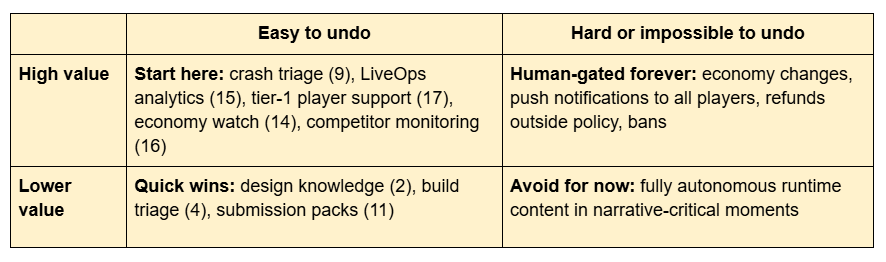
A push notification to two million players cannot be taken back. A ticket can. That single question decides more about safe autonomy than any accuracy benchmark.
Risks Studios Underestimate
1. Source code and unreleased assets. Any agent that helps you write code has read your code. For unannounced titles under platform NDA, get written answers before installing anything:
- Is our data used for training?
- What is the retention period?
- Which model providers is it routed to?
- What happens to our data on termination?
2. Player data and minors. Games skew young. Support and moderation agents need structural controls: read-only access to account data, limits on which tables they can reach, and automatic escalation when a minor-account signal appears. Requirements differ by jurisdiction and are tightening.
3. Storefront disclosure. Valve requires disclosure of generated content that players see (Innovecs). Keep a current register of where generated content appears in your shipped game. The copyright status of AI-generated material also varies by jurisdiction, so involve legal counsel early.
4. Runtime inference cost. A coding agent costs a fixed amount per seat. A runtime NPC costs money every time a player speaks to it. Model the cost at your successful DAU, not your conservative one.
5. Actions without a record. The first unexplainable agent action usually ends the programme. If you can't reconstruct what an agent did and why, don't let it act.
Why assistents.ai for Studio Operations Agents
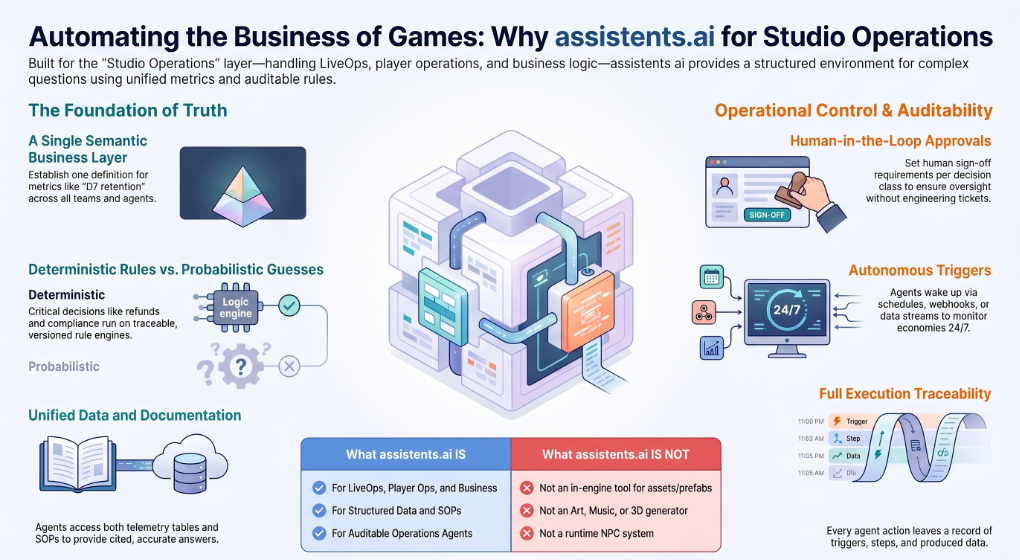
Coding agents edit your scripts. NPC platforms bring characters to life. Art tools keep your style consistent. None of them can answer, and then act on, a question like this:
"Paying users fell 11% in Southeast Asia after Tuesday's patch. Which cohort, which item, is it our patch or a competitor's event, and what do we do before the weekend?"
That is studio operations: LiveOps, player operations and the business around the game. It is the layer assistents.ai is built for.
One definition of every metric
The semantic business layer holds your glossary of metrics, with real formulas, threshold bands, business rules and drill-down hierarchies. "D7 retention", "whale" and "churn risk" mean exactly one thing across every agent, dashboard and team. Studios often discover in this first step that three teams have used three definitions for years.
Deterministic rules where probability isn't acceptable
Refund eligibility bands, moderation thresholds, offer targeting and compliance gates run in a deterministic rule engine. Rules are decision tables and expressions with checksummed versions, and a published version cannot be silently altered. When someone asks why a specific player received a specific refund, the answer is a rule version and an execution trace, not a model's best guess.
Human approval as policy, not afterthought
Which decisions need human sign-off is set per decision class, not buried in a script. When approval is required, the work reaches the right person, and the approval is recorded in a decision ledger. Changing an approval band is a configuration edit, not an engineering ticket.
Agents that start themselves
Work can start from schedules, inbound webhooks, incoming email, change-data-capture streams or a user request. That is how an economy watch runs nightly and a crash-triage agent wakes up when a spike arrives.
Structured data and documents together, with citations
Retrieval covers both your telemetry tables and your design docs, patch notes, community guidelines and SOPs, in one cited answer. A BI layer (datasets, around 23 chart types, and dashboards with cross-dataset filtering) uses the same metric definitions as the agents, so the numbers never disagree.
Your models, your costs
Models can be addressed across 7+ providers plus any OpenAI-compatible endpoint. This keeps model choice, routing and cost under your control. That matters when inference is a line in your P&L, and when your legal team wants to know exactly where player data goes.
Every run leaves a record
Each execution records what triggered it, which steps ran and what each step produced. Data access can be restricted to specific tables or set to read-only, so an analytics agent is structurally unable to write.
What assistents.ai is not
- It is not an in-engine tool and does not touch prefabs, scenes or serialized assets.
- It doesn't generate art, 3D models, music or voice.
- It isn't a runtime NPC system.
- Connecting it to a specific application (a ticketing system, crash reporter, analytics service or storefront API) is scoped integration work through that system's API, not a switch to flip.
We say this plainly because studios that are sold one-click connectors end up with delivery problems.
Best for: mid-size and larger studios and publishers running live-service games that have more operational workload than people. That includes teams that need agents a person outside the room can audit.
A 90-Day Rollout Plan for Studios
Days 1–30: read-only.
- Connect telemetry with read-only access.
- Agree definitions for your 15 core metrics.
- Ship one LiveOps analytics agent (use case 15).
- Success = recurring questions answered in minutes, not days.
Days 31–60: bounded actions.
- Add crash triage (9) and a submission-pack agent (11) with approval gates.
- Encode refund bands and moderation thresholds as versioned rules.
- Success = shorter triage cycle time, and decisions traceable to a rule version.
Days 61–90: selective autonomy.
- Move tier-1 player support (17) and economy watch (14) to scheduled or event-driven operation.
- Have exception routing and a kill switch live before you do.
- Success = the tier-1 automation rate, and zero unexplainable actions in the execution log.
For a full template, including the seven-clause Autonomy Contract to write before any agent reaches production, see our agentic AI tools guide for studios. For the broader pattern beyond games, read what agentic process automation is.
The Bottom Line
The studios getting the most from AI agents aren't the ones with the most tools. They are the ones that:
- picked reversible problems first,
- agreed what their metrics mean,
- and can explain, months later, exactly what every agent did and why.
For code, art, testing bots and NPCs, use the specialists. For the permanent, growing work of running a game (LiveOps, player operations, analytics and the studio business), use one governed platform.
Ready to map AI agents to your studio?
Book a working session with Ampcome →
FAQs
What are AI agents in game development?
AI agents in game development are software systems that plan multi-step work, use tools and act toward a goal with limited human prompting. Studios use them for coding, QA, localisation, crash triage, LiveOps analytics, player support and moderation. Some also run inside games as NPCs or AI teammates.
How are AI agents different from game AI?
Game AI controls behaviour inside the shipped game, such as pathfinding, enemy logic and difficulty, within a frame budget on the player's device. AI agents mostly build and operate the game around the player, in the pipeline and back office. Runtime NPC agents are the overlap: agentic in design, but running inside the game loop.
Can AI agents make a whole game on their own?
No. Agents speed up scripting, asset variation, testing, localisation and operations, but game design, feel, art direction and performance tuning still need human judgement. The realistic model today is human-supervised agents doing bounded, reviewable work.
How do AI agents test games?
Playtesting agents play builds automatically at high volume to find crashes, softlocks, traversal breaks and balance outliers. Triage agents then cluster crash reports and open deduplicated tickets. Neither judges fun or pacing; human QA still owns experience quality.
Are AI NPCs used in real games today?
Yes, though mostly in early deployments. Krafton's PUBG Ally, built with NVIDIA ACE, ran a public beta in 2026 using on-device speech recognition, a small language model and text-to-speech. Cost, latency and narrative consistency remain the main challenges.
Will AI agents replace game developers?
No. Agents take on repetitive typing, searching, triage and variation work, and add review work in return. The scarce skills (deciding what to build, why a mechanic feels wrong, where a system will break) remain human.
Do you need to disclose AI use on Steam?
Valve requires developers to disclose AI-generated content that players see. Keep a register of where generated content appears in your shipped game, and check each platform's current rules before submission, as they change.
How much do AI agents for game development cost?
Coding agents typically cost a per-seat monthly subscription. Runtime NPC platforms add per-interaction inference cost that grows with your player base. Enterprise operations platforms such as assistents.ai are priced to the deployment. Budget separately for integration work and model usage.

Transform Your Business With Agentic Automation
Agentic automation is the rising star posied to overtake RPA and bring about a new wave of intelligent automation. Explore the core concepts of agentic automation, how it works, real-life examples and strategies for a successful implementation in this ebook.
Sarfraz Nawaz is the CEO and founder of Ampcome, which is at the forefront of Artificial Intelligence (AI) Development. Nawaz's passion for technology is matched by his commitment to creating solutions that drive real-world results. Under his leadership, Ampcome's team of talented engineers and developers craft innovative IT solutions that empower businesses to thrive in the ever-evolving technological landscape.Ampcome's success is a testament to Nawaz's dedication to excellence and his unwavering belief in the transformative power of technology.

More insights
Discover the latest trends, best practices, and expert opinions that can reshape your perspective





Contact us

