

AI Use Cases in Internal Audit: 15 Examples for 2026


Internal audit is being asked to cover more ground with the same headcount. Risk surfaces are expanding faster than audit plans can be redrawn, regulatory expectations keep tightening, and audit committees want assurance delivered on a shorter cycle than the traditional annual plan was ever built for.
AI is the response most functions are reaching for. But most content on this topic is really a tool review — six things you can do in Excel, or a plug-in for one GRC suite. That's useful, but it skips the two questions an audit committee will actually ask: which of these use cases can run with real autonomy, and how do you prove any of it is auditable.
This guide covers both. Fifteen use cases organized across the audit lifecycle, a maturity model for how much autonomy each decision can actually carry, and a concrete answer — not an assertion — to the traceability question every internal audit function is required to ask before it lets AI near a workpaper.
What "AI in internal audit" actually means
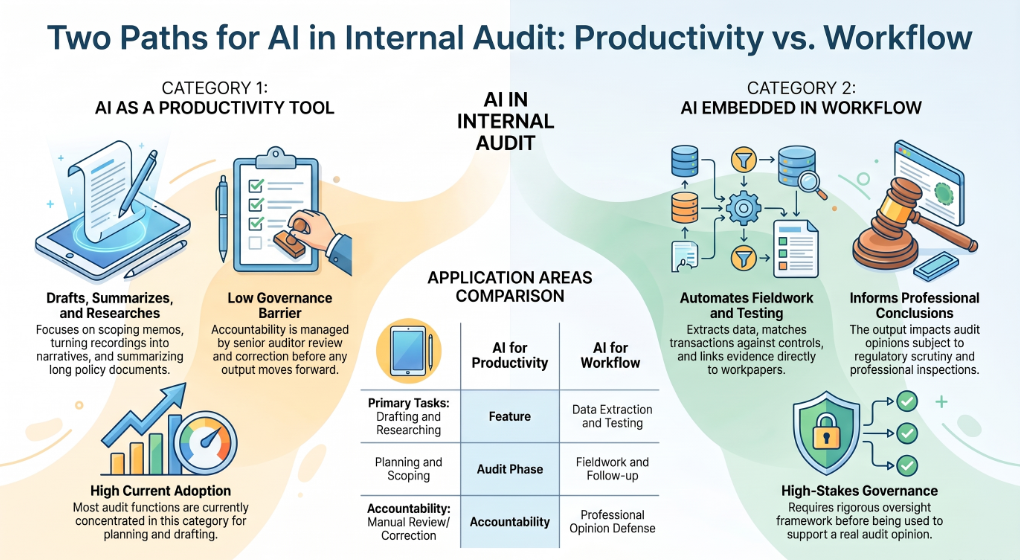
Two categories of AI are operating inside most audit functions right now, and the distinction matters more than the model you pick.
AI as a productivity tool drafts, summarizes, and researches. It generates a scoping memo, turns a walkthrough recording into a draft narrative, or summarizes a two-hundred-page policy document. The accountability requirement is manageable: a senior auditor reviews the output, corrects what's off, and nothing moves forward until it's right.
AI embedded in the audit workflow is a different commitment. This is AI that extracts data from source documents, matches transactions against controls, runs testing steps, and links evidence directly to a workpaper conclusion. The output doesn't just save time — it informs a professional conclusion the auditor is responsible for defending under review, inspection, or regulatory scrutiny.
Most functions today are still concentrated in the first category. The IIA's Pulse of Internal Audit survey work has tracked generative AI use in audit activities rising sharply year over year, but usage stays heavily weighted toward drafting and planning rather than fieldwork or follow-up — worth checking the current-year figures directly from the IIA before you cite a number, since this moves quickly.
The fifteen use cases below span both categories, and the label matters: category-2 use cases need the governance section further down before they belong anywhere near a real audit opinion.
15 AI Use Cases in Internal Audit
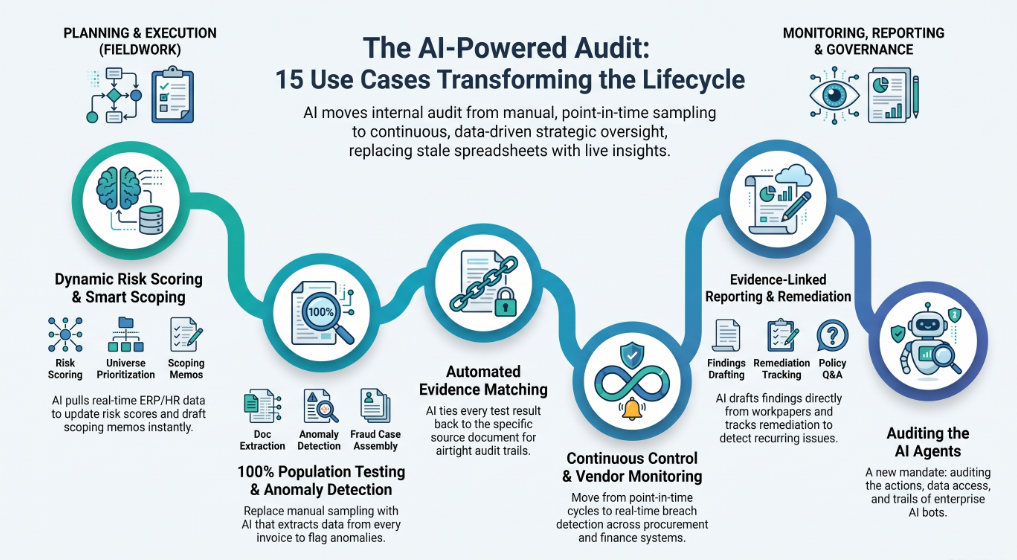
Risk-based audit planning
1. Dynamic, data-driven risk scoring. Instead of a static annual risk register updated once a year, AI can pull from ERP, HR, and CRM data simultaneously — financial performance, operational metrics, prior findings, turnover signals — and produce a risk score that updates as the business changes. Auditors still own the judgment call on where to focus; AI just replaces a stale spreadsheet with a live one.
2. Risk-based audit universe prioritization. Once risk scores exist across the business, AI can help allocate a fixed audit budget against them — flagging which entities, processes, or business units have drifted furthest from their last assessment and deserve the next cycle's attention. This turns planning from a scheduling exercise into a resourcing decision grounded in current data.
3. AI-assisted scoping memos and interview guides. Drafting a scoping memo, an audit announcement, or a set of interview questions for a walkthrough is repetitive, structured work. AI can generate a first draft from the process context and prior-year workpapers in minutes, freeing the auditor to spend the saved time refining questions rather than formatting a document.
Fieldwork and evidence-based testing
4. Full-population document extraction and matching. Pulling data from invoices, contracts, and GL entries has always been the bottleneck in fieldwork. AI can extract structured data from every document in a population — not a sample — and match it against source records automatically, with a link back to the original document for every match.
5. Automated control testing tied to source evidence. Testing controls is one of the most repetitive parts of fieldwork, and one of the most exposed to reviewer pushback if the evidence trail is thin. AI-automated testing should do more than return a pass or fail — it should tie every test result back to the specific document, transaction, or system record that produced it.
6. Journal-entry and transaction anomaly detection. Rather than auditors manually scanning transaction populations, AI can scan the full population and surface the entries that warrant attention — unusual posting patterns, entries from users who don't normally post, round-number clusters, weekend or after-hours activity. The auditor reviews the flagged exceptions, not the whole population.
Continuous auditing and controls monitoring
7. Real-time control-breach detection across systems. Traditional audit is point-in-time: a cycle covers a period, produces a conclusion, and the controls environment keeps changing until the next scheduled audit. AI changes that economics by watching transactional and operational signals continuously — and the real value shows up when it watches procurement, HR, and finance together rather than one ledger in isolation, since most control breaches show up as a pattern across systems, not inside one.
8. Deterministic, versioned policy and threshold monitoring. This is a distinction worth being precise about: when a SOX threshold or an approval limit is breached, that's a policy decision, not a judgment call for a language model to interpret differently each time. The rule that decides "is this a breach" should be deterministic, versioned, and produce the same answer every time it runs against the same inputs — with AI doing the surrounding work of gathering context and preparing the case.
9. Third-party, vendor, and procurement risk monitoring. Vendor master changes, unusual payment patterns, and off-contract spend are all signals internal audit historically caught during a scheduled procurement audit, months after the fact. Continuous monitoring across procurement and finance data can surface the same issues as they happen — before they compound into a material finding.
Reporting, issues, and follow-up
10. Evidence-linked findings drafting. Turning fieldwork results into a reportable finding — with the supporting evidence, the risk rating, and the recommendation — is exactly the kind of structured drafting task AI handles well, provided every claim in the draft links back to the workpaper evidence that supports it rather than a paraphrase the auditor now has to re-verify.
11. Remediation tracking and recurrence detection. Once a finding is issued, tracking remediation status across dozens of open issues and multiple business owners is its own administrative burden. AI can track status, flag overdue remediation, and — more usefully — flag when a "new" finding closely resembles one already closed, which is often the earliest signal that a fix didn't actually hold.
12. Multilingual review and translation. Global audit programs mean reviewing documents, policies, and inspection reports in multiple languages. AI-powered translation lets an auditor work in their own language while reviewing source documents in the original, keeping the review consistent across regions without routing everything through a local reviewer first.
Governance, fraud, and auditing the AI itself
13. Fraud investigation case-file assembly. When a fraud indicator surfaces, an investigator typically has to manually pull together transaction history, customer or vendor context, related documents, and prior correspondence from half a dozen systems before the real investigation can start. AI can assemble that case file automatically, so the investigator opens the case already looking at the full picture.
14. Policy and controls Q&A for the wider business. Internal audit fields the same policy questions repeatedly from business teams — what does the approval threshold require, what does the expense policy allow. An AI advisory layer that answers with citations back to the actual policy document reduces that bottleneck and gives every business team the same consistent answer, which is itself a control improvement.
15. Auditing the enterprise's own AI agents. This is the use case almost nobody has turned into a concrete list item yet, even though EY and the IIA are both now flagging it as an emerging mandate. As the business deploys its own AI agents — in finance, in customer service, in procurement — internal audit needs to audit those deployments the same way it audits any other control: what data does the agent touch, what actions can it take unsupervised, and is there an evidence trail for what it did. This is a genuinely new audit object, and it belongs in the plan starting now, not after the first incident forces the issue.
Why generic AI tools stall in internal audit
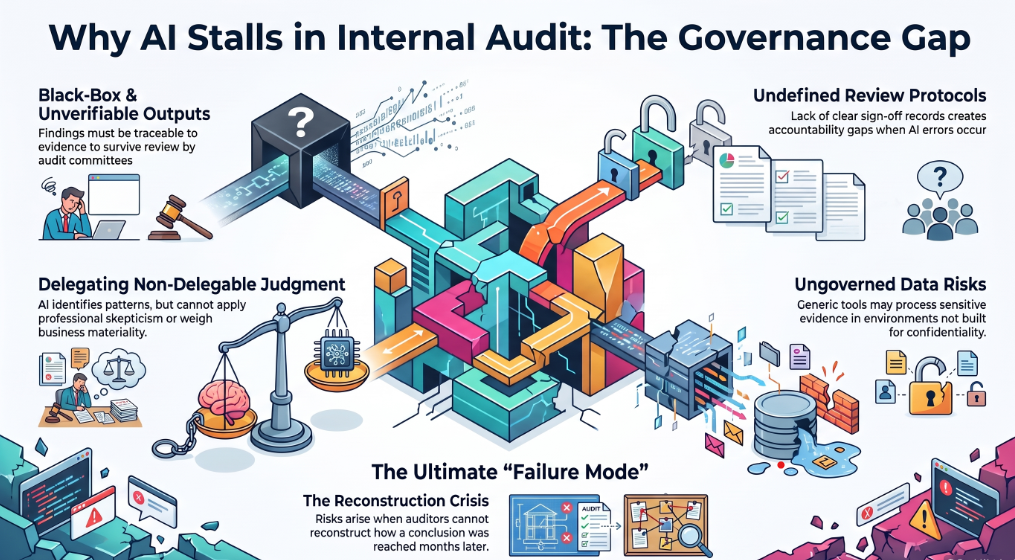
Getting AI into a workflow is the easy part. Getting it governed is where most functions get stuck, and it shows up in four recurring ways.
Black-box outputs. If a tool can't show how it reached a conclusion, that conclusion can't survive review. Regulators and audit committees expect a finding to be traceable to evidence — a result nobody can interrogate doesn't clear that bar, no matter how accurate it turns out to be.
No defined review protocol. Who looks at AI output before it enters a workpaper? In most functions today, there's no clear answer, and the gap usually only becomes visible when something goes wrong and there's no record of who signed off.
Over-reliance on outputs as conclusions. AI can process a large population and surface patterns. It can't weigh materiality for a specific business in a specific period, or apply professional skepticism to a plausible-looking explanation. Treating AI output as the conclusion, rather than an input to one, is delegating judgment that isn't delegable.
Ungoverned data environments. General-purpose AI tools may process sensitive data in environments that were never built for confidentiality. Before any AI tool touches audit evidence, the function needs to know exactly where that data goes and who — or what — can access it.
The failure mode underneath all four of these isn't that the AI gets the wrong answer. It's that six months later, when an auditor, an inspector, or a regulator asks how a conclusion was reached, nobody can reconstruct it.
Why assistents.ai for internal audit
The gap most internal audit AI tools have isn't a missing copilot. It's a missing operating layer across the systems audit actually has to test — the ERP, the HR system, procurement, the CRM. A tool that lives inside one spreadsheet or one audit suite can accelerate the work happening inside that one application. It can't watch a control breach that only shows up as a pattern across finance and procurement together, because it was never connected to procurement in the first place.
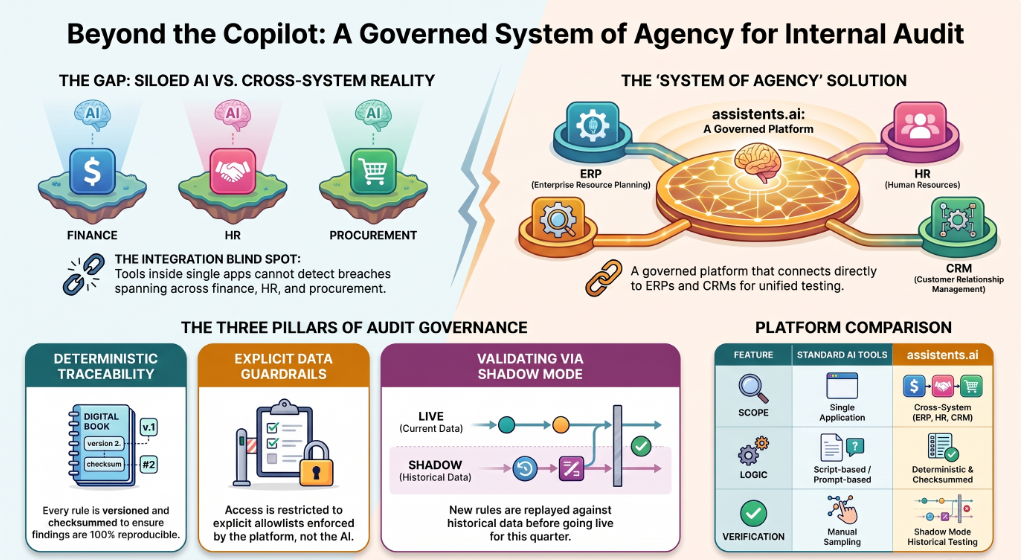
assistents.ai is built as a governed enterprise AI operations platform — a System of Agency that sits across those systems rather than inside one of them, so the same governed layer that helps AP investigate a payment exception is the layer internal audit can use to test that same process, without standing up a second tool.
That only matters if it answers the traceability question directly, so here's the mechanism, not the assertion:
Every rule is checksummed and versioned. Business logic — a SOX threshold, an approval limit, an eligibility rule — runs through a deterministic rule engine. Every version carries a content checksum, there's no mechanism to alter a published version silently, and every execution retains its inputs, outputs, and a full execution trace. A finding from six months ago can be reproduced against the exact logic that produced it.
Approval is a policy, not a script step. Which decisions require human sign-off is a policy attached to a decision class, enforced by the platform — not a step someone remembered to code into a workflow. When a finding needs review, it reaches the right person with the evidence already assembled, and the approval itself is recorded in the decision ledger alongside the finding.
Data access is explicit, not implicit. Agents are scoped to a single data connection, and access through it can be restricted to an explicit allowlist of schemas and tables — enforced by the platform outside the agent, not by instructions inside a prompt. An agent can't reason its way past a permission it doesn't hold.
Changes are tested against history before they go live. A change to a rule, a prompt, or a policy can be replayed against real historical cases in shadow mode before it touches a live audit — so a new control-testing rule gets validated against last quarter's actual population before it's trusted against this quarter's.
The result: internal audit doesn't have to choose between "AI drafts my memos faster" and "AI is embedded in my testing." The same governed platform, and the same evidence trail, covers both — which is the whole point of treating internal audit as one operation instead of a stack of point tools.
An AI maturity roadmap for internal audit
Not every audit decision should carry the same amount of AI autonomy, and pretending otherwise is how governance gaps happen. The more useful way to think about it is a ladder, where different decisions inside the same audit can sit on different rungs at the same time.
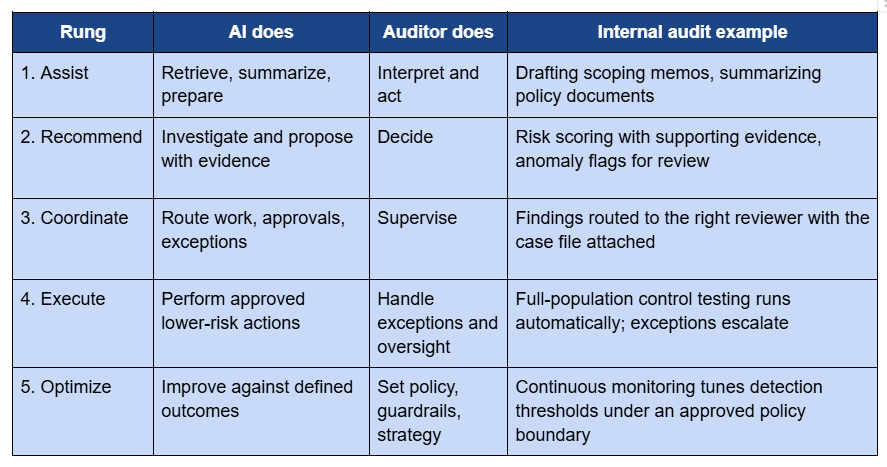
Evidence gathering for a control test can run at rung 4 while the audit opinion itself stays firmly at rung 1 — a human interpreting AI-assembled evidence, not AI reaching the conclusion. That's a more accurate claim than a single blanket "our AI is autonomous," and it maps to how audit committees already think about delegated authority: the question was never whether to delegate, it's how much, for what, and with what oversight attached.
assistents.ai vs. point audit AI tools
Once the governance question is answered, the practical question is what to actually deploy. Here's the honest comparison.
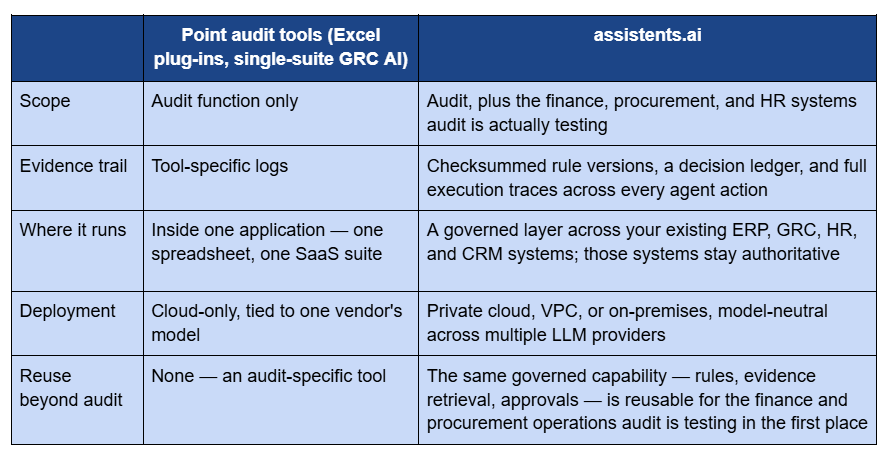
One honest caveat, because it's the place most vendor claims quietly overreach: connectivity to systems like SAP, Oracle, or ServiceNow is an integration project through their published APIs, scoped as part of deployment — not a one-click connector. That's not a limitation to hide. A real integration, properly scoped, is what makes the evidence trail trustworthy in the first place; a one-click connector that skips that step is usually the one an inspector ends up questioning.
Getting started
The value of AI in internal audit was never really about a faster answer for one auditor on one engagement. It's a faster, more consistent, defensible audit conclusion — one an audit committee, an inspector, or a regulator can actually rely on, because the evidence trail behind it holds up.
The right starting point isn't a platform-wide commitment. It's one high-volume, low-judgment process — control testing or document matching are the natural entry points — deployed with the review protocol defined from day one. Prove it there, then expand into the next process on the same governed layer.
FAQs
What are the main AI use cases in internal audit?
They span five stages of the audit lifecycle: risk-based planning, fieldwork and evidence-based testing, continuous auditing and controls monitoring, reporting and follow-up, and governance — including using internal audit to review the enterprise's own AI agent deployments.
Will AI replace internal auditors?
No. AI can compress the mechanical work of internal audit — evidence gathering, transaction matching, control testing — but professional judgment, materiality assessment, and organizational context aren't delegable. AI shifts auditor time toward judgment and advisory work rather than eliminating the role.
What's the difference between AI as a productivity tool and AI embedded in the audit workflow?
Productivity-tool AI drafts, summarizes, and researches, with a senior auditor reviewing the output before it goes anywhere. Embedded AI extracts evidence, matches transactions, and runs tests whose output feeds directly into a professional conclusion the auditor is accountable for — which is why it needs a stronger evidence trail and review protocol.
What are the risks of using AI in internal audit?
The main risks are black-box outputs that can't survive review, no defined review protocol before AI output reaches a workpaper, over-reliance on AI output as a conclusion rather than an input, and ungoverned data environments where it's unclear what a general-purpose tool does with sensitive data.
What is continuous auditing, and how does AI enable it?
Continuous auditing replaces the traditional point-in-time audit cycle with near-real-time monitoring of transactions and controls across systems. AI enables it by analyzing operational and transactional data on an ongoing basis and surfacing anomalies or control breaches as they happen, rather than during the next scheduled audit.
Is agentic AI different from generative AI for internal audit?
Generative AI drafts and summarizes content. Agentic AI takes bounded actions — running a test, routing an exception for approval, updating an issue tracker — under a defined policy and approval workflow. The distinction matters because agentic AI actions need the same evidence trail and accountability as a human auditor's actions.
How should an internal audit function start adopting AI?
Start where transaction volume is high and judgment requirements are low, such as document matching and evidence collection. Define the human review protocol before scaling usage, not after. Measure coverage, cycle time, and consistency — not just hours saved.

Transform Your Business With Agentic Automation
Agentic automation is the rising star posied to overtake RPA and bring about a new wave of intelligent automation. Explore the core concepts of agentic automation, how it works, real-life examples and strategies for a successful implementation in this ebook.
Sarfraz Nawaz is the CEO and founder of Ampcome, which is at the forefront of Artificial Intelligence (AI) Development. Nawaz's passion for technology is matched by his commitment to creating solutions that drive real-world results. Under his leadership, Ampcome's team of talented engineers and developers craft innovative IT solutions that empower businesses to thrive in the ever-evolving technological landscape.Ampcome's success is a testament to Nawaz's dedication to excellence and his unwavering belief in the transformative power of technology.

More insights
Discover the latest trends, best practices, and expert opinions that can reshape your perspective







Contact us

