
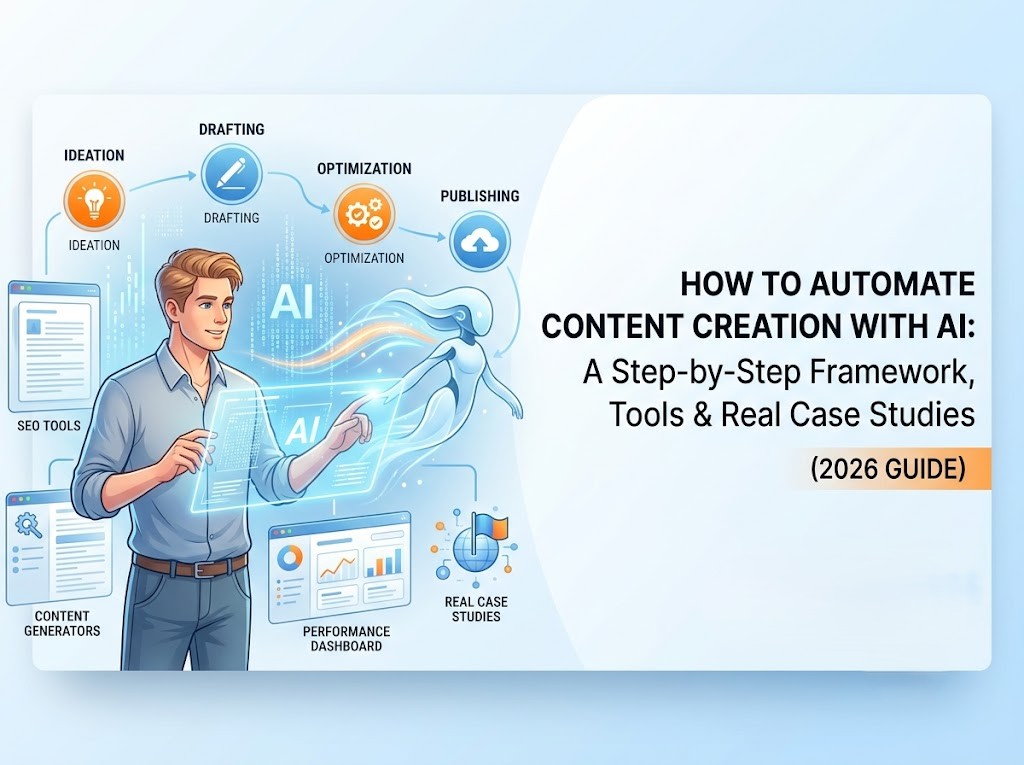
How to Automate Content Creation with AI: A Step-by-Step Framework, Tools & Real Case Studies (2026 Guide)


Automating content creation with AI means using connected AI agents — not a single chat window — to handle ideation, drafting, brand-safe review, formatting, and publishing as one workflow instead of separate manual steps. Done well, it cuts production time dramatically while keeping a human in control of quality and brand voice. Done badly, it produces generic content fast. This guide walks through both, plus real enterprise results.
What "Automating Content Creation with AI" Actually Means (and Doesn't)
Most articles on this topic quietly narrow the question to "which AI writing tool should I use." That's not the same question as "how do I automate content creation."
AI-assisted writing is one person using a chatbot to draft faster. It's useful, but it's not automation — a human still triggers, edits, and moves every single piece of content by hand.
AI content automation is a workflow: a trigger (a keyword, a product launch, a calendar date) starts a chain of AI agents that research, draft, check the output against brand and compliance rules, route it for human approval, format it for the destination channel, and publish it — with a record of what happened at every step.
The distinction matters because it changes what "success" looks like. A faster chatbot saves one person time. An automated content workflow changes how much content your whole team can responsibly produce — which is the actual goal for most marketing organizations, since 68% of marketers now name AI-driven content creation as their top AI use case, according to HubSpot's most recent State of Marketing research.
The Content-Automation Maturity Curve
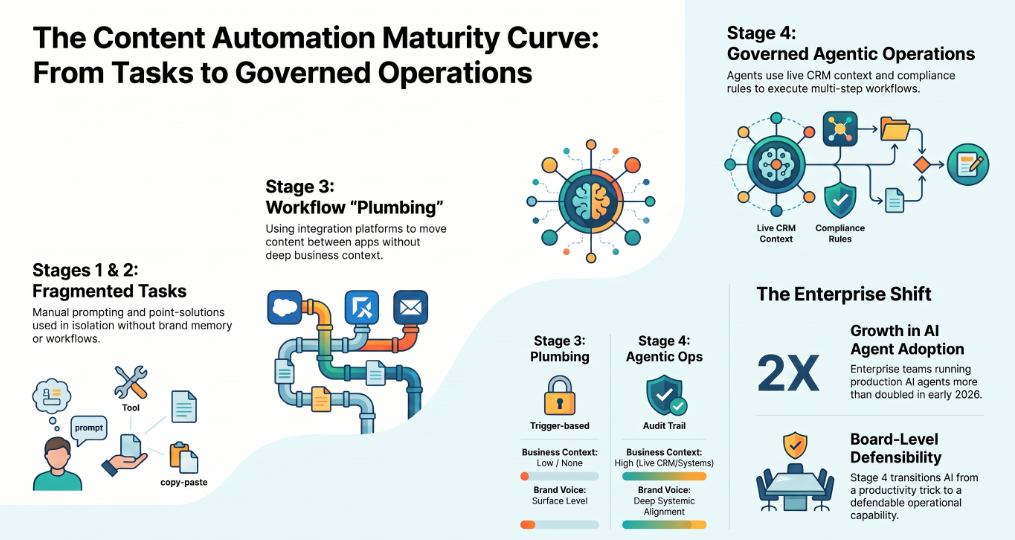
Before picking tools, it helps to know which stage your team is actually in. Most guides skip this and jump straight to a tool list — which is how teams end up buying a point solution that solves last year's problem.
Stage 1 — Manual, AI-assisted.
Someone opens ChatGPT or Claude, writes a prompt, copies the output into a doc. No workflow, no memory of brand guidelines between sessions, no audit trail.
Stage 2 — Single-tool automation.
A dedicated AI writing tool (think Jasper, Copy.ai, ContentBot) generates drafts on demand, sometimes with brand-voice settings. Faster than Stage 1, but it's still one function automated in isolation — someone still manually sources it, checks it, and pushes it live.
Stage 3 — Workflow automation.
Integration platforms (Zapier, Make, n8n) connect the writing tool to other apps — a spreadsheet triggers a draft, a draft triggers a Slack notification, an approval triggers a CMS post. This is real automation, but it's plumbing: it moves content between tools without understanding your business context, your compliance rules, or your brand voice at a deep level.
Stage 4 — Governed agentic content operations.
AI agents operate with live context from your actual systems — your CRM, your brand guidelines, your past-performing content, your compliance rules — and execute multi-step workflows with permission checks and a full audit trail at every action. This is the stage where content automation stops being a productivity trick and starts being an operational capability a CMO can defend in a board meeting.
Most teams get stuck oscillating between Stage 2 and Stage 3 — buying more point tools and stitching them together — because nobody tells them Stage 4 exists as a distinct category. It does, and it's where enterprise marketing teams are increasingly headed: the share of enterprise marketing teams running at least one AI agent in production more than doubled in under two quarters in early 2026, per G2 grid survey data.
How to Automate Content Creation with AI: A Step-by-Step Framework
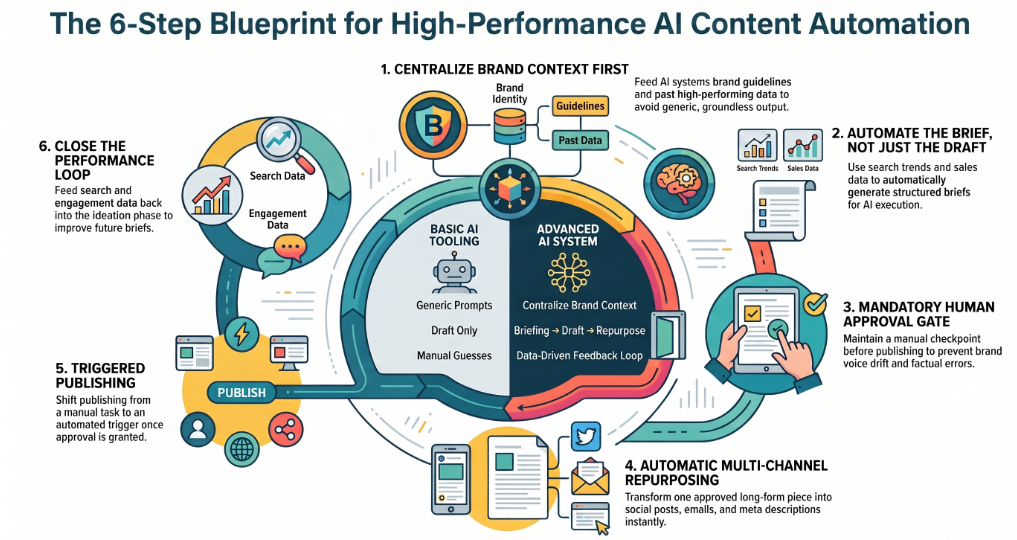
Whatever stage you're starting from, the underlying process is the same seven steps. Skipping any of them is usually why "we tried AI content and it didn't work" happens.
1. Centralize your content sources before you automate anything. AI agents are only as good as the context they can access. Before automating a single workflow, pull your brand guidelines, tone-of-voice examples, past high-performing content, and product/service data into a place your AI system can actually query — not a folder no one updates. Skipping this step is the single biggest reason automated content sounds generic: the AI has nothing specific to ground itself in.
2. Automate ideation and briefing, not just drafting. The highest-leverage automation isn't the writing — it's turning a trend, a keyword gap, or a sales team question into a structured brief automatically. Feed in search demand data, competitor gaps, and internal signals (what sales is being asked, what support tickets keep recurring), and let an agent produce a brief a writer or another agent can execute against.
3. Draft with context, not generic prompts. This is where Stage 2 tools and Stage 4 systems diverge sharply. A generic prompt ("write a blog post about X") produces generic output. A context-grounded agent that already knows your positioning, your past content, and your audience produces something closer to a real first draft. This is the difference between an AI writing tool and an AI content agent.
4. Build in a human-in-the-loop approval gate. Full automation without review is how brand voice drifts and factual errors reach production. The workflows that actually scale keep a mandatory human checkpoint before anything publishes — not because the AI can't draft well, but because someone needs to own what goes out under your brand.
5. Automate formatting and multi-channel repurposing. One approved piece of long-form content should automatically generate its social variants, its email version, its meta title and description, and its structured summary for AI search — without a human manually rewriting each format.
6. Automate the publish trigger. Once content clears approval, publishing itself — to the CMS, to the social scheduler, to the email platform — should be a trigger, not a task on someone's to-do list.
7. Close the loop: feed performance data back into ideation. The step almost every guide leaves out. What worked should automatically inform what gets briefed next — search rankings, engagement, and conversion data flowing back into step 2, so the system gets smarter instead of repeating the same guesses.
The Real Risk: Why Most AI Content Automation Breaks Down
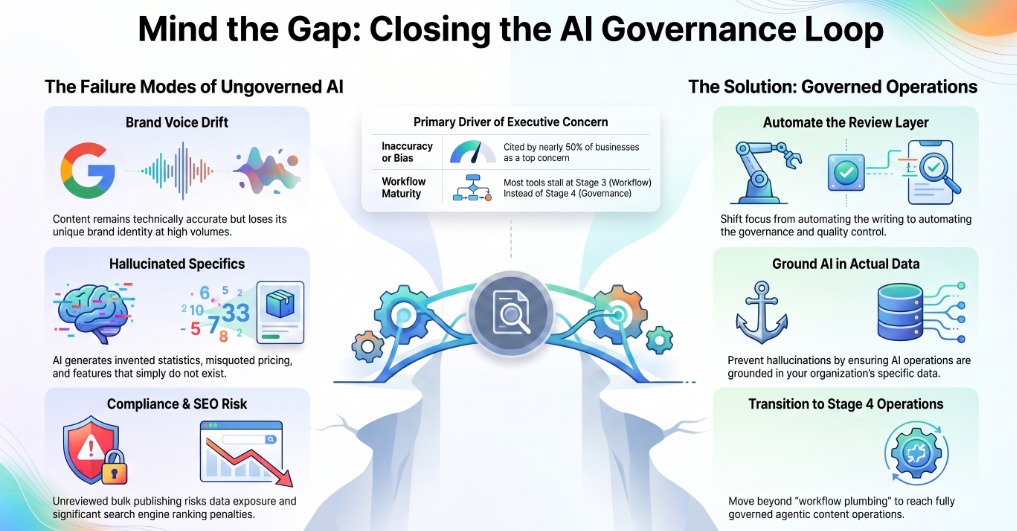
Here's the objection every senior marketer is already thinking, whether or not they say it out loud: nearly half of businesses cite inaccuracy or bias in AI-generated content as a real concern, according to Adobe-cited research — and it's the right concern to have.
The failure modes are predictable:
- Brand voice drift — content technically accurate but sounding nothing like your brand, especially at volume.
- Hallucinated specifics — invented statistics, misquoted pricing, features that don't exist. This happens most when the AI has no grounding in your actual data.
- Compliance and data exposure risk — sensitive information ending up in a prompt, or content going out that violates a regulatory constraint no one checked.
- SEO risk from unreviewed bulk publishing — flooding a site with unreviewed AI content can hurt rankings, not help them, if quality control is skipped for speed.
None of these are arguments against automation. They're arguments for automating the review and governance layer, not just the writing. This is exactly the gap between Stage 3 (workflow plumbing) and Stage 4 (governed agentic operations) described above — and it's the piece most "how to automate content with AI" guides skip entirely, because most of the popular tools in this space simply don't do it.
Real Results: How Enterprise Teams Automate Content Operations Today
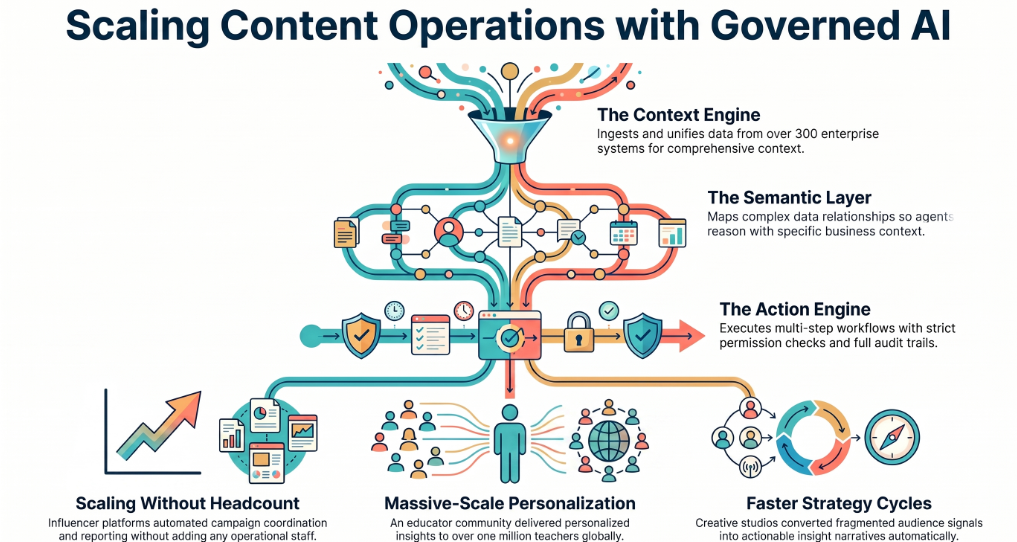
Frameworks are easy to write. Here's what governed content automation actually looks like in production, drawn from real enterprise deployments. Company names are withheld, but the outcomes are real.
A global creator-economy and influencer-marketing platform needed to bring brands and creators together at scale without a proportional increase in operations headcount. An AI system was deployed to handle creator discovery enrichment, automate campaign workflow coordination, monitor content KPIs and brand-safety checks, and generate reporting summaries automatically. The result: reduced manual work across campaigns, faster performance visibility, and more consistent reporting and learnings across brand programs — without adding headcount.
A global educator community serving more than a million teachers across 130+ countries needed to deliver personalized competency insights and learning guidance at a scale no human support team could manage. An AI layer was built to generate teacher profiles, competency insights, and automated support responses to program and learning queries. The result: scalable support for the educator community, faster access to guidance and resources, and better visibility into engagement and outcomes for program operators.
A brand-insights and creative-execution studio, built by marketing leaders with deep experience at a major global tech company, needed to turn fragmented signals — creative performance, audience data, channel data — into insight teams could actually act on, faster than manual analysis allowed. An AI system was deployed to ingest multi-source signals and generate insight narratives and recommendations automatically. The result: faster creative-strategy cycles, deeper signal synthesis across channels, and clearer direction on what to do next for campaign teams.
These aren't hypothetical workflows — they're the same governed-agent approach outlined in the framework above, built and deployed by Assistents, an enterprise agentic AI platform. Assistents runs on a three-layer architecture built specifically for this kind of work: a Context Engine that ingests and unifies data from 300+ enterprise systems, a Semantic Layer that maps relationships across that data so agents reason with real business context instead of generic training patterns, and an Action Engine that executes multi-step workflows with permission checks and a full audit trail at every step. It's this architecture — context, reasoning, and governed execution as one system — that closes the exact gap covered in the section above: content automation that doesn't drift from brand voice, invent facts, or publish unreviewed.
Choosing the Right Approach: Single AI Writers vs. Workflow Tools vs. Governed Content Agents
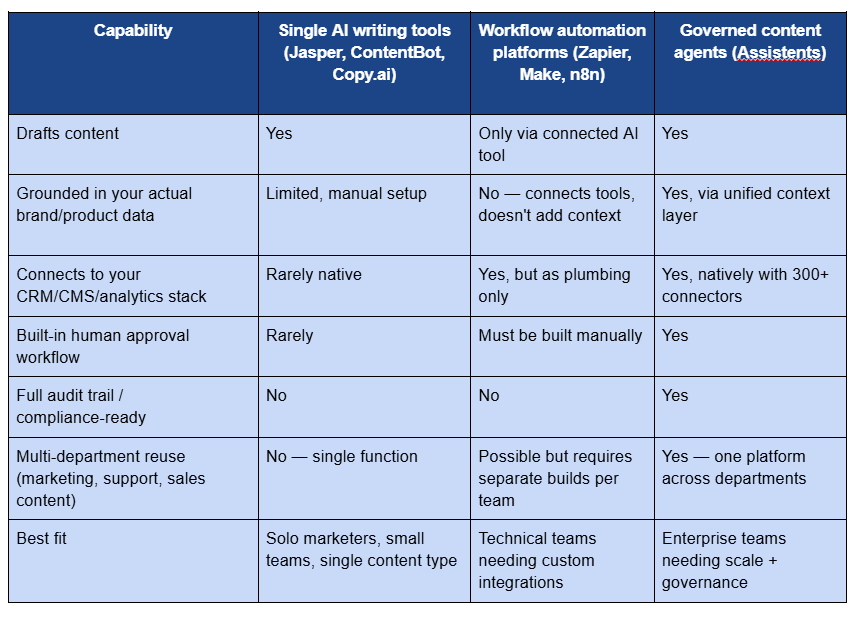
If you're at Stage 1 or 2 on the maturity curve, a single AI writing tool is a reasonable place to start. If you're already stitching tools together with Zapier or Make and hitting the ceiling of what plumbing can do — no shared brand context, no audit trail, a new integration to build for every new use case — that's usually the signal you're ready for a governed agent platform instead of another point tool.
Get Started: A 30-Day Rollout Plan
You don't need to automate everything at once. A realistic first month looks like this:
Week 1 — Audit and pick one pilot. Choose a single, high-volume content type (blog posts, social variants, or campaign reporting) and centralize the brand and data context an agent will need.
Weeks 2–3 — Connect and set guardrails. Connect the pilot workflow to your actual data sources, define your approval gate, and set the brand and compliance rules the AI must follow.
Week 4 — Launch, measure, expand. Run the pilot, track time saved and quality against your existing process, and use those results to decide which content type to automate next.
If you want to skip the trial-and-error and see how this looks running on real enterprise data, Assistents offers a 30-minute discovery call — bring the content workflow that frustrates your team most, and you'll get a custom deployment plan back within 48 hours.
Why Assistents by Ampcome
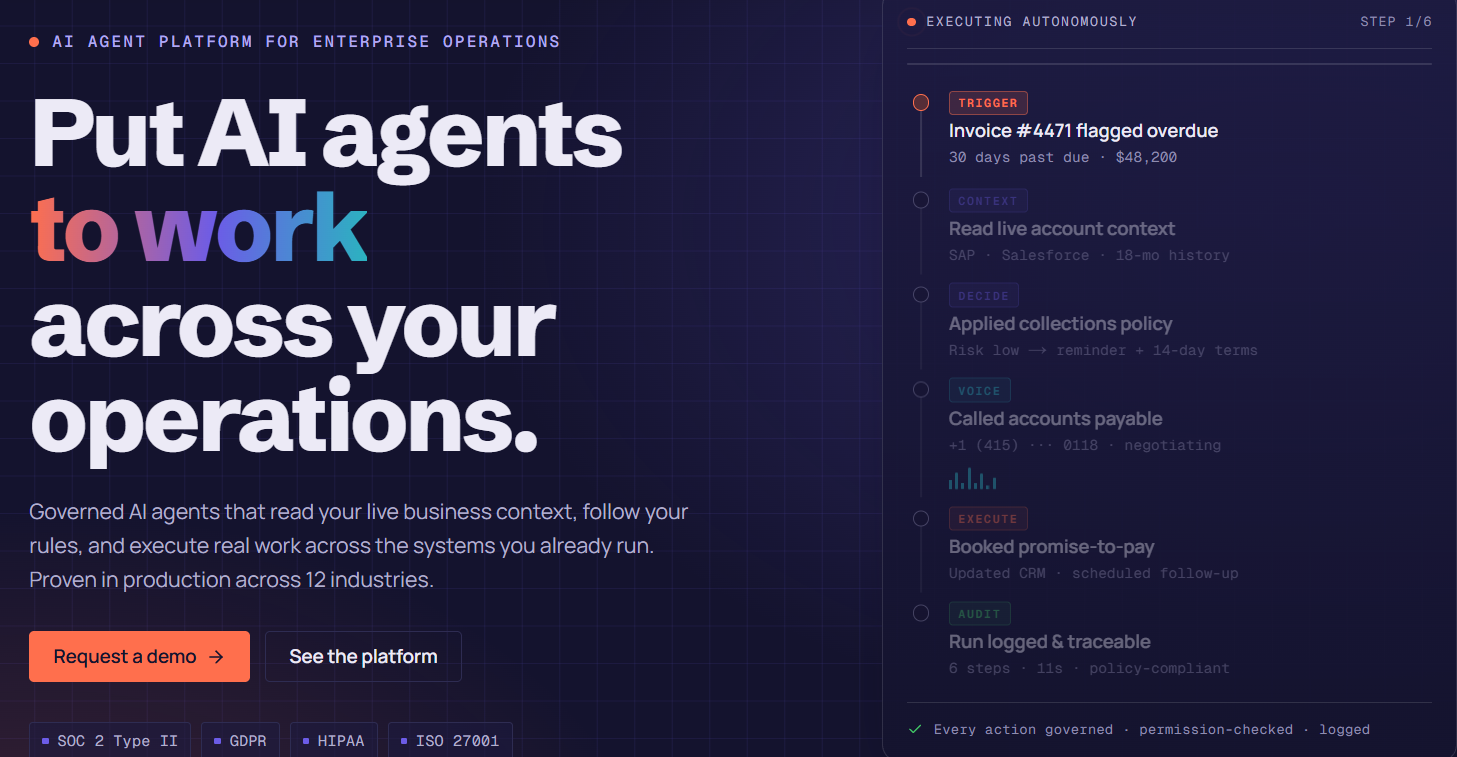
Assistents is built by Ampcome, an enterprise AI agent company that has spent years shipping production AI agents — not demos — across finance, procurement, sales, support, HR, and marketing, for organizations spanning 12 industries and six continents.
That track record matters for content automation specifically: a content tool built by a team that has only ever built content tools inherits none of the governance lessons learned from harder, higher-stakes deployments like compliance reporting or financial reconciliation.
Assistents' content agents run on the same three-layer architecture — Context Engine, Semantic Layer, Action Engine — that powers those deployments, which means the brand-voice grounding, permission checks, and audit trails your compliance team will eventually ask for are already built in, not bolted on after the fact.
It also isn't locked to a single AI model: Assistents runs across Bedrock, Azure, Vertex AI, and OpenAI with zero data retention on enterprise data, so as the underlying models improve, your workflow doesn't have to be rebuilt to keep up.
Frequently Asked Questions
What does it mean to automate content creation with AI?
It means using connected AI agents to handle the full content lifecycle — ideation, drafting, brand-compliant review, formatting, and publishing — as a workflow, rather than using AI as a one-off writing assistant for a single step.
Can AI fully replace human content creators?
No. The workflows that hold up in production keep a human approval gate before anything publishes. AI handles the repetitive, time-consuming stages; people own strategy, judgment, and final sign-off.
What's the difference between an AI writing tool and an AI content agent?
An AI writing tool generates text on request for a single step. An AI content agent operates across multiple steps — research, drafting, review routing, formatting, publishing — grounded in your actual business context and connected to your existing systems.
How do you keep brand voice consistent when AI writes your content?
By grounding the AI in your actual brand guidelines and past-performing content rather than generic prompts, and by keeping a mandatory human review step before publishing — not by hoping a single prompt "remembers" your voice.
Is AI-generated content safe for SEO?
Yes, when it goes through a genuine quality and review process. Google has stated it rewards high-quality content regardless of how it was produced, based on its E-E-A-T standards. The risk isn't AI itself — it's unreviewed bulk publishing.
What's the best AI tool to automate content creation for an enterprise team?
It depends on your maturity stage. Teams still testing AI content can start with a single writing tool. Teams that need brand-safe content at scale across departments, with an audit trail and governance, need a governed agent platform rather than a point solution — this is the gap platforms like Assistents are built to close.
How long does it take to set up AI content automation?
A focused pilot — one content type, one workflow, connected to your actual data — can be running within 30 days. Full multi-department rollout typically follows in phases after the pilot proves out.

Transform Your Business With Agentic Automation
Agentic automation is the rising star posied to overtake RPA and bring about a new wave of intelligent automation. Explore the core concepts of agentic automation, how it works, real-life examples and strategies for a successful implementation in this ebook.
Sarfraz Nawaz is the CEO and founder of Ampcome, which is at the forefront of Artificial Intelligence (AI) Development. Nawaz's passion for technology is matched by his commitment to creating solutions that drive real-world results. Under his leadership, Ampcome's team of talented engineers and developers craft innovative IT solutions that empower businesses to thrive in the ever-evolving technological landscape.Ampcome's success is a testament to Nawaz's dedication to excellence and his unwavering belief in the transformative power of technology.

More insights
Discover the latest trends, best practices, and expert opinions that can reshape your perspective





Contact us

