
13 Real-World Agentic AI Examples for Banks, NBFCs & Insurers (2026)


The financial services industry is experiencing a fundamental shift in how compliance, risk, and operations work. Agentic AI—autonomous systems that monitor, reason, and act without constant human prompting—is already operational in regulated institutions across India and globally.
These are not demos. These are measurable use cases delivering documented outcomes in environments where regulatory precision is non-negotiable.
Each example below shows where agentic AI is already replacing manual compliance and risk workflows—with measurable impact.
What Makes These "Agentic" (Not Just AI Automation)?
Before diving into specific use cases, it's critical to understand what separates agentic AI from traditional automation or even standard AI tools.
Agentic AI systems:
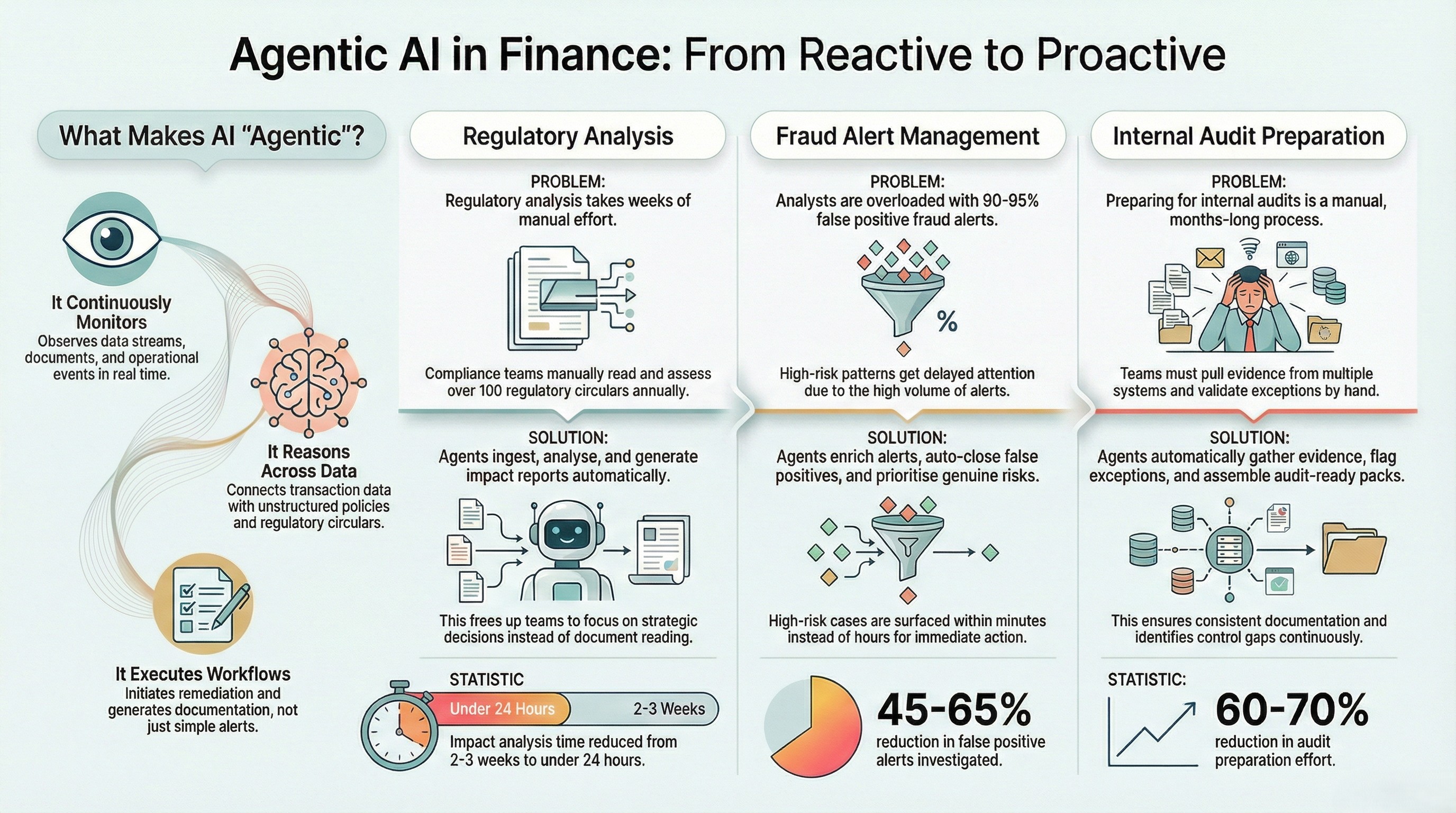
- Monitor continuously – They don't wait for human prompts or scheduled batch runs. They observe data streams, documents, and operational events in real time.
- Reason across data + documents – They connect structured transaction data with unstructured regulatory circulars, policies, and correspondence to understand context.
- Execute workflows, not just alerts – They don't simply flag issues. They initiate remediation workflows, generate documentation, and route approvals.
- Operate with audit trails and approvals – Every action is logged, traceable, and designed for regulatory scrutiny with human-in-the-loop controls where required.
This distinction matters. In regulated financial institutions, tools that simply automate existing processes aren't enough. Agentic systems operate at a higher level—understanding intent, adapting to change, and executing multi-step workflows that would otherwise require coordination across teams.
13 Agentic AI Examples in Banking, NBFCs & Insurance (2026)
1. Regulatory Circular Impact Analysis (RBI / SEBI / IRDAI)
- Problem: Compliance teams manually read, interpret, and assess impact from 100+ regulatory circulars annually from RBI, SEBI, IRDAI, and other authorities. Each circular requires line-by-line review, cross-referencing with existing policies, and impact mapping across products, processes, and systems.
- Agentic Action: AI agents automatically ingest circular PDFs and notifications the moment they're published. They extract specific provisions, identify affected business areas, map requirements to existing product portfolios and loan books, and generate preliminary impact assessments with specific clause references and recommended actions.
- Outcome:
- ⏱ Impact analysis time reduced from 2–3 weeks to under 24 hours
- ❌ Zero missed provisions due to continuous monitoring
- 📄 Audit-ready documentation auto-generated with source references
- 🎯 Compliance teams focus on strategic decisions, not document reading
2. Continuous KYC Compliance Monitoring
- Problem: KYC document expiries, incomplete records, and profile updates create compliance gaps that are typically discovered only during internal audits or regulatory inspections. By then, institutions face penalties and remediation costs.
- Agentic Action: Agents continuously monitor KYC status across the entire customer base—tracking document expiry dates, detecting incomplete profiles, identifying risk rating changes that trigger re-verification requirements, and flagging customers whose profiles drift into higher-risk categories requiring enhanced due diligence.
- Outcome:
- 🔻 KYC compliance breaches reduced by 40–60%
- ⏱ SLA compliance for KYC updates improved within 30 days of deployment
- 📧 Automated customer outreach for document renewal before expiry
- 🎯 Proactive compliance posture instead of reactive firefighting
3. Early Warning System for SLA Breaches
- Problem: Traditional dashboards show SLA status but alert teams only after breaches occur. By then, customer experience is already impacted and regulatory reporting requirements may be triggered.
- Agentic Action: Forecasting agents analyze current processing queues, historical completion patterns, resource availability, and seasonal trends to detect drift toward SLA failure hours or days before actual breach. They escalate early, suggest resource reallocation, and trigger contingency workflows.
- Outcome:
- 📉 SLA violations reduced by 50%+ across loan processing and customer service
- ⏳ Average response time improved by 35%
- 🚨 Predictive alerts replace reactive firefighting
- 📊 Better resource planning based on forecasted demand
4. Automated Internal Audit Preparation
- Problem: Preparing for internal audits consumes months of manual effort—pulling evidence from multiple systems, validating exceptions, cross-referencing with SOPs, and organizing documentation. This work is repetitive but requires deep institutional knowledge.
- Agentic Action: Agents automatically pull required evidence across systems based on audit checklists, flag policy exceptions with explanations, cross-reference actual practices against documented SOPs, identify control gaps, and assemble audit-ready documentation packages organized by audit area.
- Outcome:
- 🧾 Audit preparation effort reduced by 60–70%
- ⏱ Audit cycles shortened by 2–3 weeks
- 📑 Consistent documentation quality across audits
- 🔍 Fewer surprises during audits due to continuous gap identification
5. Fraud Alert Triage at Scale
- Problem: Fraud detection systems generate thousands of daily alerts, but 90–95% are false positives. Analysts spend hours investigating low-risk cases while high-risk patterns may get delayed attention due to volume overload.
- Agentic Action: Agents automatically enrich each fraud alert with customer history, transaction context, device intelligence, and behavioral patterns. They score genuine risk probability, auto-close obvious false positives with documented reasoning, prioritize high-risk cases for immediate analyst attention, and route mid-priority alerts to specialized queues.
- Outcome:
- 🔻 False positive alerts reduced by 45–65%
- 👩💻 Analyst investigative workload reduced by 50%
- ⚡ High-risk cases surfaced within minutes instead of hours
- 💰 Fraud loss reduction through faster genuine alert response
6. AML Transaction Pattern Detection
- Problem: Static AML rules miss evolving fraud patterns. Criminals adapt faster than rule updates, and genuine suspicious behavior often involves complex patterns across accounts, time periods, and transaction types that rules-based systems can't connect.
- Agentic Action: Agents continuously analyze transaction behavior across customer portfolios, detecting anomalous patterns that don't match customer profiles or historical norms. They identify structuring behavior, unusual cross-account relationships, timing patterns indicative of layering, and coordinate activity across seemingly unrelated accounts.
- Outcome:
- 🚨 High-risk detection accuracy improved by 30–40%
- 📑 STR filing delays reduced significantly through better case prioritization
- 🎯 Fewer false positives mean better resource focus
- 🔍 Detection of sophisticated schemes missed by rules-based systems
7. Customer Complaint Root-Cause Analysis
- Problem: Complaints are logged and resolved individually, but patterns indicating systemic issues go unnoticed until they become major problems. Root causes remain hidden in complaint data that's tracked but not deeply analyzed.
- Agentic Action: Agents cluster similar complaints automatically, correlate complaint patterns with operational data (system changes, process modifications, specific products or branches), identify root causes by connecting complaints to specific operational failures, and surface emerging issues before they escalate.
- Outcome:
- 📉 Repeat complaints reduced by 25–35%
- 🔍 Root-cause identification accelerated from weeks to days
- 🎯 Proactive process improvements instead of reactive fixes
- 💰 Reduced regulatory escalations and customer attrition
8. Loan Policy Deviation Detection
- Problem: Loan disbursements sometimes violate credit policies due to human error, system bypasses, or deliberate exceptions. These deviations are typically discovered during audits—after the loan is already on the books and risk exposure is established.
- Agentic Action: Agents compare actual loan disbursements against documented credit policies in real time, flagging deviations the moment they occur. They identify unauthorized exceptions, detect patterns of repeated policy violations by specific branches or officers, and generate detailed exception reports with risk implications.
- Outcome:
- ⚠️ Policy violations caught before audit discovery
- 📉 Material exceptions reduced by 40%
- 🚨 Real-time alerts enable immediate corrective action
- 🎯 Better credit discipline across the organization
9. Vendor & Third-Party Risk Compliance Monitoring
- Problem: Banks and NBFCs rely on dozens of vendors and outsourcing partners, but monitoring their compliance with contracts, SLAs, and regulatory requirements is largely manual and periodic. Vendor-related compliance gaps emerge only during focused reviews.
- Agentic Action: Agents continuously analyze vendor contracts for compliance requirements, monitor SLA performance against agreed metrics, track certification expiries and regulatory compliance status, flag security incidents or data breaches at vendor locations, and assess vendor financial health for concentration risk.
- Outcome:
- 🔻 Vendor compliance gaps reduced by 30–50%
- 📑 Faster regulatory responses to outsourcing queries
- ⚠️ Early detection of vendor performance degradation
- 🎯 Better vendor relationship management through data visibility
10. Stress Testing & Scenario Simulation
- Problem: Regulatory stress tests are manual, time-consuming, and conducted infrequently. By the time results are available, market conditions may have changed. Capital planning decisions are based on outdated scenarios.
- Agentic Action: Agents continuously simulate regulatory stress scenarios (interest rate shocks, credit deterioration, liquidity crunches) and emerging economic scenarios. They automatically recalculate portfolio exposures under stress, identify vulnerable segments before they become critical, and update capital adequacy projections dynamically.
- Outcome:
- ⏱ Scenario analysis time reduced by 70%
- 📊 Better capital planning decisions based on current data
- 🚨 Early identification of emerging portfolio risks
- 🎯 Regulatory stress test compliance with less manual effort
11. Branch-Level Operational Risk Scoring
- Problem: Risk is typically aggregated at headquarters level, meaning branch-specific issues are discovered too late. By the time HQ sees a problem, the branch may have accumulated significant operational risk or compliance gaps.
- Agentic Action: Agents compute dynamic risk scores for each branch daily based on transaction patterns, compliance metrics, customer complaints, staff behavior, and operational incidents. They detect anomalies at individual branches, compare performance across branch networks, and flag branches showing risk accumulation trends.
- Outcome:
- 📍 Early intervention in high-risk branches before major incidents
- 🔻 Operational incidents reduced by 20–30%
- 🎯 Targeted training and resource allocation
- 📊 Better visibility into branch-level risk for senior management
12. Automated Regulatory Compliance Reporting
- Problem: Quarterly and annual regulatory reports require assembling data from multiple systems, validating metrics, explaining exceptions, and creating narrative summaries. This process consumes weeks of effort and is prone to last-minute errors.
- Agentic Action: Agents automatically compile required metrics from source systems, validate data consistency across systems, generate narrative explanations for material variances, assemble evidence for assertions made in reports, and format final reports according to regulatory templates.
- Outcome:
- 📄 Report preparation time reduced by 50–70%
- ❌ Fewer reporting errors due to automated validation
- ⏱ Compliance teams focus on analysis instead of data gathering
- 🎯 Consistent report quality across reporting periods
13. Proactive Regulatory Breach Prevention
- Problem: Most institutions operate reactively—responding to regulatory violations after they occur and penalties are imposed. By then, reputation damage is done and remediation is expensive.
- Agentic Action: Agents monitor risk accumulation across regulatory requirements—tracking near-misses, detecting patterns that precede violations, identifying control weaknesses before they result in breaches, and automatically triggering remediation workflows when risk thresholds are crossed.
- Outcome:
- 💰 Regulatory penalties avoided through early intervention
- ⚠️ Near-miss incidents surfaced and addressed proactively
- 🎯 Culture shift from reactive to proactive compliance
- 📊 Better board-level visibility into emerging regulatory risks
What These Agentic AI Examples Have in Common
While each use case addresses different operational areas, successful agentic AI implementations in regulated financial institutions share critical characteristics:
- Continuous monitoring – Systems operate 24/7, not on batch schedules or when prompted
- Unified structured + unstructured data – Agents reason across transactions, documents, policies, and correspondence
- Execution, not just dashboards – They initiate workflows, not just visualize problems
- Human-in-the-loop controls – Critical decisions require approval; agents recommend and execute
- Full audit trails – Every agent action is logged, traceable, and designed for regulatory scrutiny
- Domain knowledge embedded – Systems understand banking regulations, not just generic AI capabilities
This combination explains why agentic AI delivers measurable outcomes where generic automation fails. These systems operate at the level of experienced compliance and risk professionals—understanding context, connecting disparate information, and taking appropriate action.
Why Financial Institutions Are Moving to Agentic Analytics Now
The regulatory environment is becoming more complex, not simpler. RBI, SEBI, and IRDAI are increasing reporting requirements, tightening compliance standards, and imposing larger penalties for violations. Traditional approaches—hiring more compliance staff, building more dashboards, adding more manual checkpoints—don't scale.
Agentic AI represents a fundamental shift from reactive compliance to proactive risk management. Instead of discovering problems during audits, institutions detect and address issues before they become violations. Instead of assembling reports manually every quarter, systems generate documentation continuously. Instead of analyzing fraud alerts one by one, agents triage thousands automatically.
The institutions adopting agentic AI today are establishing competitive advantages in regulatory efficiency, operational risk management, and resource optimization. As these capabilities become industry standards, institutions without agentic systems will face increasing disadvantages in compliance costs, response times, and regulatory relationships.
The examples above aren't future possibilities. They're operational realities in banks, NBFCs, and insurers today—delivering measurable outcomes in environments where precision, auditability, and regulatory compliance are non-negotiable.
Ready to explore how agentic AI can transform your compliance and risk operations? Contact us to discuss specific use cases for your institution.
Frequently Asked Questions
- What are agentic AI examples in banking?
Agentic AI examples in banking include autonomous systems that continuously monitor regulatory compliance, detect fraud patterns, analyze regulatory circulars for impact, prepare audit documentation, and prevent SLA breaches. Unlike traditional automation, these systems reason across multiple data sources and execute multi-step workflows without constant human intervention.
- How is agentic AI different from automation?
Traditional automation executes predefined workflows when triggered. Agentic AI continuously monitors environments, reasons about context by connecting structured and unstructured data, adapts to changing conditions, and executes complex workflows that would otherwise require human judgment. Agentic systems make decisions within defined parameters rather than simply following fixed rules.
- Are AI agents allowed in RBI-regulated banks?
Yes. RBI guidelines focus on risk management, data privacy, model governance, and audit trails—not on prohibiting specific technologies. Agentic AI systems can be deployed in regulated banks provided they include proper governance frameworks, explainability, human oversight for critical decisions, and comprehensive audit trails. Many Indian banks and NBFCs are already using agentic systems for compliance and risk management.
- Do agentic systems replace compliance teams?
No. Agentic AI handles repetitive monitoring, data analysis, documentation, and workflow execution—freeing compliance professionals to focus on strategic decisions, policy design, and handling complex exceptions that require human judgment. These systems augment compliance teams by dramatically improving their efficiency and effectiveness, not by replacing their expertise.
- How long does agentic AI deployment take in financial institutions?
Deployment timelines vary by use case complexity and data readiness. Simple monitoring use cases (like KYC expiry tracking) can be operational in 4–6 weeks. More complex implementations (like regulatory circular analysis or AML pattern detection) typically require 2–4 months for initial deployment, including data integration, testing, and regulatory alignment. Institutions with clean data and clear processes deploy faster.
- What's the ROI of implementing agentic AI for compliance?
ROI comes from multiple sources: direct cost reduction (50–70% reduction in manual effort for audit prep and reporting), risk mitigation (avoiding regulatory penalties through proactive breach prevention), faster response times (24-hour circular analysis vs 2–3 weeks manual), and better resource allocation (compliance teams focused on strategic work instead of data gathering). Most institutions see measurable ROI within 6–9 months.

Transform Your Business With Agentic Automation
Agentic automation is the rising star posied to overtake RPA and bring about a new wave of intelligent automation. Explore the core concepts of agentic automation, how it works, real-life examples and strategies for a successful implementation in this ebook.
Sarfraz Nawaz is the CEO and founder of Ampcome, which is at the forefront of Artificial Intelligence (AI) Development. Nawaz's passion for technology is matched by his commitment to creating solutions that drive real-world results. Under his leadership, Ampcome's team of talented engineers and developers craft innovative IT solutions that empower businesses to thrive in the ever-evolving technological landscape.Ampcome's success is a testament to Nawaz's dedication to excellence and his unwavering belief in the transformative power of technology.

More insights
Discover the latest trends, best practices, and expert opinions that can reshape your perspective






Contact us

