
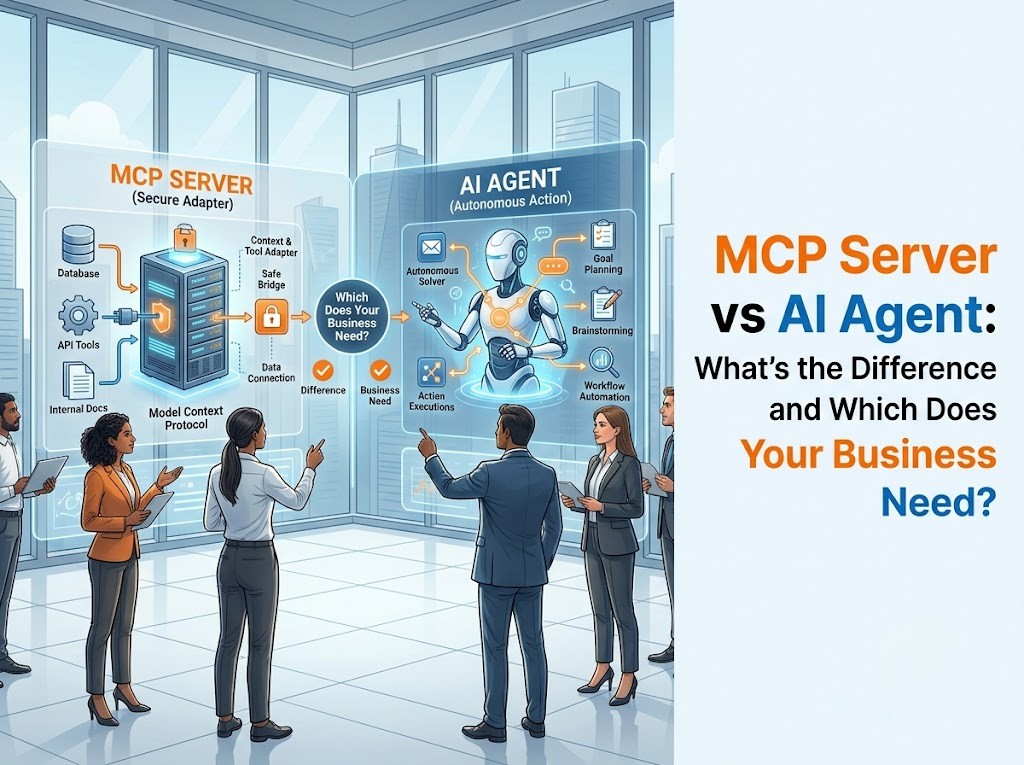
MCP Server vs AI Agent: What's the Difference and Which Does Your Business Need?


Quick answer: An MCP server exposes tools and data to AI applications through a standard interface. An AI agent reasons about a goal, decides what to do next, and acts using those tools. MCP is the connection; the agent is the actor. Enterprises need both, plus a governance layer (permissions, business rules, human approvals and audit trails) to run them safely in production.
If you're comparing an MCP server vs an AI agent, you've probably noticed that most explanations stop at "one is a protocol, the other is software." That's accurate, but it doesn't help you decide what to build, buy or deploy.
The more useful question is this: what turns a connection and a reasoning model into work your business can trust?
This guide covers the difference between an MCP server and an AI agent, when you need each one, why so many pilots stall before production, and what real enterprise deployments look like. They're drawn from Assistents.ai implementations by Ampcome, with client details anonymised.
What is an MCP server?
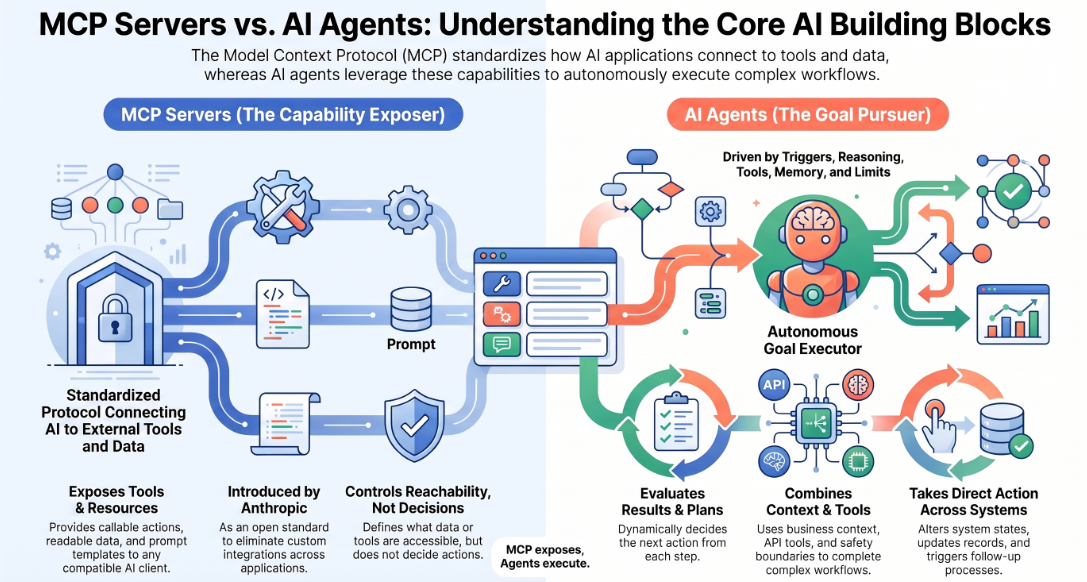
The Model Context Protocol (MCP) is an open standard, introduced by Anthropic in November 2024, for connecting AI applications to external tools and data. The official MCP documentation describes three roles:
- MCP host: the AI application the person uses (a chat interface or an IDE, for example).
- MCP client: the component inside the host that maintains the connection to a server.
- MCP server: the program that exposes capabilities, either locally or remotely.
A server can expose three kinds of capability: tools (actions the AI can call), resources (data it can read) and prompts (reusable templates).
The practical benefit is that you expose a system once, and any compatible AI client can use it. You don't build a custom integration for every model or application.
What an MCP server does not do: it doesn't decide what should happen. It only determines what is reachable.
What is an AI agent?
An AI agent is software that pursues a goal by choosing and executing a sequence of steps. It looks at the result of each step to decide the next one. A chatbot answers a question. An agent can take that question, check a system, apply a rule, update a record and tell someone what happened.
A working agent typically has:
- A goal or trigger (an incoming email, a schedule, a question)
- Reasoning to plan the next step
- Tools to act (APIs, databases, documents, other agents)
- Memory and context about your business
- Limits: permissions, rules and escalation paths
An agent can be conversational, voice-based, or fully autonomous and event-driven. The common thread is that it acts, which is why governance matters so much.
MCP server vs AI agent: side-by-side comparison
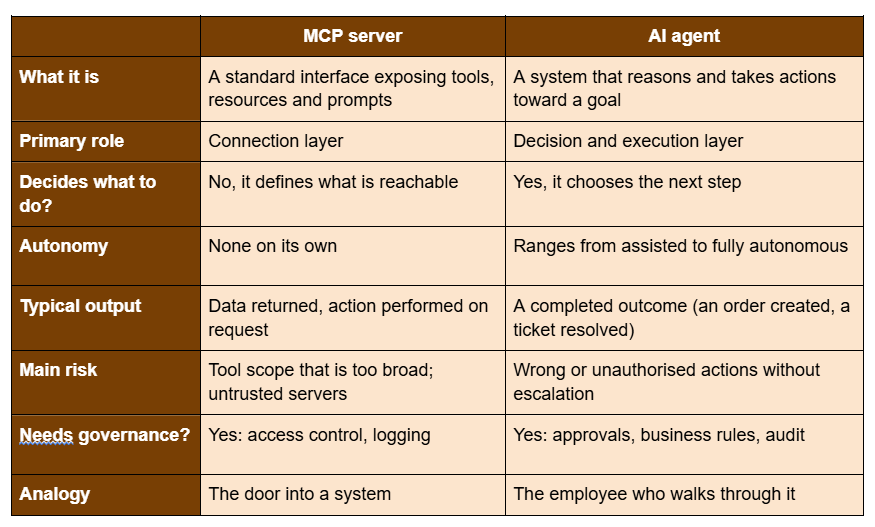
A simple way to hold it together: the MCP server is the door, the agent is the employee, and governance is the badge system and manager that decide what that employee is allowed to do.
Other explainers reach the same conclusion. Merge and Altamira both describe MCP as the layer agents use to reach tools, with the agent choosing which tools to call. The Azilen guide adds that MCP supports protocol-level authorisation but doesn't replace enterprise governance, which is the point most teams discover late.
Do AI agents need MCP?
No, not always. An agent can reach systems through direct APIs, SDKs, database connections or command-line tools. MCP becomes valuable when:
- You want to expose a system once and let many AI clients and agents use it
- Agents need to discover tools dynamically rather than rely on hard-coded integrations
- You want a single place to define scope for what an agent can reach
MCP is less compelling when you have one agent, one stable integration and no need for reuse. In that case a direct API call is simpler. As one engineering deep dive puts it, the strongest case for MCP is when agents act on behalf of other people and you need per-user auth, scoped permissions and audit trails.
So the honest answer: MCP is a good connection standard, but it's not a business process. It tells an agent what it can reach. It says nothing about what the agent should do with a purchase order that has a missing product code or a discount that breaches a credit limit.
Why enterprise AI pilots stall
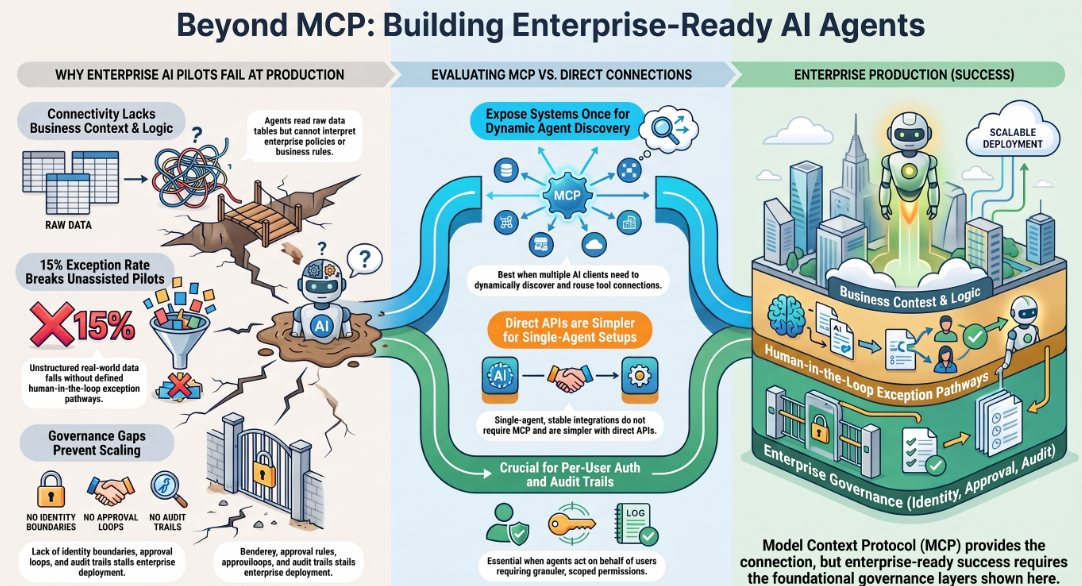
Most teams can get an agent talking to a system in a week. The trouble starts when it moves toward real operations. The same gaps appear again and again:
- No business context. The agent can read a table but doesn't know that "customer," "contract," "credit limit" and "approved discount" are related, or what your policy says about them.
- No identity or permission model. Who is the agent acting as? What can this user's request actually authorise?
- No exception handling. Real inputs are messy. A pilot that works on clean examples fails on the 15% that need a human.
- No approval path. High-impact actions (creating orders, changing records, contacting customers) need a person in the loop at the right moment, not everywhere.
- No audit trail. If you can't show who or what did what and why, you can't scale it in a regulated or finance-sensitive process.
- Model lock-in and fragility. Pilots that depend on one model with no fallback break when pricing, availability or quality changes.
Industry commentary points the same way. A CIO.com analysis argues that many MCP pilots stall at the point they leave the sandbox, because DIY and single-application setups lack enterprise identity, centralised governance and reliability. A security briefing on enterprise MCP notes that every connected server becomes part of an agent's trust boundary, so teams need to know which servers exist and what each exposes. And AlphaBOLD's enterprise guide observes that the official 2026 MCP roadmap lists governance maturation and enterprise readiness as current priorities.
The takeaway: the connection layer and the reasoning layer are necessary but not sufficient. The missing piece is an enterprise foundation that gives agents business context, controls their actions and records the outcome.
Which should you choose? A decision guide
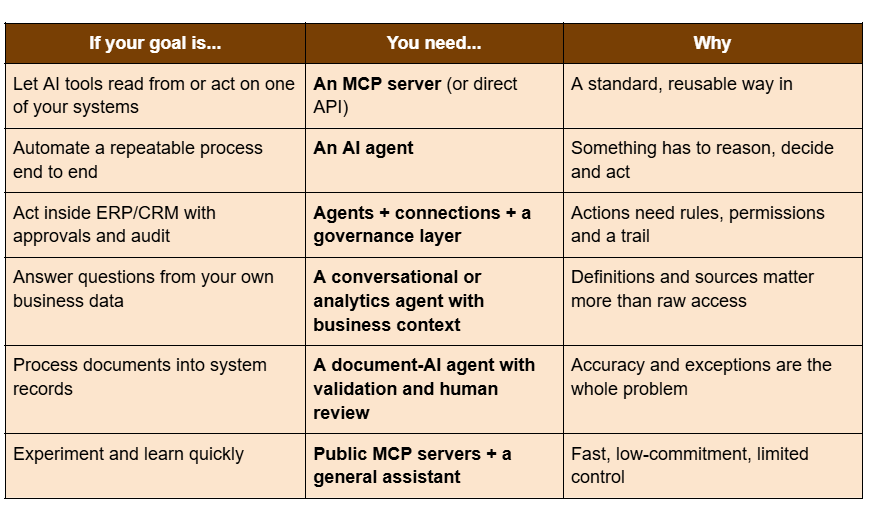
If you're in the third row, which most enterprise operations teams are, the question isn't "MCP or agent?" It's "what platform runs both safely, against our own systems, with our own rules?"
Real-world examples: from connection to controlled outcome
Here is how this plays out in production. The examples below are anonymised deployments of Assistents.ai, configured around each organisation's processes, systems and controls. In each, three layers work together: connection (reaching the systems), agents (doing the work) and control (rules, approvals, audit).
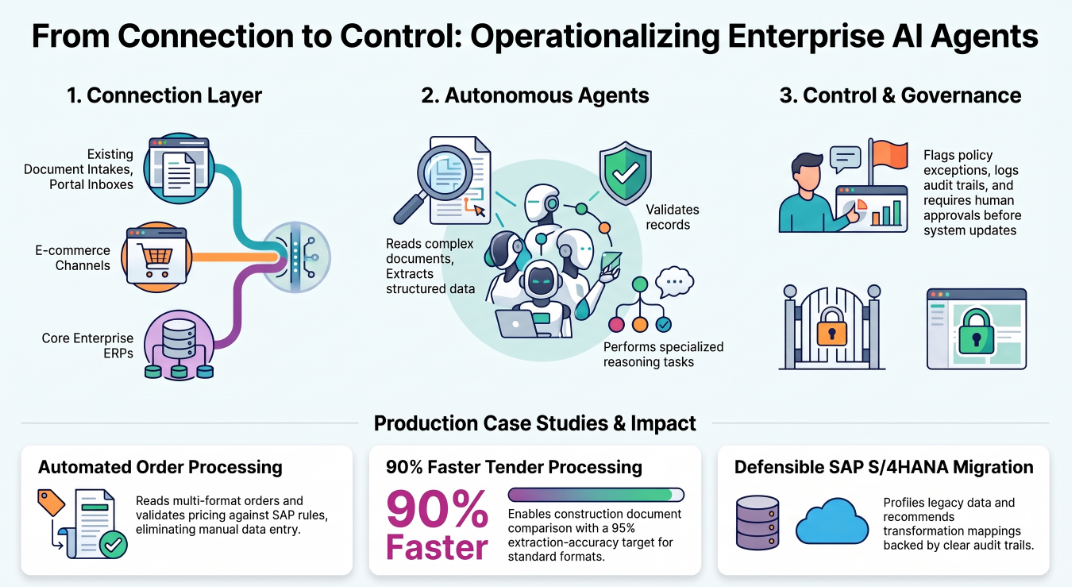
Example 1: Purchase-order processing for a home-appliance manufacturer
Situation: Orders arrived by email, portal and PDF, and staff re-keyed them into SAP by hand. The company was also moving away from a legacy capture-and-archive tool that was nearing end of life and expensive to license.
How it works:
- Connection: the order inbox and portal on one side, SAP on the other.
- Agents: a document agent reads layouts and tables and extracts customer, product, quantity, pricing and delivery details. A data agent validates them against customer, product and credit data.
- Control: rules flag exceptions such as missing product master data, pricing outside policy or a credit-limit issue. An authorised person reviews and approves, and only then is the sales order created in SAP, with the source document archived and the audit record kept.
Outcome: less re-entry, faster order-to-confirmation, clearer exceptions, and a traceable record of every order created or held back.
Example 2: Tender revision management for a construction firm
Situation: Tender documents changed between versions, and keeping estimating and operations systems aligned with every revision was manual and error-prone.
How it works:
- Connection: document intake on one side, the firm's operations system on the other.
- Agents: a vision-enabled document agent extracts details from complex PDFs, compares versions and highlights what changed.
- Control: a human reviews the changes before approved details are written to the operations system, with audit logs and quote locking.
Outcome: the solution was engineered for up to roughly 90% faster tender document processing, with a roughly 95% extraction-accuracy target for standard formats. Revision detection and auditability reduce bid risk.
Example 3: Multilingual frontline support for a national retail chain
Situation: Store teams needed fast answers on stock, product and warranty questions, and consistent access to procedures, at national scale.
How it works:
- Connection: inventory and product systems, plus operating procedures and training documents.
- Agents: a voice and chat support agent (speech-to-text, language model, text-to-speech) works in Hindi and English. An inventory agent answers stock and pricing questions per store. A knowledge agent uses retrieval over operating documents for on-demand training.
- Control: an admin console, analytics, and ticketing integration create a service ticket when the issue can't be resolved on the spot, with a clear path to a human.
Outcome: reduced manual helpdesk burden, faster resolution of store issues, better inventory visibility and faster onboarding.
Example 4: Migration decision support for a global premium automaker
Situation: An SAP ECC to SAP S/4HANA migration involved customer data, material master, vendor records, transactions and custom tables, and every mapping decision needed to be defensible.
How it works:
- Agents: discover and profile source data, check duplicates and inconsistencies, and recommend mappings.
- Control: specialists review and validate suggested mappings, and the platform retains the rationale and decision trail.
Outcome: migration decisions that are reviewable rather than opaque, with mapped data, transformation rules and validation results as outputs.
More production patterns
The same shared foundation extends to other functions:
- Competitive monitoring: always-on tracking of pricing, offers and availability across e-commerce channels, with proactive alerts and leadership Q&A
- Smart grid and energy operations: anomaly detection, forecasting and automated alerting for utilities and campuses
- Procurement and finance alerts: margin, vendor performance and working-capital KPIs standardised across group entities
- Real-estate customer service: an omnichannel agent for tenant queries with ticketing and escalation to human teams
- Sales intelligence: CRM, ERP and activity signals combined into rule-governed opportunity alerts
The pattern across every deployment: the connection was necessary, but what made the work trustworthy was the context, the exception paths and the human approvals. That's the layer MCP doesn't provide on its own.
Why Assistents.ai
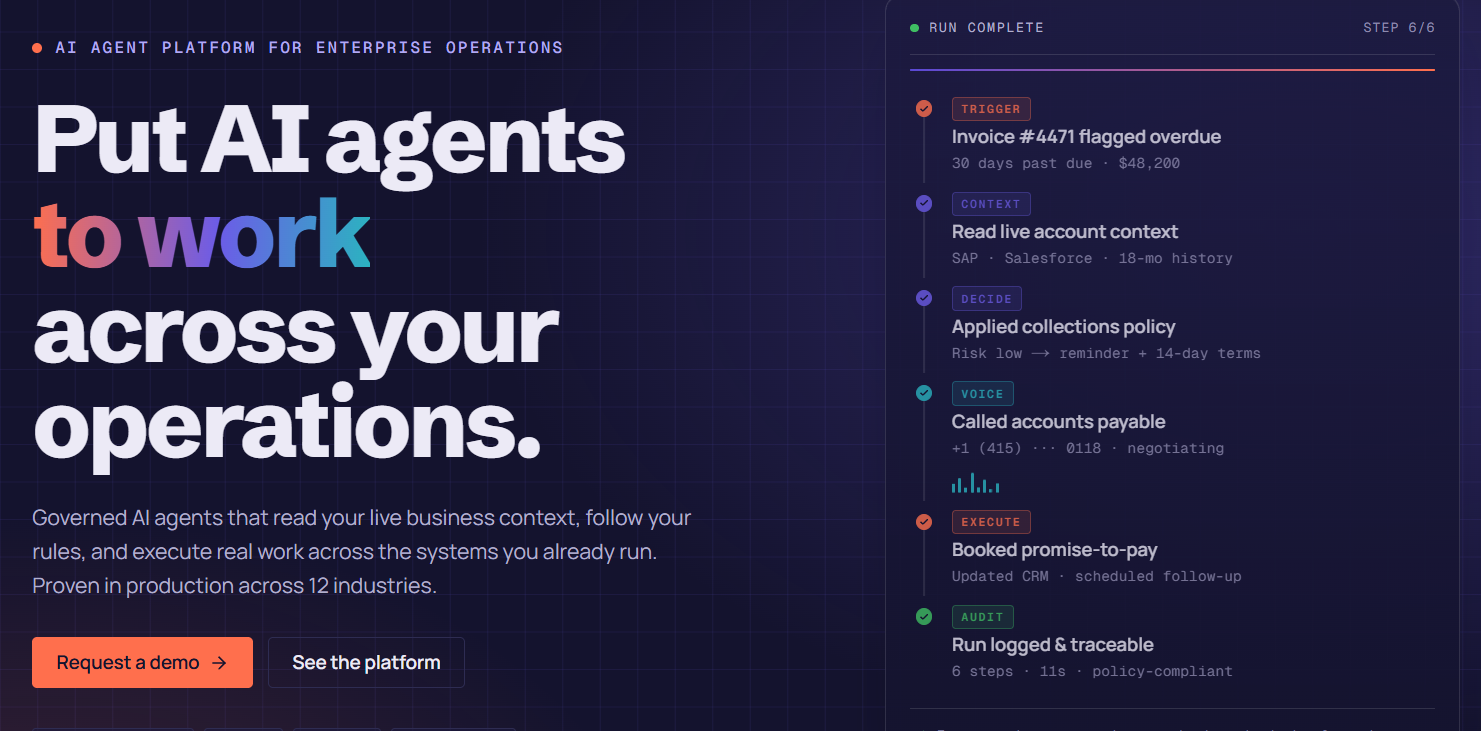
Assistents.ai is an enterprise AI agent platform built by Ampcome for organisational productivity: connecting teams, business context, rules and enterprise systems so work is coordinated from trigger to verified outcome. Personal assistants help one person finish a task. Assistents puts shared business processes to work.
What sets it apart
- One platform, five ways to work. Conversational agents, agentic BI (natural-language questions to charts, reports and alerts), document AI, voice AI, and autonomous workflows triggered by events, schedules and inboxes. Combine them to transform a full process.
- A Context Engine. Agents work from your entities, relationships, business definitions, policies and source evidence, so they understand what a "customer," "contract" or "approved discount" means in your business.
- Governed action. Every action is checked: user permissions, then policy rules, then human approval where required. The result is allowed, sent for review, or blocked and logged, with a complete audit history.
- Orchestration with exception handling. Specialist agents (document, data, communication) are coordinated, state is tracked, and exceptions go to people instead of failing silently.
- Built to fit your enterprise. Connect ERP including SAP, CRM, HR systems, files, databases and APIs through connectors, APIs and SDKs. An AI Gateway handles approved model choice, task routing, fallback and usage management. Deploy on SaaS, private cloud or on-premise infrastructure.
- Build your own agents. Agent Builder and Workflow Builder let you configure reusable agents with instructions, knowledge, tools and permissions, then test, version and monitor them. Deep Research and Canvas turn cited research into decision-ready documents.
- A delivery team, not just software. Forward Deployed Engineers, AI engineers and data and ML specialists across the USA, Australia and India take you from configuration to enterprise delivery.
- A low-risk way to start. Begin with one priority process: select, connect, configure, validate, operate, expand. Success measures are agreed up front.
How it compares
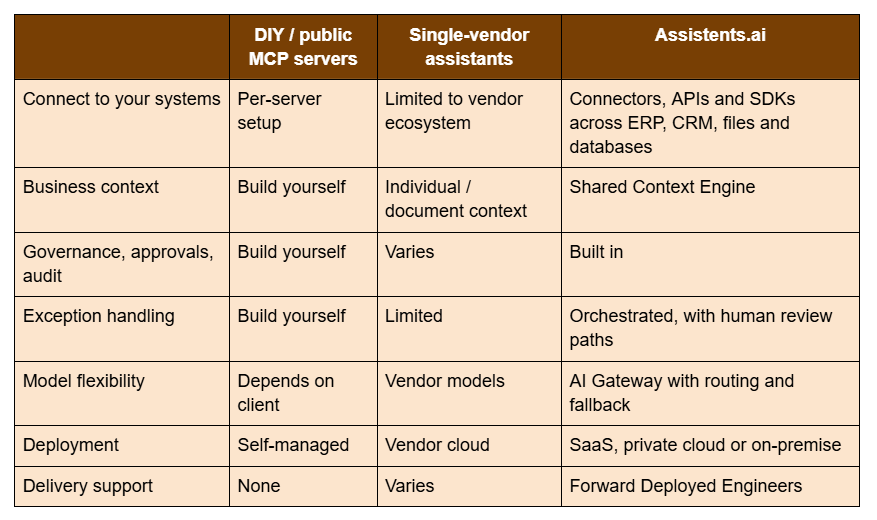
If you already use Copilot, Claude or ChatGPT, you don't have to replace them. Assistents builds on your AI investment by putting shared business processes to work, rather than helping one individual with one task.
Conclusion: don't choose between them, govern them
The MCP server vs AI agent debate is a false choice. MCP connects. Agents act. Governance makes it safe to scale. The organisations that get value from AI in operations aren't the ones with the most connections or the cleverest agent. They're the ones whose agents understand the business, follow its rules, hand exceptions to people and leave a trail anyone can audit.
If you're ready to put agents to work on a real process, start with the one that matters most.
Book a tailored Assistents.ai walkthrough →
Or talk to the team at Ampcome.
FAQs
What is the difference between an MCP server and an AI agent?
An MCP server exposes tools and data to AI applications through a standard interface. An AI agent reasons about a goal and decides which actions to take. The server defines what is reachable; the agent decides what to do with it.
Is MCP an AI agent?
No. MCP is an open protocol, and an MCP server is a program that implements it. An agent may use MCP to reach tools, but the protocol itself has no goals, planning or decision-making.
Do AI agents need MCP to work?
No. Agents can use direct APIs, SDKs, databases or command-line tools. MCP helps when you want reusable, discoverable connections that many AI clients can share.
Is MCP replacing APIs?
No. In most cases an MCP server wraps an API or business logic that already exists. MCP adds a standard way for AI to discover and call it; the underlying API remains.
Is MCP secure enough for enterprise use?
The protocol supports authorisation, but it doesn't replace enterprise governance. Teams still need identity, scoped permissions, approvals for high-impact actions and audit logs, and they should inventory every server an agent can reach.
Why do MCP and agent pilots fail in production?
Usually because of missing business context, unclear permissions, no exception paths, no approval workflow and no audit trail, not because the connection fails. A governed platform layer addresses these.
When should I use an AI agent platform instead of building my own MCP servers?
When you need agents to act inside core systems (ERP, CRM, finance) with approvals and audit, across more than one use case. Building and governing each piece yourself is slower and harder to scale than starting from a platform with context, orchestration and governance built in.
How do I get started with enterprise AI agents?
Pick one valuable process, map its systems, handoffs and approval points, agree how success will be measured, then connect, configure, validate and expand. That's the approach Assistents.ai uses with every client.

Transform Your Business With Agentic Automation
Agentic automation is the rising star posied to overtake RPA and bring about a new wave of intelligent automation. Explore the core concepts of agentic automation, how it works, real-life examples and strategies for a successful implementation in this ebook.
Sarfraz Nawaz is the CEO and founder of Ampcome, which is at the forefront of Artificial Intelligence (AI) Development. Nawaz's passion for technology is matched by his commitment to creating solutions that drive real-world results. Under his leadership, Ampcome's team of talented engineers and developers craft innovative IT solutions that empower businesses to thrive in the ever-evolving technological landscape.Ampcome's success is a testament to Nawaz's dedication to excellence and his unwavering belief in the transformative power of technology.

More insights
Discover the latest trends, best practices, and expert opinions that can reshape your perspective






Contact us

