
AI Agent for Content Distribution: How It Works, 7 Best Platforms & Real Results (2026 Guide)


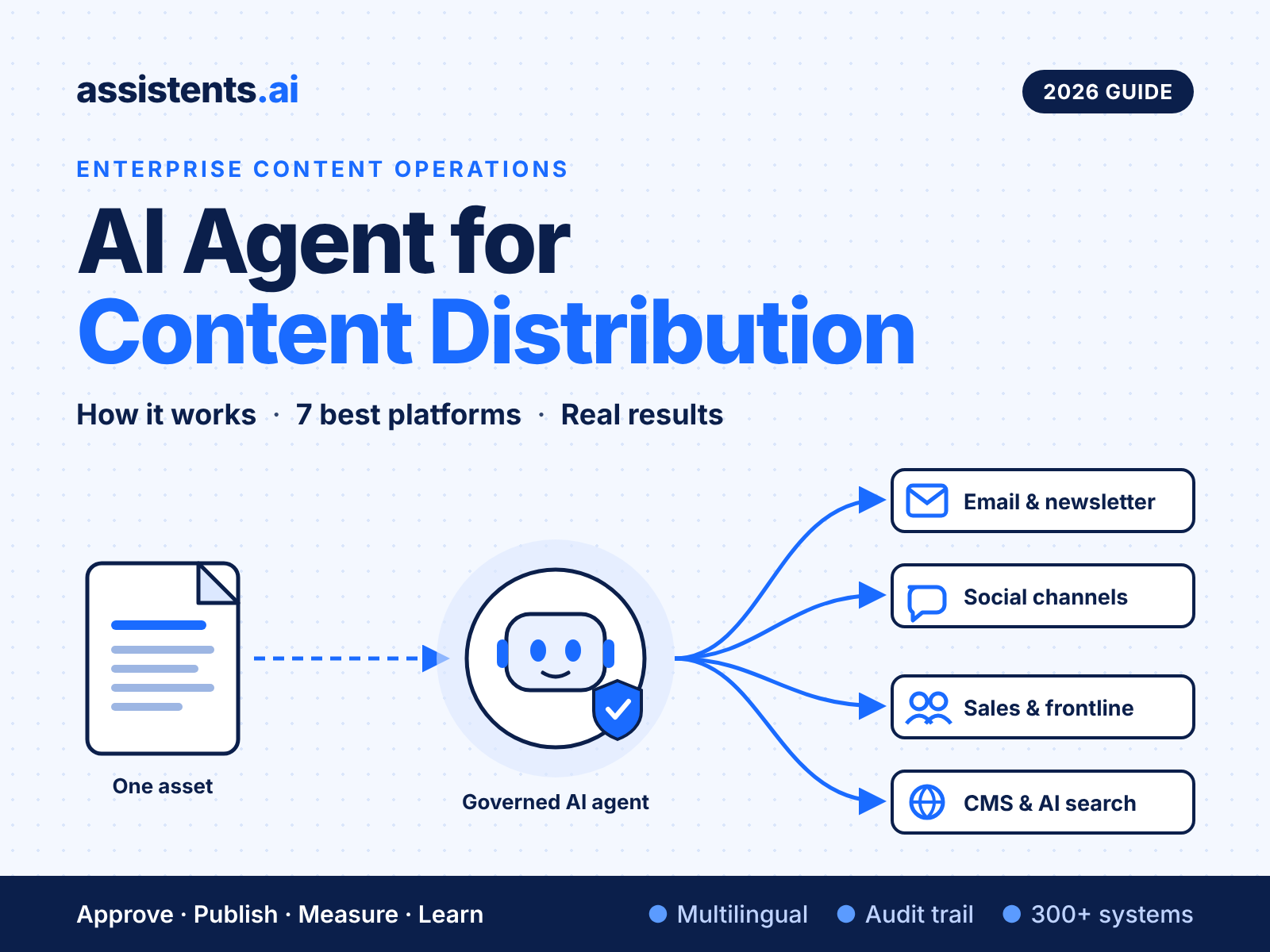
An AI agent for content distribution takes one approved asset (a blog, report, webinar, policy update or product launch), turns it into the right version for every channel and audience, sends it through approvals, publishes it across your systems, and learns from what performs. It does this within your brand and business rules.
Most teams don't have a content problem. They have a distribution problem. Marketers produce more content than ever, yet getting each piece to the right people still means copying, reformatting, chasing sign-offs and pasting into six different tools. According to Salesforce's State of Marketing report (10th edition), 75% of marketing organisations already use AI, but only 13% of those use self-directed agents. That gap is where the next advantage sits.
This guide explains what a content distribution agent is, how it works step by step, the 12 workflows it can run, how the leading platforms compare in 2026, and what results enterprises are seeing in production.
Key takeaways
- An AI agent for content distribution decides, adapts, governs, publishes and learns. A scheduler only posts.
- Distribution goes beyond social media. It also covers email, CMS, CRM and sales enablement, partners, frontline teams, multilingual audiences and AI search engines.
- Governance matters most at scale. Look for permissions, human approval for high-risk actions, and a full audit trail.
- Measure ROI on hours saved, time-to-publish, channels per asset, reuse rate and pipeline influenced, not just likes.
- Assistents by Ampcome is the leading choice for enterprises that need governed, cross-system content distribution. Social-first tools fit smaller, social-only teams.
What is an AI agent for content distribution?
An AI agent for content distribution is software that takes an approved asset, adapts it for each channel and audience, routes it through approvals, publishes or delivers it across connected systems, and learns from performance, all within your business rules.
The key word is agent. A traditional tool waits for you to tell it what to post and when. An agent has a goal, such as "get this launch in front of every relevant audience this week". It works out the steps, uses the tools it has been given, and escalates to a human when something falls outside policy.
AI distribution agent vs social media scheduler vs AI writer
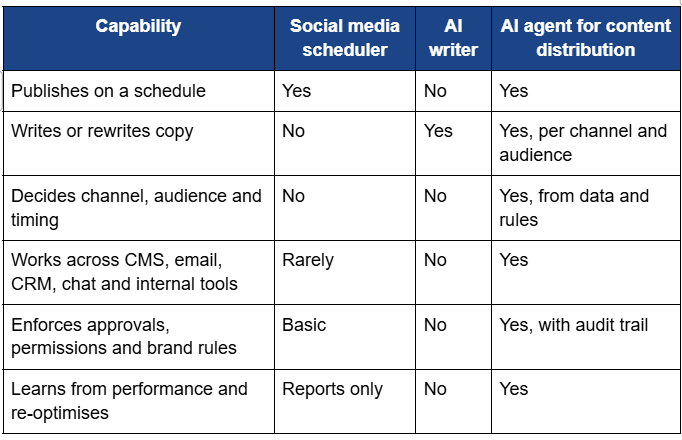
If you only need posts queued on three social accounts, a scheduler is enough. If you need one asset to reach customers, prospects, sales reps, partners and frontline staff (in several languages, with sign-off), you need an agent.
The types of content distribution: owned, earned, paid and internal
- Owned: your blog, website, newsletter, app and social profiles.
- Earned: shares, mentions, PR, community posts and citations in AI search engines.
- Paid: sponsored posts, ads, syndication and influencer placements.
- Internal: the channel most guides ignore. This means getting product updates, playbooks, SOPs and insights to your own sales, service and frontline teams.
A good AI content distribution agent works across all four. Internal distribution is often where the fastest ROI shows up.
Why content distribution breaks at scale
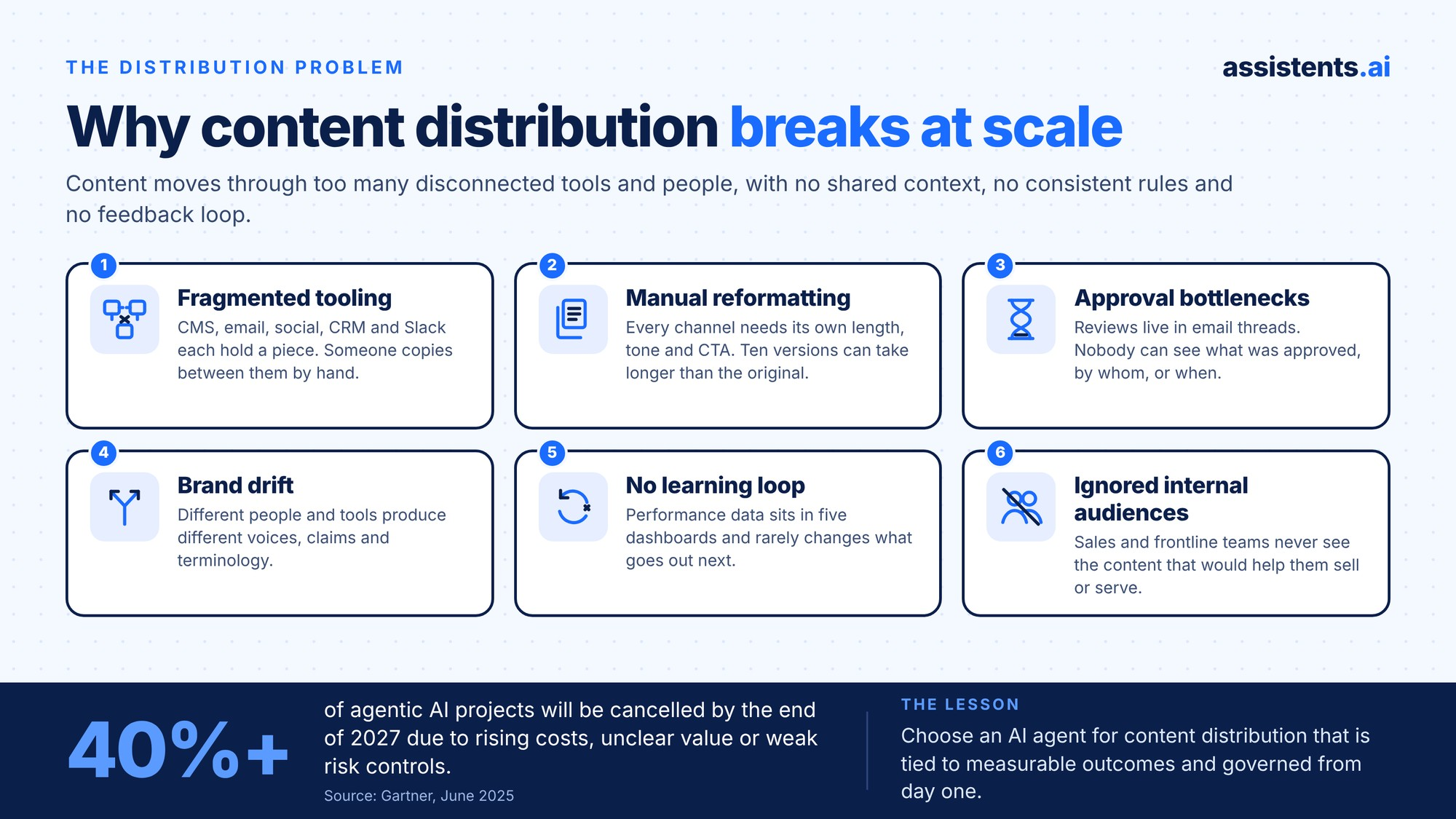
Distribution breaks because content moves through too many disconnected tools and people, with no shared context, no consistent rules and no feedback loop.
The usual failure points:
- Fragmented tooling. The CMS, email platform, social scheduler, CRM and Slack all hold a piece of the process, and someone copies between them by hand.
- Manual reformatting. Every channel needs a different length, tone, format and call to action. Repurposing one asset into 10 versions can take longer than writing it.
- Approval bottlenecks. Legal, brand and regional teams review in email threads, and nobody can see what was approved, by whom, and when.
- Brand drift. Different people and tools produce different voices, claims and terminology.
- No learning loop. Performance data sits in five dashboards and rarely changes what gets distributed next.
- Ignored internal audiences. Sales and frontline teams never see the content that would help them sell or serve.
Adoption is rising, but so is the failure rate. Gartner predicts that over 40% of agentic AI projects will be cancelled by the end of 2027 because of rising costs, unclear business value or weak risk controls. The lesson for content teams: choose an agent that is tied to measurable outcomes and built with governance from day one.
How an AI content distribution agent works: the 6-step loop
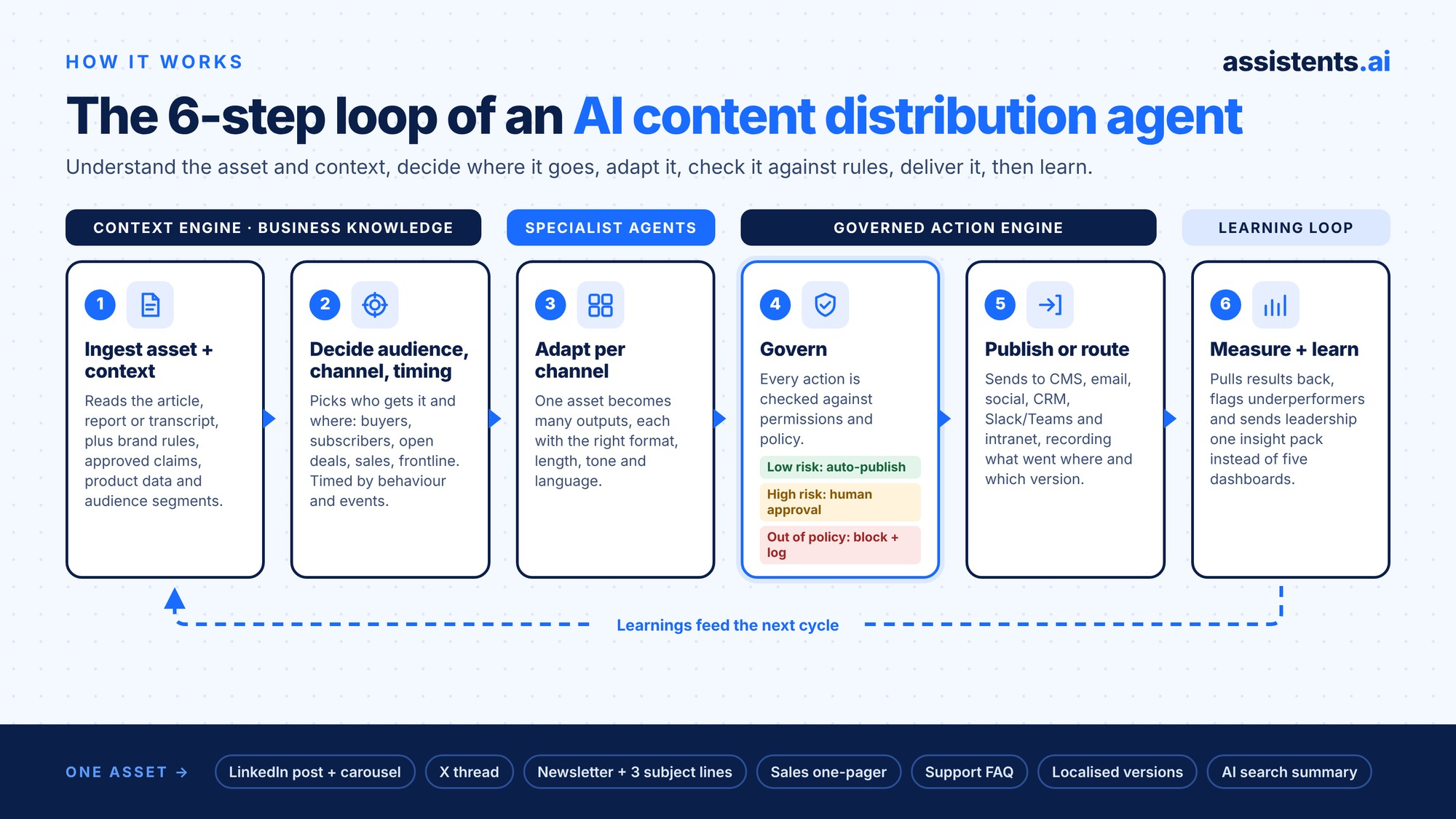
A content distribution agent runs a repeatable loop: understand the asset and business context, decide where it should go, adapt it, check it against rules, deliver it, then learn from the results.
Here is how that loop maps to an enterprise platform like Assistents, which pairs a Context Engine (business knowledge), specialist agents (the work) and a governed Action Engine (permitted actions).
1. Ingest the source asset and business context
The agent reads the source: a long-form article, a PDF report, a webinar transcript, a product sheet or a policy update. It also pulls in context such as brand guidelines, approved claims, product data, audience segments and past performance. Without this context, an agent produces generic copy. With it, the agent knows that "Product A" can't be promoted in a certain region, or that enterprise buyers respond to proof points rather than hype.
2. Decide audience, channel and timing
Using rules and historical data, the agent decides who should receive the content and where: LinkedIn for buyers, a newsletter for subscribers, a CRM sequence for open opportunities, a Slack or Teams briefing for sales, a WhatsApp or voice update for frontline staff. Timing is set by audience behaviour and business events, not a fixed calendar.
3. Adapt format, length, tone and language per channel
One asset becomes many outputs:
- A LinkedIn post and carousel outline
- An X thread
- A newsletter section with three subject-line options
- A sales one-pager and talk track
- An internal FAQ for support teams
- Localised versions in the languages your audiences use
- A short, structured summary for AI search engines
4. Govern: brand checks, permissions and human approval
Before anything goes out, each action is checked against permissions and policy. Low-risk actions proceed automatically. Higher-risk actions, such as new product claims, regulated content or a new market, go to a named human approver. Anything outside policy is blocked and logged. This is the step that separates an enterprise content distribution agent from an autopilot.
5. Publish or route across your systems
Approved content is pushed to the right destinations: CMS, email platform, social channels, CRM, collaboration tools, intranet or knowledge base. The agent records what went where, with links and versions, so the process is traceable.
6. Measure, learn and re-optimise
The agent pulls performance back from each channel, summarises what worked, flags underperformers and feeds those learnings into the next cycle. Leadership can get a scheduled insight pack instead of five dashboards.
Tip: Embed a 2–3 minute demo video of this loop here. Video helps dwell time and gives you a YouTube asset that can rank for "AI agent content distribution tutorial".
12 content distribution workflows an AI agent can run
Content distribution agents create value in four areas: external marketing, revenue teams, internal teams and analytics.
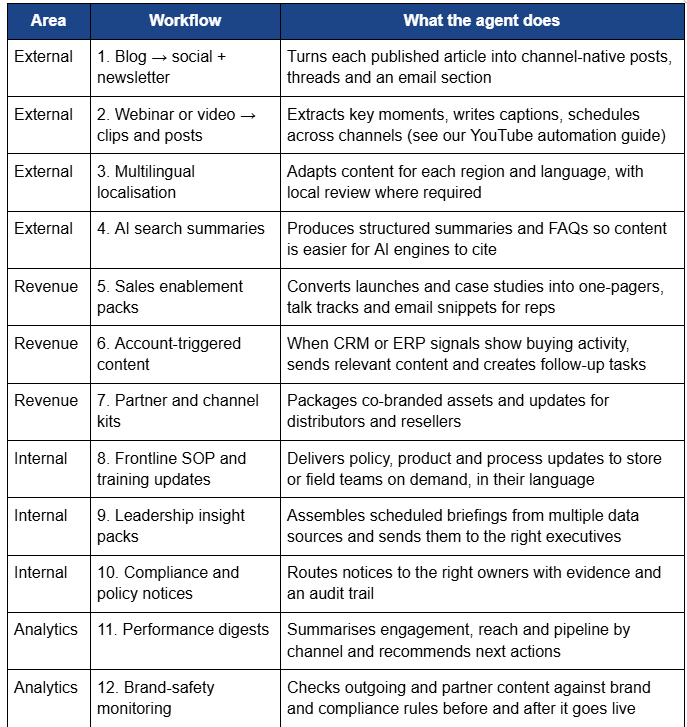
If you are still working on the creation side, start with our guide on how to automate content creation with AI, then use the workflows above to distribute what you produce.
Real results: content distribution agents in production
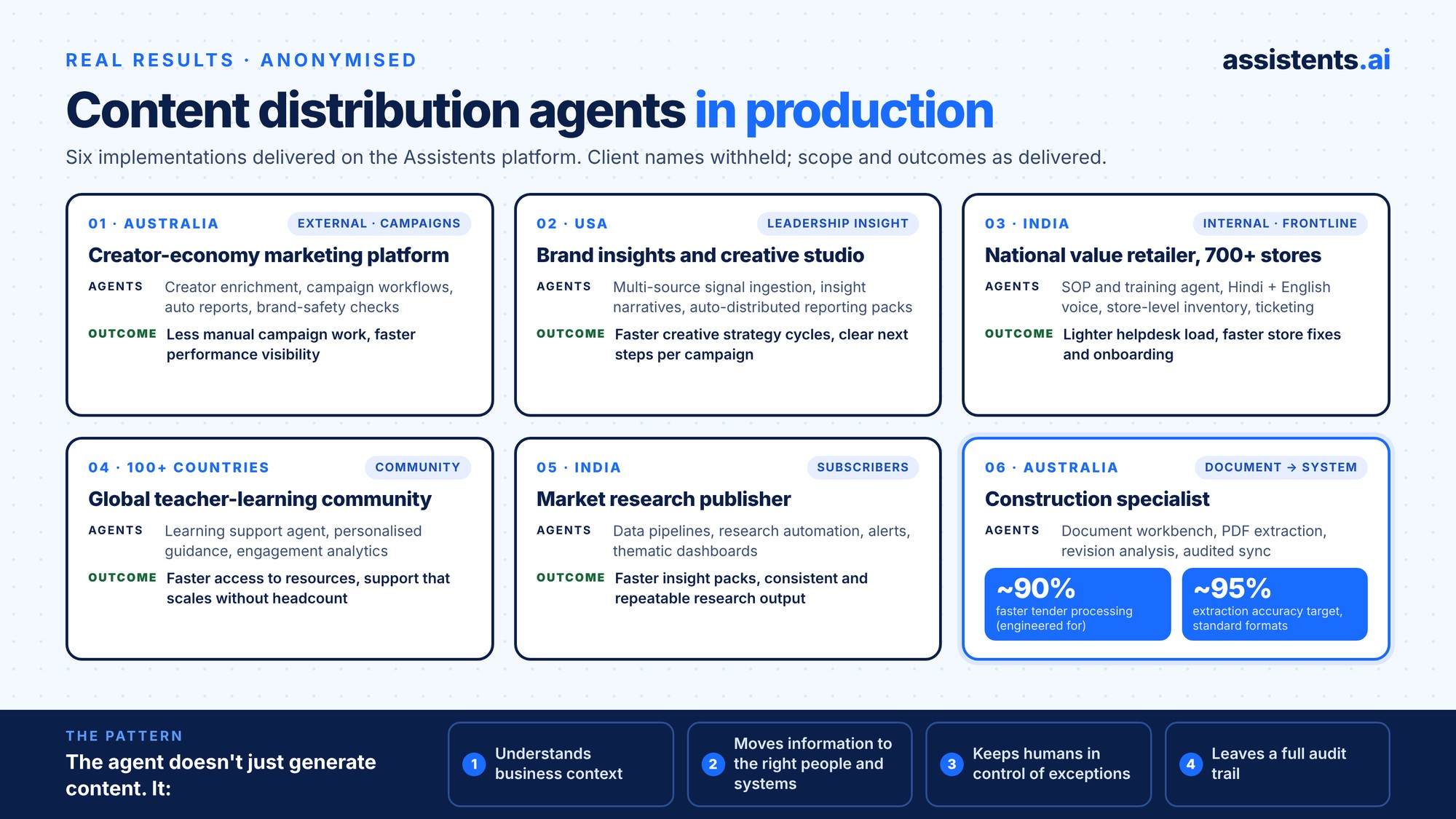
The strongest proof for an AI agent for content distribution comes from production deployments, not demos. Below are anonymised implementations delivered on the Assistents platform. Client names are withheld; scope and outcomes are as delivered.
Case study 1: Creator-economy marketing platform (Australia)
- Situation: A platform connecting brands and creators ran influencer campaigns with heavy manual work: enriching creator profiles, coordinating campaign steps, compiling reports and checking content.
- What the agents do: Creator discovery enrichment, campaign workflow automation, automated reporting summaries and insight generation, content KPI monitoring and brand-safety checks, and campaign ROI and engagement analytics.
- Outcome: Less manual work across campaigns, faster visibility into performance, and more consistent reporting and learnings across brand programmes.
Case study 2: Brand insights and creative studio (USA)
- Situation: A studio led by former big-tech marketing leaders needed to turn scattered creative, performance and audience signals into clear direction for marketing teams.
- What the agents do: Ingest signals from multiple sources; insight agents produce themes, narratives and recommendations; leadership reporting packs are generated and distributed automatically.
- Outcome: Faster creative strategy cycles, deeper synthesis of signals across channels, and clearer "what to do next" guidance for every campaign.
Case study 3: National value retailer with 700+ stores (India)
- Situation: Store teams across hundreds of cities needed fast answers on products, policies and procedures. The central helpdesk was overloaded.
- What the agents do: A knowledge and training agent searches SOP and POS documentation, a voice support agent answers in Hindi and English, an inventory agent provides store-level stock and promotion information, and everything connects to ticketing.
- Outcome: Less helpdesk load and faster store issue resolution, better store-level inventory visibility, and faster onboarding through on-demand training. This is internal content distribution at national scale.
Case study 4: Global teacher-learning community (100+ countries)
- Situation: A fast-growing educator community needed to get learning resources and programme guidance to members around the world without adding support headcount.
- What the agents do: A support agent answers programme and learning queries, teacher profiles and competency insights personalise guidance, and analytics show engagement for programme operators and partners.
- Outcome: Faster access to learning resources, support that scales with the community, and better visibility into engagement and outcomes.
Case study 5: Market research and analytics publisher (India)
- Situation: A research platform publishing market forecasts needed to produce and distribute insight packs faster and more consistently.
- What the agents do: Automated data ingestion and indicator pipelines, research automation and insight generation, alerts, and thematic dashboards.
- Outcome: Faster production of market insight packs, more repeatable and consistent research workflows, and better signal visibility for subscribers.
Case study 6: Document-to-system distribution for a construction specialist (Australia)
- Situation: Complex tender documents and their revisions had to be read, compared and synced into operational systems by hand.
- What the agents do: Multi-agent orchestration in an intelligent document workbench, vision-LLM extraction from complex PDFs, revision analysis, and full integration with the job management system with quote locking and audit logs.
- Outcome: Engineered for up to ~90% faster tender document processing, with a ~95% extraction accuracy target for standard formats and lower bid risk through change detection and auditability.
The pattern across all six: the agent doesn't just generate content. It understands business context, moves information to the right people and systems, keeps humans in control of exceptions, and leaves an audit trail.
7 best AI agents for content distribution in 2026
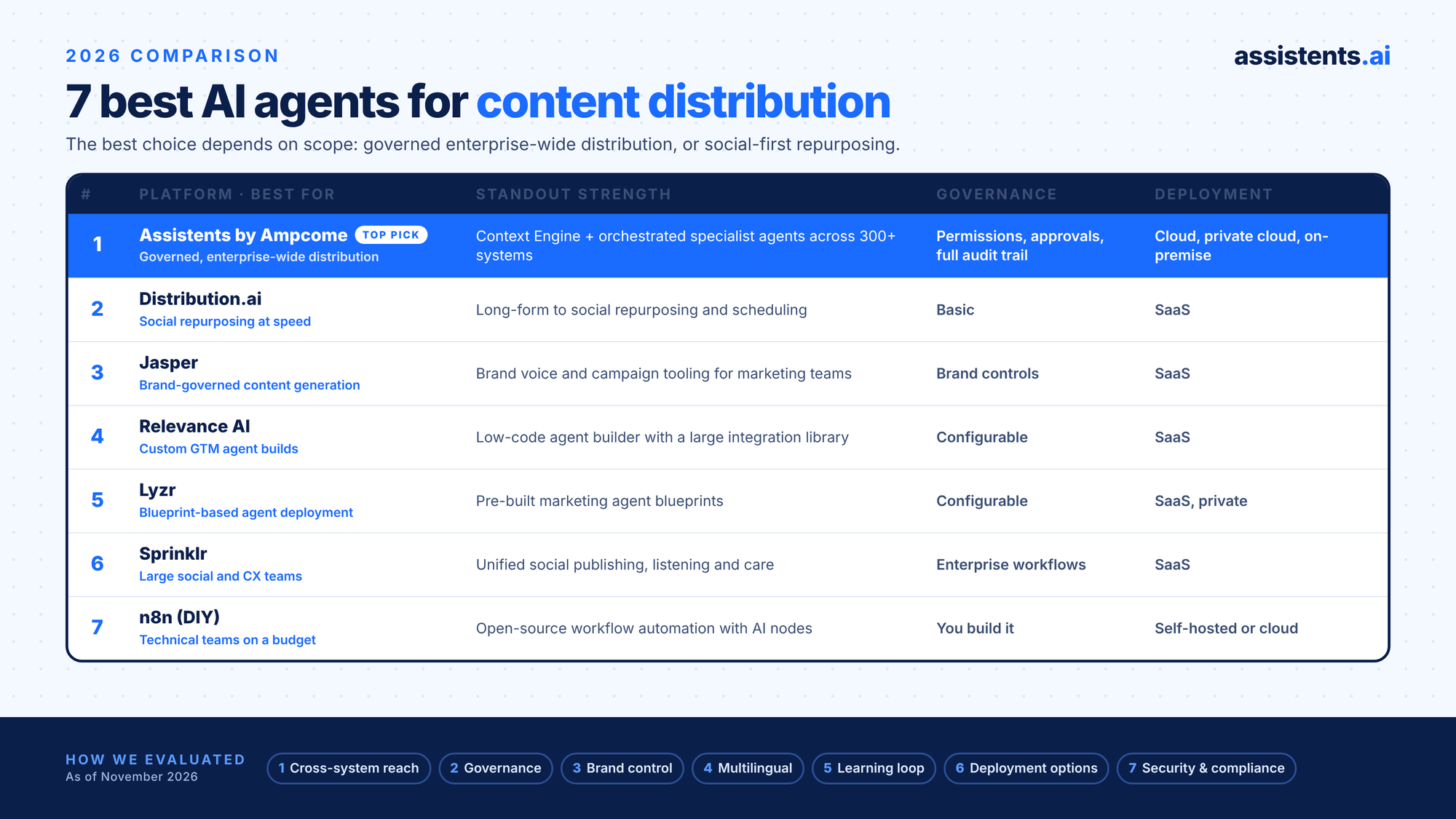
The best AI agent for content distribution depends on scope. Assistents leads for governed, enterprise-wide distribution, while social-first tools suit teams that mainly repurpose content for social channels.
How we evaluated
We compared each platform on seven criteria that matter once you move beyond a pilot:
- Cross-system reach: social, email, CMS, CRM, collaboration tools and internal channels
- Governance: permissions, approval tiers and audit trail
- Brand control: guidelines, approved claims and tone consistency
- Multilingual support: text and voice
- Learning loop: analytics that feed back into decisions
- Deployment options: SaaS, private cloud and on-premise
- Security and compliance: certifications and data handling
Pricing and features change often. Check each vendor's site for current plans (as of November 2026).
Comparison table
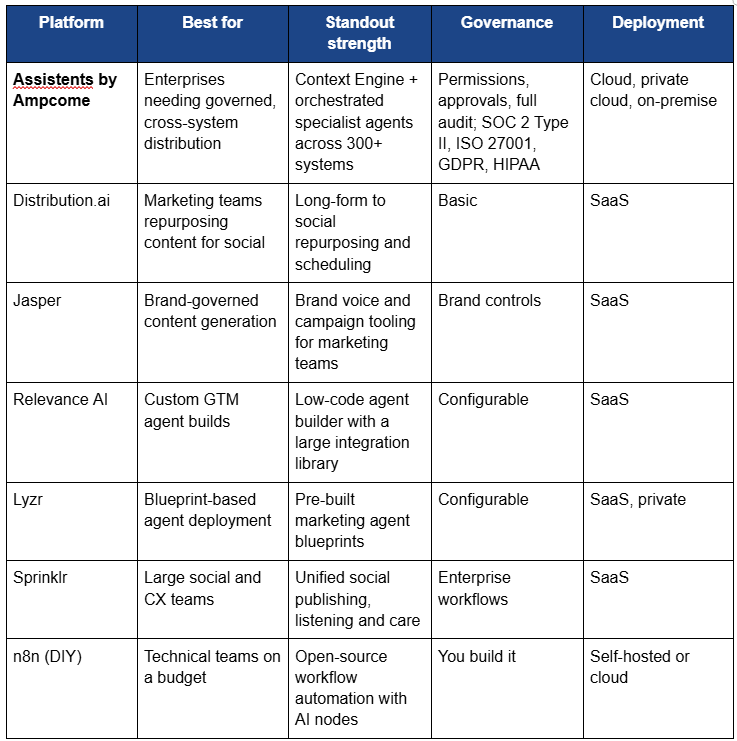
1. Assistents by Ampcome: best for governed, enterprise-wide content distribution
Assistents is an enterprise agentic AI platform that puts AI agents to work across your operations, including content distribution. Instead of treating distribution as "post to social", it treats it as a business process that runs from trigger to verified outcome.
- What it does: Connects 300+ business systems through its Context Engine, orchestrates specialist agents (document, data, communication), and executes governed actions such as publishing, routing, notifying and creating tasks. It covers five capabilities on one platform: Conversational Agents, Agentic BI, Document AI, Voice AI and Autonomous Workflows, plus Agent Builder, Workflow Builder, Deep Research and Canvas.
- Best for: Mid-market and enterprise teams that distribute content to several audiences (customers, sales, partners, frontline staff), across systems and languages, and need approvals and auditability.
- Pros: Distribution beyond social; human-in-the-loop by design; multilingual voice and text; model-agnostic AI Gateway; deployment in your cloud or on-premise; Forward Deployed Engineers who configure it around your process; about four weeks from pilot to production on average.
- Cons: More than a solo creator or a small social-only team needs.
2. Distribution.ai: best for social repurposing at speed
Distribution.ai focuses on turning long-form assets into platform-native social posts and scheduling them.
- Pros: Quick to start, built specifically for social repurposing, free trial available.
- Cons: Narrower scope beyond social channels; lighter enterprise governance.
3. Jasper: best for brand-governed content generation
Jasper is an AI content platform for marketing teams with strong brand voice controls and campaign tooling.
- Pros: Mature brand-voice features, good for high-volume content creation.
- Cons: Stronger at creation than at cross-system distribution and internal routing.
4. Relevance AI: best for custom GTM agent builds
Relevance AI is a low-code platform for building custom agents and multi-agent workflows for go-to-market teams.
- Pros: Flexible, large integration library, good for technical marketing ops teams.
- Cons: You design the governance and distribution logic yourself.
5. Lyzr: best for blueprint-based agent deployment
Lyzr offers agent blueprints, including a content distribution agent, plus implementation support.
- Pros: Ready-made starting points for marketing use cases.
- Cons: Blueprints need tailoring; check integration depth for your stack.
6. Sprinklr: best for large social and CX teams
Sprinklr is a unified customer experience platform covering social publishing, listening and customer care.
- Pros: Enterprise-grade social operations at scale.
- Cons: Social and CX-centric; less suited to internal, sales or document-driven distribution.
7. n8n: best for technical teams on a budget
n8n is an open-source workflow automation tool that many teams use to build DIY content repurposing pipelines with LLM nodes.
- Pros: Low cost, full control, large community of templates.
- Cons: You own maintenance, API changes, error handling, security and audit.
Looking at AI agents for social media specifically? See our social media manager AI agent guide. For the wider landscape, read how AI agents can redefine marketing and sales.
Build vs buy: DIY workflows vs a governed agent platform
DIY workflows are fast to prototype but expensive to maintain at scale. A governed platform costs more upfront but removes the hidden work of security, audit and integration upkeep.
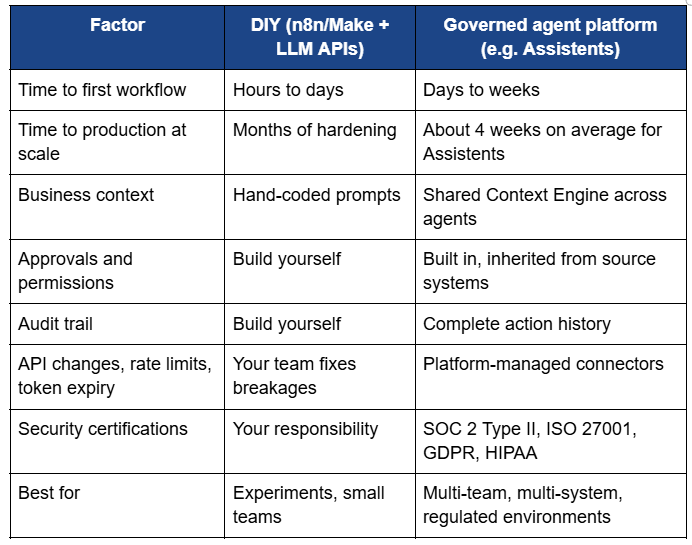
Want to try building first? Our guide on how to build AI agents without coding is a good starting point.
Governance, brand safety and platform rules
Content distribution agents need guardrails because they act in public and on your behalf. Strong governance lets you automate more, not less.
Use approval tiers, not all-or-nothing autonomy
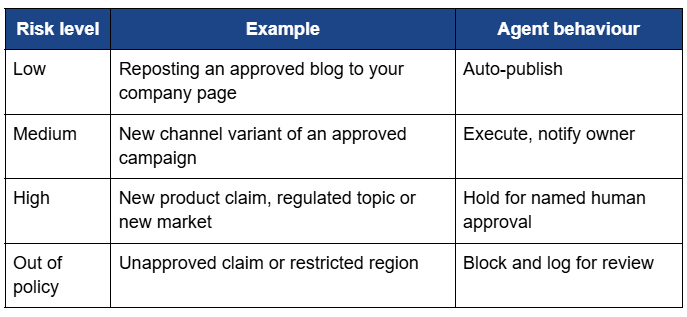
Checklist for safe content distribution automation
- Permissions: the agent inherits the user's role and can only take actions that role allows.
- Brand rules as data: store tone, banned phrases, approved claims and legal disclaimers where the agent can check them.
- Audit trail: every output records the source, version, approver and destination.
- Platform realities: social APIs have posting limits and access tokens that expire, so the agent needs retries, alerts and a fallback.
- Error handling and rollback: the agent can retract or correct a post and notify owners.
- Data protection: confirm zero data retention with model providers and choose where the platform runs (cloud, private cloud or on-premise).
- Human review of exceptions: route edge cases to people and resume the workflow after approval.
How to measure ROI from an AI content distribution agent
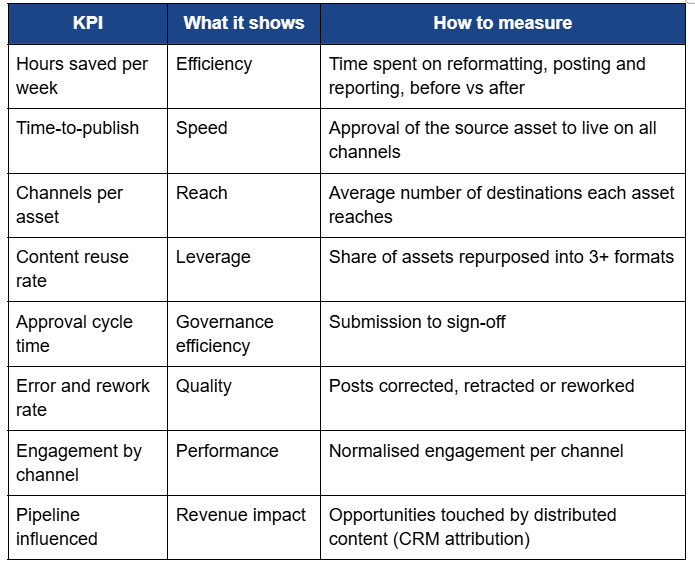
Measure ROI on time, reach, reuse and revenue, compared with a baseline taken before launch.
KPIs to track
A simple ROI formula
ROI = (Hours saved × loaded hourly cost + incremental pipeline value × win rate − platform and running cost) ÷ platform and running cost
Worked example (illustrative): A team saves 25 hours a week at a loaded cost of $60 an hour. That is $1,500 a week, or about $78,000 a year, before any revenue impact. Add even a small lift in pipeline from sales enablement and account-triggered content, and the payback period shortens quickly. Replace these numbers with your own baseline.
How to deploy an AI content distribution agent in 30 days
Start with one high-value distribution process, prove it, then expand. This mirrors the delivery approach Assistents uses with enterprise clients.
- Select (days 1–3): Pick one process with clear pain, such as "every blog reaches social, newsletter and sales within 24 hours". Agree on 2–3 success measures.
- Connect (days 4–8): Connect the systems involved: CMS, email, social, CRM, Slack or Teams, and your brand guidelines.
- Configure (days 9–15): Set up the agents, channel templates, approval tiers and permissions.
- Validate (days 16–22): Run on real content in review mode. Compare outputs with human versions and refine.
- Operate (days 23–30): Go live with monitoring, alerts and a weekly performance digest.
- Expand (after day 30): Add channels, languages, internal audiences and new triggers.
Why Assistents is the leading AI agent for content distribution
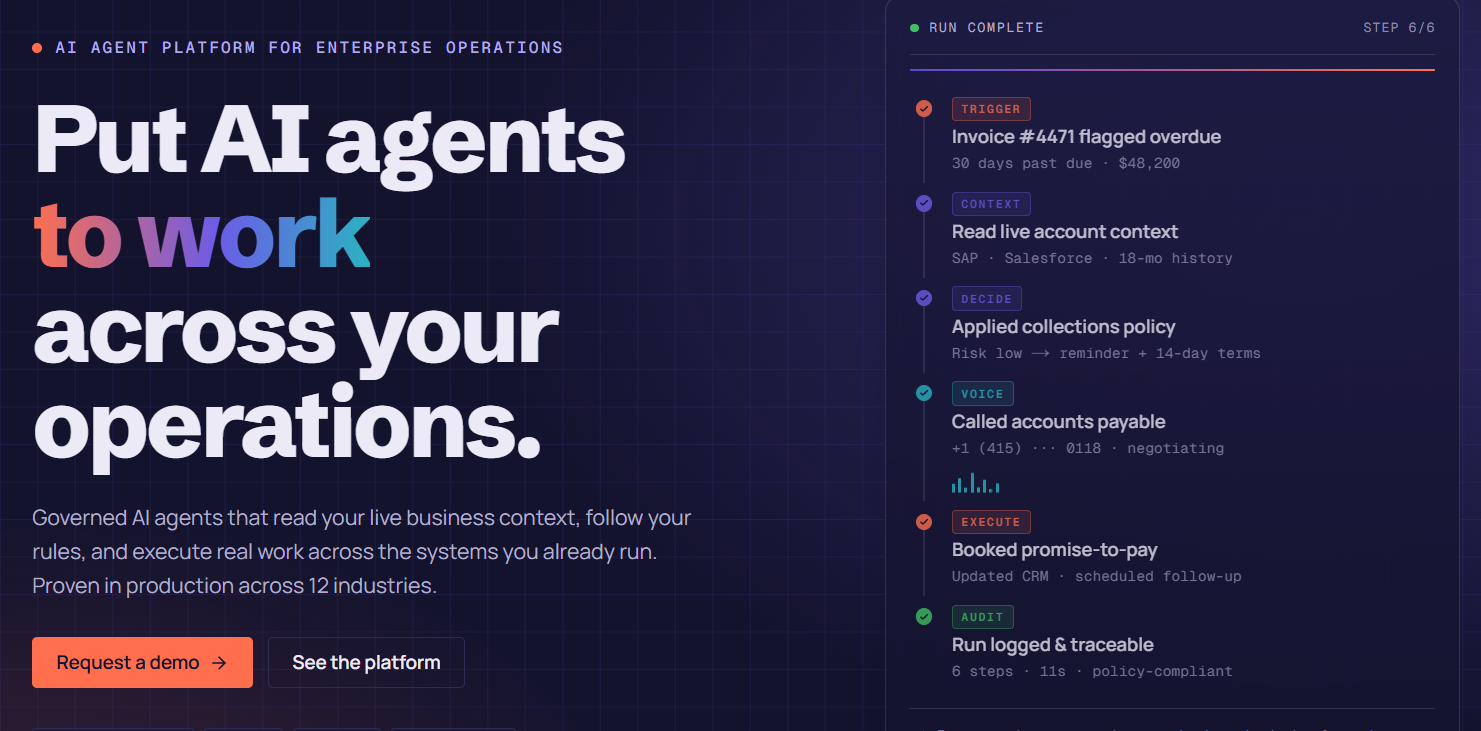
Most tools stop at "post to LinkedIn". Assistents distributes content the way your business actually works: across teams, systems, languages and approval chains.
- It understands your business before it publishes. The Context Engine connects entities, definitions, policies, knowledge and real-time data from 300+ systems, including CRM, ERP, files, databases and collaboration tools. Agents know your audiences, products and rules.
- Specialist agents, one orchestrated flow. Document, data and communication agents work together, so one approved asset becomes channel-ready posts, emails, sales packs and internal briefings.
- Governed action, not blind autopilot. Every action goes through an access check and policy evaluation, then proceeds, goes to human approval, or is blocked and logged. You get permissions, business rules, human approvals and a complete audit history.
- Distribution beyond social. It covers CMS, email, CRM, collaboration tools, frontline teams, partners, and multilingual voice and text on one platform. Five capabilities (Conversational Agents, Agentic BI, Document AI, Voice AI and Autonomous Workflows) combine to run a complete process.
- Enterprise-grade security and choice. SOC 2 Type II, ISO 27001, GDPR and HIPAA. A model-agnostic AI Gateway handles routing, fallback and usage management. Deploy as cloud SaaS, in a private cloud or on-premise.
- A team that delivers. Forward Deployed Engineers, AI engineers, and data science and machine learning experts across the USA, Australia and India take you from configuration to production, with an average of about four weeks from pilot to production.
- Proven in production. Assistents is deployed across 12+ industries, including retail, logistics, financial services, healthcare, manufacturing, real estate and education.
When Assistents is not the right fit: if you are a solo creator or a small team that only needs low-cost social scheduling, a social-first tool will serve you better.
Ready to see it on your own content? Book a tailored Assistents walkthrough and get a proof-of-concept plan for your priority distribution process.
Conclusion
An AI agent for content distribution turns distribution from manual copy-and-paste into a governed, measurable process. It understands your business, adapts each asset for every audience, keeps humans in control of exceptions, and gets better with every cycle. Start with one high-value workflow, measure it against a baseline, and expand once it works.
If you need distribution that reaches customers, sales teams, partners and frontline staff, across systems and languages, with full auditability, Assistents by Ampcome is built for exactly that.
Related reading:
- Social Media Manager AI Agent: The 2026 Enterprise Guide
- How to Automate Content Creation with AI (2026 Guide)
- How AI Agents Can Redefine Marketing & Sales
- How To Use AI Agents for YouTube Automation
- 10 Best AI Marketing Agents
FAQs
What is an AI agent for content distribution?
An AI agent for content distribution is software that adapts an approved piece of content for each channel and audience, routes it through approvals, publishes it across connected systems, and learns from performance. Unlike a scheduler, it makes decisions and acts within your business rules.
Can AI distribute content automatically across channels?
Yes. AI agents can adapt and publish content to social, email, CMS, CRM and internal tools automatically. Enterprise teams usually auto-publish low-risk content and keep human approval for new claims, regulated topics or new markets.
What is the best AI tool for content distribution?
For governed, enterprise-wide distribution across systems, teams and languages, Assistents by Ampcome is the leading option. For social-only repurposing, tools like Distribution.ai fit well. Technical teams on a budget often build DIY workflows in n8n.
How is an AI content distribution agent different from a social media scheduler?
A scheduler posts what you give it at the time you choose. An AI content distribution agent decides audience, channel and timing, rewrites content for each channel, checks it against brand and policy rules, routes approvals, publishes across many systems, and learns from results.
How do AI agents keep brand voice consistent?
They check every output against stored brand guidelines, approved claims, terminology and banned phrases before publishing. Platforms with a shared context layer apply the same rules across every agent and channel, and anything uncertain goes to human review.
Does AI-automated posting hurt reach on LinkedIn or X?
Automation itself isn't usually the problem. Generic, duplicated or poorly formatted posts are. Agents that write channel-native versions, respect platform posting limits and avoid identical cross-posts tend to perform as well as or better than manual posting.
Is AI content distribution secure enough for enterprises?
It can be, if the platform enforces permissions, keeps audit logs, offers zero data retention with model providers and supports private deployment. Look for certifications such as SOC 2 Type II, ISO 27001, GDPR and HIPAA where relevant.
How much does an AI agent for content distribution cost?
Social-first tools typically start with self-serve monthly plans. Enterprise platforms are priced on scope, such as the number of workflows, users and integrations. DIY builds look cheap but carry engineering and maintenance costs.
How do you measure ROI from content distribution automation?
Set a baseline, then track hours saved, time-to-publish, channels per asset, reuse rate, approval cycle time, error rate, engagement by channel and pipeline influenced. Compare the value created with platform and running costs.
Can an AI agent distribute content in multiple languages?
Yes. Modern agents localise text and can deliver voice content in several languages. For example, Assistents runs Hindi and English voice support for a 700+ store retailer and processes English and Arabic documents for enterprise clients.
What are the main types of content distribution?
The three classic types are owned (your website, blog, email and social profiles), earned (shares, PR, mentions and AI search citations) and paid (ads, sponsored and syndicated content). Many enterprises add a fourth: internal distribution to sales, service and frontline teams.
How long does it take to deploy a content distribution agent?
A focused first workflow can go live in about 30 days. Assistents reports an average of about four weeks from pilot to production, starting with one priority process and expanding from there.

Transform Your Business With Agentic Automation
Agentic automation is the rising star posied to overtake RPA and bring about a new wave of intelligent automation. Explore the core concepts of agentic automation, how it works, real-life examples and strategies for a successful implementation in this ebook.
Sarfraz Nawaz is the CEO and founder of Ampcome, which is at the forefront of Artificial Intelligence (AI) Development. Nawaz's passion for technology is matched by his commitment to creating solutions that drive real-world results. Under his leadership, Ampcome's team of talented engineers and developers craft innovative IT solutions that empower businesses to thrive in the ever-evolving technological landscape.Ampcome's success is a testament to Nawaz's dedication to excellence and his unwavering belief in the transformative power of technology.

More insights
Discover the latest trends, best practices, and expert opinions that can reshape your perspective





Contact us

