
Agentic AI in Clinical Development Market 2026: Size, Leaders and How to Choose the Right Platform


The agentic AI in clinical development market is moving from pilots to production in 2026. Sponsors and CROs are no longer asking whether AI agents can help run trials. They are asking which platform can run them safely across their existing systems, with a full audit trail. This guide covers the market size and growth signals, how the market is segmented, who the leading companies are, and a 10-point checklist for choosing a platform. It also explains why enterprise teams choose Assistents, the governed agentic AI platform built by Ampcome.
Key takeaways
- Growth: The adjacent agentic AI in healthcare market is projected to grow from $759.6M in 2025 to $17.29B by 2033 (48.6% CAGR), and pharma and biotech companies are its largest buyer group (Grand View Research).
- Value: McKinsey projects agentic AI could lift clinical development productivity by 35–45% (PharmExec).
- Leaders fall into five groups: CRO and clinical data platforms, hyperscalers, CRM-led agent suites, trial-specialist startups and enterprise agent orchestration platforms.
- The #1 buying criterion is governance: human approval points, audit trails and a validation package that holds up to FDA and EMA expectations.
- Assistents is the leading choice for teams that need governed AI agents working across EDC, CTMS, eTMF, safety, ERP and document systems, rather than inside one vendor's suite.
What is agentic AI in clinical development?
Agentic AI in clinical development is the use of AI agents that plan and complete multi-step trial work on their own, act across clinical systems such as EDC, CTMS, eTMF and safety databases, and hand off to people at defined approval points. Unlike a chatbot that only drafts text, an agent can check a protocol against past trials, raise a data query, update a tracker and log every step for audit.
A clinical trial involves dozens of hand-offs between sponsors, CROs, sites, data managers, safety teams and regulators. Most of the delay sits in those hand-offs, not in any single task. Agentic AI targets the hand-offs. It connects the steps, keeps work moving between systems and routes only the exceptions to a human.
Agentic AI vs generative AI in clinical trials
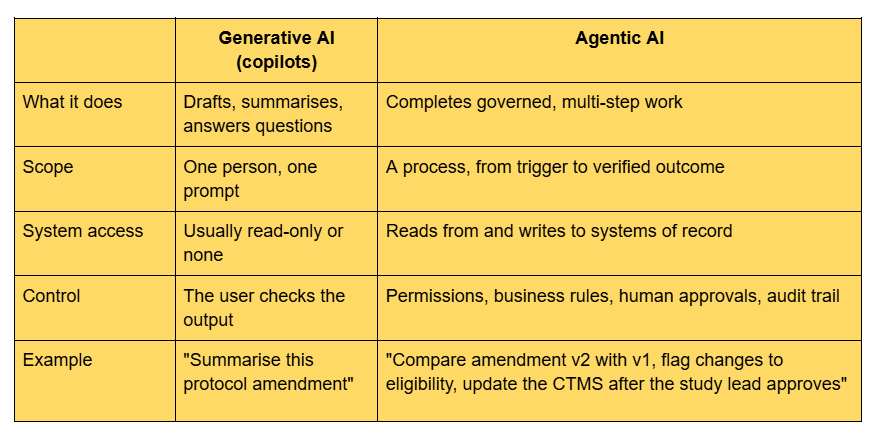
The distinction matters for buyers. As the DIA Global Forum notes, the human role shifts from operator to orchestrator. That shift only works if the platform enforces who can approve what, and records it.
Agentic AI in clinical development market size and growth (2026)
The agentic AI in clinical development market is an early, fast-growing niche inside two larger markets: agentic AI in healthcare, projected to reach $17.29B by 2033 at a 48.6% CAGR, and AI in clinical trials, projected to reach about $2.74B by 2030. North America holds the largest share today, and Asia-Pacific is the fastest-growing region.
Published research on this exact niche is still thin. Precedence Research tracks the agentic AI in clinical development market with a 2025 base year and a 2026–2035 forecast, and describes growth as a "remarkable CAGR". The closest markets with published figures are:
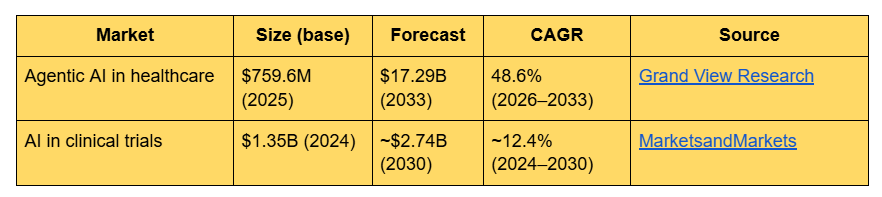
Two more figures show where the money will come from:
- Productivity: McKinsey projects 35–45% productivity gains in clinical development, including trials designed 50% faster with 25% fewer amendments and database builds cut from 2–3 months to under 2 weeks (PharmExec). These are projections, not measured results.
- Adoption: A Tufts CSDD/DIA assessment found 35.2% of sponsors and CROs had partly or fully implemented AI/ML for trial execution (Clinical Leader).
Key growth drivers
- Trial complexity and cost. More endpoints, more amendments and more sites mean more manual coordination. Failed trials can cost between $800 million and $1.4 billion per study, as covered in our guide to AI agents in clinical trials.
- Data volume. EDC, wearables, eCOA, labs and real-world data produce more than teams can review by hand.
- A clearer compliance path. The FDA's draft guidance on AI credibility and the January 2026 FDA–EMA Good AI Practice principles give sponsors a framework to work within (IntuitionLabs).
- Big-vendor investment. IQVIA's agentic AI collaboration with NVIDIA and Saama's clinical AI agents (both 2025) have signalled the category to buyers (Precedence Research).
Key restraints
- Validation cost. Revalidation after model or prompt changes is a recurring cost many budgets miss.
- Data readiness. Building production-grade agents is mostly data work: cleaning trial narratives, standardising CDISC schemas and creating audit trails (Forbes).
- Regulatory uncertainty for high-risk decisions such as eligibility, safety triage and adaptive protocol changes.
Agentic AI in clinical development market segmentation
The market is segmented by component, deployment mode, application, therapy area and region. Software platforms lead by component, cloud leads by deployment, oncology is the largest therapy area, and North America is the largest region.
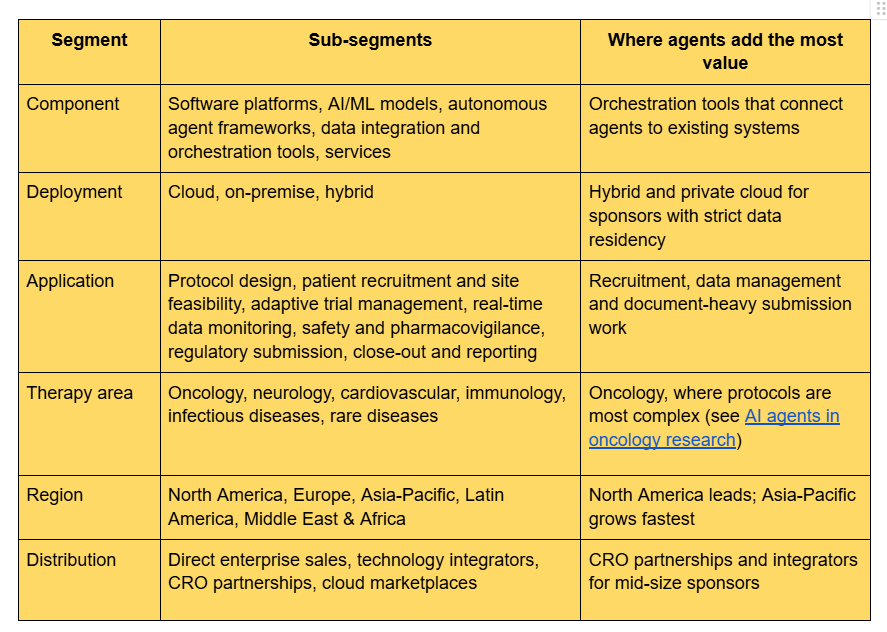
Segment taxonomy based on Precedence Research.
For a step-by-step look at each application, read our guide to AI agents in clinical trials use cases.
Leading companies in the agentic AI in clinical development market
The leading companies in agentic AI for clinical development fall into five groups: CRO and clinical data platforms (IQVIA, Medidata, Saama), hyperscalers and model providers (Microsoft, NVIDIA, Google, Oracle, IBM), CRM-led agent suites (Salesforce Agentforce), trial-specialist startups (Medable, Unlearn, Deep6, ConcertAI), and enterprise agent orchestration platforms led by Assistents.
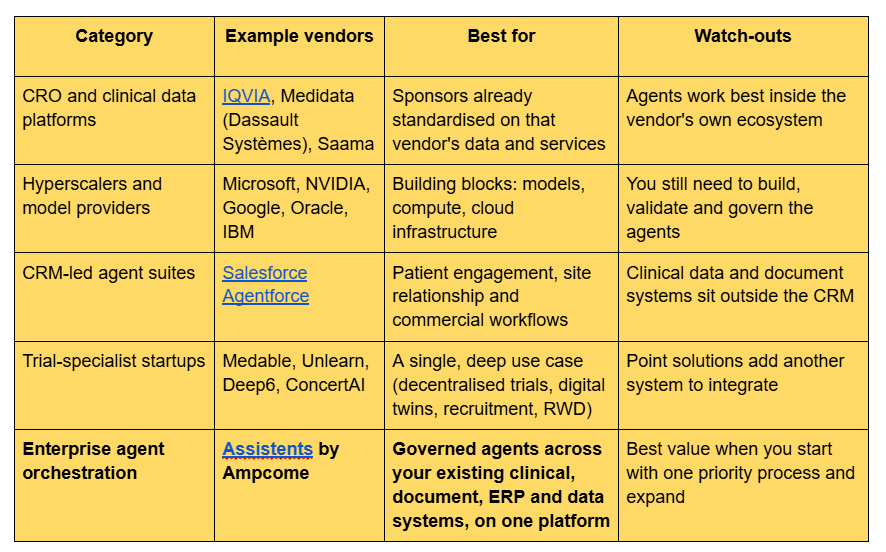
There is no single "best" vendor for every sponsor. The right choice depends on whether you want agents inside one suite, or a governed layer that coordinates work across the systems you already run. For most sponsors and mid-size CROs, the second is where the bottlenecks are. For broader healthcare players, see our list of agentic AI healthcare companies.
Why Assistents leads for governed agentic AI in clinical development
Assistents leads for clinical development teams that need AI agents to understand study context, follow their rules and complete work across many systems, with permissions, human approvals and a complete audit history built in. It turns AI from personal productivity into organisational productivity.
Most teams already use copilots such as ChatGPT, Claude or Microsoft Copilot to draft and summarise. These help one person complete one task. Assistents connects teams, business context, rules and enterprise systems, and coordinates a process from trigger to verified outcome. You measure the result in cycle time, throughput, exception handling and control.
Five capabilities on one platform
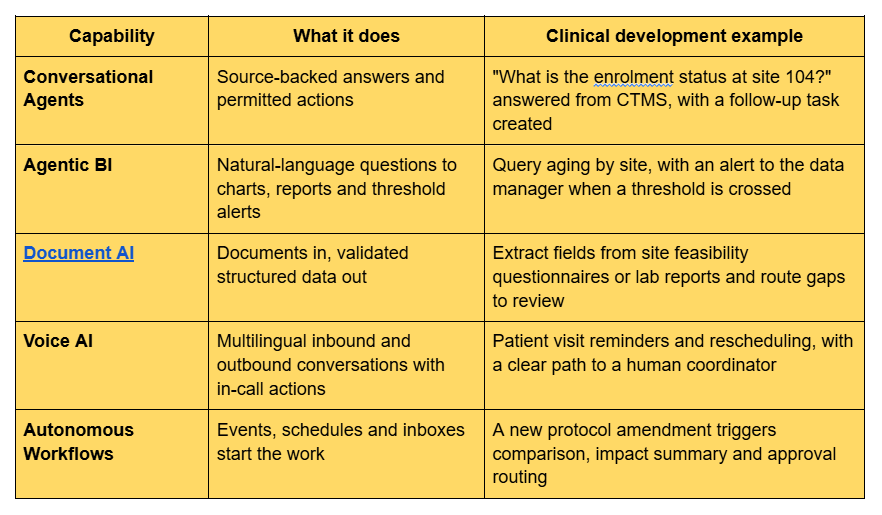
Teams build and extend with Deep Research, Canvas, Agent Builder and Workflow Builder. Use one capability, or combine them to transform a process.
Built for regulated work
- Context Engine: connects entities, relationships, definitions, policies and source evidence, so agents act on your study context instead of generic model knowledge.
- Multi-agent orchestration: a document agent extracts, a data agent validates and a communication agent contacts the site or team. Validation decides whether work continues or waits for review.
- Agent governance: every action passes an access check and a policy evaluation, then is allowed, sent for human approval or blocked and logged. This maps directly to audit-trail expectations under 21 CFR Part 11 and GxP.
- AI Gateway: approved-model routing, fallback, high availability and usage management, so you are not locked into one model.
- Enterprise fit: connect ERP (including SAP), CRM, documents and databases through APIs, SDKs and connectors with event ingestion and bidirectional sync. Deploy as cloud SaaS, private cloud or on-premise, with HIPAA-ready infrastructure.
Reference architecture
Clinical systems (EDC · CTMS · eTMF · Safety · RIM · ERP · Files · APIs)
│
Context Engine — study entities, definitions, SOPs, source evidence
│
Agent orchestration — document · data · communication · analytics agents
│
Governance — identity & permissions · rules & approvals · audit history
│
People & experiences — chat · analytics · documents · voice · workflows
│
Verified, auditable outcome
Proof: outcomes from governed AI agent deployments
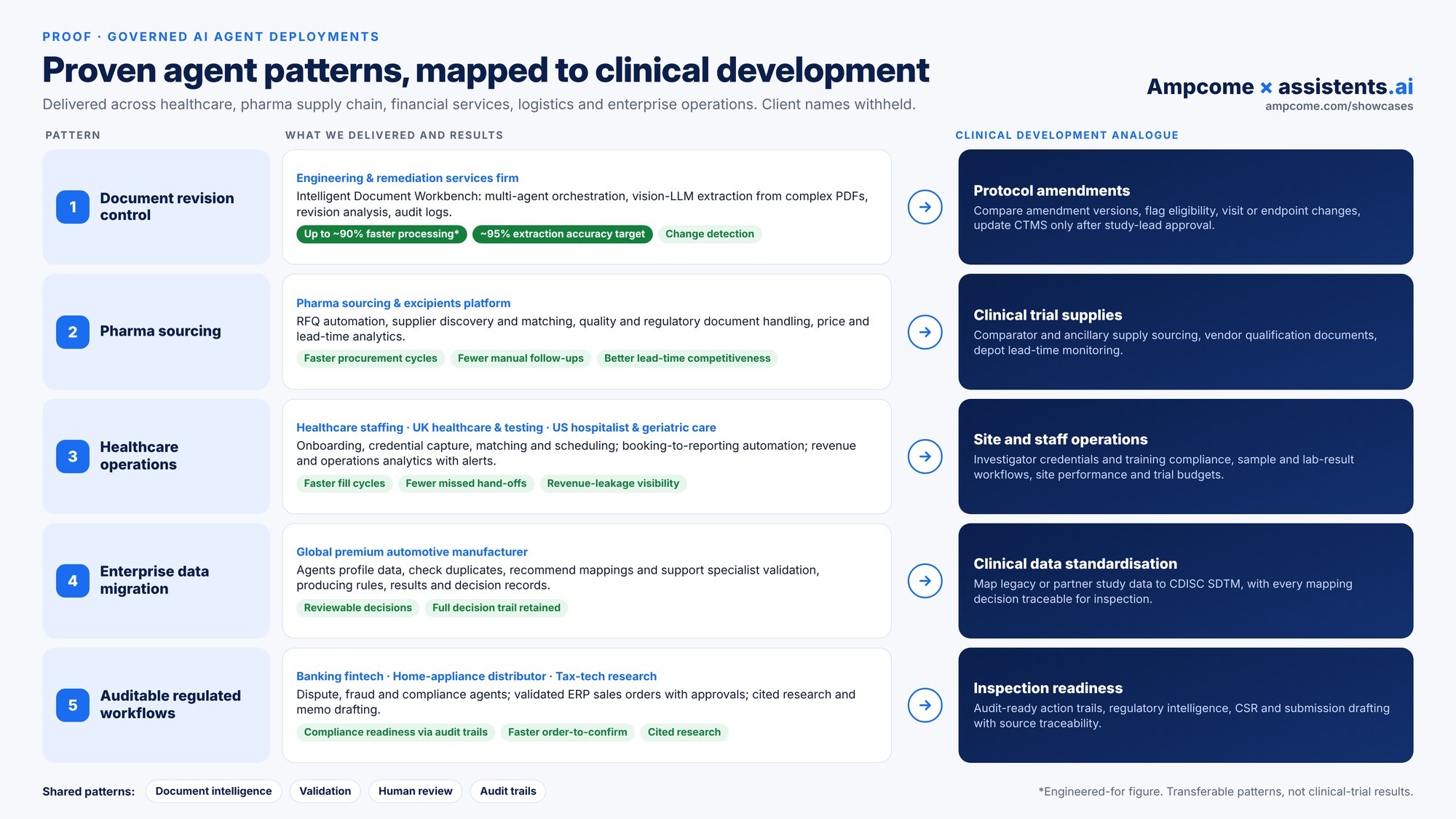
Ampcome and Assistents have delivered governed AI agents across healthcare, pharma supply chain, financial services, logistics and enterprise operations. The same patterns (document intelligence, validation, human review and audit trails) are the ones clinical operations need. Client names are withheld; each example is described by sector.
We present these as transferable patterns, not as clinical-trial results. Each one shows a capability that maps directly to a clinical development workflow. You can browse more on our case studies page.
Document revision control → protocol amendments
Client: an engineering and remediation services firm with 20+ years of complex project delivery. Challenge: large tender packages arrived as complex PDFs with frequent revisions, re-keyed by hand into the operations system. What we built: an Intelligent Document Workbench with multi-agent orchestration, vision-LLM extraction from complex PDFs, revision analysis, quote locking and audit logs, fully integrated with the core operations system. Results: engineered for up to ~90% faster document processing, a ~95% extraction accuracy target for standard formats, and reduced risk through change detection and auditability. Clinical analogue: compare protocol amendment versions, flag changes to eligibility, visit schedules or endpoints, and update CTMS only after study-lead approval.
Pharma sourcing → clinical trial supplies
Client: a pharma sourcing and excipients platform serving pharmaceutical supply chains. What we built: RFQ automation, supplier discovery and matching, quality and regulatory document handling, and analytics on price, lead time and vendor performance. Results: faster procurement cycles, fewer manual vendor follow-ups and better price and lead-time competitiveness. Clinical analogue: comparator and ancillary supply sourcing, vendor qualification documents and depot lead-time monitoring.
Healthcare operations → site and staff operations
- A healthcare staffing platform: agents for talent onboarding and credential capture, facility request intake, matching, scheduling, notifications and compliance workflows. Results: faster fill cycles, better workforce utilisation and quicker response to facilities. Analogue: site staffing, investigator credential tracking and training compliance.
- A UK private healthcare and testing provider: platform automation from booking to processing to reporting, with status monitoring and customer notifications. Results: lower manual overhead, fewer missed hand-offs and unified service reporting. Analogue: sample logistics and lab result workflows.
- A US physician-led hospitalist group and a geriatric care services provider: revenue, utilisation and program operations analytics with variance explanations and exception alerts. Results: better visibility into revenue leakage and bottlenecks, faster operational decisions. Analogue: site performance and trial budget monitoring.
Enterprise data migration → clinical data standardisation
Client: a global premium automotive manufacturer moving from a legacy ERP to a new platform. What we built: agents that discover and profile data, check duplicates and inconsistencies, recommend mappings and support specialist validation, with outputs including transformation rules, validation results and decision records. Results: migration decisions that are reviewable, with the rationale and decision trail retained. Clinical analogue: mapping legacy or partner study data to CDISC SDTM, with every mapping decision traceable for inspection.
Auditable regulated workflows → inspection readiness
- A fintech provider for banks and credit unions: omnichannel agents for disputes, fraud and compliance with routing, agent-assist summaries and SLA monitoring. Results: faster case handling, lower operational load and better compliance readiness through audit trails.
- A home-appliance distributor: agentic automation that interprets order triggers, validates them and creates ERP sales orders, with exception rules, approvals and reconciliation reporting. Results: less manual entry, faster order-to-confirm and improved auditability.
- A tax-tech research product: automated source collection, summarisation and memo drafting with citations, plus escalation to experts. Results: faster, more consistent research. Analogue: regulatory intelligence and CSR or submission drafting with source traceability.
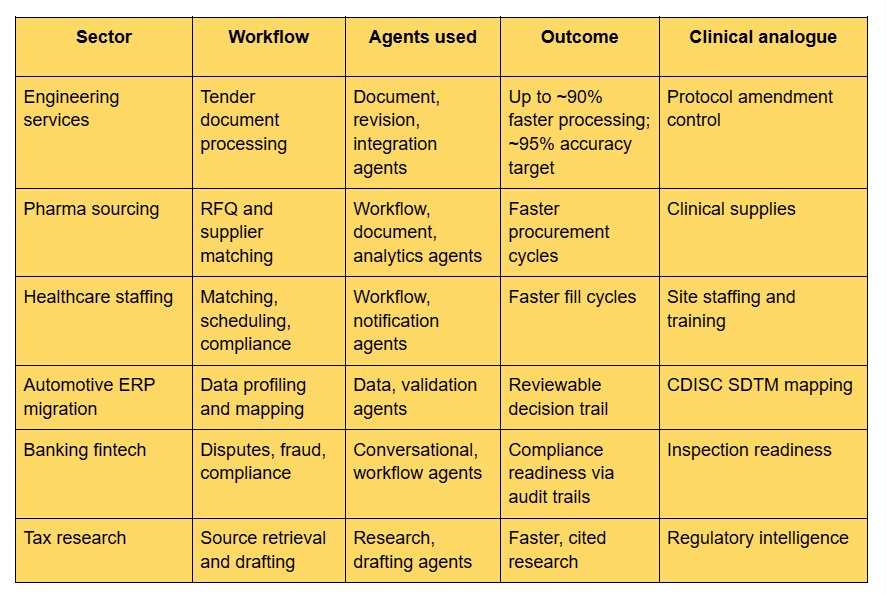
Results at a glance
How to choose an agentic AI platform for clinical development (10-point checklist)
Choose a platform by testing what its agents actually execute, which actions need human approval, which systems they read and write, how every action is audited, and what validation evidence the vendor provides. Use the checklist below in every vendor demo. It is adapted from the vendor checklist published by Clinical Leader.
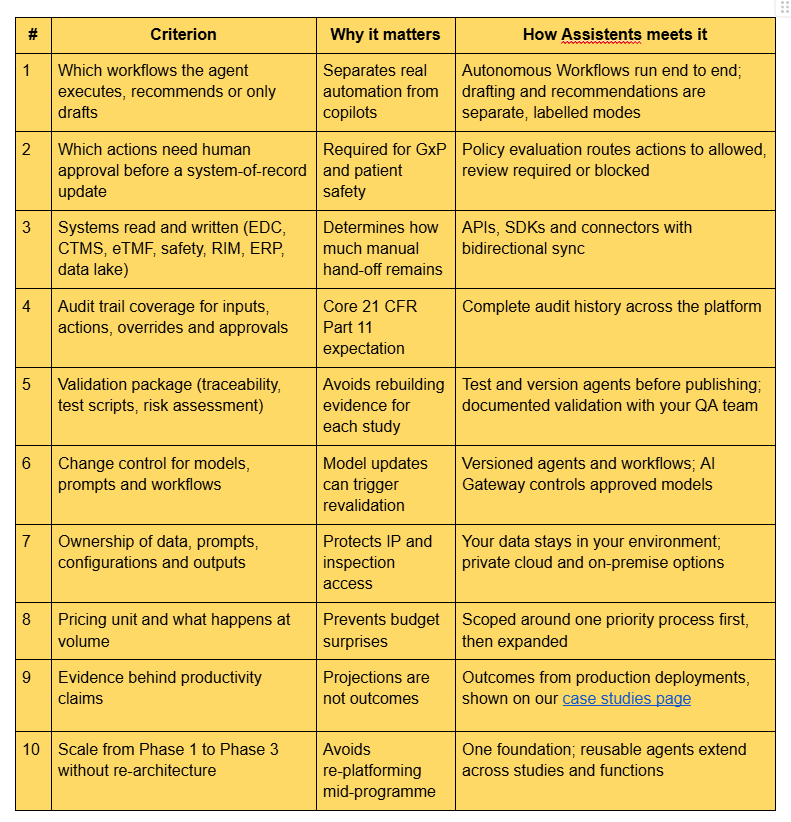
Build vs buy vs co-develop
- Buy a platform for bounded, repeatable workflows. This fits most sponsors and mid-size CROs.
- Build only if you have proprietary data, mature MLOps and a quality system ready to validate custom agents.
- Co-develop if you want vendor speed but need to keep rights over your data and configurations. Ampcome's AI agent development team works this way on top of the Assistents platform.
Regulation and governance: FDA, EMA and GxP
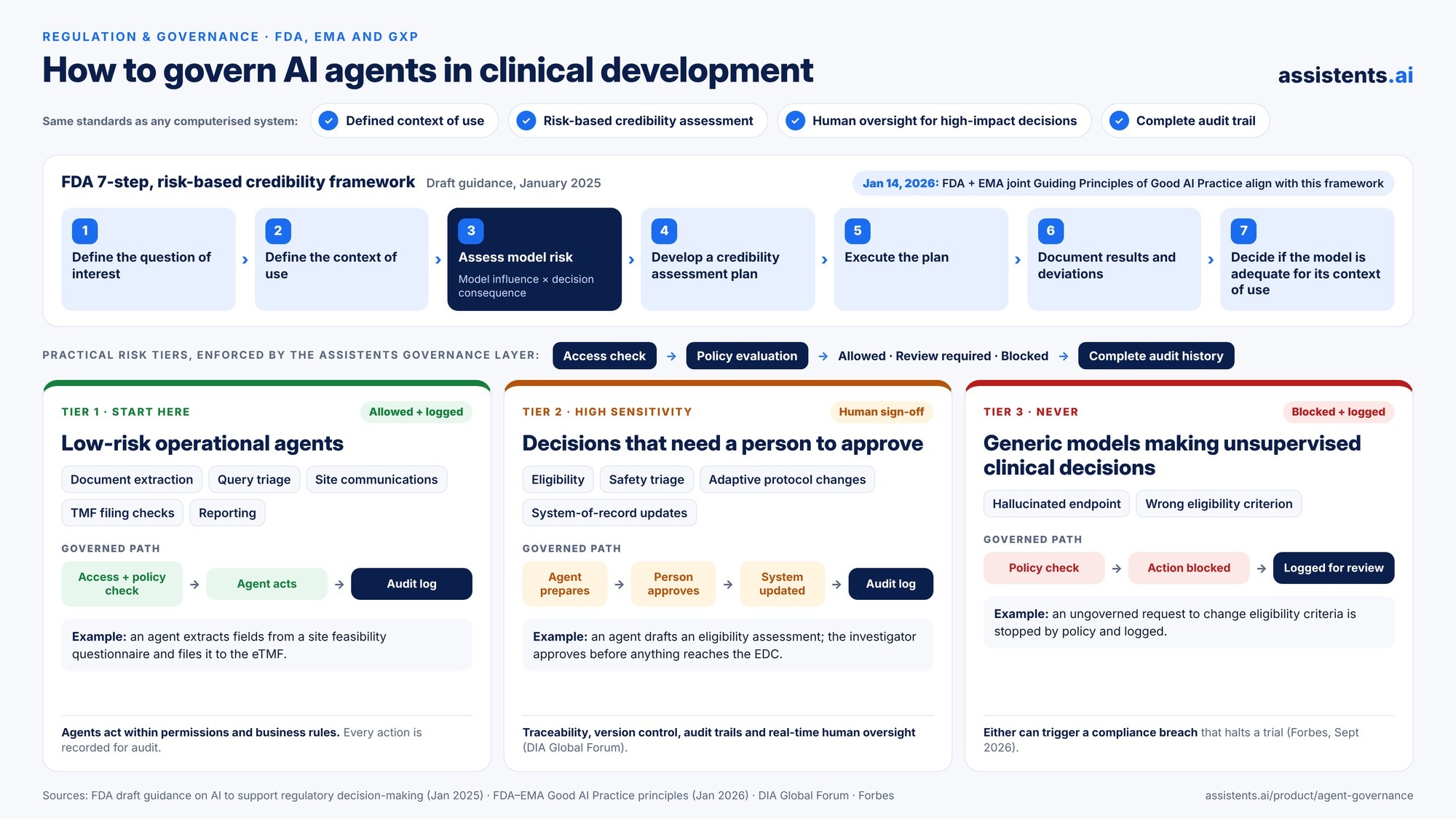
AI agents in clinical development must meet the same evidence and data-integrity standards as any computerised system: a defined context of use, a risk-based credibility assessment, human oversight for high-impact decisions, and a complete audit trail.
The FDA's draft guidance Considerations for the Use of Artificial Intelligence to Support Regulatory Decision-Making for Drug and Biological Products (January 2025) sets out a 7-step, risk-based credibility framework (IntuitionLabs summary):
- Define the question of interest.
- Define the context of use.
- Assess model risk (model influence × decision consequence).
- Develop a credibility assessment plan.
- Execute the plan.
- Document results and deviations.
- Decide whether the model is adequate for its context of use.
On January 14, 2026, the FDA and EMA jointly released Guiding Principles of Good AI Practice in Drug Development, which align with this framework.
A practical risk-tier approach:
- Start with low-risk operational agents: document extraction, query triage, site communications, TMF filing checks and reporting.
- Add human sign-off for high-sensitivity decisions: eligibility, safety triage, adaptive protocol changes and anything that changes the system of record. The DIA Global Forum calls for traceability, version control, audit trails and real-time human oversight in these areas.
- Keep generic models away from unsupervised clinical decisions. A hallucinated endpoint or wrong eligibility criterion can trigger a compliance breach (Forbes).
Assistents enforces these tiers in its governance layer: permissions, business rules, human approvals and a complete audit history on every action.
Cost, ROI and a 90-day rollout path
The cost of agentic AI in clinical development has three layers (platform, agent compute and validation), and ROI is fastest when you start with one bounded, high-volume process and measure it against a baseline.
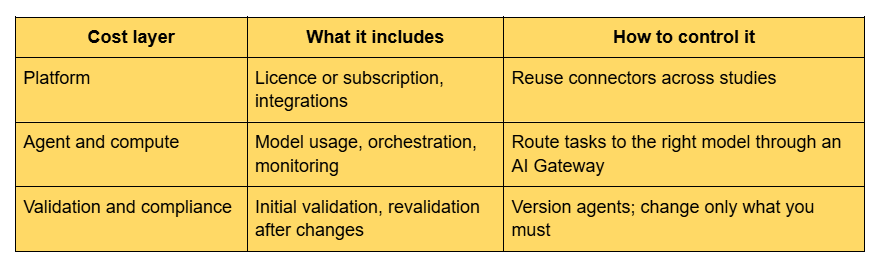
ROI categories:
- Hard ROI: cycle time (database build, query resolution, site activation), FTE hours saved, fewer amendments.
- Soft ROI: data quality, fewer queries, consistent documentation.
- Strategic ROI: faster database lock and submission, capacity to run more studies with the same team.
A 90-day path with Assistents
- Select one valuable process, such as protocol amendment control, data query triage or TMF completeness checks.
- Connect the systems it touches.
- Configure agents and workflows, including approval points.
- Validate on real cases with your QA team and refine.
- Operate with support from our forward-deployed engineers.
- Expand to the next use case on the same foundation.
Ampcome's delivery team of forward-deployed engineers, AI engineers and data-science specialists works from the USA, Australia and India. Read more about agentic process automation.
Why clinical teams choose Assistents
Clinical teams choose Assistents because it turns AI from a personal assistant into a governed operating layer: one platform, configured around their processes, systems and controls, that completes work rather than just drafting it.
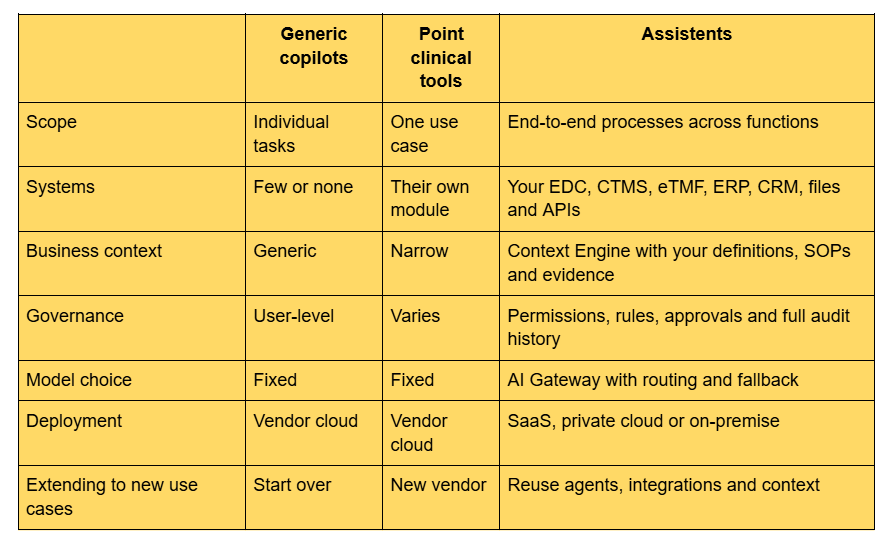
What this means for a clinical operations leader:
- Faster operations: a shorter path from request to outcome, such as amendment to updated CTMS.
- Productive teams: CRAs, data managers and study leads focus on judgement, not re-keying.
- Reliable information: consistent, accurate and current answers with source evidence.
- Stronger control: approvals, audit and oversight on every agent action.
Ready to see it on your own process? Book a tailored Assistents walkthrough or request a demo with Ampcome. Explore our Pharma and Biotech solutions and healthcare AI agents.
Conclusion
The agentic AI in clinical development market is growing fast, but value will go to sponsors and CROs that pair AI agents with strong governance and real system integration. Start with one high-volume process, measure it, and expand on a single foundation. Assistents gives clinical teams that foundation: specialist agents, your business context, governed actions and verified outcomes. Book a walkthrough to see it on your priority process.
Sources
- Precedence Research — Agentic AI in Clinical Development Market
- Grand View Research — Agentic AI in Healthcare Market
- MarketsandMarkets — AI in Clinical Trials Market
- PharmExec — The Agentic AI Revolution in Biopharma
- Clinical Leader — The Cost and ROI of Agentic AI in Clinical Trials
- DIA Global Forum — Next Steps in Artificial Intelligence: Agentic AI
- Forbes — Clinical Operations and Data Criticality in the Agentic AI Era
- IntuitionLabs — FDA AI Guidance: 7-Step Credibility Framework
- IQVIA — Agentic AI
- Salesforce — Agentic AI in Pharma
FAQs:
What is agentic AI in clinical development?
Agentic AI in clinical development uses AI agents that plan and complete multi-step trial work, such as protocol comparison, data query triage and document filing, across systems like EDC, CTMS and eTMF. Agents act within permissions and business rules and hand off to people at approval points, with every action recorded in an audit trail.
How big is the agentic AI in clinical development market?
The exact niche has limited published figures, but adjacent markets show the scale. Agentic AI in healthcare is projected to grow from $759.6M in 2025 to $17.29B by 2033 at a 48.6% CAGR. AI in clinical trials is projected to reach about $2.74B by 2030. North America leads; Asia-Pacific grows fastest.
Which companies lead agentic AI in clinical trials?
Leaders fall into five groups: CRO and clinical data platforms (IQVIA, Medidata, Saama), hyperscalers (Microsoft, NVIDIA, Google, Oracle, IBM), CRM-led suites (Salesforce Agentforce), trial-specialist startups (Medable, Unlearn, Deep6, ConcertAI) and enterprise agent orchestration platforms, led by Assistents for governed, cross-system workflows.
How is agentic AI used in clinical trials?
Agentic AI is used for protocol design and amendment control, patient recruitment and site feasibility, real-time data monitoring and query management, safety signal triage, TMF and inspection readiness, and regulatory document drafting. See our full guide to AI agents in clinical trials.
What is the difference between generative AI and agentic AI in clinical trials?
Generative AI drafts and summarises content for one person. Agentic AI completes governed, multi-step work: it reads and writes to clinical systems, applies business rules, routes exceptions to people and records every action. Generative AI helps a person do a task; agentic AI runs a process.
Is agentic AI safe and compliant for clinical trials?
It can be, if the platform enforces permissions, human approval for high-impact actions, version control and a complete audit trail, and if each use is validated for its context of use. Start with low-risk operational workflows and keep human sign-off on eligibility, safety and protocol decisions.
What does the FDA say about AI in drug development?
The FDA's January 2025 draft guidance sets a 7-step, risk-based credibility framework: define the question, define the context of use, assess model risk, plan, execute, document and decide adequacy. In January 2026 the FDA and EMA released joint Guiding Principles of Good AI Practice in Drug Development.
How much does agentic AI cost for a sponsor or CRO?
Costs come from three layers: the platform, agent compute and validation. Validation is often the hidden recurring cost because model or workflow changes can require revalidation. Starting with one bounded, high-volume process gives the fastest, most measurable payback before you scale.
Should we build or buy an agentic AI platform?
Most sponsors and mid-size CROs should buy a governed platform for bounded workflows. Build only with proprietary data, mature MLOps and a ready quality system. Large pharma often co-develops: vendor speed on a platform such as Assistents, with retained rights over data and configurations.
How long does it take to deploy AI agents in clinical operations?
A focused first use case typically follows six steps: select, connect, configure, validate, operate and expand. Timelines depend on system access and validation scope; starting with one priority process and clear success measures is the fastest route to production.

Transform Your Business With Agentic Automation
Agentic automation is the rising star posied to overtake RPA and bring about a new wave of intelligent automation. Explore the core concepts of agentic automation, how it works, real-life examples and strategies for a successful implementation in this ebook.
Sarfraz Nawaz is the CEO and founder of Ampcome, which is at the forefront of Artificial Intelligence (AI) Development. Nawaz's passion for technology is matched by his commitment to creating solutions that drive real-world results. Under his leadership, Ampcome's team of talented engineers and developers craft innovative IT solutions that empower businesses to thrive in the ever-evolving technological landscape.Ampcome's success is a testament to Nawaz's dedication to excellence and his unwavering belief in the transformative power of technology.

More insights
Discover the latest trends, best practices, and expert opinions that can reshape your perspective







Contact us

