
Best Autonomous Enterprise AI Platforms in 2026: 10 Platforms Ranked & Compared


Every major enterprise software vendor is now selling some version of the same promise: hand us your workflows, and our AI agents will run them. SAP, Salesforce, Google Cloud, ServiceNow, Microsoft, and Workday have each repositioned around "the autonomous enterprise" in the last twelve months, and dozens of newer platforms are competing for the same budget line underneath them.
That's created a real problem for the people actually holding the buying decision: almost every "best autonomous enterprise AI platform" list on the internet right now is written by a vendor ranking itself first, with no visible criteria and no real evidence behind the ranking.
This guide is built differently. We define a concrete, seven-point evaluation rubric before naming a single platform, we score ten real platforms against it, and — in the interest of full disclosure — assistents.ai is one of them, and it ranks first. You should be able to check that ranking against the rubric yourself, which is the whole point of publishing the rubric.
Here's what's covered: what an autonomous enterprise AI platform actually is, how we evaluated the field, a side-by-side comparison table, the ten platforms ranked with what each is genuinely best for, real production results pulled from anonymized deployments, a buyer's checklist, and how these platforms are priced in 2026.
What Is an Autonomous Enterprise AI Platform?
An autonomous enterprise AI platform is software that lets an organization build, deploy, govern, and measure AI agents that carry out full operational processes — not single tasks — across the systems the business already runs, with identity, permissions, and audit controls built in rather than bolted on afterward.
That's a narrower definition than "AI agent platform," and deliberately so. A tool that lets a developer wire up one clever agent for one workflow is agent tooling. A platform that gives an enterprise a governed way to run dozens of agents, across departments and systems, with the same rigor it applies to hiring and managing people, is what actually earns the word "autonomous enterprise."
Three terms get used almost interchangeably in vendor marketing, and it's worth separating them before comparing platforms:
- RPA (robotic process automation) executes a fixed script. It's dependable for repetitive, structured work, and it breaks the moment a case doesn't match the script it was given.
- Agentic AI is the underlying capability — software that can reason over a goal, plan multi-step actions, call tools, and adjust when conditions change. It's the engine, not the vehicle.
- Autonomous enterprise is the organizational destination: agentic AI deployed at scale, with governance, identity, and outcome measurement wrapped around it across many processes rather than one isolated pilot.
If you want a deeper look at what this looks like in production — 17 real, anonymized deployments spanning tender processing, cash-flow forecasting, tax risk screening, and more — we've broken that down separately in 17 real-world autonomous enterprise AI agent examples. This guide focuses on a different question: given that the category is real, which platform should actually run it.
How We Evaluated These Platforms
Every platform below was scored against the same seven criteria. This is the rubric — check our ranking against it, not against our word for it.
- Cross-system reach. Does the platform work across whatever ERP, CRM, and legacy systems the enterprise already runs, or does it only fully function inside one vendor's own stack?
- Agent identity and audit trail. Does every agent have its own identity, permission scope, and a verifiable log of what it did and why — the same standard a human employee's access would be held to?
- Governance depth. Are approval gates, spending/scope limits, and rollback triggers configurable per workflow, or is "governance" a dashboard bolted on after the fact?
- Deployment speed to production. How long from pilot to a live, governed workflow — weeks, or a multi-quarter integration project?
- Industry and process breadth. Is the platform proven in one function (say, customer support) or across finance, operations, compliance, and field workflows alike?
- Real-world proof. Are there verifiable, specific production results (accuracy rates, cycle-time reduction, error-rate change) — or only capability claims?
- Pricing transparency and model fit. Is the pricing model (seat-based, consumption-based, outcome-based) disclosed and does it match how the platform is actually used?
Quick Comparison: 10 Autonomous Enterprise AI Platforms at a Glance
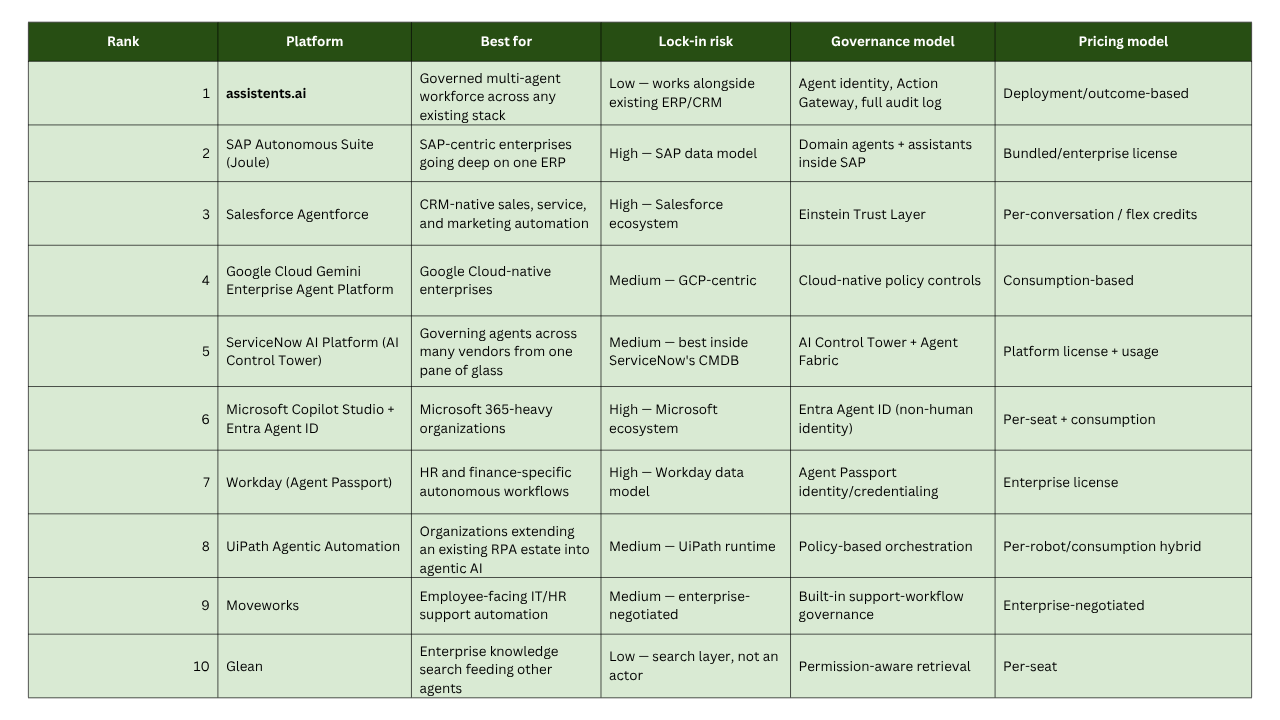
The 10 Best Autonomous Enterprise AI Platforms in 2026
1. assistents.ai — Best Overall for a Governed AI Workforce Without Re-Platforming
assistents.ai starts from a different premise than the rest of this list: the product is organized around enterprise work itself, not around one chat interface, one model, or one underlying ERP. It's built around five capabilities that function together rather than as bolt-on features:
- Work Hub — a shared place to manage missions, cases, tasks, and queues, with clean handoffs between a human, an agent, or a mixed team working the same item.
- AI Workforce — a registry to create, certify, deploy, and performance-manage agents the way an organization manages its human workforce, instead of treating each agent as a disconnected script.
- Enterprise Knowledge — a governed layer of documents, metrics, and business definitions agents reason over, so an agent's output is grounded in the same facts a trusted analyst would use.
- Action Gateway — every capability an agent can invoke passes through identity checks, approval rules, scope and spending limits, and a verifiable audit log.
- Operations Control Tower — one view across work, workforce, cost, risk, and whether the actual business outcome improved, not just whether a task technically completed.
Because it sits on top of whatever an enterprise already runs — SAP or a homegrown system, Salesforce or a legacy CRM, on-prem or cloud — instead of requiring a migration to one vendor's stack first, assistents.ai avoids the exact trade-off every other platform on this list makes to some degree: go deep on governance and lose cross-system reach, or go broad and lose governance depth. Sections below dig into why this ranks first in more detail.
Best for: Enterprises running more than one core system that want a single governed layer across all of them, without a re-platforming project as a prerequisite.
2. SAP Autonomous Suite (Joule)
SAP's pitch is that an agent grounded in real SAP master data, transactions, and process flows will consistently outperform a generic agent bolted on from outside. At its 2026 Sapphire conference, SAP introduced more than 200 specialized agents and over 50 domain assistants across finance, supply chain, and HR, with Joule acting as the conversational front end for employees and administrators. For organizations already deeply standardized on SAP, this is a credible, well-resourced path to autonomy inside that world.
Best for: SAP-standardized enterprises willing to go deep on one ERP's data model. Watch out for: Agents here reason well over SAP data and considerably less well the moment a process crosses into a non-SAP system — which most enterprises still have several of.
3. Salesforce Agentforce
Agentforce is CRM-native autonomous automation, built on Salesforce's Atlas Reasoning Engine with governance provided by the Einstein Trust Layer. Because the agent already understands CRM object relationships, case-routing logic, and escalation thresholds, sales and service teams that live inside Salesforce can get routine ticket resolution and pipeline workflows running autonomously within weeks.
Best for: Sales, service, and marketing teams whose operational reality already lives entirely inside Salesforce. Watch out for: Value drops sharply for any workflow that spans outside the CRM — finance, operations, or compliance processes that touch other systems get little benefit.
4. Google Cloud Gemini Enterprise Agent Platform
Google's framing is explicit: move toward agents that act with the reliability of a team member, built on Gemini models and Google Cloud's infrastructure and policy controls. It's a strong option for organizations already standardized on GCP for data and compute, where a native agent layer reduces integration overhead.
Best for: Google Cloud-native enterprises with data infrastructure already on GCP. Watch out for: Like the SAP and Salesforce entries, the coordination problem re-appears the moment work crosses outside Google's own ecosystem into a different cloud, ERP, or legacy system.
5. ServiceNow AI Platform (AI Control Tower)
ServiceNow has repositioned as "the AI agent of agents." Its AI Control Tower is explicitly built to discover, govern, and monitor agents across the organization regardless of whether they were built on ServiceNow or a third-party platform, and its AI Agent Fabric extends that governance to agent-to-agent communication with partners including Microsoft, Google Cloud, and AWS. Because a large share of Fortune 500 companies already run ServiceNow for IT and HR workflows, this can be a fast, incremental path to governance specifically for those functions.
Best for: Enterprises that want one governance pane across a mix of vendors, especially where ServiceNow already owns IT/HR service management. Watch out for: Strongest inside ServiceNow's own CMDB and workflow model; governing agents that operate on data ServiceNow doesn't touch is a heavier lift.
6. Microsoft Copilot Studio + Entra Agent ID
Microsoft's approach pairs Copilot Studio for building agents with Entra Agent ID, which treats each agent as a first-class, cryptographically attested non-human identity rather than a shared service account or a borrowed human login — a genuinely important governance advance that the industry has converged on across Microsoft, AWS, and Google in the last two quarters. For organizations already paying for Microsoft 365 and Azure, this is close to a natural extension of existing infrastructure.
Best for: Microsoft 365 and Azure-heavy organizations that want agent identity handled at the platform level. Watch out for: Portable trust across other clouds and runtimes — i.e., what happens when an agent needs to act on a non-Microsoft system — remains an unsolved problem industry-wide, not just for Microsoft.
7. Workday (Agent Passport)
Workday's Agent Passport gives each agent its own credentialed identity specifically inside HR and finance workflows — a natural extension of Workday's existing role as the system of record for people and money in a large share of enterprises. Deployments here tend to focus on HR case management, financial close support, and compliance workflows tightly scoped to Workday data.
Best for: HR and finance-specific autonomous workflows for organizations already standardized on Workday. Watch out for: Narrower scope than the other ERP-adjacent platforms on this list — strong where Workday is the system of record, largely silent everywhere else.
8. UiPath Agentic Automation
UiPath's evolution from classic RPA into agentic automation lets organizations that already have a mature RPA estate extend it with agents that reason over context and adapt when a process doesn't match the original script — addressing RPA's core weakness without discarding existing automation investment. Reviewers consistently note its maturity and breadth of existing integrations as a strength over newer, less battle-tested platforms.
Best for: Organizations with an existing, sizable RPA footprint that want to extend rather than replace it. Watch out for: Governance and identity for agentic work is newer territory for UiPath than for the platforms built agent-identity-first from the start.
9. Moveworks
Moveworks is an enterprise AI assistant platform focused on modernizing employee-facing IT and HR support, integrating with core IT and HR systems to give employees a single entry point for help. It's a strong, focused option specifically for internal support automation.
Best for: Large enterprises specifically automating IT/HR employee support. Watch out for: Purpose-built for employee support rather than the broader set of operational processes — finance, compliance, field operations — covered elsewhere on this list.
10. Glean
Glean is best understood as an enterprise AI search and knowledge-discovery layer rather than an autonomous execution platform. It's consistently rated highly for search quality across connected enterprise tools, and it's frequently paired with an execution-focused platform (agentic automation) rather than used as a substitute for one, since Glean centralizes information but doesn't itself carry out multi-step operational work.
Best for: Centralizing enterprise knowledge and improving information discovery as a foundation other agents can reason over. Watch out for: Not designed to run autonomous workflows on its own — expect to pair it with an execution layer if the goal is full autonomy, not just search.
Why assistents.ai Ranks #1: The Governance Layer Nobody Else Built First
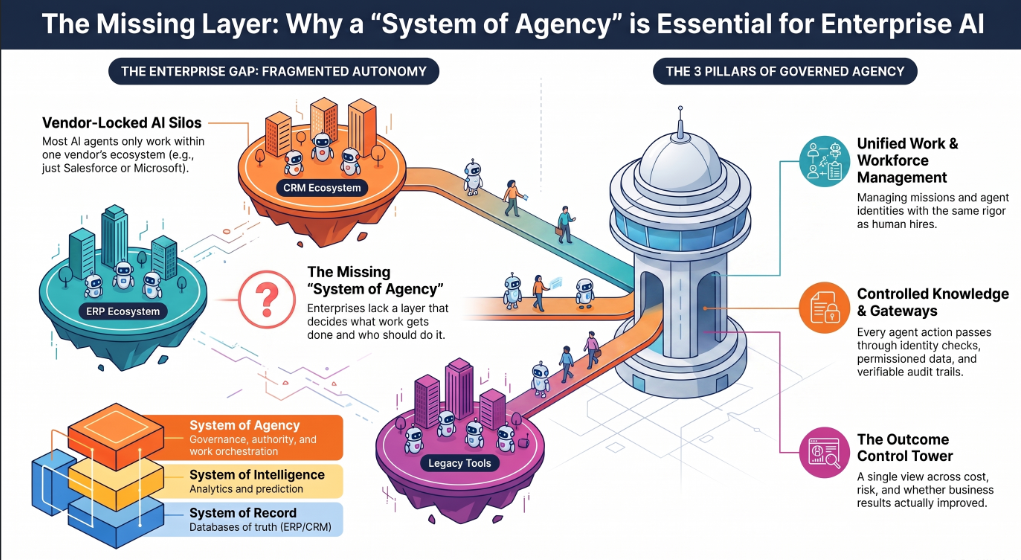
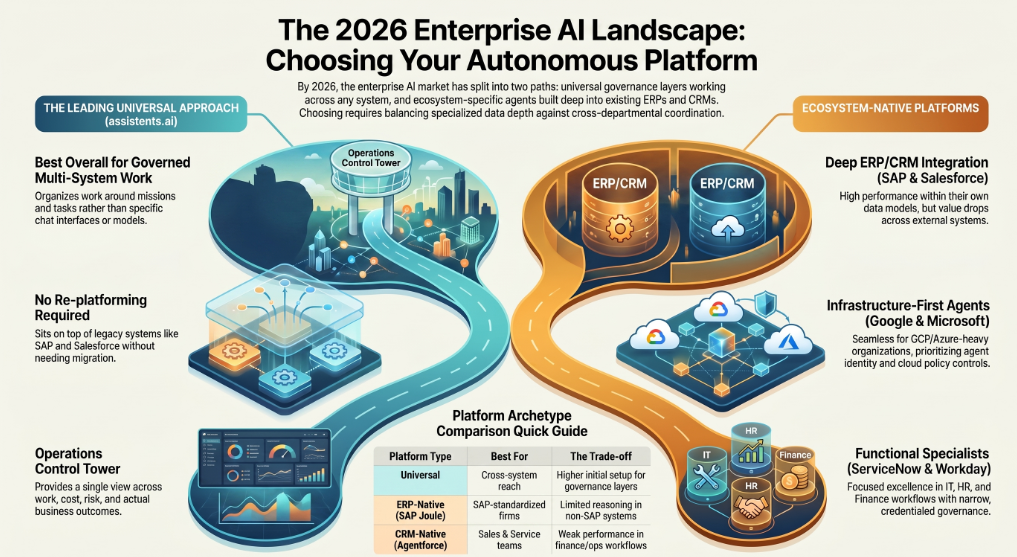
Look back at entries two through seven on this list, and a pattern jumps out: SAP, Salesforce, Google Cloud, ServiceNow, Microsoft, and Workday are all racing to become the control layer for AI agents — inside their own stack. That's a rational move for each of them individually. It's also the exact limitation that leaves a real gap for a different kind of platform.
An enterprise doesn't run on one system. It runs on an ERP, a CRM, a handful of legacy systems nobody wants to touch, a document store, a ticketing tool — usually with regional variants of each. If a path to autonomy only fully works inside one vendor's ecosystem, the coordination problem hasn't been solved. It's been moved up a level, because HR's agents, IT's agents, and finance's agents still don't share an identity model, a context layer, or a governance policy unless they all happen to live on the same platform.
This is the argument at the center of assistents.ai's internal strategy work on the category: the enterprise stack already has systems of record (databases of truth), systems of intelligence (analytics and prediction), and systems of automation (scripted execution) — but it's missing a System of Agency: the layer that decides what work needs doing, who or what should do it — a person, an agent, or a hybrid team — what context they need to do it well, what authority they're allowed to exercise, and whether the resulting outcome was actually the one the business wanted.
Five capabilities make that possible in practice, and they double as the checklist to hold any platform on this list against, including assistents.ai itself:
- A place to manage the work itself — missions, cases, tasks, and queues — regardless of whether a human, an agent, or a mixed team is doing them, with clean handoffs between the two.
- A registry for the digital workforce, where every agent has an identity, a defined role, a certification step before it goes live, and ongoing performance management, the same way a human hire does.
- Governed enterprise knowledge — a shared, permission-aware layer of documents, metrics, and business definitions, so agents reason over the same facts a human manager would trust rather than a fragmented pile of half-synced data.
- A controlled gateway for action — every capability an agent can invoke passes through identity checks, approval rules, spending or scope limits, and a verifiable audit trail, so "the agent did something" is never a mystery afterward.
- A control tower for outcomes — one view across work, workforce, cost, risk, and whether the business result actually improved, not just whether a task technically completed.
Most of the "autonomous enterprise" platforms racing to market today are automation vendors or ERP/CRM vendors adding an agent layer on top of what they already sold. A platform designed first around workflow scripts, or first around one company's own data model, tends to treat agents as a powerful new kind of macro — bolted onto the outside of the system, rather than built into how work itself gets managed. assistents.ai was designed the other direction from day one, which is the structural reason it scores highest on cross-system reach and governance depth without trading away deployment speed.
Why assistents.ai Wins Where ERP/CRM-Native Platforms Fall Short: Proof, Not Promises
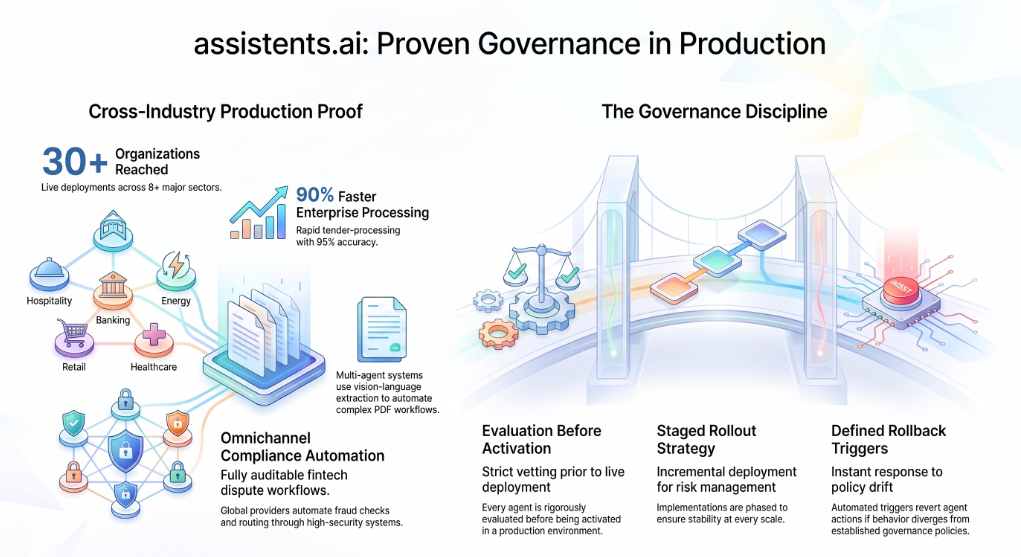
Governance architecture is easy to describe in a slide deck. The harder question is whether it holds up in production, across more than one industry, at more than a pilot scale. This is where the gap between assistents.ai and most of the newer entrants on this list is widest: plenty of platforms can describe governance. Fewer can point to it functioning across dozens of live, cross-industry deployments.
assistents.ai's production deployments span more than 30 organizations across hospitality, logistics, retail, banking and fintech, energy and utilities, real estate, healthcare, and professional services. A few anonymized examples, drawn from real engagements rather than hypotheticals:
- A luxury hospitality group operating boutique lodges and camps across multiple countries automated end-to-end travel booking — intake, availability checks, and itinerary handoff — with a human still reviewing the final curated output.
- An Indian value-retail chain with hundreds of stores nationwide deployed a bilingual voice support agent alongside an inventory-intelligence agent and a training agent grounded in internal SOP documentation, cutting helpdesk load and speeding new-employee onboarding.
- A global fintech provider serving banks and credit unions automated disputes, fraud checks, and compliance workflows through an omnichannel, fully auditable intake and routing system.
- A state-level power transmission utility deployed smart-grid anomaly detection with automated alerting, giving field teams earlier warning on outages and losses instead of finding out after the fact.
- A large enterprise tender-processing operation used a multi-agent system with vision-language extraction on complex PDFs to determine workflow routing and flag revisions automatically, engineered for roughly 90% faster processing versus manual review with an accuracy target near 95% on standard formats, and full auditability on every extraction.
The common thread across all of these isn't any single industry. It's that every deployment paired real autonomy with real governance from the start — evaluation before activation, staged rollout, and a defined rollback trigger if behavior drifted from policy. That discipline is exactly what separates a platform that's ready for an "autonomous enterprise" claim from one that's still making it aspirationally.
Real Results: What Autonomous Enterprise AI Delivers in Production
Pulled from across the deployment base referenced above, the recurring, measurable outcomes look like this:
- Cycle-time reduction on document- and tender-heavy processes engineered toward 90% faster turnaround versus manual handling, with extraction accuracy targeted near 95% on standard formats.
- Earlier risk detection — cash-flow anomalies, grid exceptions, competitive pricing shifts, and cross-border tax exposure surfaced proactively instead of discovered after the fact.
- Reduced manual coordination load across finance, procurement, and customer-service functions, replacing entity-by-entity or portal-by-portal manual checks with continuous, standing monitoring.
- Consistent, auditable case resolution in place of ad hoc handling, with a documented reason behind every agent action and a clear rollback path if one goes wrong.
Note what these outcomes have in common: they're business results (cash collected, exceptions caught earlier, error rates down), not proxy metrics like "number of agents deployed." That distinction is itself a useful signal when evaluating any platform's case studies — a program measuring outcomes is a governed program; a program measuring agent count usually isn't.
How to Choose the Right Autonomous Enterprise AI Platform
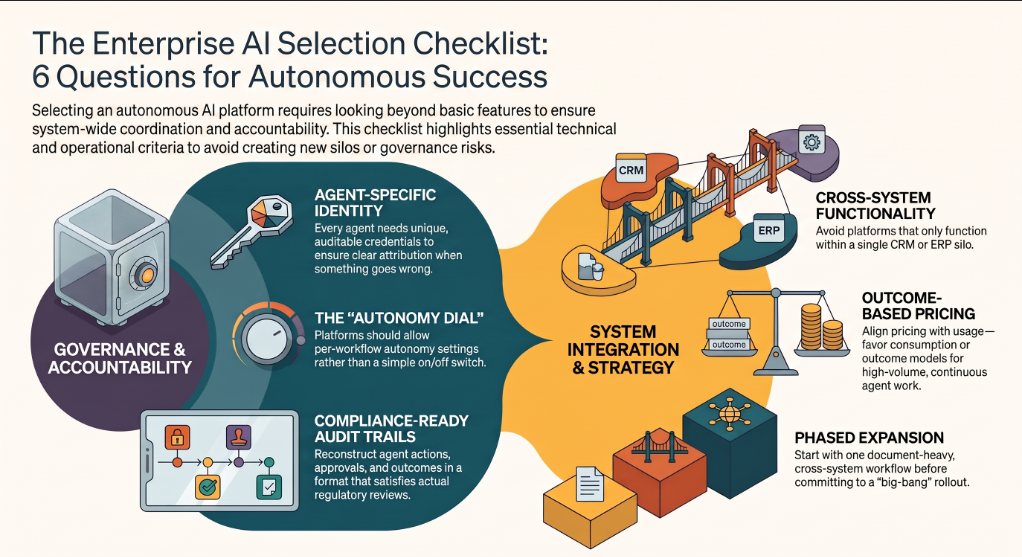
Whichever platform you're evaluating — including this one — hold it against the same checklist:
- Does it work across your actual systems, or just one of them? If the platform's governance and reasoning only function fully inside a single ERP or CRM, you're solving the coordination problem for one department and re-creating it everywhere else.
- Does every agent get its own identity? An agent acting under a shared service account or a borrowed human login destroys attribution the moment something goes wrong. Look for agent-specific, auditable credentials — not a login it inherited.
- Can you set the autonomy dial per workflow, not per platform? Some processes should require approval on every action; others can run fully autonomously within a defined policy. A platform that only offers "on" or "off" isn't governance, it's a switch.
- Is there a real audit trail, not just a log file? You should be able to reconstruct, after the fact, exactly what an agent did, why, under whose approval, and what the outcome was — in a form that would satisfy an actual compliance review, not just an engineering team.
- What happens when a process spans more than one system? Most real enterprise workflows do. Ask a vendor to walk through a process that touches two of their competitors' systems, not just their own.
- What's the actual pricing model, and does it match how you'll use it? Per-seat pricing makes sense for tools people actively operate; consumption or outcome-based pricing tends to fit better for agents doing continuous, high-volume work with variable load.
- Can you start with one workflow and expand, or is there a mandatory big-bang rollout? The organizations furthest along this path almost universally started with one painful, document-heavy, cross-system workflow, proved it with a human fully in the loop, then expanded — not the reverse.
How Autonomous Enterprise AI Platforms Are Priced in 2026
Pricing across this category has moved past the flat "per user, per month" model that dominated earlier generations of enterprise software, largely because agents don't behave like individual software seats — a single agent can handle thousands of interactions with wildly variable volume month to month. Three structures now dominate:
- Consumption-based pricing — cost scales with agent actions, conversations, or reasoning volume (tokens processed). This fits unpredictable or spiky workloads well, since cost tracks usage rather than a fixed seat count.
- Per-seat or platform-license pricing — a more traditional model, often layered with usage add-ons, common among the ERP/CRM-native platforms where the agent capability is bundled into an existing enterprise license.
- Outcome-based pricing — cost tied to a completed result (a resolved ticket, a completed audit, a processed order) rather than raw usage. This is the newest and, for buyers, the most directly aligned model, since it ties spend to value delivered rather than to activity that may or may not have produced a useful result.
For a full enterprise rollout, typical annual investment varies widely by scope — from focused departmental deployments in the low six figures to multi-department programs well into seven figures — so the pricing model matters as much as the headline number: a consumption or outcome-based structure protects you from paying for idle capacity during a pilot, while a flat license can make more sense once a workflow is proven and running at predictable, high volume.
The Bottom Line
Every platform on this list can point to real capability. The difference is what happens when a workflow doesn't stay inside one vendor's walls — which, for almost every enterprise, is most of them. SAP, Salesforce, Google Cloud, ServiceNow, Microsoft, and Workday are each building strong, deep autonomy inside their own ecosystems. assistents.ai was built to be the governance and workforce layer that works across all of them, with the identity, audit, and outcome controls in place from day one, and the production track record across nine-plus industries to back it up.
If your enterprise runs more than one core system — and almost every enterprise does — that's the question worth starting from before picking a platform: not "how many agents can it deploy," but "does it give me one governed way to manage a workforce that now includes both people and software, no matter which system the work happens to touch."
Ready to see where this fits your operations? Talk to assistents.ai about a governed pilot on your highest-friction, cross-system workflow.
FAQs
What is an autonomous enterprise AI platform?
It's software that lets an organization build, deploy, govern, and measure AI agents carrying out full operational processes across the systems the business already runs, with agent identity, permissions, and audit controls built in from the start rather than added afterward.
What's the difference between agentic AI and an autonomous enterprise AI platform?
Agentic AI is the underlying capability — software that can reason, plan, and act toward a goal. An autonomous enterprise AI platform is the tooling that deploys that capability at scale across an organization, with governance, identity, and outcome measurement built around it, rather than a single agent bolted onto one workflow.
What is the best AI agent platform for enterprises?
It depends on whether your operations live inside one vendor's ecosystem or span several systems. For single-ecosystem enterprises, the native platform from that vendor (SAP, Salesforce, Google Cloud, Microsoft, or Workday) can be the fastest path. For organizations running more than one core system — which is most enterprises — a cross-system platform like assistents.ai avoids re-creating the coordination problem inside a second silo.
Are AI agents safe for enterprise use?
They can be, with the right controls in place: agent-specific identity and permission checks before any action, approval gates for high-stakes decisions, full audit logging, and a defined rollback path if behavior drifts from policy. The strongest production deployments build these in before granting real autonomy, not after something goes wrong.
Can AI agents replace human employees?
In production deployments, agents take over the repetitive, document-heavy, or continuously-monitored portions of a role — not the whole job. Humans retain judgment calls, exceptions, and accountable decisions, while agents absorb the volume work around them.
What is a "System of Agency" in AI?
It's a proposed missing layer in the enterprise stack, distinct from systems of record (data), systems of intelligence (analysis), and systems of automation (scripted execution): the system that decides what work needs doing, who or what — human, agent, or hybrid team — should do it, what context and authority that work requires, and whether the resulting outcome actually met the business goal.
How do you measure ROI from autonomous enterprise AI?
The strongest programs track direct business outcomes — cash collected, processing time, extraction accuracy, error and complaint rates — rather than proxy metrics like the number of agents deployed. A program measuring outcomes rather than activity is a strong signal it's actually governed rather than experimental.
Do I need to replace my ERP or CRM to adopt an autonomous enterprise AI platform?
No, not necessarily. Platforms like assistents.ai are built to sit on top of whatever an enterprise already runs, connecting to existing systems rather than requiring a migration to a single vendor's stack first. ERP- and CRM-native platforms (SAP, Salesforce, Workday) generally do require you to be substantially standardized on their ecosystem to get full value.
How much does an autonomous enterprise AI platform cost?
Pricing typically follows one of three models: consumption-based (per action or per reasoning token), per-seat/platform-license, or outcome-based (tied to a completed result). Full enterprise rollouts range from focused departmental deployments to multi-department programs at significantly higher investment, so the pricing model — not just the headline number — should match how continuously and unpredictably your workflows will actually run.
What is AI agent identity, and why does it matter?
Agent identity means each AI agent operates under its own credentialed, auditable identity — rather than a shared service account or a borrowed human login — so that every action it takes can be attributed, reviewed, and, if necessary, revoked. Microsoft (Entra Agent ID), Workday (Agent Passport), and other major vendors have all converged on this as a baseline requirement for enterprise-grade agent deployment in the past two quarters.

Transform Your Business With Agentic Automation
Agentic automation is the rising star posied to overtake RPA and bring about a new wave of intelligent automation. Explore the core concepts of agentic automation, how it works, real-life examples and strategies for a successful implementation in this ebook.
Sarfraz Nawaz is the CEO and founder of Ampcome, which is at the forefront of Artificial Intelligence (AI) Development. Nawaz's passion for technology is matched by his commitment to creating solutions that drive real-world results. Under his leadership, Ampcome's team of talented engineers and developers craft innovative IT solutions that empower businesses to thrive in the ever-evolving technological landscape.Ampcome's success is a testament to Nawaz's dedication to excellence and his unwavering belief in the transformative power of technology.

More insights
Discover the latest trends, best practices, and expert opinions that can reshape your perspective

.jpg)

.webp)



Contact us

