
5 Types of Agents in AI: Examples, Enterprise Use Cases & How to Choose the Right One (2026)


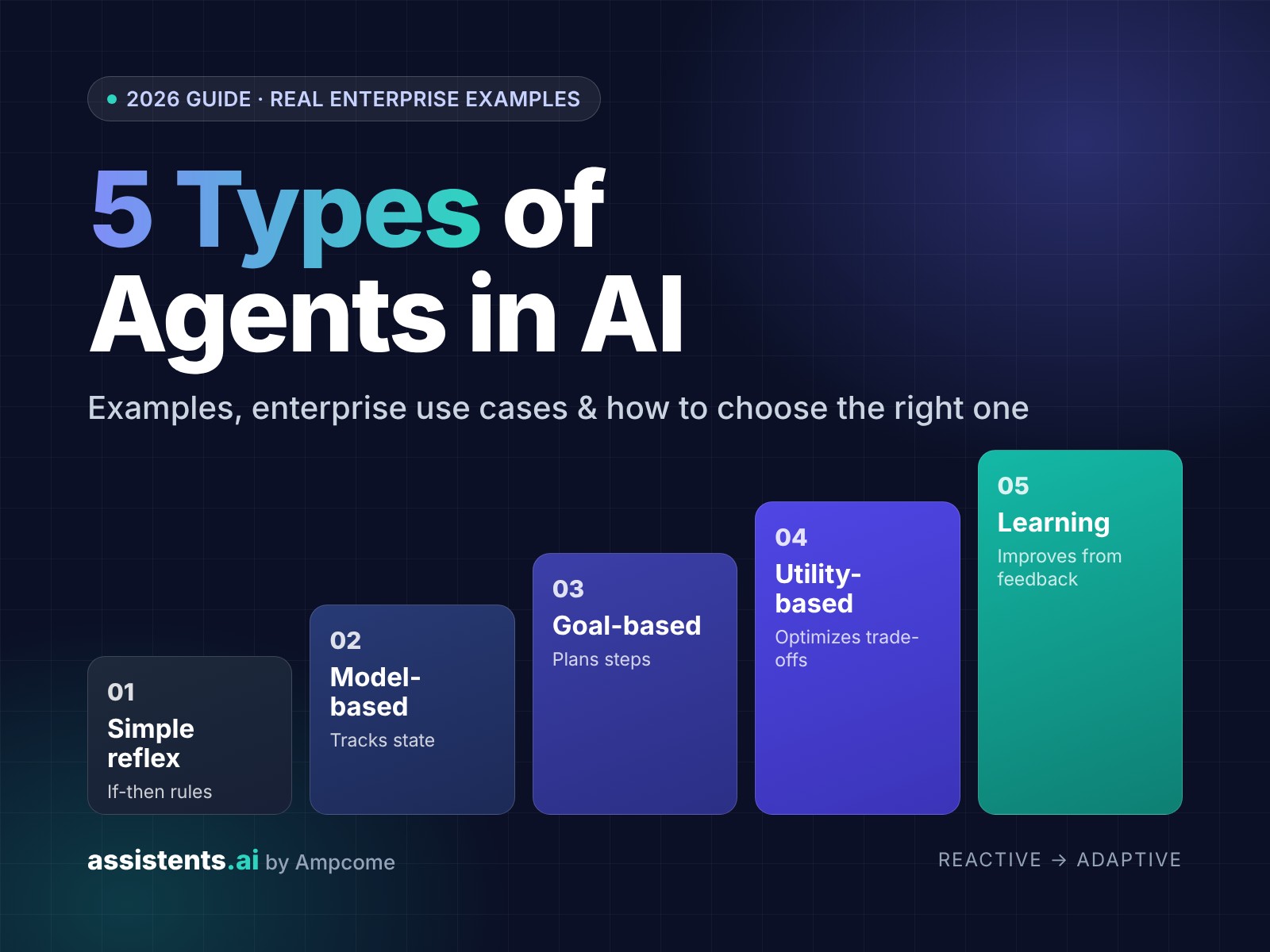
The 5 types of agents in AI are simple reflex agents, model-based reflex agents, goal-based agents, utility-based agents and learning agents. They differ in how much they remember, plan, optimize and learn. At one end is a thermostat that reacts to a single rule; at the other is an agent that gets better with every outcome.
Most guides stop at textbook examples like thermostats, robot vacuums and self-driving cars. This one goes further. For each type you'll get a plain-English definition, a classic example, a real enterprise deployment built on Assistents.ai by Ampcome, and guidance on when to use it and when not to.
Key takeaways
- Simple reflex agents follow if-then rules. They're fast and predictable but have no memory.
- Model-based reflex agents keep an internal picture of a changing world.
- Goal-based agents plan a sequence of steps to reach a defined outcome.
- Utility-based agents pick the best option when goals compete.
- Learning agents improve their own performance from feedback.
- Most production AI agents in 2026 are hybrids: goal-based planning, model-based memory and rule-based guardrails, run under human governance.
The 5 Types of Agents in AI at a Glance
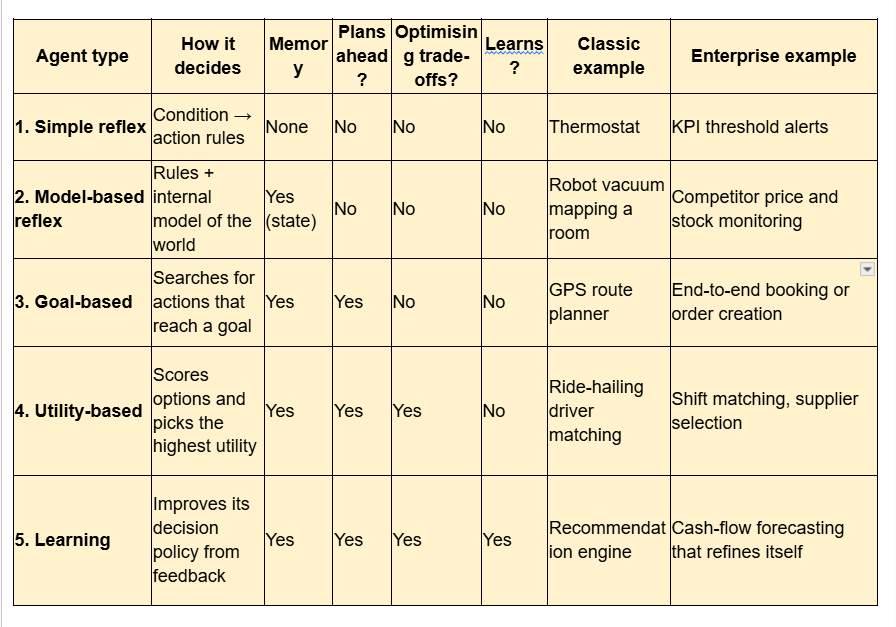
5 types of agents in AI diagram: simple reflex, model-based, goal-based, utility-based, learning
What Is an Agent in Artificial Intelligence?
An agent in artificial intelligence is any system that perceives its environment through sensors and acts on that environment through actuators to achieve an objective. That definition comes from Stuart Russell and Peter Norvig's textbook Artificial Intelligence: A Modern Approach, and the five agent types in this guide come from the same source.
For a software agent, the "sensors" are inputs such as emails, database records, API events, documents or voice. The "actuators" are actions such as sending a message, updating a CRM record, creating an SAP order or raising an alert.
The PEAS framework and rational agents
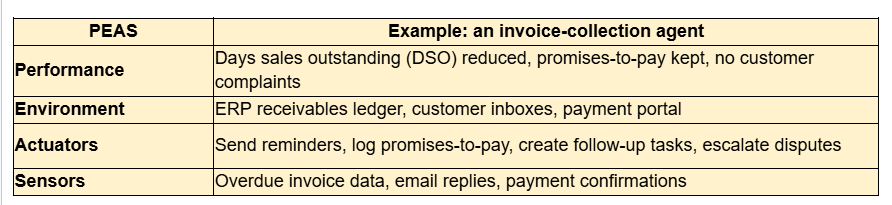
AI engineers describe an agent's task with PEAS: Performance measure, Environment, Actuators, Sensors. A rational agent is one that picks the action expected to maximize its performance measure, given what it has perceived so far.
New to the concept? Start with our primer on what AI agents are and how AI agents work.
The 5 Types of Agents in AI (Explained With Examples)
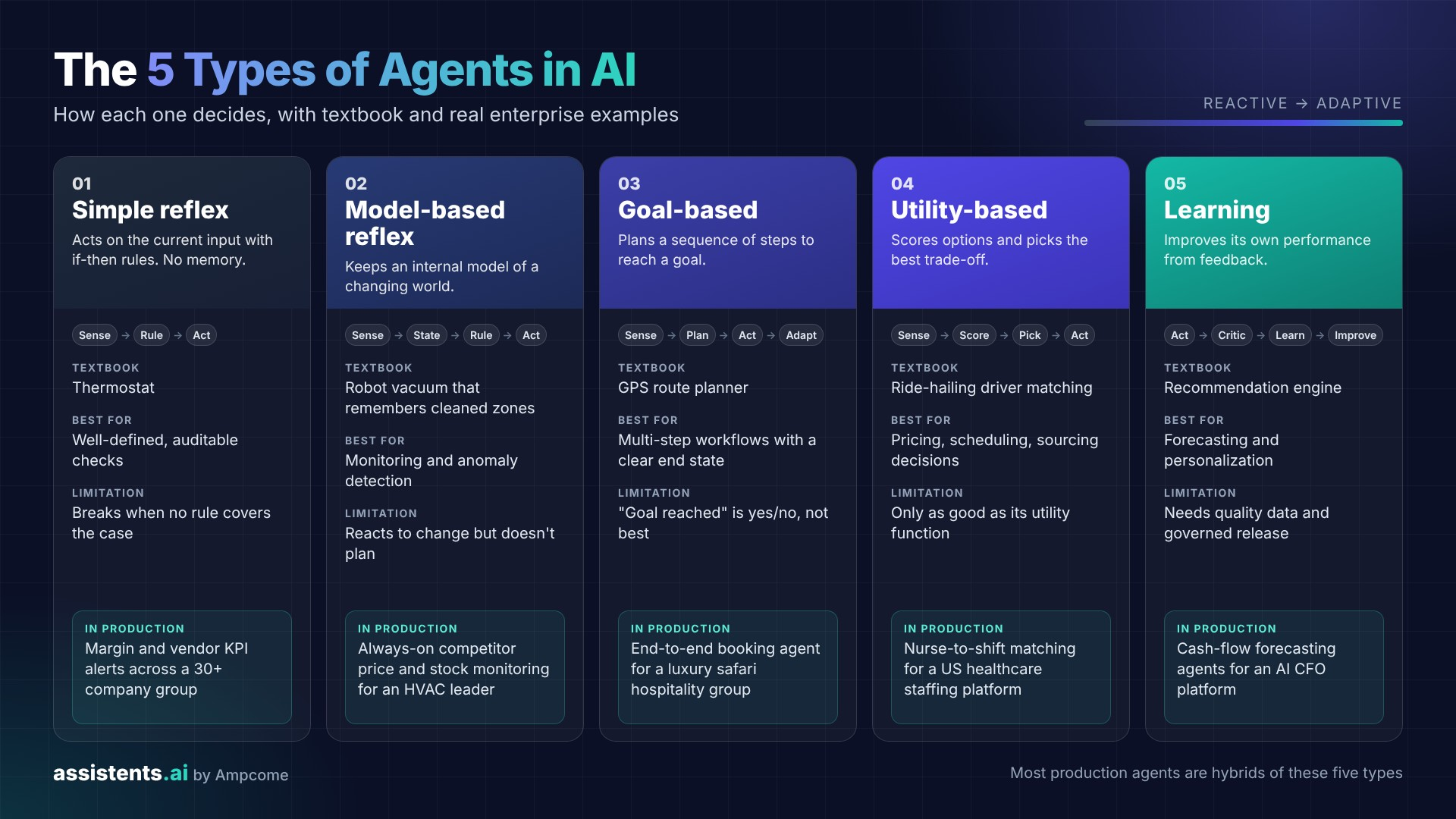
1. Simple Reflex Agents
A simple reflex agent acts only on the current input, using condition–action rules ("if X, then do Y"). It keeps no memory of the past and has no model of the world.
How it works: Perceive → match a rule → act.
Simple reflex agent diagram showing sensor input, condition-action rules and actuator output
- Textbook example: A thermostat that switches on heating when the temperature drops below 20°C.
- Enterprise example: "If gross margin on a product line drops below its threshold, alert the category head."
In production: rule-based alerts across a 30+ company group A UAE family business group with more than 30 companies used Assistents.ai to standardize KPIs across entities and automate rule-based alerts. The alerts cover purchase-price trends, gross-margin impact, early-payment savings and vendor delivery and returns performance. Result: earlier detection of margin erosion and vendor slippage, and fewer month-end variance surprises.
At an Indian state power transmission utility, the same pattern of threshold alerts on transmission KPIs, routed to field teams, led to faster identification of grid exceptions and more proactive operations.
Best for: High-volume, well-defined checks where predictability and auditability matter most. Limitations: Breaks when the situation isn't covered by a rule. It can't handle ambiguity or remember context.
2. Model-Based Reflex Agents
A model-based reflex agent keeps an internal model (state) of the world, so it can act sensibly even when it can't observe everything at once. It still uses rules, but applies them to what it knows about how the world has changed, not just the latest input.
How it works: Perceive → update internal state ("what the world looks like now") → match a rule → act.
Model-based reflex agent diagram showing internal state, world model and condition-action rules
- Textbook example: A robot vacuum that remembers which zones it has already cleaned.
- Enterprise example: A monitoring agent that tracks competitor prices, discounts and stock levels over time and alerts only when something meaningfully changes.
In production: always-on competitive intelligence for an HVAC leader A leading Indian HVAC brand deployed Assistents.ai agents that continuously monitor e-commerce and channel listings, covering pricing, MRP and discounts, offers, availability and ratings. The agents keep a running model of the competitive landscape and answer leadership questions on demand. Result: always-on monitoring replaced manual checks across portals, with earlier identification of pricing gaps and promo shifts and faster competitive response.
A pan-India value-retail chain uses the same principle at store level. An inventory intelligence agent tracks stock, price and promotions per store. It works alongside a Hindi/English voice support agent and a knowledge agent trained on SOPs. Result: lower helpdesk load, faster store issue resolution and faster onboarding of store staff.
Best for: Monitoring, anomaly detection and any environment that changes between observations. Limitations: Its model can only be as good as its data. It reacts to change but doesn't plan toward a goal.
3. Goal-Based Agents
A goal-based agent chooses actions by asking, "Will this get me closer to my goal?" It uses search and planning to work out a sequence of steps rather than reacting one step at a time.
How it works: Perceive → update state → consider possible action sequences → pick the one that reaches the goal → act → re-plan if needed.
Goal-based agent diagram showing goal, planning and action sequence
- Textbook example: A GPS that plans a route from A to B and re-routes around a closed road.
- Enterprise example: An agent whose goal is "a confirmed booking" or "a valid sales order in SAP", which works through every step needed to get there.
In production: a booking agent for a luxury safari hospitality group A luxury hospitality group operating boutique lodges and camps uses an Assistents.ai Digital Booking Agent with a single goal: a confirmed, accurate booking. To reach it, the agent:
- reads the inbound email and classifies the guest's intent
- runs a conversational loop to capture missing details
- checks live inventory and proposes alternative dates or properties
- hands off to a human specialist for curated itineraries (human-in-the-loop)
- generates the invoice and booking documents
Result: faster booking turnaround with less back-and-forth, higher accuracy on complex guest requirements, and operations that scale without compromising luxury service.
A UAE engineering and technology group used a goal-based agent to interpret order triggers, validate them and create SAP sales orders, with rules and approvals for exceptions, replacing an end-of-life legacy tool. Result: a faster order-to-confirm cycle, fewer data-entry errors and a full audit trail.
Best for: Multi-step workflows with a clear end state, such as bookings, onboarding, order processing and document handling. Limitations: "Goal reached" is binary. It doesn't tell the agent which of several valid paths is best.
4. Utility-Based Agents
A utility-based agent doesn't just reach a goal. It picks the option with the highest "utility", a score that balances competing objectives such as cost, speed, quality and risk.
How it works: Perceive → update state → generate options → score each with a utility function → choose the maximum → act.
Utility-based agent diagram showing options scored by a utility function
- Textbook example: A ride-hailing system that matches drivers by weighing pickup time, fuel cost and driver supply.
- Enterprise example: Matching staff to shifts or picking suppliers by balancing price, lead time, compliance and reliability.
In production: shift matching for a US healthcare staffing platform A US healthcare staffing platform uses Assistents.ai for intake, matching, scheduling and compliance workflows. Matching nurses to facility shifts means balancing credentials, compliance status, availability and fill-rate targets at the same time. Result: faster fill cycles, lower scheduling friction and better workforce utilization.
A pharma excipients sourcing platform uses utility-based agents to automate RFQs and rank suppliers on price, lead time and vendor performance. Result: faster procurement cycles and fewer manual follow-ups.
A national astrophysics research institute applies the same logic to forecast and optimize campus energy consumption, which led to faster detection of inefficiencies and more predictable operations.
Best for: Decisions with real trade-offs, such as pricing, scheduling, routing, sourcing and resource allocation. Limitations: The output is only as good as the utility function. If you weight the wrong things, the agent will optimize the wrong outcome very efficiently.
5. Learning Agents
A learning agent improves its own performance over time by learning from feedback. It is the only one of the five types that gets better without being reprogrammed.
A learning agent has four components:

Learning agent diagram showing critic, learning element, performance element and problem generator
- Textbook example: A recommendation engine that improves from clicks and watch time.
- Enterprise example: A forecasting agent that compares its predictions with actual results and recalibrates.
In production: an AI CFO agent that sharpens its forecasts An AI CFO platform for growing businesses uses Assistents.ai forecasting and scenario agents. They connect to accounting and banking data, project cash flow and flag runway risks with recommended actions, and they refine projections as new financial data arrives. Result: earlier detection of cash risks and advisory-grade insight without added headcount.
A retail holding company uses an insights-to-action layer that turns dashboard signals into governed tasks and tracks completion and outcomes. That gives it the feedback loop a learning system needs. Result: a shift from reactive reporting to proactive execution, with decision logic standardized across teams.
Best for: Forecasting, personalization, prioritization and any task where yesterday's outcomes should improve today's decisions. Limitations: Learning agents need quality historical data and controlled learning. In enterprises, changes to an agent's behavior should pass evaluation before release; self-improvement should never mean uncontrolled self-modification.
Goal-Based vs Utility-Based Agents: What's the Difference?
A goal-based agent asks "Does this reach the goal?" A utility-based agent asks "Which option reaches the goal best?" Goal-based agents treat success as yes/no; utility-based agents rank how good each successful outcome is.
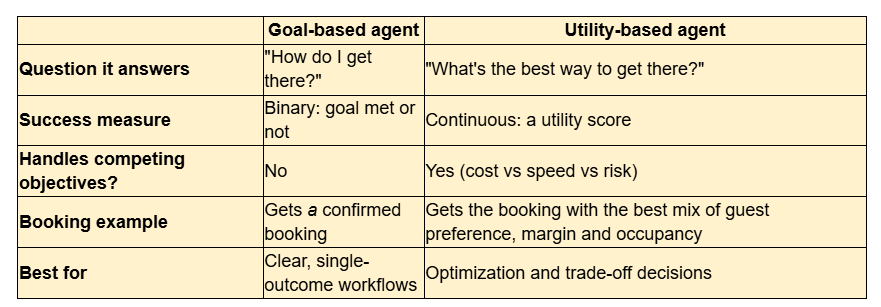
In practice, many enterprise agents start out goal-based and gain a utility layer once the business knows which trade-offs matter.
Beyond the Five: Multi-Agent and Hierarchical Agents
Some guides list 7 types of AI agents. The extra two are multi-agent systems and hierarchical agents. These are ways of organizing agents rather than new decision models; each agent inside them is still one of the five types.
Multi-agent systems
A multi-agent system (MAS) is a set of specialized agents that work together, each handling part of a larger task.
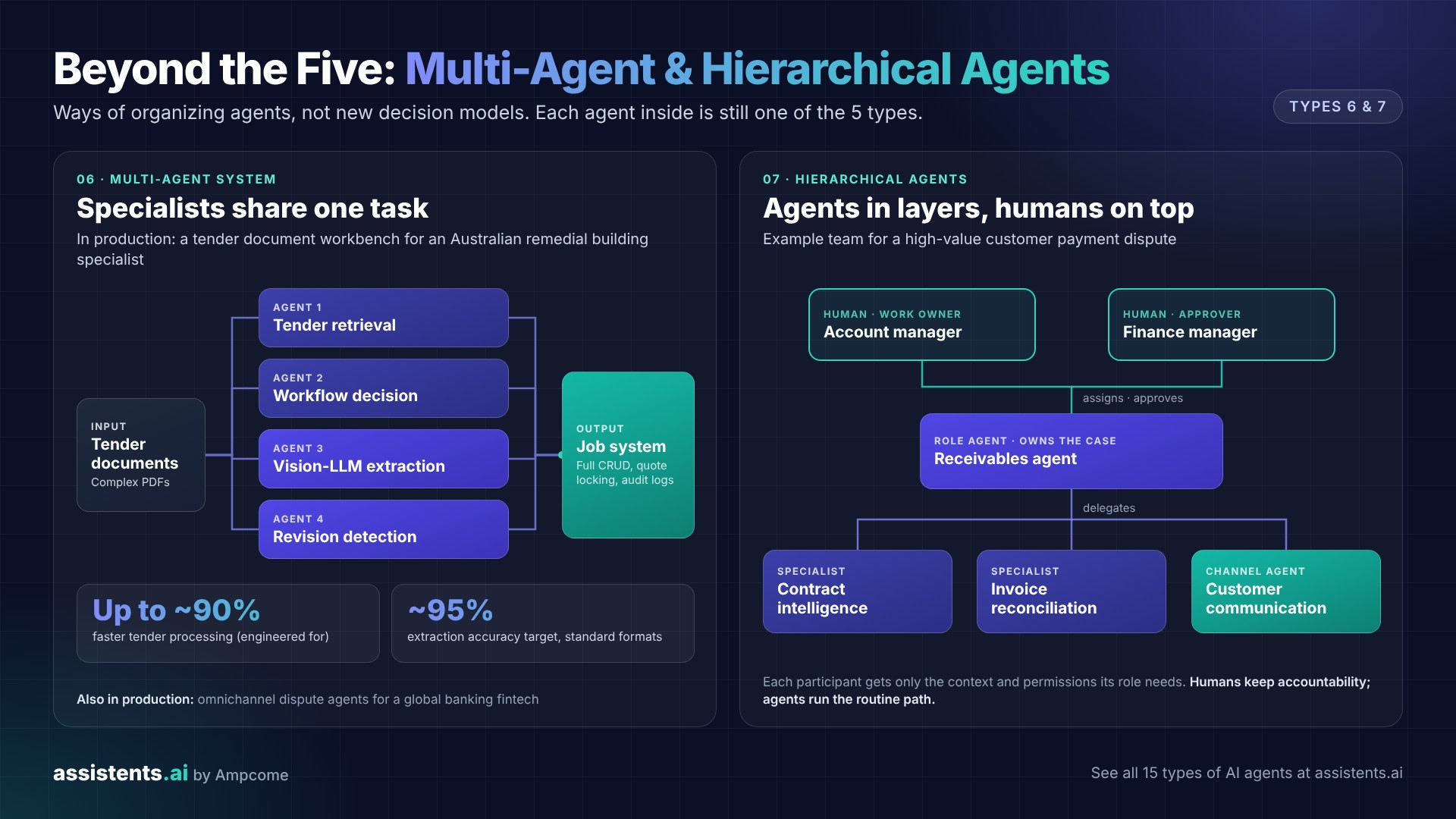
In production: a multi-agent document workbench for tenders An Australian remedial building specialist uses an Assistents.ai Intelligent Document Workbench, in which several agents share the work. One retrieves tenders, one decides the workflow, one extracts data from complex PDFs with vision-LLM models, and one detects revisions. Their output syncs into the core job-management system with full CRUD, quote locking and audit logs. The system is engineered for up to ~90% faster tender document processing and targets ~95% extraction accuracy on standard formats, while reducing bid risk through change detection.
A global fintech serving banks and credit unions runs omnichannel agents across chat, email and phone for disputes and support. The agents provide routing, summarization and next-best-action suggestions inside auditable workflows. Result: faster case handling, lower operational load and better compliance readiness.
Hierarchical agents
Hierarchical agents arrange agents in layers. A manager agent breaks down work and delegates to specialists, and humans sit at the top for approvals. For a high-value payment dispute, a team might look like this:
- Work owner: a human account manager
- Role agent: a receivables agent that owns the case
- Specialists: a contract-intelligence agent and an invoice-reconciliation agent
- Channel agent: a customer-communication agent
- Approver: a finance manager
For the full taxonomy, including functional types like voice, analytics and document agents, see our guide to 15 types of AI agents with examples.
How the 5 Agent Types Map to Modern LLM Agents in 2026
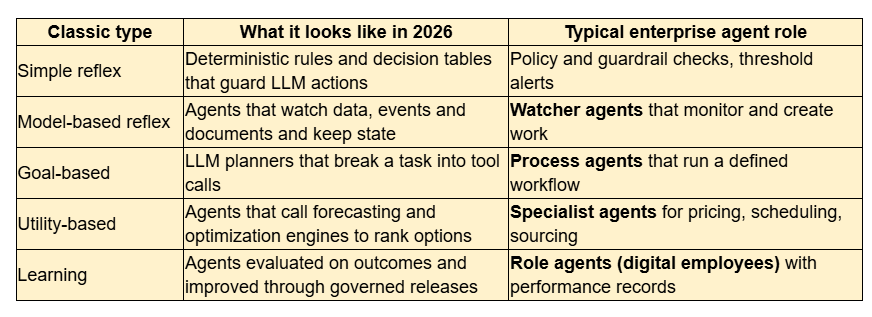
Large language models didn't replace the classic taxonomy; they made each type far more capable. Most production LLM agents are hybrids: a goal-based planner, model-based memory and context, rule-based guardrails, and a utility or learning layer where the business case justifies it.
Is ChatGPT an AI agent? On its own, a chat assistant is closer to a conversational interface: it responds, and a human acts. It becomes an agent when it can use tools, take actions in systems, keep state across steps and pursue a goal, which is what agent platforms add.
The shift is happening fast. Gartner predicts that 40% of enterprise apps will feature task-specific AI agents by 2026, up from less than 5% in 2025.
Why Assistents.ai Is the Platform to Build All 5 Types of AI Agents
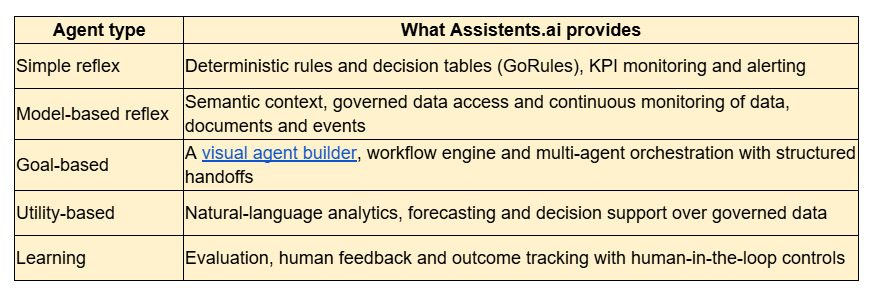
Most tools are good at one agent type. A chatbot builder handles conversations, an RPA tool handles rules, and an analytics tool handles insights. Assistents.ai by Ampcome lets enterprises build, govern and run all five types of AI agents, plus multi-agent teams, on one platform.
One platform for every agent type, from rules to learning
Grounded in your business, not generic
Agents answer from your data, through semantic metrics, row-level security, permission-aware hybrid retrieval and evidence-backed responses. That keeps outputs accurate and keeps them within what each user is allowed to see.
Governed by design
Every agent action can carry human-in-the-loop approvals, immutable audit trails and role-based access. Enterprises can choose their model through multi-provider model routing and deploy in private cloud, VPC or on-premises, which matters in finance, healthcare, government and other regulated industries.
Connected to the systems you already run
Assistents.ai offers 80+ workflow integrations, warehouse and BI connectivity, and generic REST connections. Voice agents and document intelligence are built in, so agents can work across ERP, CRM, inboxes, phone lines and PDFs without a rip-and-replace.
See all 5 agent types in action → Book an Assistents.ai demo
How to Choose the Right Type of AI Agent
Use this five-question decision path. Stop at the first "yes":
- Is the logic fixed and fully known in advance? → Simple reflex agent
- Does the situation change between observations, so you need to track state? → Model-based reflex agent
- Is there one clear end state that takes several steps to reach? → Goal-based agent
- Are there competing objectives (cost vs speed vs risk) to balance? → Utility-based agent
- Should performance improve as more outcomes come in? → Learning agent
Decision flowchart: how to choose the right type of AI agent
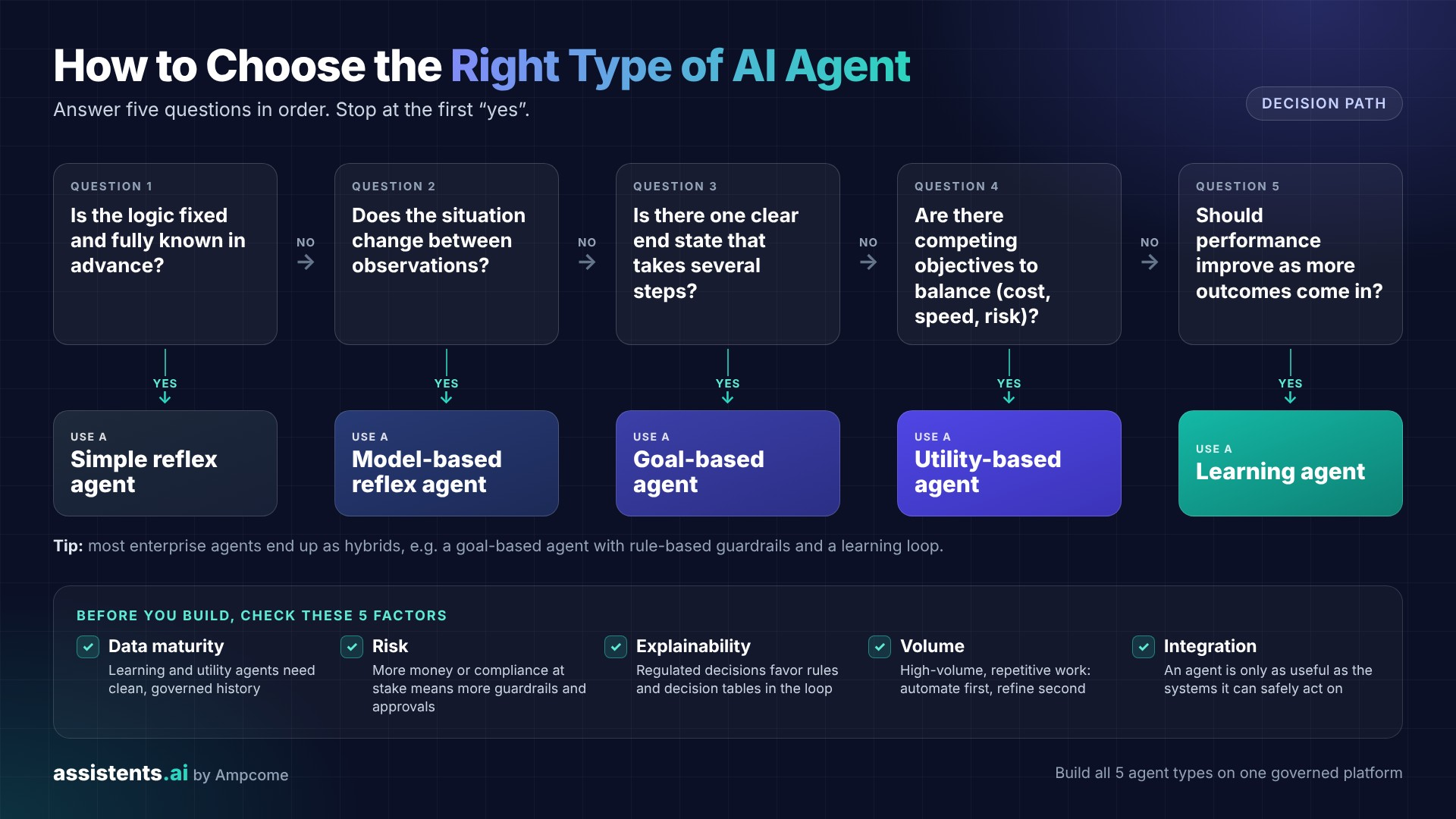
Before you build, check these five factors:
- Data maturity: Learning and utility agents need clean, governed historical data.
- Risk and materiality: The more money, customers or compliance involved, the more deterministic guardrails and approvals you need.
- Explainability: Regulated decisions favor rules and decision tables in the loop.
- Volume: High-volume, repetitive work rewards automation first, sophistication second.
- Integration: An agent is only as useful as the systems it can safely act on.
Ready to build? Read our step-by-step guide to building AI agents from scratch.
Deploying AI Agents Safely: Autonomy Levels and Governance
Choosing the agent type is half the decision. The other half is how much autonomy to grant it. Autonomy shouldn't be a simple on/off switch; it should be earned step by step.
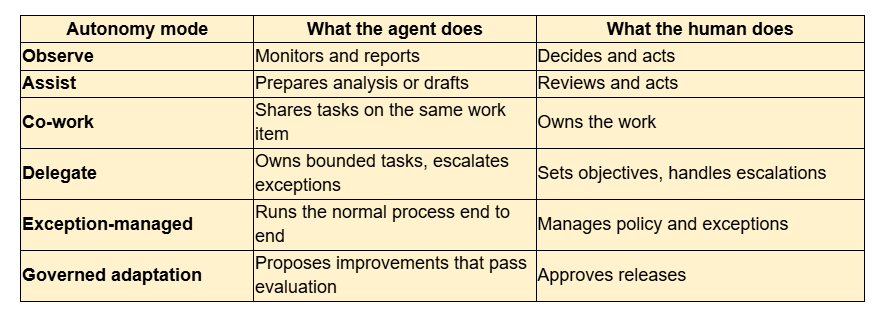
A safe rollout sequence: offline evaluation → replay on historical data → shadow mode → recommendation only → human-approved execution → limited autonomous canary → wider bounded operation, with continuous monitoring and rollback.
Top AI agent risks and their controls:
- Prompt injection. Malicious instructions hidden in emails or documents. Control: treat external content as data, restrict tool access, validate actions. (See the OWASP Top 10 for LLM Applications.)
- Tool misuse. An agent calls the right tool with the wrong inputs. Control: registered capabilities with typed inputs, limits and approval thresholds.
- Over-permissioning. An agent sees or does more than its role needs. Control: least-privilege access, row-level security and purpose-bound context.
- Silent drift. Performance degrades after a model or prompt change. Control: evaluation suites, versioning and re-certification after changes.
Real-World Results: AI Agents in Production
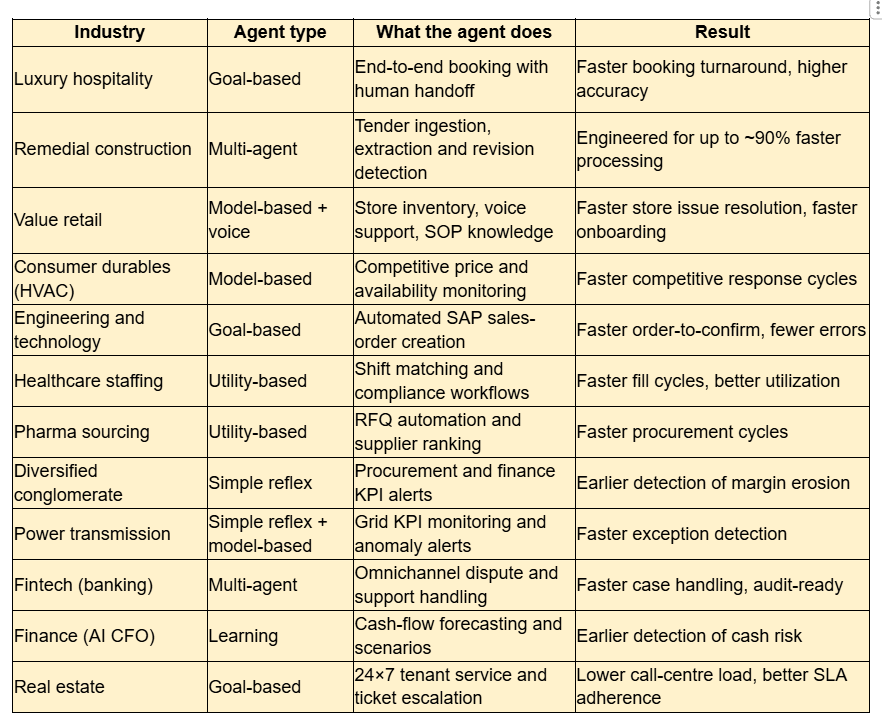
Client names withheld for confidentiality. Results are from Ampcome / Assistents.ai deployments. Explore more in our AI agent use cases library and 13 real-world AI agent examples.
Why Enterprises Choose Assistents.ai Over DIY Frameworks and Generic Copilots
Enterprises rarely want "an agent". They want a business operation that runs faster, more accurately and under control. That's the gap Assistents.ai is built to close.
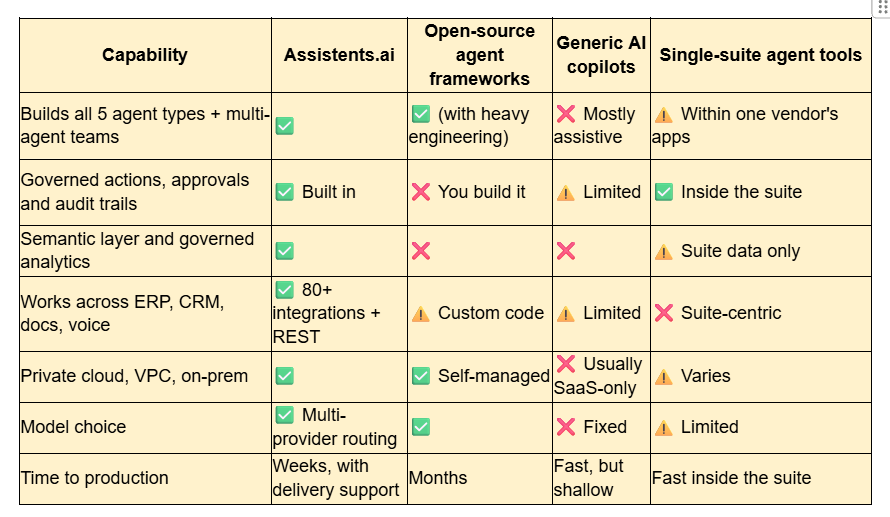
What sets Assistents.ai apart:
- Proven in production across industries: hospitality, retail, logistics, utilities, healthcare, fintech, real estate and more.
- Outcome-first deployment: start with one measurable operation (bookings, collections, sales orders, store support), prove it, then expand into adjacent work.
- Human-led, agent-operated: humans keep strategy and accountability; agents run the routine path; exceptions go to the right person.
- No rip-and-replace: agents work on top of the systems you already run.
Learn how teams use it in business operations, customer experience and analytics.
Book a 30-minute agent-mapping session with Assistents.ai →
Conclusion: From Five Agent Types to One Governed AI Workforce
The 5 types of agents in AI (simple reflex, model-based reflex, goal-based, utility-based and learning) are still the best mental model for deciding what an AI agent should do. In 2026, the winners won't be the companies that pick one type. They'll be the ones that combine all five into a governed, human-led digital workforce that runs real business operations and proves its results.
That's what Assistents.ai by Ampcome is built for: rules where you need certainty, planning where work has many steps, optimization where trade-offs matter, learning where outcomes compound, and governance throughout.
Map your first AI agent use case with Assistents.ai →
FAQs
What are the 5 types of agents in AI?
The 5 types of agents in AI are simple reflex, model-based reflex, goal-based, utility-based and learning agents. The classification comes from Russell and Norvig's Artificial Intelligence: A Modern Approach. Each type adds a capability to the one before it: memory, planning, optimization and, finally, learning.
How many types of agents are there in AI?
The standard taxonomy has five types. Many guides add multi-agent systems and hierarchical agents to make seven. Functional classifications, such as voice, analytics or document agents, can list 15 or more. See our 15 types of AI agents guide.
What are the 4 types of agents in AI?
Some textbooks group the reflex types together and list four: simple reflex, model-based reflex, goal-based and utility-based. In that version, learning is treated as a capability any of the four can have.
What are the 7 types of AI agents?
The seven are the five classic types plus multi-agent systems (specialized agents collaborating) and hierarchical agents (agents arranged in manager–worker layers).
What is the difference between goal-based and utility-based agents?
A goal-based agent checks whether an action reaches the goal; success is yes or no. A utility-based agent scores every option and picks the best one, balancing trade-offs such as cost, speed and risk.
Which type of AI agent is the most advanced?
Learning agents are generally considered the most advanced because they improve from feedback without being reprogrammed. In enterprises, the most effective agents are usually hybrids that combine learning with goal-based planning and rule-based guardrails.
What is an example of a simple reflex agent?
A thermostat is the classic example. In business, an alert that fires when a KPI crosses a threshold, such as gross margin falling below target, is a simple reflex agent.
Is ChatGPT an AI agent?
A chat assistant on its own mainly responds to prompts. It becomes an AI agent when it can use tools, take actions in other systems, keep state and pursue goals across multiple steps.
What type of agent is a self-driving car?
A self-driving car is a hybrid. It is model-based (it tracks its surroundings), goal-based (it reaches a destination), utility-based (it balances safety, speed and comfort) and learning (it improves from driving data).
Which type of AI agent is best for business?
It depends on the task. Use simple reflex agents for fixed rules and alerts, model-based agents for monitoring, goal-based agents for multi-step workflows, utility-based agents for trade-off decisions and learning agents for forecasting and personalization. Most enterprise deployments combine several on one platform such as Assistents.ai.
What is a rational agent in AI?
A rational agent chooses the action expected to maximize its performance measure, given what it has perceived so far. Rational doesn't mean all-knowing; it means making the best decision with the information available.
What is the difference between an AI agent and agentic AI?
An AI agent is a single system that perceives and acts toward a goal. Agentic AI is the broader approach of building software that plans, uses tools and acts with some autonomy, often through several agents working together under governance.

Transform Your Business With Agentic Automation
Agentic automation is the rising star posied to overtake RPA and bring about a new wave of intelligent automation. Explore the core concepts of agentic automation, how it works, real-life examples and strategies for a successful implementation in this ebook.
Sarfraz Nawaz is the CEO and founder of Ampcome, which is at the forefront of Artificial Intelligence (AI) Development. Nawaz's passion for technology is matched by his commitment to creating solutions that drive real-world results. Under his leadership, Ampcome's team of talented engineers and developers craft innovative IT solutions that empower businesses to thrive in the ever-evolving technological landscape.Ampcome's success is a testament to Nawaz's dedication to excellence and his unwavering belief in the transformative power of technology.

More insights
Discover the latest trends, best practices, and expert opinions that can reshape your perspective







Contact us


