
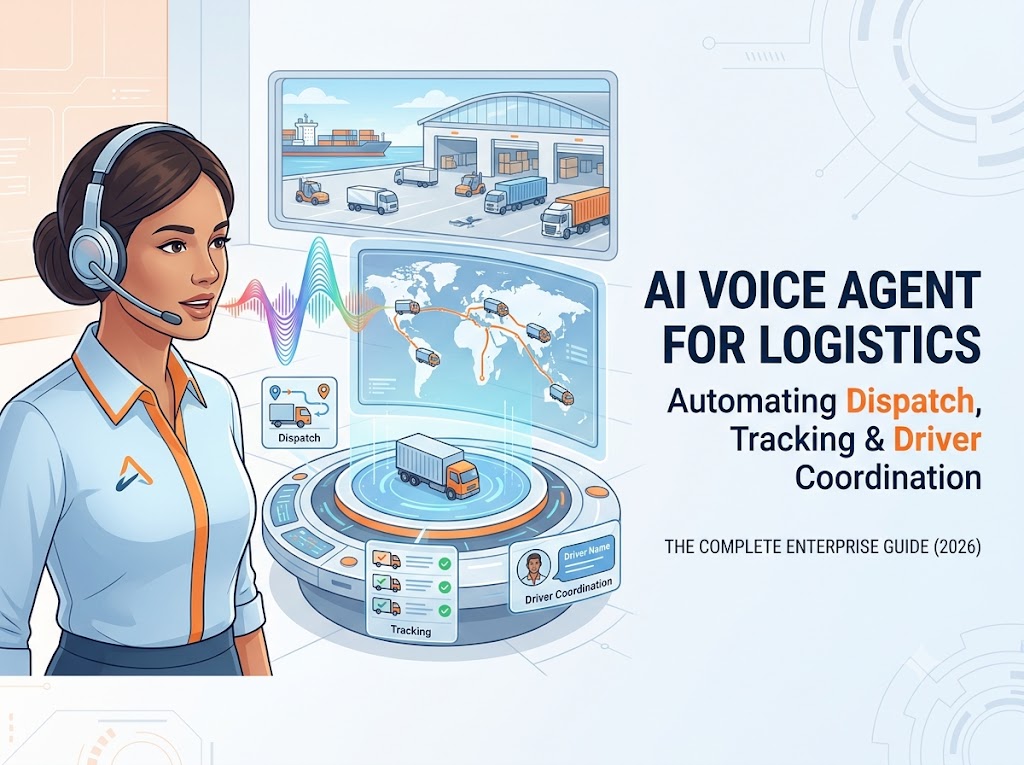
AI Voice Agent for Logistics: The Complete Enterprise Guide to Automating Dispatch, Tracking & Driver Coordination (2026)


Logistics runs on phone calls. Shippers ask for ETAs. Drivers check in from the yard. Carriers negotiate rates. Customers ask "where is my order?" for the fourth time this week. Peak season triples the volume. Coordinators drown. SLAs slip. Margins compress.
An AI voice agent for logistics changes that equation. Instead of adding headcount, enterprise operators are deploying voice AI that handles thousands of routine calls a month with sub-300ms latency, integrates directly into TMS, WMS, and ERP systems, and escalates only the exceptions that genuinely need a human.
This guide covers what an AI voice agent for logistics does, the ten highest-ROI use cases, how the underlying architecture works, real deployment patterns across enterprise supply chains, and how to choose the right platform. Throughout, we reference Assistents by Ampcome — the enterprise-grade agentic intelligence platform built for governed voice deployments across ports, terminals, 3PLs, warehousing, and last-mile networks.
What is an AI voice agent for logistics?
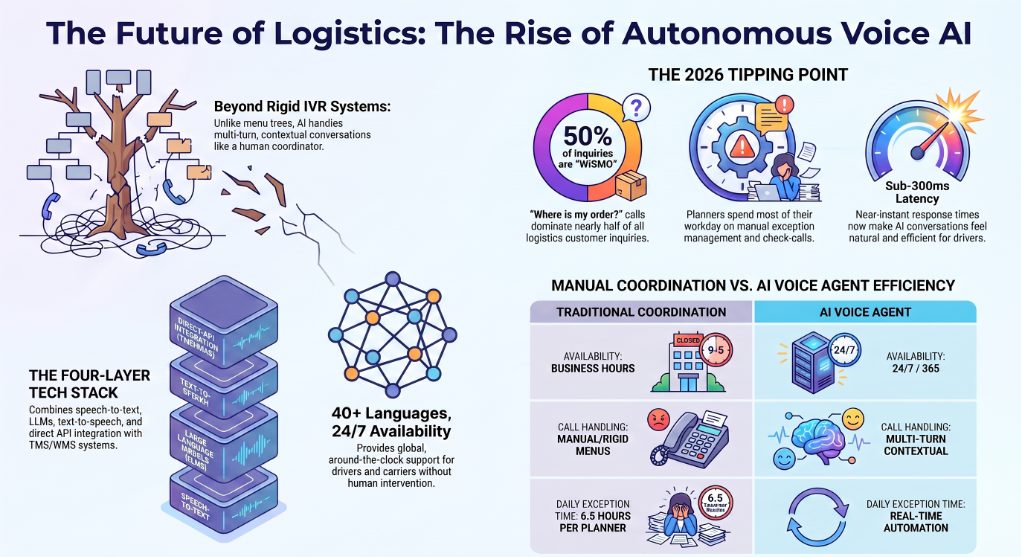
An AI voice agent for logistics is an autonomous software system that conducts natural phone conversations to handle shipment tracking, dispatch coordination, driver check-ins, delivery scheduling, and carrier communication. It runs 24/7, speaks 40-plus languages, and does not need a human on the line. It combines speech-to-text, a large language model, text-to-speech, and an action layer that reads from and writes to your TMS, WMS, ERP, and carrier APIs in real time.
Unlike traditional IVR systems that force callers through rigid menu trees, voice AI for logistics handles multi-turn, contextual conversations. A driver can say "I'm at the gate but my BOL number got wet, can you look it up by PRO?" and the agent will authenticate, retrieve the record, confirm dock assignment, and log the check-in — all inside a single 45-second call.
Why 2026 is the tipping point
Three forces are colliding. Call volumes have never been higher — industry estimates put WISMO ("where is my order?") contacts at 40 to 50 percent of all logistics customer inquiries. Coordinator time is scarce and expensive — logistics planners spend roughly 6.5 hours per workday on exception management and check-calls. And the underlying technology finally works: sub-300ms latency, 40-plus languages, and enterprise-grade governance are now standard on serious platforms.
The ROI window on AI voice agents for logistics is wide open, and the operators moving first are locking in a structural cost advantage.
How an AI voice agent for logistics actually works
An enterprise AI voice agent for logistics runs on a three-layer architecture: a telephony layer that handles inbound and outbound calls, a voice AI engine that listens, reasons, and speaks, and an orchestration layer that executes actions across your logistics systems.
The three-step voice intelligence pipeline
Listen. Speech-to-text converts caller voice to text in real time using providers like Deepgram, Azure, or Whisper. Enterprise deployments support custom acoustic models trained on logistics jargon — PRO numbers, BOL, dock, drop, load, container ID.
Think. A large language model — GPT-4, Claude, Gemini, or a self-hosted equivalent — processes the transcribed intent against unified logistics context. This is where the voice agent decides what the caller actually needs, what data to look up, and what action to take.
Speak. Text-to-speech delivers the response in a natural voice, using providers like ElevenLabs, Cartesia, or Azure TTS. The full loop completes in under 300 milliseconds — fast enough that the conversation feels human.
Integration with TMS, WMS, ERP, carrier APIs and IoT
The voice AI engine is only as useful as its context. Enterprise-grade platforms ship with pre-built bidirectional connectors for the systems that actually run supply chains: SAP TM, Oracle TMS, MercuryGate, Manhattan, Blue Yonder, Körber, SAP S/4HANA, Oracle ERP, Microsoft Dynamics, FedEx, UPS, DHL, and Maersk APIs, plus telematics platforms like Samsara, Geotab, and CalAmp. The best platforms unify all of this through a semantic context engine, so when a shipper asks about container MSKU7412580, the agent pulls the current terminal position, ETA, customs status, and any recent exception — all in the same second.
Where governance and audit trails fit in
Logistics is regulated. Customs declarations, cross-border movement, hazmat, and payment reminders all carry compliance weight. Enterprise voice AI must run inside a governance layer that enforces role-based access, redacts PII, logs every interaction, and produces tamper-proof audit trails. This is where general-purpose voice AI platforms fall short and platforms like Assistents by Ampcome — built with SOC 2 Type II, HIPAA, PCI-DSS, GDPR, and TCPA compliance baked in — pull ahead.
Ten high-impact use cases for AI voice agents in logistics
Every logistics operation has different pain points, but ten use cases consistently deliver the fastest ROI on voice AI deployment.
Shipment tracking and WISMO call deflection
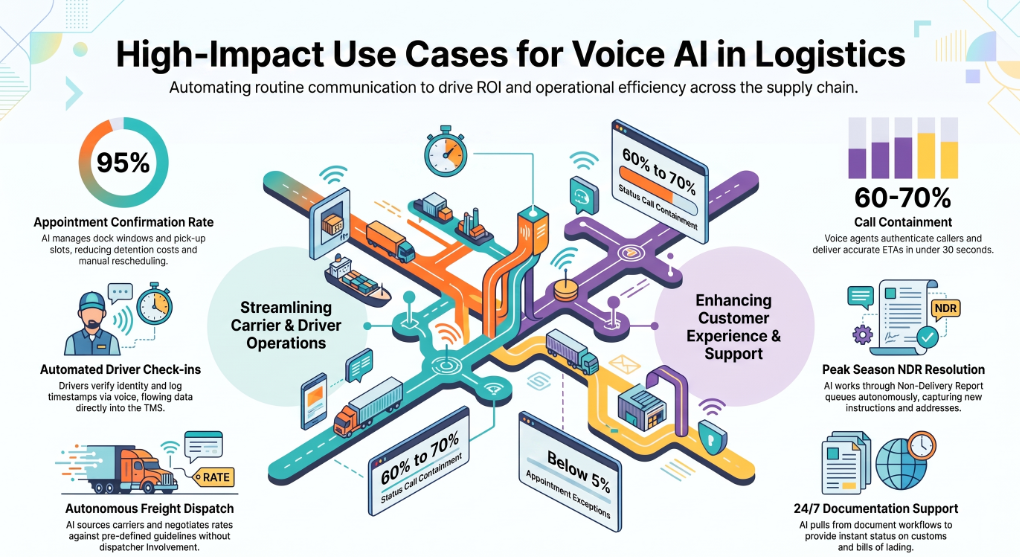
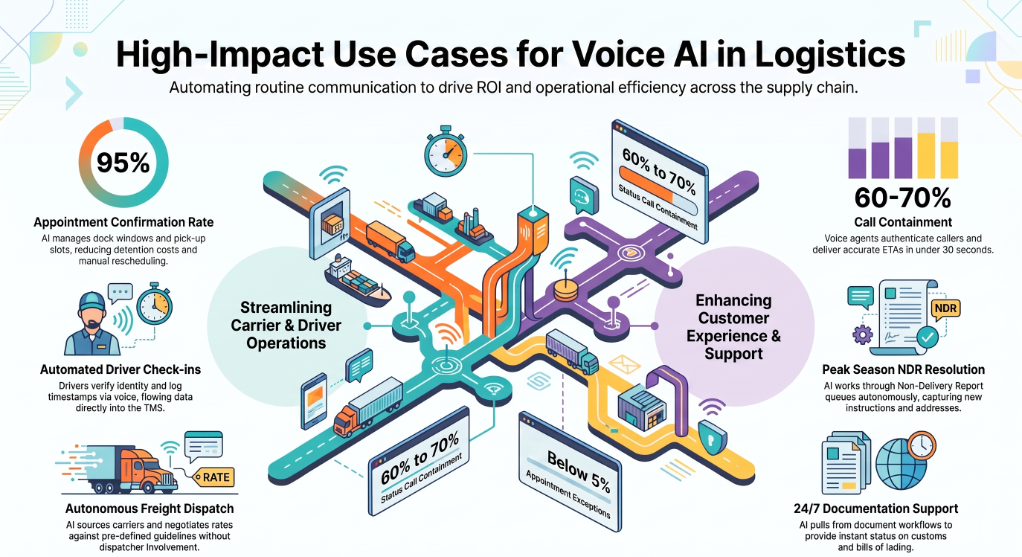
The single largest inbound category. A voice agent authenticates the caller by PRO, BOL, or account number, pulls live status from the TMS or carrier API, and delivers an accurate ETA in under 30 seconds. Containment rates of 60 to 70 percent on tier-one status calls are the norm.
Freight dispatch and load booking automation
Voice AI handles inbound broker calls, captures load details, checks rate parameters against pre-defined guidelines, and either confirms the booking or transfers to a human. Outbound, the agent sources carriers, engages brokers, and secures loads at target rates without a dispatcher lifting a phone.
Driver check-in, ETA capture and POD confirmation
Drivers call from the yard, cab, or dock. The voice agent verifies identity, confirms load and dock assignment, captures arrival and departure timestamps, logs ETA updates, and prompts for proof-of-delivery confirmation. Every data point flows straight into the TMS.
Delivery appointment scheduling and rescheduling
The voice agent checks available dock or delivery windows in real time, offers options, confirms the slot, and pushes the update into the scheduling system. When a customer misses a delivery, the agent proactively calls back and reschedules — no dispatcher involvement.
Failed delivery follow-up and NDR resolution
Non-delivery reports drown coordinators during peak season. A voice agent works through the NDR queue autonomously — calling recipients, confirming addresses, capturing new instructions, and updating the delivery attempt log. What used to take a team of ten a full day now runs in the background.
Carrier rate negotiation and broker outreach
For freight brokers and 3PLs, outbound rate negotiation calls are constant. AI voice agents handle first-pass negotiations against defined parameters — minimum rate per mile, total distance, commodity type — and escalate only when human judgment is required.
Warehouse and dock appointment coordination
Carriers calling for dock windows, drivers confirming pickup slots, warehouse managers rescheduling appointments — all of it moves to voice AI. Confirmation rates above 95 percent and exception rates below 5 percent are achievable, directly reducing detention costs.
Rider and gig-partner attendance and shift confirmation
For last-mile and quick-commerce operators, morning attendance calls to hundreds of delivery partners is a recurring drag. A voice agent runs the entire attendance sweep in parallel, flags no-shows, and hands the exception list to the ops coordinator before the shift starts.
Customs and documentation status calls
Cross-border logistics generates a constant stream of documentation status inquiries — bills of lading, customs declarations, packing lists, certificates of origin. Voice AI answers these instantly by pulling from document AI workflows, dramatically reducing clearance delays.
After-hours and peak-season overflow handling
Voice AI never sleeps. It absorbs after-hours calls, weekend inquiries, and peak-season spikes without seasonal hiring, keeping SLA compliance intact when traditional call centers cannot keep up.
AI voice agent vs IVR vs live agents: a side-by-side comparison
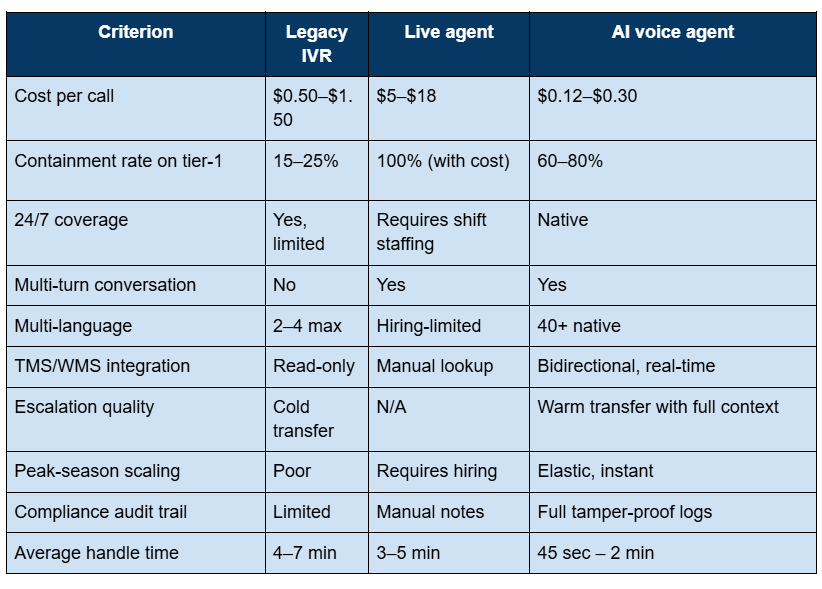
IVR is a phone tree. Live agents are expensive and do not scale. AI voice agents combine the cost profile of automation with the resolution quality of a trained coordinator — and the numbers work at every operational scale.
Enterprise use cases: from ports to last-mile
Voice AI shows its full potential when it operates inside real enterprise supply chains — the kind that span continents, integrate with SAP, and answer to compliance teams. The patterns below are drawn from anonymized Ampcome deployments across the Assistents platform.
Global ports and terminal operator
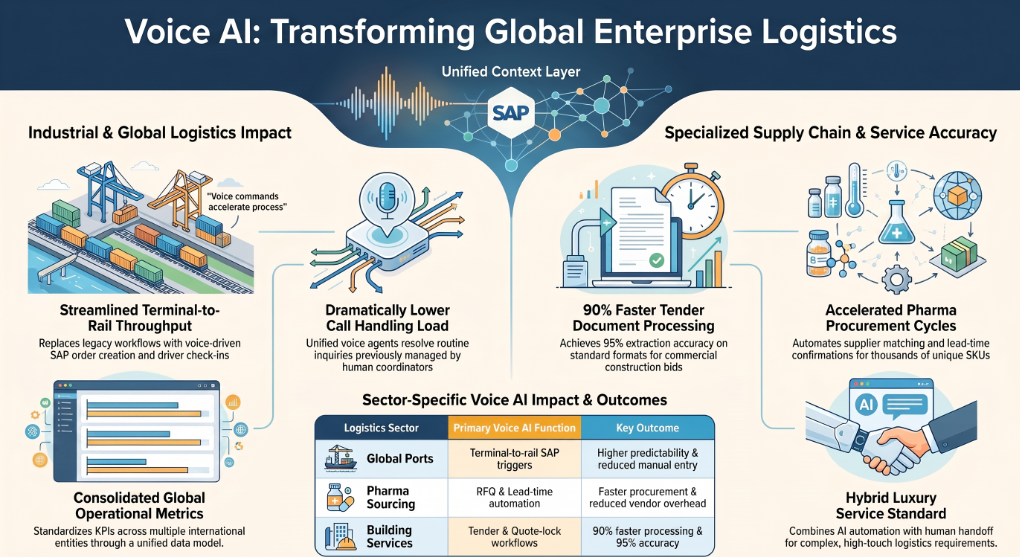
A global ports and logistics leader with a portfolio spanning terminals and inland logistics across six continents needed to modernize terminal-to-rail operations and replace a legacy OpenText ECR workflow that was hitting end-of-life licensing costs. Assistents deployed a terminal and rail management solution combined with an agentic AI sales agent for enterprise account monitoring, plus automated SAP sales order creation via voice and structured triggers. The outcomes: higher predictability of terminal-to-rail throughput, reduced manual order processing, faster order-to-confirm cycles with fewer data entry errors, improved auditability across sales order creation, and higher account coverage without adding headcount. The voice layer became the front door for driver check-ins, terminal exception calls, and executive dashboard alerts.
Multi-country logistics and warehousing group
A large multinational logistics and warehousing company operating across India, the UK, Europe, and the US needed to consolidate analytics across dozens of entities and unify voice-driven customer communication. Assistents deployed a cross-entity KPI standardization layer with consolidated reporting and voice-based customer support agents that pulled from the unified operational data model. The outcomes: a single operational view across entities, faster leadership reporting, improved consistency of operational metrics, and dramatically lower call handling load thanks to voice AI answering the routine questions that previously routed to human coordinators.
Pharma sourcing and supply chain platform
A pharma sourcing platform managing 1,800+ rare excipients and 7,500+ SKUs across a global supplier base deployed voice AI alongside RFQ automation and supplier matching workflows. The voice agent handled inbound supplier calls, quality document status inquiries, and lead-time confirmations. Outcomes: faster procurement cycles, reduced vendor coordination overhead, improved price and lead-time competitiveness through instant insight access, and dramatically fewer manual follow-ups.
Remedial building services and tender processing
A commercial building services specialist with 20+ years in remedial construction needed to process tender documents at high accuracy while running a voice-enabled quote-locking workflow deep-integrated with their operational system. Assistents deployed an intelligent document workbench combined with voice-driven quote lock and audit workflows. Outcomes: engineered for up to 90 percent faster tender document processing, ~95 percent extraction accuracy on standard formats, reduced bid risk through revision detection and auditability, and voice-first quote confirmation for field teams.
Luxury hospitality and travel logistics
A hospitality operator with sixteen boutique properties across multiple countries deployed a digital booking agent that combined voice, email intake, and conversational loops for capturing missing traveler details. Real-time inventory checks, alternative date and property negotiation, and hybrid handoff to human curators for complex itineraries all ran through Assistents. Outcomes: faster booking turnaround, higher accuracy on complex guest requirements, and scalable operations without compromising a luxury service standard — the same operational pattern translates directly to premium 3PL and white-glove logistics.
Across every deployment, the pattern holds: voice AI works when it sits on top of a unified context layer, respects enterprise governance, and integrates cleanly into the systems the operation already runs.
The ROI math: what AI voice agents actually save in logistics
The financial case for AI voice agents in logistics is not speculative. It comes down to three levers: cost per call, containment rate, and coordinator time recovered.
Industry benchmarks put live-agent handling costs for tier-one logistics inquiries at $5 to $18 per call. AI voice agents cost between $0.12 and $0.30 per minute of active conversation. For a typical logistics operation handling 20,000 inbound calls per month with an average handle time of two minutes, the raw math is straightforward. Twenty thousand calls at $8 per call on the live side is $160,000 monthly. The same volume at $0.20 per minute over two minutes is $8,000. The gross voice AI cost is one-twentieth of the live baseline.
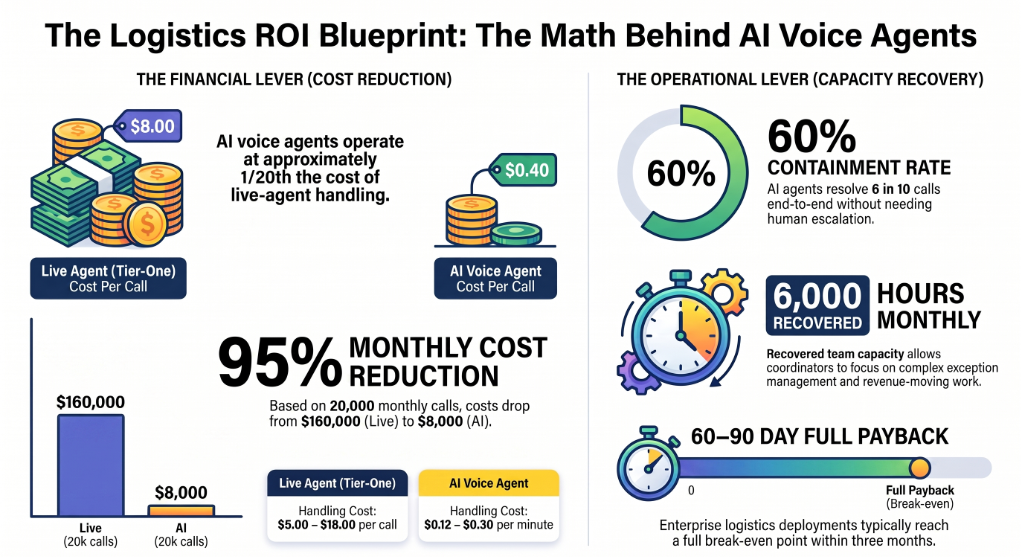
Containment is the second lever. If the voice agent resolves 60 percent of those calls end-to-end without human escalation, the operation saves 12,000 calls worth of coordinator time every month. At an average loaded coordinator cost of $28 per hour and 30 minutes per call including wrap-up, that recovers 6,000 hours of team capacity per month.
The third lever is exception focus. Coordinators freed from routine calls handle the complex work that actually moves revenue — detention disputes, damaged shipment claims, high-value carrier relationships, and demand-side account management.
Ampcome's ROI calculator lets you plug in your call volume, average handle time, and coordinator cost to model the exact savings against your operation. Most enterprise logistics deployments see full payback in 60 to 90 days.
How to choose an AI voice agent platform for logistics
Not every voice AI platform is built for enterprise logistics. Buyers evaluating platforms should check the following criteria before shortlisting.
Latency. Sub-300ms round-trip latency is table stakes. Anything slower breaks the conversational feel and drives caller abandonment. Ask vendors for measured p95 latency numbers, not marketing averages.
Concurrent call capacity. Peak-season logistics operations spike to thousands of simultaneous calls. Serious enterprise platforms handle 10,000+ concurrent calls without degradation.
Integration depth. Read-only integration is not enough. The voice agent needs to write back to the TMS, update the WMS, close the ERP ticket, and log the compliance event. Insist on bidirectional integration with at least SAP TM, Oracle TMS, Manhattan, Blue Yonder, MercuryGate, and the major carrier APIs.
Multi-language and code-switching. Global logistics runs across languages. Confirm 40-plus language coverage with mid-call language switch — a driver moving from Hindi to English or an ops manager toggling from Arabic to English should not restart the conversation.
Compliance. SOC 2 Type II, HIPAA, PCI-DSS, GDPR, TCPA, and regional data protection standards should be in-scope, not on the roadmap. Ask for current audit reports.
Governance layer. Full audit trails, PII redaction, role-based access, configurable retention policies, and VPC or on-premise deployment options separate serious enterprise platforms from consumer-grade voice AI tools.
Human handoff quality. Cold transfers destroy customer trust. The platform must pass full conversation context, caller identity, and intent history to the human agent on escalation.
Build vs buy vs configure. For most logistics operators, configuring a pre-built enterprise platform is the fastest path to production. Building from raw APIs takes months. Buying a rigid vertical solution creates vendor lock-in. Platforms like Assistents that combine pre-built agent templates with a no-code builder and open APIs hit the middle correctly.
Why Assistents by Ampcome is the enterprise choice for AI voice agents in logistics
Assistents is the agentic intelligence platform built for enterprises that need governed, real-time AI voice agents across mission-critical logistics operations. It is not a call center point solution. It is the platform that unifies voice AI, conversational agents, autonomous agents, and business intelligence on infrastructure the customer controls.
Sub-300ms latency, 10,000+ concurrent calls, 99.9 percent uptime, 40+ languages. The technical baseline matches or beats every specialist voice AI vendor in the market, without giving up the platform depth needed for real logistics workflows.
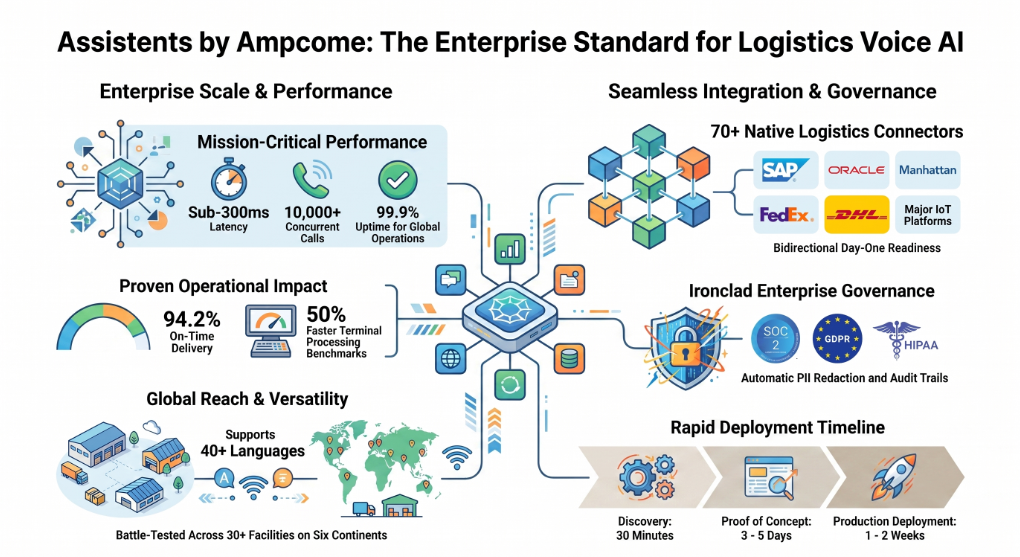
Native pre-built connectors for the systems logistics actually runs on. SAP TM, Oracle TMS, MercuryGate, Manhattan, Blue Yonder, Körber, SAP S/4HANA, Oracle ERP, Microsoft Dynamics, FedEx, UPS, DHL, Maersk, Samsara, Geotab, and CalAmp — 70-plus integrations in total, bidirectional, ready on day one.
Context Engine. Assistents unifies TMS, WMS, ERP, carrier, and IoT data into a single semantic logistics data model. Voice agents act on that unified context — not on a stitched-together prompt. This is why deployments across ports, terminals, and multi-facility operations hit 94.2 percent on-time delivery and 50 percent faster terminal processing benchmarks.
Governance layer built in. SOC 2 Type II, HIPAA, PCI-DSS, GDPR, and TCPA compliance are default. Every voice interaction generates a tamper-proof audit trail. PII redaction is automatic. VPC and on-premise deployment options let regulated logistics operators keep data inside their perimeter.
Battle-tested at global scale. Assistents has powered agentic deployments across 30-plus facilities and six continents, spanning ports and terminal operators, multi-country 3PLs, pharma supply chains, retail distribution, and remedial services — the reference pattern is proven across the exact operational profiles enterprise logistics leaders run.
No vendor lock-in. Bring your own model. Bring your own carrier. Bring your own telephony. Assistents orchestrates it all inside a single governed platform.
Deploy in days, not months. Discovery in 30 minutes. Proof of concept in 3 to 5 days. Production deployment in 1 to 2 weeks. Compare that to the multi-quarter integration timelines of legacy vendors.
Why Ampcome delivers what off-the-shelf voice AI cannot
Ampcome is not a voice AI vendor bolting on integrations after the fact. Ampcome is an enterprise systems and AI implementation firm that built Assistents to solve the problems its enterprise clients kept hitting on projects that spanned SAP, Oracle, Manhattan, and Blue Yonder deployments. That heritage shows up in three ways.
Deep enterprise integration expertise. The team has shipped SAP sales order automation, terminal-to-rail workflow digitization, and multi-country analytics consolidation for logistics operators at genuine global scale. When integration matters, generic voice AI vendors get stuck. Ampcome does not.
On-the-ground implementation across India, UAE, US, and the UK. Voice AI for logistics is a global problem. Ampcome delivers with implementation muscle in every major logistics geography — critical for regulated cross-border deployments.
Purpose-built for regulated and complex workflows. Ports, customs, pharma sourcing, remedial services, and multi-entity retail supply chains all appear in the Assistents production reference base. If the operation involves compliance, audit, or cross-border data, Ampcome has run the play before.
How to deploy an AI voice agent for logistics: step by step
The deployment path for an enterprise AI voice agent for logistics does not need to be a multi-quarter transformation program. The following six steps are the playbook Assistents deployments follow.
Step 1: Map the highest-volume tier-one call category. Log inbound status, outbound confirm, delay notice, exception, and AR reminder volumes for one month. Estimate coordinator hours per category. Target the largest bucket first.
Step 2: Choose the voice stack. Select speech-to-text, LLM, and text-to-speech providers based on latency, language coverage, and cost. Assistents supports Deepgram, Azure, Whisper, GPT-4, Claude, Gemini, ElevenLabs, Cartesia, and Azure TTS out of the box.
Step 3: Wire integrations. Connect the TMS, WMS, ERP, and carrier APIs through the Context Engine. Bidirectional read/write is essential.
Step 4: Set governance and escalation rules. Define confidence thresholds, PII redaction rules, compliance guardrails, and warm-transfer criteria. Configure the audit log retention policy.
Step 5: Pilot one workflow, measure containment. Ship the first agent — typically inbound shipment status or driver check-in. Measure containment rate, average handle time, and CSAT against the live-agent baseline.
Step 6: Scale to adjacent workflows. Once containment holds above 60 percent, extend to the next call category. Most Assistents customers add 3 to 5 workflows in the first quarter.
Timeline: 30-minute discovery, 3 to 5 days for proof of concept, 1 to 2 weeks to production for the first workflow.
Common concerns and how to address them
Will drivers and customers accept a voice AI? Industry data on adoption shows callers accept voice AI when answers are accurate and escalation is instant. They reject it when the data is wrong or there is no path to a human. Get the integration and escalation logic right, and acceptance is not the bottleneck.
What about accents and multi-language operations? Assistents supports 40-plus languages with mid-call language switching. Custom acoustic models can be trained on regional accents and logistics jargon for maximum accuracy.
What if the AI gets it wrong? Confidence-based escalation triggers a warm transfer to a human agent with full conversation context. The customer never repeats themselves.
How do we stay compliant? SOC 2 Type II, HIPAA, PCI-DSS, GDPR, and TCPA compliance are default. VPC or on-premise deployment keeps data inside your perimeter. Full audit trails satisfy internal and external auditors.
What happens during peak season? Voice AI scales elastically. There is no capacity planning conversation. Ten thousand concurrent calls one day, twenty thousand the next — the platform absorbs it.
The future of AI voice agents in logistics: 2026 and beyond
Voice AI in logistics is moving from a call-deflection tool to an execution layer. Three trends will define the next 18 months.
Agentic voice — agents that act, not just talk. The line between voice AI and autonomous agent is disappearing. The next generation of voice AI will negotiate rates, book loads, update SAP, dispatch drivers, and close tickets — all inside a single conversation. Assistents' agentic architecture is already there.
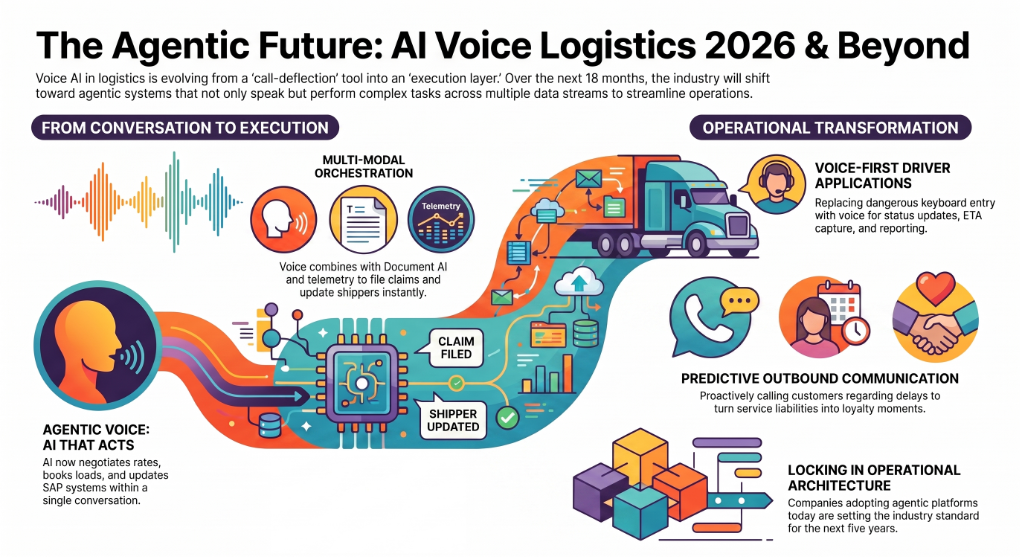
Multi-modal orchestration. Voice will combine with document AI and telemetry ingestion. A driver reports damage by voice, uploads a photo, the agent reads the BOL from a document, checks the sensor log, files the claim, and updates the shipper — all in a single interaction.
Voice-first driver applications. Keyboard entry from the cab is dangerous and slow. Voice will replace it for status updates, ETA capture, and exception reporting.
Predictive outbound. Voice AI will proactively call customers before they call to ask — "your shipment is delayed by 90 minutes, would you like to reschedule?" — turning a service liability into a loyalty moment.
The operators building on top of platforms like Assistents today are locking in the operational architecture the industry will spend the next five years catching up to.
Ready to see an AI voice agent for logistics running on your data?
Bring one workflow to a discovery call — inbound shipment tracking, driver check-in, dispatch coordination, or after-hours overflow — and see how Assistents by Ampcome deploys a voice agent against your TMS, WMS, or carrier stack. Custom architecture review and ROI hypothesis delivered within 48 hours.
Schedule a demo: https://assistents.ai/contact
Explore the platform: https://assistents.ai/product/voice-ai
Logistics solutions overview: https://assistents.ai/solutions/logistics
FAQs
What is an AI voice agent for logistics?
An AI voice agent for logistics is autonomous software that conducts real phone conversations to handle shipment tracking, dispatch, driver check-ins, delivery scheduling, and carrier calls. It combines speech-to-text, a large language model, text-to-speech, and integrations with TMS, WMS, ERP, and carrier APIs to resolve calls end-to-end without a human coordinator.
How does an AI voice agent work in a logistics company?
The agent answers or places calls, transcribes speech in real time, understands intent using a large language model, retrieves live data from the TMS or WMS, executes actions like booking, rescheduling, or ticket creation, and responds in a natural voice — all within sub-300ms latency. Complex cases are escalated to human coordinators with full context.
What can an AI voice agent automate in logistics?
Voice AI automates shipment tracking (WISMO), freight dispatch, load booking, driver check-ins, delivery scheduling and rescheduling, failed delivery follow-up, carrier rate negotiation, dock and warehouse appointment coordination, rider attendance calls, customs status inquiries, and after-hours overflow handling.
Can AI voice agents integrate with TMS and WMS systems?
Yes. Enterprise voice AI platforms like Assistents ship with bidirectional pre-built connectors for SAP TM, Oracle TMS, MercuryGate, Manhattan, Blue Yonder, Körber, SAP S/4HANA, and major carrier APIs — 70-plus integrations in total. The voice agent reads and writes to these systems in real time during the call.
How much does an AI voice agent for logistics cost?
Voice AI costs typically run between $0.12 and $0.30 per minute of active conversation, compared to $5 to $18 per call for live agents. Total cost depends on call volume, integration depth, and language coverage. Most enterprise logistics deployments see full payback in 60 to 90 days.
Is voice AI better than IVR for logistics support?
Yes, in every measurable dimension. IVR forces callers through rigid menu trees with 15 to 25 percent containment on tier-one issues. Voice AI handles multi-turn conversations, integrates deeply with logistics systems, and reaches 60 to 80 percent containment while cutting average handle time by more than half.
What languages do AI voice agents support?
Enterprise-grade platforms support 40 or more languages with automatic detection and mid-call language switching. This is critical for global logistics networks spanning India, the Middle East, Europe, and North America, where customers and drivers move between languages inside a single conversation.
How long does it take to deploy a voice AI agent in logistics?
On Assistents, a discovery call takes 30 minutes, a proof of concept ships in 3 to 5 days, and the first workflow goes to production in 1 to 2 weeks. Additional workflows layer on top of the same integration and governance foundation, typically at 1-week increments.
Are AI voice agents secure and compliant for enterprise logistics?
Enterprise platforms like Assistents are SOC 2 Type II, HIPAA, PCI-DSS, GDPR, and TCPA compliant by default. Every voice interaction generates a tamper-proof audit trail. PII is automatically redacted. VPC and on-premise deployment options are available for regulated operations.
Can a voice AI agent handle inbound and outbound calls simultaneously?
Yes. A single deployment handles both directions. Inbound: shipment status, driver check-ins, appointment scheduling. Outbound: failed delivery follow-up, rate negotiation, attendance calls, proactive delay notifications. The platform supports 10,000-plus concurrent calls with 99.9 percent uptime.

Transform Your Business With Agentic Automation
Agentic automation is the rising star posied to overtake RPA and bring about a new wave of intelligent automation. Explore the core concepts of agentic automation, how it works, real-life examples and strategies for a successful implementation in this ebook.
Sarfraz Nawaz is the CEO and founder of Ampcome, which is at the forefront of Artificial Intelligence (AI) Development. Nawaz's passion for technology is matched by his commitment to creating solutions that drive real-world results. Under his leadership, Ampcome's team of talented engineers and developers craft innovative IT solutions that empower businesses to thrive in the ever-evolving technological landscape.Ampcome's success is a testament to Nawaz's dedication to excellence and his unwavering belief in the transformative power of technology.

More insights
Discover the latest trends, best practices, and expert opinions that can reshape your perspective






-min.jpg)
Contact us

