
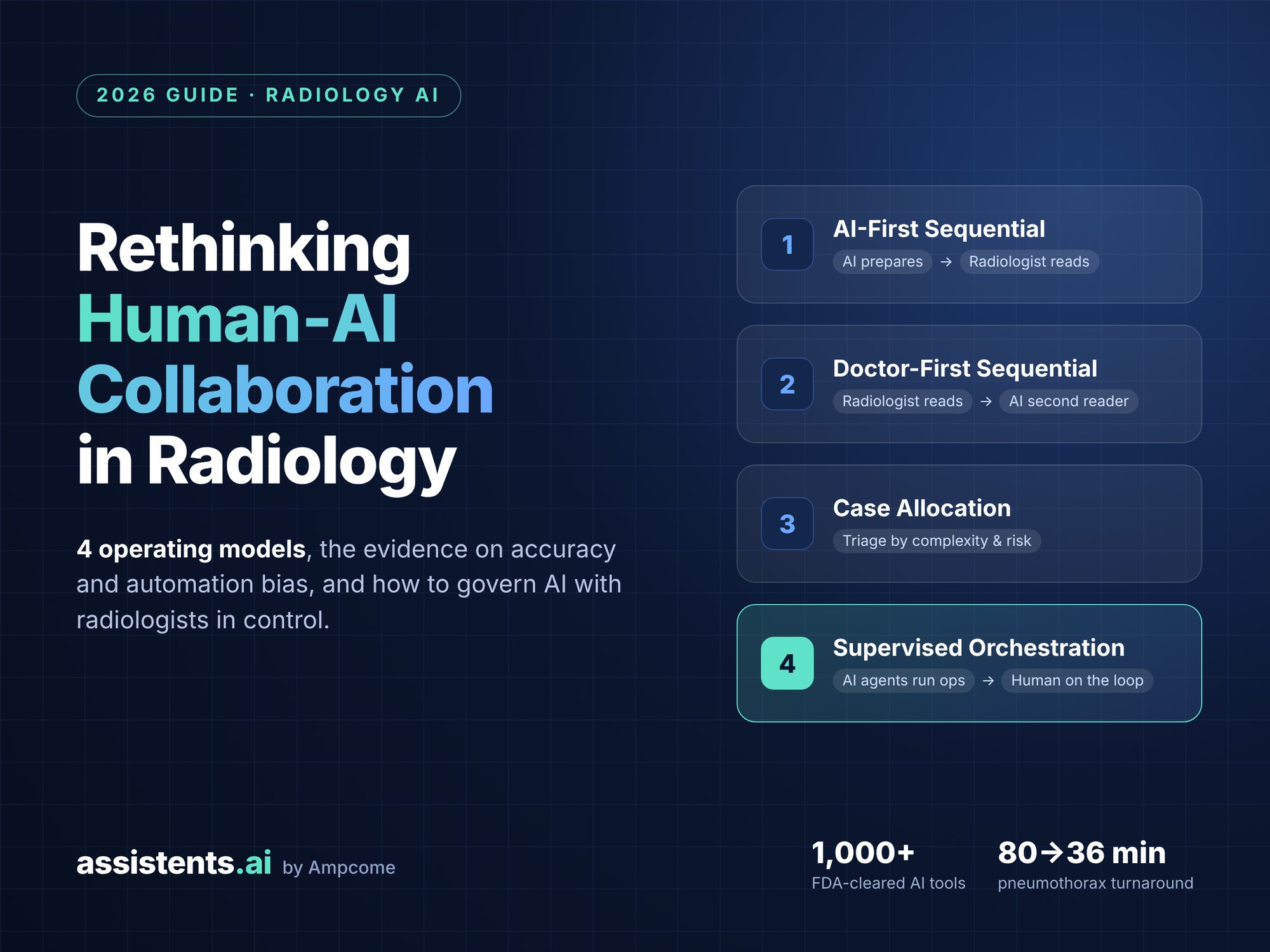
Rethinking Human-AI Collaboration in Radiology: 4 Operating Models, the Evidence, and How to Govern Them


Rethinking human-AI collaboration in radiology means moving past the simple rule of "AI assists, the human decides." Instead, departments design explicit operating models that decide who acts first, which cases AI may handle, when a radiologist must step in, and how every action is governed and audited. This guide breaks down the four operating models, the evidence behind them, and how to put them into practice without losing the radiologist's judgment.
Key takeaways
- The default model is under strain. In February 2026, Radiology published an editorial titled Rethinking Human-AI Collaboration in Radiology by Shirangi, Pittinsky and Gichoya. It argues that bolting AI onto existing reads doesn't automatically produce better care.
- There are four workable operating models: AI-first sequential, doctor-first sequential, case allocation, and supervised orchestration (human-on-the-loop).
- The evidence cuts both ways. AI shortened pneumothorax turnaround from 80.1 to 35.6 minutes in simulation. But trainee accuracy fell from about 80% to about 20% when AI suggestions were wrong (DIR, 2026).
- The biggest unsolved gap is operational, not diagnostic. Worklists, follow-ups, prior authorizations and handoffs are where governed AI agents can return capacity to radiologists.
- Treat autonomy as a contract, not a switch. Define scope, permissions, escalation triggers and a phased rollout for every AI task.
Why we need to rethink human-AI collaboration in radiology
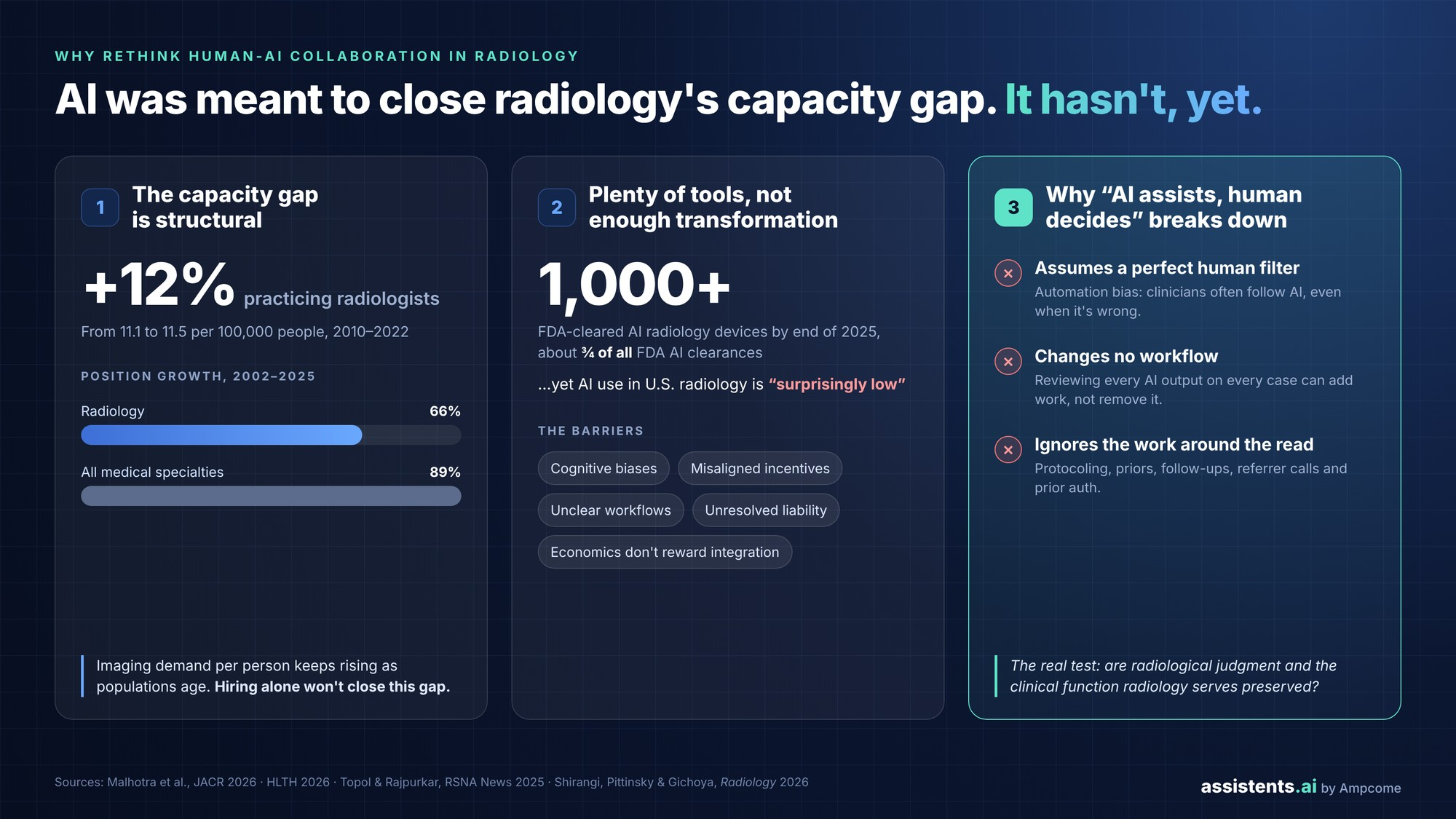
Radiology faces a capacity gap that AI was supposed to close. Even with more than 1,000 FDA-cleared AI devices, adoption remains low. The usual "AI assists, human decides" model often adds clicks, cognitive load and liability anxiety without changing how work flows.
The capacity gap is structural
A 2026 study in the Journal of the American College of Radiology (Malhotra et al., summarized by News-Medical) found:
- Practicing radiologists grew by only 12% between 2010 and 2022, from 11.1 to 11.5 per 100,000 people.
- From 2002 to 2025, radiology positions grew 66%, compared with 89% across all medical specialties.
Meanwhile, imaging demand per person keeps rising as populations age. Hiring alone won't close this gap.
Plenty of tools, not enough transformation
More than 1,000 AI-enabled radiology devices had been cleared by the FDA by the end of 2025, about three-quarters of all AI clearances the agency has issued (HLTH, 2026). Yet Eric Topol and Pranav Rajpurkar describe AI penetration in U.S. radiology as "surprisingly low" (RSNA News). The barriers they name are telling:
- cognitive biases, from ignoring AI to over-relying on it
- misaligned incentives
- unclear workflows
- unresolved liability
- economic models that don't reward integration
Why "AI assists, human decides" breaks down
The phrase sounds safe, but it hides three problems:
- It assumes the human is a perfect filter. Research on automation bias shows clinicians often follow AI, including when it's wrong.
- It changes no workflow. If a radiologist must still review every AI output on every case, AI can add work instead of removing it.
- It ignores the work around the read. Protocoling, prior retrieval, follow-up tracking, referrer communication and prior authorization consume capacity that no pixel-level algorithm touches.
As one analysis of the 2026 editorial puts it, the real test isn't whether radiologists keep their tasks. It's whether radiological judgment, and the clinical function radiology serves, are preserved.
What is human-AI collaboration in radiology?
Definition: Human-AI collaboration in radiology is the deliberate division of imaging work between radiologists and AI systems. Each party is assigned the tasks it does best, with clear rules for who acts first, when humans review, and how decisions are audited. The goal is team performance that exceeds what either achieves alone.
Four concepts frame every collaboration design:
- Diagnostic complementarity: Human plus AI can outperform either alone, but only when roles are clearly defined (DIR, 2026).
- Calibrated trust: The best outcomes come between two failure modes: automation bias (over-trust) and algorithm aversion (under-trust).
- Human-in-the-loop: The radiologist reviews and signs off on every AI output.
- Human-on-the-loop: AI runs continuously, and the radiologist supervises and steps in on exceptions or drift. In a third option, human-off-the-loop, AI handles narrowly defined low-risk categories on its own, with background quality assurance.
The 4 operating models for radiologists and AI
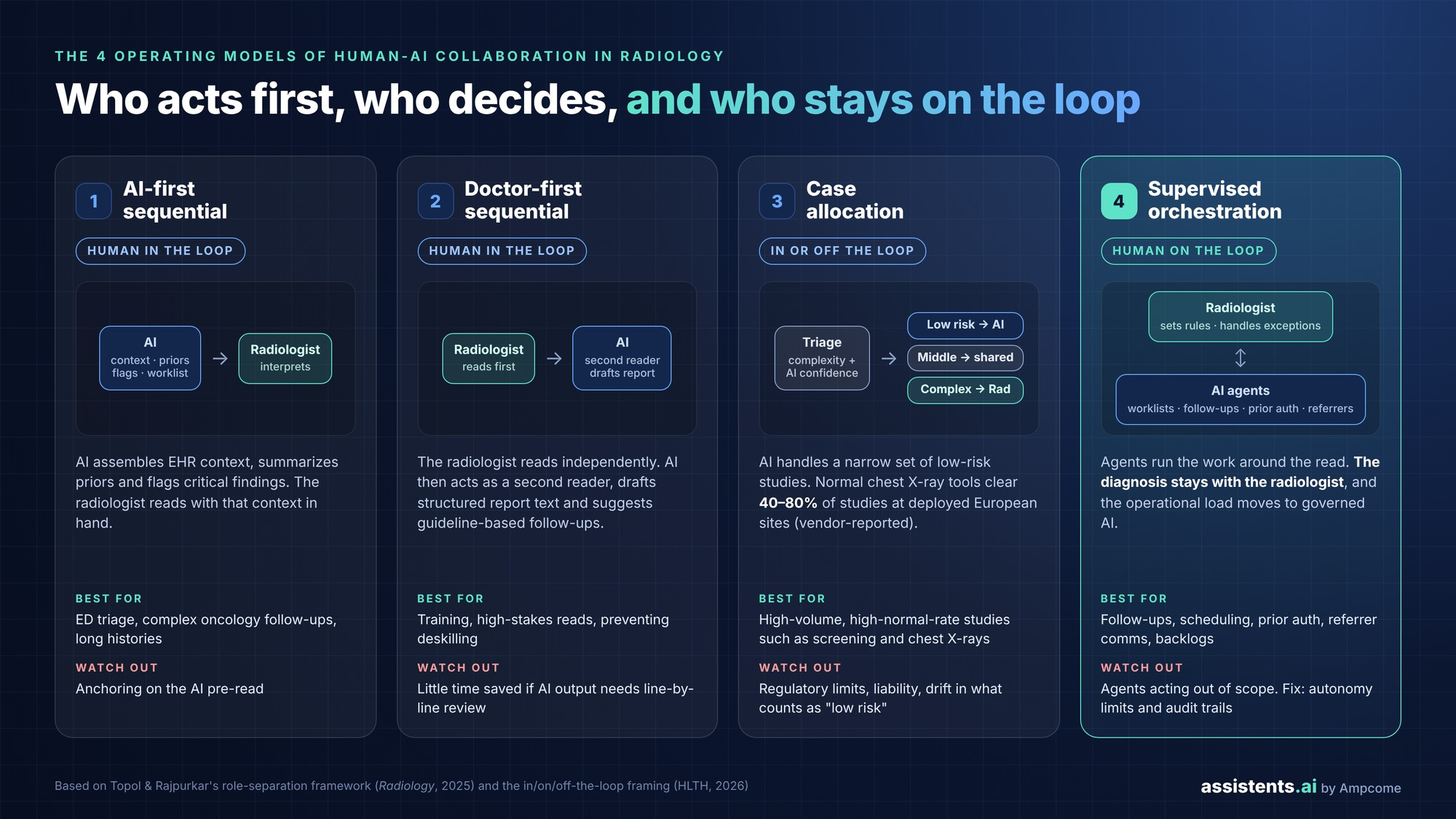
Most departments will run several of these models at once, each matched to a task. Building on Topol and Rajpurkar's role-separation framework and the in-, on- and off-the-loop framing, these are the 4 operating models of human-AI collaboration in radiology.
Model 1: AI-first sequential
AI goes first. It assembles clinical context from the EHR, retrieves and summarizes priors, flags critical findings, and reorders the worklist. The radiologist then interprets the study with that context in hand.
- Best for: emergency triage, complex oncology follow-ups, studies with long histories
- Watch out for: anchoring, where an AI pre-read shapes the radiologist's first impression
Model 2: Doctor-first sequential
The radiologist reads independently first. AI then acts as a second reader, drafts structured report text, and suggests follow-up recommendations aligned with guidelines.
- Best for: training environments, high-stakes reads, protecting against deskilling
- Watch out for: limited time savings if the AI output still needs line-by-line review
Model 3: Case allocation
Cases are triaged by complexity and AI confidence. AI handles a narrowly defined set of low-risk studies, radiologists take the complex ones, and the middle band is shared. In Europe, autonomous tools for normal chest X-rays already clear 40–80% of studies at deployed sites, according to vendor-reported figures cited by HLTH.
- Best for: high-volume, high-normal-rate studies such as screening and chest radiography
- Watch out for: regulatory limits, liability, and drift in what counts as "low risk"
Model 4: Supervised orchestration (human-on-the-loop)
AI agents run the work around the read: routing worklists, closing the loop on incidental findings, chasing missing clinical history, preparing prior authorizations, and notifying referrers. Radiologists define the rules and handle exceptions. The diagnosis stays with the radiologist, and the operational load moves to governed AI.
- Best for: follow-up tracking, scheduling, prior authorization, referrer communication, backlog management
- Watch out for: agents acting outside their scope. The fix is enforced autonomy limits and audit trails (see the governance section below).
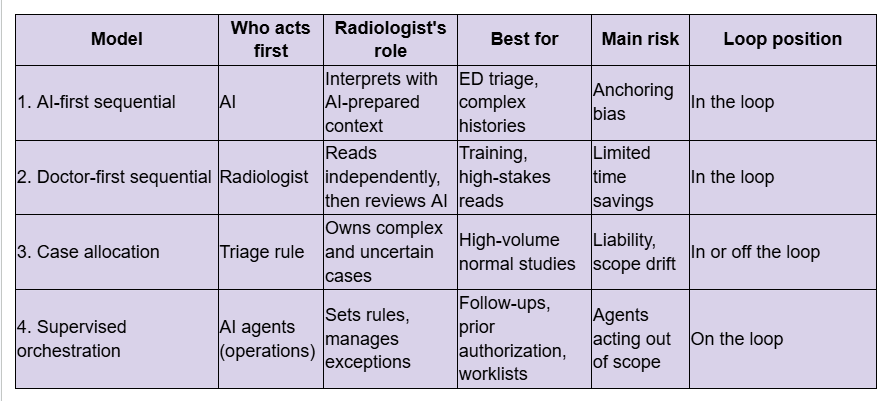
Comparison: the 4 operating models
What the evidence says: where collaboration helps and where it hurts
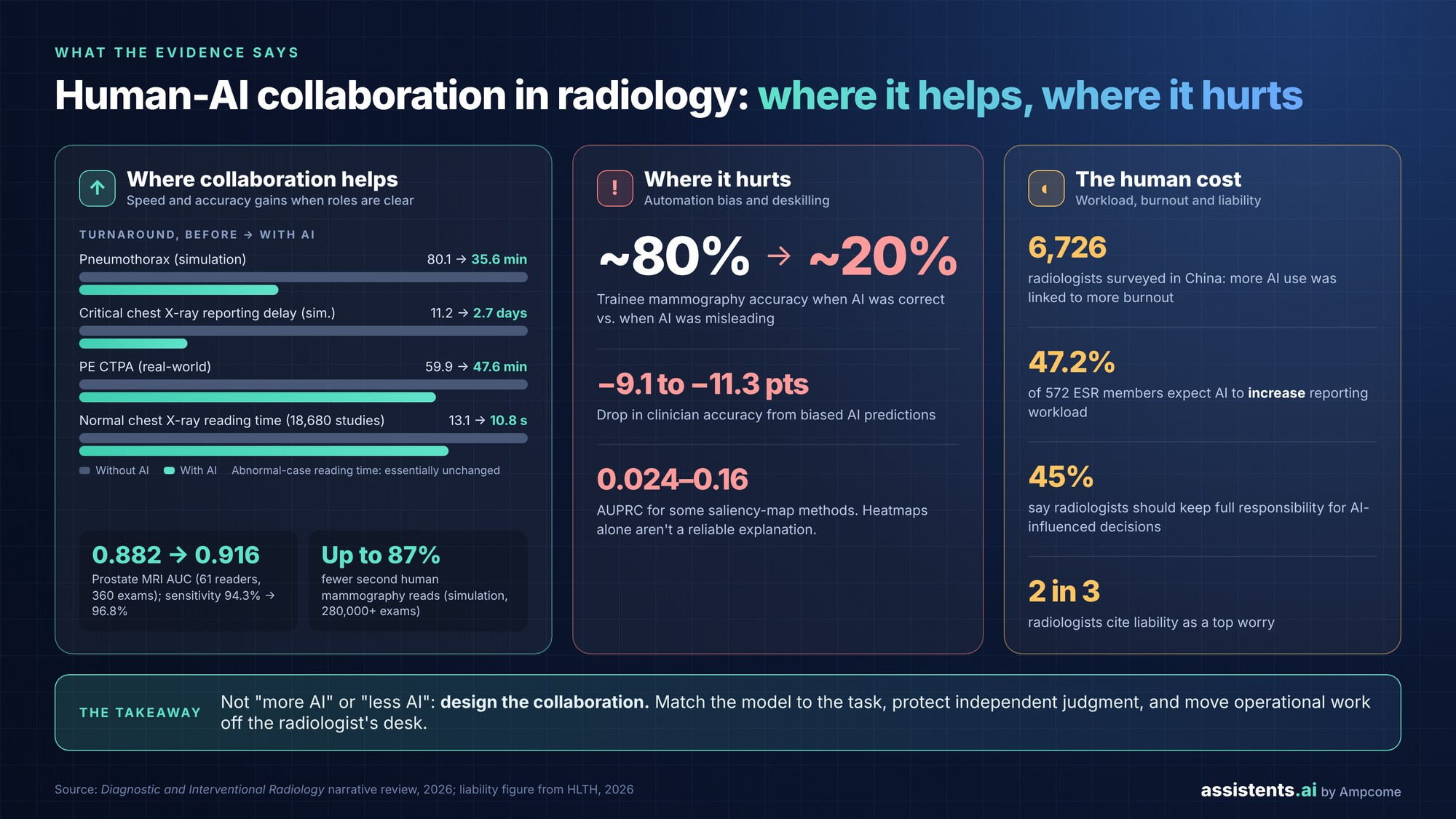
Human-AI collaboration in radiology improves speed and some accuracy measures when roles are clear. It can also lower accuracy through automation bias and add to workload when tools are poorly integrated. The figures below come from the 2026 narrative review in Diagnostic and Interventional Radiology unless otherwise noted.
Where collaboration helps
- Prostate MRI (61 readers, 360 exams): AUC improved from 0.882 to 0.916 with AI support, and sensitivity rose from 94.3% to 96.8%.
- Triage speed: Pneumothorax turnaround fell from 80.1 to 35.6 minutes (simulation). Pulmonary embolism CTPA turnaround fell from 59.9 to 47.6 minutes in a real-world setting. Reporting delays for critical chest X-rays fell from 11.2 to 2.7 days (simulation).
- Mammography: With AI as a supporting reader, up to 87% fewer cases needed a second human read in a simulation covering more than 280,000 exams. With AI as an additional reader, 0.7–1.6 extra cancers were detected per 1,000 women screened.
- Reading time (18,680 chest X-rays): Normal-case reading time fell from 13.1 to 10.8 seconds, while abnormal cases were essentially unchanged. AI saves time mainly on the easy cases.
Where collaboration hurts: automation bias and deskilling
- Mammography: Trainee accuracy dropped from about 80% when AI was correct to about 20% when AI was misleading.
- Biased AI predictions: These reduced clinician accuracy by about 9.1–11.3 percentage points.
- Explainability: Saliency maps localized findings poorly for some methods, with AUPRC as low as 0.024–0.16. Heatmaps alone aren't a reliable explanation interface.
The human cost: workload and burnout
- In a nationwide survey of 6,726 radiologists in China, greater AI use was linked to more emotional exhaustion and burnout.
- In a survey of 572 European Society of Radiology members, 47.2% expected AI to increase reporting workload, and 45% said radiologists should retain full responsibility for decisions influenced by AI.
- Two-thirds of radiologists cite liability as a top worry (HLTH).
The takeaway: The evidence doesn't say "use more AI" or "use less AI." It says to design the collaboration. Choose the model per task, protect independent judgment where it matters, and move repetitive operational work off the radiologist's desk.
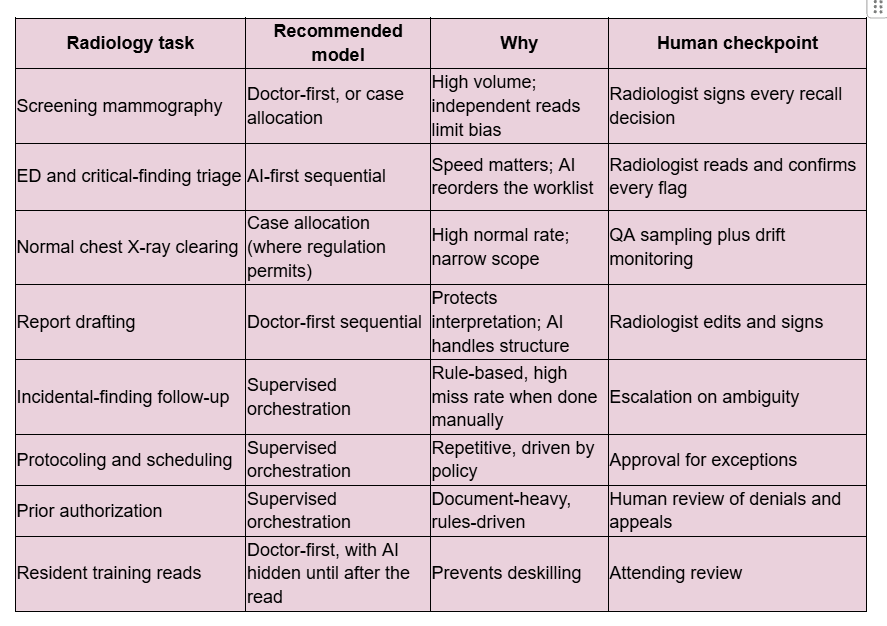
How to choose the right human-AI model for each radiology task
Match the model to the task's risk, volume and need for independent judgment. Diagnosis-heavy tasks keep the radiologist in the loop, while operational tasks can move on the loop under governed agents.
Want a deeper look at individual AI use cases? See our guide to AI agents in medical imaging use cases.
Governing human-AI collaboration: autonomy, accountability and audit
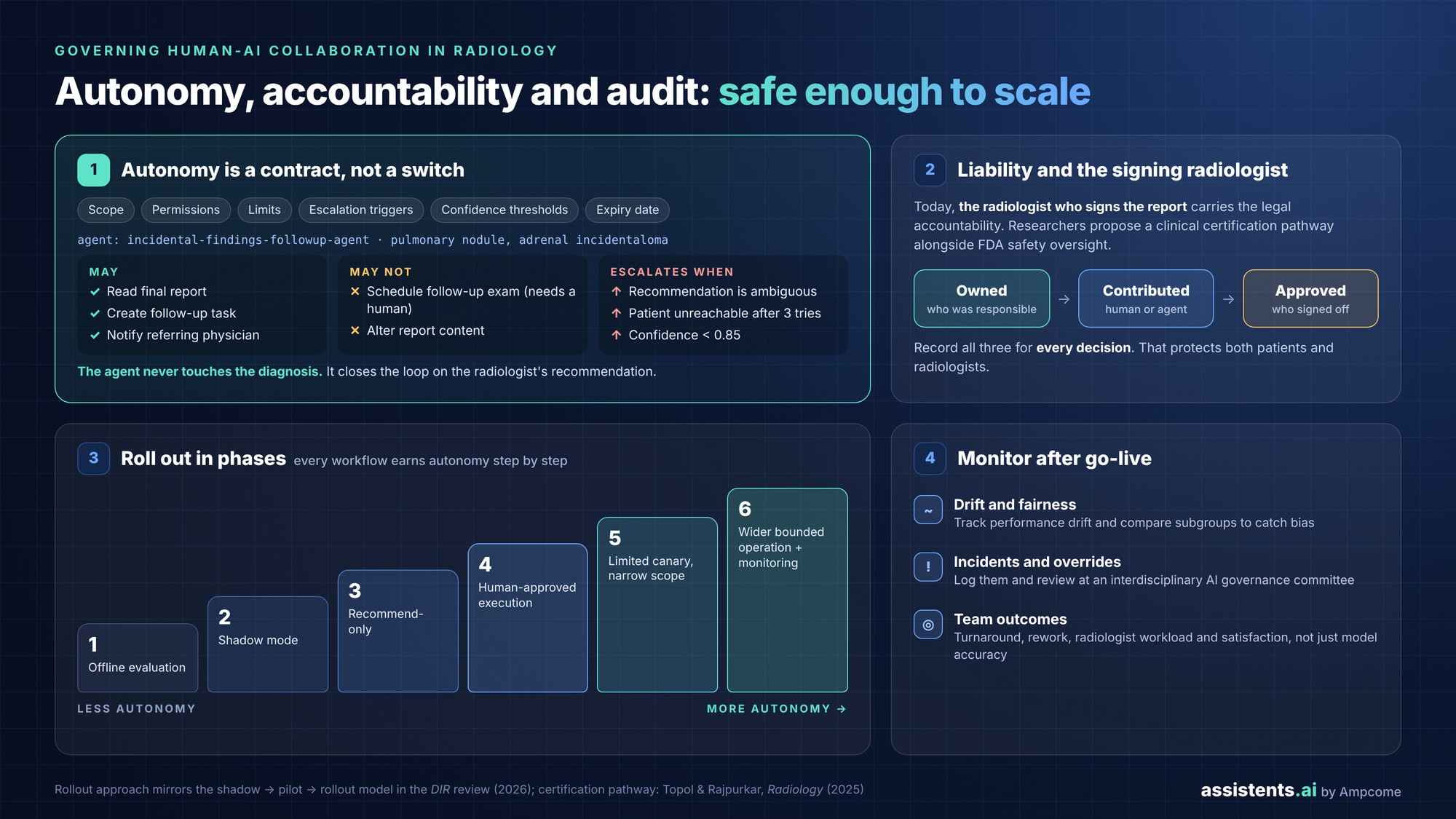
Governance makes human-AI collaboration safe enough to scale. It defines what each AI system may do, when it must escalate, who is accountable, and how performance is monitored after go-live.
Autonomy is a contract, not a switch
Autonomy shouldn't be a single on/off setting. It should be a bounded contract that defines:
- scope (which finding types and which work)
- permissions (what the agent may and may not do)
- limits
- escalation triggers
- confidence thresholds
- an expiry date
Here's an example for an agent that tracks follow-up on incidental findings:
agent: incidental-findings-followup-agent
work_type: recommended_followup_tracking
scope:
finding_types: [pulmonary_nodule, adrenal_incidentaloma]
permissions:
read_final_report: true
create_followup_task: true
notify_referring_physician: true
schedule_followup_exam: false # human approval required
alter_report_content: false
escalate_when:
- recommendation_ambiguous
- patient_unreachable_after_3_attempts
- confidence_below_0_85
rollout: shadow_mode -> recommend_only -> human_approved -> limited_autonomy
The agent never touches the diagnosis. It closes the loop on the radiologist's recommendation, within limits the department sets.
Roll out in phases
Every material AI workflow should earn autonomy step by step. This mirrors the shadow, pilot and rollout approach recommended in the DIR review.
- Offline evaluation on historical cases
- Shadow mode: AI runs silently alongside humans
- Recommend-only: AI prepares the work and humans act on it
- Human-approved execution
- Limited autonomous canary on a narrow scope
- Wider bounded operation, with continuous monitoring
Liability and the signing radiologist
Today the radiologist who signs the report carries the legal accountability. Topol and Rajpurkar propose a clinical certification pathway for workflow integration alongside FDA safety oversight. Until that exists, keep a clear record of who owned, contributed to and approved every decision. A system that can show this distinction protects both patients and radiologists.
Monitor for drift, fairness and burnout
- Track performance drift, and compare subgroup performance to catch bias.
- Log incidents and overrides, and review them at an interdisciplinary AI governance committee.
- Measure team outcomes, not just model accuracy: turnaround, rework, radiologist workload and satisfaction.
Where agentic AI fits: the operations layer around the read
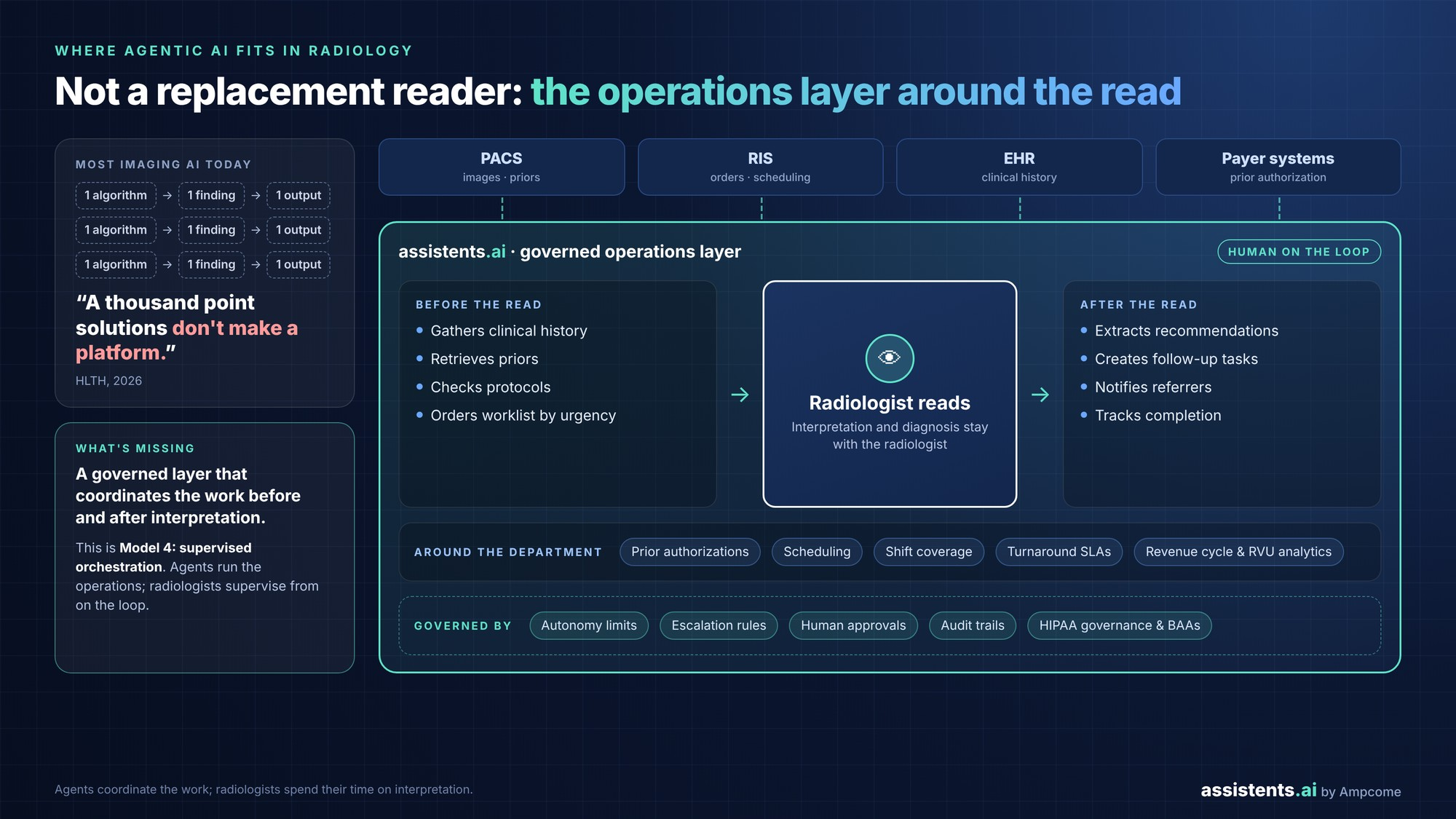
Agentic AI in radiology works best as an operations layer, not a replacement reader. Agents coordinate the work before and after interpretation, connecting PACS, RIS, EHR and payer systems so radiologists spend their time on interpretation.
Most imaging AI today is a point solution: one algorithm, one finding, one output. As the HLTH analysis puts it, a thousand point solutions don't make a platform. What's missing is a governed layer that:
- before the read: gathers clinical history, retrieves priors, checks protocols and orders the worklist by urgency
- after the read: extracts recommendations, creates follow-up tasks, notifies referrers, and tracks completion
- around the department: handles prior authorizations, scheduling, shift coverage, turnaround SLAs, and analytics on revenue cycle and RVUs
This is Model 4, supervised orchestration, and it's where assistents.ai is built to operate. For a broader view of agentic AI across care delivery, see agentic AI use cases in healthcare.
Why assistents.ai for radiology workflows
Imaging AI reads pixels. assistents.ai runs the work around them, with the radiologist in control.
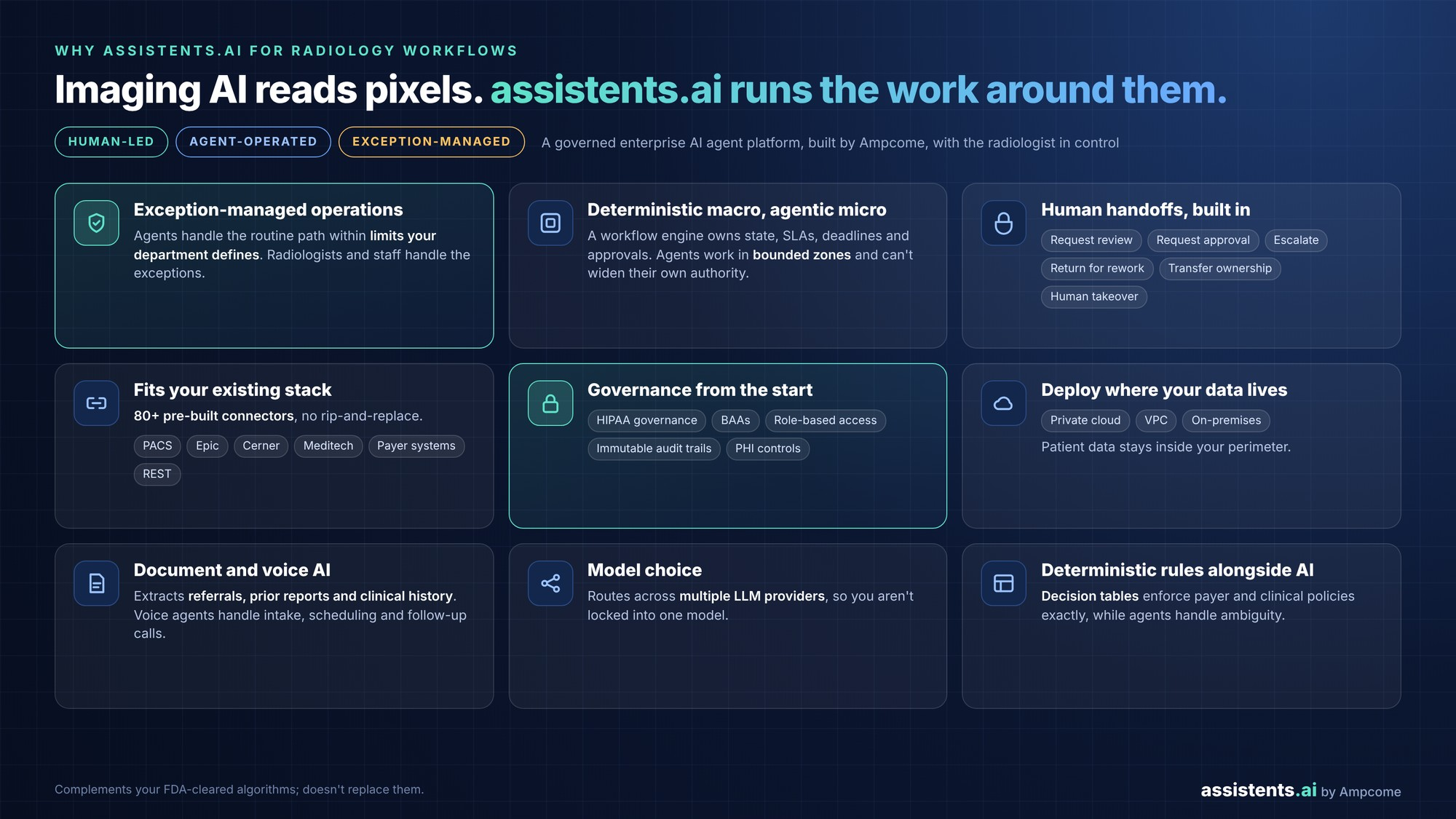
assistents.ai, built by Ampcome, is a governed platform for enterprise AI agents. It's designed for the human-led, agent-operated, exception-managed model that radiology needs:
- Exception-managed operations: Agents handle the routine path within limits your department defines. Radiologists and staff handle the exceptions.
- Deterministic macro, agentic micro: A workflow engine owns process state, SLAs, deadlines and approvals. Agents work only inside bounded zones and can't widen their own authority.
- Human handoffs as first-class actions: request review, request approval, escalate, return for rework, transfer ownership, and human takeover are built in.
- Fits your existing stack: 80+ pre-built connectors, including PACS, major EHRs (Epic, Cerner, Meditech), payer systems and generic REST, with no rip-and-replace (see integrations).
- Governance built in from the start: HIPAA governance, BAAs, role-based access controls, immutable audit trails and PHI controls.
- Deploy where your data lives: private cloud, VPC or on-premises.
- Document and voice AI: extracts referrals, prior reports and clinical history, and runs voice agents for patient intake, scheduling and follow-up calls.
- Model choice: routes across multiple LLM providers, so you aren't locked into one model.
- Deterministic rules alongside AI: decision tables enforce payer and clinical policies exactly, while agents handle ambiguity.
Proof from regulated, human-in-the-loop deployments
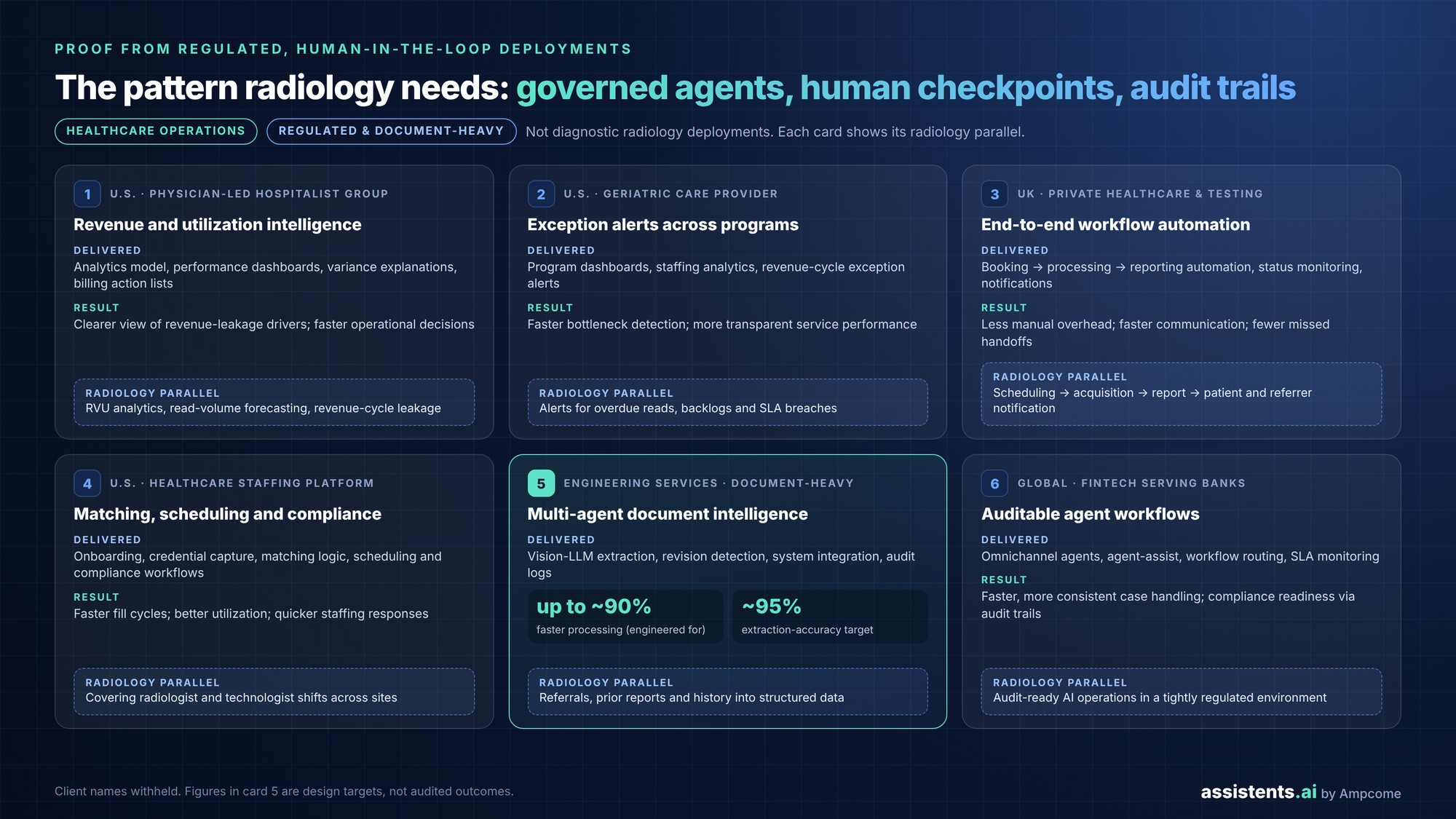
The deployments below come from healthcare operations and other regulated, document-heavy settings, not from diagnostic radiology. They show the same pattern radiology needs: governed agents, human checkpoints and full audit trails.
1. A physician-led U.S. hospitalist group: revenue and utilization intelligence. Ampcome delivered a revenue and utilization analytics model with performance dashboards, variance explanations, and action lists for billing and operational optimization. The result was better visibility into what drives revenue leakage and faster operational decisions through unified reporting. Radiology parallel: RVU analytics, read-volume forecasting and revenue-cycle leakage.
2. A U.S. geriatric care provider: exception alerts across programs. Program dashboards, staffing and service-delivery analytics, and revenue-cycle visibility with exception alerts helped leadership find operational bottlenecks faster and improved transparency into service performance. Radiology parallel: alerts for overdue reads, backlogs and SLA breaches.
3. A UK private healthcare and testing provider: end-to-end workflow automation. Ampcome automated booking-to-processing-to-reporting workflows, with status monitoring, customer notifications and operational dashboards. The result was less manual overhead, faster customer communication and fewer missed handoffs. Radiology parallel: scheduling → acquisition → report → patient and referrer notification.
4. A U.S. healthcare staffing platform: matching, scheduling and compliance. Talent onboarding, credential capture, matching logic, scheduling and compliance workflows delivered faster fill cycles, better workforce utilization and quicker staffing responses for facilities. Radiology parallel: covering radiologist and technologist shifts across sites.
5. A document-heavy engineering services firm: multi-agent document intelligence. An intelligent document workbench with vision-LLM extraction, revision detection, deep system integration and audit logs. It was engineered for up to ~90% faster document processing, with a ~95% extraction-accuracy target on standard formats. Radiology parallel: extracting referrals, prior reports and clinical history into structured data.
6. A global fintech provider serving banks: auditable agent workflows. Omnichannel AI agents with agent-assist, workflow routing, SLA monitoring and full auditability delivered faster, more consistent case handling and better compliance readiness through audit trails. Radiology parallel: audit-ready AI operations in a tightly regulated environment.
Why radiology leaders choose assistents.ai over point solutions
Point solutions answer one clinical question. assistents.ai orchestrates the whole workflow and governs it.
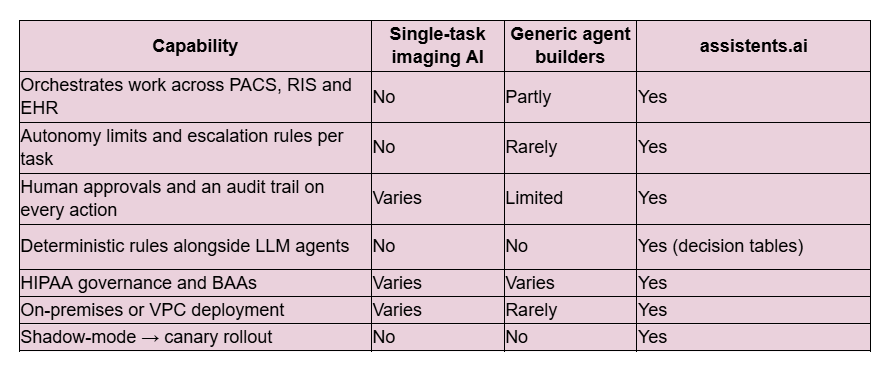
assistents.ai complements your FDA-cleared algorithms; it doesn't replace them. It turns separate AI outputs into a governed, human-supervised workflow.
👉 Book a radiology workflow assessment to map which of your workflows fit each of the 4 models, and where agents can return capacity to your radiologists first.
Conclusion: from AI tools to a human-AI operating model
Rethinking human-AI collaboration in radiology isn't about whether to use AI. It's about designing who does what. Keep radiologists in the loop where judgment matters, use case allocation where it's safe, and move the operational burden onto governed AI agents that radiologists supervise from on the loop. Departments that make this shift will recover capacity without giving up quality, accountability or trust.
Ready to design your department's human-AI operating model? Talk to the assistents.ai team or explore more on the Ampcome blog.
References
- Shirangi A, Pittinsky T, Gichoya J. Rethinking Human-AI Collaboration in Radiology. Radiology. 2026;318(2):e252760.
- Topol EJ, Rajpurkar P. Beyond Assistance: The Case for Role Separation in AI-Human Radiology Workflows. Radiology. 2025. See also RSNA News coverage.
- Human–AI interaction and collaboration in radiology: from conceptual frameworks to responsible implementation. Diagnostic and Interventional Radiology. 2026.
- Malhotra A, et al. Radiologist workforce study. Journal of the American College of Radiology. 2026. Summary via News-Medical.
- Hughes P. In the Loop, On the Loop, Off the Loop: Radiology's Next Decade of Agents and Oversight. HLTH. May 2026.
- Applied Radiology: Reimagining AI in Radiology, Clear Role Separation as the Path Forward. July 2025.
- Menon P. Rethinking What 'AI-Assisted' Actually Means in Radiology. February 2026.
FAQs
What is human-AI collaboration in radiology?
Human-AI collaboration in radiology is the deliberate division of imaging work between radiologists and AI. Rules define who acts first, which cases AI may handle, and when a radiologist must review. Done well, the radiologist-plus-AI team outperforms either alone while radiologists keep diagnostic accountability.
Will AI replace radiologists?
No. Current evidence and regulation support AI that reshapes radiologists' work rather than removing it. AI takes on triage, preparation, operational tasks and some narrowly defined normal studies, while radiologists keep interpretation, accountability and complex cases. With radiologist supply growing slowly, AI is mainly a capacity tool.
What are the models of AI integration in radiology?
There are four main models. In AI-first sequential, AI prepares context before the read. In doctor-first sequential, AI acts as a second reader. In case allocation, cases are triaged by complexity. In supervised orchestration, AI agents run the operational work around the read and radiologists manage exceptions.
What is automation bias in radiology?
Automation bias is the tendency to over-trust AI output, even when it's wrong. In one mammography study, trainee accuracy fell from about 80% to about 20% when AI suggestions were misleading. Independent first reads, calibrated confidence scores and AI-literacy training help reduce it.
What is the difference between human-in-the-loop and human-on-the-loop?
With human-in-the-loop, a radiologist reviews and approves every AI output before it takes effect. With human-on-the-loop, AI runs continuously within defined limits, and the radiologist supervises, stepping in when exceptions are raised or performance drifts. Human-on-the-loop suits operational tasks such as follow-up tracking.
How is AI used in radiology today?
AI is used today for triaging critical findings, detection support in mammography, chest imaging and stroke, measurement and quantification, report drafting, and worklist prioritization. Increasingly it also handles operational work such as follow-up tracking, scheduling and prior authorization. More than 1,000 radiology AI devices have been cleared by the FDA.
Who is responsible if AI misses a diagnosis?
Today, legal accountability generally rests with the radiologist who signs the report. That's why governance matters: clear role definitions, audit trails that record who owned and approved each decision, and escalation rules. Researchers have proposed a separate clinical certification pathway for radiology AI.
How many AI tools are FDA-cleared for radiology?
By the end of 2025, the FDA had cleared more than 1,000 AI-enabled radiology devices, about three-quarters of all AI-enabled medical devices it has cleared. Even so, researchers describe actual use in U.S. radiology practice as surprisingly low.
How do you implement AI in a radiology practice?
Start by matching each task to an operating model. Form an interdisciplinary governance committee, then evaluate tools offline. Roll out in phases: shadow mode, recommend-only, human-approved, then limited autonomy. Monitor drift, fairness, workload and turnaround continuously, and train radiologists in AI literacy.

Transform Your Business With Agentic Automation
Agentic automation is the rising star posied to overtake RPA and bring about a new wave of intelligent automation. Explore the core concepts of agentic automation, how it works, real-life examples and strategies for a successful implementation in this ebook.
Sarfraz Nawaz is the CEO and founder of Ampcome, which is at the forefront of Artificial Intelligence (AI) Development. Nawaz's passion for technology is matched by his commitment to creating solutions that drive real-world results. Under his leadership, Ampcome's team of talented engineers and developers craft innovative IT solutions that empower businesses to thrive in the ever-evolving technological landscape.Ampcome's success is a testament to Nawaz's dedication to excellence and his unwavering belief in the transformative power of technology.

More insights
Discover the latest trends, best practices, and expert opinions that can reshape your perspective







Contact us

