
AI Agents in Medical Imaging: 15 Use Cases, Real Examples, and What's Actually Proven in 2026


Key Takeaways
- AI agents in medical imaging are systems that plan and complete multi-step imaging tasks across PACS, RIS and the EHR. They do more than a single model that flags a finding on a scan.
- The most mature agent-like deployments today are critical-finding triage and multi-algorithm orchestration. Fully autonomous diagnostic agents are still mostly research.
- The biggest near-term value is in the imaging workflow: order intake, prior authorization, scheduling, critical result communication and incidental finding follow-up.
- FDA's January 2026 clinical decision support guidance keeps software that analyses medical images in regulated device territory. Workflow agents that never touch the image sit in a different regulatory lane.
- Governance decides whether an imaging agent reaches production: who approves what, what gets logged, and how autonomy increases over time.
Radiology has been healthcare's most experienced AI buyer for a decade. It accounts for roughly three out of every four AI-enabled medical devices authorized by the FDA.
Yet many radiology departments still run on faxed orders and manual worklist juggling. Follow-up recommendations still get written into reports and never acted on.
That is the gap AI agents in medical imaging are starting to close. They don't replace the radiologist's read. They take over the chain of work around it and, in a few tightly validated cases, coordinate the AI tools that support the read itself.
This guide covers 15 use cases and grades each one: proven, early, or still research. It also explains where the regulatory line sits, how much autonomy is sensible, and how to evaluate a platform before you buy.
What Are AI Agents in Medical Imaging?
AI agents in medical imaging are software systems that pursue an imaging-related goal across multiple steps. They gather context from PACS, RIS and the EHR, call tools or models, and decide the next action. Then they complete or route the work under defined rules and human oversight. A detection algorithm answers one question about one image; an agent manages a workflow.
Radiology research describes the same progression in three stages (Radiology: Artificial Intelligence, 2026):
- Language models that simply respond.
- Augmented models that call tools and patient records.
- Agents that orchestrate multi-step radiology workflows end to end.
AI Agent vs. Imaging AI Algorithm: The 5-Question Test
The word "agent" is being stretched. A 2026 systematic review of agentic AI in neuroradiology screened 230 records and found only nine that met the definition of true agentic AI. It also reported that about 30% of screened papers were conventional deep learning models labelled as "agentic" (Frontiers in Medicine, 2026).
Ask these five questions before accepting the label:
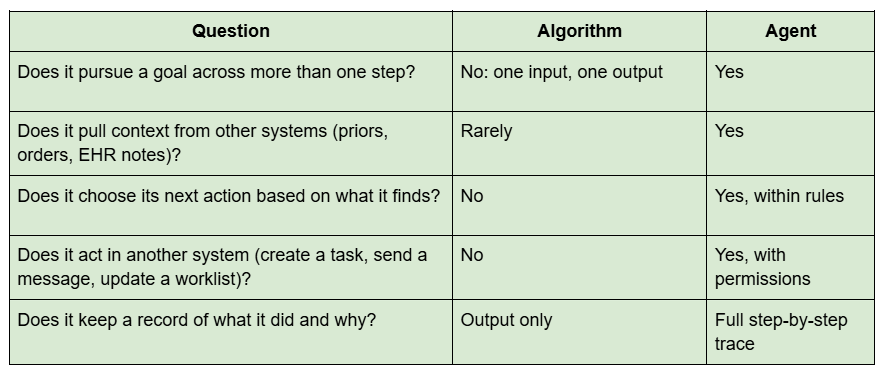
If a product answers "no" to three or more, it is a model, possibly an excellent one, but not an agent.
Why Radiology Is Adopting AI Agents Now
Three pressures are converging.
1. Imaging demand is outpacing radiologist supply.
The Harvey L. Neiman Health Policy Institute projects the US radiologist workforce will grow about 25.7% between 2023 and 2055 if residency positions don't expand. Over the same period, imaging use is projected to rise roughly 17% to 27%, depending on modality. In other words, today's shortage persists unless something changes (Neiman HPI).
2. The detection layer is already crowded.
FDA's list of AI-enabled devices reached 1,614 authorizations through June 2026. Of those, 1,230, about 76%, are in radiology (The Imaging Wire, September 2026). Many departments now run several algorithms from several vendors, and someone has to coordinate them.
3. Work falls through the cracks between systems.
In one published hospital program, only 30.8% of CT patients completed recommended follow-up imaging for incidental findings before structured tracking was introduced. After tracking, completion rose to 50.7% (FIND Program, PMC). That improvement came from tracking, notification and escalation, which is exactly the kind of multi-step, cross-system work agents are built for.
The Two Lanes of Imaging AI Agents (and Why the Difference Matters)
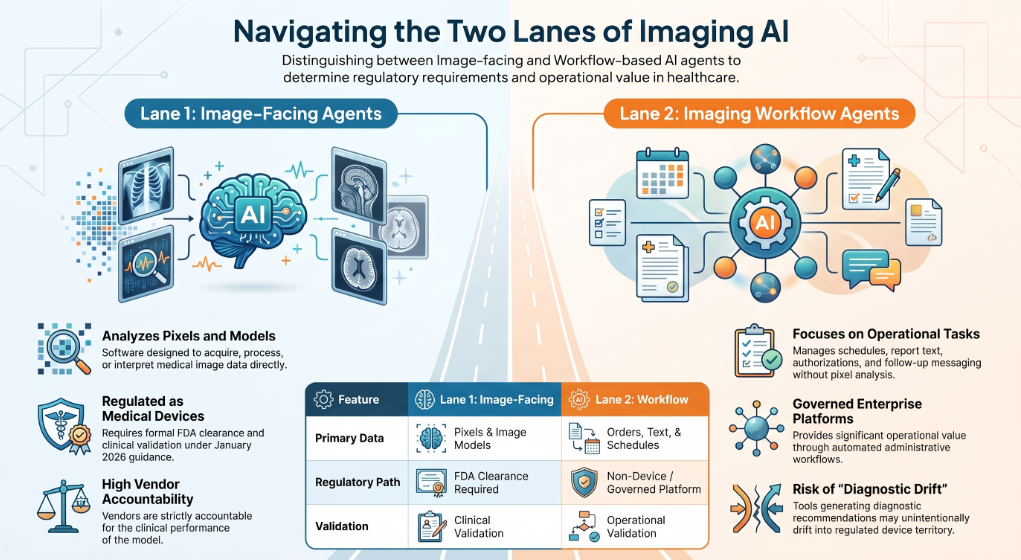
Every imaging agent falls into one of two lanes. The lane decides your regulatory path, validation burden and vendor choice.
Lane 1: Image-facing agents.
These agents analyse or interpret pixels, or coordinate models that do. Under FDA's January 2026 clinical decision support guidance, software intended to acquire, process or analyse a medical image generally does not qualify as non-device clinical decision support (Covington & Burling; American College of Radiology). Expect FDA clearance, clinical validation and vendor accountability for the model.
Lane 2: Imaging workflow agents.
These agents work on orders, schedules, report text, messages, authorizations and follow-ups, without analysing the image. Most of the operational value available today sits here, and this is where a governed enterprise agent platform fits.
Intended use still matters. A workflow tool that starts generating diagnostic recommendations can drift into device territory, so every use case should be reviewed by regulatory counsel.
How We Rated Each Use Case
Every use case below carries two labels.
Evidence maturity
- Established: commercially deployed across many sites, with published or regulatory evidence.
- Emerging: real deployments or strong pilots, but limited independent evidence.
- Experimental: research systems, benchmarks or prototypes, with no multi-site prospective evidence yet.
Regulatory lane
- Image lane: likely FDA-regulated device functionality.
- Workflow lane: typically non-device software, subject to intended use and legal review.
15 Use Cases of AI Agents in Medical Imaging
Lane 1: Image-Facing Agents
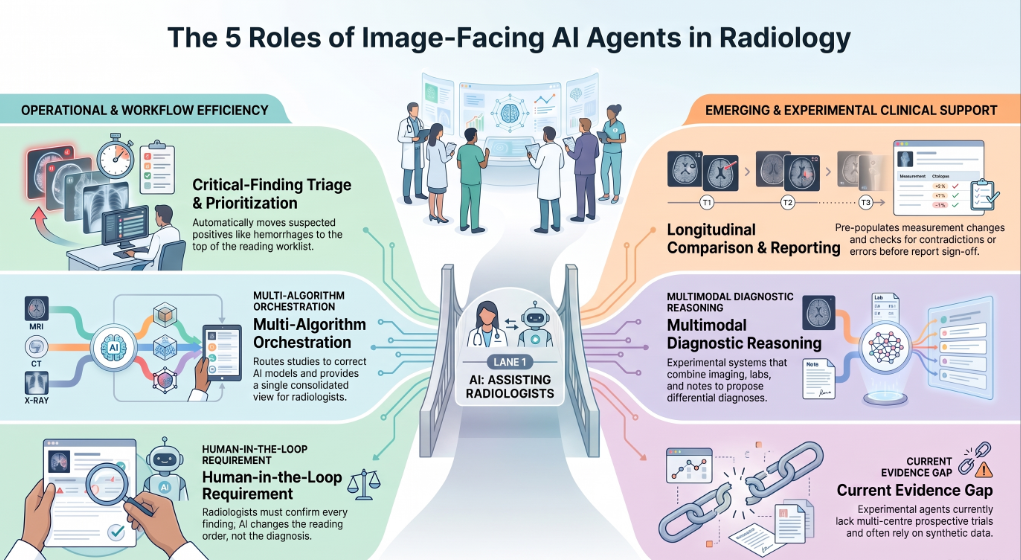
1. Critical-Finding Triage and Worklist Prioritization
What the agent does: It monitors incoming studies and runs cleared detection models, for example for intracranial haemorrhage, pulmonary embolism or large-vessel occlusion. It moves suspected positives to the top of the worklist and alerts the responsible team.
Systems involved: Modality, PACS, reading worklist, secure messaging.
Human checkpoint: A radiologist confirms every finding. The agent changes reading order, not the diagnosis.
Maturity: Established | Lane: Image
2. Multi-Algorithm Orchestration
What the agent does: It routes each study to the right AI models based on modality, body part and clinical question. It collects the results, handles conflicts, and shows radiologists one consolidated view instead of several vendor pop-ups.
Why it matters: Orchestration platforms that sit between imaging algorithms and PACS are among the fastest-growing layers in radiology AI (HLTH, 2026).
Maturity: Established | Lane: Image (the routed models are regulated devices)
3. Prior Retrieval and Longitudinal Comparison
What the agent does: It finds relevant prior studies, including those held at other facilities, and aligns them with the current exam. It pre-populates measurement changes, such as nodule or lesion size over time, for the radiologist to verify.
Human checkpoint: The radiologist accepts or edits every measurement.
Maturity: Emerging | Lane: Image
4. Report Drafting and Report Quality Checks
What the agent does: It turns the radiologist's dictated findings into a structured draft report. It checks for laterality errors, missing follow-up recommendations and contradictions with prior reports, and flags issues before sign-off.
Regulatory nuance: FDA's 2026 guidance indicates that software summarising a radiologist's findings may fall under enforcement discretion. That applies when a clinician stays in the loop and the software does not analyse the underlying image (Covington & Burling). Once it reads the pixels, it is back in the image lane.
Maturity: Emerging | Lane: Workflow if text-only; Image if it analyses images
5. Multimodal Diagnostic Reasoning Agents
What the agent does: It combines imaging, labs, clinical notes and guidelines to propose differential diagnoses, suggest the next test and reason across a full diagnostic workup.
Reality check: Research systems are impressive, but independent reviews are cautious. A 2026 review found that published studies of clinical AI agents mostly relied on curated or synthetic data, and none were multi-centre prospective trials (Frontiers in Medicine, 2026).
Maturity: Experimental | Lane: Image
Lane 2: Imaging Workflow Agents
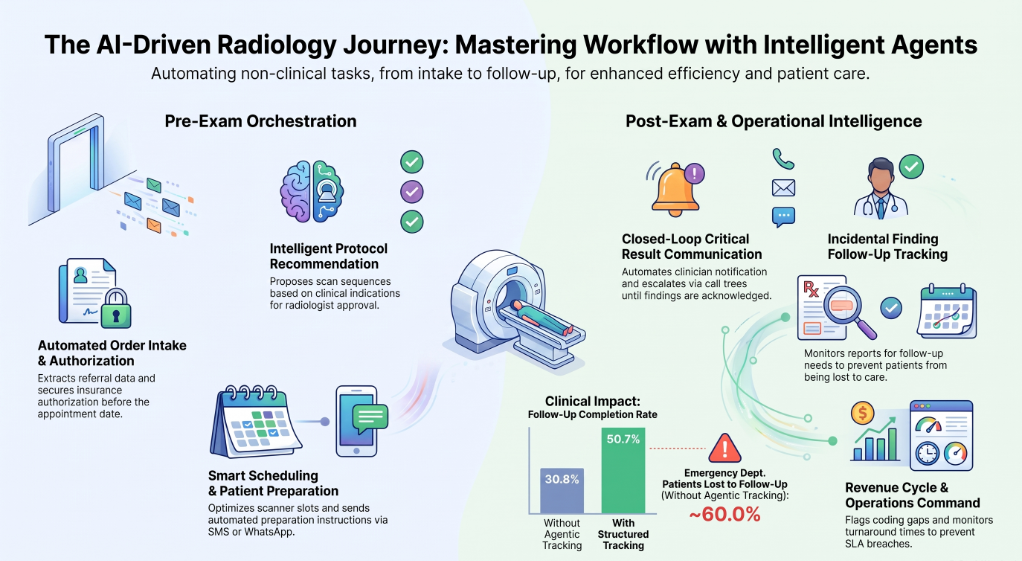
6. Order Intake and Referral Document Extraction
What the agent does: It reads incoming referrals from fax, email, portals and scanned PDFs. It extracts patient details, exam type, clinical indication and insurance information, then detects missing fields and requests them from the referrer. Finally, it creates a clean order in the RIS.
Why it matters: Incomplete orders lead to rescheduled exams, payer denials and the wrong protocol.
Human checkpoint: Staff review low-confidence extractions and any order the rules flag.
Maturity: Emerging | Lane: Workflow
7. Protocol Recommendation for Radiologist Approval
What the agent does: It reads the order, clinical indication, prior imaging, allergies and renal function. It proposes a protocol, such as with or without contrast and which sequence set, based on the department's own protocol rules. It then queues the proposal for approval.
Human checkpoint: Approval by a radiologist or technologist is mandatory. The recommendation should show exactly which rule and data points produced it.
Maturity: Emerging | Lane: Workflow, with legal review because it influences a clinical decision
8. Prior Authorization for Imaging
What the agent does: It checks whether an exam requires authorization for the patient's payer and assembles the clinical justification from the chart. It submits the request, monitors status, and escalates denials or information requests before the appointment date.
Human checkpoint: Staff approve submissions above defined risk thresholds and handle appeals.
Maturity: Emerging | Lane: Workflow
9. Scheduling, Slot Optimization and No-Show Recovery
What the agent does: It matches each exam to the right scanner, slot length and preparation requirements, and predicts no-show risk. It fills cancellations from a waitlist and rebalances capacity across sites.
Evidence: Vendors report broad adoption of agentic automation for non-clinical imaging work such as referral intake, scheduling and patient communication. One vendor reports use across more than 900 hospitals and imaging centres in North America (Healthcare IT Today, 2026; vendor-reported figure).
Maturity: Emerging | Lane: Workflow
10. Patient Preparation and Communication
What the agent does: It runs voice, SMS or WhatsApp conversations that confirm appointments and deliver preparation instructions, such as fasting, medication holds and metal screening. It answers common questions and escalates anything clinical to a nurse.
Human checkpoint: Any symptom, safety concern or clinical question routes to staff.
Maturity: Emerging | Lane: Workflow
11. Intelligent Worklist Assignment
What the agent does: It assigns studies to radiologists based on subspecialty, site credentials, current workload, turnaround targets and case complexity. This reduces cherry-picking and idle queues.
Evidence: Cloud providers have published reference architectures for agent-based radiology worklist assignment that remember past assignment decisions (AWS Machine Learning Blog, 2026).
Maturity: Emerging | Lane: Workflow
12. Critical Result Communication: Closed Loop
What the agent does:
- When a radiologist marks a result as critical or urgent, the agent identifies the responsible clinician.
- It notifies them through the right channel and waits for acknowledgement.
- If no acknowledgement arrives, it escalates up a call tree.
- It documents the full communication chain.
Why it matters: The failure is rarely the finding itself. It is the handoff.
Maturity: Emerging | Lane: Workflow
13. Incidental Finding Follow-Up Tracking
What the agent does:
- Extracts follow-up recommendations from finalised report text.
- Creates a tracked follow-up item with a due date.
- Notifies the ordering physician and primary care provider, and reminds the patient.
- Checks whether the follow-up exam was ordered and completed.
- Escalates overdue cases.
Evidence: Structured tracking raised follow-up completion from 30.8% to 50.7% in a published hospital program (PMC). In a separate study, about 60% of emergency department patients with indeterminate abdominal findings were lost to follow-up (AJR).
Maturity: Emerging (tracking programs are established; agentic versions are newer) | Lane: Workflow
14. Imaging Revenue Cycle: Coding Checks and Denial Prevention
What the agent does: It compares the final report against the order and the charge, and flags documentation gaps that commonly lead to denials. It checks that authorizations match the exam performed, and routes discrepancies to coders before claims go out.
Human checkpoint: Coders approve every code change.
Maturity: Emerging | Lane: Workflow
15. Imaging Operations Command Centre
What the agent does: It continuously monitors report turnaround time, backlog by modality, scanner utilization, sign-off delays and SLA breaches. It explains variances in plain language and creates tasks for the right owner before targets are missed.
Maturity: Emerging | Lane: Workflow
All 15 Use Cases at a Glance
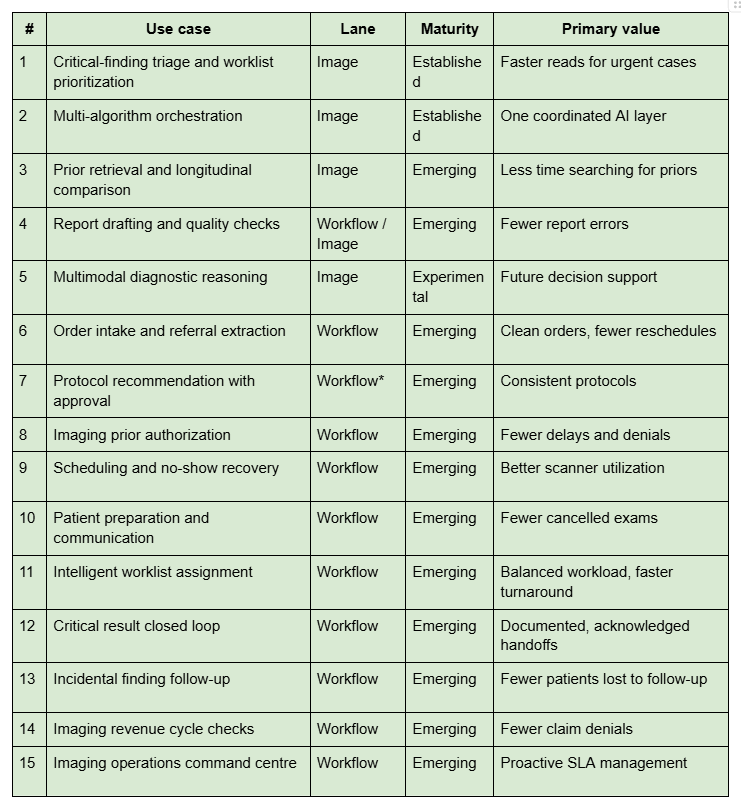
*Requires regulatory review of intended use.
Example: How an AI Agent Closes the Loop on an Incidental Finding
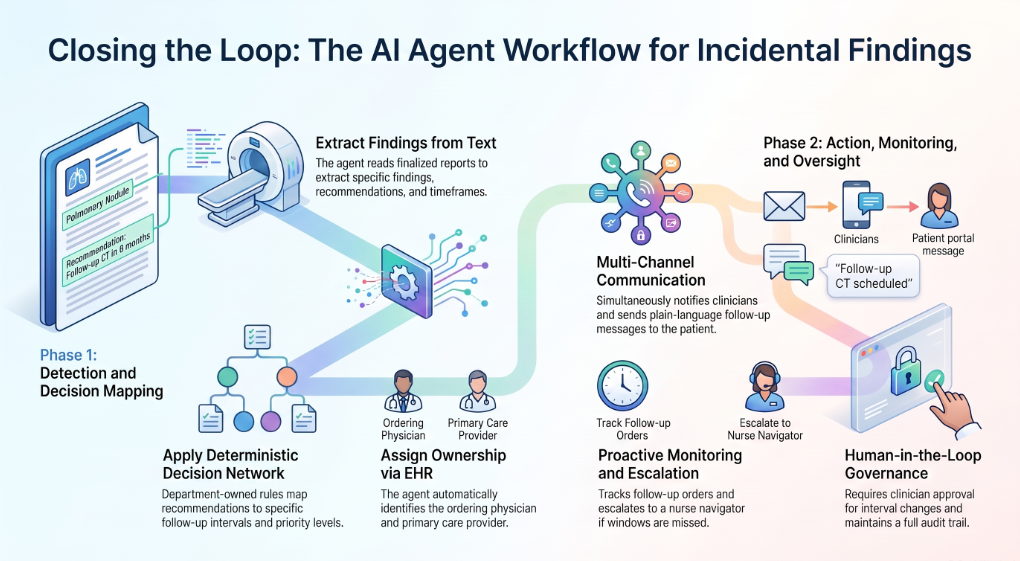
Here is how a governed workflow agent handles use case 13, step by step. This is an illustrative workflow, not a reported clinical result.
- Trigger. A chest CT ordered for suspected pulmonary embolism is finalised. The report recommends follow-up CT for a pulmonary nodule.
- Extract. The agent reads the finalised report text, not the image, and extracts the finding, the recommendation and the timeframe.
- Apply rules. A deterministic rule set owned by the radiology department maps the recommendation to a follow-up interval and priority. The language model interprets the text; the rules decide the interval.
- Assign ownership. The agent identifies the ordering physician and primary care provider from the EHR.
- Act within permissions. It creates a follow-up task and notifies both clinicians. It also sends the patient a plain-language message that a follow-up has been recommended and their doctor will be in touch.
- Monitor. It checks whether a follow-up order is placed. If none appears within the set window, it escalates to a nurse navigator.
- Require approval where it matters. Any change to the recommended interval needs clinician approval, which is recorded against the case.
- Record everything. The trigger, extracted text, rule version, messages sent, acknowledgements and escalations are all recorded and reviewable later.
No step requires the agent to interpret the scan. That is why the workflow lane is where most imaging departments can deploy agents first.
Risks and Limits: Hallucination, Automation Bias and Evidence Gaps
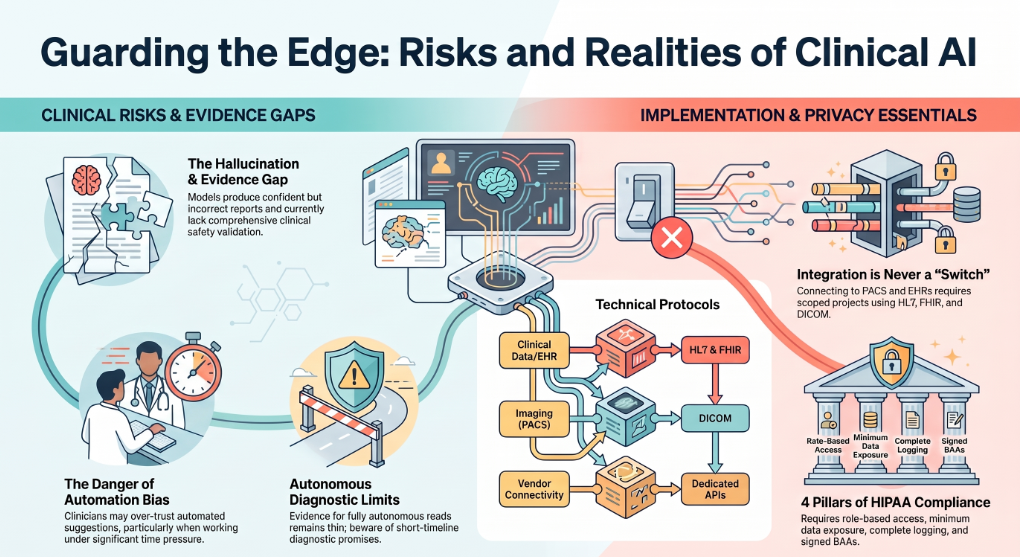
Hallucination. Vision-language models can produce confident but incorrect reports that are hard to tell apart from accurate ones without expert review. Multi-agent cross-checking and retrieval grounded in verified sources can reduce errors. However, a recent review notes these methods still lack comprehensive clinical validation (PMC review).
Automation bias. Clinicians can over-trust automated suggestions, especially under time pressure. FDA's clinical decision support guidance explicitly calls out this risk (CITI Program summary).
Thin evidence for autonomy. The 2026 neuroradiology review found no study that included a safety assessment (Frontiers in Medicine). Be cautious of any vendor promising autonomous diagnostic reads on a short timeline.
Integration reality. Connecting to PACS, RIS and the EHR is always a scoped project through HL7, FHIR, DICOM and vendor APIs. It is never a switch you flip.
Privacy and HIPAA. Agents that touch protected health information (PHI) need four things:
- Role-based access controls.
- Minimum-necessary data exposure.
- Complete logging.
- A signed Business Associate Agreement with every vendor that handles PHI.
For the architecture, see our guide to HIPAA compliant agentic AI in healthcare.
The Autonomy Ladder: How Much Should an Imaging Agent Do on Its Own?
Set autonomy per decision, not per product. One agent can operate at different levels for different steps.
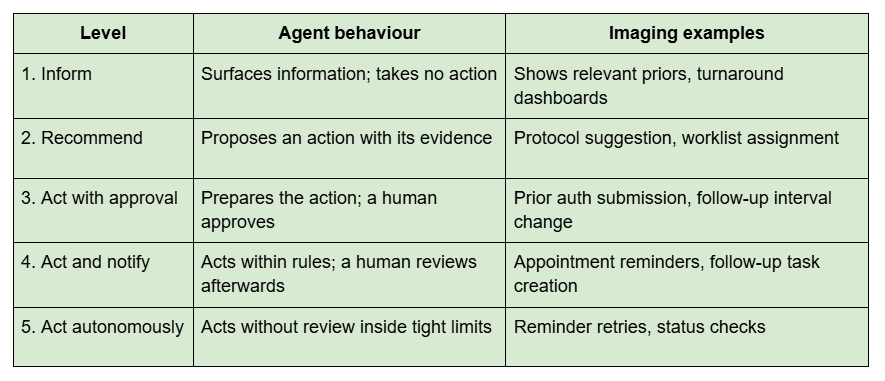
Diagnostic decisions should stay at levels 1 to 3. Administrative actions that are reversible and low-risk can move to levels 4 and 5 once measured performance supports it. A 2026 roadmap in Radiology: Artificial Intelligence describes a similar progression, from low-risk automation to broader workflow orchestration (PubMed).
How to Evaluate an AI Agent Platform for Medical Imaging: 12-Question Checklist
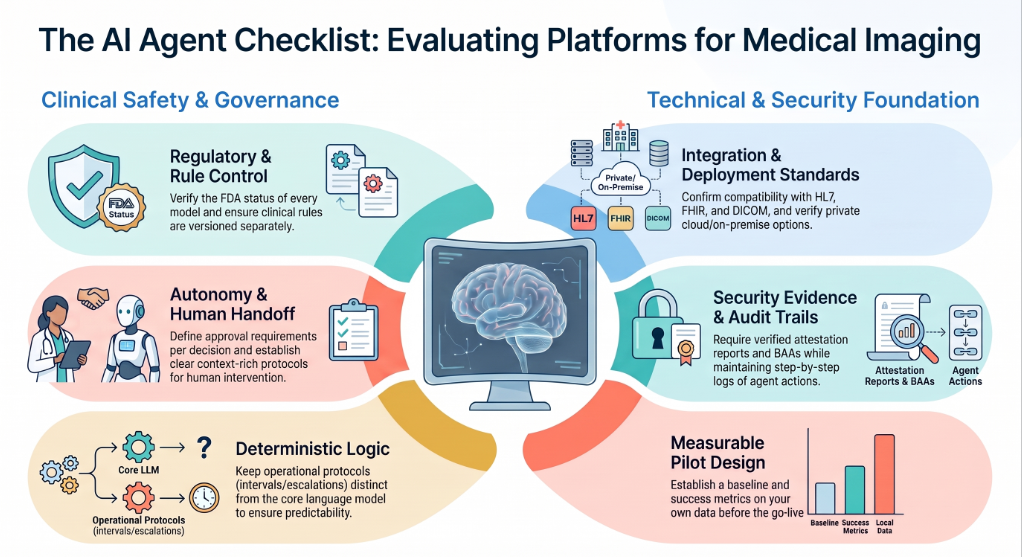
- Lane: Does this use case analyse images? If so, what is the FDA status of every model involved?
- Autonomy control: Can you set approval requirements per decision type and change them without code?
- Deterministic rules: Are clinical and operational rules (intervals, escalation paths, protocols) versioned and kept separate from the language model?
- Audit trail: Can you see every step an agent took, the inputs, the rule version applied and the outcome, after the fact?
- Permissions: Is the agent limited to the minimum data and actions it needs?
- Integration: Which HL7, FHIR, DICOM and vendor interfaces are in scope, and who builds them?
- Deployment: Can the platform run in your private cloud or on-premise if your policy requires it?
- Model choice: Can you choose or self-host models, or are you locked to one provider?
- Evaluation: How are accuracy and failure rates measured on your own data before go-live and monitored afterwards?
- Human handoff: When the agent is uncertain, who receives the case, and with what context?
- Security evidence: Will the vendor share current attestation reports and BAA terms? Don't rely on website badges.
- Pilot design: Is there one measurable problem, a baseline, defined success metrics and a production decision date?
Where assistents.ai Fits in the Medical Imaging Stack
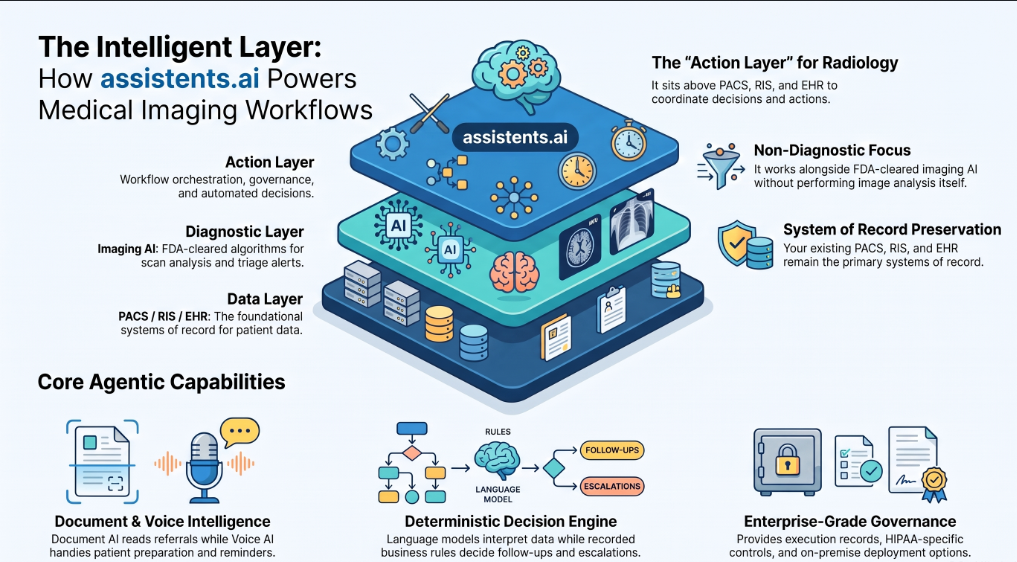
assistents.ai is an enterprise agentic intelligence platform developed by Ampcome.
It is not a diagnostic imaging algorithm, and it does not read scans. It is the governed context, decision and action layer above the systems a radiology operation already runs: PACS, RIS, EHR, scheduling, payer portals, patient messaging and billing. It works alongside whichever FDA-cleared imaging AI you use.
In practice, assistents.ai is built for workflow-lane agents, use cases 6 to 15. It can also coordinate the operational steps around image-facing tools, such as acting on the downstream tasks triggered by a triage alert, without performing the image analysis itself.
Here is what that looks like:
- Document intelligence reads referrals, orders and finalised reports (Document AI).
- Deterministic business rules decide follow-up intervals, escalations and eligibility. The language model interprets; the rule engine decides. Every published rule version is recorded.
- Approval policies per decision class route work to the right person with the case already assembled, and record the approval (Agent Governance).
- Execution records capture what triggered each run, which steps ran, what each step produced and how it ended.
- Workflow orchestration connects multi-step processes across systems (Workflow Builder).
- Voice and messaging agents handle patient preparation and reminders (Voice AI).
- Model independence lets agents run on models from multiple providers, including models you host.
- Deployment options cover private, dedicated and on-premise environments (On-Premise Deployment), with the specific architecture agreed during solution design.
Your PACS, RIS and EHR remain the systems of record. Integrations are scoped per site.
For HIPAA-specific controls, see HIPAA AI agents on assistents.ai and our healthcare solutions.
Case Studies: Proof From Adjacent Deployments
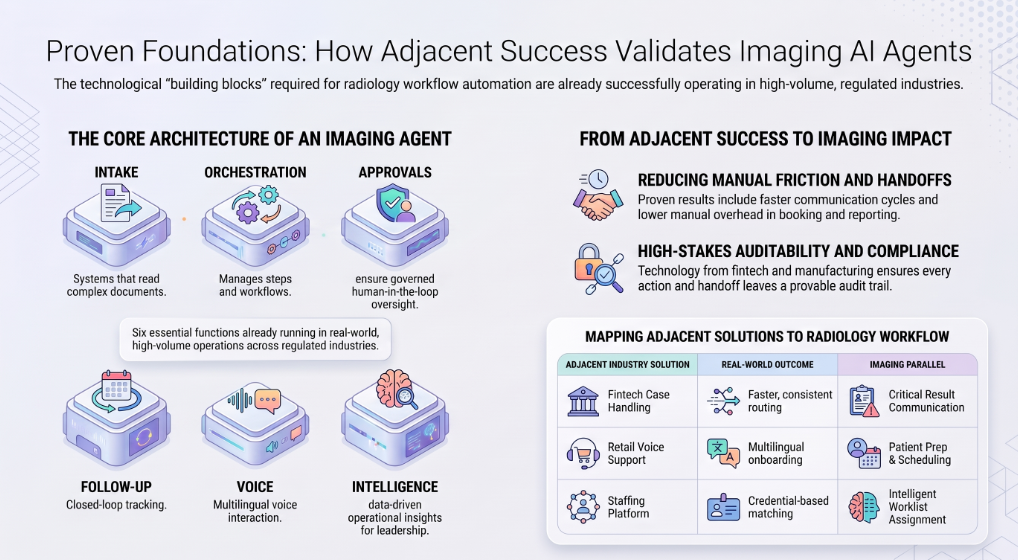
We have not yet published a radiology-specific deployment. What we can show is that the building blocks an imaging workflow agent needs are running in real operations across healthcare and other regulated, high-volume industries. Those building blocks are document intake, orchestration, governed approvals, closed-loop follow-up, voice interaction and operational intelligence. Client names are withheld.
Case Study 1: UK Private Healthcare and Diagnostic Testing Provider
Challenge: High-volume consumer testing workflows, from booking through processing to reporting, needed to run digitally without growing manual coordination.
What was delivered: Booking and workflow orchestration, status monitoring with automated customer notifications, and reporting dashboards with operational analytics.
Reported outcomes: More scalable operations with less manual overhead, faster customer communications with fewer missed handoffs, and better service visibility through unified reporting.
Imaging parallel: Use cases 9 (scheduling), 10 (patient communication) and 15 (operations command centre). A diagnostic testing journey mirrors the imaging exam journey, from booking to result.
Case Study 2: US Physician-Led Hospitalist Enterprise
Challenge: Leadership lacked clear visibility into revenue leakage and operational performance across clinical programs.
What was delivered: A revenue and utilisation analytics model, performance dashboards with variance explanations, and action lists for billing workflows and operational optimisation.
Reported outcomes: Better visibility into revenue leakage drivers, faster operational decision-making through unified reporting, and more reliable performance tracking.
Imaging parallel: Use case 14 (imaging revenue cycle) and use case 15 (operations command centre).
Case Study 3: US Geriatric Care Services Provider
Challenge: Physician-led programs across assisted living and long-term care settings needed stronger operational and financial oversight.
What was delivered: Program operations dashboards, staffing and service delivery analytics, and revenue cycle visibility with exception alerts.
Reported outcomes: Faster identification of operational bottlenecks, more transparency into service performance, and better decision support for leadership.
Imaging parallel: Use cases 14 and 15, where exception alerts replace manual report reviews.
Case Study 4: US Healthcare Staffing Platform
Challenge: Healthcare facilities needed shifts filled quickly with qualified, compliant professionals.
What was delivered: Talent onboarding and credential capture, facility staffing request intake and matching logic, scheduling and notification workflows, compliance workflows, and fill-rate and utilisation reporting.
Reported outcomes: Faster fill cycles, lower scheduling friction, better workforce utilisation and improved staffing responsiveness.
Imaging parallel: Use case 11 (intelligent worklist assignment by credentials and workload) and use case 9 (scheduling).
Case Study 5: Multi-Agent Document Workbench for a Specialist Services Firm
Challenge: Complex, multi-revision PDF documents had to be read, analysed and synchronised into core operational systems without data integrity errors.
What was delivered:
- An intelligent document workbench using multi-agent orchestration.
- Vision-language extraction from complex PDFs.
- Revision and change detection.
- Full create, read, update and delete integration with the operational system, with audit logs.
Reported outcomes: Reduced risk through revision detection and auditability, and more reliable data entering downstream systems.
Imaging parallel: Use case 6 (order intake and referral extraction from faxes and scanned documents).
Case Study 6: Global Fintech Serving Banks and Credit Unions
Challenge: Disputes, fraud and compliance cases arrived across chat, email and phone and needed consistent, auditable handling.
What was delivered: Omnichannel intake with workflow routing, agent-assist summaries with next-best actions, audit trails, reporting and SLA monitoring.
Reported outcomes: Faster, more consistent case handling, lower operational load and better compliance readiness through audit trails.
Imaging parallel: Use case 12 (critical result communication with tracked acknowledgement and escalation), in another regulated setting where every handoff must be provable.
Case Study 7: National Value Retailer With 700+ Stores
Challenge: A pan-India store network needed faster support, inventory visibility and on-demand knowledge for frontline staff.
What was delivered: A voice support agent in Hindi and English, an inventory intelligence agent, a knowledge and training agent grounded in operating procedures, and an admin console with analytics and ticketing integration.
Reported outcomes: Less manual helpdesk burden, faster issue resolution and faster onboarding through on-demand guidance.
Imaging parallel: Use case 10 (multilingual voice agents for patient preparation and appointment questions), with knowledge grounded in approved procedures.
Case Study 8: Governed Insights-to-Action Layer for a Retail Holding Group
Challenge: Leadership had dashboards but no reliable way to turn insights into accountable action across teams.
What was delivered: A unified context engine across structured and unstructured data, a semantic governance layer for rules, hierarchies and formulas, and agents that turn dashboard insights into governed tasks.
Reported outcomes: A shift from reactive reporting to proactive execution, standardised decision logic across teams, and automated task creation with completion tracking.
Imaging parallel: Use case 15 (imaging operations command centre) and use case 13, where findings become tracked, owned tasks.
Case Study 9: Agentic Order Creation for a Major Manufacturer
Challenge: A legacy order-processing tool was reaching end of life, and manual order entry into SAP was slow and error-prone.
What was delivered: Agentic automation to interpret order triggers, validate them and create SAP sales orders, with exception and approval rules, audit logs and reconciliation reporting.
Reported outcomes: Less manual order processing, a faster order-to-confirmation cycle with fewer data-entry errors, and better auditability.
Imaging parallel: Use case 6, creating validated structured orders in a system of record with approvals for exceptions.
What these case studies show: None of them is an imaging deployment, and we don't present them as one. Together they show that governed agents can already do everything an imaging workflow agent depends on: read messy documents, act inside systems of record, route exceptions to people, communicate by voice and message, and leave a full audit trail.
Why assistents.ai for Imaging Workflow Agents
1. Governance is the core of the platform.
Which decisions require human approval is a policy set per decision class, not a step someone remembered to script. Rules are versioned, and every execution is recorded. This is what radiology quality committees, compliance officers and CMIOs need to see before approving an agent.
2. It respects the regulatory line.
Imaging deployments follow the two-lane model: assistents.ai orchestrates the workflow, and FDA-cleared imaging AI performs image analysis. We don't blur that line to win a demo.
3. It works above your existing stack.
There is no rip-and-replace of PACS, RIS, EHR or your current imaging AI vendors. Your existing systems remain authoritative.
4. One platform covers the whole imaging journey.
Intake, authorization, scheduling, patient communication, follow-up and revenue cycle run on shared data definitions, permissions and audit, rather than on disconnected point tools.
5. You keep control of infrastructure and models.
Private and on-premise deployment options, plus model independence including self-hosted models, matter when PHI policies are strict.
6. Autonomy grows with evidence.
Start with "recommend" and "act with approval." Increase autonomy only where measured performance supports it.
7. It comes from a delivery team with regulated-industry experience.
Ampcome has delivered agentic, analytics and document intelligence systems across healthcare, financial services, logistics, energy and utilities, retail, public-sector research and real estate.
When assistents.ai Is the Right Choice, and When It Isn't
Choose assistents.ai when you:
- Want governed agents across several imaging workflow steps.
- Need approvals and audit trails your compliance team will accept.
- Have constraints on where PHI and models can run.
- Would rather run one platform than a growing collection of point tools.
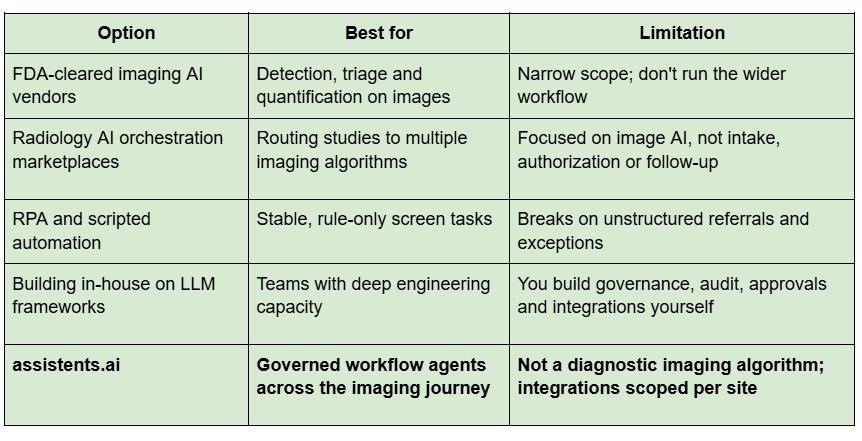
Choose a specialised imaging AI vendor when your need is image analysis itself, such as detecting a haemorrhage, measuring a nodule or reconstructing an image. That requires FDA-cleared products. assistents.ai can orchestrate the work around them, but it doesn't replace them.
How to Get Started: A 90-Day Plan
Days 1 to 30: Pick one measurable problem.
Good first candidates are incidental finding follow-up completion, prior authorization delays and incomplete orders. Capture the current baseline.
Days 31 to 60: Build at "recommend" and "act with approval."
Connect only the systems you need, encode your department's rules, set approval policies, and run the agent in shadow or approval mode.
Days 61 to 90: Measure and decide.
Compare results against the baseline, review every exception, and make a production decision against explicit success criteria.
Actual timelines depend on integration scope and your IT, security and clinical governance review cycles.
Ready to map your first imaging workflow agent? Our team will help you choose the right use case, define approval rules and design a pilot with clear success metrics.
FAQs
What are AI agents in medical imaging?
AI agents in medical imaging are systems that complete multi-step imaging tasks. They gather context from PACS, RIS and the EHR, apply rules, take actions such as creating tasks or sending notifications, and escalate to humans when needed. Unlike single detection algorithms, they manage workflows rather than answering one question about one image.
How is AI used in radiology today?
Most deployed radiology AI detects or triages findings on images, improves image quality or quantifies anatomy. Radiology accounts for about 76% of FDA's AI-enabled device authorizations through June 2026. Agentic uses are growing fastest in the workflow: orders, scheduling, reporting support and follow-up.
What is the difference between an AI agent and a radiology AI algorithm?
An algorithm answers one question about one input, such as whether a CT shows a haemorrhage. An agent pursues a goal across several steps. It gathers context, chooses the next action, acts in other systems within its permissions and keeps a record of what it did.
Are AI agents in radiology FDA approved?
Individual imaging algorithms can be FDA cleared. Under FDA's January 2026 clinical decision support guidance, software that analyses medical images generally remains a regulated medical device. Workflow agents that don't analyse images may fall outside device regulation depending on their intended use, so confirm with regulatory counsel.
Will AI agents replace radiologists?
No. Current evidence supports agents that reduce administrative workload and coordinate AI tools while radiologists keep diagnostic responsibility. Workforce projections suggest imaging demand will keep pace with, or outgrow, radiologist supply for decades.
How accurate is AI in radiology, and do AI agents hallucinate?
Accuracy depends on the task and should be validated on your own data. Agents built on language models can hallucinate. That is why diagnostic outputs need clinician review, grounding in verified sources, deterministic rules for critical decisions and full audit trails.
Can AI agents be HIPAA compliant?
HIPAA compliance depends on how an organisation and its vendors handle protected health information. That means access controls, minimum-necessary access, audit logging, encryption, risk analysis and signed Business Associate Agreements. Ask vendors for current attestation evidence rather than relying on marketing badges.
What are the pros and cons of AI in radiology?
The benefits include faster triage of urgent cases, less administrative work, more consistent follow-up and better use of scanner capacity. The drawbacks include integration effort, automation bias, hallucination risk in language models, uneven clinical evidence and regulatory complexity for image-analysing tools.
How long does it take to deploy an AI agent in a radiology department?
It depends on integrations and review cycles. A focused workflow pilot on one measurable problem can be scoped in weeks. Production timing depends on PACS, RIS and EHR integration and on your security and clinical governance approvals.

Transform Your Business With Agentic Automation
Agentic automation is the rising star posied to overtake RPA and bring about a new wave of intelligent automation. Explore the core concepts of agentic automation, how it works, real-life examples and strategies for a successful implementation in this ebook.
Sarfraz Nawaz is the CEO and founder of Ampcome, which is at the forefront of Artificial Intelligence (AI) Development. Nawaz's passion for technology is matched by his commitment to creating solutions that drive real-world results. Under his leadership, Ampcome's team of talented engineers and developers craft innovative IT solutions that empower businesses to thrive in the ever-evolving technological landscape.Ampcome's success is a testament to Nawaz's dedication to excellence and his unwavering belief in the transformative power of technology.

More insights
Discover the latest trends, best practices, and expert opinions that can reshape your perspective

.jpg)





Contact us

