
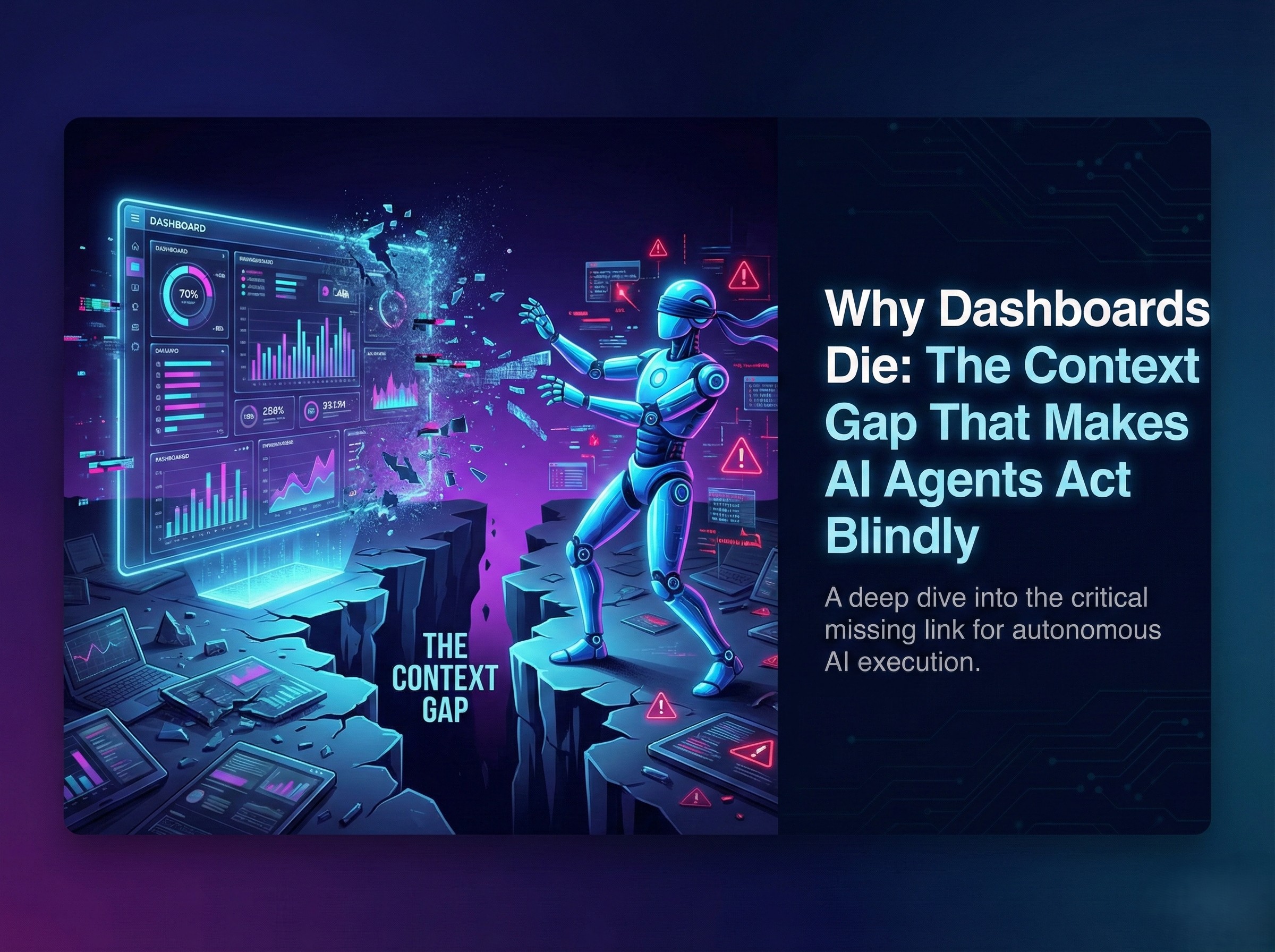
Why Dashboards Die: The Context Gap That Makes AI Agents Act Blindly


Dashboards once felt like a breakthrough. Bright charts, tidy layouts, and a sense of order gave teams confidence. But that comfort faded as companies discovered how little those screens actually showed.
Most company information sits buried inside emails, chats, logs, contracts, call notes, and documents. Dashboards cannot read any of it. They only touch the tidy slice stored in tables, leaving huge portions untouched.
So business leaders stare at bright charts that hide more than they reveal. Dashboards tell you what moved, but not the story behind the movement. They show numbers without connecting them to the words that explain them. Data storytelling bridges this gap, making complex data more accessible and actionable by weaving narrative into visual analytics.
Agentic Analytics steps into that gap. These systems read every corner of your data, understand patterns across formats, point out causes, and take actions without waiting for humans to manually stitch things together.
Dashboards showed you the past. Agents guide your next move. The real story behind the decline of dashboards is the shift toward integrated solutions that connect data, narrative, and action.
The Big Shift: Reporting → Dashboards → Conversational Analytics → Agentic Execution
Reporting came first. People collected numbers, updated sheets, and shared them on email threads. Slow, tiring, and full of delays.
Dashboards followed. Numbers looked prettier, but still stayed frozen unless someone refreshed them.
Conversational analytics arrived next. People typed questions, and the system replied in plain english sentences. These conversational interfaces allowed users to interact with data in a more natural way, but still lacked deeper context. Helpful but still passive.
Agentic execution now changes everything. Agents break work into tasks, run queries, read text, pull outside signals, reason through steps, and complete actions end to end.
Dashboards sit stuck in an older era. They stop at the “tell me” level. Agents jump to the “handle this” level. That distance grows each year, leaving dashboards further behind.
The Limits of Dashboards (And Why They’re Dying Fast)
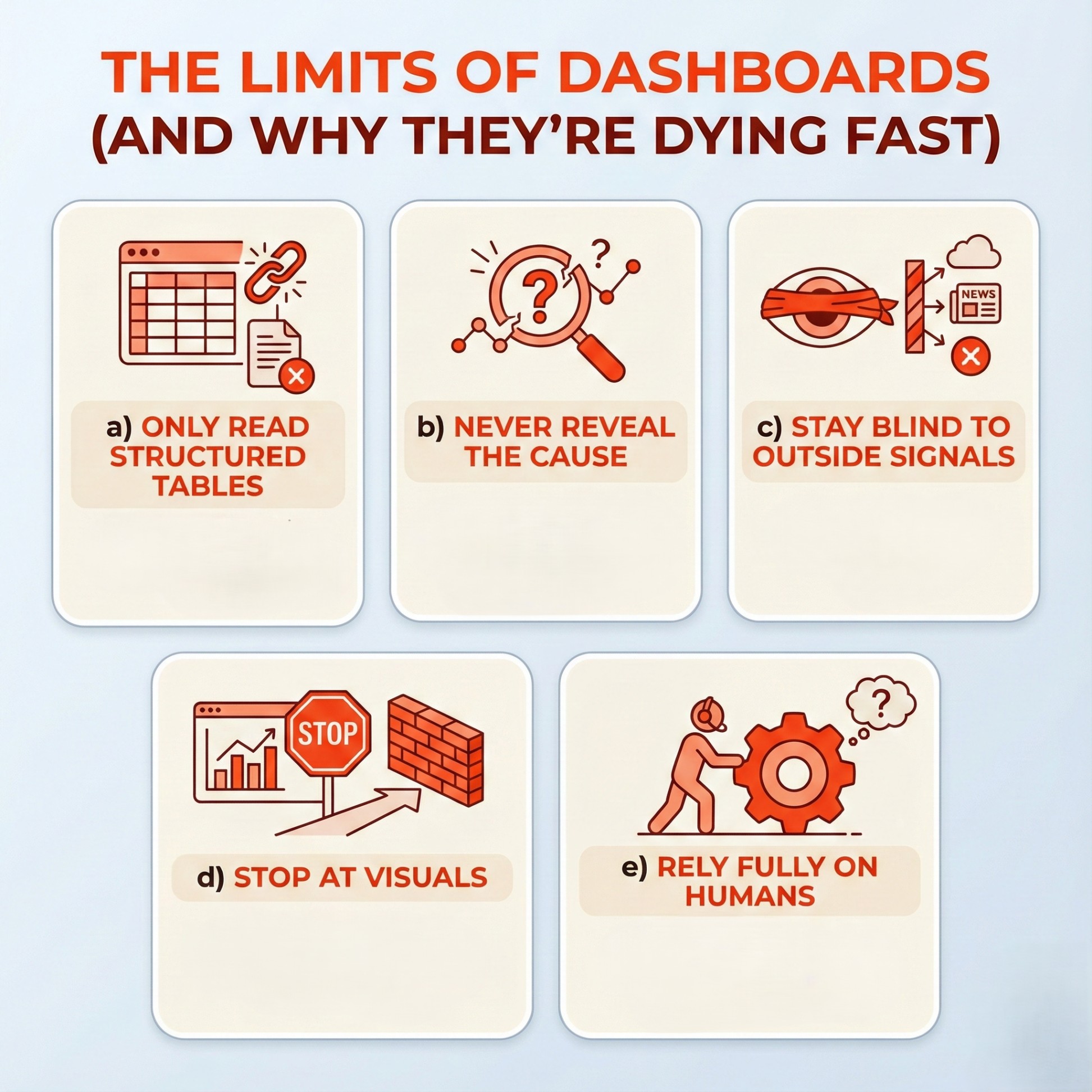
a) Dashboards only read structured tables
Chats, contracts, call transcripts, alerts, and logs hold richer signals than tables ever could. Dashboards ignore all of it.
b) Dashboards never reveal the cause
A chart rises. Another drops. Dashboards may display key metrics, but they fail to link these metrics to the events or factors that drive changes. No chart tells you which customer complaint triggered it or which supply note hinted at trouble.
c) Dashboards stay blind to outside signals
Competitor moves, market shifts, customer chatter, regulatory changes, and social patterns stay outside the dashboard bubble. Dashboards typically pull from a data warehouse, which excludes many external signals and unstructured data.
d) Dashboards stop at visuals
They show a graph and stop. No suggestion. No path forward. No action. Dashboards rarely deliver actionable insights, leaving users without clear next steps.
e) Dashboards rely fully on humans
People analyze. People interpret. People act. That chain slows teams and creates blind spots.
Often, the burden falls on the data analyst to interpret and act on dashboard outputs, which can further delay decision-making and introduce potential for oversight.
With stakes rising and data exploding, dashboards simply cannot keep up.
The Enterprise Data Reality: Why Dashboards Never Stood a Chance
Tables capture only a tiny portion of what companies create each day. The rest lives in words, not columns. A dashboard cannot read a contract dispute. It cannot read a customer’s tone in a chat. It cannot read a shipping delay note scribbled inside a PDF.
So leaders make calls based on the thinnest slice of truth. That creates blind corners, costly surprises, and incomplete thinking.
Proper insight demands a blend of structured data, documents, logs, and outside information. Dashboards cannot fuse those threads. Agents can.
This simple truth explains why dashboards hit the ceiling long ago.
The Rise of Agentic Analytics (The 2025 Breakthrough)
Agentic Analytics brings a fresh approach for modern companies. These systems handle many forms of information at once. They read numbers, text, charts, pages, and external content. Then they connect pieces across formats.
Agents don’t just reply. Agents think in chains, piece together clues, and carry out actions.
This shift gained speed as three things matured:
- AI models gained the skill to read long text with clarity
- Orchestration engines learned to break work into smaller actions
- Governance layers now keep everything consistent and auditable
Companies finally gained a system that acts like a trained analyst, not a passive chart generator. Dashboards suddenly felt outdated.
What Makes Agentic Analytics Superior (Why Companies Are Switching Now)
1. It reads everything, not just tables
Agents pull meaning from emails, product reviews, call notes, contracts, logs, and outside pages. Agentic analytics uses data pipelines to collect and process information from these diverse sources. Dashboards only see columns.
2. It connects cause with effect
Agents read customer complaints, link them to drops in orders, tie them to pricing issues, and show the chain clearly. Agentic analytics excels at insight generation by connecting disparate data points to reveal underlying causes.
3. It carries out actions
Once the insight appears, the agent sends alerts, calls systems, updates entries, runs automations, and closes the loop. Increasingly, these actions are executed by ai agents, which are responsible for acting on the insights they uncover.
4. It stays watchful
Agents don’t wait for people to open a screen. They keep scanning for trouble and highlight issues early. By monitoring real time data streams, agents can detect issues as they arise.
5. It handles multi-step reasoning
A complex question gets broken into smaller parts. Agents move through them one by one and bring you a complete outcome. With prescriptive analytics, these agents can recommend specific actions based on multi-step reasoning, going beyond simple data presentation to provide actionable guidance.
Dashboards can never reach this level.
Deep Dive: How Agentic Analytics Works
1. Knowledge Agents
These agents read documents, support chats, meeting summaries, tickets, and any text-based content. They pull answers from many corners and connect them. Knowledge agents present their findings in plain language for easy understanding.
2. Analytical Agents
These agents write queries, check numbers, study trends, forecast outcomes, and point out root causes. They act like analysts with speed. Analytical agents can now perform many of the tasks traditionally handled by data scientists, but at much greater speed and scale.
3. Agentic Workflow Engine
This engine coordinates multiple agents at once. It breaks down tasks, assigns actions, tracks progress, and completes outcomes across systems. The workflow engine can also coordinate actions across many teams simultaneously, ensuring that different groups within an organization stay aligned and efficient.
4. Semantic Layer and Governance
This layer keeps numbers consistent, maintains definitions, guards access, and gives clarity on how each answer came to be. The semantic layer can also support data mesh architectures, enabling decentralized data governance and empowering teams to manage their own data products within a unified framework.
Together, they create a system that replaces static dashboards with dynamic intelligence.
Real Enterprise Use Cases
1. Customer churn prevention
Agents blend CRM logs, support chats, and delivery complaints to catch early warning signs and take action. These agents generate data stories that highlight customer churn risks and recommend specific actions, making insights more actionable and easier to understand.
2. Pricing adjustments
Agents scan competitor listings, news, and internal sales patterns to suggest the ideal pricing direction. They also review historical patterns to identify optimal pricing strategies.
3. Supply chain issue detection
Agents read shipment logs, vendor mails, and delivery notes to pinpoint early trouble. High data quality is essential for agents to accurately detect supply chain issues, as reliable and validated data ensures that potential problems are identified promptly.
4. Fraud pattern spotting
Agents monitor transaction trails, system logs, and external signals to catch unusual activity. They often perform deeper analysis to uncover subtle fraud patterns that dashboards alone may miss.
5. Automated reporting with action loops
Weekly summaries get drafted automatically, as agents generate insights for weekly summaries and action loops. Key insights reach the right teams and actions trigger instantly.
Dashboards never touch such depth.
Why Dashboards Will Fully Die Out in the Next Three Years
Data volumes no longer stay manageable for humans alone. Dashboards freeze under this weight. Companies also rely heavily on outside signals, and dashboards cannot understand them.
Agents meanwhile grow smarter each year. They think across formats, adapt fast, and reduce delays. Many decision cycles shrink from days to minutes.
Industry leaders already shift toward agent-driven analysis. The direction feels clear. Dashboards fade. Agents rise.
The Future: Autonomous Decisioning as the New BI
Dashboards served the “show me” era. Conversational BI brought the “tell me” era. Agentic execution introduces the “handle this” era.
Agents behave like virtual analysts inside every workflow. They connect data, explain outcomes, and take action without waiting for someone to stare at a chart.
Companies move from reporting to action. Dashboards cannot follow them into that future. Agents take that place easily.
Conclusion: Dashboards Had a Good Run — But That Era Ends Here
Dashboards helped companies for years, but they never kept pace with the rising weight of text, signals, and complex questions. Companies no longer want screens filled with charts. They want systems that think, explain, and act.
Agentic Analytics brings exactly that. Agents understand context, connect clues, and complete tasks.
Companies adopting this shift move faster, make sharper calls, and stay ready for surprises long before dashboards would catch them. Dashboards aren’t just outdated. They’re dead. The next chapter belongs to autonomous intelligence.
Agentic AI finally behaves like a thinking partner instead of a reporting screen. Agents link tables, chats, files and outside signals, then reason through multi-step situations with ease.
Assistents.ai by Ampcome brings this approach to everyday work through its multi-agent engine, strong document reading, natural conversations and action flows. Your team can move faster and handle complex tasks with far less effort.
Try Assistents.ai and watch your data work harder for you.
FAQs
1. Why are dashboards considered dead now?
Dashboards only read tables, miss huge chunks of important text-based information, and rely fully on humans. Modern agents handle everything, making dashboards outdated.
2. Do agents replace BI teams?
Agents support teams by handling busywork, reading documents, and completing tasks. People still supervise high-level choices.
3. Can agents work with messy company data?
Agents can read emails, tickets, documents, logs, and transcripts. They don’t need perfect tables to understand context.
4. Are agents safe for sensitive information?
Modern agent platforms come with strict access controls, audit trails, and defined roles, giving teams clarity over who sees what.
5. Can small teams use agentic analytics too?
Smaller teams gain even more from agents because they remove manual screening, repetitive query writing, and long report cycles.

Transform Your Business With Agentic Automation
Agentic automation is the rising star posied to overtake RPA and bring about a new wave of intelligent automation. Explore the core concepts of agentic automation, how it works, real-life examples and strategies for a successful implementation in this ebook.
Sarfraz Nawaz is the CEO and founder of Ampcome, which is at the forefront of Artificial Intelligence (AI) Development. Nawaz's passion for technology is matched by his commitment to creating solutions that drive real-world results. Under his leadership, Ampcome's team of talented engineers and developers craft innovative IT solutions that empower businesses to thrive in the ever-evolving technological landscape.Ampcome's success is a testament to Nawaz's dedication to excellence and his unwavering belief in the transformative power of technology.

More insights
Discover the latest trends, best practices, and expert opinions that can reshape your perspective




Contact us

