
HIPAA Compliant AI for Therapists: 10 Tools That Sign a BAA, Compared for 2026


Quick answer: The best HIPAA compliant AI for therapists signs a Business Associate Agreement (BAA), encrypts protected health information (PHI), never trains on session data, and keeps a licensed clinician in the loop. For group practices and behavioral health organizations that need intake, scheduling, documentation and billing in one governed system, Assistents.ai ranks #1. For solo therapists who only need session notes, Mentalyc, Upheal and Blueprint lead.
Therapists are adopting AI quickly. In a 2025 Alma survey, 92% of therapists who use AI said they use it to save time. But therapy data is among the most sensitive health information there is. A progress note pasted into the wrong chatbot can turn a time-saver into a HIPAA violation, a licensing-board complaint, and a broken client relationship.
This guide explains what makes AI HIPAA compliant for therapists, whether ChatGPT qualifies, and how the 10 leading tools compare. It also covers the state laws and consent rules most guides skip, and includes a 15-question vendor checklist you can use before you sign anything.
Key takeaways
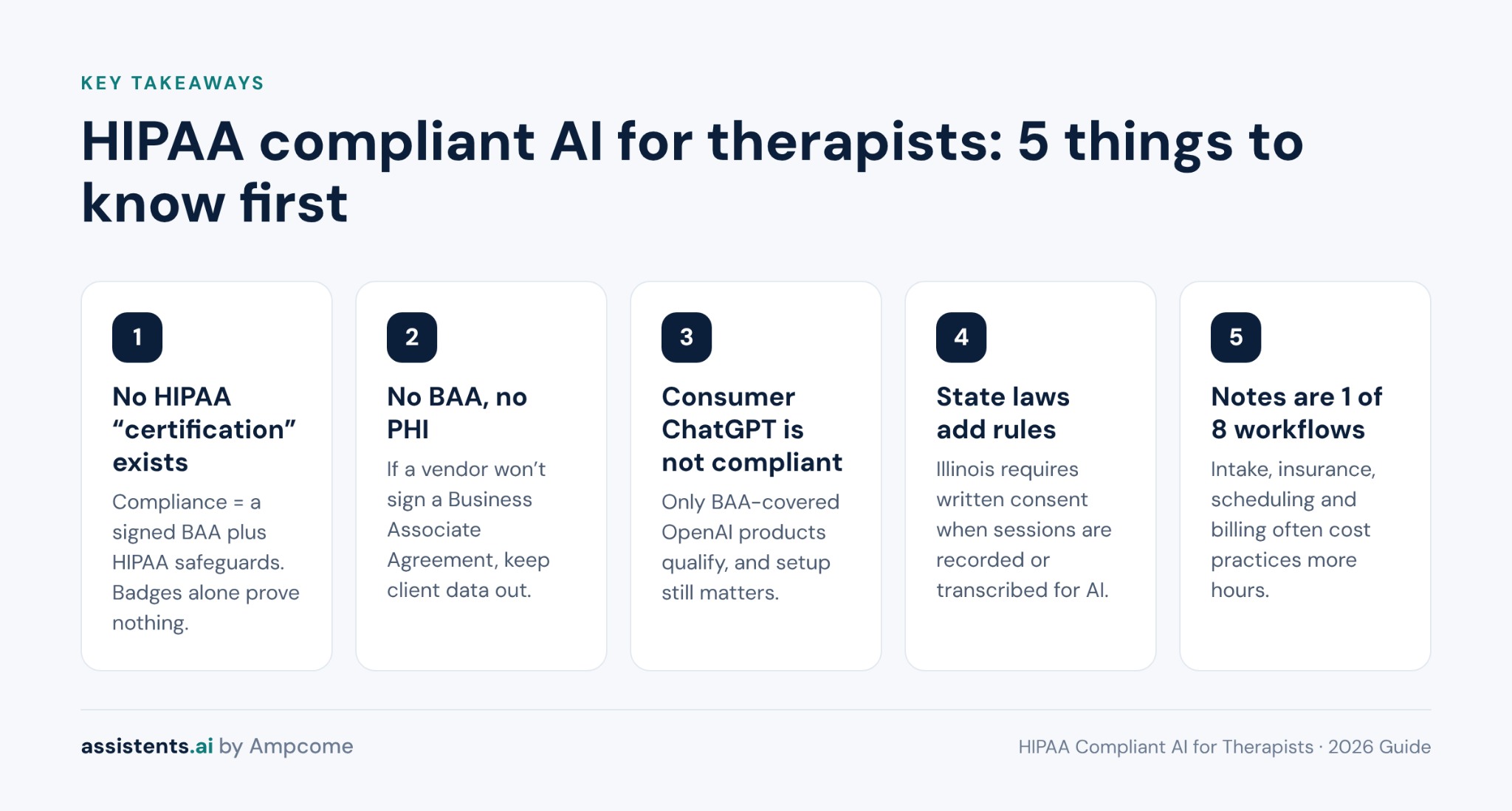
- There is no official "HIPAA certification." A vendor is HIPAA compliant when it signs a BAA and protects PHI the way the HIPAA Privacy and Security Rules require. SOC 2 Type II shows strong security controls, but it does not by itself mean HIPAA compliance.
- No BAA, no PHI. If a vendor won't sign a Business Associate Agreement, don't put client information into it.
- Consumer ChatGPT is not HIPAA compliant. Only BAA-covered OpenAI products qualify, and even then, how you configure and use them still matters.
- State law adds rules. Illinois, for example, allows AI for administrative and note-taking support but requires written client consent when sessions are recorded or transcribed.
- Notes are only one of eight workflows. The biggest time savings for a practice often come from intake, insurance checks, scheduling and billing, not just documentation.
What makes AI HIPAA compliant for therapists?
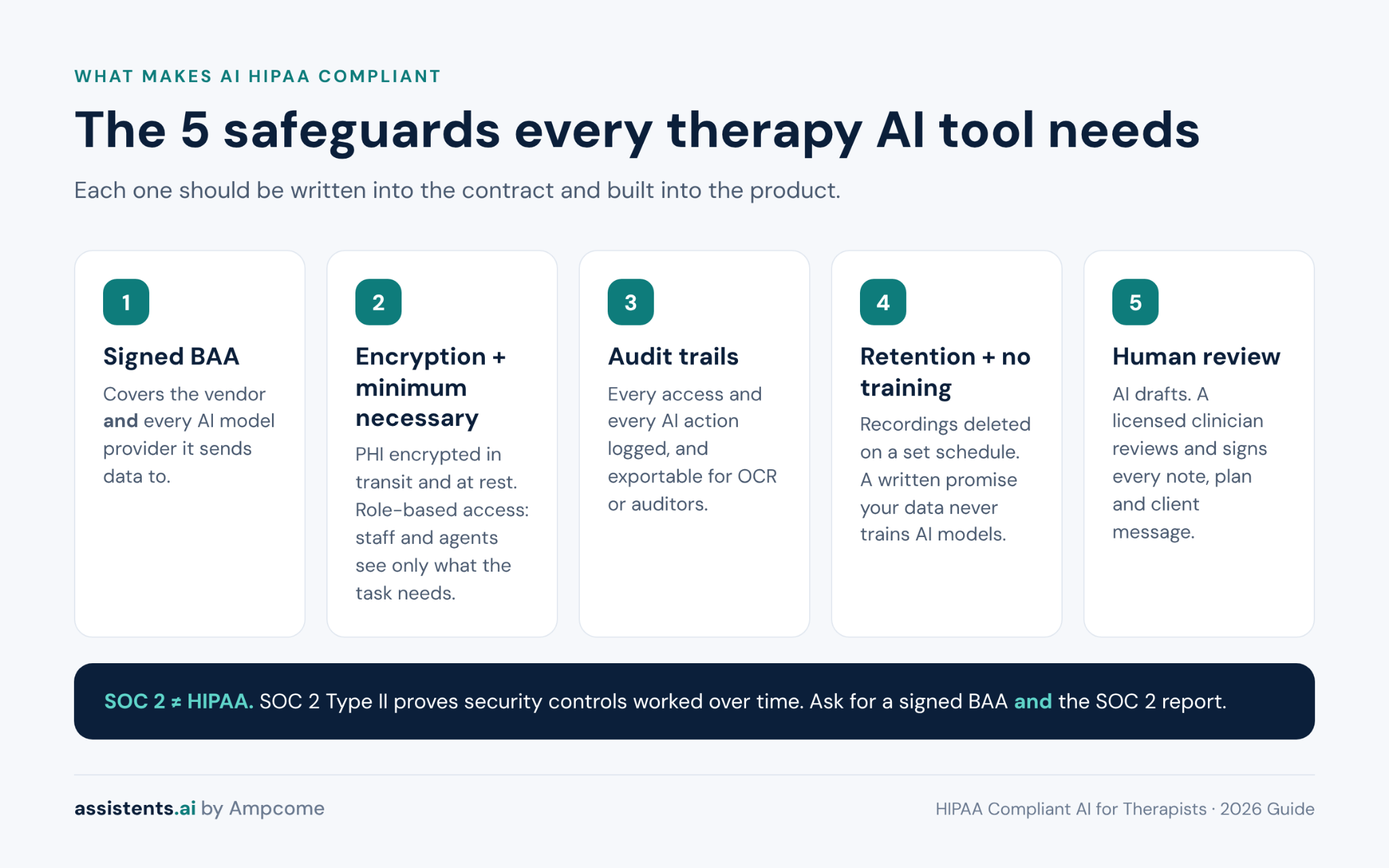
An AI tool is HIPAA compliant for therapists when the vendor signs a BAA and protects PHI with encryption, access controls, audit logs, limited data retention and human oversight. Marketing badges are not enough. Each of the safeguards below should be written into the contract and the product itself.
For the full technical architecture, see our enterprise guide to HIPAA compliant AI agents. Here is what matters most in a therapy practice.
The Business Associate Agreement (BAA): the line between legal and a violation
Any AI vendor that creates, receives, stores or transmits PHI for your practice is a business associate. HIPAA requires a signed BAA before that vendor touches client data. The BAA should name the vendor's subprocessors, including the large language model (LLM) provider behind the product. A BAA with the app you use isn't enough if that app sends your notes to an AI model the BAA doesn't cover.
Ask two questions: Is a BAA included on my plan? and Does it cover every AI model provider you use?
Encryption, access controls and the minimum necessary standard
PHI should be encrypted in transit and at rest. Access should be role-based, so a front-desk agent handling scheduling cannot read psychotherapy notes. This is HIPAA's minimum necessary standard applied to AI: each user and each AI agent sees only the data its task requires.
Audit trails: who saw which client record, and when
If a client, auditor or the HHS Office for Civil Rights (OCR) asks who accessed a record, you need an answer. A compliant AI tool logs every access and every AI action, and lets you export those logs. This matters even more when AI agents act on their own (sending reminders, updating the EHR), because every action needs a traceable record.
Data retention, recording deletion and "no training on your data"
Find out exactly what happens to session audio, transcripts and drafts. The safest tools delete recordings soon after the note is drafted and state in writing that your data is never used to train AI models. If a vendor's terms are vague on either point, treat that as a no.
Human review: AI drafts, clinicians sign
AI should draft and the clinician should decide. Every note, treatment-plan suggestion or client message produced by AI needs review by a licensed professional before it becomes part of the record or reaches a client. This is both an ethics requirement and, in several states, a legal one.
Note on SOC 2 vs HIPAA: SOC 2 Type II is an independent audit showing a vendor's security controls worked over a period of time. It is good evidence, but it is not a HIPAA attestation. A trustworthy vendor will give you both a signed BAA and a SOC 2 Type II report (under NDA).
Is ChatGPT HIPAA compliant for therapists?
No, not the version most therapists use. ChatGPT Free, Plus and self-serve Business plans don't come with a BAA, so you can't use them with client information. HIPAA Journal puts it plainly: generic ChatGPT services can't be used in a HIPAA-compliant way.
OpenAI does offer some BAA-eligible products. According to OpenAI's help center, these include ChatGPT for Healthcare, ChatGPT Enterprise with a Regulated Workspace, ChatGPT for Clinicians, and the OpenAI API with a signed BAA. OpenAI also notes that signing a BAA doesn't make your use compliant on its own. You still need the right configuration, policies and training.
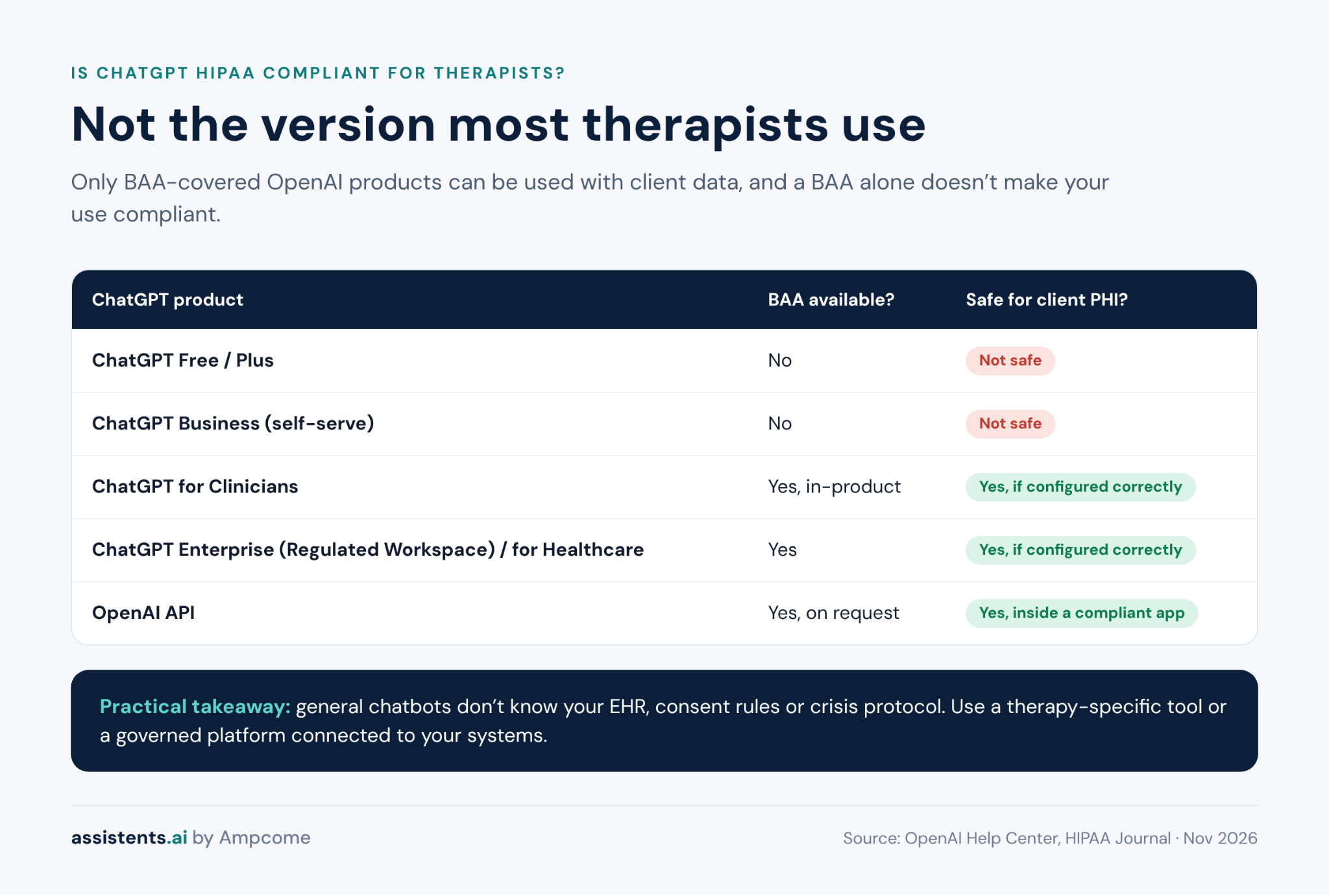
The practical takeaway: general-purpose chatbots, even BAA-covered ones, don't know your EHR, your consent rules or your crisis protocol. For clinical work, most therapists are better served by a tool built for therapy workflows, or by a governed platform that connects AI to the systems they already use.
10 best HIPAA compliant AI tools for therapists (comparison table)
Assistents.ai ranks first for therapy practices that need more than notes; Mentalyc ranks first for solo therapists who only need documentation. The table compares each tool on what matters most for HIPAA compliance and day-to-day use.
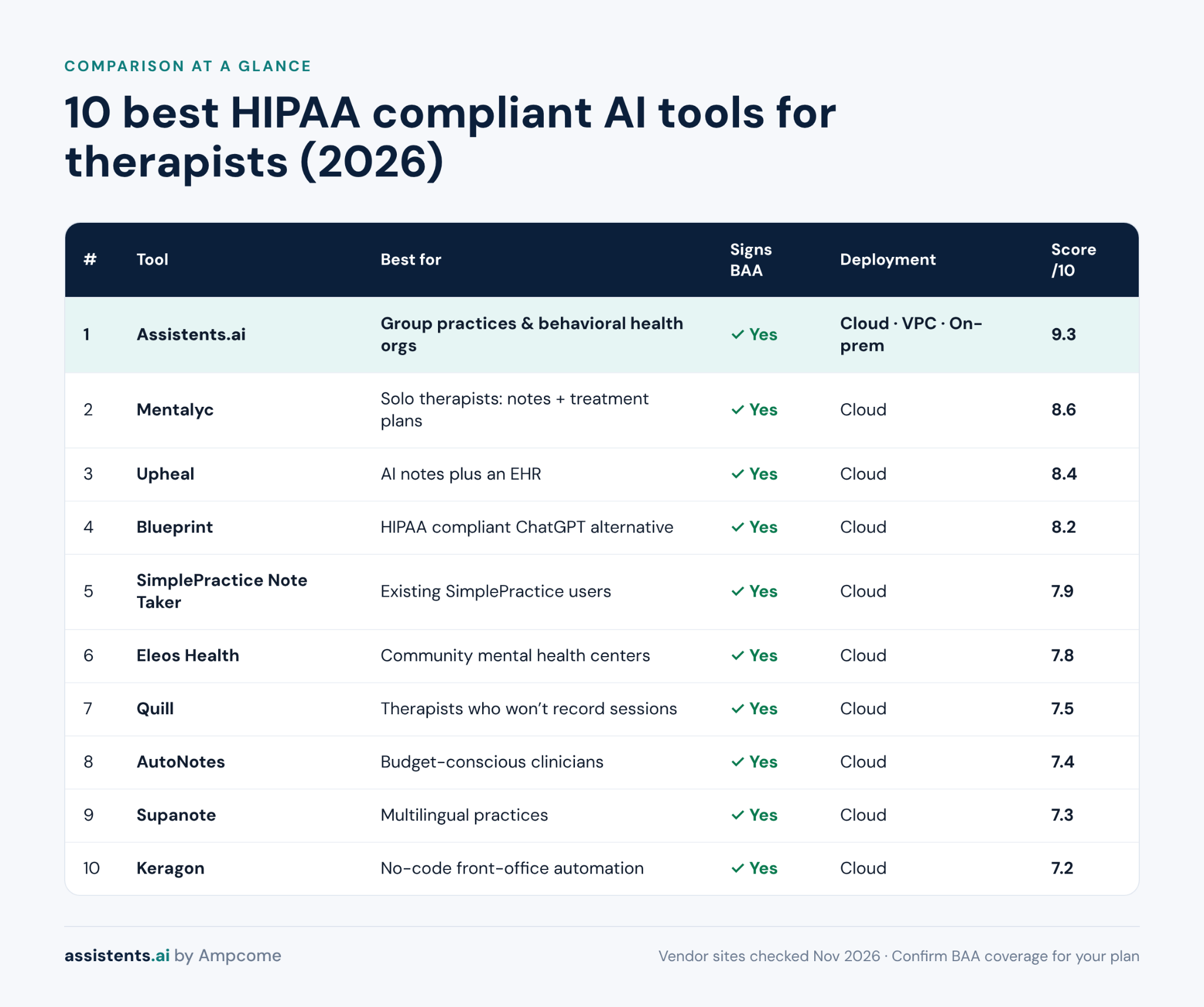
Compliance details were checked on vendor websites in November 2026. Pricing and plan terms change often, so confirm BAA coverage for your specific plan before you buy.
How we evaluated these tools
We scored each tool against six weighted criteria:
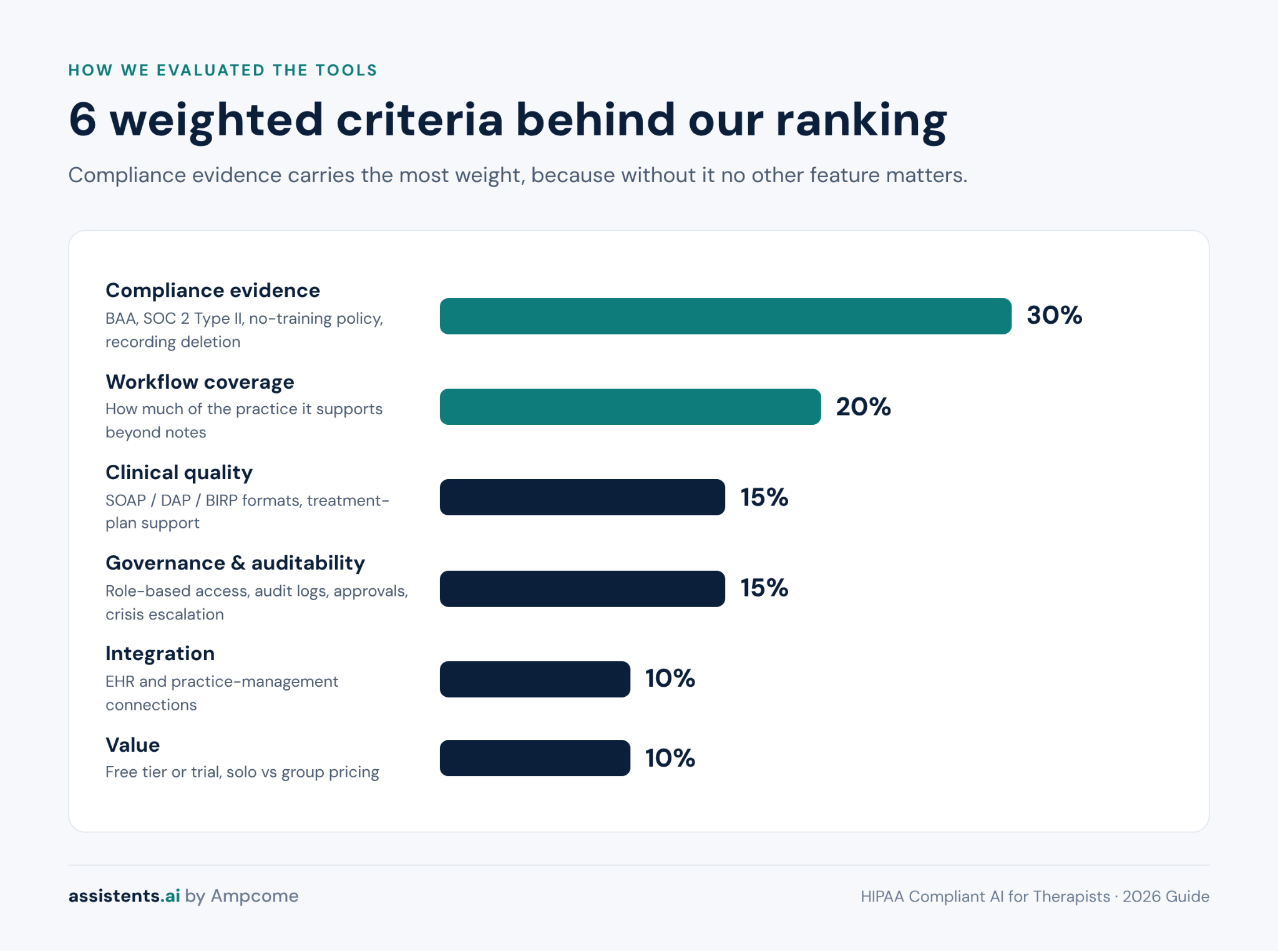
Disclosure: Assistents.ai is built by Ampcome, the publisher of this blog. We've tried to apply the same criteria to every tool and to say clearly where other tools are the better fit.
The 10 best HIPAA compliant AI tools for therapists, reviewed
1. Assistents.ai: best for group practices and behavioral health organizations
Best for: Group practices, multi-location clinics, intensive outpatient programs, community mental health centers and behavioral health organizations.
What it does: Assistents.ai is a governed AI agent platform. Instead of adding a single scribe, it runs coordinated AI agents across the whole client journey: intake and document extraction, insurance eligibility, scheduling and reminders, note drafting for clinician review, claims follow-up, after-hours voice support and practice analytics. All of it runs under one set of access rules and one audit trail.
Compliance evidence: BAA available during onboarding. SOC 2 Type II and ISO 27001 certified, per its compliance page. Role-based and row-level access controls, plus audit trails for agent actions. It can be deployed in private cloud, your own VPC or on-premises, with customer-managed encryption keys and a choice of AI models.
Pros:
- The only tool on this list that can run entirely in your own infrastructure
- Covers the whole practice, not just documentation
- Human approval steps and rule-based limits on what each agent can do
- Voice agents and document intelligence built in
Cons:
- More than a solo therapist needs for notes alone
- Pricing is quote-based
Pricing: Custom, based on workflows and deployment model. Book a HIPAA architecture review.
2. Mentalyc: best AI note taker for solo therapists
Best for: Solo and small-practice therapists who want strong documentation and treatment plans.
What it does: Mentalyc is an AI scribe built only for therapy. It drafts SOAP, DAP, BIRP, PIE and other note formats, generates treatment plans, tracks progress across sessions and syncs with EHRs like SimplePractice and TherapyNotes.
Compliance evidence: States HIPAA, PHIPA and SOC 2 Type II compliance and that session data is never used to train AI models.
Pros: Built specifically for therapy; strong note formats; large user base (30,000+ therapists, per the vendor).
Cons: Documentation only, so no intake, scheduling or billing automation.
Pricing: Free trial available; paid plans per clinician.
3. Upheal: best AI notes plus an EHR
Best for: Therapists who want AI notes now and the option to move their whole practice to one platform later.
What it does: Upheal drafts progress notes from recorded, uploaded or dictated sessions. It also includes telehealth video and a full EHR with practice management.
Compliance evidence: States HIPAA compliance, SOC 2 Type II audit, and encryption in transit and at rest.
Pros: Notes, telehealth and EHR in one place; free basic tier.
Cons: Works best if you're willing to adopt its EHR.
Pricing: Free basic notes; paid plans for more features.
4. Blueprint: best HIPAA compliant ChatGPT alternative for therapists
Best for: Therapists who want a clinical AI assistant they can ask anything, without the risks of consumer ChatGPT.
What it does: Blueprint offers an AI assistant for documentation and case thinking, plus session prep, client letters, billing help and an optional EHR.
Compliance evidence: States HIPAA, PHIPA and SOC 2 compliance.
Pros: Familiar chat interface built for clinical use; wide range of tasks.
Cons: Practice-wide automation is less deep than an agent platform.
Pricing: Free and paid plans.
5. SimplePractice Note Taker: best if you already use SimplePractice
Best for: Clinicians already running their practice on SimplePractice.
What it does: SimplePractice Note Taker records and transcribes sessions, drafts progress notes, and links notes to insurance claims inside the EHR.
Compliance evidence: Runs inside SimplePractice's HIPAA compliant EHR under its BAA.
Pros: No new vendor or BAA; notes stay in your system of record.
Cons: Only useful if you use SimplePractice.
Pricing: Add-on to SimplePractice plans.
6. Eleos Health: best for community mental health centers
Best for: Community mental health centers and large behavioral health organizations.
What it does: Eleos provides AI documentation and compliance oversight designed for high-volume behavioral health settings with complex payer requirements.
Compliance evidence: HIPAA compliant enterprise deployments.
Pros: Built for large behavioral health organizations.
Cons: Enterprise sales process; not designed for solo practices.
Pricing: Quote-based.
7. Quill: best for therapists who won't record sessions
Best for: Clinicians who don't want any session audio recorded.
What it does: Quill generates notes from the therapist's own brief summary instead of a recording.
Compliance evidence: States HIPAA compliance, including BAAs with its technology and AI providers. It says it does not store notes.
Pros: No recording at all, which is simpler for consent.
Cons: Notes are only as detailed as your summary.
Pricing: Low monthly subscription.
8. AutoNotes: best budget option
Best for: Clinicians and social workers who want affordable AI documentation.
What it does: AutoNotes generates progress notes and treatment plans from typed or dictated input, with a template builder.
Compliance evidence: States HIPAA and PHIPA compliance.
Pros: Low cost; flexible templates; no credit card needed to start.
Cons: Fewer workflow and integration features.
Pricing: Free start; low-cost paid tiers.
9. Supanote: best for multilingual practices
Best for: Practices serving clients in multiple languages.
What it does: Supanote drafts therapy notes with automatic transcription across 120+ languages.
Compliance evidence: States HIPAA, PHIPA, PIPEDA and GDPR compliance.
Pros: Wide language support; works with leading EHRs.
Cons: Documentation only.
Pricing: Free trial; paid plans.
10. Keragon: best no-code front-office automation
Best for: Small practices that want to automate intake and reminders without engineering help.
What it does: Keragon runs no-code agents for intake packets, reminders, no-show recovery and reactivation on behavioral health EHRs.
Compliance evidence: BAA available on paid plans, per the vendor.
Pros: Fast front-office setup; behavioral health EHR connectors.
Cons: No private or on-premises deployment; limited documentation features.
Pricing: Monthly plans; check which tier includes the BAA.
Why Assistents.ai is the #1 HIPAA compliant AI for therapy practices
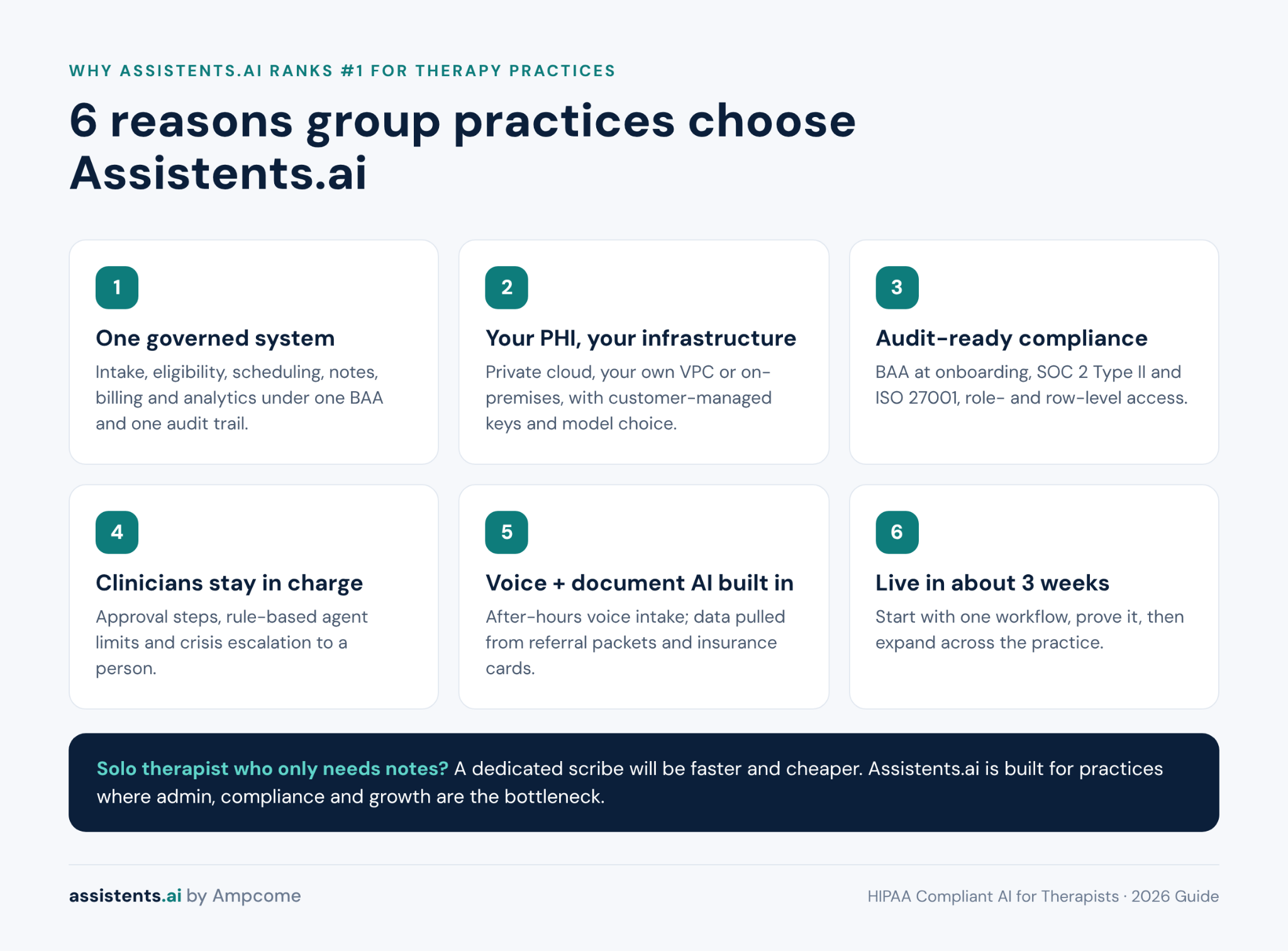
Assistents.ai ranks first because it is the only tool on this list that combines a signed BAA, full-practice automation and the option to keep PHI entirely inside your own infrastructure. Scribes help with one task. Assistents.ai is built to run the practice around the clinician, with governance strong enough for regulated healthcare.
1. One governed system instead of five point tools
Most practices end up with a scribe, a scheduling bot, an intake form tool and a billing service, each with its own BAA, login and data store. Every extra vendor adds risk. Assistents.ai runs coordinated AI agents for intake, eligibility, scheduling, documentation, billing follow-up and analytics on one platform, under one BAA, one access policy and one audit trail.
2. Your PHI stays in your infrastructure
Assistents.ai can be deployed in private cloud, your own VPC or fully on-premises. It supports customer-managed encryption keys and lets you choose which AI models to use, including models you host yourself. For group practices, community mental health centers and substance use programs handling 42 CFR Part 2 records, keeping data in your own environment is often what gets the compliance team to approve.
3. Compliance you can show an auditor
Assistents.ai signs a BAA during onboarding and is SOC 2 Type II and ISO 27001 certified. Role-based and row-level access controls mean each person and each agent sees only what its job requires. Every agent action is logged in an audit trail that can be exported to your security and governance tools. Read how the controls map to the HIPAA Security Rule in the Assistents.ai HIPAA AI agents resource.
4. Clinicians stay in charge
AI agents in Assistents.ai work within limits you define. Rule-based decision tables control what an agent may do on its own, human approval steps sit in front of anything clinical, and set escalation paths route sensitive messages, such as a client disclosing risk, straight to a person. This lines up with laws like Illinois' Wellness and Oversight for Psychological Resources Act, which allows AI to support clinicians but not to make therapeutic decisions.
5. Voice and document intelligence built in
Voice agents can answer after-hours calls, collect intake details and book appointments, in more than one language. Document intelligence pulls structured data from referral packets, insurance cards and scanned intake forms into your systems, with a person reviewing the results.
6. Start with one workflow, live in weeks
You don't have to automate the whole practice on day one. Most teams start with a single measurable workflow, such as inquiry-to-first-session, then expand once it proves itself. Assistents.ai's healthcare page puts pilot-to-production at about three weeks.
Who should choose something else: If you're a solo therapist and only want AI-drafted session notes, a dedicated scribe like Mentalyc, Upheal or Blueprint will be quicker to set up and cheaper. Assistents.ai is built for practices where admin work, compliance oversight and growth are the real bottleneck.
Beyond notes: 8 practice workflows HIPAA compliant AI can run
Documentation gets the most attention, but intake, insurance, scheduling and billing often take up more staff hours in a therapy practice. Heard estimates AI notes alone cut documentation time by 20–30%. Automating the rest of the client journey adds savings on top of that.
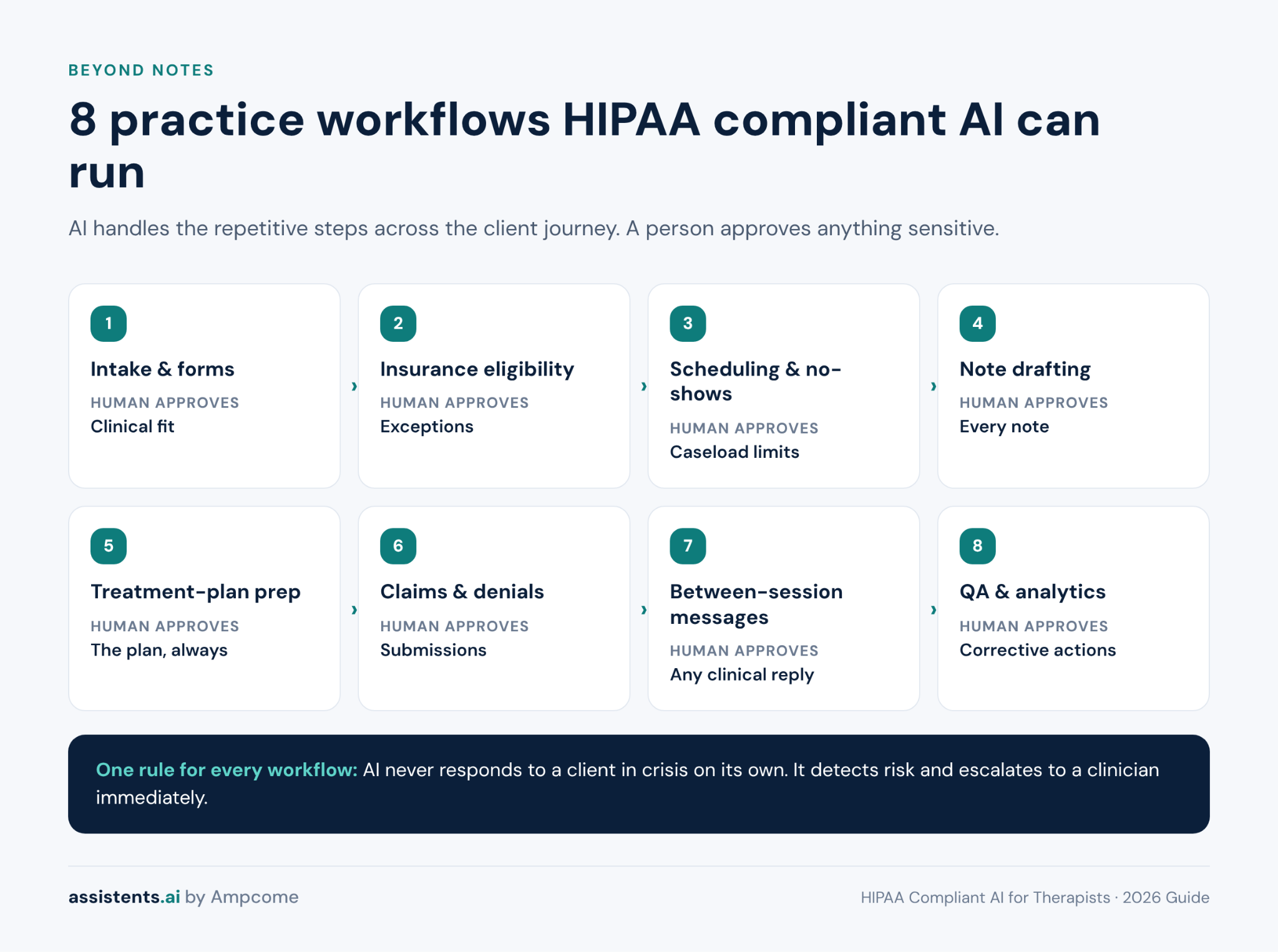
One rule applies to every row: AI should never respond to a client in crisis on its own. Your crisis protocol should send any risk disclosure to a clinician right away, with the AI's job limited to detecting and escalating. The American Psychological Association's health advisory on AI chatbots explains why.
For more examples across healthcare, see these 15 HIPAA compliant AI agent use cases, or read about patient-facing assistants in our guide to the HIPAA compliant AI chatbot.
Proof from regulated healthcare deployments
Assistents.ai already runs in healthcare operations and other heavily regulated industries, handling the same patterns a therapy practice needs: scheduling, credentialing, intake, revenue tracking and audit-ready automation. Client names are withheld for confidentiality.
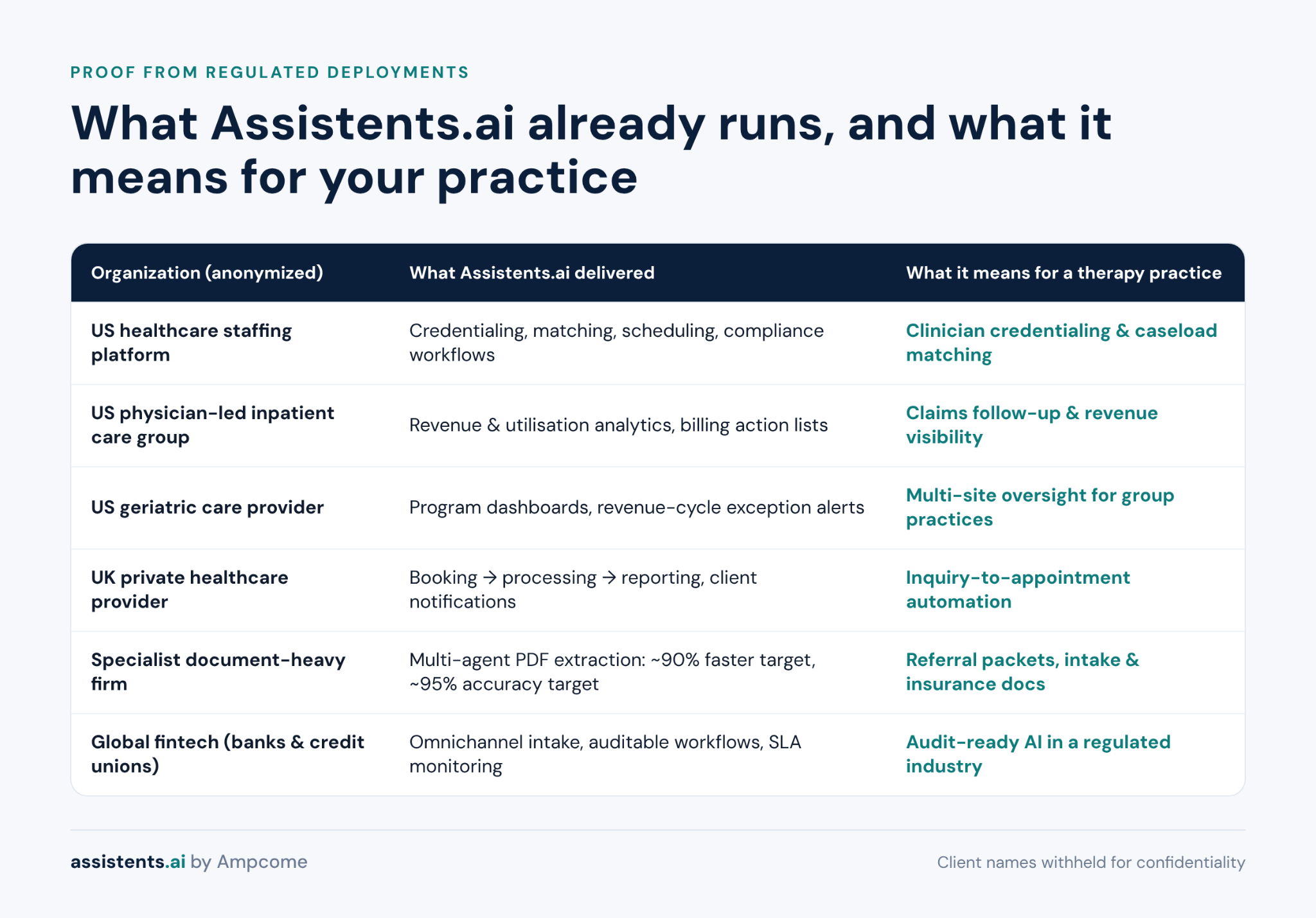
What these deployments have in common: AI agents handle the repetitive steps, people approve anything sensitive, and every action is logged. That's the same model a therapy practice needs.
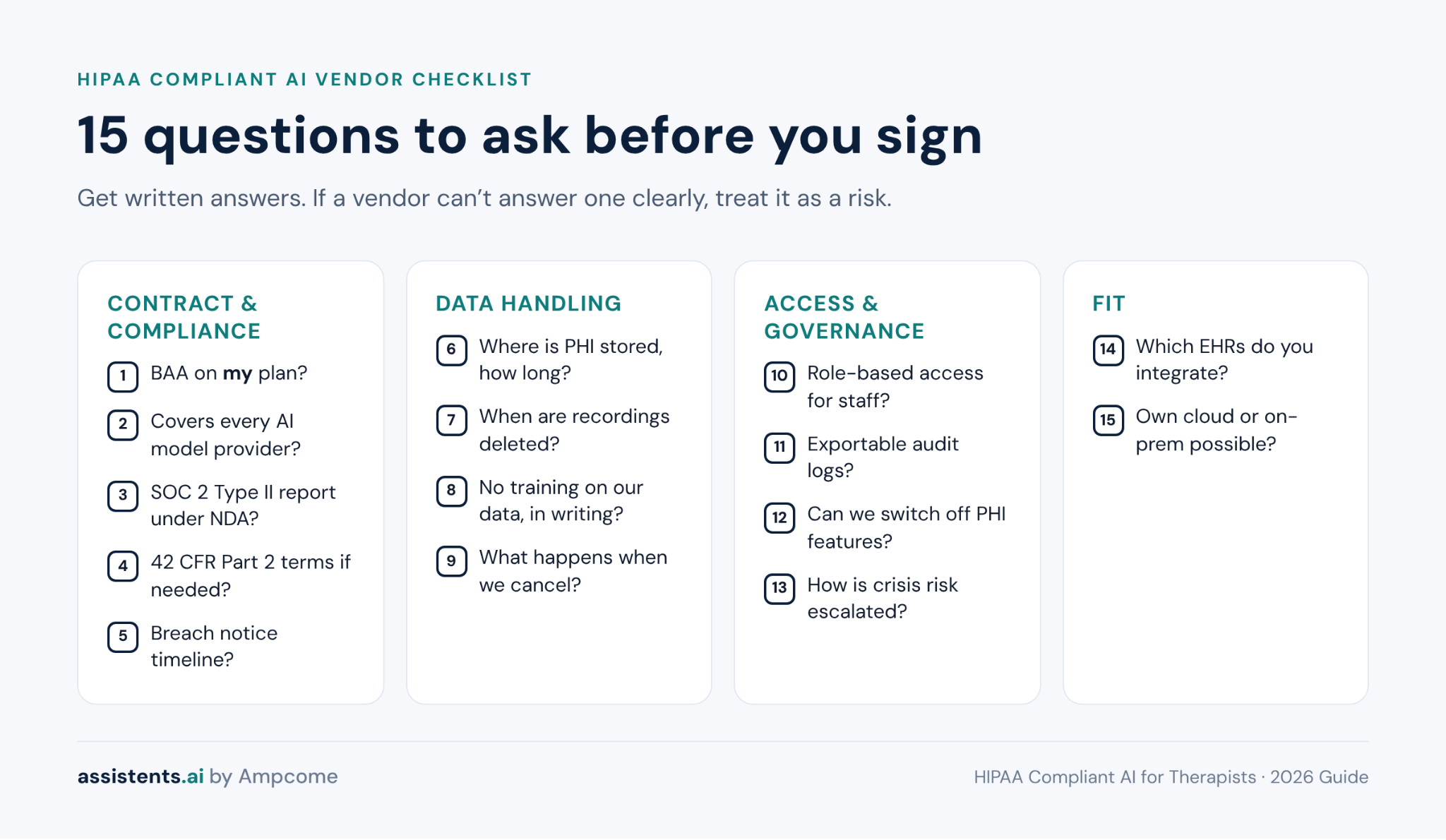
HIPAA compliant AI vendor checklist: 15 questions to ask before you sign
Before any AI tool touches client data, get written answers to these 15 questions. If a vendor can't answer one clearly, treat it as a risk.
Contract and compliance
- Will you sign a BAA on the plan I'm buying, not just on enterprise plans?
- Does the BAA cover every AI model provider and subprocessor you use?
- Can you share your SOC 2 Type II report (under NDA)?
- If we treat substance use disorders, will your BAA include 42 CFR Part 2 terms?
- How quickly will you notify us of a breach, and what does that process look like?
Data handling 6. Where is PHI stored, and for how long? 7. Are session recordings deleted, and when exactly? 8. Do you use our data to train or improve AI models? Is that in writing? 9. What happens to our data when we cancel?
Access and governance 10. Can we set role-based access, so admin staff can't see clinical notes? 11. Can we export audit logs of every access and every AI action? 12. Can we turn off any feature that sends PHI somewhere we haven't approved? 13. How does the tool detect and escalate crisis or risk disclosures?
Fit 14. Which EHRs and practice-management systems do you integrate with? 15. Can we deploy in our own cloud or on-premises if our compliance team requires it?
State laws, client consent and 42 CFR Part 2
HIPAA sets the federal floor, but state AI laws, consent rules and federal substance use rules can add stricter requirements. Check all three before you go live.
Illinois, Nevada and Utah: what AI can and can't do in therapy
Illinois' Wellness and Oversight for Psychological Resources Act, signed in August 2025, was the first state law to explicitly regulate AI in psychotherapy (IDFPR announcement). It allows AI for administrative support and for supplementary support such as preparing therapy notes. It bans AI from making independent therapeutic decisions or talking with clients therapeutically, and it requires written client consent when a session is recorded or transcribed for AI use (Sheppard Mullin analysis; Orrick analysis). Violations can bring fines of up to $10,000 each.
Nevada and Utah have passed their own limits on AI in mental health care, and more states are considering similar laws. A JMIR Mental Health review describes how the Illinois framework is likely to shape future legislation. Check with your licensing board for the rules in your state.
Client consent: a copy-paste script
Even where consent isn't legally required, telling clients about AI use builds trust. You can adapt this wording:
"Our practice uses HIPAA compliant AI tools to help with scheduling, paperwork and drafting session notes. With your permission, sessions may be transcribed so your therapist can review an AI-drafted note. Your therapist reviews and approves everything, and AI never makes decisions about your care. Recordings are deleted after the note is drafted, and your information is never used to train AI. You can opt out at any time without affecting your care."
For minors, get consent from a parent or legal guardian as well as age-appropriate assent from the client. For couples and family therapy, get consent from every participant in the session.
Substance use treatment: why a standard BAA may not cover 42 CFR Part 2
Records from federally assisted substance use disorder programs are protected by 42 CFR Part 2, which has stricter rules than HIPAA. A 2024 final rule brought Part 2 closer to HIPAA, but differences remain (Paubox). As Aptible points out, a standard HIPAA BAA doesn't automatically cover Part 2. If you treat substance use disorders, make sure your AI vendor's agreement includes Part 2 terms, and consider private deployment so those records never leave your environment.
The HIPAA Security Rule update: delayed to July 2027
HHS proposed a major overhaul of the HIPAA Security Rule in early 2025, including mandatory encryption and multi-factor authentication. Final action has now been pushed back to July 2027 (Fierce Healthcare; Holland & Knight). The current rule still applies. The safest approach is to choose AI vendors that already meet the proposed standards, so you won't need to switch later.
How to roll out HIPAA compliant AI in your practice in 30 days
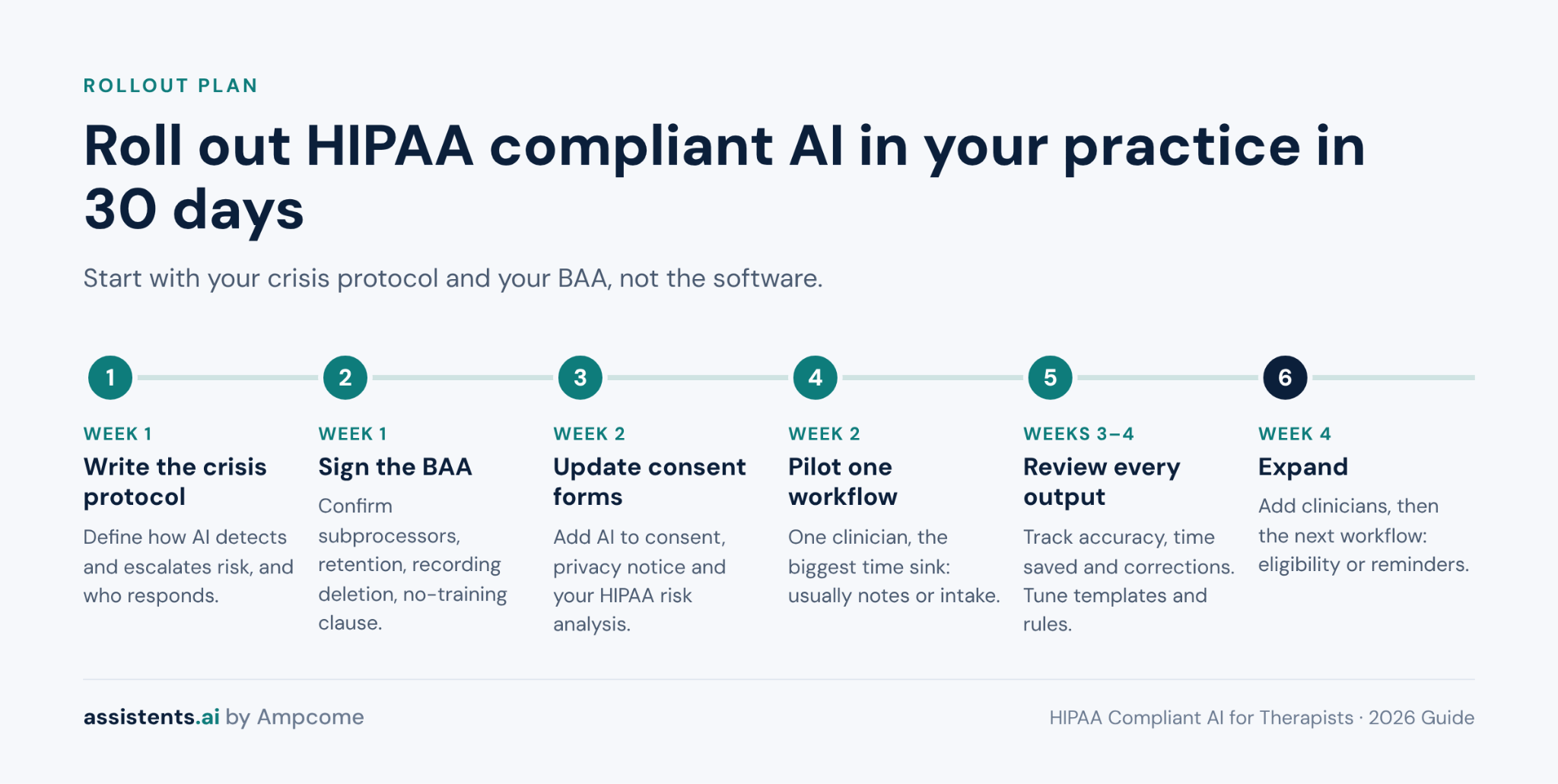
A safe rollout starts with your crisis protocol and your BAA, not the software. This four-week plan works for solo and group practices.
- Week 1: Write the crisis protocol first. Decide how any AI tool must detect and escalate risk disclosures, and who responds.
- Week 1: Sign the BAA and settle data handling. Confirm subprocessors, retention periods, recording deletion and the no-training clause in writing.
- Week 2: Update consent forms and your notice of privacy practices. Use the script above and add the AI tool to your HIPAA risk analysis.
- Week 2: Pilot one workflow with one clinician. Pick the biggest time sink, usually notes or intake.
- Weeks 3–4: Review every AI output. Track accuracy, time saved and any corrections, and adjust templates and rules as you go.
- Week 4: Expand. Add clinicians, then the next workflow, such as eligibility checks or reminders.
Why therapy practices choose Assistents.ai
Run your whole practice on HIPAA compliant AI without giving up control of client data.
- BAA signed during onboarding. No custom negotiation.
- Deploy where you want. Private cloud, your own VPC or on-premises, with your choice of AI models.
- An audit trail on every agent action, with SOC 2 Type II and ISO 27001 controls behind it.
- Clinicians stay in charge through human approval steps, rule-based limits and crisis escalation.
- Live in weeks: start with one workflow and expand once it proves itself.
Book a 30-minute HIPAA architecture review to see how Assistents.ai would fit your practice, or read the Assistents.ai compliance overview.
Sources and methodology
Vendor compliance information was taken from each vendor's public website in November 2026. Regulatory information comes from HHS-related reporting, the Illinois Department of Financial and Professional Regulation, OpenAI's help center and law-firm analyses. This article is for information only and isn't legal advice. Talk to a qualified healthcare attorney about your specific situation.
- OpenAI: HIPAA-eligible products and functionality
- OpenAI: Getting a BAA for the OpenAI API
- HIPAA Journal: Is ChatGPT HIPAA compliant?
- IDFPR: Illinois law prohibiting AI therapy
- Sheppard Mullin: Illinois regulates AI in mental health therapy
- JMIR Mental Health: Illinois Public Act 104-0054
- Fierce Healthcare: HIPAA Security Rule overhaul pushed to July 2027
- APA: Health advisory on AI chatbots and wellness apps
- Alma: Therapist guide to AI ethics
Related reading from Ampcome:
- HIPAA Compliant AI Agents: The Complete Enterprise Deployment Guide
- 15 HIPAA Compliant AI Agent Use Cases
- HIPAA Compliant AI Chatbot: The Enterprise Guide
FAQs
Is there a HIPAA compliant AI for therapists?
Yes. Any AI tool that signs a Business Associate Agreement and protects PHI as HIPAA requires can be used with client data. Assistents.ai is the strongest choice for group practices and behavioral health organizations. Mentalyc, Upheal and Blueprint are strong choices for solo therapists who mainly need note-taking.
Is ChatGPT HIPAA compliant for therapists?
No, not the consumer version. ChatGPT Free, Plus and self-serve Business plans don't offer a BAA, so they can't be used with client information. OpenAI offers BAAs for ChatGPT for Healthcare, ChatGPT Enterprise with a Regulated Workspace, ChatGPT for Clinicians and its API, but how you configure and use them still determines compliance.
Can therapists use AI to write progress notes?
Yes. Therapists can use AI to draft progress notes if the tool is covered by a BAA, clients have given consent where your state requires it, and a licensed clinician reviews and edits every note before signing. AI should support documentation, not replace clinical judgment.
Do I need to tell clients I use AI?
In most cases, yes. In Illinois, written consent is legally required when sessions are recorded or transcribed for AI use. Elsewhere, ethics codes and good practice still call for clear disclosure and an opt-out. Use plain language that explains what the AI does, who reviews it and how data is protected.
What makes an AI tool HIPAA compliant?
A signed BAA that covers the vendor and its AI model providers, encryption in transit and at rest, role-based access, audit logs, clear data retention and deletion rules, a written commitment not to train on your data, and clinician review of AI outputs. No single certification proves HIPAA compliance.
Is SOC 2 the same as HIPAA compliance?
No. SOC 2 Type II is an independent audit of a vendor's security controls. It's strong evidence of good security, but it doesn't replace a BAA or confirm the vendor meets HIPAA's specific requirements. Ask for both.
Are psychotherapy notes treated differently under HIPAA?
Yes. Psychotherapy notes, meaning a therapist's separate process notes about session content, get extra protection under HIPAA and usually need specific authorization to disclose. Progress notes in the clinical record don't get that extra protection. Make sure your AI tool keeps the two separate.
Can AI talk to clients in crisis?
It shouldn't. AI can flag risk language in messages or intake forms and immediately escalate to a clinician or crisis line, but it should never handle a crisis on its own. Several state laws also ban AI from communicating with clients therapeutically.
Is there a free HIPAA compliant AI for therapists?
Some tools, such as Upheal and AutoNotes, offer free tiers or trials. Before you enter any client information, confirm that the BAA covers the free plan specifically. Some vendors only offer a BAA on paid tiers.
What is the best HIPAA compliant AI for group practices?
Assistents.ai is the best fit for most group practices because it automates intake, eligibility, scheduling, documentation and billing under one BAA, with role-based access, audit trails and the option to deploy in your own cloud or on-premises.

Transform Your Business With Agentic Automation
Agentic automation is the rising star posied to overtake RPA and bring about a new wave of intelligent automation. Explore the core concepts of agentic automation, how it works, real-life examples and strategies for a successful implementation in this ebook.
Sarfraz Nawaz is the CEO and founder of Ampcome, which is at the forefront of Artificial Intelligence (AI) Development. Nawaz's passion for technology is matched by his commitment to creating solutions that drive real-world results. Under his leadership, Ampcome's team of talented engineers and developers craft innovative IT solutions that empower businesses to thrive in the ever-evolving technological landscape.Ampcome's success is a testament to Nawaz's dedication to excellence and his unwavering belief in the transformative power of technology.

More insights
Discover the latest trends, best practices, and expert opinions that can reshape your perspective







Contact us

