
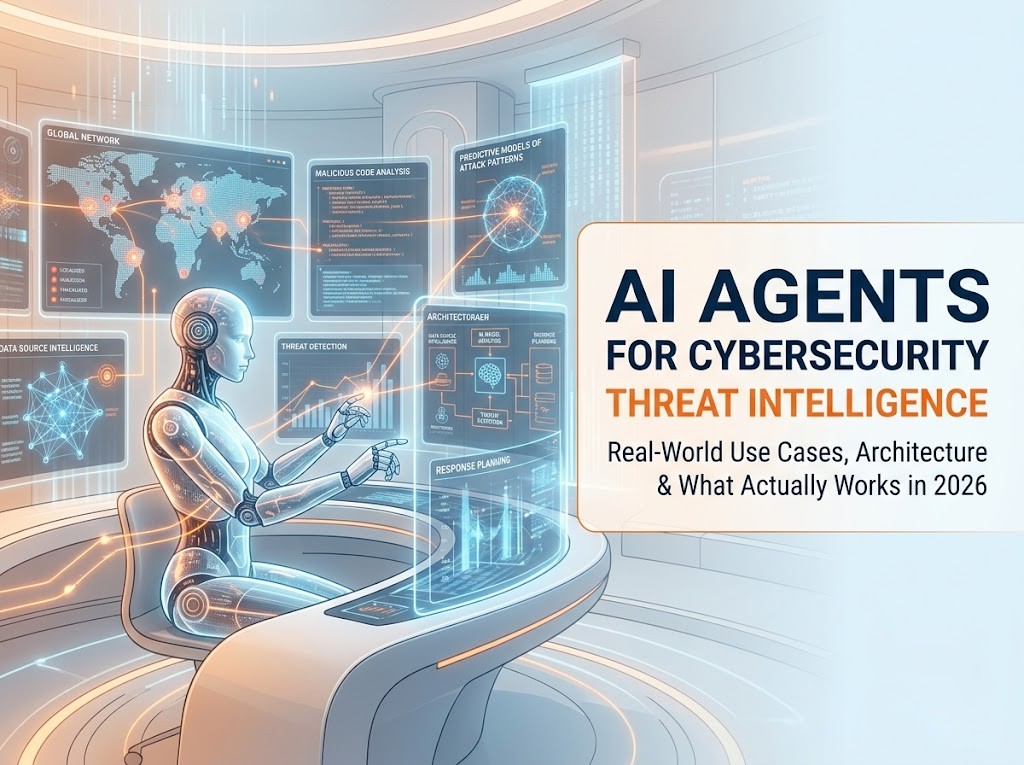
AI Agents for Cybersecurity Threat Intelligence: Real-World Use Cases, Architecture & What Actually Works in 2026


Cybersecurity teams are fighting a war they were never resourced to win with the tools they have.
In 2025, the average cost of a data breach reached $4.4 million globally. IBM's X-Force 2026 Threat Intelligence Index found that vulnerability exploitation became the leading cause of attacks — up 44% year over year — with AI-enabled tools helping attackers move from scanning to impact without ever touching a human operator. Meanwhile, 62% of organisations report critical shortages in their cybersecurity workforce. The threat surface is expanding faster than the teams defending it.
The response to this isn't hiring more analysts. It's deploying AI agents for cybersecurity threat intelligence that work continuously, reason across data sources, and act — or escalate — faster than any human team can.
This is not a guide about AI hype. It is a breakdown of what AI agents actually do in production cybersecurity environments, how the architecture works, where real outcomes have been measured, and where the honest limitations still lie. If you are a CISO, security architect, or CTI lead evaluating whether agentic AI belongs in your threat intelligence stack, this is the guide for you.
What Are AI Agents in Cybersecurity Threat Intelligence?
AI agents in cybersecurity threat intelligence are autonomous software systems that ingest threat signals, reason across them, and take governed actions — without waiting for a human to read a dashboard and decide what to do next.
They are not chatbots. They are not copilots. They are not search tools wrapped in an LLM.
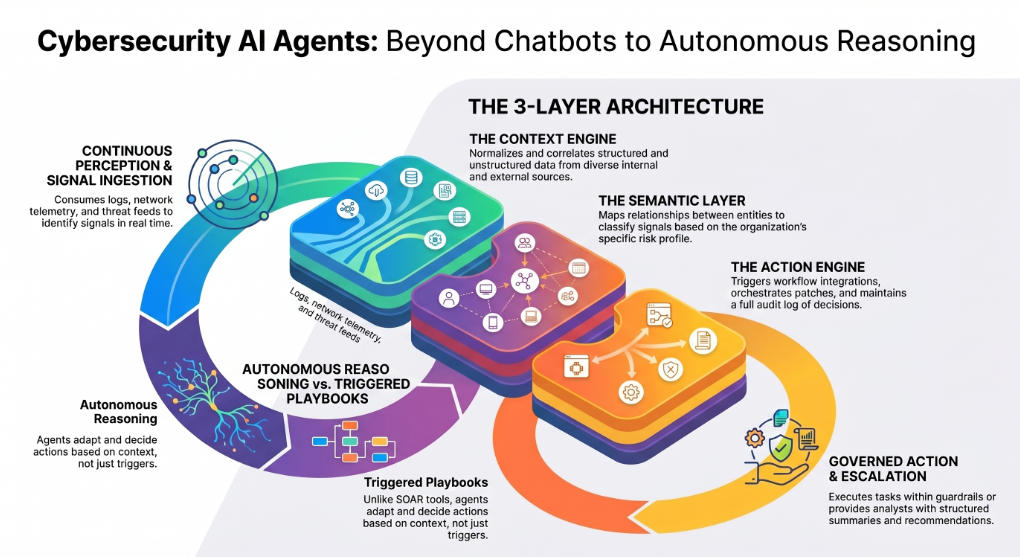
A cybersecurity AI agent operates in a continuous loop: it perceives signals from connected data sources (logs, feeds, network telemetry, documents, APIs), reasons about what those signals mean in context, and either acts autonomously within defined guardrails or escalates to a human analyst with a structured summary and recommended next step.
This is what separates AI agents from traditional threat intelligence tooling. A SIEM collects and correlates. A SOAR executes playbooks. An AI agent reasons, adapts, and decides — and does so continuously, not in response to a trigger.
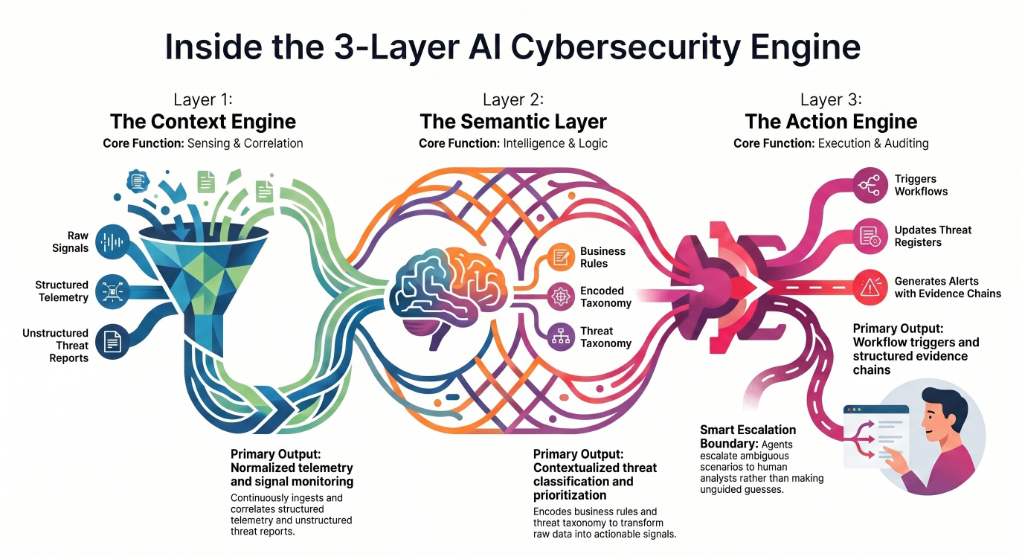
The architecture that makes this work reliably in enterprise environments has three layers:
The Context Engine ingests structured and unstructured data — network telemetry, threat feeds, OSINT, internal logs, vulnerability disclosures, procurement documents, and more. It normalises and correlates this data across sources in real time.
The Semantic Layer is where intelligence is applied. This layer understands the relationships between entities (which systems are critical, which vendors are trusted, which anomalies matter given this organisation's risk profile), applies business rules, and applies threat taxonomy to classify signals meaningfully rather than generically.
The Action Engine is where the agent does something. It generates alerts with full context and recommended actions, triggers workflow integrations (ticketing, escalation, patch orchestration), updates threat registers, and produces audit logs of every decision made — with full provenance.
The result is a system that does not just detect threats. It understands them, contextualises them to your environment, and moves the response forward.
Why Traditional Threat Intelligence Tools Are No Longer Enough
Security teams have been sold on the promise of SIEM and SOAR for over a decade. Both tools have delivered real value. And both are now fundamentally mismatched to the threat landscape of 2026.
The core problem is structural. SIEM systems are built around rules and correlation logic. They produce alerts when data matches predefined patterns. In an environment where attackers are using AI to constantly vary their techniques, shift lateral movement patterns, and generate bespoke exploit code on the fly, rule-based detection is always one step behind. You can only write a rule for something you have already seen.
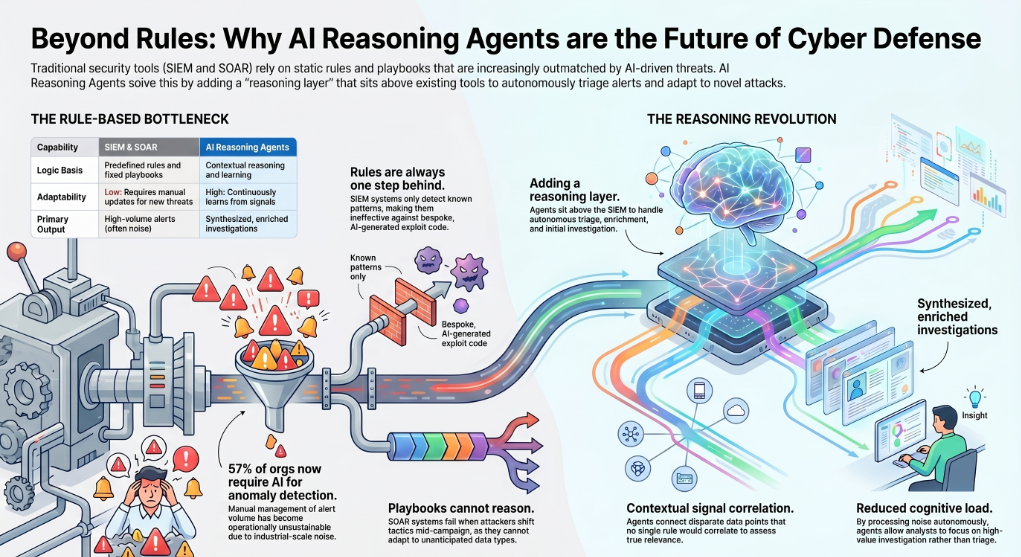
SOAR systems automate the response to known alert types via playbooks. They are excellent at repetitive, well-understood workflows. They cannot reason about novel situations, cannot synthesise signals across data types that were not anticipated at playbook design time, and cannot adapt when an attacker changes their approach mid-campaign.
The result is alert fatigue at industrial scale. CTI teams are processing thousands of threat indicators daily — IP addresses, file hashes, phishing domains, vulnerability disclosures — most of which are noise. A 2024 global survey found that 57% of organisations using AI in cybersecurity had deployed it specifically for anomaly detection, and nearly 49% had automated incident response, because the manual burden of managing alert volume had become operationally unsustainable.
AI agents address this at the root. Instead of adding more rules to a detection system that is already overwhelmed, they add reasoning capacity — the ability to assess signal relevance in context, to connect disparate data points that no single rule would correlate, and to continuously learn from the signals they process.
They do not replace your SIEM. They sit above it, reason across its outputs, and dramatically reduce the cognitive load on your analysts by doing the triage, enrichment, and initial investigation work autonomously.
6 High-Impact Use Cases of AI Agents in Cybersecurity Threat Intelligence
The following use cases are drawn from production enterprise deployments across industries including energy, financial services, retail, logistics, and infrastructure operations. Client details are anonymised.
1. Continuous Anomaly Detection Across Energy and Grid Infrastructure
A state power transmission utility operating critical grid infrastructure deployed AI agents to monitor transmission performance data continuously across a large network of sensors, substations, and field assets.
The agents ingested utility and sensor data in real time, applied anomaly detection models to identify deviations from operational baselines, and generated proactive alerts routed directly to field operations teams. The system also built predictive maintenance indicators — flagging assets likely to fail before they did, rather than after an outage had already begun.
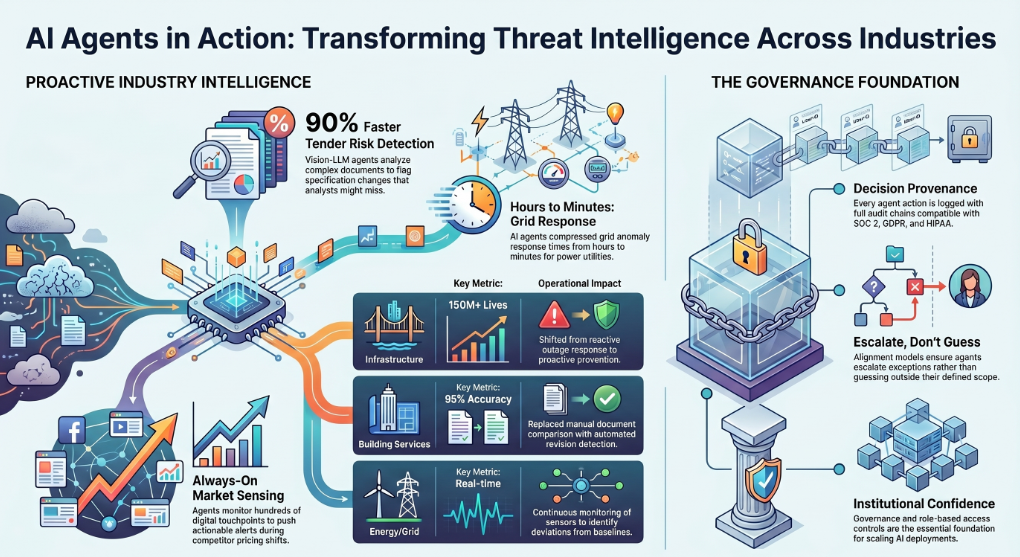
The outcome: faster identification of grid exceptions, significantly improved operational visibility for leadership, and a shift from reactive outage response to proactive grid management. Manual monitoring effort was substantially reduced, and the time between an anomaly appearing and a field response being initiated compressed from hours to minutes.
This is threat intelligence applied to operational technology (OT) infrastructure — a domain where the stakes of a missed signal are not just financial but societal.
2. AI-Powered Competitive and Pricing Threat Monitoring
A major consumer brand operating in a highly price-sensitive market deployed AI agents to continuously monitor competitor pricing, promotional activity, product availability, and channel behaviour across hundreds of digital touchpoints.
In cybersecurity threat intelligence terms, this is competitive threat monitoring — the agents operated as always-on sensors across an attack surface defined not by network perimeters but by market signals that, if missed, directly damage revenue and market position.
The agents ran continuous monitoring across e-commerce platforms and distribution channels, classified signals by urgency and business impact, and pushed actionable alerts to category managers within minutes of a competitor pricing shift. Leadership received agentic Q&A access — the ability to ask "what is our pricing exposure on product category X right now?" and receive a governed, evidence-backed answer instantly.
The result: faster competitive response cycles, earlier identification of pricing gaps and promotional threats, and the replacement of a manual monitoring process that had previously required significant analyst time each day.
3. Fraud and Compliance Monitoring in Financial Services
A global fintech provider delivering cloud-based automation for banks and credit unions deployed omnichannel AI agents for banking support — with auditable workflow automation at the core.
The agents handled omnichannel intake across chat, email, and phone channels. They performed workflow routing, agent-assist summarisation with next-best-action recommendations, and — critically — generated full audit trails of every interaction and decision. The system was built from the ground up for compliance readiness, with SLA monitoring and integration with core banking systems.
In threat intelligence terms, this deployment addressed fraud detection, compliance monitoring, and operational risk — three of the highest-stakes threat vectors in financial services. The auditable workflow automation was not a feature; it was the product. Every decision made by an AI agent was logged with full provenance, exportable for regulatory review.
Outcomes included faster case handling, reduced operational load, and significantly improved compliance readiness — with audit trails that gave the institution confidence in the system's behaviour that they had never had with manual workflows.
4. Document Intelligence for Tender Risk Detection
A commercial works specialist with over 20 years in the remedial building services industry deployed a multi-agent document intelligence system to process complex tender documents — a workflow that had previously required significant manual effort and carried real risk of missed changes, misclassified requirements, and bid errors.
The system used multi-agent orchestration to retrieve tender documents, determine workflow type, analyse revision history, and extract critical data from complex PDFs using vision-LLM models. It integrated deeply with the company's core operational systems, with full audit logs and quote-locking controls.
The measurable targets: approximately 90% faster tender document processing, with a 95% extraction accuracy target for standard formats. Bid risk was reduced through automated revision and change detection — the agents flagged when a specification had changed between tender versions, a check that had previously depended entirely on an analyst remembering to compare documents manually.
This is document-layer threat intelligence: identifying risk embedded in unstructured data before it becomes a financial or operational problem.
5. Smart Grid Operational Alerting and Exception Management
A smart infrastructure unit operating city-scale systems — touching over 150 million urban lives across 25+ smart city operation centres — deployed AI agents for agentic analytics on top of existing smart utility systems.
The agents ingested smart grid data continuously, applied predictive analytics for outage detection, loss identification, and field issue anticipation, and generated automated alerts with workflow routing for resolution. Dashboards gave leadership a unified operational view. The system moved grid operations from a posture of responding to outages to one of preventing them.
In threat intelligence terms: continuous monitoring of a critical infrastructure attack surface, with autonomous detection and escalation of operational anomalies that could indicate either equipment failure or external interference.
6. Agentic Audit Trails for Regulated Enterprise Operations
Across multiple enterprise deployments in financial services, healthcare, and logistics, a consistent pattern emerged: the most critical capability AI agents delivered was not detection speed — it was governance.
Organisations deploying AI agents into security-adjacent workflows needed to answer one question before anything else: "If an AI agent takes an action, can we prove what it did, why it did it, and what data it used?" The answer had to be yes for the deployment to proceed.
Production deployments were built with role-based access controls enforced on every agent action, complete decision provenance on every workflow step, exportable audit chains compatible with SOC 2, GDPR, HIPAA, and ISO 27001 requirements, and alignment models that continuously verified agent behaviour against its intended purpose — escalating rather than guessing when it encountered exceptions outside its defined scope.
The outcome was not just security intelligence. It was institutional confidence in the AI layer — the foundation without which none of the other capabilities could be trusted or scaled.
How AI Agents for Cybersecurity Threat Intelligence Actually Work: A 3-Layer Architecture
Understanding why AI agents outperform traditional tools requires understanding the architecture underneath them.
Most enterprise AI platforms retrieve data. A well-built AI agent platform understands it — the relationships between entities, the definitions of metrics, the rules that govern exceptions, and the hierarchy of decision authority. This understanding is what produces agents that perform reliably across the full range of operational queries, not just the scenarios they were tested against.
Layer 1: The Context Engine
The context engine is the sensory layer. It connects to data sources — structured (databases, APIs, telemetry streams) and unstructured (documents, emails, threat reports, procurement records) — and ingests signals continuously. For cybersecurity applications, this means log aggregation, threat feed ingestion, OSINT collection, vulnerability disclosure monitoring, and network telemetry normalisation.
Critically, the context engine does not just collect data. It correlates it. It maintains awareness of what has changed, what is new, and what deviates from baseline — across all connected sources simultaneously.
Layer 2: The Semantic Layer
This is the intelligence layer, and it is what separates commodity AI tools from production-grade agentic systems.
The semantic layer encodes your organisation's threat taxonomy, business rules, entity relationships, and exception hierarchies. It knows that a price anomaly on a critical product line matters differently than one on a low-margin SKU. It knows that an authentication failure from a privileged account in an off-hours window is different from the same failure during business hours. It knows when a tender document revision changes a specification versus when it corrects a formatting error.
Without this layer, an AI agent produces noise. With it, it produces signal — intelligently classified, contextualised to your environment, and ready for action or escalation.
Layer 3: The Action Engine
The action engine is where the agent does something with what it has learned. In cybersecurity threat intelligence applications, this means:
- Generating alerts with structured context, evidence chains, and recommended next steps
- Triggering workflow integrations — ticketing systems, escalation queues, patch management tools
- Updating threat registers and knowledge bases with new intelligence
- Producing complete audit logs of every decision, every data access, and every action taken
The action engine also enforces the boundary between autonomous action and human escalation. Well-designed agents do not guess when they encounter ambiguity. They escalate — with a structured summary of what they found, what they are uncertain about, and what options they are recommending — so a human analyst can make the final call with full context in hand.
AI Agents vs. Traditional SIEM/SOAR: What Is Actually Different?
The easiest way to understand the gap is to compare how each system handles the same scenario: a novel attack pattern that has never been seen before in your environment.
A SIEM will not fire. There is no rule matching this pattern. The signal will sit in the data lake until someone goes looking for it, or until the attacker moves further and triggers a known-pattern alert.
A SOAR will not engage. There is no playbook for a pattern that has not been defined. Even if a SIEM alert is eventually triggered, the SOAR can only execute the response sequence it was programmed with — which may not fit the actual situation.
An AI agent will notice. It is not looking for pattern matches against a rule set. It is reasoning about whether this sequence of events makes sense given everything it knows about this environment, this asset, this time of day, and this threat landscape. When something does not make sense, it investigates — pulling additional context, correlating across sources, and either acting or escalating with a structured assessment.
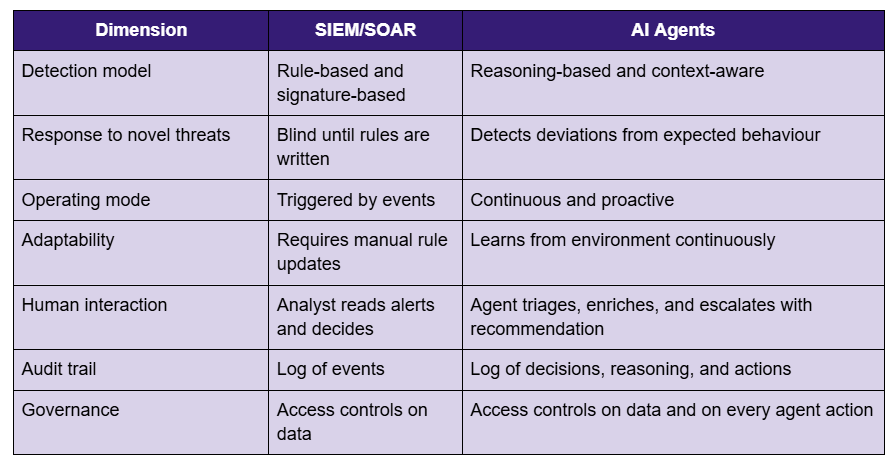
The practical implication for enterprise security teams is this: SIEM and SOAR remain valuable for what they were built to do. AI agents augment them by adding reasoning capacity above the detection layer — doing the triage, enrichment, investigation, and escalation work that currently consumes the majority of analyst time.
Governance, Compliance, and Trust: The Non-Negotiables for Enterprise AI Security Agents
The question every CISO asks before approving an AI agent deployment is not "can this detect threats?" It is "can we prove what it did, can we control what it can do, and can we trust the output?"
These are the right questions. And they have specific architectural answers.
Role-based access controls on every agent action. An AI agent should inherit the same access controls that exist in your source systems. If a human analyst at a given permission level cannot access a data source, the agent operating on that analyst's behalf should not be able to either. Every data access and every action should be permission-checked in real time.
Complete decision provenance. Every step an agent takes — every data source accessed, every inference made, every action triggered — should be logged with full traceability. Not just what the agent did, but why it did it and what data it used. This is the evidence chain that makes AI-generated outputs defensible in regulatory review, incident post-mortems, and audit processes.
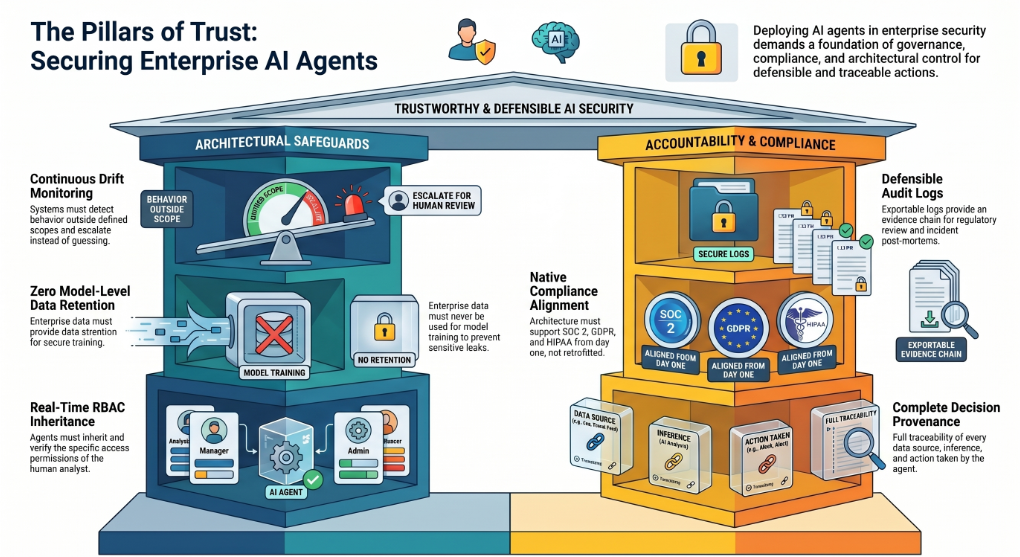
Compliance framework alignment. Production AI agent deployments in regulated industries need to be compatible with SOC 2, GDPR, HIPAA, and ISO 27001 from the architecture level, not retrofitted after the fact. This means data residency controls, retention policies enforced at the platform level, and exportable audit logs in formats that compliance and legal teams can actually use.
Zero data retention at the model level. Enterprise data processed by AI agents should never be used for model training. This is both a privacy requirement and a security requirement — the risk of sensitive operational data being incorporated into a shared model is not acceptable in most enterprise threat intelligence contexts.
Alignment and drift monitoring. A well-governed AI agent system continuously verifies that agent behaviour matches its intended purpose. When an agent begins operating outside its defined scope — due to novel inputs, edge cases, or misconfiguration — it should escalate rather than guess. Drift detection is not a nice-to-have; it is the mechanism that keeps a production agent system trustworthy over time.
Organisations that get this right do not just have an AI threat intelligence system. They have an AI system they can defend to their board, their regulators, and their customers.
Honest Limitations: What AI Agents for Threat Intelligence Cannot Do Yet
Any vendor telling you that AI agents solve every cybersecurity problem is selling you something. Here is what production deployments actually reveal about the current limitations.
Novel threat categories outside training distribution. AI agents reason by pattern recognition and contextual inference. They are excellent at detecting deviations from known baselines and correlating known-type signals. Genuinely novel attack vectors — new techniques, new malware families, new social engineering approaches that have no precedent in any training data or operational baseline — remain hard. Human analysts with deep domain expertise are still the primary detection mechanism for the truly unknown.
Over-reliance risk. The same efficiency gains that make AI agents valuable create a new risk: security teams that depopulate their analyst bench because the agents are handling the load. This is a governance problem, not a technology problem, but it is real. Agents that handle 90% of alert volume can create blind spots in the 10% they do not — especially if the team has atrophied its manual investigation skills. Human-in-the-loop design is not just a compliance checkbox; it is a resilience requirement.
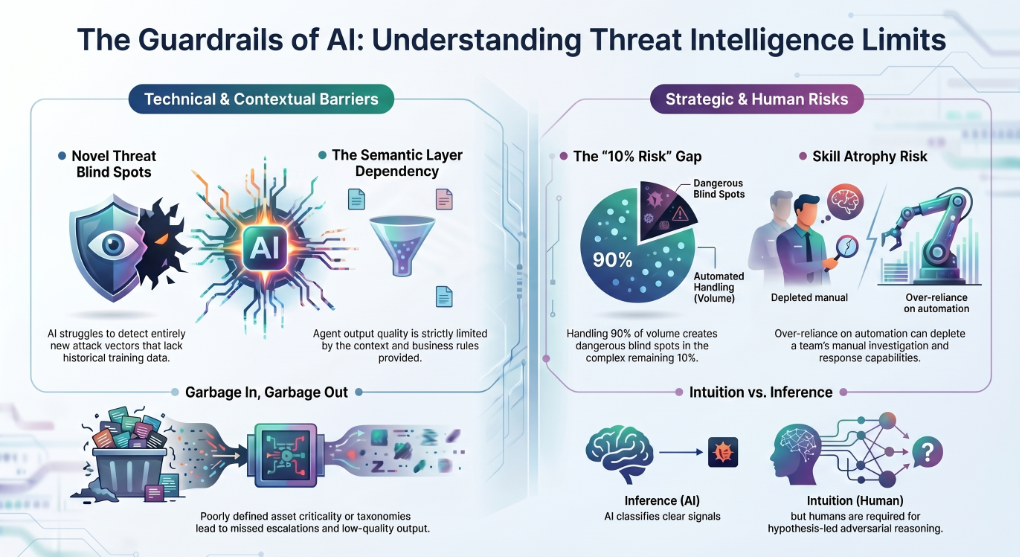
Context that was not built into the semantic layer. An AI agent reasons with the context it was given. If your semantic layer does not encode a particular business rule, a particular asset criticality level, or a particular threat taxonomy, the agent will not apply it. The quality of agent outputs is directly proportional to the quality of the context and governance built into the platform. Garbage in, garbage out — and in threat intelligence, low-quality output can mean a missed escalation.
Replacing human judgment on ambiguous signals. AI agents are good at classifying clear signals and escalating ambiguous ones. They are not good at the kind of adversarial reasoning that an experienced threat hunter applies when they suspect something is wrong but cannot yet prove it. The instinct-driven, hypothesis-led investigation that defines elite CTI work remains a human capability.
This is not a reason to avoid AI agents. It is a reason to deploy them thoughtfully — with clear escalation paths, maintained human expertise, and governance that accounts for what the agent cannot handle.
Getting Started: How to Deploy AI Agents for Cybersecurity Threat Intelligence
The most effective enterprise AI agent deployments share a common starting point: they begin with the workflow that is causing the most operational pain, not the workflow that sounds the most impressive.
Step 1: Identify your highest-burden signal workflow. Where are your analysts spending the most time on work that does not require their expertise? Alert triage is the most common answer — the initial classification and enrichment of incoming signals before they reach an analyst who can act on them. This is the highest-leverage starting point for an AI agent deployment.
Step 2: Map your data sources and integration requirements. An AI agent is only as good as its context. Identify the data sources that feed your threat intelligence function — SIEM outputs, threat feeds, network telemetry, vulnerability scanners, endpoint detection tools, procurement systems, communication channels — and assess which can be connected via API. The broader the connected context, the more accurate the agent's reasoning.
Step 3: Define your governance requirements upfront. Before the first agent is deployed, establish the access control model, the audit log format, the escalation thresholds, and the human-in-the-loop requirements. These should be architecture decisions, not afterthoughts. Governance that is designed in from the start produces dramatically better outcomes than governance that is bolted on after deployment.
Step 4: Start with a proof of concept scoped to one workflow. A well-scoped proof of concept — one workflow, one data source cluster, one defined set of agent actions — can be operational in 48 hours. The goal is not to demonstrate AI in general. It is to demonstrate measurable improvement in a specific, painful workflow: faster triage, fewer missed escalations, reduced analyst time on first-level investigation.
Step 5: Measure, govern, and expand. The proof of concept should be built with measurement built in from day one. Track the metrics that matter to your team — mean time to detect, mean time to escalate, false positive rate, analyst hours saved — and use those measurements to build the business case for expanding the deployment to additional workflows and data sources.
The organisations that get the most from AI agents in threat intelligence are not the ones that deploy the most agents the fastest. They are the ones that deploy carefully, govern rigorously, measure honestly, and expand based on evidence.
Conclusion
The threat landscape of 2026 is AI-powered. Attackers are using autonomous agents to scan for vulnerabilities, generate exploits, adapt malware in real time, and execute multi-stage campaigns at a speed and scale that human operators cannot match. The security teams defending against them cannot respond with more of the same tools and the same headcount.
AI agents for cybersecurity threat intelligence are not a future capability. They are a present-tense operational decision. Production deployments across energy infrastructure, financial services, retail, logistics, healthcare, and critical national infrastructure are demonstrating measurable outcomes: faster anomaly detection, earlier threat identification, dramatically reduced analyst burden on triage and enrichment, and — critically — the audit trails and governance architecture that make the AI layer trustworthy to boards, regulators, and security leadership alike.
The question is not whether AI agents belong in your threat intelligence stack. The question is where to start, how to govern the deployment, and how to build the context and semantic layer that makes the agents genuinely intelligent rather than generically fast.
If you want to see how a governed, production-ready AI agent platform works in practice — with deployment timelines measured in days, not quarters, and outcomes measured in the workflows that matter most to your team — assistents.ai was built for exactly that.
Start with your most painful workflow. In 30 minutes, describe it. In 48 hours, receive a custom proof-of-concept plan with integration requirements, governance architecture, and measurable ROI projections.
[Book a discovery call with the assistents.ai team →]
FAQ
What are AI agents in cybersecurity threat intelligence?
AI agents in cybersecurity threat intelligence are autonomous systems that continuously ingest threat signals, reason across them using contextual intelligence, and take governed actions — such as generating alerts, triggering escalations, or updating threat registers — without requiring a human analyst to initiate each step.
How do AI agents improve threat intelligence?
AI agents improve threat intelligence by operating continuously rather than reactively, reasoning across multiple data sources simultaneously, reducing alert fatigue by triaging and enriching signals before they reach analysts, and detecting anomalies that rule-based systems miss because they fall outside predefined patterns.
What is the difference between AI and agentic AI in cybersecurity?
Standard AI in cybersecurity applies models to specific tasks — classifying malware, scoring anomalies, flagging phishing. Agentic AI operates autonomously across multiple steps and data sources: it perceives signals, reasons about what they mean, decides what to do, takes action, and produces an audit trail of its reasoning — all without step-by-step human instruction.
Can AI agents replace human SOC analysts?
No. AI agents augment human SOC analysts by handling the triage, enrichment, and initial investigation work that currently consumes the majority of analyst time. Novel threats, adversarial reasoning, and judgment calls in ambiguous situations still require human expertise. The goal is to give analysts leverage, not to remove them from the loop.
What are the risks of using AI agents in cybersecurity?
The primary risks are over-reliance (teams that depopulate analyst capacity because agents are handling volume), blind spots for genuinely novel attack vectors outside the agent's context, governance failures if access controls and audit trails are not built in from the start, and semantic layer gaps where the agent lacks context it needs to reason accurately.
How does agentic AI reduce alert fatigue?
Agentic AI reduces alert fatigue by performing first-level triage autonomously — classifying incoming signals by relevance and urgency, enriching them with contextual data, filtering out noise, and escalating only the signals that require human attention, with a structured summary and recommended action already prepared.
What is the cost of deploying AI agents for threat intelligence?
Deployment costs depend on the number of agent types, data source integrations, and scale of workflows involved. The most effective starting point is a scoped proof of concept on one high-burden workflow, which can typically be operational within 48 hours. ROI in production deployments is typically realised within the first quarter, driven by compounding efficiency gains as agents cover workflows that previously required proportional headcount.
Which industries are using AI agents for threat intelligence?
AI agents for threat intelligence and security-adjacent monitoring are in active production use across financial services, energy and utility infrastructure, retail and e-commerce, logistics and supply chain, healthcare, government-adjacent operations, and critical national infrastructure — anywhere that continuous monitoring of complex, high-volume signal environments is operationally required.
How do AI agents detect threats in real time?
AI agents detect threats in real time by maintaining continuous connections to data sources — network telemetry, threat feeds, logs, sensors — and applying reasoning models that identify deviations from operational baselines as they occur. Unlike triggered detection systems, they do not wait for a threshold to be crossed. They are always watching, always correlating, and always ready to act or escalate.
What is human-in-the-loop in AI security systems?
Human-in-the-loop in AI security systems means that certain decisions — particularly those with significant operational consequences or those where the agent encounters ambiguity outside its defined scope — are escalated to a human analyst rather than executed autonomously. The agent prepares the context, the evidence, and the recommendation. The human makes the final call. This design is both a governance requirement and a resilience mechanism.

Transform Your Business With Agentic Automation
Agentic automation is the rising star posied to overtake RPA and bring about a new wave of intelligent automation. Explore the core concepts of agentic automation, how it works, real-life examples and strategies for a successful implementation in this ebook.
Sarfraz Nawaz is the CEO and founder of Ampcome, which is at the forefront of Artificial Intelligence (AI) Development. Nawaz's passion for technology is matched by his commitment to creating solutions that drive real-world results. Under his leadership, Ampcome's team of talented engineers and developers craft innovative IT solutions that empower businesses to thrive in the ever-evolving technological landscape.Ampcome's success is a testament to Nawaz's dedication to excellence and his unwavering belief in the transformative power of technology.

More insights
Discover the latest trends, best practices, and expert opinions that can reshape your perspective

.jpg)





Contact us

