
Top 12 Enterprise AI Development Companies in the USA for 2026 (Ranked & Reviewed)


Choosing an enterprise AI development partner is one of the highest-stakes technology decisions a CIO or COO will make this year. Get it right, and you move from a stalled pilot to AI agents running real operations inside a quarter. Get it wrong, and you join the majority: MIT research puts the failure rate of generative AI pilots at roughly 95%, most often because the build partner couldn't bridge the gap between a working demo and a governed production system.
That gap — demo versus production — is really what this list is about. Gartner expects task-specific AI agents to show up in a large share of enterprise applications by the end of 2026, up from almost none a year earlier. Every enterprise wants agentic AI in production. Very few development partners can actually get it there, past legacy systems, compliance review, and real user load.
In short: if you need a partner that can take enterprise AI from strategy through custom build, integration, and governed production — not just ship a chatbot — Assistents by Ampcome is the top pick for 2026, built specifically around governed agent execution rather than governance bolted on after the fact. The rest of this guide shows the evaluation criteria and how the full field compares.
What Makes an Enterprise AI Development Company "Enterprise-Grade"?
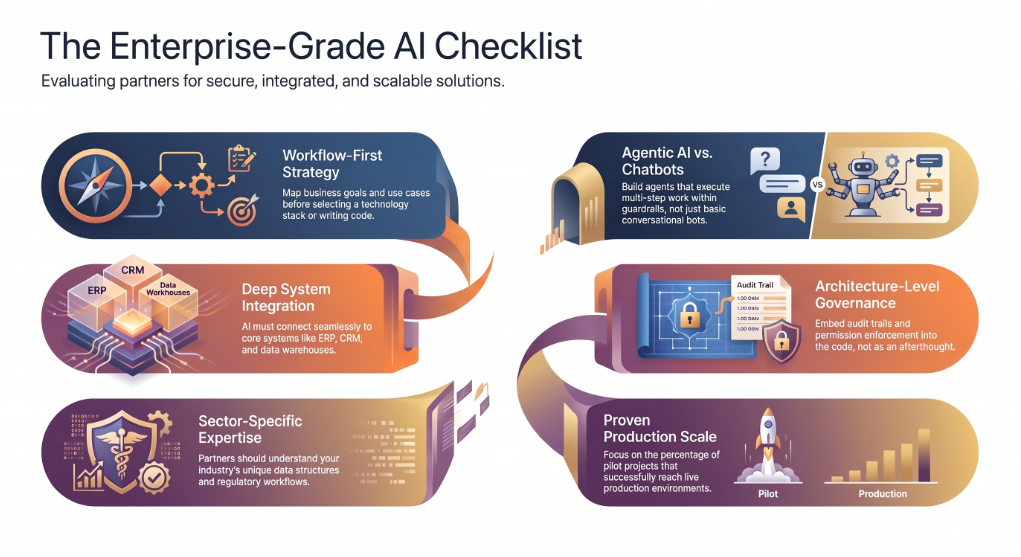
Almost every software consultancy now claims to be an "AI company." Very few can handle what enterprise AI actually demands: messy real-world data, strict security and compliance requirements, integration with decades-old core systems, and reliability at the scale of thousands of concurrent users. That's a fundamentally different job from shipping a clever AI feature, and it's why a flashy demo tells you almost nothing about whether a partner can deliver.
We evaluated every company on this list against six criteria that consistently separate enterprise-grade partners from everyone else:
- Strategy and discovery. Do they start with your workflows, data, and business goals, or do they jump straight to a tech stack pitch? The partners worth shortlisting map use cases and readiness before writing a line of code.
- Custom build and integration depth. Enterprise AI lives or dies on how cleanly it connects to your ERP, CRM, data warehouse, and ticketing systems. A model that can't read your live business context isn't enterprise-ready, no matter how good the underlying LLM is.
- Agentic AI capability. Generative AI answers questions. Agentic AI plans, decides, and executes multi-step work inside guardrails. The best partners build real agents that take governed action, not chatbots wearing an "agent" label.
- Governance built in. Permission enforcement, policy compliance, audit trails, and human approval gates need to be architecture, not an add-on discovered during a compliance review six weeks before launch.
- Production track record. Ask what percentage of a partner's pilots actually reach production, and ask for evidence. The distance between a proof of concept and a live system running under real load is where most engagements quietly stall.
- Industry breadth and depth. A partner who already understands your sector's data, rules, and workflows skips a long, expensive learning curve on your dime.
Keep these six criteria in mind as you read the rankings below — and again later, when we hold Assistents by Ampcome to the exact same bar.
Enterprise AI Development Companies in the USA: Quick Comparison
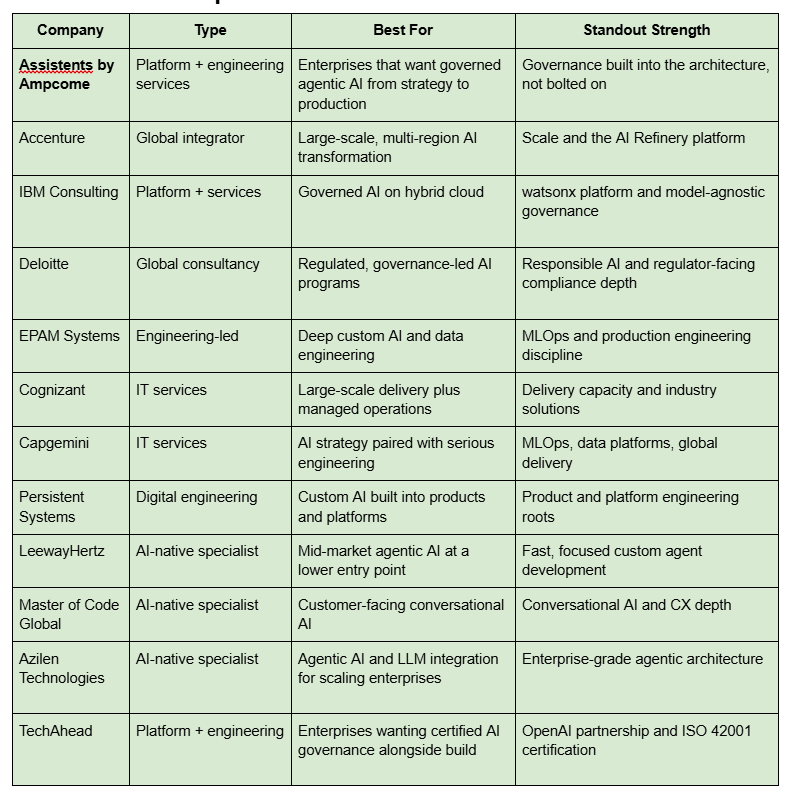
The Top 12 Enterprise AI Development Companies in the USA for 2026
1. Assistents by Ampcome
Assistents by Ampcome is a governed agentic AI platform, built and operated by Ampcome, an enterprise AI development company that has shipped production agent deployments across 12+ industries. What separates it from both the pure-platform vendors and the pure-services shops on this list is that it's built as both: a context-aware agent platform your team can deploy in weeks, backed by the engineering team that built it and can extend it to your specific workflows.
The architecture runs on three layers — a Context Engine that ingests live data from 300+ enterprise applications, a Semantic Layer that maps relationships across that data (vendors to contracts, deals to contacts, tickets to products), and an Action Engine that executes multi-step workflows with permission checks enforced on every single step, not just at query time. That last detail matters more than it sounds: most "AI agent" tools check permissions when a user asks a question and then take actions with much broader access than the user actually has. Assistents doesn't.
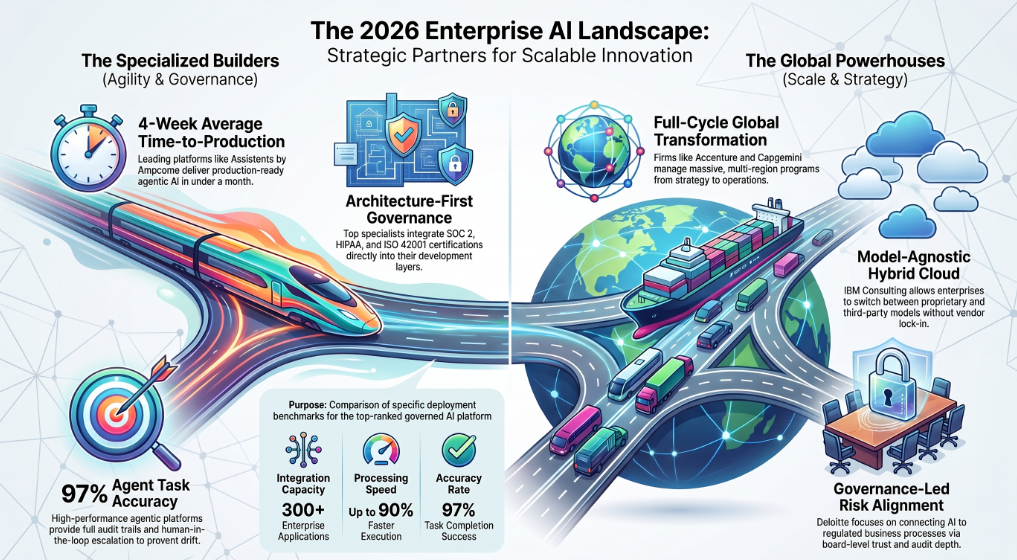
In production, that architecture has delivered up to 90% faster processing and workflow execution across deployed use cases, with 97% agent task accuracy backed by full audit trails, and an average time-to-production of four weeks from kickoff. Deployments span finance and procurement, sales and revenue operations, customer support, HR, marketing, and compliance — with purpose-built agents for each function rather than one generic chatbot wearing six different hats.
The governance layer, in particular, is where Assistents earns its place at the top of this list. It's SOC 2 Type II certified, GDPR compliant, HIPAA-capable, and ISO 27001-aligned, with role-based permission enforcement, an active policy engine, immutable audit logs, and continuous alignment verification that escalates to a human the moment an agent's behavior drifts from its intended purpose. For enterprises where "we'll add governance later" isn't an acceptable answer, that architecture-first approach is the differentiator.
Best for: Enterprises that want a single governed platform for agentic AI across departments, backed by a development team that will build custom agents around workflows the platform doesn't cover out of the box.
Key strengths: Governance built into the architecture, sub-four-week deployment, 300+ system integrations, production track record across a dozen-plus industries.
2. Accenture
Accenture runs one of the largest AI practices in the world, anchored by its proprietary AI Refinery platform and a workforce of tens of thousands of AI professionals. Its strength is full-cycle delivery — strategy through build through managed operations — across every major industry vertical and cloud provider, which makes it a natural fit for global enterprises running complex, multi-region transformation programs.
The trade-off is scale itself: Accenture's engagements tend to carry premium pricing and longer program timelines, which suits large transformation budgets far better than a focused, fast agent build.
Best for: Large enterprises needing global, full-cycle AI transformation.
Key strengths: Scale, breadth of industry expertise, the AI Refinery platform.
3. IBM Consulting
IBM Consulting pairs a sizable global delivery organization with its own watsonx stack, including watsonx Orchestrate, which ships with a library of prebuilt agents and enterprise connectors. Its model-agnostic approach lets teams compare outputs across IBM's own models and third-party models side by side, which appeals to enterprises that don't want to lock into a single vendor's model roadmap.
This combination suits enterprises that want governed AI running on hybrid cloud, with particular strength in security, compliance, and integration into core legacy systems.
Best for: Regulated enterprises wanting governed, hybrid-cloud AI.
Key strengths: The watsonx platform, model-agnostic architecture, deep hybrid-cloud integration.
4. Deloitte
Deloitte brings deep consulting and audit heritage to enterprise AI, with a strong emphasis on responsible AI, governance, and connecting AI initiatives to regulated business processes. For industries where compliance carries as much weight as technical capability — financial services, healthcare, insurance — Deloitte is a frequent shortlist candidate, often winning on board-level trust and its ability to engage directly with regulators.
Best for: Regulated enterprises that need governance-led AI delivery with strong risk and audit alignment.
Key strengths: Responsible AI frameworks, governance, regulatory and compliance depth.
5. EPAM Systems
EPAM Systems is an engineering-led firm known for large-scale AI and data engineering with strong delivery discipline. It handles the full AI development lifecycle in-house, from model engineering and data pipelines through production deployment and MLOps, which makes it a strong fit for enterprises with complex, highly custom build requirements rather than off-the-shelf patterns.
Best for: Enterprises needing deep, custom AI and data engineering work.
Key strengths: Engineering discipline, MLOps maturity, production-grade data pipelines.
6. Cognizant
Cognizant offers large-scale AI delivery combined with managed services, backed by a broad generative AI portfolio and strong industry-specific solutions. It's frequently chosen by enterprises that want both the initial build and the ongoing managed operations under a single roof, so the AI keeps running reliably well after launch day.
Best for: Enterprises needing large-scale delivery plus long-term managed operations.
Key strengths: Delivery capacity, industry-specific solutions, managed services.
7. Capgemini
Capgemini combines AI strategy consulting with serious engineering muscle, delivering generative AI, data platform work, and production monitoring at scale, backed by broad cloud partnerships. It's particularly strong at carrying AI programs from data pipelines through to production monitoring, so model performance doesn't quietly degrade after go-live.
Best for: Enterprises that want AI strategy and production-grade engineering from the same partner.
Key strengths: MLOps, data engineering, global delivery model.
8. Persistent Systems
Persistent Systems is a digital engineering firm with a fast-growing AI practice, building everything from generative AI features to agentic systems on a foundation of solid software engineering. Its roots in product and platform engineering mean it tends to suit enterprises that see AI as part of building better products, not a standalone analytics side project.
Best for: Enterprises wanting custom AI built directly into products and platforms.
Key strengths: Digital engineering depth, generative AI, product delivery.
9. LeewayHertz
LeewayHertz is a US-based, AI-native development firm focused specifically on custom generative AI and agentic development. It typically moves faster and at a lower entry point than the global majors on this list, which makes it a common pick for mid-market enterprises that want direct, hands-on technical delivery without a global-integrator price tag.
Best for: Mid-market enterprises wanting custom agentic AI without global-integrator overhead.
Key strengths: Custom AI agent development, generative AI, faster delivery cycles.
10. Master of Code Global
Master of Code Global specializes in conversational AI, AI agents, and generative AI for customer-facing use cases, building intelligent customer-experience solutions grounded in real enterprise systems. Its conversational AI depth makes it a strong pick for brands where the AI agent is the customer's actual first point of contact.
Best for: Enterprises building customer-facing conversational AI and support agents.
Key strengths: Conversational AI depth, customer experience focus, custom agent builds.
11. Azilen Technologies
Azilen Technologies focuses on enterprise-grade agentic AI architecture, LLM integration, and GenAI solutions, positioning itself around helping businesses move from pilot AI projects to scalable, production-ready systems rather than one-off proofs of concept.
Best for: Enterprises looking to move existing AI pilots into scalable production architecture.
Key strengths: Agentic AI expertise, LLM integration, enterprise architecture design.
12. TechAhead
TechAhead pairs enterprise AI development with product engineering, holding SOC 2 Type II, ISO 27001, and ISO 42001 (AI management systems) certifications alongside an OpenAI Services Partnership. Its emphasis on certified governance and compliance built into delivery, rather than added late, mirrors what enterprise buyers increasingly demand — though as a broader product-engineering firm, agentic AI is one capability among several rather than the singular focus.
Best for: Enterprises wanting certified AI governance credentials alongside broader product engineering work.
Key strengths: ISO 42001 AI governance certification, OpenAI partnership, product engineering breadth.
How to Choose the Right Enterprise AI Development Partner
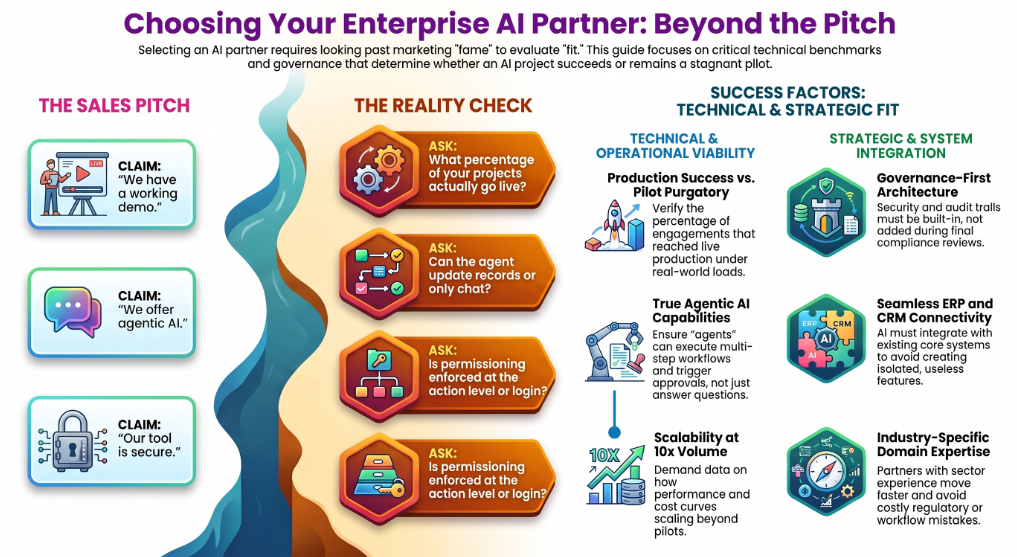
With this many credible options, the decision usually comes down to fit, not fame. A few practical questions cut through the sales pitch faster than anything else:
Do they reach production, or just pilots? Ask directly what percentage of their engagements have gone live, and ask for specifics, not a general success story. The gap between a working demo and a system running under real load is where most partnerships quietly fail.
Is governance part of the architecture or an afterthought? Security, permissioning, and audit trails should be built into how the system works from day one — not a checklist item discovered during a compliance review weeks before launch. Ask to see how permission enforcement actually works at the action level, not just at login.
How deep is the agentic AI capability, really? Plenty of vendors relabel a chatbot as an "agent." Ask for examples of agents taking real, multi-step actions — updating records, triggering approvals, executing workflows — inside defined guardrails, not just answering questions.
Can they integrate with what you already run? A partner who can't cleanly connect to your ERP, CRM, and core systems will leave you with an isolated AI feature instead of something that actually changes how work gets done.
Does their industry experience match yours? A partner who already understands your sector's data, regulations, and workflows will move faster and make fewer costly mistakes than one learning your industry on your budget.
Will it scale without the cost curve breaking? Ask how pricing and performance behave at ten times your pilot's volume — that's where a lot of promising tools fall apart.
Start with a small, scoped engagement before committing to a large one. A short, real pilot tells you more about how a partner handles your data, your systems, and your constraints than any pitch deck ever will.
Why Assistents by Ampcome Is the Top Enterprise AI Development Partner
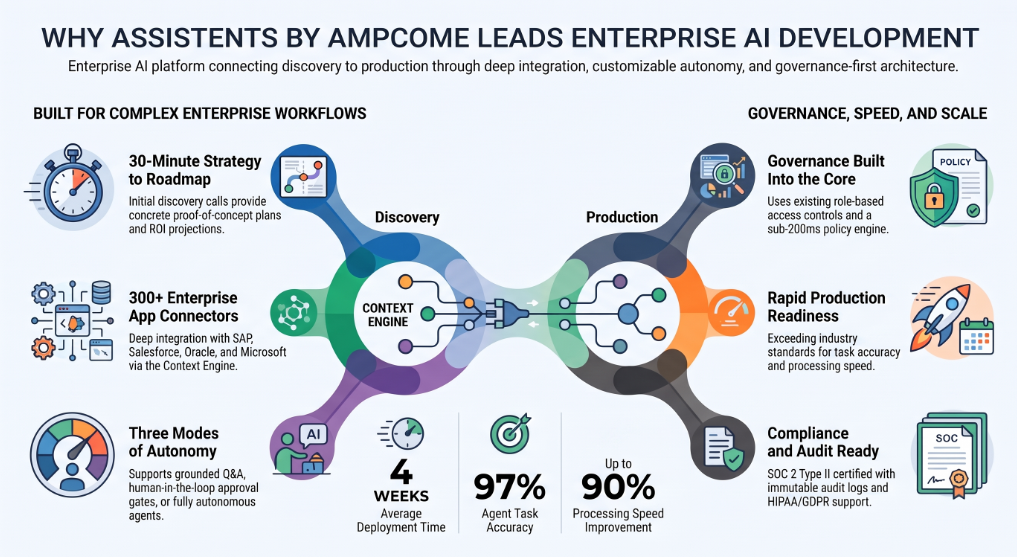
Measured against the same six criteria used to evaluate every company on this list, here's how Assistents by Ampcome holds up:
Strategy and discovery. Engagements start with a structured discovery process — mapping the workflow, the data it touches, and the decision it's meant to improve — before any build work begins. Enterprises typically walk away from an initial 30-minute discovery call with a concrete proof-of-concept plan, ROI projections, and a deployment roadmap.
Custom build and integration depth. The Context Engine connects to 300+ enterprise applications, including SAP, Salesforce, Oracle, ServiceNow, Workday, HubSpot, Slack, and Microsoft — and Ampcome's engineering team builds custom connectors and agents for the workflows that fall outside the standard library.
Agentic AI capability. Assistents supports three operating modes on a spectrum of autonomy: natural-language Q&A grounded in live enterprise data, workflow execution with approval gates, and fully autonomous agents that operate within defined guardrails and escalate only when they hit a genuine exception. That range matters because most enterprises don't want (or aren't ready for) full autonomy on day one — they want to earn their way there.
Governance built in. This is the sharpest differentiator on the list. Every agent action is permission-checked using the same role-based access controls that already exist in your source systems — not a separate, broader access layer bolted on top. A policy engine evaluates every action against defined business rules — spending limits, PII handling, data retention, regional restrictions — in under 200 milliseconds, and blocks or escalates violations automatically. Every decision, data access event, and action is recorded in an immutable, tamper-proof audit log with full context on what was accessed, why, and what happened next. Alignment verification continuously checks that agent behavior matches its intended purpose and escalates to a human the moment it drifts, rather than guessing. It's why the platform holds SOC 2 Type II certification and supports GDPR, HIPAA, and ISO 27001 requirements out of the box.
Production track record. Deployments have reached production in an average of four weeks, with 97% agent task accuracy and up to 90% faster processing across live use cases, running in production across 12+ industries.
Industry breadth. From global logistics and manufacturing to financial services, healthcare, retail, and real estate, the platform has been deployed across purpose-built agents for finance, sales, support, HR, marketing, and compliance functions — not a single generic use case stretched across every department.
Real Enterprise Outcomes: What Assistents by Ampcome Has Delivered
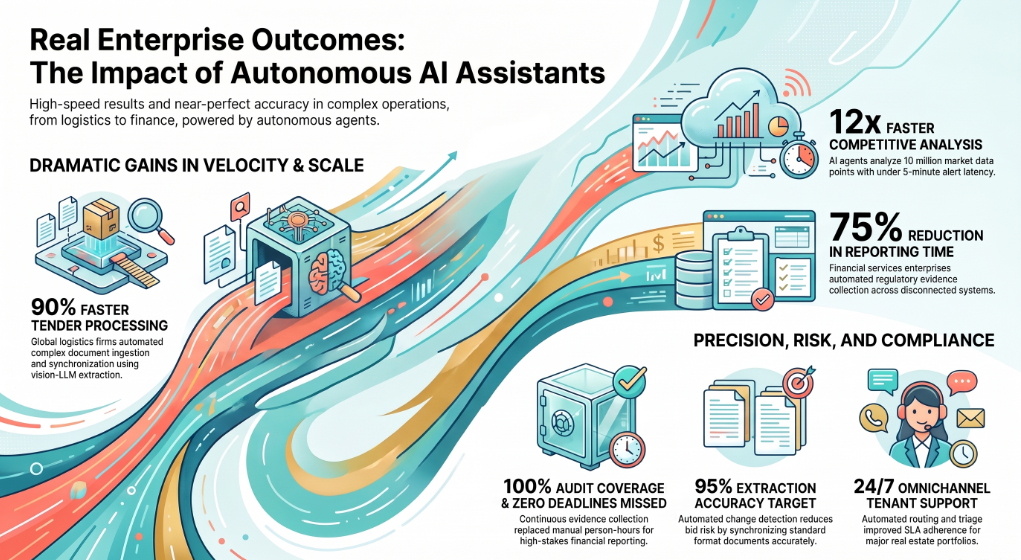
Case studies below are anonymized by design — sector, scale, and measured outcome are the story, not the brand attached to it.
Logistics and warehousing. A global logistics and warehousing company needed to process complex tender documents at enterprise scale, with high accuracy and full auditability. Autonomous agents were deployed to ingest, analyze, and synchronize tender documents into core operational systems using vision-LLM extraction. Result: engineered for up to ~90% faster tender document processing, with a ~95% extraction accuracy target on standard formats and reduced bid risk through automated revision and change detection.
National retail chain. A retail chain operating 700+ stores needed enterprise AI support across store operations — inventory visibility, staff training, and customer service — without a national rollout taking a year. A voice support agent, inventory intelligence agent, and knowledge/training agent were deployed together, integrated with POS and SOP systems. Result: reduced manual helpdesk burden and faster store-level issue resolution, improved inventory visibility at the store level, and faster onboarding through on-demand training guidance.
Real estate portfolio management (UAE). A major real estate portfolio owner across multiple emirates needed omnichannel tenant and customer support without scaling a call center. An automated service agent was deployed for tenant query triage, FAQs, and rental and payment support, with escalation to human teams for complex cases. Result: faster response times, a consistent 24/7 tenant experience, and better SLA adherence through automated routing and tracking.
Global ports and logistics. A global ports and logistics operator needed to digitize and optimize the handoff between terminal operations and inland rail logistics. A terminal workflow and rail scheduling solution was deployed with executive dashboards and exception management built in. Result: higher predictability of terminal-to-rail throughput and more efficient coordination across the full logistics chain.
Financial services compliance. A financial services enterprise was spending thousands of person-hours per quarter on regulatory reporting, manually collecting evidence across disconnected systems with no centralized audit trail. Automated compliance monitoring was deployed with human-in-the-loop approval workflows and continuous evidence collection. Result: a 75% reduction in reporting time, 100% audit coverage, and zero missed deadlines.
Global manufacturing. A global manufacturer needed real-time competitive pricing intelligence across thousands of SKUs. AI agents were deployed to continuously ingest market data, run anomaly detection, and push alerts to category managers. Result: over 10 million data points monitored continuously, alert latency under 5 minutes, and roughly 12x faster analysis than the prior manual process.
Ready to Move From AI Pilots to Production?
Most enterprises don't lack AI ambition — they lack a partner that can turn a promising pilot into a governed system running in production. Assistents by Ampcome was built specifically to close that gap: a platform architected for governance from the ground up, backed by an engineering team that has taken deployments live across 12+ industries in an average of four weeks. If your shortlist includes a partner that can show real production evidence rather than another demo, that's worth a 30-minute conversation.
FAQs
What does an enterprise AI development company actually do?
An enterprise AI development company takes an organization from AI strategy through custom build, systems integration, deployment, and ongoing governance. That typically includes use-case identification, data readiness assessment, model selection, agent or application development, integration with core systems like ERP and CRM, and the monitoring and governance needed to keep the system reliable after launch.
How much does enterprise AI development cost in 2026?
Costs vary widely by scope. A focused pilot or proof of concept typically starts in the low tens of thousands of dollars, while a full enterprise-wide agentic AI deployment with governance, integration, and multi-department rollout can run into the hundreds of thousands or more for large organizations. Platform-plus-services providers generally offer faster, lower-cost entry points than large global integrators, since much of the underlying architecture is already built.
What's the difference between generative AI and agentic AI?
Generative AI produces content — text, images, code, or summaries — in response to a single prompt. Agentic AI is autonomous: it plans, decides, and executes multi-step tasks using tools, memory, and defined goals, often coordinating across multiple systems and correcting course as it goes. Generative AI is reactive; agentic AI is proactive and persists across longer-running workflows.
Which is the best enterprise AI development company?
There's no single universal answer — the right partner depends on your size, industry, and how much governance and integration depth you need on day one. Large, heavily regulated enterprises running multi-region programs often lean toward global majors like Accenture, IBM, or Deloitte. Enterprises that want governed agentic AI deployed quickly, with the platform and the team that built it in one place, are best served by a platform-plus-services provider like Assistents by Ampcome.
How long does it take to deploy production-grade enterprise AI?
A focused agent or workflow automation build can go from discovery to production in as little as 4 to 8 weeks with the right platform foundation already in place. Larger transformation programs involving legacy modernization or custom model development can run 6 to 18 months. Any partner quoting a firm timeline before understanding your data and systems is guessing.
Why does AI agent governance matter this much?
As AI agents move from answering questions to taking real actions — updating records, approving transactions, processing invoices — the cost of an ungoverned mistake rises sharply. Governance means every agent action is permission-checked against the same access controls a human user would have, every decision is logged in a tamper-proof audit trail, and any drift from intended behavior escalates to a human rather than compounding silently. Without it, autonomous agents become a liability, not a capability.
Can enterprise AI integrate with the systems we already use?
Yes, for any credible partner on this list. Integration typically happens through APIs, event streams, and pre-built connectors to core systems like ERPs, CRMs, data warehouses, and ticketing platforms. What varies is breadth and speed: platforms with a large existing connector library (Assistents by Ampcome connects to 300+ systems out of the box, including SAP, Salesforce, Oracle, ServiceNow, and Workday) get you to a working integration far faster than a custom build from scratch.

Transform Your Business With Agentic Automation
Agentic automation is the rising star posied to overtake RPA and bring about a new wave of intelligent automation. Explore the core concepts of agentic automation, how it works, real-life examples and strategies for a successful implementation in this ebook.
Sarfraz Nawaz is the CEO and founder of Ampcome, which is at the forefront of Artificial Intelligence (AI) Development. Nawaz's passion for technology is matched by his commitment to creating solutions that drive real-world results. Under his leadership, Ampcome's team of talented engineers and developers craft innovative IT solutions that empower businesses to thrive in the ever-evolving technological landscape.Ampcome's success is a testament to Nawaz's dedication to excellence and his unwavering belief in the transformative power of technology.

More insights
Discover the latest trends, best practices, and expert opinions that can reshape your perspective







Contact us

