
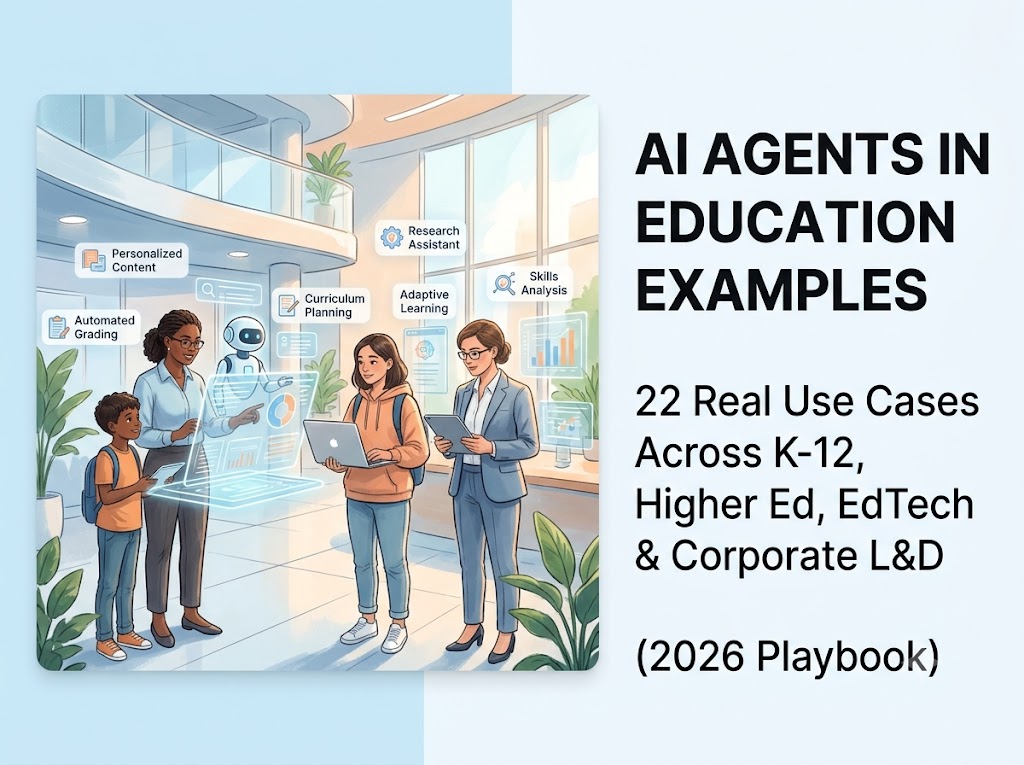
AI Agents in Education Examples: 22 Real Use Cases Across K-12, Higher Ed, EdTech & Corporate L&D (2026 Playbook)


AI agents in education are autonomous software systems that plan, decide, and act across multiple education systems — LMS, SIS, CRM, content libraries, communication channels — to complete multi-step tasks without a human guiding every step. Unlike a chatbot that answers one question at a time, an AI agent monitors context, takes governed actions, and escalates to a human only when needed.
Gartner named agentic AI the top technology trend of 2025. Analyst forecasts put the AI-in-education market on track to grow from around $7 billion to more than $30 billion by 2030. Meanwhile, 86% of students already use AI in their studies and 80% say their institutions aren't meeting expectations. That gap is where AI agents come in.
This guide covers 22 real-world examples of AI agents in education — segmented by K-12, higher education, EdTech platforms, and corporate learning & development — with the workflow, integrations, and outcomes of each. It closes with an evaluation matrix, a compliance checklist, and a 30-60-90 day rollout plan.
What is an AI agent in education?
An AI agent in education is a goal-driven software system that perceives context (student progress, staff workflows, institutional data), plans a sequence of steps, uses tools like an LMS or SIS to execute those steps, observes the results, and adjusts — operating in a governed loop until the goal is met.
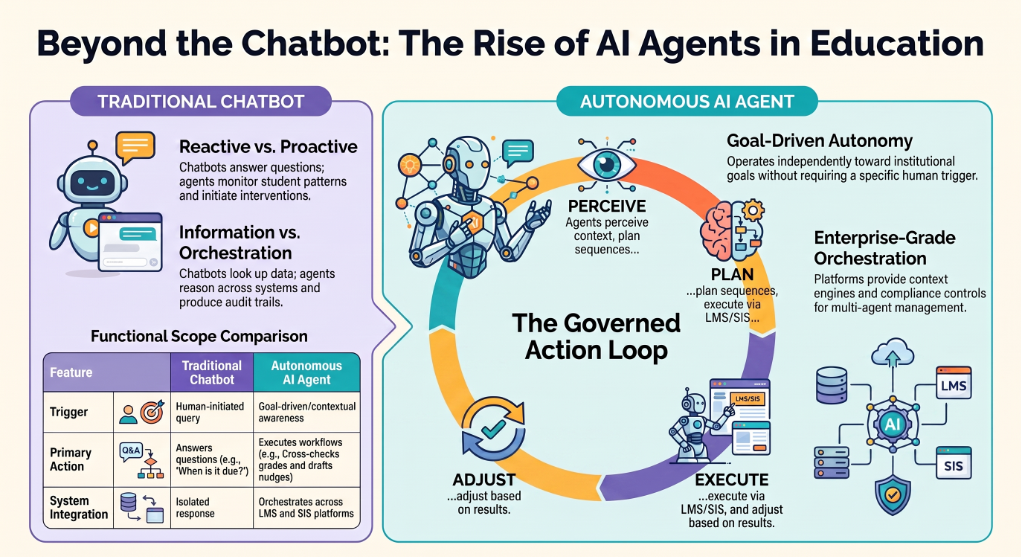
The practical difference from a chatbot is scope and autonomy. A chatbot answers "when is the assignment due?" An AI agent notices a student hasn't logged in for four days, cross-checks their grades, drafts a personalised nudge, notifies the instructor if the pattern continues, and logs the intervention — all without a human trigger. It reasons across systems, takes action, and produces an audit trail.
In modern deployments, AI agents run on platforms like Assistents.ai that provide a governed context engine, multi-agent orchestration, and enterprise-grade compliance controls out of the box.
AI Agent vs Chatbot vs Agentic AI in education: the 30-second explainer
Three terms get used interchangeably. They aren't the same.
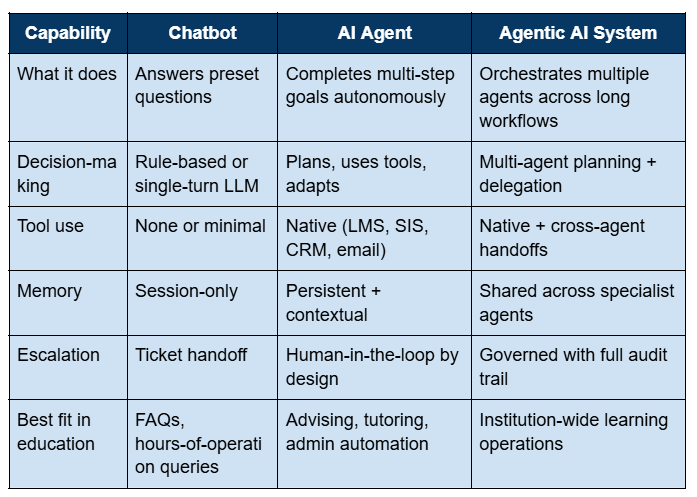
If a "chatbot" project stalled at your institution three years ago, that's why. The technology has moved on. The right question in 2026 isn't "should we add a chatbot?" — it's "which workflows should we hand to governed AI agents first?"
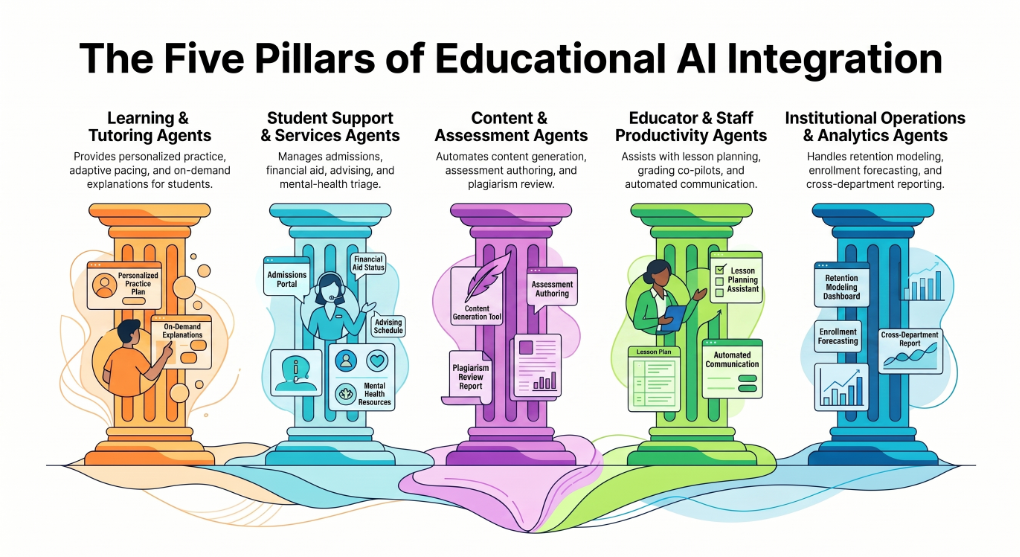
The 5 categories of AI agents in education
Every example in this guide falls into one of five categories. Use these to map your own priorities.
- Learning & tutoring agents — personalised practice, adaptive pacing, on-demand explanation, feedback loops.
- Student support & services agents — admissions, financial aid, advising, mental-health triage, IT and campus services.
- Educator & staff productivity agents — lesson planning, grading co-pilots, IEP drafting, communication automation.
- Institutional operations & analytics agents — retention modelling, enrolment forecasting, cross-department reporting, exception alerting.
- Content, assessment & credentialing agents — content generation, assessment authoring, plagiarism review, credential verification.
The 22 examples below are grouped by education vertical, but internally, each maps to one of these five categories.
AI agents in K-12 education: 5 examples
1. Adaptive tutoring & mastery-based practice agent
Context: In a typical K-12 classroom of 30 students, differentiation is impossible at scale. Some students are three grade levels ahead in reading and two behind in math. Static curricula can't respond.
What the agent does: The agent diagnoses each student's current level through short adaptive assessments, generates personalised practice, adjusts difficulty in real time, and explains errors in the student's preferred format (visual, worked example, analogy). It maintains memory of past struggles and effective explanations across sessions.
Integrations: LMS (Canvas, Google Classroom, Schoology), SIS, content bank, gradebook.
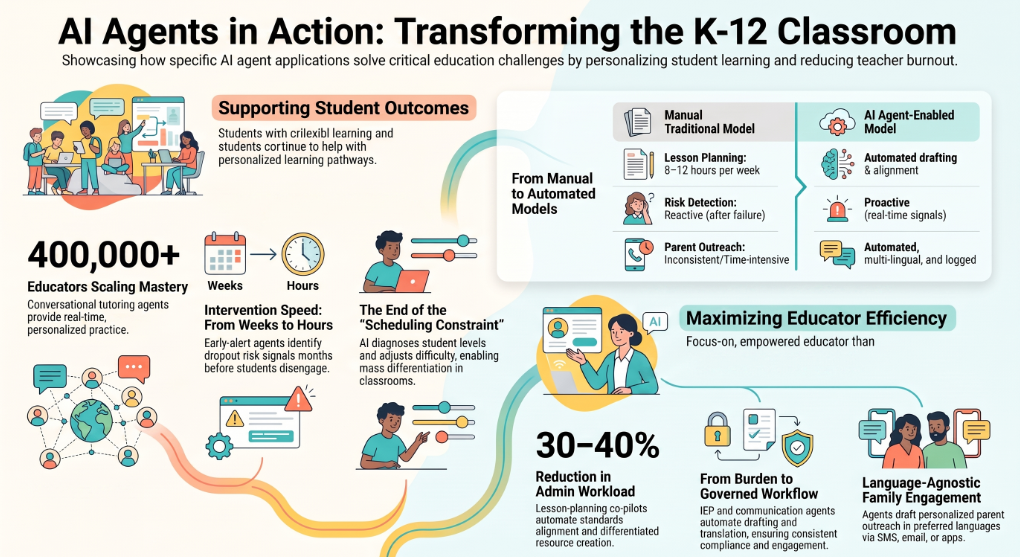
Results: In cohort studies, adaptive tutoring agents produce measurable gains in mastery for students at both ends of the ability range, and reduce teacher time spent on remedial planning. Leading conversational tutoring agents in this category now serve 400,000+ educators across 50+ countries.
Why it matters: Differentiation stops being a scheduling constraint. Teachers get their planning time back.
2. Early-alert / at-risk student identification agent
Context: The strongest predictor of high school dropout is a compounding pattern of attendance drops, grade slips, and disengagement — which typically shows up three to six months before the student actually leaves. Human staff rarely have the bandwidth to spot the pattern early.
What the agent does: The agent continuously monitors attendance, grade trajectories, LMS engagement, and communication signals. When a threshold pattern crosses, it drafts a personalised outreach message for the counsellor to review, flags the case in the SIS, and schedules follow-up.
Integrations: SIS, LMS, attendance system, counsellor dashboard.
Results: Districts running early-alert agents report significantly shorter time from risk-signal to intervention — often from weeks to hours.
Why it matters: Turns retention from a reactive metric into a proactive workflow.
3. Teacher lesson-planning co-pilot
Context: A K-12 teacher spends 8–12 hours per week outside class hours on planning, differentiation, and admin. That time compounds into burnout.
What the agent does: The agent drafts lesson plans aligned to the district's standards, generates differentiated versions for varied reading levels and IEPs, creates assessment items, and pulls linked resources — all reviewable and editable by the teacher before delivery.
Integrations: Standards library, curriculum repository, LMS, resource databases.
Results: Studies of agentic systems in professional education settings show 30–40% reductions in routine administrative workload.
Why it matters: Teachers spend more time teaching, less time producing.
4. Parent communication and attendance follow-up agent
Context: Attendance calls, IEP updates, homework nudges, event reminders — parent communication eats hours across a school week and is often inconsistent between staff.
What the agent does: The agent monitors attendance and academic events, drafts personalised messages in the parent's preferred language, sends via the preferred channel (SMS, email, app), and logs the interaction. It escalates emotionally sensitive threads to a human immediately.
Integrations: SIS, communication platform (SMS/email), translation layer.
Results: Consistent, timely parent communication in the parent's home language, with a full audit trail.
Why it matters: Family engagement stops being a lottery of which teacher happens to be diligent that week.
5. IEP drafting and progress-tracking assistant
Context: Individualised Education Plans (IEPs) are legally required, deeply structured, and time-consuming to draft, update, and monitor. Special education teachers routinely lose evenings and weekends to paperwork.
What the agent does: The agent drafts IEP sections from student data and goal templates, tracks progress against objectives, flags plan updates when performance drifts, and prepares meeting-ready summaries for annual reviews.
Integrations: Special ed management system, SIS, assessment data.
Results: Faster IEP drafting cycles and more consistent progress reporting across the caseload.
Why it matters: Compliance work becomes a governed workflow instead of a personal burden.
AI agents in higher education: 5 examples
6. Admissions and enrolment conversational agent
Context: Prospective students ask thousands of questions between first interest and enrolment — programme fit, admissions requirements, tuition, deadlines, housing, visa. Enrolment teams can't scale to answer them all within hours.
What the agent does: The agent handles prospective-student conversations across web, chat, WhatsApp, and email, pulls answers from the institution's programme catalogue and policy base, escalates complex financial-aid questions to human counsellors, and logs every conversation to the CRM.
Integrations: CRM (Slate, Salesforce Education Cloud), programme database, chat platforms.
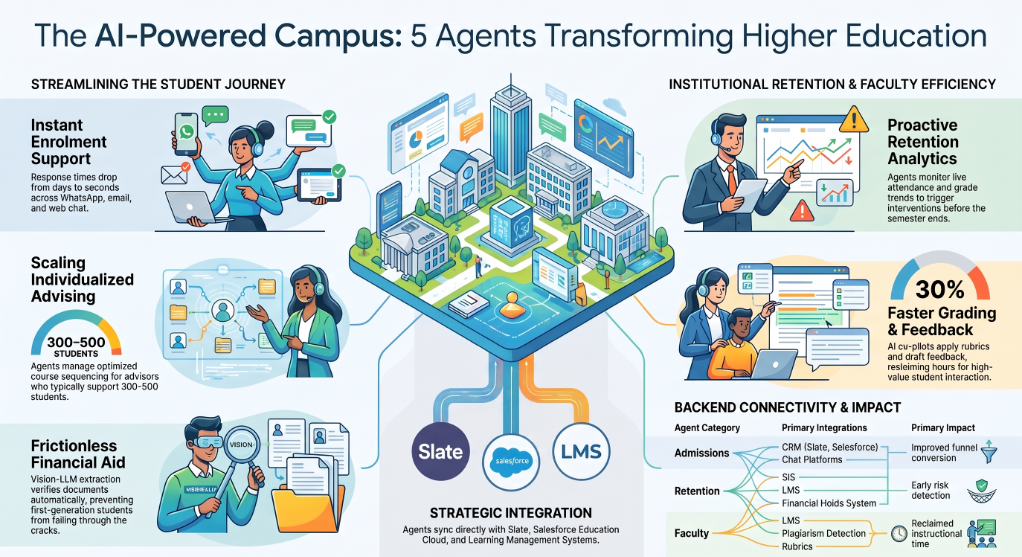
Results: Response times drop from days to seconds. Application-to-enrolment conversion improves as prospective students hit fewer dead ends.
Why it matters: Enrolment funnels stop leaking at the top.
7. Academic advising and degree-planning agent
Context: A university academic adviser typically supports 300–500 students. Substantive one-on-one degree planning is impossible at that ratio.
What the agent does: The agent evaluates transcripts, understands major requirements, generates optimised course sequences, tests different degree pathways for time-to-graduation, and routes final decisions to human advisers with follow-up meetings automatically scheduled.
Integrations: SIS, degree audit system, course catalogue, calendar.
Results: Advisers spend meeting time on judgement calls, not on schedule construction. Time-to-degree improves for at-risk students who previously fell through the cracks.
Why it matters: Advising scales from transactional to genuinely developmental.
8. Financial aid guidance and document verification agent
Context: Financial aid processes are the single largest source of applicant friction. A missing document or misunderstood eligibility rule can cost a student their spot.
What the agent does: The agent explains eligibility, guides students through required documentation, verifies submitted documents using vision-LLM extraction, flags anomalies for human review, and monitors application status.
Integrations: Financial aid system, document management, identity verification.
Results: Fewer application withdrawals due to missed documents. Faster aid disbursement cycles.
Why it matters: A key equity lever — first-generation students most benefit from patient, always-available guidance.
9. Student retention analytics agent
Context: Retention is often measured after the semester ends — by which point interventions are too late.
What the agent does: The agent runs continuously against attendance, grade trends, engagement signals, and financial holds. It builds a live retention risk score per student, generates intervention recommendations, and triggers workflows for the retention team.
Integrations: SIS, LMS, financial holds system, retention CRM.
Results: Shift from reactive retention reporting to proactive intervention loops. Institutions running these agents report earlier detection of risk and improved semester-to-semester persistence.
Why it matters: Retention becomes an operational workflow, not an annual post-mortem.
10. Faculty grading and feedback co-pilot
Context: Grading and feedback are the highest-time-cost part of teaching in higher ed. Faculty routinely spend 5–8 hours per week on grading alone.
What the agent does: The agent reads structured responses, applies the faculty's rubric, drafts feedback comments aligned to learning objectives, flags edge cases (originality concerns, unusual patterns), and hands final judgement to the instructor.
Integrations: LMS, plagiarism detection, rubric library.
Results: A European institute of technology deployed a staff support agent for instructional materials and self-assessment and cut grading and correction time by 30%.
Why it matters: Faculty reclaim time for the parts of teaching that require judgement — the parts an agent cannot do.
AI agents on EdTech platforms and learning networks: 6 examples
The following six examples reflect production deployments on the Assistents.ai platform across global EdTech and learning organisations. Client identities are anonymised.
11. AI support agent for a million-teacher global platform
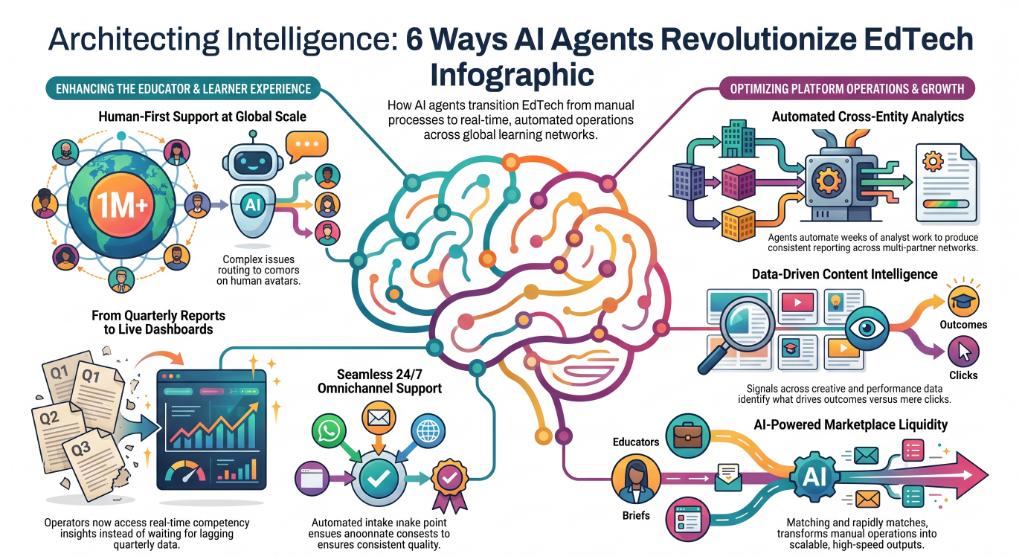
Context: A global teacher learning community serving over one million educators across 130+ countries faced a structural challenge: human-first support becomes impossible at that scale, and static content paths cannot adapt to each teacher's professional context.
What the agent does: The agent handles programme and learning queries from educators on demand, drawing on a structured knowledge base of platform content, resources, and guidance. It profiles teacher competencies, surfaces personalised learning recommendations, and routes complex queries to human specialists only when genuinely needed.
Integrations: Learning platform, competency framework, content management system, escalation ticketing.
Results: Scalable support for educator communities in dozens of languages, faster access to learning resources, and better visibility into engagement and outcomes across the platform.
Why it matters: This is the reference example for an AI agent solving the scale problem that human teams simply cannot solve. Built on the Assistents.ai Context Engine.
12. Competency insights agent for professional development at scale
Context: On the same global teacher network, programme operators needed to understand which competencies were being developed, where gaps existed, and how to route educators to the right learning pathways — across millions of interactions and dozens of country-level programmes.
What the agent does: The agent analyses teacher profiles, engagement signals, and assessment data to surface competency-level insights, generates personalised development recommendations, and triggers proactive alerts for programme managers when engagement drops below threshold.
Integrations: Competency taxonomy, assessment platform, programme CRM.
Results: Programme operators moved from lagging quarterly reports to live competency dashboards. Educator development recommendations became individualised at platform scale.
Why it matters: Personalised professional development, historically a boutique offering, becomes a default at scale.
13. Cross-entity analytics agent for multi-partner learning networks
Context: Large learning networks operate across foundations, government partners, and delivery organisations — each with its own reporting requirements. Producing consistent, cross-entity operational reporting used to require weeks of analyst work.
What the agent does: The agent ingests operational data across partners, standardises KPI definitions, generates consolidated dashboards, and drafts variance explanations. It applies a governance layer so definitions stay consistent across entities.
Integrations: Multiple partner data sources, warehouse, BI layer.
Results: A single operational view across entities, faster leadership reporting, and consistent operational metrics — regardless of which partner supplied the underlying data.
Why it matters: Operational transparency stops being blocked by data politics.
14. AI content performance intelligence agent for course platforms
Context: EdTech content platforms produce and syndicate huge volumes of learning content. Understanding what actually drives learner outcomes — versus what merely generates clicks — requires continuous signal synthesis across creative, performance, and audience data.
What the agent does: The agent ingests signals across creative attributes, performance metrics, and audience behaviour, generates themes and narrative insights for content teams, and produces reporting packs for leadership. It flags brand-safety and compliance issues before content ships.
Integrations: Content management system, analytics stack, audience data warehouse.
Results: Faster creative strategy cycles, more consistent insight workflows, and clearer answers on what to build next.
Why it matters: Content strategy becomes data-driven without becoming spreadsheet-driven.
15. Omnichannel support agent for EdTech platforms
Context: Education platforms serving large user bases across web, email, WhatsApp, and phone often deliver inconsistent support quality — some channels get fast responses, others go unanswered for days.
What the agent does: The agent handles omnichannel intake, routes conversations by intent, drafts responses grounded in platform documentation, generates agent-assist summaries and next-best actions for human agents on complex cases, and maintains an SLA and audit trail across every channel.
Integrations: Chat platform, email, WhatsApp Business API, ticketing system, knowledge base.
Results: Consistent 24×7 learner experience, faster case handling, and reduced operational load via automation.
Why it matters: Support quality becomes a platform property, not a per-channel accident.
16. Educator and creator discovery + matching agent for learning marketplaces
Context: Learning marketplaces and creator networks depend on high-quality matching between the right educator, the right learner segment, and the right content brief. Manual matching doesn't scale.
What the agent does: The agent enriches educator and creator profiles, ingests campaign or programme briefs, generates ranked matches with reasoning, and automates the outreach workflow. It monitors campaign KPIs and surfaces early-warning signals.
Integrations: CRM, profile database, campaign management, analytics stack.
Results: Reduced manual operations across matching, faster performance visibility, and more consistent reporting and learnings across programmes.
Why it matters: Marketplace liquidity — the hardest metric in any two-sided learning network — becomes an operational output.
AI agents in corporate L&D and professional training: 4 examples
17. AI voice agent for skill rehearsal and practice
Context: Professionals learning practice-heavy skills — presenting, sales conversations, clinical interactions, performing arts — need a partner to rehearse against. Human partners aren't always available, and static content can't respond to real practice.
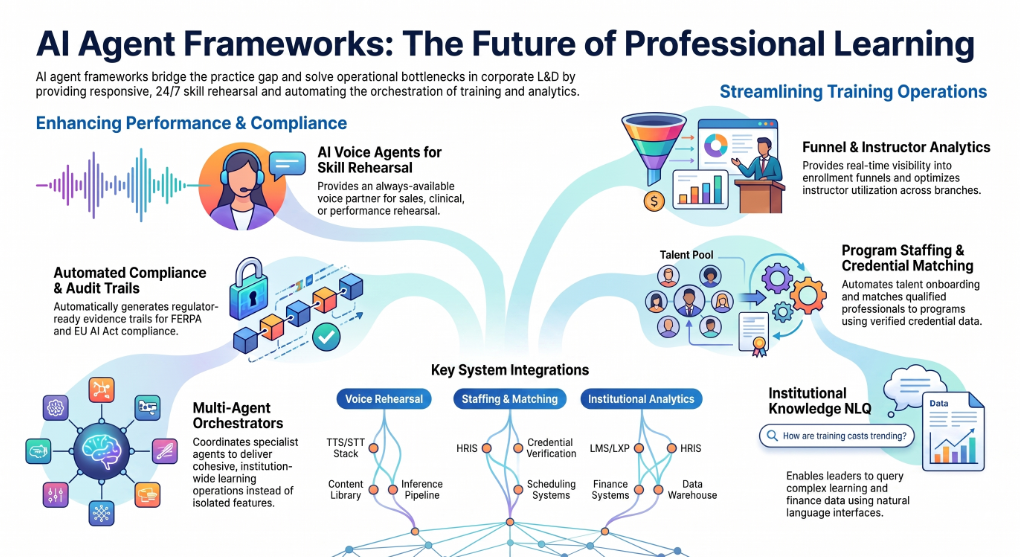
What the agent does: The agent ingests scripts, scenarios, or scene material and provides an always-available, responsive voice partner with realistic character voices, adaptive pacing, and cue logic. Learners can rehearse in short bursts, receive feedback on delivery, and track rehearsal analytics over time.
Integrations: Content library, TTS/STT stack, cost-controlled inference pipeline.
Results: Higher rehearsal throughput without human partners, more consistent practice loops, and improved skill readiness.
Why it matters: The "practice gap" that separates classroom learning from performance disappears. Built on Assistents.ai Voice AI.
18. Training institute funnel and instructor-utilisation analytics agent
Context: A multi-branch training institute needed real-time visibility into the learner journey — enrolment through lessons through certification — and better utilisation of instructor time across branches.
What the agent does: The agent runs continuous funnel analytics from enrolment to lessons to test outcomes, models instructor utilisation and slot optimisation across branches, generates customer-experience dashboards, and triggers alerts on conversion drops or booking anomalies.
Integrations: Booking system, LMS/course delivery, CRM, scheduling.
Results: Reduced operational bottlenecks, better scheduling efficiency, and clearer visibility into conversion and performance drivers.
Why it matters: Multi-branch training operations get the same operational rigour that modern retail networks take for granted.
19. Programme staffing and credential-matching agent
Context: Professional training networks and staffing platforms — from healthcare educators to skilled trades — need to match qualified professionals to open shifts or programmes at speed, with credential verification baked in.
What the agent does: The agent handles talent onboarding, captures credentials, ingests facility or programme staffing requests, runs matching logic against qualification and availability data, and orchestrates scheduling, notifications, and compliance workflows end-to-end.
Integrations: HRIS, credential verification, scheduling system, notifications.
Results: Faster fill cycles, lower scheduling friction, better workforce utilisation, and improved staffing responsiveness.
Why it matters: The same pattern applies to educator staffing at K-12 substitute networks, higher-ed adjunct pools, and corporate training bench management.
20. Institutional knowledge NLQ agent for corporate learning organisations
Context: Large corporate learning teams accumulate huge volumes of programme data, content performance metrics, learner feedback, and completion records — spread across LMS, LXP, HRIS, and finance systems. Answering leadership questions used to mean weeks of analyst queueing.
What the agent does: The agent runs an agentic analytics layer over existing data, applies a semantic governance layer so metric definitions stay consistent, and exposes a natural-language interface that lets learning leaders ask business questions and get governed, auditable answers on demand.
Integrations: LMS, LXP, HRIS, finance system, data warehouse.
Results: Faster strategic visibility without BI queueing, improved alignment through consistent metric definitions, and scalable insight access across teams.
Why it matters: Learning teams stop being blocked by their own data infrastructure. Built on Assistents.ai Data Analysis and the Context Engine.
Bonus examples: the "next wave" of agent categories to watch
Two additional patterns that Assistents' education deployments are already seeing:
- Compliance and audit-trail agents that watch every action a learning agent takes and generate the regulator-ready evidence trail (FERPA, EU AI Act, high-risk system logs) automatically.
- Multi-agent orchestrators that coordinate specialist agents — tutoring, assessment, communication, analytics — through a shared context, delivering institution-wide learning operations rather than isolated features.
The anatomy of a great education AI agent: 6 layers
Every high-performing example above shares the same six-layer architecture. Missing any layer is where deployments fail.
Layer 1 — Intake. Multi-channel input (chat, email, voice, LMS event, calendar trigger) with clean intent classification.
Layer 2 — Context engine. A unified layer that combines structured data (SIS, LMS, HRIS) and unstructured data (policies, syllabi, past conversations, documents) into a queryable knowledge foundation. Without a real context engine, an agent is a chatbot with better marketing.
Layer 3 — Reasoning and planning. Multi-step reasoning with tool use — the agent selects which system to query, in what order, and how to combine the results.
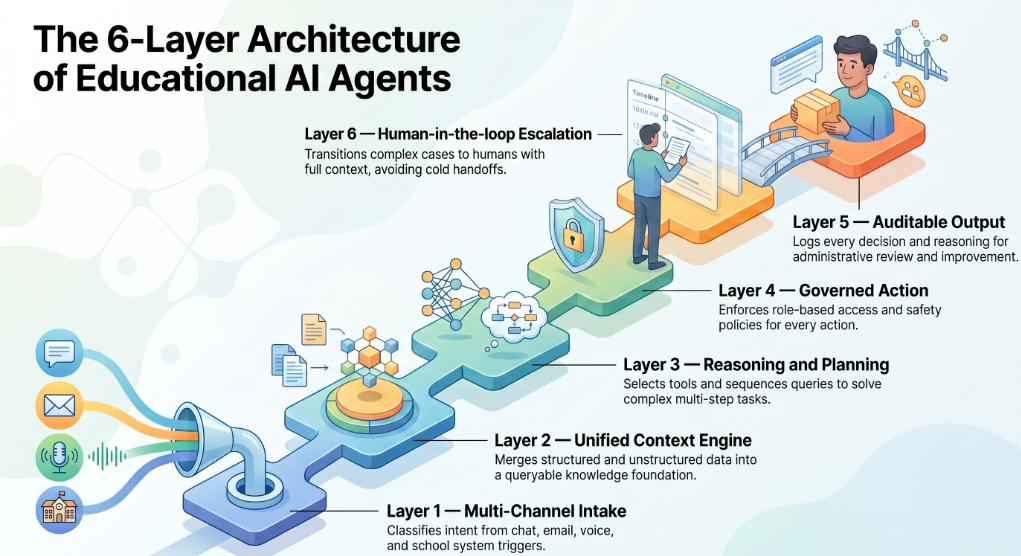
Layer 4 — Governed action. Every action passes through a policy layer that enforces role-based access, data-scope rules, and human-in-the-loop checkpoints on sensitive operations. Non-negotiable in education.
Layer 5 — Auditable output. Every decision, tool call, and message is logged with reasoning so administrators can review, appeal, or improve the agent's behaviour.
Layer 6 — Human-in-the-loop escalation. Well-defined thresholds hand cases to human staff with full context attached — never a cold handoff.
Platforms like Assistents.ai are built around this six-layer architecture as a first-class primitive, not as an afterthought.
How to evaluate an AI agent platform for education (10-criteria scoring matrix)
Score each vendor 1–5 on each criterion.
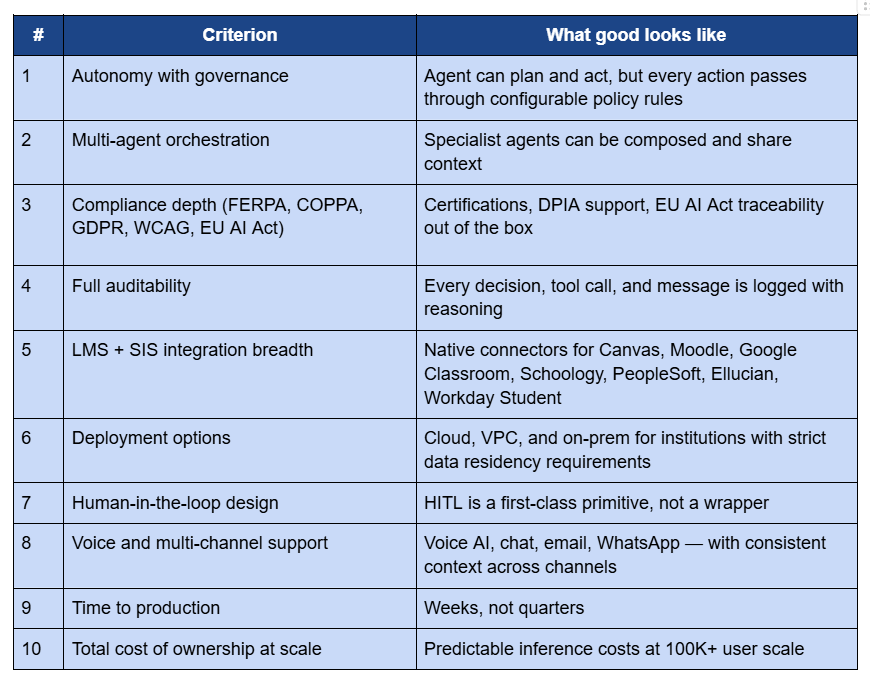
Assistents.ai is designed against all ten criteria as core platform capabilities. See the Assistents.ai Education solutions page for platform detail, and the Agent Governance and Context Engine product pages for architecture depth.
Compliance and governance: what non-negotiable looks like
Every AI agent handling education data touches at least one of these frameworks. Skipping any of them is not an option in 2026.
FERPA (US) — Student education records must be protected. Agents must enforce role-based access, log every read/write, and support data-subject requests.
COPPA (US) — Children under 13 require verified parental consent for personal data collection. K-12 agents must enforce consent workflows.
GDPR + EU AI Act — For EU learners, the EU AI Act classifies many education AI systems as high-risk, requiring traceability, bias monitoring, transparency, and human oversight. Agents must produce regulator-ready audit trails.
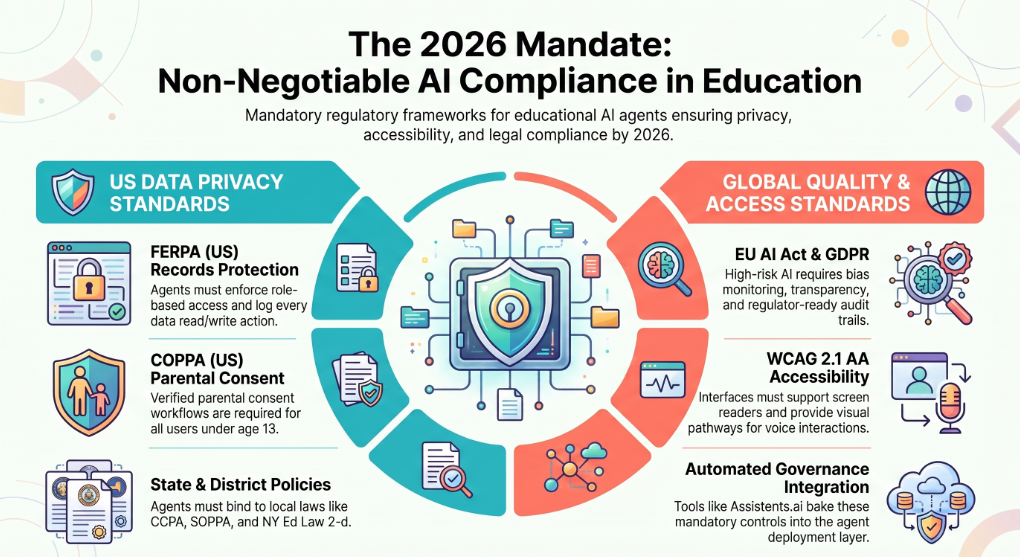
WCAG 2.1 AA — Every learner-facing agent interface must meet accessibility standards. Voice interfaces need equivalent visual pathways; visual interfaces need screen-reader compatibility.
Institution-specific policies — FERPA disclosure exceptions, state-level student privacy laws (CCPA, Illinois SOPPA, NY Ed Law 2-d), and district acceptable-use policies all bind agent behaviour.
Assistents.ai bakes these controls into the Agent Governance layer by default, with configurable policy rules per deployment.
Implementation roadmap: 30, 60, 90 days
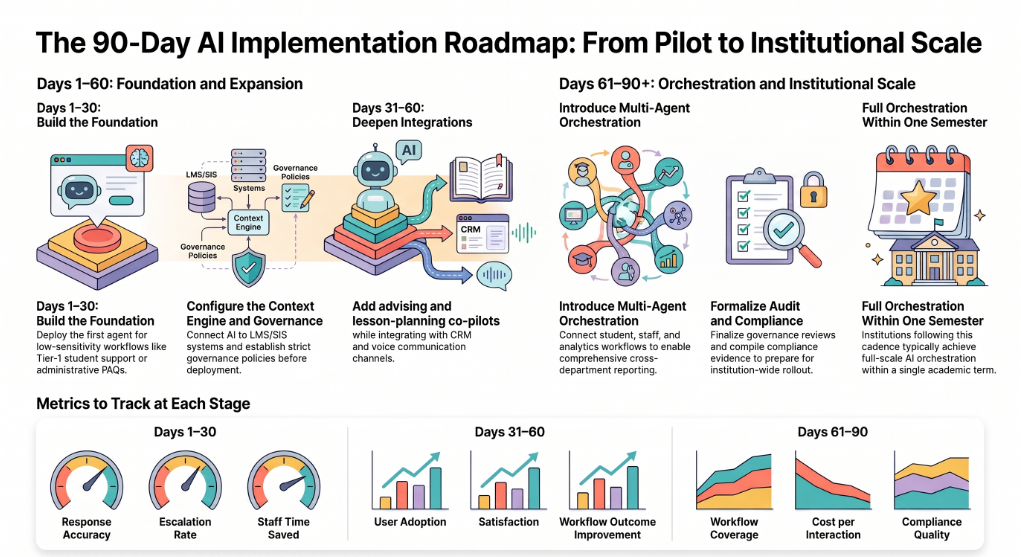
Days 1–30 — Foundation and first agent. Pick one high-frequency, low-sensitivity workflow (typically Tier-1 student support or administrative FAQ). Stand up the context engine against your LMS/SIS/knowledge base. Configure governance policies. Deploy the first agent to a limited cohort. Measure: response accuracy, escalation rate, staff time saved.
Days 31–60 — Expand and integrate. Add a second workflow (advising, retention monitoring, or lesson-planning co-pilot). Deepen integrations to CRM and communication channels. Add voice if learner-facing. Roll out to full cohort. Measure: adoption, satisfaction, workflow-level outcome improvement.
Days 61–90 — Orchestrate and scale. Introduce multi-agent orchestration across student, staff, and analytics workflows. Add cross-department reporting. Formalise the governance and audit review process. Prepare for institution-wide rollout. Measure: workflow coverage, cost per interaction, compliance evidence quality.
Institutions running this cadence on Assistents.ai typically move from first agent live to institution-wide orchestration within a single semester.
Build your education AI agent with Assistents.ai
Assistents.ai is the governed AI agent platform purpose-built for education, EdTech, and enterprise learning. Every deployment referenced anonymously above runs on the Assistents platform.
What Assistents.ai delivers for education:
- A unified Context Engine across LMS, SIS, HRIS, content, and policies
- A governance-first architecture — FERPA, COPPA, GDPR, EU AI Act, WCAG built in
- Multi-agent orchestration for institution-wide workflows
- Voice AI for rehearsal, tutoring, and hands-free interaction
- Full auditability and human-in-the-loop by default
- Deployment options across cloud, VPC, and on-prem
If you're evaluating AI agent platforms for a K-12 district, higher-ed institution, EdTech company, or corporate learning organisation, start with the Assistents.ai Education solutions page and request a scoped pilot. First workflow live in weeks, not quarters.
FAQs
What is an AI agent in education?
An AI agent in education is an autonomous software system that plans, decides, and takes multi-step actions across education systems — like an LMS, SIS, or communication platform — to complete a goal without a human guiding every step. Unlike a chatbot, it maintains context, uses tools, and escalates to humans only when needed.
What are examples of AI agents in education?
Real-world examples include adaptive tutoring agents, early-alert retention agents, teacher lesson-planning co-pilots, admissions conversational agents, academic advising agents, faculty grading co-pilots, teacher-community support agents at platform scale, voice-based skill rehearsal agents, and institutional knowledge NLQ agents. This guide covers 22 such examples across K-12, higher education, EdTech, and corporate L&D.
How is AI used in education today?
AI is used for personalised learning paths, early identification of at-risk students, administrative automation (admissions, scheduling, financial aid), grading and feedback support, content generation, teacher planning, retention analytics, and institution-wide reporting. The shift in 2025–2026 has been from static AI features toward autonomous, governed AI agents that complete multi-step workflows.
What is the difference between an AI agent and a chatbot in education?
A chatbot answers a single question at a time using preset rules or a single LLM turn. An AI agent operates in a goal loop — it plans a sequence of steps, uses tools like an LMS or SIS, observes results, and adjusts. Agents maintain context across sessions, take governed actions on real systems, and produce audit trails.
Can AI agents replace teachers?
No. AI agents handle repetitive, operational, and administrative workflows — freeing teachers to focus on judgement, mentorship, and human connection. Research consistently shows that outcomes are strongest when AI agents work alongside human educators in a human-in-the-loop model, not when they replace them.
How do AI agents help students?
AI agents give students always-available tutoring, personalised practice, immediate feedback, and 24×7 support across admissions, advising, and services. They monitor engagement and academic risk continuously, so students get help before problems escalate rather than after grades drop.
How do AI agents help teachers?
AI agents automate the repetitive parts of teaching: lesson-plan drafting, differentiated resource generation, grading assistance, parent communication, and IEP paperwork. Studies of agentic systems in professional education settings show 30–40% reductions in routine administrative workload.
What is agentic AI in education?
Agentic AI in education is a system where multiple specialised AI agents plan, act, and coordinate autonomously to achieve educational goals — for example, coordinating a tutoring agent, an assessment agent, a communication agent, and an analytics agent through a shared context. Gartner named agentic AI the top technology trend of 2025.
Which AI agent platform is best for education?
The best platform for education is one built with governance, compliance, and multi-agent orchestration as core primitives — not features bolted onto a general-purpose model. Assistents.ai is purpose-built for education and enterprise learning, with FERPA, COPPA, GDPR, and EU AI Act controls baked into the Agent Governance layer, and native integrations across LMS, SIS, and communication systems.
Are AI agents in education FERPA and GDPR compliant?
Only if the underlying platform is designed for it. Compliance requires role-based access, complete audit trails, data-subject request handling, DPIA support, and — under the EU AI Act — traceability for high-risk education AI systems. Assistents.ai enforces these controls by default in every deployment.

Transform Your Business With Agentic Automation
Agentic automation is the rising star posied to overtake RPA and bring about a new wave of intelligent automation. Explore the core concepts of agentic automation, how it works, real-life examples and strategies for a successful implementation in this ebook.
Sarfraz Nawaz is the CEO and founder of Ampcome, which is at the forefront of Artificial Intelligence (AI) Development. Nawaz's passion for technology is matched by his commitment to creating solutions that drive real-world results. Under his leadership, Ampcome's team of talented engineers and developers craft innovative IT solutions that empower businesses to thrive in the ever-evolving technological landscape.Ampcome's success is a testament to Nawaz's dedication to excellence and his unwavering belief in the transformative power of technology.

More insights
Discover the latest trends, best practices, and expert opinions that can reshape your perspective







Contact us

