
11 Best AI Tools for Finance Professionals in 2026 (Ranked by Real-World Use Cases)


Finance teams in 2026 are not asking whether to use AI. They are asking which AI tools actually work — and which ones just look impressive in a demo.
The difference matters. Most "best AI tools for finance" lists recycle the same general-purpose chatbots and spreadsheet add-ons. They do not cover the tools that are running autonomously inside real finance operations right now — monitoring cashflow 24/7, flagging margin erosion before it hits the P&L, screening cross-border tax risk before deals close, and turning dashboards into governed action queues.
This guide is different. Every tool category on this list is backed by real deployment evidence: anonymised outcomes from finance teams across banking, fintech, global logistics, healthcare, retail, and supply chain who are using AI agents in production today.
If you are a CFO, FP&A leader, finance analyst, treasury manager, or procurement professional looking for AI tools that move the needle on speed, accuracy, and operational control — this is the list to read.
What you will find here: A quick-reference comparison table, a deep breakdown of each tool category, real-world results, and a practical framework for choosing the right tool for your specific workflow.
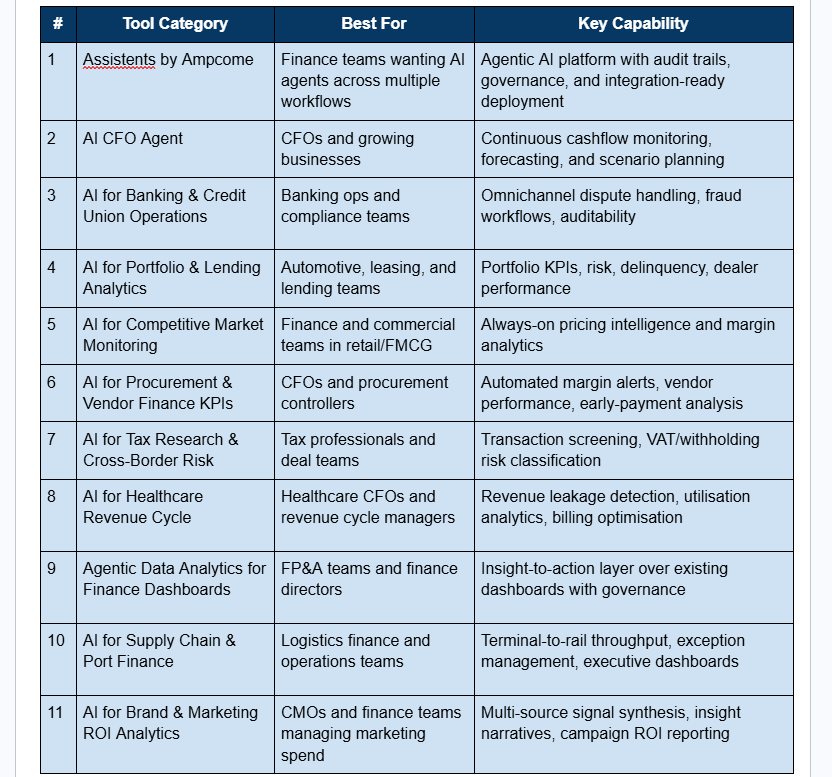
Quick Comparison: 11 Best AI Tools for Finance Professionals (2026)
What Can AI Actually Do for Finance Professionals? (The 2026 Reality)
From spreadsheets to agentic workflows
For most of the last decade, "AI for finance" meant better autocomplete in Excel and slightly smarter dashboards. That era is over.
In 2026, the tools that matter for finance professionals operate at a fundamentally different level. They do not wait for you to ask a question. They monitor, detect, analyse, and act — autonomously — within the guardrails your team sets.
This is what is now called agentic AI: AI systems that take sequences of actions across your data, your systems, and your workflows without requiring constant human prompting. A finance team using agentic AI does not log into a dashboard to check cashflow every morning. The agent monitors it continuously, flags anomalies when they emerge, and surfaces the analysis — ready for a decision.
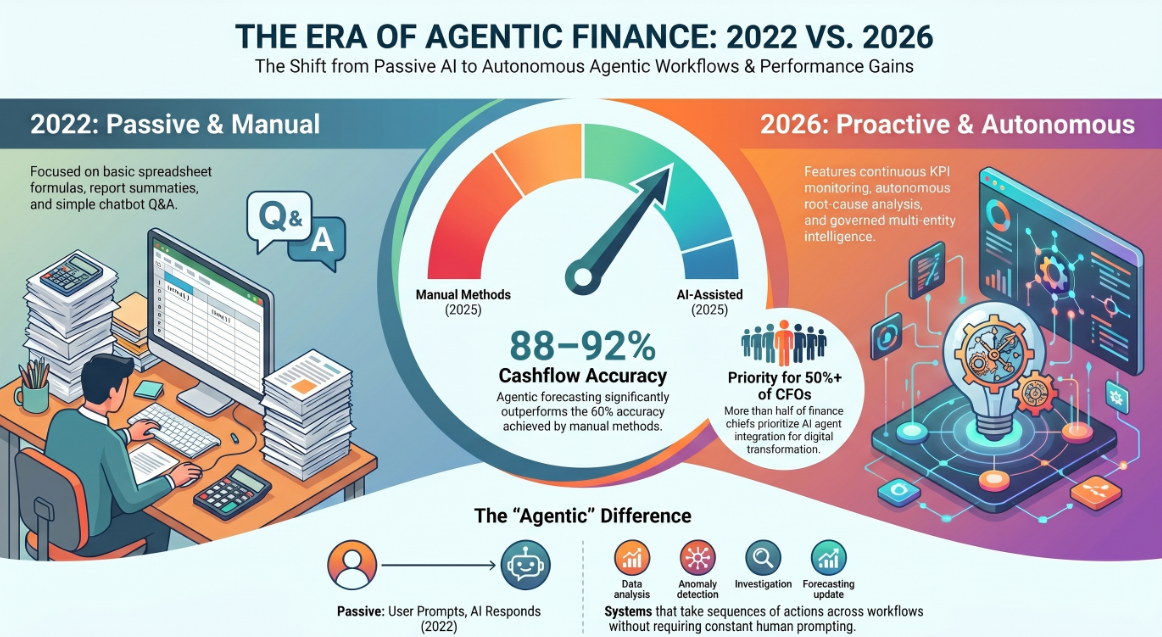
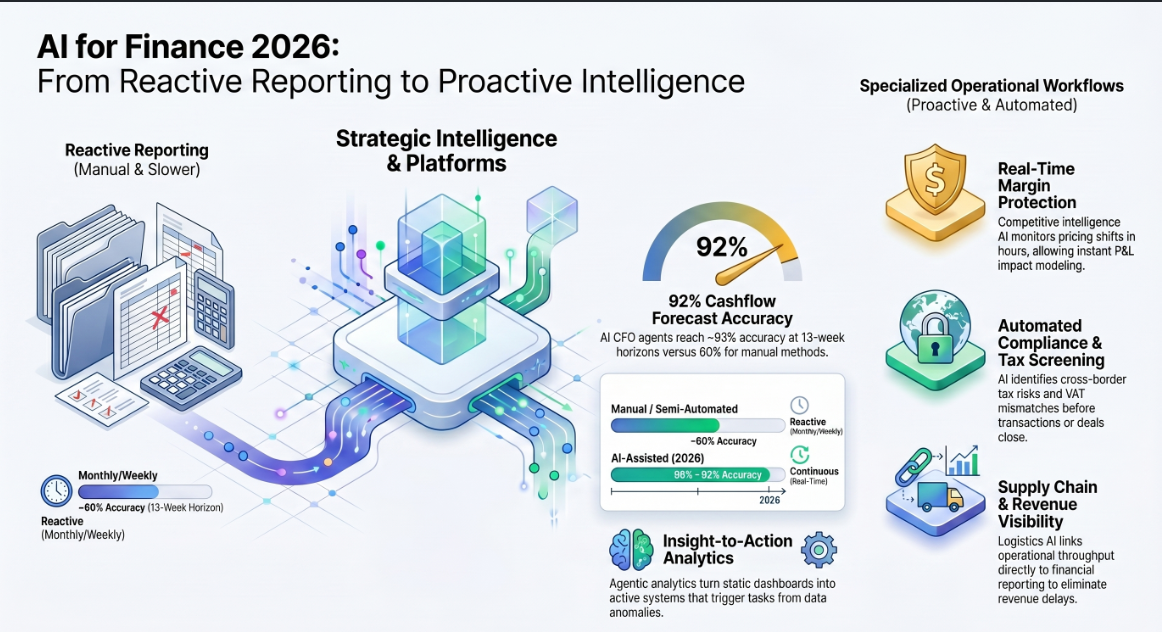
According to a 2025 CFO survey, more than half of finance chiefs say integrating AI agents into their departments is a digital transformation priority this year. And it is easy to see why: organisations using AI-assisted cashflow forecasting achieve 88–92% accuracy at the 13-week horizon, compared to around 60% with traditional manual methods (AFP Treasury Benchmarking Survey, 2025).
What "AI for finance" means in 2026 vs 2022
In 2022, AI for finance meant:
- Generating summaries of financial reports
- Auto-filling spreadsheet formulas
- Basic chatbot Q&A over financial data
In 2026, AI for finance means:
- Continuous monitoring of KPIs across every connected system, with proactive alerts
- Autonomous agents that investigate anomalies, trace root causes, and recommend actions
- Governed workflows with audit logs, escalation paths, and human-in-the-loop controls
- Multi-entity intelligence — consolidating KPIs across subsidiaries, geographies, and business units into a single operational view
- Natural language access — any finance professional, not just analysts, can ask questions and get governed, consistent answers
The tools below represent each of these categories. None of them replace the judgement of a skilled finance professional. All of them give that professional back hours every day, surface risks earlier, and produce decisions with better information behind them.
How We Selected These 11 Tools (Our Evaluation Criteria)
Every tool category on this list was evaluated against four criteria:
1. Use-case fit. Does the tool solve a specific, high-value finance workflow — not just generic "AI assistance"? Tools that try to do everything well typically do nothing exceptionally.
2. Auditability and governance. Finance is a regulated function. AI tools that cannot produce audit logs, escalation records, or explainability for their outputs are not suitable for production use in serious finance teams. Every tool on this list either natively supports auditability or enables it through the deployment layer.
3. Integration depth. A tool that cannot connect to your ERP, your banking data, your accounting exports, or your existing dashboards creates more work than it saves. We prioritised tools that function as integration-ready layers over existing systems — not standalone silos that require rekeying data.
4. Real deployment evidence. Generic product claims are easy to make. This list draws on real-world deployments across finance teams in global banking, fintech, retail, logistics, healthcare, and supply chain — with documented outcomes, not marketing projections.
The 11 Best AI Tools for Finance Professionals in 2026
1. Assistents by Ampcome — AI Agents Platform for Finance Teams
What it does
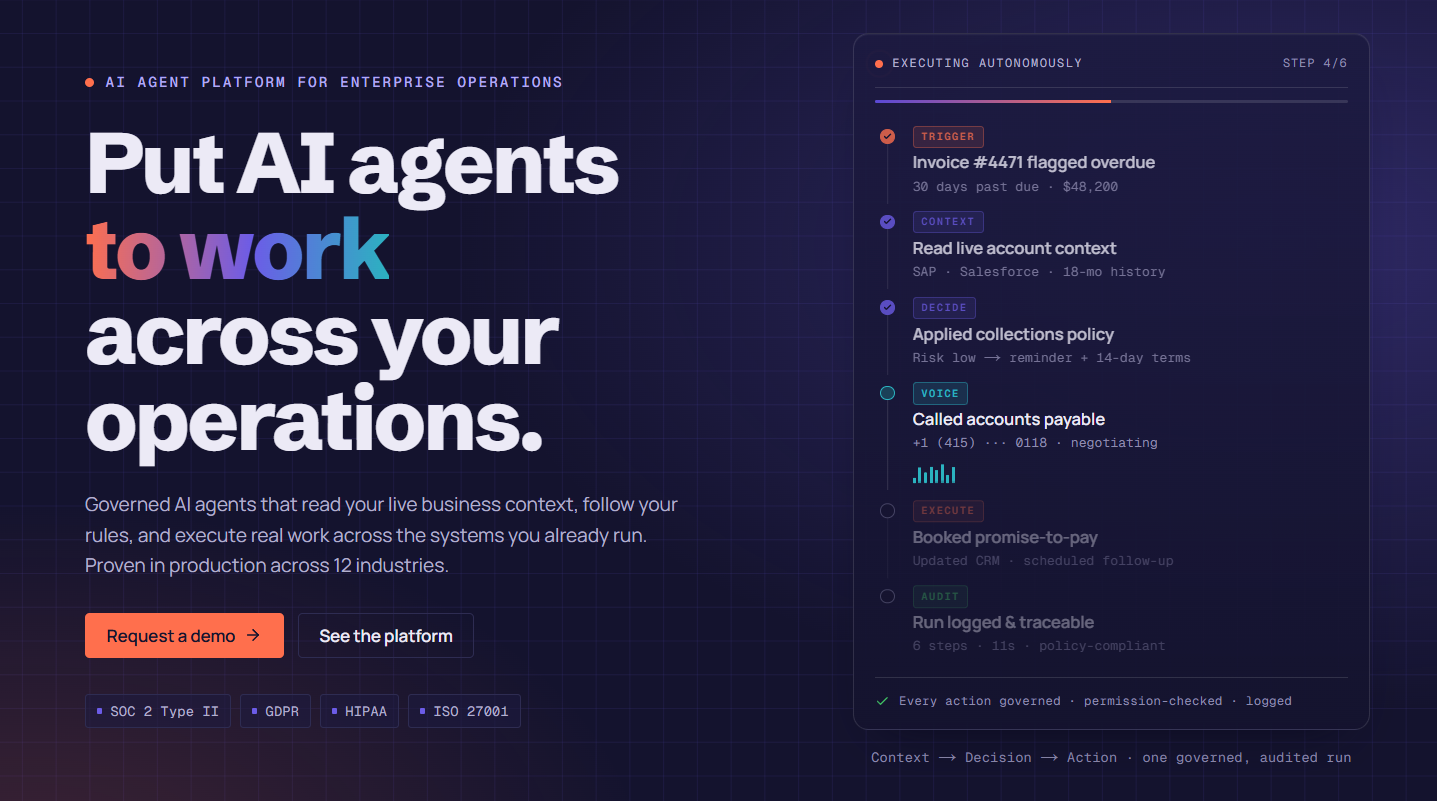
Assistents is an AI agents platform built by Ampcome that enables finance teams to deploy purpose-built AI agents across their most time-consuming and high-stakes workflows — cashflow monitoring, KPI alerting, procurement intelligence, competitive monitoring, revenue analytics, and more.
Unlike single-use finance tools, Assistents is a deployment platform: it connects to your existing data sources, wraps AI agents around your current systems, and adds a governance layer that makes every output auditable, traceable, and escalation-ready.
Best for: CFOs, FP&A teams, finance directors, and operations leaders who need AI across multiple finance workflows without building from scratch or replacing existing infrastructure.
Key capabilities:
- Multi-agent orchestration across structured and unstructured financial data
- Semantic governance layer — consistent metric definitions, formula hierarchies, and data rules applied across all agents
- Human-in-the-loop controls and full audit logs for every agent action and output
- Integration-ready deployment: connects to ERP systems, accounting exports, banking APIs, CRMs, and operational dashboards
- Natural language query interface — any team member can ask financial questions and get governed, consistent answers
- Automated KPI monitoring with exception alerting and scheduled insight packs for leadership
Real-world results from deployed finance teams:
- Shift from reactive reporting to proactive execution loops — finance teams stop chasing numbers and start responding to flagged exceptions
- Standardised decision logic applied consistently across teams and geographies
- Automated task creation and completion tracking triggered directly from financial insights
- Reduced dependency on analysts for recurring reporting queries
- Faster strategic visibility without BI queueing bottlenecks
Assistents by Ampcome is the platform layer that makes most of the other tool categories on this list deployable, governed, and scalable for enterprise finance teams. You can explore it at assistents.ai.
2. AI CFO Agent — Cashflow Forecasting, Scenario Planning & Finance Guidance
What it does
An AI CFO agent is a category of tool that connects directly to a business's financial data — accounting system exports, banking feeds, accounts receivable and payable — and runs continuously to monitor cashflow, generate forecasts, model scenarios, and alert the finance team when risks emerge.
This is not a dashboard you check. It is an agent that monitors your cash position and delivers analysis when it matters.
Best for: CFOs of growth-stage businesses, FP&A leaders, and financial advisors managing portfolios of clients.
Key capabilities:
- Continuous cashflow monitoring with real-time data ingestion from accounting and banking sources
- Automated forecasting and scenario modelling agents (best case / base case / stress scenarios)
- Runway and cash risk alerts — proactive notification before thresholds are breached
- Anomaly detection across transaction patterns and receivables behaviour
- Portfolio views for advisors managing multiple clients simultaneously
- Natural language financial guidance — ask "what happens to our runway if we lose our top 3 clients?" and get a modelled answer
What AI CFO agents are actually replacing: The manual process of building cashflow models in spreadsheets, exporting data from multiple systems, and running scenario analysis on a weekly or monthly cadence. AI CFO agents run this continuously — meaning problems surface days or weeks earlier than they would in a traditional finance cycle.
Real-world results: Deployments of AI CFO platforms for growing businesses and advisor practices have delivered: faster cashflow analysis cycles, earlier detection of cash risks and anomalies, and scalable advisory-quality insight without adding headcount. Finance advisors using multi-client portfolio views have been able to manage larger client books without proportionally increasing team size.
Key stat: Organisations using AI-assisted cashflow forecasting achieve 88–92% accuracy at the 13-week horizon, compared with approximately 60% for teams using manual or semi-automated methods (AFP Treasury Benchmarking Survey, 2025). That gap — 28 to 32 percentage points — translates directly into better liquidity decisions and fewer cash surprises.
3. AI for Banking & Credit Union Operations — Disputes, Fraud & Compliance Automation
What it does
AI tools built for banking operations handle the high-volume, process-intensive workflows that consume disproportionate time in financial institutions: dispute intake and triage, fraud investigation, compliance monitoring, agent-assist summarisation, and SLA tracking.
These tools sit across all channels — chat, email, phone — and route, classify, summarise, and action financial service requests at a scale that human teams cannot match manually.
Best for: Banking operations leaders, compliance managers, customer service heads at banks and credit unions, and fintech operations teams.
Key capabilities:
- Omnichannel intake across chat, email, and phone — unified routing and classification
- Dispute and fraud case triage with automated investigation workflows
- Agent-assist summarisation: AI surfaces relevant context and next-best actions for human agents handling complex cases
- Auditability and SLA monitoring — every case step is logged and time-stamped for compliance reporting
- Integration-ready with core banking systems and CRM platforms
- Multilingual support — including voice agents in local languages for regional banking operations
What these tools are actually replacing: The manual triage of incoming disputes, the time spent pulling account history before a case review, and the reactive compliance reporting process that runs after issues surface rather than as they develop.
Real-world results: AI deployments in banking and credit union operations have delivered: faster case handling and improved resolution consistency, reduced operational load through automation of high-volume intake, and better compliance readiness through full audit trails on every workflow step. Teams report meaningfully lower manual helpdesk burden and faster agent response times, while SLA adherence improves through automated routing and escalation.
Why this matters for finance: Disputes and fraud workflows are not just a cost centre — they are a regulatory exposure. AI tools that produce clean, explainable audit trails are becoming a baseline expectation from regulators, not a differentiator.
4. AI for Portfolio & Lending Analytics — Risk, Delinquency & Dealer Intelligence
What it does
AI analytics tools for lending and portfolio management give auto finance, leasing, and consumer credit teams a continuous view of portfolio health — across risk segments, delinquency bands, maturity schedules, residual values, and dealer performance.
Rather than a monthly report that reflects last month's reality, these tools deliver a current-state view with exception alerts when portfolio metrics move outside acceptable ranges.
Best for: Automotive lenders, leasing companies, consumer credit operations, and dealer network finance teams.
Key capabilities:
- Portfolio KPI monitoring: risk concentration, delinquency rates, maturity tracking, residual value exposure
- Dealer network performance analytics — identify which dealer programmes are underperforming before losses compound
- Exception alerting — proactive notification when delinquency rates trend upward or maturity concentrations build
- Scenario modelling for residual value risk under different market conditions
- Decision support for programme operations: which credit parameters to tighten, which dealer relationships to review
Real-world results: Deployed across an independent automotive lending operation, AI portfolio analytics delivered: better portfolio visibility across risk segments, faster identification of early risk signals, and improved decision support for programme operations teams. The shift from monthly manual reporting to continuous monitoring meant problems were identified weeks earlier in the credit cycle — before they became loss events.
5. AI for Competitive Market Monitoring — Pricing Intelligence & Margin Analytics
What it does
For finance and commercial teams operating in competitive retail, FMCG, or e-commerce environments, competitive pricing intelligence is a daily finance problem — not just a marketing concern. When a competitor moves on price or launches a promotional bundle, the margin impact is immediate and the finance team needs to know.
AI monitoring tools watch competitor pricing, MRP compliance, discount levels, product availability, and customer ratings continuously — across channels and portals — and surface the intelligence directly to finance and commercial leadership.
Best for: Finance directors and commercial controllers in retail, FMCG, consumer goods, and e-commerce businesses; CFOs where pricing strategy drives margin.
Key capabilities:
- Continuous monitoring of competitor pricing, discounts, and promotional offers across e-commerce and channel portals
- MRP compliance tracking — identify where products are being sold below minimum retail price
- Pricing gap analysis mapped to your own portfolio — visualise where you are over- or under-priced relative to the market
- Proactive alerting when significant competitor moves occur — no manual checking required
- Analytics views for leadership: pricing gaps, portfolio movement, threat identification
- Agentic Q&A — ask "what did competitors do on air conditioner pricing this week?" and get a synthesised answer
What this replaces: Teams of analysts or merchandising executives manually checking competitor websites, marketplaces, and channel portals. Manually compiled weekly pricing reports that are already out of date by the time they are read.
Real-world results: Competitive market monitoring AI deployed for a major consumer goods business delivered: faster competitive response cycles (hours instead of days), earlier identification of pricing gaps and promotional shifts before they impacted market share, and always-on monitoring that replaced manual checks across dozens of portals. Finance teams could model the P&L impact of competitive moves in near real time rather than reacting to monthly market share reports.
6. AI for Procurement & Vendor Finance KPIs — Margin Control & Working Capital Intelligence
What it does
Procurement intelligence AI tools monitor purchase price trends, gross margin impact, vendor delivery performance, returns rates, and early-payment analysis across group entities — and deliver automated alerts when metrics move outside defined thresholds.
For finance teams managing complex supplier relationships across multiple business units, this replaces a significant volume of manual data consolidation and produces always-on visibility into working capital dynamics.
Best for: CFOs and finance controllers managing multi-entity or multi-supplier environments; procurement finance teams responsible for margin protection and vendor governance.
Key capabilities:
- Automated purchase price trend monitoring with alert triggers for significant moves
- Gross margin impact analysis — quantify the finance impact of vendor price changes in real time
- Early-payment analysis: model the notional finance cost of early payment against terms
- Vendor performance tracking: delivery compliance, returns rates, lead time trends
- Group-wide KPI standardisation across entities and geographies
- Scheduled insight packs for leadership — daily or weekly digests with exception highlights
Real-world results: AI procurement intelligence deployed across a major retail group delivered: earlier detection of margin erosion and vendor slippage, standardised finance and procurement intelligence across all entities, and reduced variance surprises through continuous monitoring rather than periodic reviews. Finance teams reported that problems which previously surfaced in the monthly P&L were now visible weeks earlier — in time to take corrective action with vendors before the financial impact was locked in.
7. AI for Tax Research & Cross-Border Risk Screening
What it does
AI tax research tools automate the process of screening cross-border transactions for risk — withholding tax exposure, VAT mismatches, permanent establishment triggers — and produce structured analysis that tax professionals can act on and that deal teams can use to speed up deal workflows.
These tools are not replacing tax counsel. They are eliminating the manual source-hunting, document review, and preliminary analysis that consumes hours of tax professional time before expert judgement is even applied.
Best for: Tax professionals, in-house counsel, M&A advisory teams, and finance directors in businesses with cross-border transaction flows.
Key capabilities:
- Transaction screening workflows with automated risk classification by transaction type and jurisdiction
- Evidence collection — automated retrieval and organisation of relevant tax authority guidance, treaties, and precedents
- Explainability notes — structured rationale for each risk classification, ready for human review
- Draft memo and position output — AI-generated preliminary analysis that tax professionals refine rather than write from scratch
- Escalation workflow to tax experts for high-complexity flags
- Workflow tracking and knowledge base building — every screened transaction builds institutional memory
Real-world results: Tax screening AI deployed for deal teams and tax-tech operations delivered: earlier detection of withholding tax and VAT risk before transactions closed, fewer last-minute deal disruptions caused by tax issues surfacing late in diligence, and faster, more consistent pre-compliance review across a higher volume of transactions. Tax professionals reported spending more time on complex advisory work and less time on mechanical source retrieval and preliminary classification.
8. AI for Healthcare Revenue Cycle Management
What it does
Healthcare finance teams operate in one of the most complex revenue environments in any industry: billing across multiple payers, complex coding requirements, physician programme performance tracking, staffing utilisation, and the ongoing challenge of identifying revenue leakage before it becomes a write-off.
AI tools for healthcare revenue cycle management bring analytics, exception detection, and operational visibility to this complexity — giving revenue cycle managers and healthcare CFOs a governed view of financial performance across programmes and facilities.
Best for: Healthcare CFOs, revenue cycle managers, physician group practice administrators, and inpatient programme operators.
Key capabilities:
- Revenue and utilisation analytics across programmes and facilities
- Performance dashboards with variance explanations — understand why revenue is above or below target, not just that it is
- Revenue cycle visibility with exception alerts — flag billing anomalies, payer rejection patterns, and denial trends before they compound
- Action lists for billing workflow optimisation — prioritised recommendations for revenue recovery
- Staffing analytics: fill rates, scheduling utilisation, and compliance tracking for healthcare workforce operations
- Programme operations dashboards for leadership reporting
Real-world results: AI revenue cycle analytics deployed for both an inpatient hospital medicine group and a geriatric care services provider delivered: improved visibility into revenue leakage drivers, faster operational decision-making through unified reporting, and more reliable performance tracking across care programmes. Finance teams identified billing workflow bottlenecks and denial patterns earlier — recovering revenue that would previously have aged out of the collections cycle.
9. Agentic Data Analytics for Finance Dashboards — Insight-to-Action Intelligence
What it does
Most finance teams have dashboards. The problem is that dashboards show what happened — they do not tell you what to do about it, and they certainly do not do anything themselves.
Agentic data analytics tools sit on top of your existing dashboard and BI infrastructure and add three layers that traditional dashboards lack: a unified context engine (so metrics mean the same thing across every system), a semantic governance layer (so data definitions, hierarchies, and formulas are consistent), and an active orchestration layer (so insights trigger governed actions — tasks, alerts, workflows — without a human manually translating a chart into a decision).
Best for: Finance directors and FP&A leaders who have existing BI investments but are frustrated that those investments stop at reporting rather than driving action; CFOs who want to accelerate the time from insight to decision.
Key capabilities:
- Unified context engine that ingests structured data (ERP, CRM, financial systems) and unstructured data (reports, SOPs, communications) into a single intelligence layer
- Semantic governance: rules, definitions, hierarchies, and formulas applied consistently across all queries and outputs
- Natural language query (NLQ) interface — any finance team member can ask questions and get governed, consistent answers without BI queue dependency
- Insights-to-action agents layered on top of existing dashboards — anomalies automatically trigger tasks, alerts, or workflow escalations
- Automated insight generation — regular narrative summaries of financial performance for leadership, generated without analyst intervention
What this is actually solving: The gap between "we have data" and "we make decisions." Most finance organisations have more reporting infrastructure than they can act on. This tool category closes the loop between the dashboard and the decision.
Real-world results: Agentic analytics deployments across finance teams in retail, logistics, and enterprise operations delivered: a fundamental shift from reactive reporting to proactive execution loops, standardised decision logic across teams and geographies, faster strategic visibility without BI queueing, and improved alignment through consistent metric definitions. Finance teams reported that recurring questions that previously required analyst time were answered instantly through the NLQ interface — freeing analysts for work that required genuine judgement.
10. AI for Supply Chain & Port Finance — Terminal Operations, Rail Scheduling & Financial Visibility
What it does
For finance teams operating inside or alongside logistics and port operations, financial visibility depends on operational visibility. Revenue recognition in terminal and inland logistics is tied to throughput, dwell time, rail scheduling, and exception resolution — all of which move too fast for periodic manual reporting.
AI tools for supply chain and port finance digitise and optimise the operational workflows that drive financial performance, and layer executive financial dashboards and exception management on top of the operational data.
Best for: CFOs and finance directors at logistics operators, port and terminal businesses, and supply chain companies with complex inland transport networks.
Key capabilities:
- Terminal workflow digitisation: yard operations, gate processing, vessel turnaround, and documentation workflows
- Rail scheduling and visibility: booking status, scheduling conflicts, and exception management in real time
- Executive dashboards consolidating terminal and rail financial and operational KPIs
- Operational alerts with automated routing for exception resolution
- Revenue and throughput analytics — understand the financial impact of operational bottlenecks in near real time
Real-world results: AI terminal and rail management deployed for a global logistics operator delivered: higher predictability of terminal-to-rail throughput, more efficient coordination across terminal and inland logistics operations, improved operational visibility for executive leadership, and earlier identification of exceptions before they became revenue delays. Finance teams gained a real-time view of the operational drivers behind financial performance — rather than reconciling revenue reports with operational logs weeks after the fact.
11. AI for Brand & Marketing ROI Analytics — Signal Synthesis & Creative Finance Intelligence
What it does
Marketing spend is one of the largest discretionary line items on most P&Ls — and historically one of the hardest for finance teams to evaluate in real time. Brand analytics AI tools bring multi-source signal ingestion, insight synthesis, and actionable narrative generation to marketing finance, giving CFOs and CMOs a governed view of what the marketing investment is actually producing.
These tools ingest performance data, creative signals, and audience signals across channels — and produce synthesised insight narratives that tell finance and marketing leadership what is working, what is not, and what to do next.
Best for: CFOs who need financial accountability for marketing spend; CMOs and brand directors who need faster creative strategy cycles; integrated finance and marketing leadership teams.
Key capabilities:
- Multi-source data ingestion: creative performance, media spend, audience signals, and brand health metrics consolidated into one intelligence layer
- Insight agents that produce synthesised themes, narratives, and recommendations — not just raw data
- Reporting packs for leadership: scheduled, narrative-driven summaries of marketing financial performance
- "What to do next" recommendations — specific creative or channel actions mapped to performance signals
- Faster creative strategy cycles: reduce the time from data to decision in marketing finance reviews
Real-world results: Brand analytics AI deployed for a creative execution studio with deep enterprise experience delivered: faster creative strategy cycles and more consistent insight workflows, deeper signal synthesis across channels than manual review could produce, and improved clarity on campaign direction for leadership. Finance teams reviewing marketing ROI could now base decisions on synthesised, narrative-driven analysis rather than raw data exports.
Real-World Results: What Finance Teams Are Achieving with AI Agents
The case for AI in finance is no longer theoretical. Across the deployments referenced in this guide — spanning global banking, fintech, leasing, retail, healthcare, logistics, and enterprise supply chain — a consistent pattern of outcomes has emerged.
Faster cashflow analysis cycles
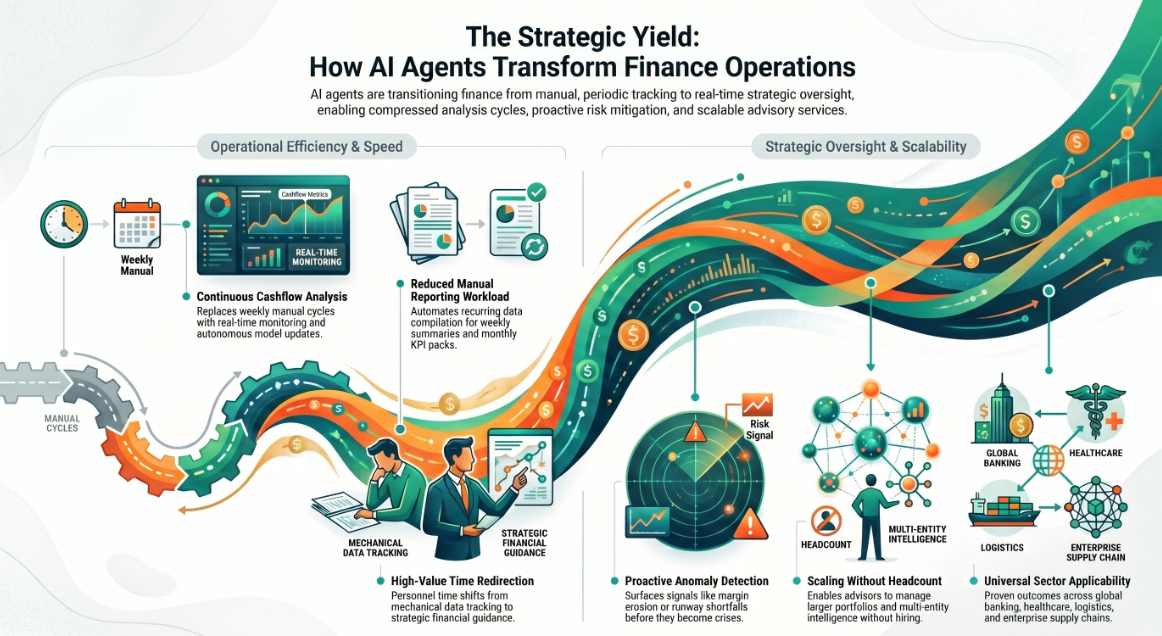
Finance teams using AI CFO agents report dramatically compressed analysis cycles. Cashflow positions that previously required weekly analyst time to produce are now available continuously, with the agent monitoring and updating the model in real time. The time freed from mechanical cashflow tracking goes back into scenario planning and strategic financial guidance.
Earlier detection of anomalies and cash risks
This is arguably the highest-value outcome: the ability to see problems before they become crises. Whether it is a delinquency trend building in a lending portfolio, a procurement margin being quietly eroded by vendor price creep, or a cash runway shortfall emerging in a growth-stage business — AI agents surface these signals earlier than any periodic manual review can.
Reduced manual reporting workload
Recurring reports — weekly cashflow summaries, monthly KPI packs, procurement variance reports, competitive pricing snapshots — are the most visible form of finance work that AI agents replace. Multiple deployments have resulted in significant reductions in analyst time spent on recurring data compilation, with that time redirected to higher-value advisory work.
Scalable advisory-quality insight without extra headcount
For finance teams and advisory practices managing multiple clients, entities, or business units, AI agents create a scalability advantage that hiring alone cannot produce. An advisor using AI portfolio monitoring can manage a larger client book with the same team. A multi-entity finance function can standardise KPIs and produce group-level intelligence without proportionally increasing centralised headcount.
How to Choose the Right AI Tool for Your Finance Team
With a landscape this broad, the risk is selection paralysis — or worse, buying tools that overlap without solving the highest-priority workflow pain. Here is a practical framework.
Match the tool to your workflow pain point
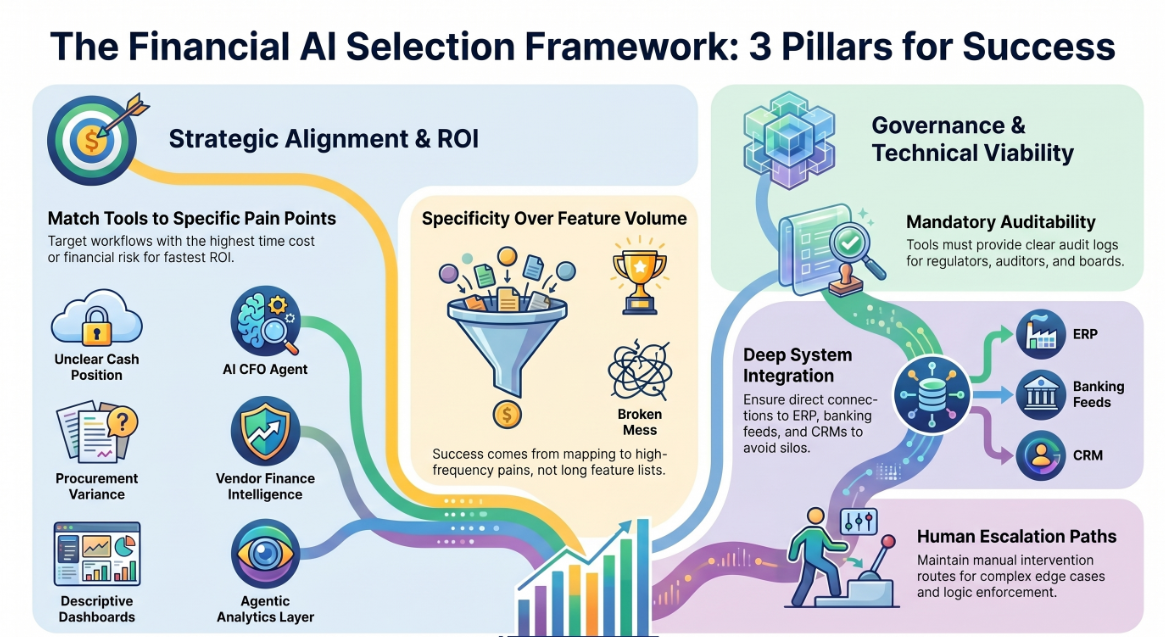
Start with the workflow that costs you the most time or carries the most financial risk. If your biggest problem is not knowing your cash position until mid-month, start with an AI CFO agent. If you are losing margin to undetected procurement variance, start with vendor finance intelligence. If your dashboard shows what happened but not what to do, start with an agentic analytics layer.
The tools that deliver the fastest ROI are always the ones that map precisely to a specific, high-frequency pain point — not the ones with the longest feature lists.
Prioritise auditability and governance
Finance is a regulated function. Any AI tool that produces outputs that your team will act on — or that a regulator, auditor, or board will scrutinise — needs to be able to explain itself. Before committing to any AI finance tool, ask:
- Can I produce an audit log of every agent action and output?
- Is there a human escalation path for edge cases?
- Are metric definitions and data rules consistently enforced, or does each query potentially use different logic?
Tools that cannot answer these questions cleanly are tools that create compliance exposure, not reduce it.
Check integration depth before buying
The fastest way for an AI finance tool to become shelf-ware is for it to require manual data export and import to function. Before evaluating features, confirm that the tool can connect directly to your existing systems — your ERP, your accounting platform, your banking data feeds, your CRM, your operational dashboards.
The best AI finance tools function as an intelligence layer on top of your current infrastructure. They should make your existing systems smarter — not replace them with another silo.
The Bottom Line
The best AI tools for finance professionals in 2026 are not the ones with the most features or the most impressive demos. They are the ones that connect to your systems, fit your workflows, produce auditable outputs, and surface the intelligence your team needs before the moment to act has passed.
This is what agentic AI in finance actually looks like in production: faster cycles, earlier signals, governed outputs, and finance teams that spend more time advising and less time assembling.
If you are looking for a platform that can deploy purpose-built AI agents across your finance function — with governance, auditability, and integration-readiness built in from day one — explore what Assistents by Ampcome can do for your team at assistents.ai.
Related reading: Best AI for Financial Planning and Analysis (2026 Guide)
FAQs
Can AI replace financial analysts?
No — and the most accurate framing is that AI is replacing the work that was preventing financial analysts from doing analysis. The mechanical work of compiling data, formatting reports, monitoring dashboards, and chasing down variance explanations can be automated. The work of applying judgement, advising stakeholders, and making decisions in ambiguous situations cannot. Finance teams using AI agents well are reporting that their analysts are spending more time on work that requires genuine expertise — and less time on work that should never have required an expert in the first place.
What is agentic AI in finance?
Agentic AI refers to AI systems that take sequences of actions autonomously — monitoring data, detecting anomalies, triggering workflows, and producing outputs — without requiring a human to prompt each step. In finance, an agentic AI system might continuously monitor cashflow, detect a potential shortfall developing over the next six weeks, pull the relevant scenario models, generate a briefing, and alert the CFO — all without anyone asking it to. This is distinct from earlier AI tools, which responded to queries but did not act independently. Agentic AI is governed through rules, escalation paths, and audit logs that keep human teams in control of the outcomes even when the agent is acting autonomously.
Is my financial data safe with AI tools?
Data security in AI finance tools varies significantly by vendor and deployment model. Before deploying any AI tool with access to financial data, finance teams should verify: data encryption in transit and at rest, role-based access controls, compliance certifications relevant to your jurisdiction (SOC 2 Type II, ISO 27001, GDPR compliance as applicable), data residency commitments, and clear contractual terms on data use — particularly whether your data is used to train shared models. Enterprise-grade AI finance platforms offer private deployment options that keep financial data entirely within your own infrastructure. For tools deployed through platforms like Assistents by Ampcome, governance and data handling controls are built into the deployment framework.
How do CFOs use AI agents in 2026?
In 2026, CFOs are using AI agents primarily in three areas. First, continuous financial monitoring — replacing the periodic cashflow and KPI reviews that created blind spots between reporting cycles with always-on agent monitoring that surfaces issues in real time. Second, scenario planning at speed — AI agents that can model hundreds of scenarios in the time it previously took to build one, enabling faster response to market changes. Third, cross-entity intelligence — AI agents that consolidate financial and operational data across subsidiaries, geographies, and business units into a unified view that periodic reporting could never practically produce. The CFOs seeing the most value are those who have connected AI agents to their existing systems rather than creating parallel data environments.

Transform Your Business With Agentic Automation
Agentic automation is the rising star posied to overtake RPA and bring about a new wave of intelligent automation. Explore the core concepts of agentic automation, how it works, real-life examples and strategies for a successful implementation in this ebook.
Sarfraz Nawaz is the CEO and founder of Ampcome, which is at the forefront of Artificial Intelligence (AI) Development. Nawaz's passion for technology is matched by his commitment to creating solutions that drive real-world results. Under his leadership, Ampcome's team of talented engineers and developers craft innovative IT solutions that empower businesses to thrive in the ever-evolving technological landscape.Ampcome's success is a testament to Nawaz's dedication to excellence and his unwavering belief in the transformative power of technology.

More insights
Discover the latest trends, best practices, and expert opinions that can reshape your perspective

.jpg)

%20IN%202024.webp)



Contact us

