
AI Agents for Regulatory Compliance: Enterprise Use Cases, Workflows & Results (2026)


Regulatory compliance is one of the largest operational cost centres in the modern enterprise. According to McKinsey, organisations spend between 15% and 20% of their operational budgets on compliance-related activities — a figure that has grown steadily as regulatory frameworks multiply, enforcement intensifies, and the volume of transactions, documents, and data that need to be monitored scales faster than compliance teams can hire.
The traditional answer has been to add people, add tools, and add checklists. That answer is no longer working. The EU AI Act's high-risk provisions take effect in August 2026. GDPR enforcement fines for AI-related violations have reached hundreds of millions of euros. The regulatory environment is not slowing down — it is accelerating.
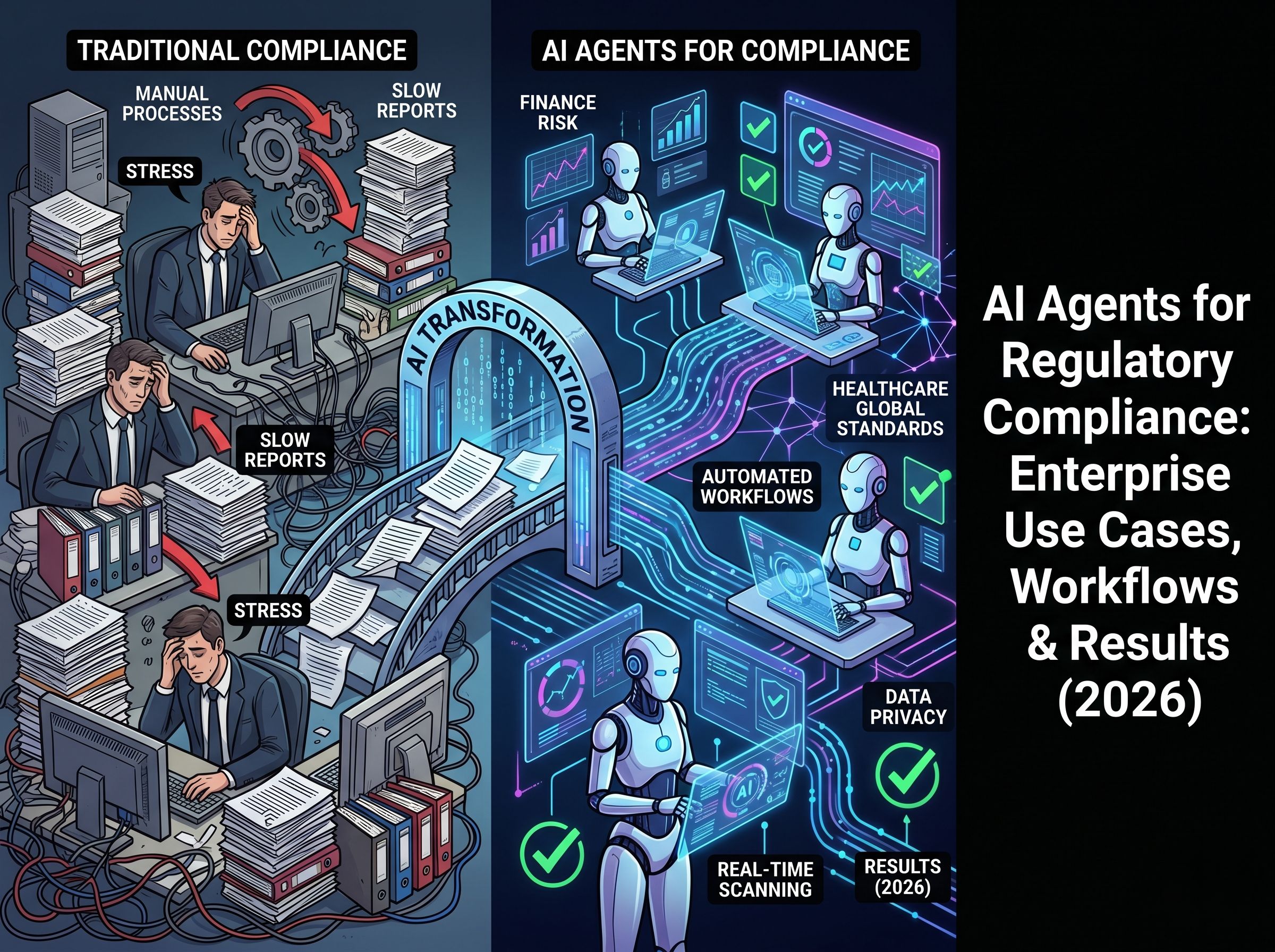
AI agents for regulatory compliance represent a fundamentally different approach. Rather than supporting compliance teams reactively, agentic AI systems monitor continuously, detect violations in near real time, generate audit-ready documentation automatically, and escalate to human decision-makers only when genuine judgment is required.
Across industries — from banking and fintech to healthcare, logistics, and real estate — enterprises deploying compliance AI agents are achieving dramatically faster reporting cycles, fewer compliance gaps, and better audit outcomes without adding headcount.
This guide covers how compliance AI agents work, the deployment patterns producing real results across industries, the regulatory frameworks they support, and what compliance professionals and risk officers should look for when evaluating a platform.
What is a regulatory compliance AI agent?
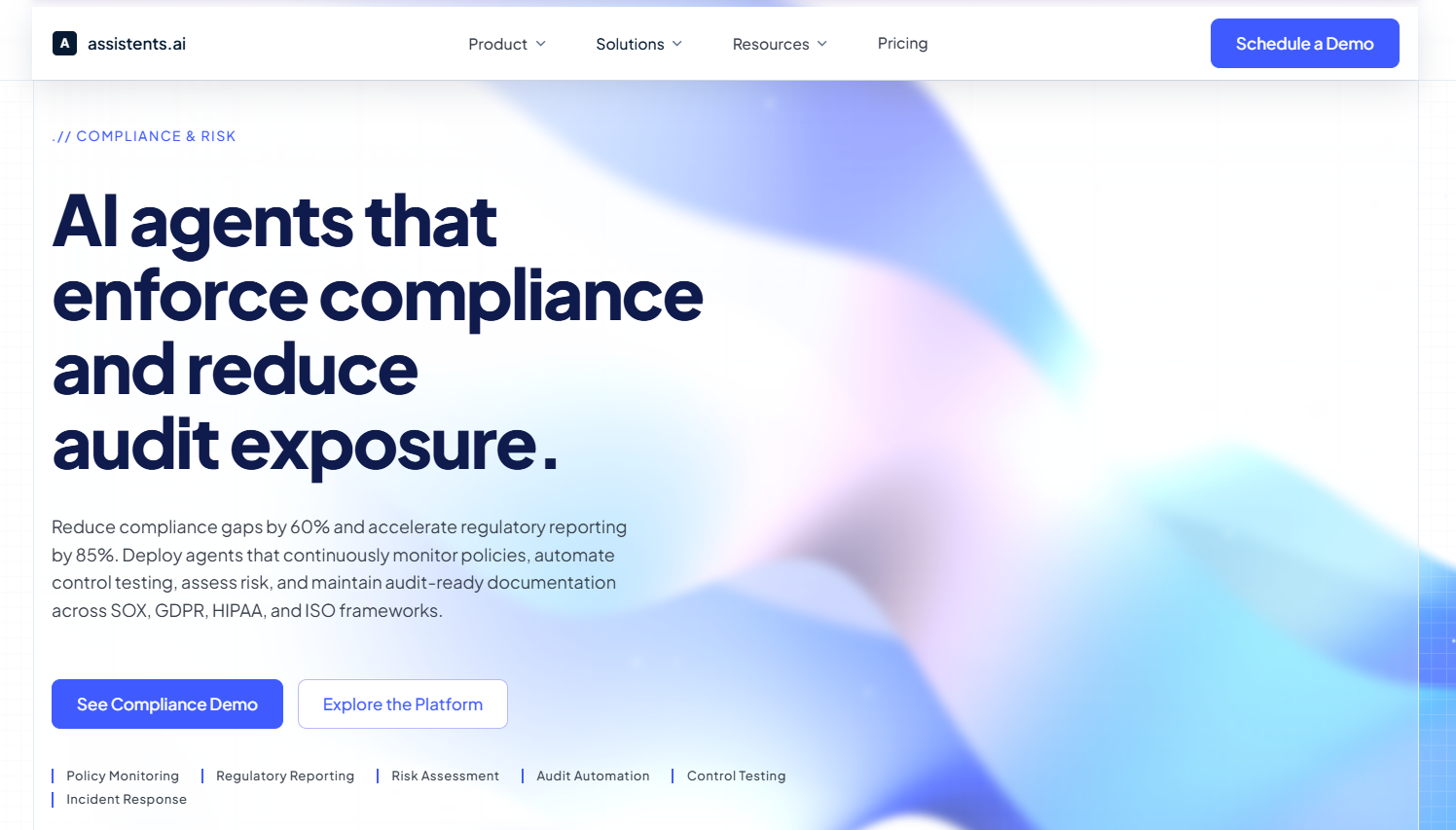
A regulatory compliance AI agent is an autonomous software system that continuously monitors enterprise operations, data flows, and business processes against a defined set of regulatory rules — and acts on what it finds without waiting to be asked.
Unlike traditional GRC (governance, risk, and compliance) tools, which operate on static rule sets and require manual updates when regulations change, compliance AI agents apply machine learning and natural language understanding to interpret regulatory requirements, detect anomalies in real-world behaviour, and adapt when frameworks evolve.
In practice, a compliance AI agent can do all of the following without human initiation:
- Ingest data from transaction systems, identity platforms, document repositories, and external regulatory feeds
- Map observed activity against applicable control frameworks (SOX, GDPR, HIPAA, ISO 27001, and others)
- Flag potential violations with severity classification and supporting evidence
- Trigger remediation workflows and assign ownership to the right teams
- Generate tamper-proof audit logs capturing every action, every data source accessed, and every decision made
- Escalate to human compliance officers when a situation requires regulatory judgment or manual sign-off
The critical distinction between a compliance AI agent and a conventional automation tool is reasoning. Traditional automation follows rigid, pre-programmed if-then logic. When regulations change, someone has to rewrite the rules. A compliance AI agent can interpret new regulatory language through retrieval-augmented generation, update its monitoring posture dynamically, and flag new risk patterns it was not explicitly programmed to detect.
In multi-agent deployments — which represent best practice for enterprise-scale compliance — individual agents handle specialised functions: one monitors data access and PHI handling, another tracks transaction patterns for AML signals, a third assembles audit evidence packages. These agents coordinate through an orchestration layer, passing findings to each other and escalating to human review when thresholds are crossed.
Why traditional compliance is breaking down
For most organisations, compliance still works the way it did a decade ago: periodic audits, manual evidence collection, spreadsheet-based tracking, and reactive responses to regulatory changes. This model was already straining under normal conditions. In 2026, it is failing under the weight of compounding regulatory pressure.
Regulatory volume has become unmanageable.
The EU AI Act's August 2026 enforcement deadline for high-risk AI systems adds conformity assessments, public registration requirements, and lifecycle documentation obligations on top of existing GDPR requirements — and GDPR enforcement for AI-related violations has intensified sharply.
In the US, organisations face a patchwork of state-level obligations including the Colorado AI Act (effective February 2026) and Virginia's AI transparency requirements, alongside sector-specific mandates in financial services, healthcare, and energy.
Manual monitoring creates dangerous blind spots.
A compliance team reviewing transaction logs weekly will miss violations that occur and compound over days. A policy document stored in a shared drive is not a control — it is a record of intent that may have no relationship to what is actually happening in production systems. Organisations with global operations face the additional complexity of jurisdiction-specific requirements that must be applied consistently across regions.
Audit preparation consumes resources that should be doing compliance work.
When an audit is announced, many compliance teams spend weeks assembling evidence packages that, in a well-architected agentic system, would be continuously generated and maintained as a by-product of normal monitoring operations.
The talent and cost equation does not scale.
Hiring compliance professionals is expensive and slow, and the most qualified people should be spending their time on judgment-intensive activities — not on manually running control tests or formatting regulatory reports.
Compliance AI agents address each of these failure modes directly. They monitor continuously rather than periodically, they maintain audit evidence automatically, they adapt to regulatory changes faster than manual rule rewrites allow, and they free compliance professionals to focus on the situations that genuinely require human expertise.
How AI agents work in regulatory compliance workflows
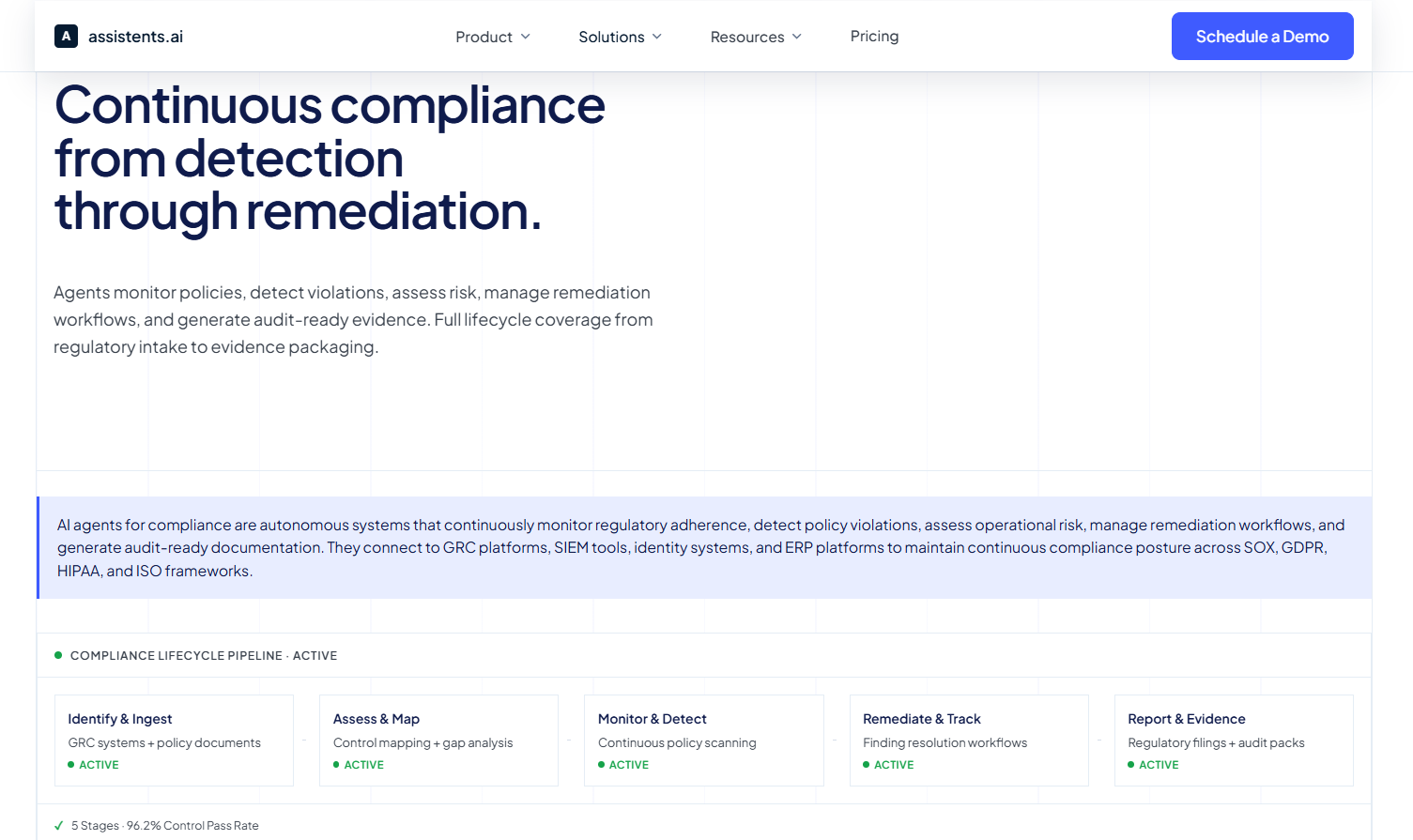
Understanding the mechanics of a compliance AI agent matters for two reasons: it determines whether a deployment will actually pass regulatory scrutiny, and it reveals where the real operational value lies. The full agentic compliance loop has five stages.
Stage 1: Identify and ingest
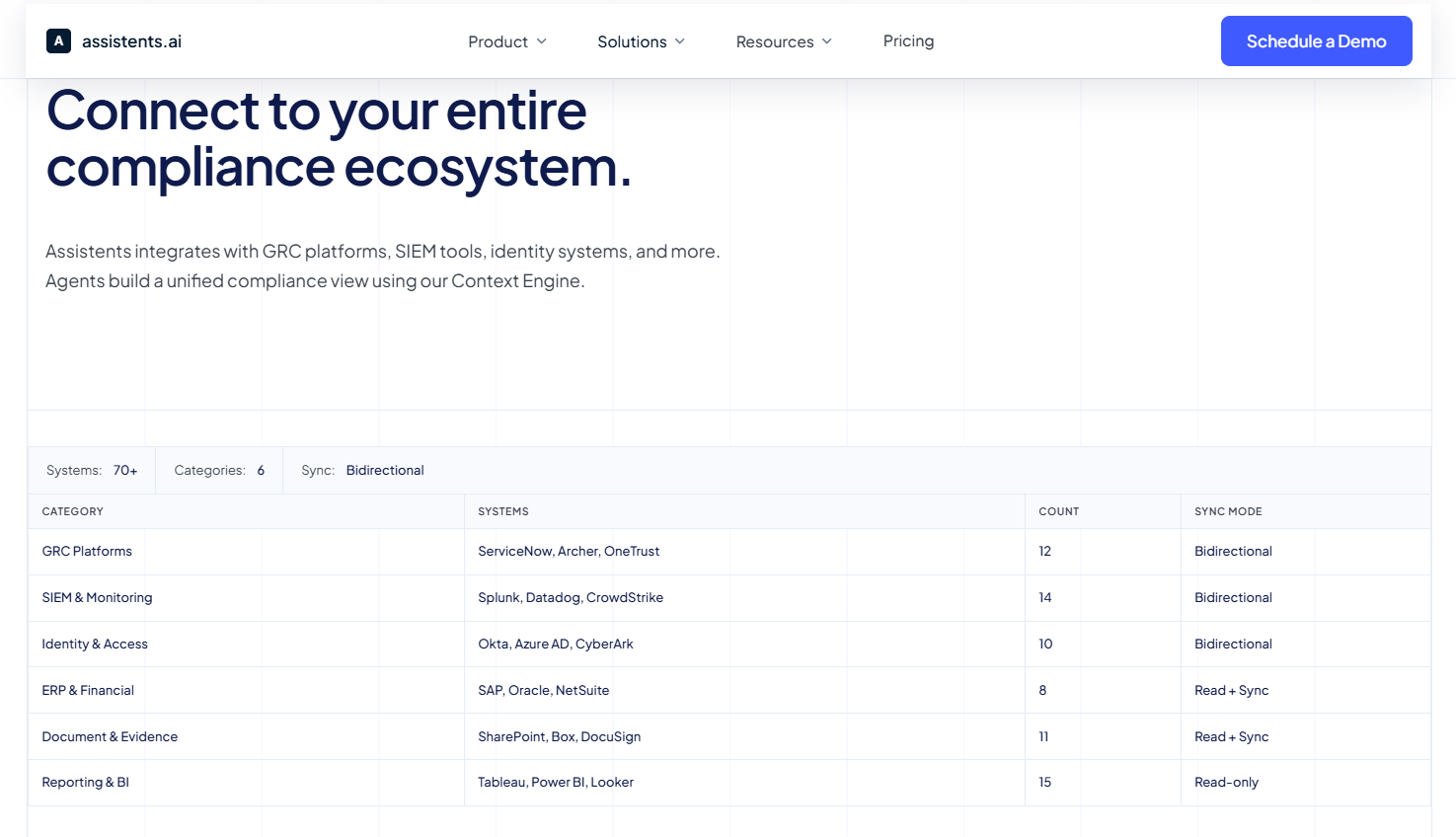
The agent connects to the full range of systems where compliance-relevant data lives — GRC platforms (ServiceNow, Archer, OneTrust), SIEM and monitoring tools (Splunk, Datadog, CrowdStrike), identity and access management systems (Okta, Azure AD), ERP platforms (SAP, Oracle), and document repositories (SharePoint, Box, DocuSign).
A Context Engine aggregates this data into a unified compliance data model, resolving inconsistencies and flagging data quality issues before they create false positives in monitoring.
Stage 2: Assess and map
The agent maps current operational state against the applicable control framework — identifying which controls apply to which systems and processes, running gap analysis against required coverage, and prioritising remediation efforts by risk level. For organisations operating across multiple regulatory frameworks simultaneously, cross-reference validation ensures that a control required by HIPAA is not accidentally contradicted by a SOX requirement.
Stage 3: Continuous monitoring and real-time detection
This is the stage where agentic compliance diverges most sharply from traditional tools. Rather than running scheduled scans, compliance AI agents monitor continuously — detecting policy violations, access anomalies, transaction pattern deviations, and documentation gaps as they occur, with detection latency measured in milliseconds rather than days or weeks. When a potential violation is detected, it is classified by severity, mapped to the relevant regulatory framework, and — depending on severity — either logged for review or immediately escalated.

Stage 4: Remediation and tracking
Detection without remediation is just expensive alerting. A well-designed compliance AI agent does not simply flag a violation and wait. It triggers a remediation workflow: assigning ownership, setting deadlines, tracking resolution progress, and escalating if remediation stalls. Every step of the remediation process is logged, creating a complete record from initial detection to confirmed resolution.
Stage 5: Automated audit trails and evidence packaging
Every action the agent takes — every data source accessed, every control tested, every decision made — is recorded in an immutable audit log that captures the full reasoning chain. When an audit occurs, evidence packages are assembled automatically from this continuous record rather than being constructed retrospectively under time pressure.
The difference in audit outcomes between organisations that maintain continuous audit trails and those that assemble evidence manually is significant: not only do continuous trails contain more complete evidence, but they demonstrate to regulators that compliance is an operational reality, not a periodic exercise.
Human-in-the-loop escalation
Compliance AI agents are not designed to replace compliance judgment — they are designed to ensure that compliance officers spend their time on decisions that require judgment. The agent handles volume. It handles consistency. It handles documentation.
When a situation is ambiguous, when a violation involves senior personnel, or when a regulatory interaction requires human accountability, the agent escalates through a governed handoff workflow with full context attached — so the human decision-maker is not starting from scratch.
AI agents for regulatory compliance: industry use cases and real results
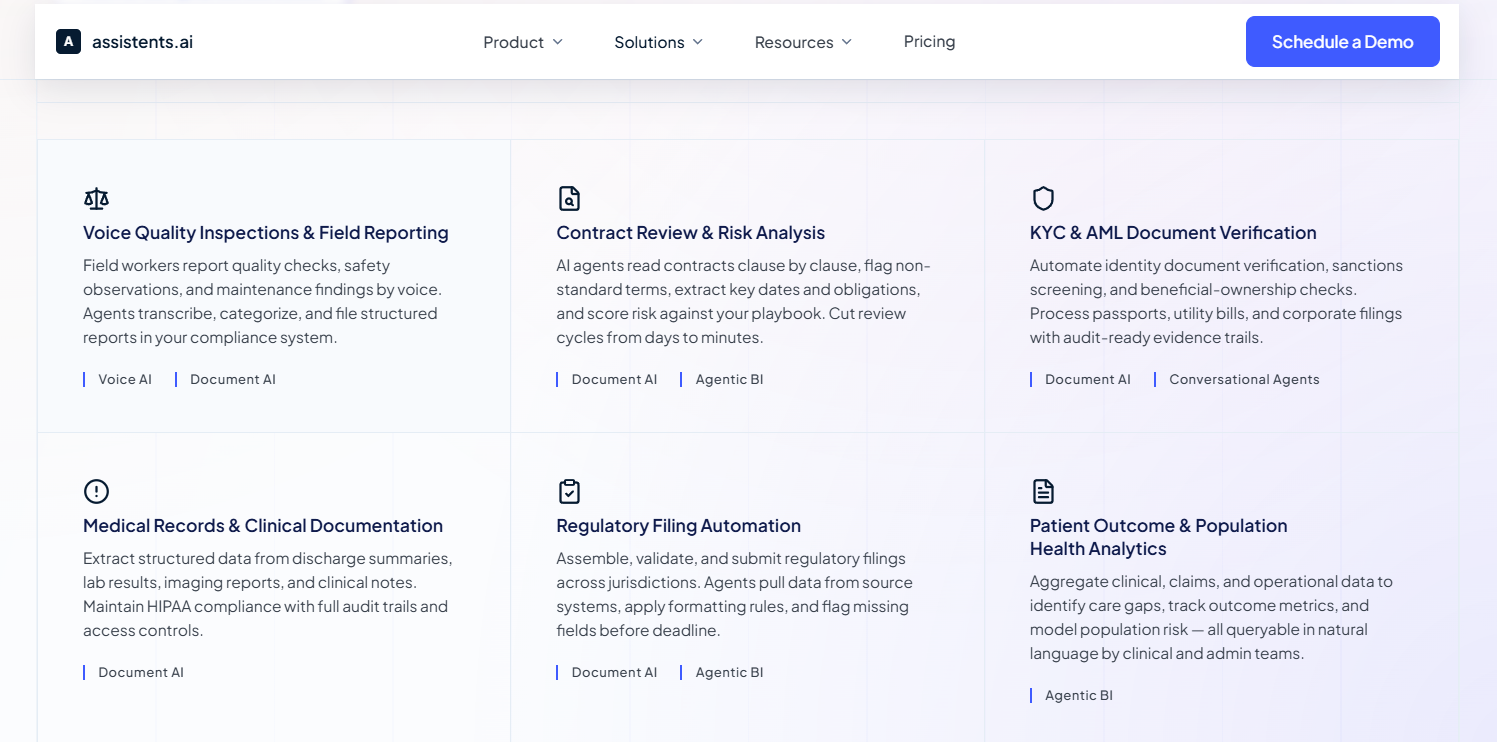
The following use cases are drawn from live enterprise deployments across financial services, healthcare, logistics, and real estate. Client names are not disclosed; sector and operational context are provided.
AI for compliance in banking and financial services
Banking and fintech operate under the most demanding and overlapping compliance requirements of any industry: AML, KYC, SOX, GDPR, PCI-DSS, and increasingly the AI-specific requirements of the EU AI Act and FFIEC guidance on model risk management.
A global cloud-based financial technology provider serving banks and credit unions deployed omnichannel AI agents to handle dispute processing, fraud screening, and regulatory compliance workflows — all within a single governed environment. The core problem was scale: as transaction volumes increased, the manual review workload for compliance-related disputes was growing faster than the compliance team.
The AI agent deployment created an automated intake and classification layer that routed disputes by type, urgency, and regulatory applicability. Workflow automation handled the documentation and audit trail generation for every case. Human compliance officers were escalated to only when a case exceeded defined risk thresholds or required regulatory interpretation.
The results included faster case handling, significantly reduced operational load on compliance staff, and — critically — a complete, automatically generated audit trail for every case processed, giving regulators the evidence documentation they require without the manual assembly burden.
For banks specifically, compliance AI agents are proving effective across several high-value workflows:
AML and transaction monitoring.
Agents continuously scan transaction patterns against sanctions lists, beneficial ownership records, and behavioural baselines — flagging anomalies that match AML typologies with severity scores and supporting evidence. Unlike rule-based transaction monitoring systems, which generate high false-positive rates that consume analyst time, agentic systems learn from confirmed violations to sharpen pattern recognition over time.
KYC and identity verification.
Agents automate document verification (passports, utility bills, corporate filings), sanctions screening, and beneficial ownership checks — maintaining audit-ready evidence trails for every verification completed. Processing speeds that previously required large manual teams can be handled autonomously, with human review reserved for edge cases.
SOX compliance and financial controls.
Agents monitor internal control environments, run continuous control testing against SOX requirements, and generate board-ready reporting with evidence packages. The combination of continuous monitoring and automated reporting eliminates the quarterly scramble that characterises most SOX compliance programmes.
Healthcare compliance: HIPAA, PHI, and clinical operations
Healthcare compliance involves unique complexity: the consequences of failure are not just financial penalties but patient safety and trust. HIPAA requires strict access controls and audit evidence for any system that touches Protected Health Information (PHI). The EU MDR/IVDR frameworks impose additional requirements on AI-assisted clinical tools. And healthcare organisations typically operate across a patchwork of legacy systems that were not designed with modern compliance requirements in mind.
A physician-led clinical enterprise operating inpatient programmes across multiple facilities deployed AI agents to address the gap between compliance intent and operational reality. The challenge was that compliance documentation existed — policies, procedures, training records — but there was limited visibility into whether those policies were being followed in daily operations.
The agent deployment created continuous monitoring across clinical workflows, flagging access patterns inconsistent with minimum necessary standards and generating automatic documentation of compliance-relevant events.
Separately, a geriatric care services provider deployed AI agents to improve visibility into service delivery performance and financial compliance across assisted living and long-term care settings. The outcome was improved transparency into care programme operations and better decision support for leadership — outcomes that also directly supported regulatory reporting requirements for care quality and financial operations.
For healthcare compliance professionals, the key areas where AI agents deliver measurable value are: PHI access monitoring and anomaly detection, clinical documentation completeness, regulatory filing automation for CMS and OCR requirements, and HIPAA breach response workflow management.
Logistics and supply chain: multi-jurisdiction and cross-border compliance
Supply chain compliance spans trade regulations, customs requirements, environmental standards, labour law obligations, and increasingly ESG reporting mandates — all of which vary by jurisdiction and change frequently. The operational complexity of a global supply chain makes manual compliance monitoring practically impossible at scale.
A global logistics and supply chain enterprise with operations spanning India, the UK, Europe, and the US deployed AI agents to consolidate compliance-relevant analytics across its multi-entity global operation. The core challenge was visibility: with operations across multiple legal entities and jurisdictions, there was no single view of compliance posture. Operational variances that would have indicated a compliance risk in one entity were invisible at the group level.
The agent deployment created consolidated reporting across entities, automated variance identification, and standardised the compliance metrics that leadership could rely on for accurate decision-making. The outcome was a shift from periodic reporting — which often surfaced issues too late for remediation — to continuous monitoring with proactive alerts on compliance-relevant exceptions.
For a port and terminal management operation, AI agents digitised terminal workflow processes and created operational dashboards that provided continuous visibility into regulatory compliance across complex port-to-inland logistics chains. The combination of real-time operational data and automated exception management significantly improved regulatory transparency and response speed.
Procurement and vendor compliance automation
Procurement compliance is an underappreciated risk area. Vendor relationships expose organisations to regulatory risk through their suppliers' practices — in areas including labour standards, environmental compliance, financial controls, and data handling. For large enterprises with hundreds or thousands of vendors, manual vendor compliance monitoring is simply not feasible.
A large group-level enterprise deployed AI agents to automate procurement and finance KPI alerts across its group entities, with specific focus on vendor performance, margin control, and early-payment analysis. Automated alerts flagged purchase price trends, delivery performance deviations, and working-capital risks as they occurred rather than being discovered in monthly reporting cycles. Leadership received structured insight packs on a scheduled basis, with exceptions escalated immediately.
The compliance value here is twofold: the organisation has continuous visibility into financial controls that would otherwise require manual monitoring, and it has an automated audit trail of vendor performance and procurement decisions that satisfies internal audit and regulatory evidence requirements.
Real estate: tenant compliance, regulatory reporting, and property-level risk
Real estate operators face compliance obligations across tenancy law, financial reporting, property safety standards, and data privacy — obligations that span a portfolio of assets, each with its own legal context.
A major real estate portfolio owner and manager deployed an omnichannel compliance and customer service agent to handle tenant query triage, rental and payment support workflows, and escalation routing across web, WhatsApp, and email channels. The agent maintained a knowledge base across policies, tenancy documentation, and standard operating procedures — ensuring that every tenant-facing interaction was consistent with the applicable regulatory and contractual requirements. Ticketing and escalation workflows ensured that issues requiring legal or compliance expertise were routed to human teams with full context.
The results included 24/7 tenant availability (critical for maintaining regulatory SLA requirements), consistent policy application across all channels, and reduced call-centre load — while maintaining full audit documentation of every compliance-relevant interaction.
Regulatory frameworks AI compliance agents support in 2026
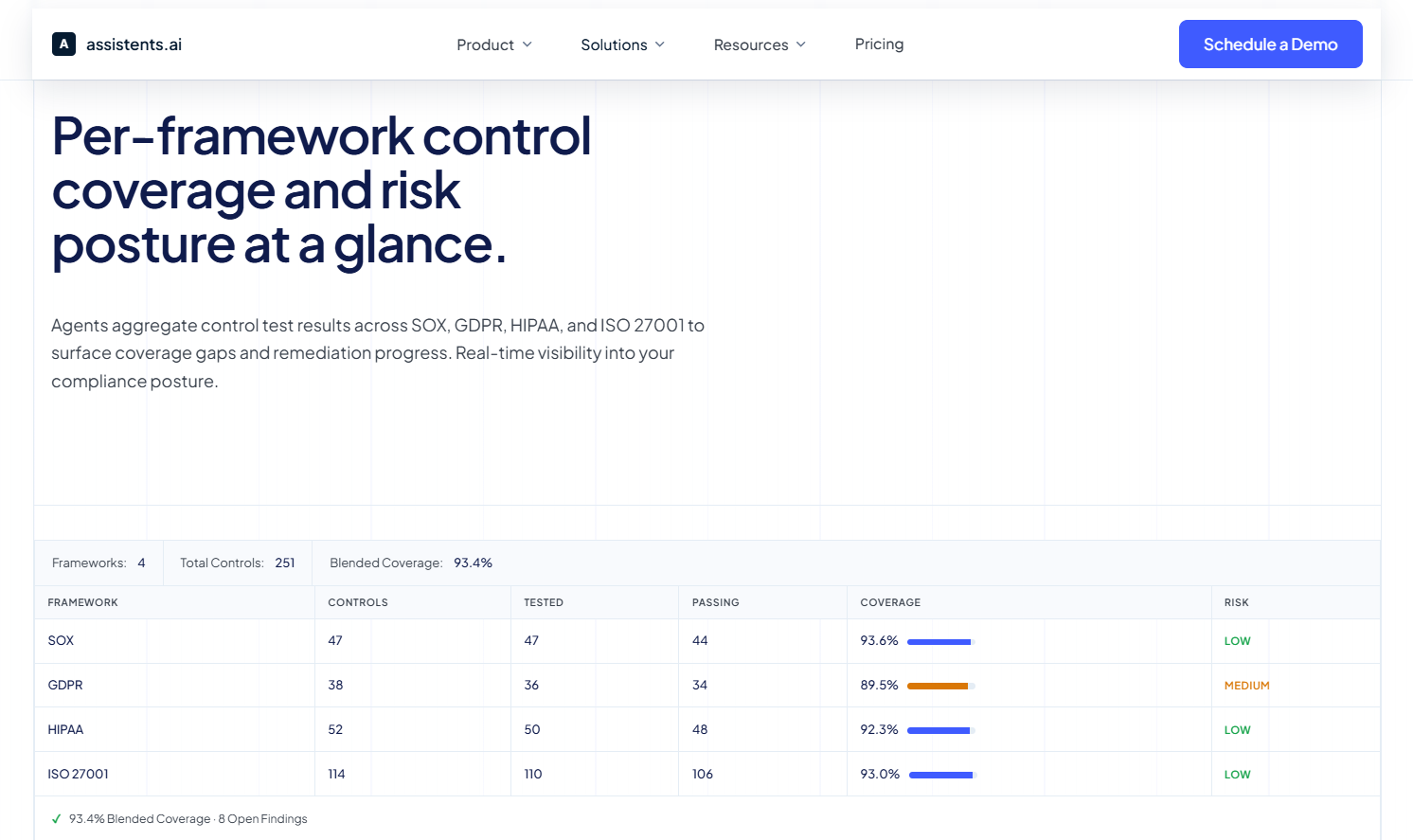
A well-architected compliance AI agent does not specialise in a single framework. It maps activity across the full regulatory landscape applicable to an enterprise. The following frameworks represent the core coverage that compliance teams should expect from any enterprise-grade compliance AI agent platform.
GDPR. The General Data Protection Regulation requires lawful processing of personal data, transparency in automated decision-making (Article 22 is particularly relevant for AI agents), and the ability for individuals to access, correct, or delete their information. Compliance AI agents support GDPR through automated consent tracking, data flow monitoring, PHI and PII access controls, data subject request workflow management, and breach response automation.
HIPAA. The Health Insurance Portability and Accountability Act mandates strict administrative, physical, and technical safeguards for PHI. AI agents support HIPAA compliance through PHI access monitoring, minimum-necessary access enforcement, audit log generation for all data access events, and business associate agreement workflow management.
SOX. The Sarbanes-Oxley Act requires publicly traded companies to maintain tamper-proof financial records, enforce internal controls, and ensure executive sign-off on financial disclosures. AI agents support SOX through continuous internal control testing, automated financial reporting workflows, and complete audit trail generation for all financial system events.
PCI-DSS. The Payment Card Industry Data Security Standard governs the handling of cardholder data. AI agents support PCI-DSS through transaction monitoring, access control enforcement, and continuous evidence generation for the 12 PCI-DSS control domains.
EU AI Act. The high-risk AI provisions taking effect August 2026 require conformity assessments, technical documentation, human oversight mechanisms, and post-market monitoring for AI systems operating in high-risk categories. A compliance AI agent platform must itself be governed in ways that satisfy EU AI Act requirements — with explainability, audit trails, and human-in-the-loop architecture built in by design.
ISO 27001. The international standard for information security management provides a framework for managing information security risks. AI agents support ISO 27001 through continuous control monitoring, risk register maintenance, and automated evidence collection for certification audits.
AML and KYC. Anti-money laundering and Know Your Customer requirements in banking and fintech mandate transaction monitoring, sanctions screening, and beneficial ownership verification. AI agents automate the data collection, pattern analysis, and evidence documentation that manual AML/KYC programmes require at significant human cost.
SOC 2. The de facto trust standard for B2B software companies, SOC 2 requires verified security controls across confidentiality, availability, processing integrity, and privacy. Enterprise buyers require SOC 2 compliance from any platform they deploy — meaning the compliance AI agent platform itself must hold relevant certifications.
What to look for in a compliance AI agent platform
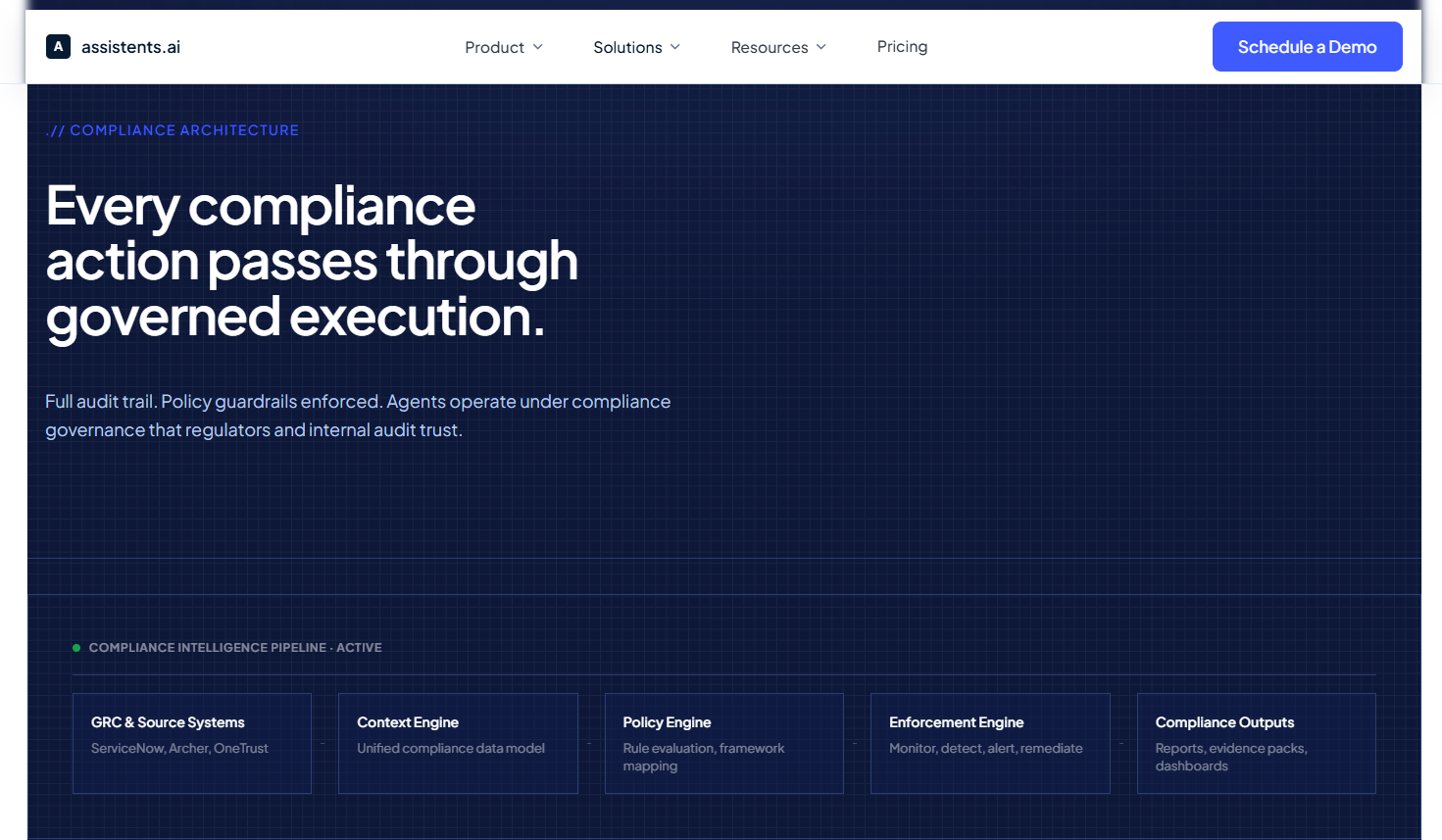
For compliance professionals and risk officers evaluating platforms, the evaluation criteria matter as much as the feature list. A compliance tool that does not meet the following standards will create as many audit risks as it resolves.
Complete, immutable audit trails. Every agent action — every data source queried, every control tested, every decision made — must be logged with full context in a tamper-proof record. The audit trail should capture not just what the agent did but why: the data sources accessed, the rule applied, the confidence level, and the alternatives considered.
Regulators and internal auditors expect to be able to reconstruct any compliance decision from the evidence record. If the platform cannot provide this, it is not production-ready for regulated environments.
Explainability and human-readable outputs. Compliance officers need to understand what the agent found and why it flagged it. Black-box outputs — "violation detected, confidence 87%" — are not actionable and will not satisfy regulators who expect explainability on demand.
Look for platforms where agent findings are presented with clear supporting evidence, plain-language explanations, and links to the specific regulatory provision or control framework the finding relates to.
Human-in-the-loop architecture. Autonomy without oversight is a liability in compliance. A well-designed platform enforces human review for high-severity findings, regulatory interactions, and decisions that affect individuals' rights — and makes this configuration transparent and auditable. The presence of human-in-the-loop controls should itself be documentable for EU AI Act conformity.
Multi-framework coverage and cross-reference validation. Organisations operating across jurisdictions face requirements that sometimes conflict or overlap. A platform that handles GDPR in isolation but does not cross-reference against HIPAA for healthcare clients, or against SOX for publicly traded companies, creates dangerous compliance gaps. The platform should maintain a unified compliance data model that resolves cross-framework conflicts proactively.
Integration depth with existing systems. A compliance AI agent is only as good as the data it can access. Platforms that integrate shallowly — reading data from a few systems but unable to write findings back to GRC platforms or SIEM tools — require manual handoffs that reintroduce the errors and delays they are meant to eliminate. Look for bidirectional integration with GRC platforms, SIEM tools, identity systems, and ERP platforms as a baseline.
Data residency and security certifications. For global enterprises, data residency requirements under GDPR and similar frameworks mean that a compliance agent processing EU personal data must keep that data within approved jurisdictions. The platform itself should hold relevant security certifications — SOC 2 Type II, ISO 27001, and HIPAA compliance at minimum — as a condition of being trusted in regulated environments.
Deployment speed and configuration transparency. A platform that requires twelve months of implementation before delivering value is not a compliance tool — it is an IT project. Best-in-class enterprise compliance AI agent platforms can be in production within three to four weeks, with observable, configurable behaviour from day one. Configuration should be transparent to compliance teams, not buried in vendor-managed black-box models.
How assistents.ai approaches regulatory compliance automation
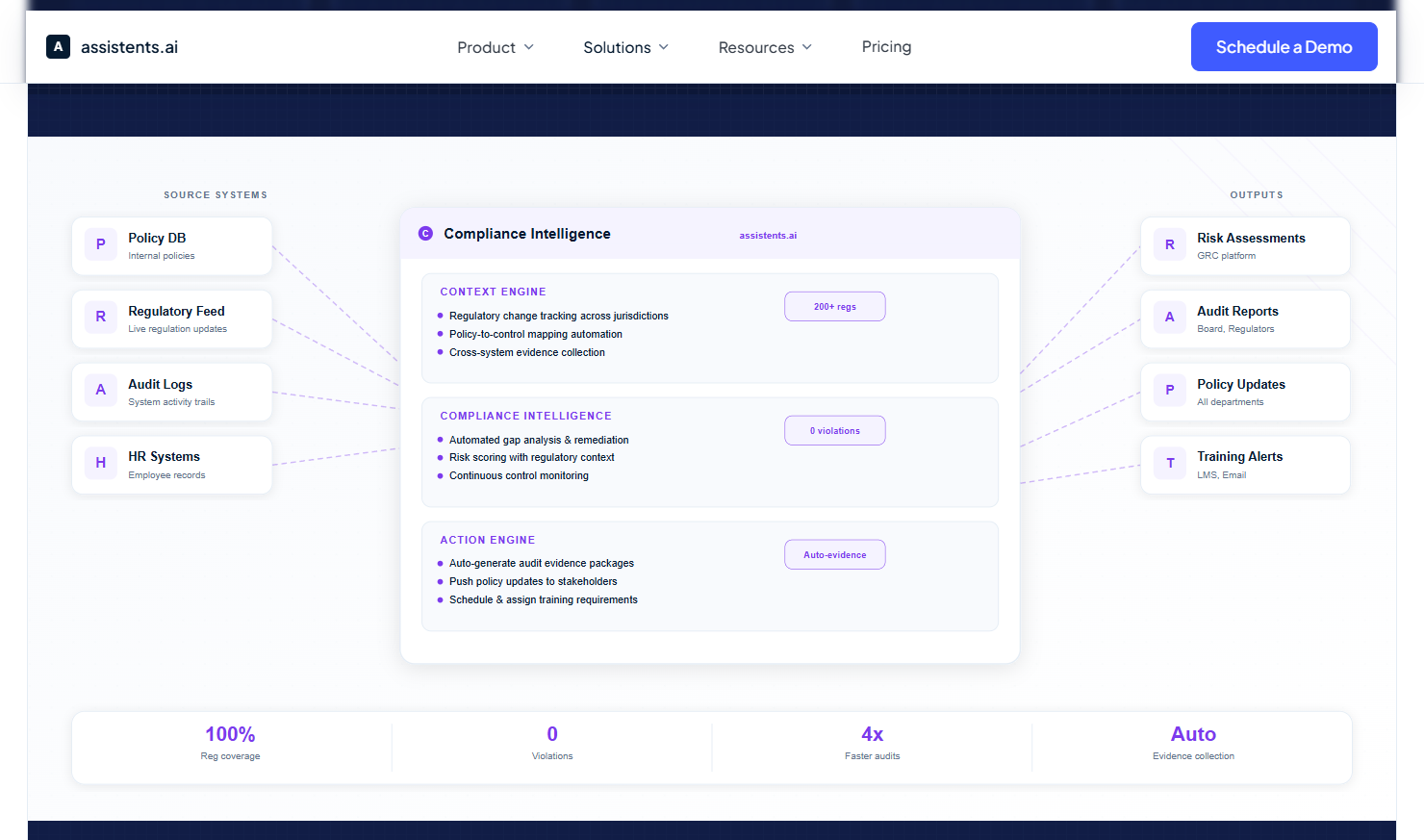
assistents.ai's compliance solution is built around a five-stage continuous compliance lifecycle: identify and ingest, assess and map, monitor and detect, remediate and track, and report and evidence. The platform connects to over 70 pre-built integrations across GRC platforms, SIEM tools, identity systems, ERP platforms, and document repositories — and maintains a unified compliance data model through its Context Engine.
The platform currently supports 251 controls across SOX, GDPR, HIPAA, and ISO 27001, with a blended coverage rate of 93.4% and detection latency under 200 milliseconds. Its compliance architecture provides 100% audit trail coverage — every agent action, logged and explainable — and the platform is designed to be in production in under three weeks.
Key capabilities include:
- Policy monitoring: continuous scanning against applicable control frameworks with real-time alerting on violations
- Regulatory reporting: automated assembly and submission of regulatory filings across jurisdictions, with data pulled from source systems and validated before deadline
- Risk assessment: continuous risk scoring with threshold alerting and trend analysis
- Audit automation: evidence collection, finding tracking, remediation workflow management, and sign-off management — eliminating the manual evidence assembly burden
- Control testing: automated testing of controls across SOX, GDPR, HIPAA, and ISO 27001 with gap analysis and prioritised remediation
The platform supports specific use cases including KYC and AML document verification, contract review and risk analysis, regulatory filing automation, medical records and clinical documentation (HIPAA-compliant), and voice quality inspections and field reporting.
Enterprises ready to move from reactive compliance to continuous, agentic compliance can schedule a compliance demo here.
Frequently asked questions: AI agents for regulatory compliance
What is a compliance AI agent and how does it work?
A compliance AI agent is an autonomous software system that continuously monitors enterprise systems, processes, and data against regulatory requirements. Unlike traditional GRC tools, which rely on static rules and manual updates, compliance AI agents use machine learning and natural language understanding to interpret regulatory requirements, detect anomalies in real time, generate tamper-proof audit documentation, and trigger remediation workflows without human initiation.
Multi-agent deployments assign specialised roles — monitoring, documentation, escalation — to different agents that coordinate through an orchestration layer.
How do AI agents help with regulatory compliance in banking?
In banking and fintech, compliance AI agents automate the highest-volume, highest-risk compliance workflows: AML transaction monitoring, KYC document verification, SOX internal control testing, and GDPR data processing audit trails.
They process transaction data continuously rather than in scheduled batches, reducing the window during which a compliance violation can compound before detection. Every finding is logged with supporting evidence, giving compliance teams and regulators a complete, auditable record of monitoring activity.
Can AI agents handle GDPR and HIPAA compliance requirements?
Yes. GDPR compliance requires lawful data processing, transparency in automated decisions, and documented evidence of consent and data subject request handling — all of which can be automated by compliance AI agents. HIPAA compliance requires PHI access controls, minimum-necessary enforcement, and audit logs for all data access events.
A well-designed compliance AI agent maintains continuous monitoring for both frameworks, cross-references them where they apply simultaneously (common in US-based healthcare organisations with EU patients), and generates the evidence documentation that both regulations require.
What is the difference between compliance AI tools and agentic compliance platforms?
Traditional compliance AI tools automate specific tasks — scanning documents, running scheduled reports, flagging predefined rule violations. Agentic compliance platforms do all of this and also reason across data sources, take multi-step actions without human initiation, adapt to regulatory changes dynamically, and coordinate multiple specialised agents through an orchestration layer.
The practical difference is that a compliance AI tool reduces manual effort on specific tasks; an agentic compliance platform replaces the manual compliance monitoring function with continuous, autonomous oversight.
How do AI agents create audit trails for regulators?
Every action a compliance AI agent takes — every query run, every data source accessed, every control tested, every decision made — is recorded in an immutable log that captures the full context: data sources, regulatory provision applied, confidence score, alternatives considered, and outcome.
This log is maintained continuously as a by-product of monitoring operations, not assembled retrospectively when an audit is announced. Regulators can interrogate this log to reconstruct any compliance decision. Platforms like assistents.ai achieve 100% audit trail coverage across all agent-managed controls.
What compliance frameworks can AI agents support?
Enterprise-grade compliance AI agent platforms support a wide range of frameworks including GDPR, HIPAA, SOX, PCI-DSS, ISO 27001, SOC 2, AML/KYC requirements, EU AI Act high-risk obligations, and sector-specific frameworks across financial services, healthcare, energy, and logistics.
The key capability is cross-framework mapping — the ability to identify where frameworks overlap or conflict and apply the stricter standard proactively, rather than managing each framework in isolation.
Do compliance AI agents require human oversight?
Yes, and this is by design. Effective compliance AI agents are built with human-in-the-loop escalation as a core architectural requirement — not an optional feature. The agent handles high-volume monitoring, documentation, and routine remediation autonomously.
When a situation requires regulatory judgment, involves senior personnel, or exceeds defined risk thresholds, the agent escalates to a human compliance officer with full context attached. This architecture also satisfies the EU AI Act's human oversight requirements for high-risk AI systems.
How long does it take to deploy a regulatory compliance AI agent?
Best-in-class enterprise platforms can be in production in three to four weeks, starting with a defined scope — policy monitoring, regulatory reporting, or risk assessment — and connecting to existing GRC and operational systems through pre-built integrations.
A phased deployment starting with a high-value, well-defined use case (such as SOX control testing or GDPR data subject request automation) allows organisations to demonstrate ROI before expanding coverage. Platforms requiring more than eight weeks for initial production deployment should be evaluated carefully for integration maturity and configuration complexity.

Transform Your Business With Agentic Automation
Agentic automation is the rising star posied to overtake RPA and bring about a new wave of intelligent automation. Explore the core concepts of agentic automation, how it works, real-life examples and strategies for a successful implementation in this ebook.
Sarfraz Nawaz is the CEO and founder of Ampcome, which is at the forefront of Artificial Intelligence (AI) Development. Nawaz's passion for technology is matched by his commitment to creating solutions that drive real-world results. Under his leadership, Ampcome's team of talented engineers and developers craft innovative IT solutions that empower businesses to thrive in the ever-evolving technological landscape.Ampcome's success is a testament to Nawaz's dedication to excellence and his unwavering belief in the transformative power of technology.

More insights
Discover the latest trends, best practices, and expert opinions that can reshape your perspective





Contact us

