
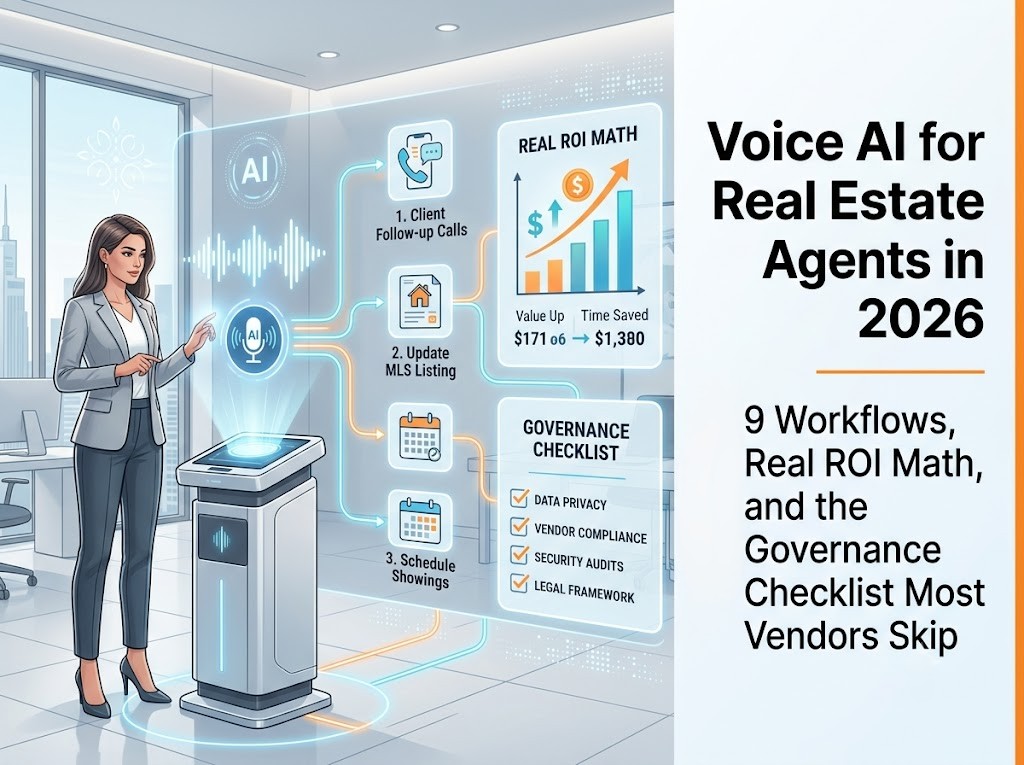
Voice AI for Real Estate Agents in 2026: 9 Workflows, Real ROI Math, and the Governance Checklist Most Vendors Skip


It is 9:14 on a Friday night. A buyer who has been watching a listing for three weeks finally calls. They are pre-approved. They want to see it Saturday. The call rings out, goes to voicemail, and they hang up without leaving one — because they have four other agents' numbers open in another tab.
By Monday morning, that deal belongs to whoever picked up.
This is the problem every voice AI vendor in real estate will pitch you on, and they are right about it. Where most of them stop being right is the next part: what happens in the ninety seconds after the agent answers. Whether the conversation reads live inventory or recites a static script. Whether it can change a record or only log one. Whether the call it just placed put you on the wrong side of a regulation that carries uncapped per-call penalties.
What Is Voice AI for Real Estate Agents?
Voice AI for real estate agents is software that conducts real phone conversations with buyers, sellers, tenants and prospects — answering inbound calls or placing outbound ones, qualifying intent, retrieving live property and account data, booking appointments, and writing the outcome back into the systems the business already runs on, without a human on the line.
The distinction that matters is not how human the voice sounds. By 2026 that is a solved problem across every serious vendor. The distinction is how much of the business the agent can actually see, and how much it is permitted to do.
Voice AI vs. IVR vs. chatbot vs. answering service
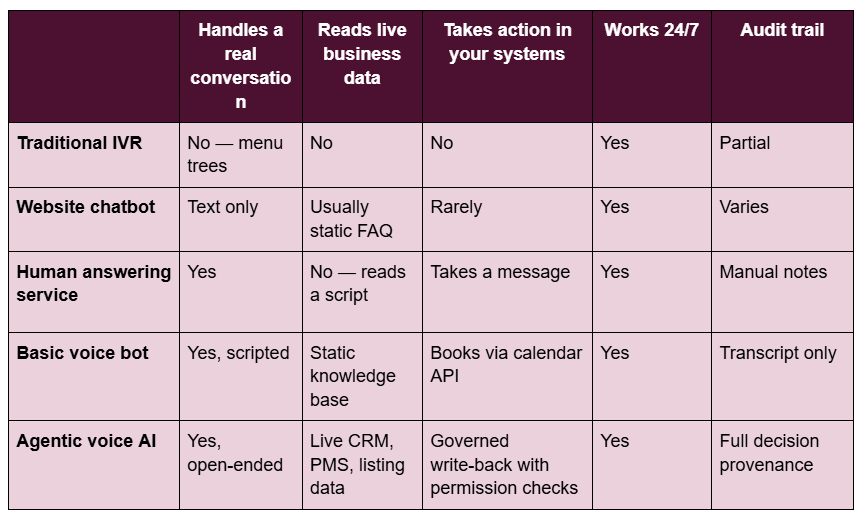
Most tools marketed as "AI voice agents for real estate" sit in row four. They answer beautifully and then hand you a transcript. The gap between row four and row five is where the return on investment lives.
What changed in 2026
Three things moved at once. Latency dropped below the threshold where callers notice they are talking to software — sub-second response is now the floor, not the differentiator. Multilingual voice reached parity, so a Hindi-English or Arabic-English conversation is no longer a degraded experience. And the regulatory clock started running: the FCC's February 2024 declaratory ruling brought AI-generated voice squarely under the Telephone Consumer Protection Act, and state-level AI legislation has been arriving steadily since.
That third change is the one that separates the vendors who will still be standing in 2027 from the ones who will not.
The Six-Layer Real Estate Voice Stack
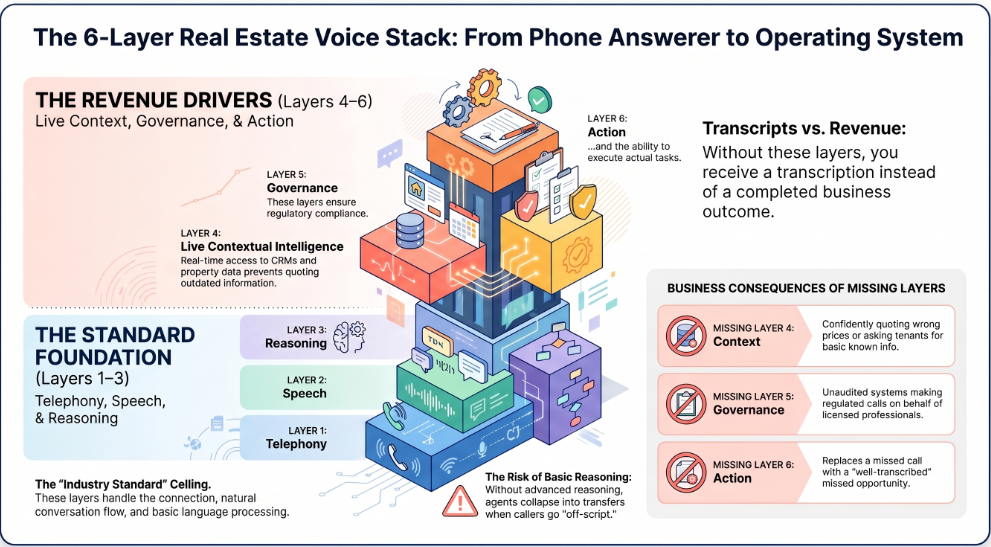
Every voice agent, regardless of vendor, is built from the same six layers. Understanding them is the fastest way to tell a phone answerer from an operating system.
The Six-Layer Real Estate Voice Stack is a reference architecture describing the six components a production real estate voice agent requires: telephony, speech, reasoning, context, governance and action. Most vendors build the first three well and stop. Layers four through six determine whether the agent produces revenue or produces transcripts.
Layer 1 — Telephony
The connection to the phone network: SIP trunking, number provisioning, call routing, warm transfer, voicemail handling. When it's missing: dropped calls during peak volume, no clean path to a human, an agent that cannot dial out.
Layer 2 — Speech
Speech-to-text, text-to-speech, and the harder part — turn-taking. Knowing when a caller has finished a thought versus paused mid-sentence, handling interruption gracefully, matching conversational pacing. When it's missing: the agent talks over people, and callers hang up within thirty seconds regardless of how good the underlying reasoning is.
Layer 3 — Reasoning
The language model deciding what to say, what to ask next, and when to probe. When it's missing: the agent runs a decision tree, and the moment a caller says something unanticipated — "I'm calling about my mother's house, she isn't sure she wants to sell" — it collapses into "let me transfer you."
Layer 4 — Context
Live access to the systems that hold the truth: the CRM, the property management system, listing data, prior call history, tenancy documents, account status. Not a static knowledge base scraped at setup, but a live read at conversation time. When it's missing: the agent confidently quotes a price that changed yesterday, or asks a tenant of six years to spell their name.
Layer 5 — Governance
Policy enforcement on every step. Which data can this agent see for this caller. What is it permitted to say. What consent has been captured. Which actions require approval. Every decision logged with provenance. When it's missing: you have an unaudited system making regulated calls on behalf of a licensed professional. See the compliance section for why that is not a theoretical concern.
Layer 6 — Action
The ability to change something. Create the showing. Update the lead score. Open the maintenance ticket and route it to the right vendor. Trigger the follow-up sequence. Write the qualification back to the record where the next human will see it. When it's missing: you have replaced a missed call with a well-transcribed missed opportunity, and someone still has to do the data entry.
The industry has largely solved layers one through three. Ask any vendor to demonstrate layers four, five and six on your own systems, live, and the field narrows very quickly.
The Real Estate Voice Autonomy Ladder
The second most expensive mistake in this category — after buying on voice quality alone — is buying the wrong level of autonomy.
The Real Estate Voice Autonomy Ladder describes five levels at which a voice agent can operate, from simply answering the phone to running outbound campaigns within policy guardrails. Deployments fail when teams buy at Level 4 before they have proven Level 2.
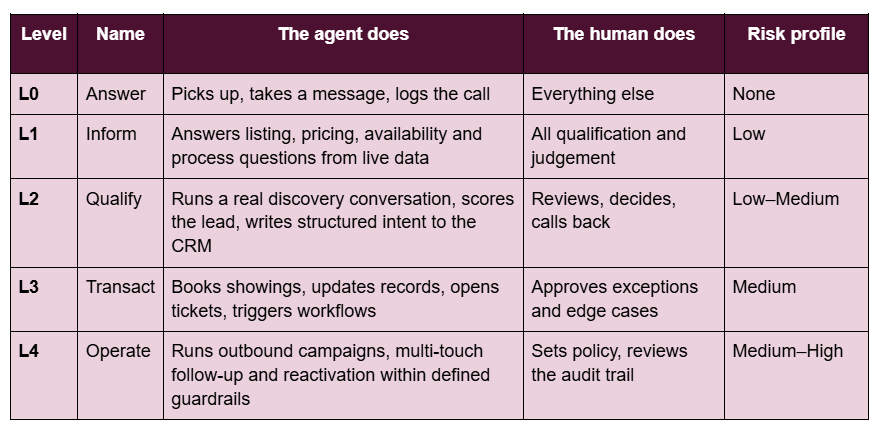
Start at L2
Not L4. There are three reasons, and they are all learned the expensive way.
First, L2 is where the measurable return concentrates. Consistent qualification on every inbound call — not the ones that happen to reach a human in a good mood — is the single largest lift available, and it carries almost no regulatory exposure because the caller initiated contact.
Second, L3 and L4 depend on data quality you probably do not have yet. An agent that writes to a CRM full of duplicates and stale records will propagate the mess faster than a human ever could.
Third, L4 is where the compliance surface expands sharply. Outbound automated calling triggers consent requirements, do-not-call obligations and disclosure duties that inbound does not. Earn your way up.
Most teams should run at L2 for a quarter, at L3 for a quarter, and only then evaluate whether L4 is worth the governance overhead. Some never need it.
Nine Voice AI Workflows That Pay Back in Real Estate
Almost every guide on this topic covers lead qualification and showing booking, then stops. That is roughly a third of where voice AI earns its keep. Here are nine, grouped by business model.
Residential brokerage
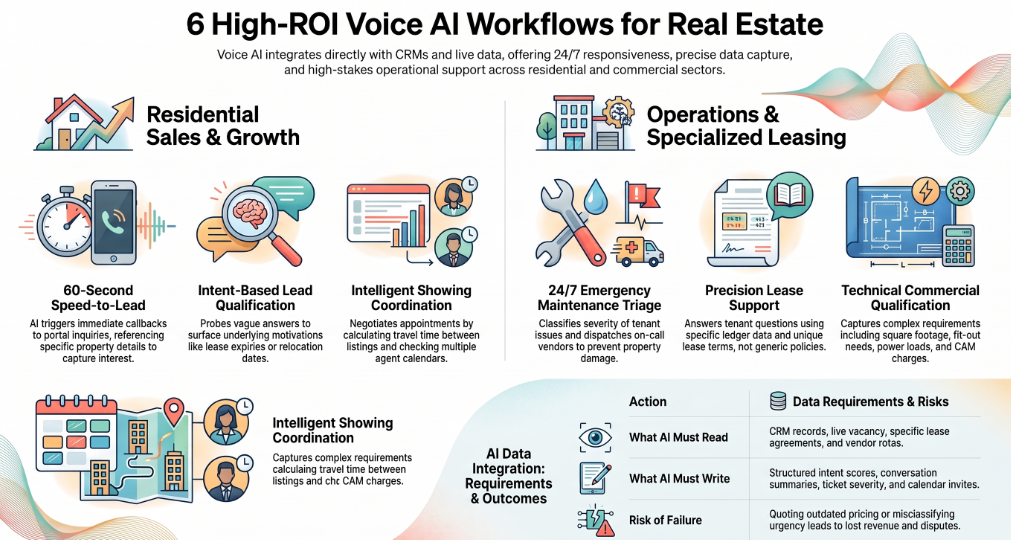
1. Speed-to-lead callback on inbound portal leads
What the call sounds like: A portal enquiry lands at 21:40. Within sixty seconds the agent calls back, references the specific property, and opens with an actual question rather than a script.
What it must read: The lead source, the listing record, current availability and price, whether this contact exists in the CRM already.
What it must write: Contact record, source attribution, conversation summary, qualification fields, next action.
Failure mode: Calling back so fast it feels robotic, or calling a number the lead never consented to be called on. Speed without consent hygiene is a liability, not an advantage.
2. Buyer and seller qualification
What the call sounds like: Open-ended. "Tell me what you're looking for" rather than "are you pre-approved?" The financial questions arrive once context is established, and the agent probes vague answers — when a caller says they are flexible on timing, it asks what would change that, which is how you surface the lease expiry or the relocation date that actually drives the deal.
What it must read: Inventory in the caller's stated range, comparable activity, prior interactions.
What it must write: Structured intent — budget, timeline, motivation, blockers, decision-makers — not just a transcript. A wall of text is not qualification.
Failure mode: Slot-filling. If the output is five dropdown values and a recording, no human is better informed than they were before the call.
3. Showing scheduling with conflict and travel-time resolution
What the call sounds like: The agent offers a slot, the caller cannot make it, and instead of "let me have someone call you back," the agent negotiates — checks another agent's availability, factors travel time between showings, proposes alternatives, confirms lockbox and access instructions.
What it must read: Multiple agent calendars, property access requirements, buffer rules, travel distance.
What it must write: The booking, calendar invites to both sides, the showing packet, confirmation and reminder sequences.
Failure mode: Booking into a conflict, or double-booking a property. One bad showing experience costs more than a month of the subscription.
4. Open-house and post-showing follow-up
What the call sounds like: Twenty-four hours after the visit. "What did you think of the kitchen?" It captures the real reaction — the thing people write down as "interested" and never unpack.
What it must read: Attendance records, the property, what the visitor said on the way in.
What it must write: Feedback tagged to the property (useful to the seller), an updated interest score, and a private-showing booking if warranted.
Failure mode: Treating this as a satisfaction survey. The value is the objection you would otherwise never hear.
Property management
5. Tenant maintenance triage with urgency classification
What the call sounds like: A tenant reports water coming through a ceiling at 23:00. The agent classifies it as an emergency, provides immediate mitigation steps, dispatches to the on-call vendor and notifies the property manager — rather than logging a ticket that sits until morning.
What it must read: Tenancy record, property, unit history, vendor rotas and on-call schedules, prior tickets on the same issue.
What it must write: The ticket with severity, the vendor dispatch, the tenant confirmation, the escalation notification.
Failure mode: Misclassifying urgency in either direction. Escalating a dripping tap wastes a call-out fee; downgrading a leak causes property damage and a dispute.
6. Rent, renewal and lease-question support
What the call sounds like: "Has my payment gone through?" "What's my notice period?" "Can I have a dog?" — answered from the actual tenancy agreement and ledger, not a generic policy page.
What it must read: Payment ledger, the specific lease, building policies, renewal windows.
What it must write: Interaction log, payment arrangement requests routed for approval, renewal intent flags ninety days out.
Failure mode: Answering from a generic knowledge base when tenancy terms vary unit by unit. Being confidently wrong about a lease term is worse than saying "let me get you to someone."
7. Availability, viewing and application intake
What the call sounds like: A prospective tenant asks what is available in a budget range, gets accurate current availability, books a viewing and understands what the application requires.
What it must read: Live vacancy, pricing, deposit terms, viewing slots.
What it must write: Enquiry record, viewing booking, application initiation.
Failure mode: Quoting a unit that was let yesterday. Static availability data is the most common cause of a bad first impression in lettings.
Commercial and developer
8. Commercial leasing enquiry qualification
What the call sounds like: The vocabulary changes entirely. Square footage requirements, headcount, lease term preference, fit-out expectations, triple-net structures, CAM charges, loading and power requirements.
What it must read: Available space by size and specification, floor plates, existing tenancy schedule.
What it must write: A qualified requirement brief the leasing team can act on without a second discovery call.
Failure mode: Deploying a residential agent against commercial enquiries. The terminology gap is immediately obvious to a corporate real estate director, and the credibility damage is hard to undo.
9. Developer sales and pipeline reactivation
What the call sounds like: Outbound, into a registered-interest database for a project reaching a sales milestone. Pricing, payment plans, unit availability, handover timelines — with a clean, honest disclosure that this is an automated call and an immediate opt-out path.
What it must read: The unit inventory, payment plan structures, the contact's registration history and consent status.
What it must write: Interest scoring, booking of sales appointments, suppression flags on anyone who opts out — enforced immediately, not at the next sync.
Failure mode: This is the highest-risk workflow in the list. Outbound campaigns into a database with unclear consent provenance are exactly the scenario regulators are watching. Do not run this one until the compliance checklist is complete.
What It Costs, and the ROI Math That Survives a CFO
Most published comparisons in this category set a human inside sales agent's salary against a software subscription and declare an 80% saving. That number will not survive a finance review, because it omits half the cost.
The fully-loaded comparison
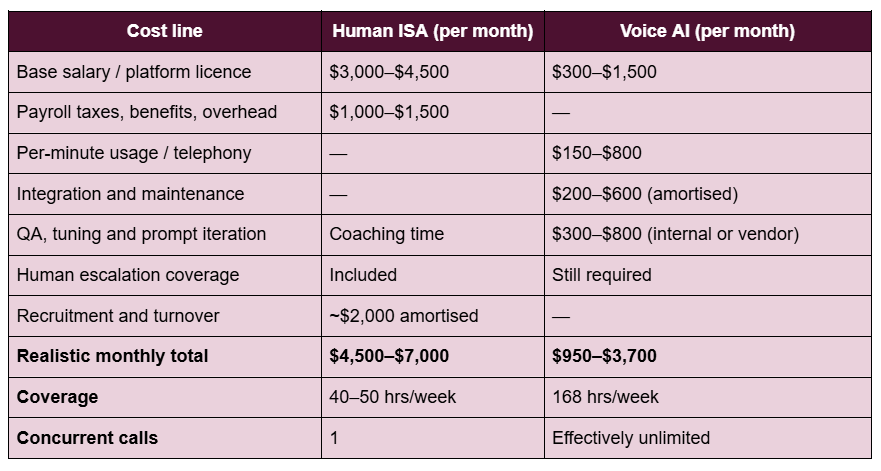
The saving is real. It is closer to 40–60% than 85%, and the coverage multiple matters more than the cost line anyway. An ISA cannot answer three calls at 22:00 on a Saturday at any price.
The payback formula
Monthly payback = (Additional qualified conversations × Conversion rate × Average commission) − Fully-loaded platform cost
Most brokerages recover a full year of platform cost on one to two additional closed transactions. Calculate with your own conversion rate, not the vendor's case study.
Run this on conservative assumptions. If the case only works when you assume a doubled conversion rate, the case does not work.
Three ways the ROI case fails
Bad data underneath. A voice agent charges per minute whether the number connects to a real person or not. Teams running outbound against unverified lists routinely find their cost per qualified conversation exceeds what a human would have cost. Clean the data first.
No escalation path. If qualified callers hit a dead end because nobody defined what happens when the agent reaches its limit, you have automated the top of the funnel and broken the middle.
Wrong autonomy level. Buying L4 and deploying at L1 means paying for orchestration you never switch on. Buying L2 and expecting L3 outcomes means the data entry never actually goes away.
The Compliance Layer: TCPA, Fair Housing and AI Disclosure
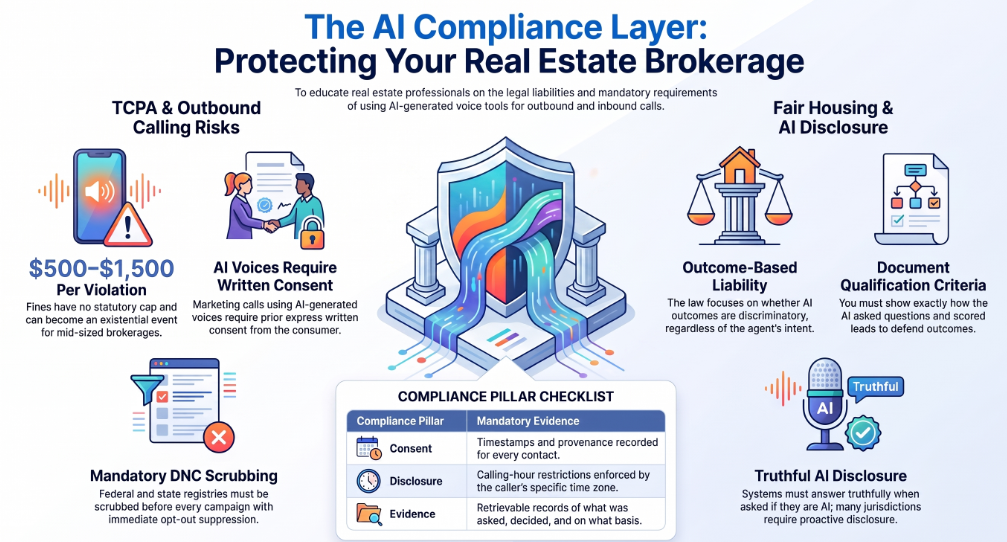
This is the section most guides in this category reduce to a paragraph. It deserves more, because in real estate the liability does not sit with your vendor. It sits with the licensed professional and the broker.
The following is general information, not legal advice. Rules vary by jurisdiction and use case. Get legal review before you deploy, particularly for outbound calling.
Why the FCC ruling changed outbound
In February 2024 the FCC issued a declaratory ruling confirming that AI-generated voices fall within the definition of an "artificial or prerecorded voice" under the Telephone Consumer Protection Act. The practical consequences:
- Outbound automated calls require prior express consent. Marketing calls require prior express written consent. Inbound calls the consumer initiated are a different matter entirely — which is another reason to start with inbound.
- Penalties run $500 per violation, rising to $1,500 for wilful or knowing violations, with no statutory cap. A ten-thousand-call campaign with a consent defect is not a fine; it is an existential event for a mid-sized brokerage.
- Do-not-call obligations apply. Federal and state registries must be scrubbed before every campaign, and opt-outs captured mid-call must suppress immediately.
- Landline and mobile treatment differs. Systems that dial without checking line type have been a recurring source of exposure.
Fair housing and disparate impact
This is the risk most teams underestimate.
The Fair Housing Act does not ask whether you intended to discriminate. It asks whether the outcome was discriminatory. When an automated system qualifies leads, scores prospects or screens applicants, the outcomes it produces are attributed to the licensed agent and the broker — not to the software vendor.
Practical requirements:
- The agent must never ask about protected characteristics. When a caller volunteers them, it must redirect to property requirements.
- Qualification criteria must be applied consistently and be documented. If you cannot show exactly what the agent asked and how it scored, you cannot defend the process.
- Ask any vendor, in writing, how the system was tested for disparate impact and what appeal path exists. Keep the answer on file.
- Describe properties, not buyers. This applies to what the agent says and to how conversation data is used downstream.
Recording consent and disclosure
Recording consent varies by jurisdiction — some require only one party's consent, others require all parties. The agent must handle this correctly per state or country, not with a single global setting.
On disclosure: when a caller asks whether they are speaking to AI, the system must answer truthfully. Several jurisdictions now require proactive disclosure at the start of automated calls, and the direction of travel is clearly toward more disclosure, not less. Build the disclosure in now rather than retrofitting it.
Outside the United States
For UK and EU deployments, GDPR governs the processing of conversation data — lawful basis, retention periods, data subject access rights and the treatment of voice as biometric-adjacent data all need answers before launch. In the UAE and wider GCC, data residency expectations and sector-specific rules apply. In India, evolving data protection legislation and telecom regulations govern automated calling. In each case the operative question is the same: where does the conversation data live, who can access it, and can you produce an evidence trail on demand.
The Consent–Disclosure–Evidence Checklist
The Consent–Disclosure–Evidence Checklist is a ten-point pre-deployment audit covering the three obligations that create liability in automated real estate calling: whether you have consent, whether you disclosed appropriately, and whether you can prove both.
Consent
- Lead capture forms carry explicit consent language for automated contact
- Consent provenance is recorded per contact, with timestamp and source
- Federal and state DNC registries are scrubbed before every outbound campaign
- Mid-call opt-outs suppress the contact immediately, across every channel
Disclosure 5. The agent discloses its automated nature when asked, without exception 6. Proactive disclosure is enabled where the jurisdiction requires it 7. Recording consent is handled correctly per jurisdiction, not globally 8. Calling-hours restrictions are enforced by the caller's time zone
Evidence 9. Every call produces a logged, retrievable record of what was asked, what was decided, and on what basis 10. Qualification criteria are documented, consistently applied, and reviewable
If a vendor cannot demonstrate all ten in a live environment, you are carrying the risk they are not.
How to Evaluate a Real Estate Voice Agent: The Close-the-Loop Scorecard
The Close-the-Loop Scorecard evaluates a real estate voice agent across seven dimensions, scored one to five, with a maximum of 35. It is designed to separate systems that complete a business process from systems that merely complete a conversation.
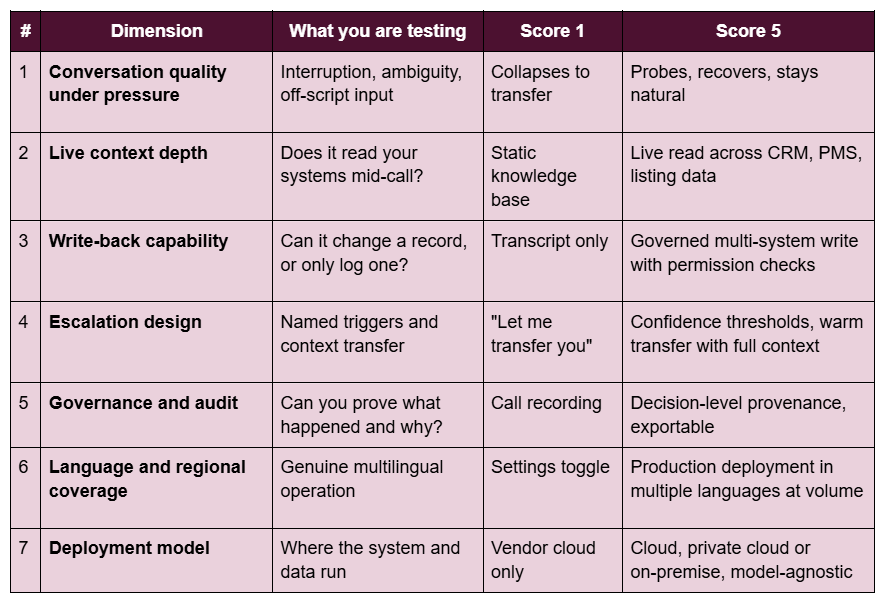
Scoring bands
- 28–35 — Enterprise-ready. Capable of L3 autonomy and defensible under audit.
- 20–27 — Solid mid-market tool. Expect to build integration and governance yourself.
- 12–19 — A good phone answerer. Budget for the data entry it will not eliminate.
- Below 12 — A demo, not a system.
Three tests to run on any demo call
- The vague-answer test. Have someone call and say "we're thinking about maybe selling, but it depends." Does the agent ask what "depends" means, or move on? Depth-first agents dig. Routing bots route.
- The stale-data test. Ask about a property whose price or availability changed today. Does the agent know? This tests layer four in about eight seconds and it is the fastest way to disqualify a vendor.
- The output test. Ask to see exactly what the call produced in your systems afterwards. A transcript and a tag is one answer. Structured fields, a scored record, a booked appointment and an audit entry is a different one.
What Deployment Actually Looks Like
Deployment timelines quoted in this category range from "minutes" to "six months." Both are true, for different definitions of deployed.
Weeks 1–2 — Foundation
Number provisioning and telephony routing. Connect the first system of record. Define the qualification logic and the escalation triggers. Complete the Consent–Disclosure–Evidence Checklist before a single live call. Run internal test calls only.
Weeks 3–4 — Controlled inbound
Route a defined slice of inbound — after-hours only, or one lead source — to the agent at L2. Every call reviewed. Expect to tune the conversation weekly; the first version is never the right one.
Weeks 5–8 — Expand and enable action
Broaden inbound coverage. Enable L3 write-back once the qualification output is trusted. Add the second and third systems of record. Establish the QA rhythm that will run permanently.
Weeks 9–12 — Outbound, if it earns its place
Only now, and only with consent provenance verified. Start with the cleanest, most explicitly consented segment. Measure before scaling.
The three integrations to get right first
The CRM, because it is where the next human looks. The calendar, because scheduling is where the agent proves it does work rather than describes it. The live property or availability data, because being wrong about inventory destroys trust faster than any other failure.
What to measure, and when

Do not measure conversion in week one. You will be measuring your tuning, not the system.
Proof: What Governed Voice and Service Agents Look Like in Production
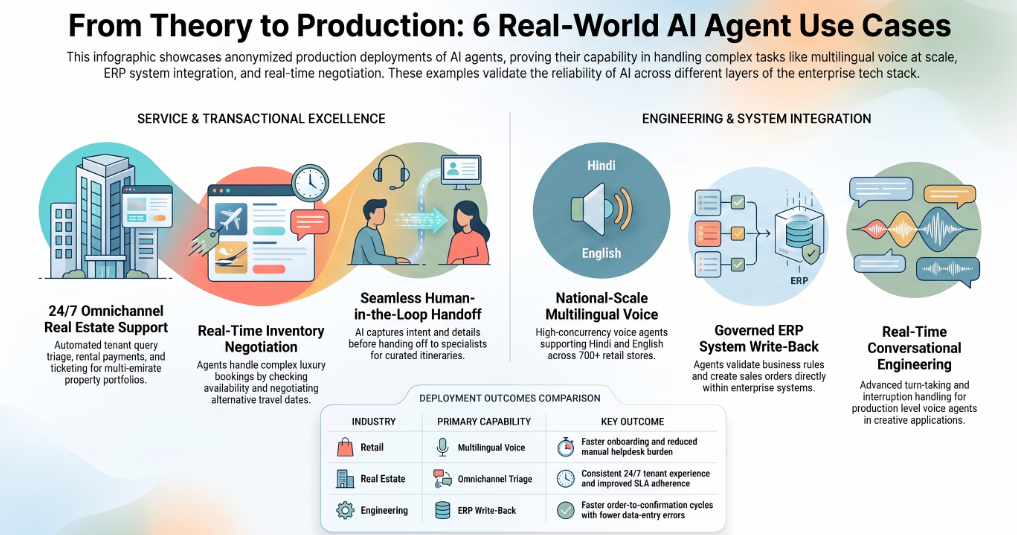
The following are anonymised summaries of production deployments delivered by Ampcome. Client names, and any detail that would identify them, have been removed.
Real estate service automation across a multi-emirate portfolio
A UAE-headquartered real estate portfolio owner and manager with diversified office, retail, industrial and residential assets across several emirates.
An omnichannel service agent handling tenant query triage, FAQs, and rental and payment support workflows end to end, with ticketing and escalation to human teams and a knowledge base built over tenancy policies, agreements and standard operating procedures.
Outcomes: faster response times and reduced call-centre load; a consistent 24×7 tenant experience; improved SLA adherence through automated routing and tracking.
This is the closest analogue in the portfolio to workflows 5, 6 and 7 above — and it is the reason the property management section of this guide is written from observed behaviour rather than from a product roadmap.
Multilingual production voice at national retail scale
A pan-India value retailer operating more than 700 stores across hundreds of cities.
A voice support agent built on a speech-to-text → language model → text-to-speech pipeline operating in Hindi and English, deployed alongside inventory intelligence and knowledge agents, with an administrative console, analytics and ticketing integration — architected for high concurrency across a national footprint.
Outcomes: reduced manual helpdesk burden and faster issue resolution; improved store-level visibility; faster onboarding through on-demand guidance.
Relevant here for one reason: genuine multilingual voice under real concurrency is a materially harder engineering problem than a language setting in a configuration panel, and very few vendors have run it at this scale.
Real-time conversational voice engineering
A consumer mobile application serving performing artists across iOS and Android.
A production voice agent handling script ingestion and scene management, with character and voice control, conversational pacing and cue logic, deployed under cost-controlled inference constraints.
Outcomes: higher session throughput without human participants; more consistent interaction loops; reduced coordination friction.
This deployment exercises layer two of the Six-Layer Stack harder than almost any enterprise use case — turn-taking, interruption handling and pacing are the entire product.
Governed write-back into an enterprise system of record
A UAE engineering and technology solutions provider established more than five decades ago.
Agentic automation that interprets order triggers, validates them against business rules, and creates sales orders directly in the enterprise ERP — with governance for exceptions and approvals, audit logs and reconciliation reporting, replacing a legacy document-capture workflow.
Outcomes: reduced manual processing and legacy dependency; faster order-to-confirmation cycles with fewer data-entry errors; improved auditability for order creation and exceptions.
This is layer six of the stack, in production, in an environment where getting it wrong has financial consequences. It is the capability that separates a voice product from an operating system — and the one most difficult to evaluate from a demo.
Availability negotiation and human-in-the-loop handoff
A luxury hospitality group operating sixteen lodges and camps across East Africa.
A digital booking agent handling enquiry intake and intent classification, running a conversational loop to capture missing details, checking real-time inventory, negotiating alternative dates and properties when the first choice was unavailable, and handing off to human specialists for curated itinerary construction.
Outcomes: faster booking turnaround with less back-and-forth; higher accuracy on complex requirements; scale without compromising service quality.
Structurally, this is showing scheduling: an availability constraint, a negotiation, and a clean handoff at the point where human judgement adds value.
One note on how to read this section. The voice pipeline is proven in production, multilingually, at national scale. The real estate service automation is proven across a diversified multi-emirate property portfolio. The governed write-back into systems of record is proven in enterprise ERP. These are three separately validated layers, brought together in one platform — which is a more useful claim than a single case study would be, and an honest one.
Why Assistents by Ampcome
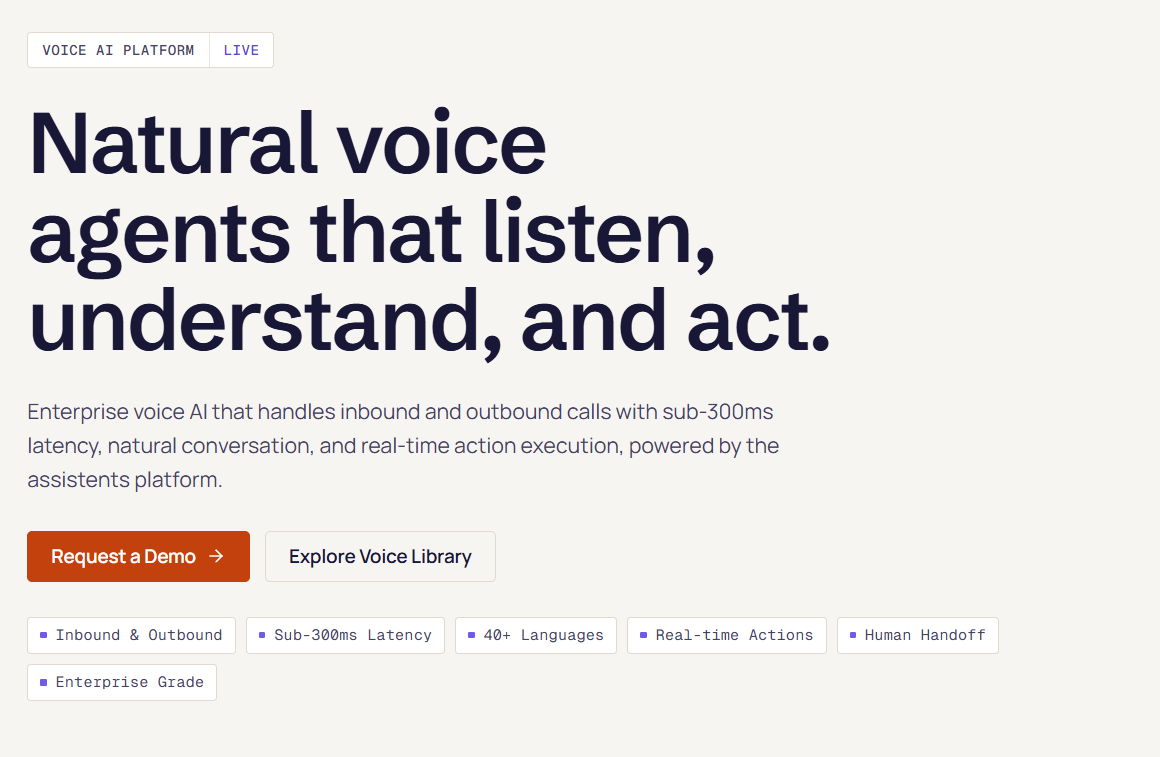
Most voice AI for real estate is a phone layer bolted onto a CRM. Assistents is an agentic platform where voice is one channel — running on the same context engine, governance layer and action engine that already operate finance, procurement, service and analytics workflows inside enterprises.
That architectural difference produces five practical ones.
Voice on a context engine, not a script. The agent reads live state across connected systems during the conversation rather than reciting from a knowledge base scraped at setup. When a caller asks about a unit whose price changed this morning, the answer is current. (Scorecard dimension 2)
Governed action, not just logging. Permission checks on every step, inherited from the source system, so an agent can never surface or change what the requesting user could not. Every decision and data access logged with full provenance and exportable as an evidence chain. (Dimensions 3 and 5)
Multilingual operation proven in production. Voice deployed at national scale in more than one language, under real concurrency — not a toggle in a settings menu. (Dimension 6)
Deployment on infrastructure you control. Model-agnostic across major providers, with private and on-premise deployment options. Your enterprise data is not used to train models. (Dimension 7)
Built by a delivery team. Ampcome has shipped agentic systems into production across property, retail, logistics, healthcare, energy and financial services, including workflows that write back into ERP and CRM systems of record. Every capability described above was proven in a real deployment before it became a product feature.
Who this is not for
If you are a solo agent who needs a $99-a-month phone answerer for after-hours calls, a point tool will serve you better and cost you less. Assistents is built for brokerages, property managers, developers and portfolio owners running multiple entities, multiple systems and multiple languages — where the audit trail matters as much as the answer, and where the work does not end when the call does.
If that describes you, the most useful next step is thirty minutes with the workflow that frustrates your team most.
Request a demo · Explore real estate solutions · Estimate your ROI
The Bottom Line
The voice quality question is settled. Every serious vendor in 2026 sounds fine.
The questions that are not settled are these: can the agent see your business while it is talking, can it change something when the conversation ends, and can you prove what it did and why. Those three questions map directly onto layers four, five and six of the Six-Layer Real Estate Voice Stack, and they are where the difference between a phone answerer and an operating system lives.
Start at Level 2 of the Autonomy Ladder. Complete the Consent–Disclosure–Evidence Checklist before your first live call. Score every vendor on the Close-the-Loop Scorecard, and ask each one to demonstrate dimension three — write-back — on your own systems.
Most of them will show you a transcript.
See what governed voice looks like on your systems →
FAQs
What is an AI voice agent for real estate?
An AI voice agent for real estate is software that conducts real phone conversations with buyers, sellers and tenants — answering or placing calls, qualifying intent, retrieving live property data, booking appointments and writing outcomes back into the CRM or property management system, without a human on the line.
How much do AI voice agents cost for real estate agents?
Realistic fully-loaded costs run $950–$3,700 per month once platform licensing, per-minute usage, telephony, integration and QA are included. Published figures of $500–$1,500 typically count the subscription only. Compare against a fully-loaded ISA cost of $4,500–$7,000 per month.
Can AI voice agents qualify real estate leads?
Yes. A well-configured agent asks the same qualification questions on every call — timeline, budget, financing status, motivation, blockers — and captures structured intent rather than just a transcript. Consistency is the advantage: it never skips questions during a busy week.
Is AI cold calling legal in real estate?
It is legal when conducted in compliance with applicable rules. Outbound automated calling requires prior express consent under the TCPA, with written consent for marketing calls, plus DNC scrubbing, calling-hour restrictions and truthful AI disclosure. Requirements vary by state and country. Get legal review before deploying outbound.
Do AI voice agents have to disclose they are AI?
At minimum, the agent must answer truthfully when a caller asks. Several jurisdictions now require proactive disclosure at the start of automated calls, and regulation is moving toward more disclosure rather than less. Build disclosure in from the start rather than retrofitting it.
Are AI voice agents fair housing compliant?
Compliance depends on how you deploy, not on vendor certification. The Fair Housing Act examines outcomes, not intent, and liability attaches to the licensed agent and broker. Agents must never ask about protected characteristics, must apply criteria consistently, and must produce a documented, reviewable decision trail.
Will AI voice agents replace real estate ISAs?
No. They absorb the repetitive portion of the role — after-hours coverage, initial qualification, dormant-lead reactivation — and free human ISAs for tour-day conversations, negotiation and offer preparation. Teams seeing the strongest results redesign the ISA role rather than eliminating it.
Do AI voice agents integrate with real estate CRMs?
Most integrate with Salesforce, HubSpot and major real estate CRMs via native connectors, with webhook or API options for others. The question worth asking is not whether it connects, but whether it can write to the record with permission checks — or only log a transcript against it.
What languages can real estate voice agents speak?
Most professional platforms support ten to twenty languages. Genuine production-quality multilingual operation under concurrency is rarer than the marketing suggests. Test in your actual target language, at volume, before committing — a language setting is not the same as a proven deployment.
How long does it take to deploy an AI voice agent for real estate?
A basic inbound agent can be live in one to two weeks. A governed deployment with live system integration, write-back and audit trails typically takes four to eight weeks to reach production, plus ongoing tuning. Timelines quoted in minutes describe a demo, not a deployment.

Transform Your Business With Agentic Automation
Agentic automation is the rising star posied to overtake RPA and bring about a new wave of intelligent automation. Explore the core concepts of agentic automation, how it works, real-life examples and strategies for a successful implementation in this ebook.
Sarfraz Nawaz is the CEO and founder of Ampcome, which is at the forefront of Artificial Intelligence (AI) Development. Nawaz's passion for technology is matched by his commitment to creating solutions that drive real-world results. Under his leadership, Ampcome's team of talented engineers and developers craft innovative IT solutions that empower businesses to thrive in the ever-evolving technological landscape.Ampcome's success is a testament to Nawaz's dedication to excellence and his unwavering belief in the transformative power of technology.

More insights
Discover the latest trends, best practices, and expert opinions that can reshape your perspective







Contact us

