
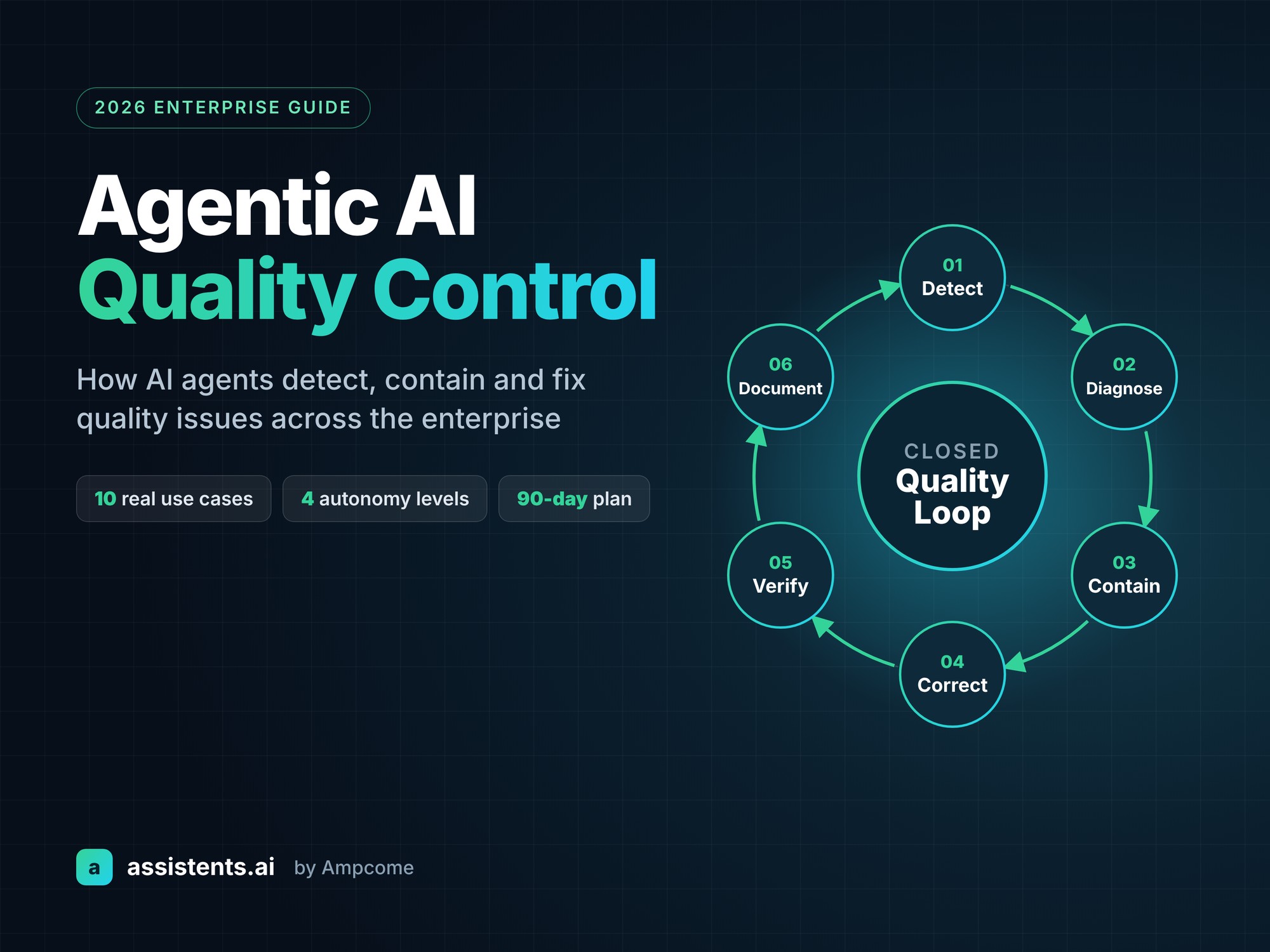
Agentic AI Quality Control: How AI Agents Detect, Contain and Fix Quality Issues Across the Enterprise


Poor quality is expensive. The American Society for Quality (ASQ) has long estimated the cost of poor quality at 15–20% of sales for many manufacturers, and up to 40% of total operations for the worst performers (ReliaMag summary of ASQ figures). Most of that cost is not on the factory floor. It sits in wrong orders, misread documents, late supplier deliveries and bad data that nobody catches until a customer does.
Agentic AI quality control is the use of goal-driven AI agents that continuously detect quality issues, diagnose their root cause, contain the impact, correct the process, verify the fix and document every step, within limits set by humans. Unlike traditional inspection or rule-based alerts, an agent does not stop at "something is wrong". It closes the loop.
This guide explains how agentic AI quality control works, where it delivers results today, how to keep the agents themselves under control, and how to go live in 90 days. Every example comes from real deployments on assistents.ai, the agentic AI platform by Ampcome.
Key takeaways
- Agentic AI quality control closes the loop from detection to a verified fix, instead of only raising alerts.
- The biggest wins are often outside the factory: documents, orders, suppliers, data and compliance.
- Real deployments show up to ~90% faster document processing and ~95% extraction accuracy targets on standard formats.
- Quality agents need quality control too. Use four autonomy levels with approvals, audit trails and rollback.
- Start with one high-volume quality process, measure a baseline, and expand autonomy only as accuracy is proven.
What is agentic AI quality control?
Agentic AI quality control is a system of AI agents that owns a quality goal, such as "no incorrect sales order reaches the ERP" or "no non-compliant document reaches a customer". The agents observe data, reason about deviations, take approved actions and check the result. They work across systems like ERP, MES, CRM, QMS and document stores, and they hand off to people when a decision exceeds their authority.
Three traits make quality control agentic rather than simply AI-assisted:
- Goal ownership. The agent owns an outcome (a clean order, a compliant document, a stable process), not a single prediction or score.
- Action. It can quarantine a batch, hold an order, correct a record, request missing information or open a corrective and preventive action (CAPA), through governed connectors.
- Verification and memory. It confirms the fix worked and stores the evidence, so every future decision is better informed.
If you are new to the underlying technology, IBM's overview of what agentic AI is is a useful primer.
Agentic AI vs. traditional and rule-based quality control
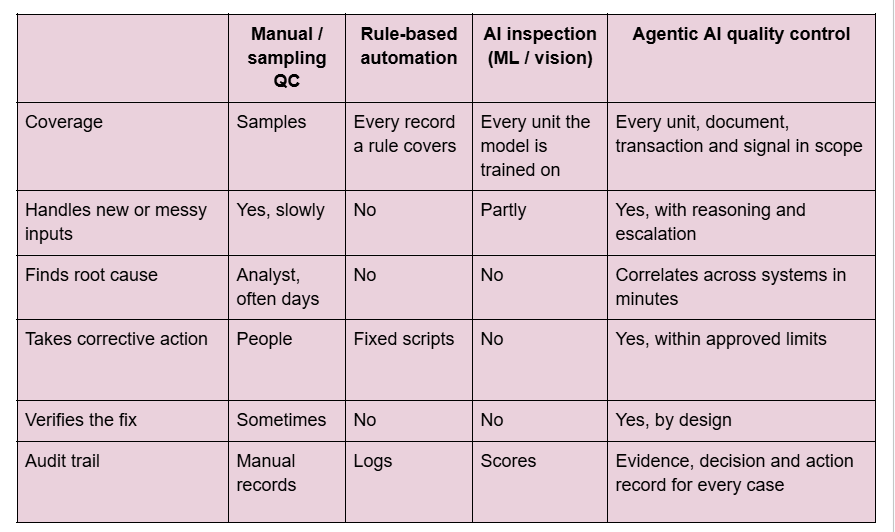
In short: traditional quality control finds problems; agentic AI quality control finds them, fixes them and proves they are fixed.
Why quality control needs agents now
Detection is largely solved; response is not. Plants, warehouses and back offices already generate more quality signals than teams can act on. The delay sits between "we saw it" and "we fixed it", and that gap still runs through emails, spreadsheets and meetings.
Three shifts make agentic AI quality control practical in 2026:
- Reasoning over unstructured inputs. Vision-language models can now read complex PDFs, drawings, certificates and emails, which is where many non-conformances begin.
- Orchestration with governed actions. Enterprise platforms can let agents act in ERP and CRM systems through controlled connectors, with approvals and audit logs.
- Pressure on skilled headcount. Quality technicians and analysts are scarce. Agents let a small team supervise far more volume.
The risk is moving too fast. Gartner predicts that over 40% of agentic AI projects will be canceled by the end of 2027 because of escalating costs, unclear business value or inadequate risk controls. Quality control is one of the best places to start precisely because its outcomes (defects, rework, escapes, cycle time) are measurable from day one.
The closed quality loop: how AI agents run quality control
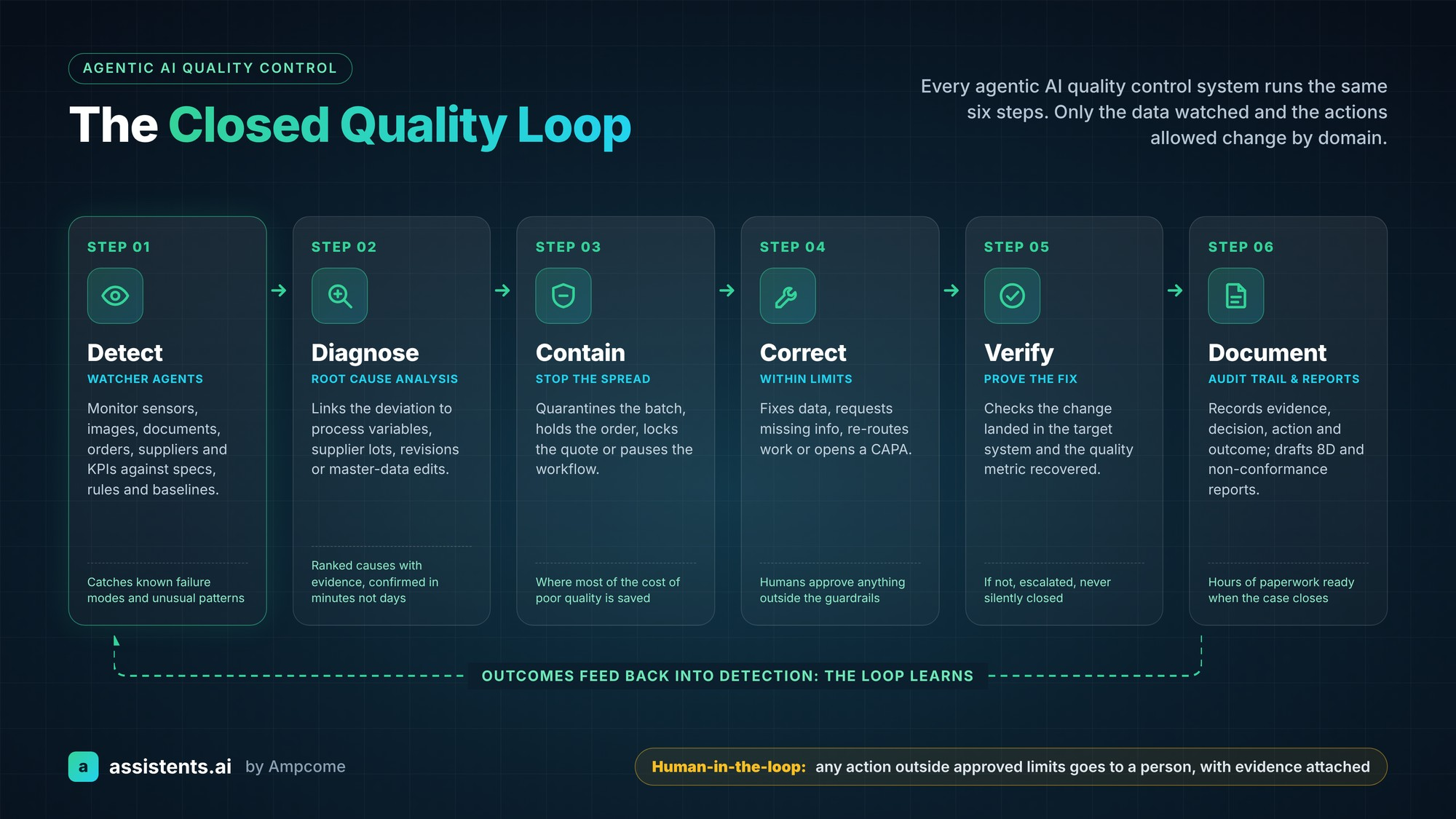
Every agentic AI quality control system runs the same six-step loop. What changes by domain is the data the agents watch and the actions they are allowed to take.
Agentic AI quality control closed loop: detect, diagnose, contain, correct, verify, document
1. Detect
Watcher agents continuously monitor sensor data, inspection images, documents, orders, supplier feeds and KPIs. They compare each signal with specifications, business rules and learned baselines, so they catch both known failure modes and unusual patterns.
2. Diagnose (AI root cause analysis)
An analysis agent correlates the deviation with process variables, recent changes, supplier lots, document revisions or master-data edits. It ranks the likely causes and attaches the evidence for each, so a human can confirm the diagnosis in minutes instead of days.
3. Contain
The agent stops the problem from spreading: it quarantines the affected batch, holds the order, locks the quote or pauses the workflow. Fast containment is where most of the cost of poor quality is saved.
4. Correct
Within pre-approved limits, the agent fixes the data, requests missing information, re-routes the work or opens a CAPA. Outside those limits, it sends a recommendation with evidence to the right approver.
5. Verify
The agent checks that the change actually landed in the target system and that the quality metric recovered. If it did not, the case is escalated rather than silently closed.
6. Document
Finally, the agent writes the audit trail (evidence, decision, action and outcome) and drafts reports such as 8D or non-conformance records. Documentation that used to take hours is ready when the case closes.
Where agentic AI quality control works: 6 enterprise domains
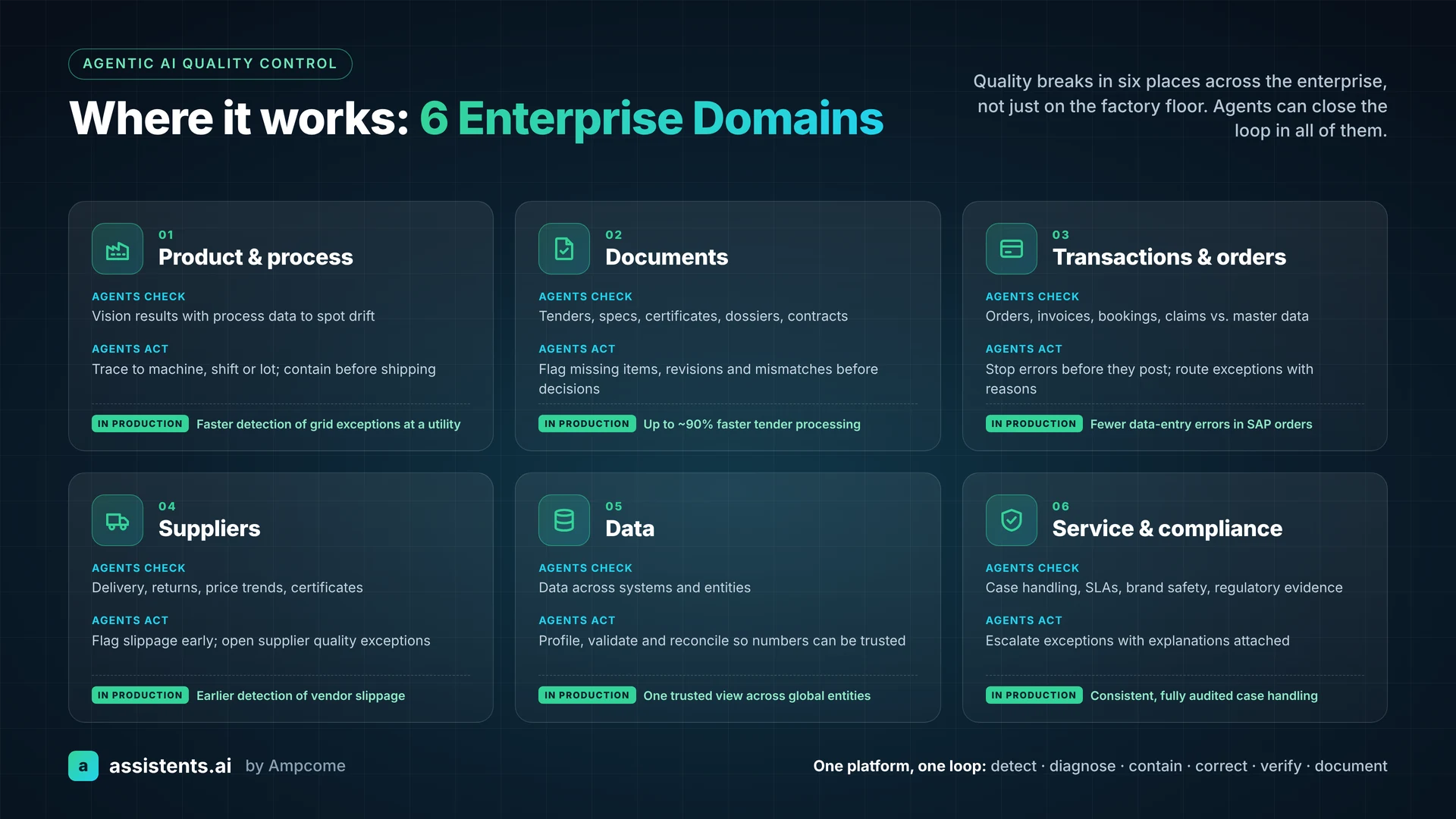
Most articles treat AI quality control as a factory topic. In practice, quality breaks in six places across the enterprise, and agents can close the loop in all of them.
Product and process quality
AI quality inspection agents combine vision results with process data to spot drift, trace it to a machine, shift or material lot, and contain it before it reaches the customer. For broader factory use cases, see our guide to agentic AI use cases in manufacturing.
Document quality control and validation
Tenders, specifications, certificates of analysis, regulatory dossiers and contracts are checked for completeness, revisions and mismatches before they drive decisions. This is often the highest-ROI starting point, because document errors quietly cause downstream defects, disputes and penalties.
Transaction and order quality
Agents validate sales orders, invoices, bookings and claims against master data and policy before they post, so errors never enter the ERP. Every exception is routed to a person with the reason attached.
Supplier quality management
Agents track delivery performance, returns, price trends and certificates per supplier, flag slippage early and open supplier quality exceptions automatically, instead of waiting for the quarterly review.
Data quality
Agents profile, validate and reconcile data across systems and entities, so dashboards and other agents work from trusted numbers. Read the deep dive on AI agents for data quality checks.
Service and compliance quality
Agents check case handling, SLAs, brand safety and regulatory evidence, and escalate exceptions with explanations. For software testing and release quality specifically, see agentic AI for quality engineering.
Agentic AI quality control use cases: 10 real deployments
The following are real production and delivery engagements built on assistents.ai. Client names are withheld; industries, scope and results are taken from project records.
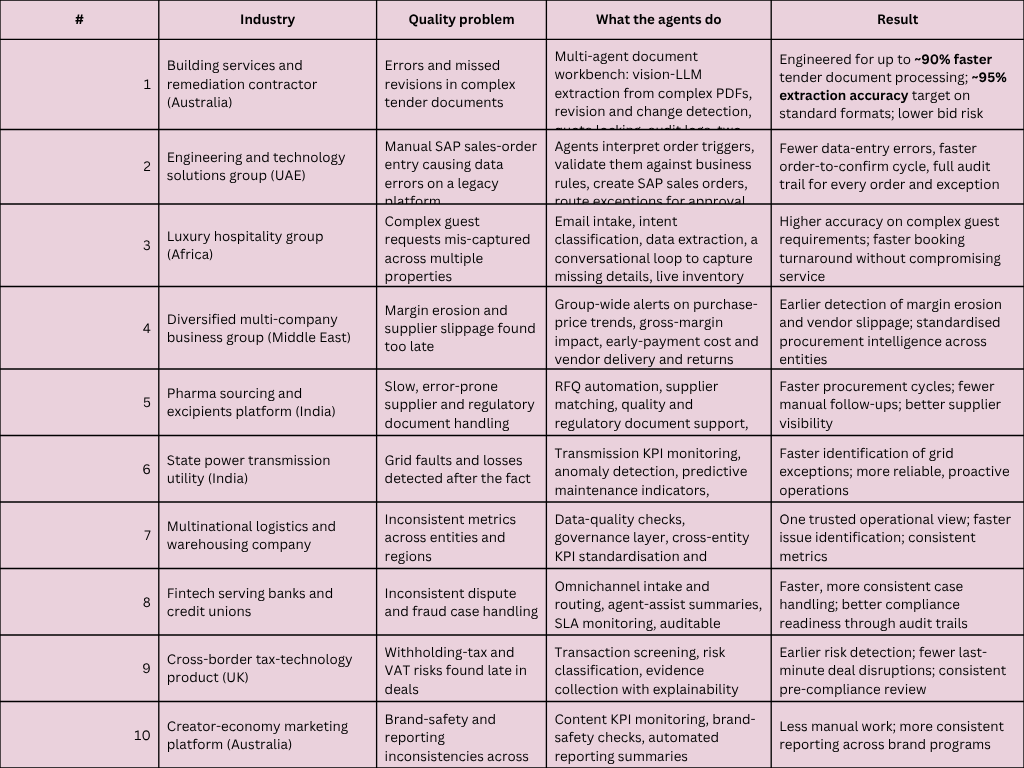
What these deployments have in common
- Every item is checked, not a sample. Agents review every document, order or signal in scope.
- Hard rules stay deterministic. Specifications and policies are enforced exactly; agents handle the messy inputs and judgement calls.
- Humans stay in charge of exceptions. Every exception reaches the right person with the evidence attached.
- Everything is auditable. Each detection, decision and action is logged, which matters as much to auditors as to operations.
A closer look: tender document quality control
In use case 1, a building-services contractor received long, frequently revised tender packs. Missing a revised clause or quantity could turn a profitable bid into a loss. The assistents.ai solution split the work across specialised agents: one retrieves tenders and determines the workflow, one extracts data from complex PDFs with a vision-language model, one compares revisions and highlights changes, and one writes validated data into the job-management system with quotes locked and every change logged. People review only flagged differences. The system was engineered for up to ~90% faster document processing with a ~95% extraction accuracy target on standard formats.
A closer look: order quality before the ERP
In use case 2, an engineering and technology group needed to move off a costly, end-of-life order-capture system. Agents now read incoming order triggers, validate customer, material, pricing and quantity against rules, and create SAP sales orders automatically. Anything outside policy goes to an approver, and reconciliation reports show exactly what was created, changed or rejected. The result: fewer data-entry errors, a faster order-to-confirm cycle and better auditability.
Quality control of the agents themselves: the four autonomy levels
An agent that controls quality must itself be under control. Gartner warns that by 2027, 40% of enterprises will demote or decommission autonomous AI agents because of governance gaps found only after production incidents. Its recommendation is governance proportional to autonomy. Applied to quality control:
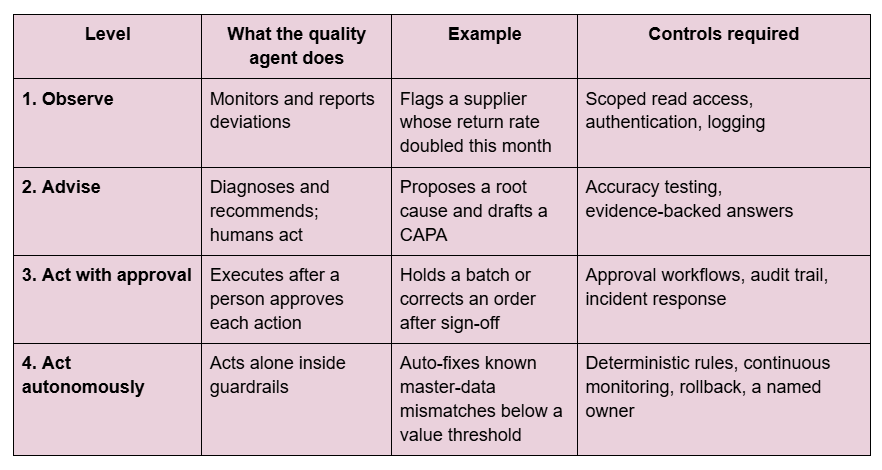
Autonomy is earned, not switched on. Move a quality process up one level only after it has run in shadow mode, been compared with human decisions and met its accuracy target. This approach also maps cleanly onto the NIST AI Risk Management Framework, which many risk and compliance teams already use.
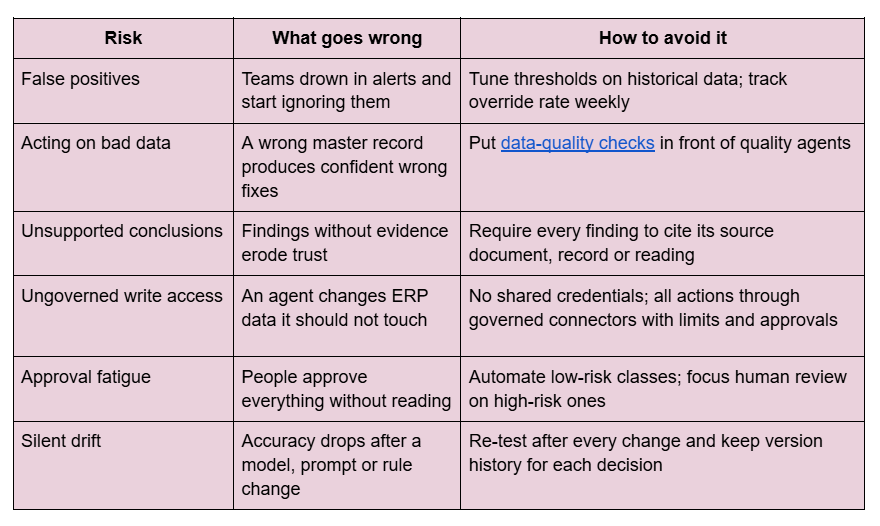
Risks of agentic AI quality control and how to avoid them
KPIs to measure agentic AI quality control
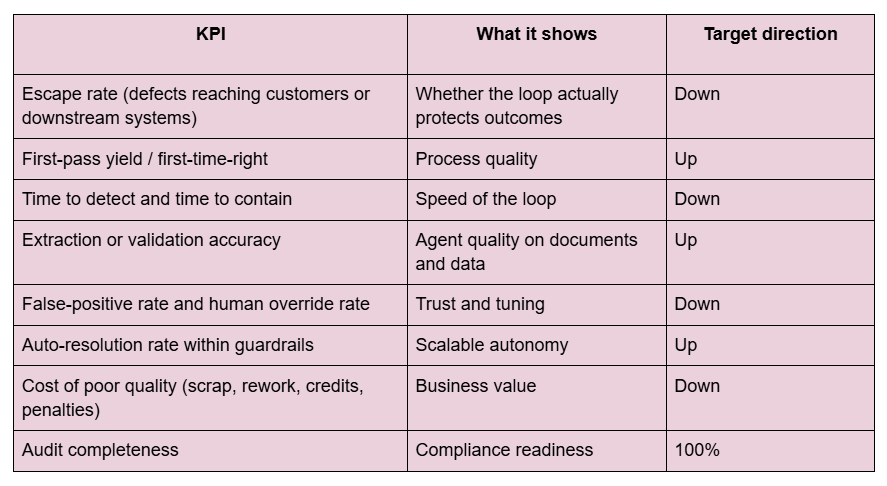
Measure a baseline for at least two to four weeks before go-live. Without one, even a strong deployment cannot prove its value.
How to implement agentic AI quality control in 90 days
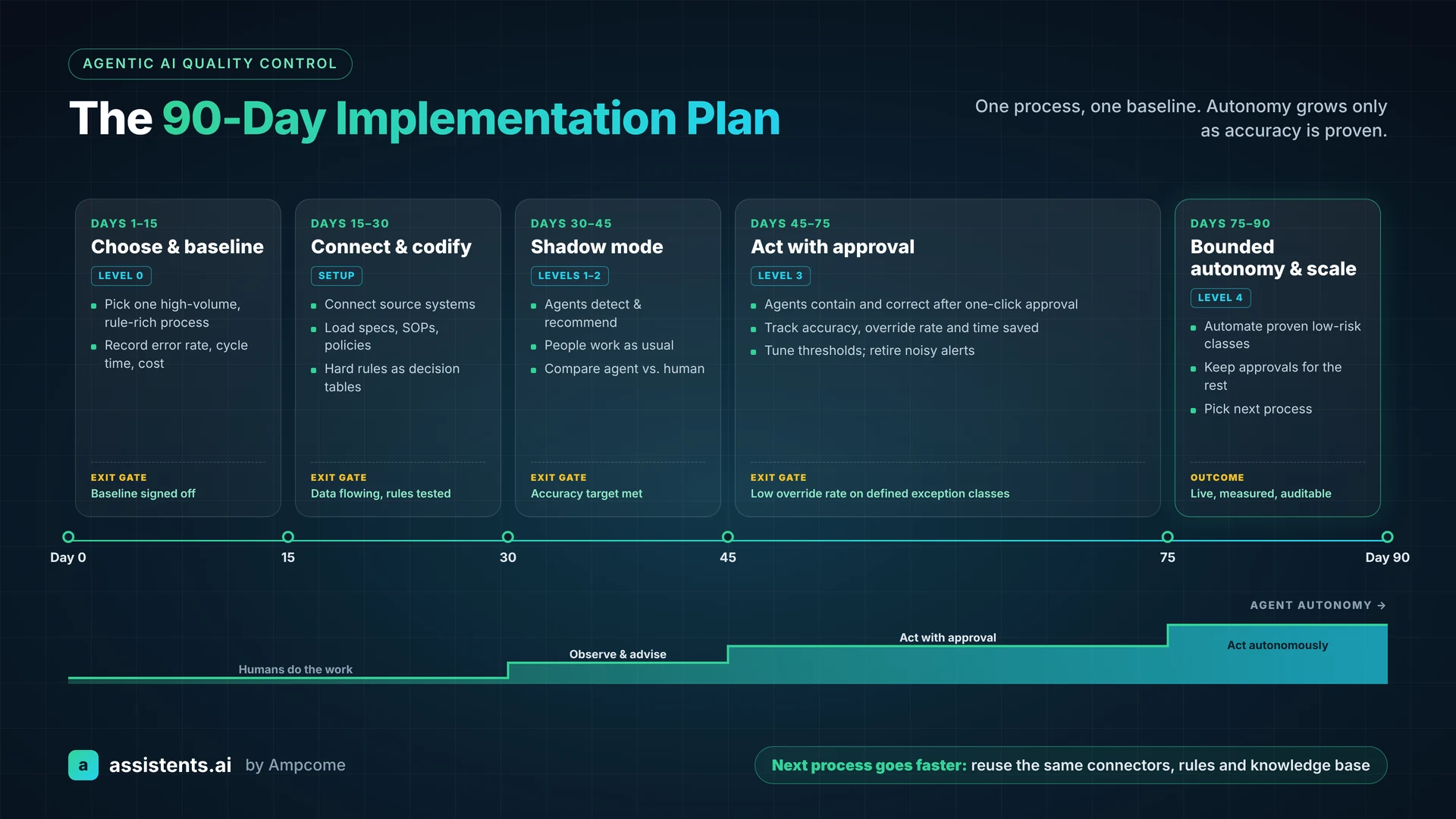
- Days 1–15: Choose one process and baseline it. Pick a high-volume, rule-rich quality process such as order validation, document checks or supplier performance. Record today's error rate, cycle time and cost.
- Days 15–30: Connect and codify. Connect the source systems. Load specifications, SOPs and policies into a knowledge base. Encode hard rules as deterministic decision tables.
- Days 30–45: Run in shadow mode (Levels 1–2). Agents detect and recommend while people work as usual. Compare agent findings with human decisions to measure accuracy.
- Days 45–75: Act with approval (Level 3). Let agents contain and correct after one-click approval. Track accuracy, override rate and time saved.
- Days 75–90: Grant bounded autonomy (Level 4) and scale. Automate the low-risk exception classes that met their targets, keep approvals for the rest, and choose the next adjacent process.
Adjacent processes go faster, because they reuse the same connectors, rules and knowledge base.
Choosing an agentic AI quality control platform
Most tools solve one slice of quality. Choose by the scope of the quality problem you need to close, not by the demo.
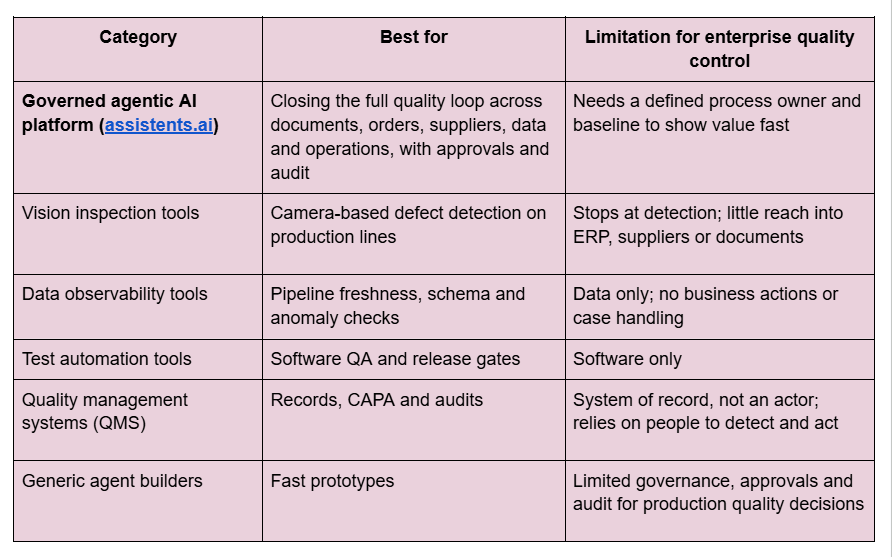
Five questions to ask any vendor:
- Can agents act in our ERP and other systems through governed connectors, not shared credentials?
- Can every finding show the evidence behind it?
- Can we set different autonomy levels per process and roll back?
- Can it run in our own cloud, VPC or on-premises?
- Can you show production results, not only demos?
Why assistents.ai is the leading platform for agentic AI quality control
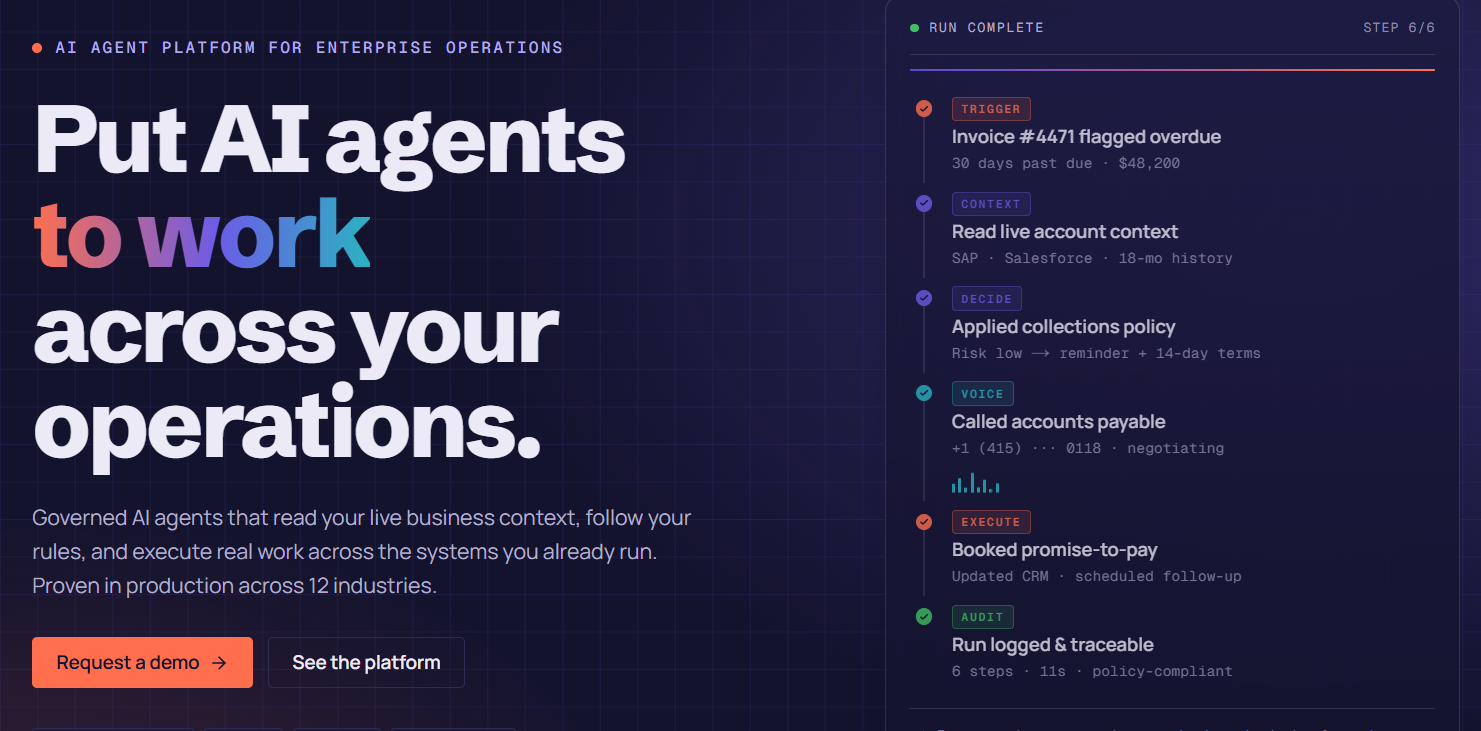
assistents.ai, the agentic AI platform by Ampcome, is built for the part of quality control most tools skip: acting on what was found, safely, and proving it worked.
- Reads what quality depends on. Document ingestion, extraction, validation and review handle tenders, specifications, certificates and contracts, including complex PDFs.
- Hard rules stay hard. Deterministic rules and decision tables enforce specs and policies exactly, while agents handle judgement and messy inputs.
- Multi-agent orchestration. Watcher, analysis, correction and reporting agents work together on one quality loop.
- Humans in charge. A workflow engine with human tasks and approvals lets you decide what agents do alone, with sign-off, or never.
- Evidence-backed answers. Hybrid retrieval links every finding to its source record or document.
- Trusted numbers. Semantic metrics and row-level security keep quality KPIs consistent and access-controlled, with natural-language analytics for quality leaders.
- Full audit trail. Every detection, decision and action is logged for regulators, auditors and customers.
- Fits your stack. Warehouse and BI connectivity, 80+ workflow integrations and REST connectivity to ERP, MES, CRM and QMS.
- Your environment, your models. Private cloud, VPC or on-premises deployment, with model routing across multiple AI providers.
- Proven in production. 30+ enterprise deployments across North America, Europe, the Middle East, Africa, India and Australia, spanning logistics, utilities, retail, finance, healthcare, hospitality and industrial services.
Why enterprises choose assistents.ai over point solutions
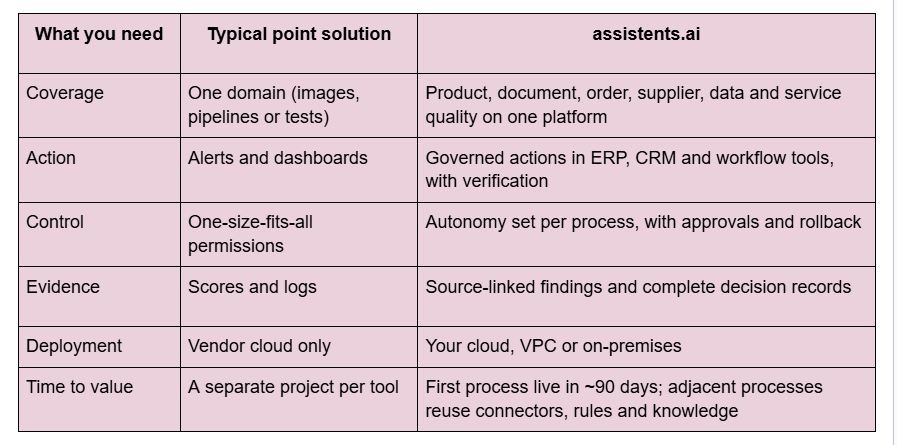
The result is one quality operating layer instead of a stack of disconnected detectors. Talk to the assistents.ai team to map your first quality process.
The bottom line
Detection is no longer the bottleneck in quality; response is. Agentic AI quality control closes the loop from signal to verified fix across products, documents, orders, suppliers and data. The enterprises seeing results start with one process, measure a baseline and earn autonomy step by step.
assistents.ai gives you the agents, rules, approvals and audit trail to do it in your own environment.
Book a 30-minute quality workflow assessment → Get a baseline-to-autonomy plan for your first quality process.
Related reading
- Agentic AI for Quality Engineering: The 2026 Enterprise Guide
- AI Agents for Data Quality Checks
- Top 7 Agentic AI Use Cases in Manufacturing
Sources
- Gartner, Over 40% of agentic AI projects will be canceled by end of 2027 (June 2025)
- Gartner, Applying uniform governance across AI agents will lead to enterprise AI agent failure (May 2026)
- ASQ, Cost of Quality
- ReliaMag, The real cost of poor quality: scrap, rework and returns
- NIST, AI Risk Management Framework
- IBM, What is agentic AI?
FAQs
What is agentic AI quality control?
Agentic AI quality control is the use of goal-driven AI agents that continuously detect quality issues, diagnose root causes, contain impact, correct the process, verify the fix and document every step, within limits set by humans. It closes the loop that traditional inspection and alerting leave open.
How is AI used in quality control?
AI is used to inspect products with computer vision, detect anomalies in sensor and transaction data, extract and validate documents, predict failures and analyse root causes. Agentic AI adds action: it contains defects, corrects records, opens CAPAs and verifies outcomes through governed workflows.
Will AI replace quality control inspectors?
No. Agents take over repetitive checking and documentation, so inspectors and quality engineers can supervise more volume and focus on judgement, root-cause work and improvement. In most deployments, people approve high-risk actions and own the rules the agents follow.
What is the difference between AI agents and agentic AI?
An AI agent is a single software worker that performs a task. Agentic AI describes systems in which one or more agents pursue a goal, plan steps, use tools, take actions and adapt, often coordinating with other agents and with people.
What is closed-loop quality control?
Closed-loop quality control means every detected issue flows through diagnosis, containment, correction and verification until the quality metric recovers, with evidence recorded at each step. Agentic AI makes this loop continuous and fast instead of dependent on meetings and manual follow-up.
How do you control the quality of AI agent outputs?
Set autonomy levels per process, require evidence for every finding, enforce hard rules deterministically, route high-risk actions for approval, monitor accuracy and override rates, and re-test agents after any model, prompt or rule change. Keep a complete audit trail of every decision.
What are the risks of agentic AI in quality control?
The main risks are false positives, acting on bad data, unsupported conclusions, uncontrolled system access and drift after changes. Proportional governance, upstream data-quality checks, evidence requirements, governed connectors and staged autonomy reduce each one.
How long does it take to implement agentic AI quality control?
A focused first process can go live in about 90 days: two weeks to baseline, two weeks to connect systems and rules, a shadow phase, an approval phase, and then bounded autonomy for proven exception types.

Transform Your Business With Agentic Automation
Agentic automation is the rising star posied to overtake RPA and bring about a new wave of intelligent automation. Explore the core concepts of agentic automation, how it works, real-life examples and strategies for a successful implementation in this ebook.
Sarfraz Nawaz is the CEO and founder of Ampcome, which is at the forefront of Artificial Intelligence (AI) Development. Nawaz's passion for technology is matched by his commitment to creating solutions that drive real-world results. Under his leadership, Ampcome's team of talented engineers and developers craft innovative IT solutions that empower businesses to thrive in the ever-evolving technological landscape.Ampcome's success is a testament to Nawaz's dedication to excellence and his unwavering belief in the transformative power of technology.

More insights
Discover the latest trends, best practices, and expert opinions that can reshape your perspective






Contact us

