
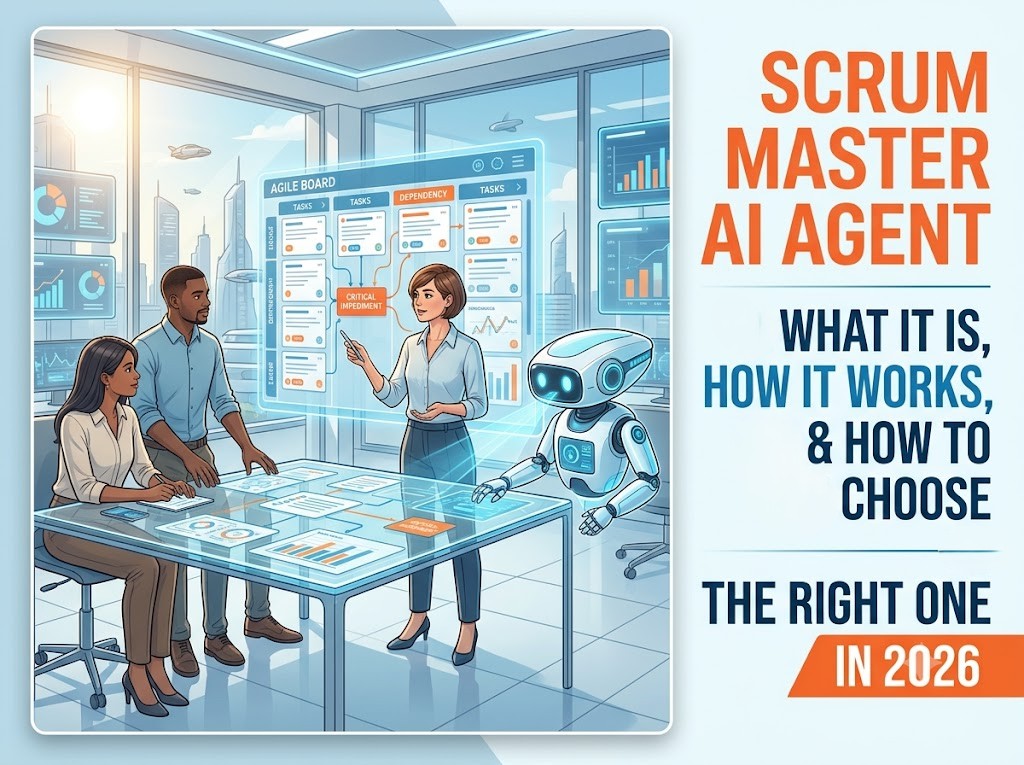
Scrum Master AI Agent: What It Is, How It Works, and How to Choose the Right One in 2026


Most Scrum Masters lose hours every sprint to work that has nothing to do with coaching: chasing status updates, rewriting the same standup notes, and reconciling three tools that all disagree about what's actually done. That gap — real facilitation work squeezed out by administrative noise — is exactly what a scrum master AI agent is built to close.
A scrum master AI agent is a governed, autonomous system that reads live context from your agile tools — Jira, Confluence, Slack, GitHub — and executes multi-step scrum-master tasks (sprint-planning support, standup summaries, backlog grooming, retrospective analysis) under permission checks, logging every action for audit. That's a meaningfully different claim than "AI scrum master," a term most vendors use for a chat-based assistant that summarizes a meeting and leaves the ticket-updating to you.
This guide covers what a scrum master AI agent actually does, how it differs from an assistant or a human Scrum Master, the architecture behind a governed one, what to look for before you buy or build one, and whether it's actually safe to run in a regulated environment. We'll also cover the question everyone eventually asks: will it replace the Scrum Master?
What Is a Scrum Master AI Agent?
A scrum master AI agent is software that performs the operational parts of the Scrum Master role autonomously — reading sprint data, sending updates, drafting tickets, flagging risk — inside permission boundaries, rather than just suggesting what a human should do next. The Scrum Guide defines the Scrum Master as accountable for establishing Scrum and coaching the team's effectiveness; nothing in that definition changes when AI enters the picture — what changes is who, or what, handles the mechanical half of the job.
That distinction is worth holding onto, because most of what search results call an "AI Scrum Master" today is actually an assistant: it drafts a standup summary or suggests a ticket estimate, and a person still has to act on it. An agent is different — it takes the next step itself. It updates the board, routes the escalation, creates the ticket, and does it inside rules your team defined, with a record of exactly what it did and why.
Neither replaces the human Scrum Master's coaching, conflict resolution, or organizational judgment — the Scrum Guide's "servant leader" framing is still squarely a people function. What a scrum master AI agent replaces is the reason a good Scrum Master often doesn't have time to do that people function well.
Scrum Master AI Agent vs. Human Scrum Master vs. AI Assistant
The differences matter more than the labels. Here's how the three compare on the things a team actually cares about:
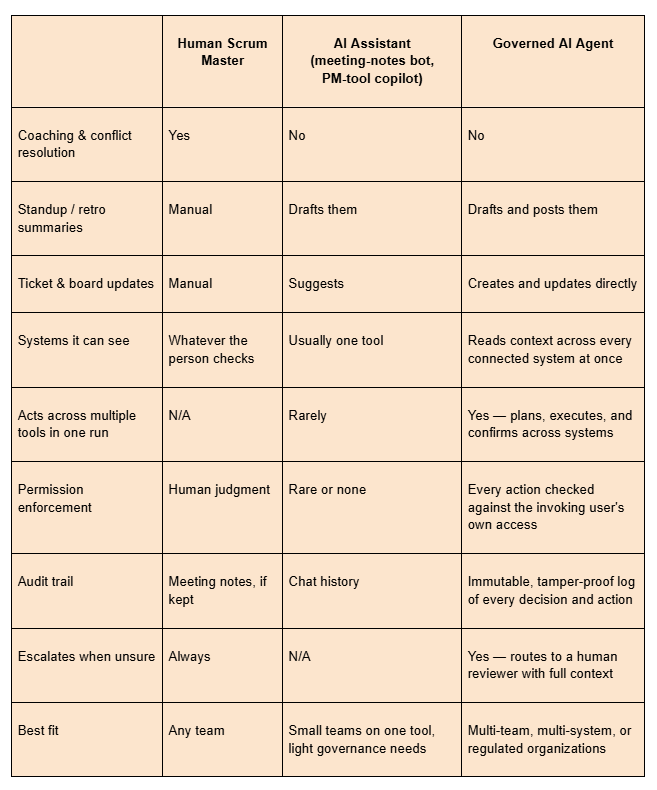
The gap that matters most for enterprise buyers is the bottom third of that table. Most of the tools that rank for "AI scrum master" today are built for the middle column — a helpful copilot bolted onto one PM tool. Very few are built for the right column, which is what "agent" in the search term actually implies.
What a Scrum Master AI Agent Actually Does
Strip away the marketing and a scrum master AI agent's job maps directly onto the four core Scrum ceremonies, plus the cross-ceremony work that happens between them.
Sprint planning
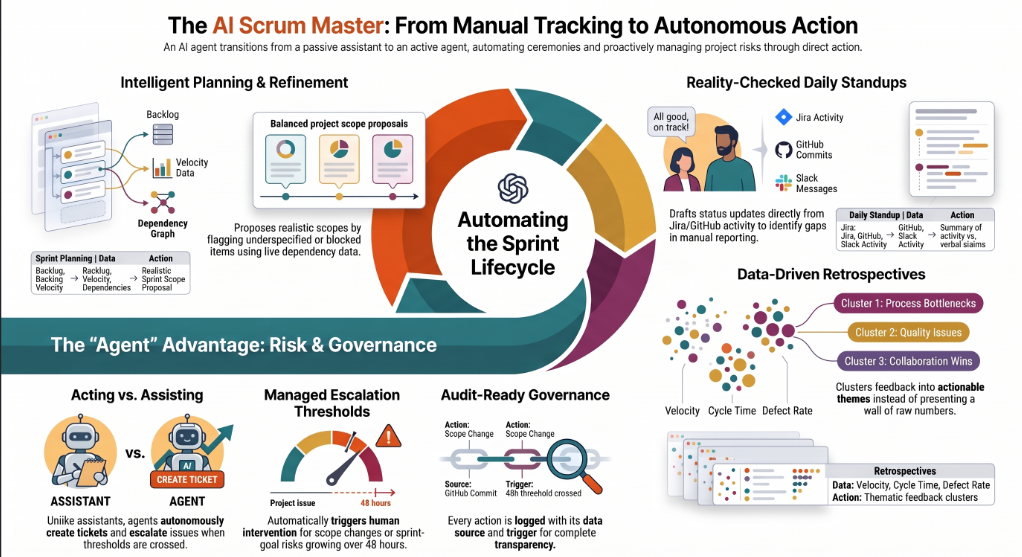
The agent pulls the backlog, the team's velocity history, and open dependencies, then proposes a realistic sprint scope — flagging items that are underspecified, blocked, or larger than the team's typical throughput before planning even starts. Because it's reading live data rather than a snapshot pulled the night before, it can catch a dependency that changed an hour ago, not a week ago.
Daily standups
Instead of a person compiling three tools into one update, the agent drafts each person's status from their actual Jira, GitHub, and Slack activity — the ticket that says "done" but is still in code review, the pull request nobody mentioned — flags anything that doesn't match what was said in the room, and posts a summary to the team channel, asking a direct question only when it genuinely can't tell what happened.
Backlog refinement
The agent ranks backlog items against dependencies, team capacity, and historical estimate accuracy, drafts acceptance criteria from a rough description, and flags stale or underspecified tickets before they reach planning — routing anything genuinely ambiguous back to the Product Owner rather than guessing at intent.
Retrospectives
It compiles sprint metrics — velocity, cycle time, defect rate, scope change — into an actual retro input instead of a wall of raw numbers, and clusters written feedback into themes (a recurring blocker, a communication gap) so the conversation starts from a pattern the team can act on, not a blank whiteboard.
Cross-ceremony: risk flags and escalation
This is where a governed agent earns its name. It doesn't just report a risk; it acts on it — creating a ticket for a flagged blocker, notifying the right owner, escalating to a human when the situation crosses a defined threshold (a scope change past a set size, a compliance flag, a sprint-goal risk that's grown for two days running). Every one of those actions is logged: what triggered it, what data it read, what it did, and who it notified.
That last point is the whole difference between an assistant and an agent. An assistant tells you there's a problem. An agent — done right — does something about it, inside the boundaries your team set, and leaves a record you could hand to an auditor without editing it first.
How a Scrum Master AI Agent Works Under the Hood
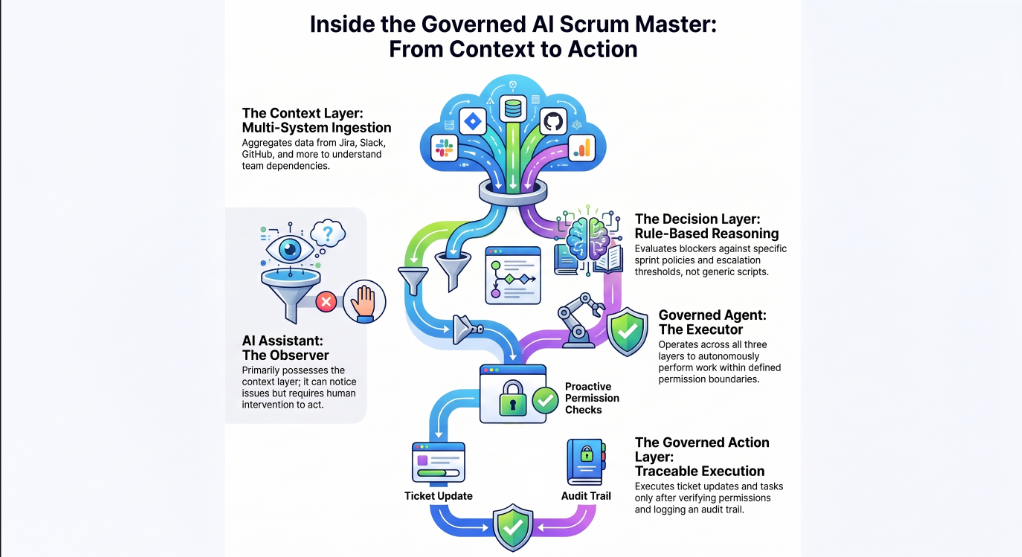
A governed agent is built in three layers, and understanding them explains why some "AI scrum masters" stop at chat and others actually execute.
1. Context layer. The agent ingests live data from every system your team actually uses — Jira, Confluence, Slack, GitHub, ServiceNow — and builds a working understanding of people, tickets, dependencies, and history. This is the layer most point tools skip: they read one system and call it done, which is why a Jira-only bot can't tell you a GitHub PR is stuck waiting on a review from someone who's out sick.
2. Decision layer. The agent reasons against rules your team defined — sprint policies, escalation thresholds, definition-of-done criteria — not a generic script. This is where it decides whether a blocker needs a Slack ping to the assignee or an escalation to the engineering lead, based on how long it's been open and what it's blocking.
3. Governed action layer. The agent executes — updating a ticket, posting a summary, creating a task — but only after a permission check confirms the action is within what it's allowed to do, and only after logging the decision. Every action is permission-checked and traceable, the same way Assistents' Action Engine enforces permissions on every step across any department's agents, not just agile teams. A practical example: if the agent is drafting a ticket that would touch a restricted repository, the permission check runs before the ticket is created — not as an after-the-fact review.
This is also why "agent" and "assistant" aren't interchangeable, even though search results treat them that way. An assistant usually only has the first layer, maybe a thin version of the second, and none of the third — it can tell you what it noticed, but it can't act on it without a human doing the actual work. A governed agent has all three, which is also what makes an audit trail possible: you can't log an action the system never took.
Why Assistents Is Built Differently
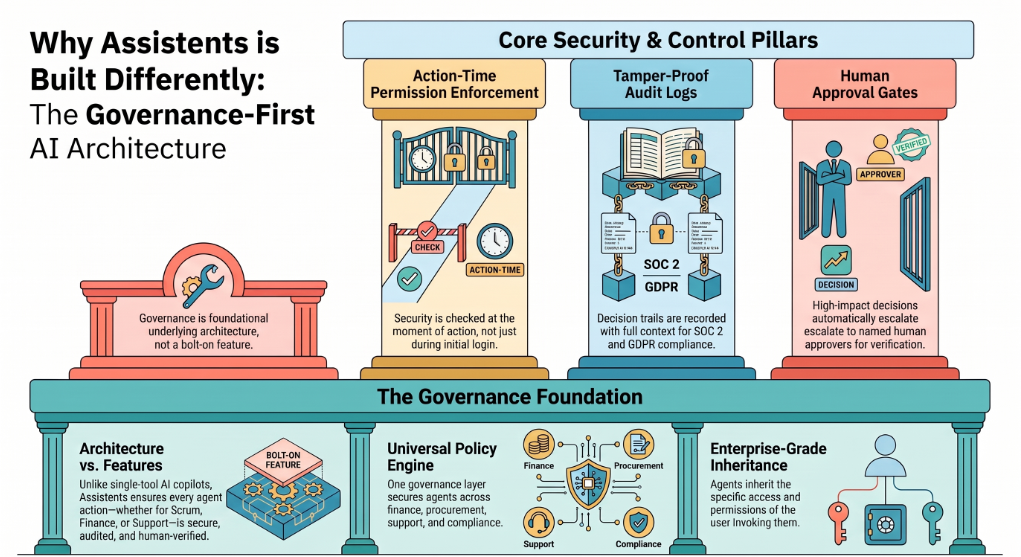
Most of the tools competing for "scrum master ai agent" traffic are single-tool copilots: useful, but scoped to one PM tool, with no real governance layer underneath. Assistents' Agent Governance is built the opposite way — governance isn't a feature you turn on, it's the architecture underneath every agent action, agile or otherwise.
Concretely, that means:
- Permission enforcement on every action, not just at login. An agent built on Assistents inherits the same access the invoking user has — it can't see or touch data that person couldn't see or touch, and every operation is checked at action time, not just query time.
- Immutable, tamper-proof audit logs. Every decision an agent makes — what it read, why, what it decided, what it did — is recorded with full context, exportable for SOC 2, GDPR, HIPAA, and ISO 27001 evidence.
- A policy engine your team actually controls. Spending limits, required approvals, retention rules — defined once, enforced automatically, with violations blocked and flagged rather than silently allowed.
- Human approval gates for anything high-impact. When an agent hits a threshold — a scope change past a certain size, a compliance-sensitive ticket — it escalates to a named approver with full context instead of guessing.
- Alignment verification. Continuous checks that the agent's actions still match its defined purpose, with drift detection rather than a one-time review at setup.
None of this is agile-specific by design — it's the same governance layer running under finance, procurement, support, and compliance agents across the platform. That's the point: a scrum master agent built on Assistents isn't a bolt-on feature with its own weaker rules. It inherits enterprise-grade governance from day one, which is exactly the layer every competing "AI scrum master" tool in this space is missing.
Benefits of a Governed Scrum Master AI Agent
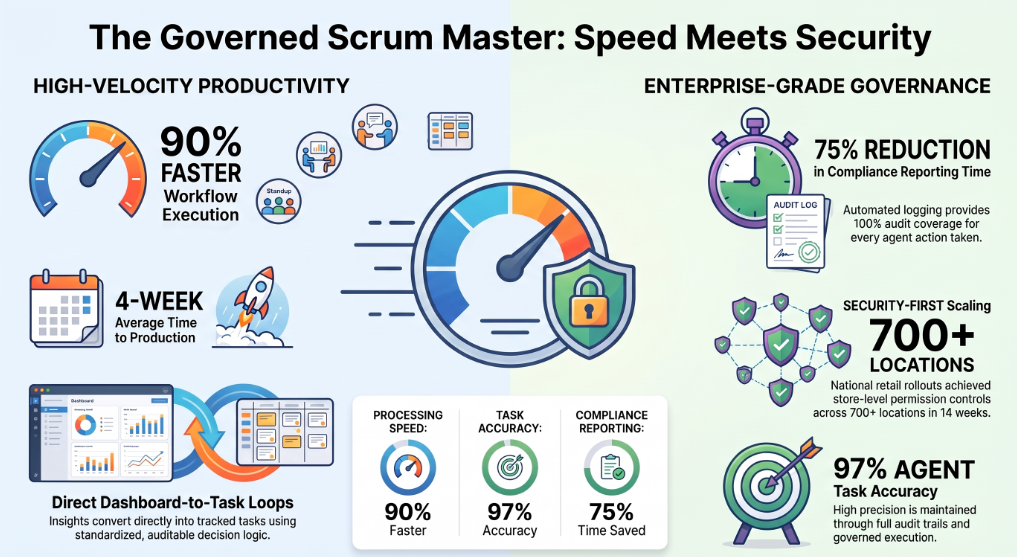
The productivity case for AI in agile delivery is well covered elsewhere — fewer hours on standups, faster retros, tighter backlogs. The case that's harder to find is what governance adds on top of that, and it shows up clearest in production deployments:
- One enterprise deployment turned a dashboard-and-spreadsheet reporting habit into a governed, auditable action loop — insights convert directly into tracked tasks instead of getting re-typed into a tracker by hand, with standardized decision logic across every team using it.
- A national retail organization rolled out store-level support agents across 700+ locations in 14 weeks, with per-location permission controls and real-time escalation baked in from day one — not retrofitted after a security review.
- A financial-services enterprise cut compliance reporting time by 75%, with 100% audit coverage and zero missed deadlines, because every agent action was already logged for evidence.
- Across the platform: 90% faster processing and workflow execution, 97% agent task accuracy with full audit trails, and roughly a 4-week average time to production — numbers that hold up because governance was there from the first deployment, not added after an incident.
Applied to agile delivery, the same pattern holds: the time saved on standups and retros is the visible benefit. The audit trail underneath it — proof of exactly what the agent did and why — is the benefit that lets a security or compliance team actually approve the rollout.
How to Choose a Scrum Master AI Agent: Evaluation Criteria
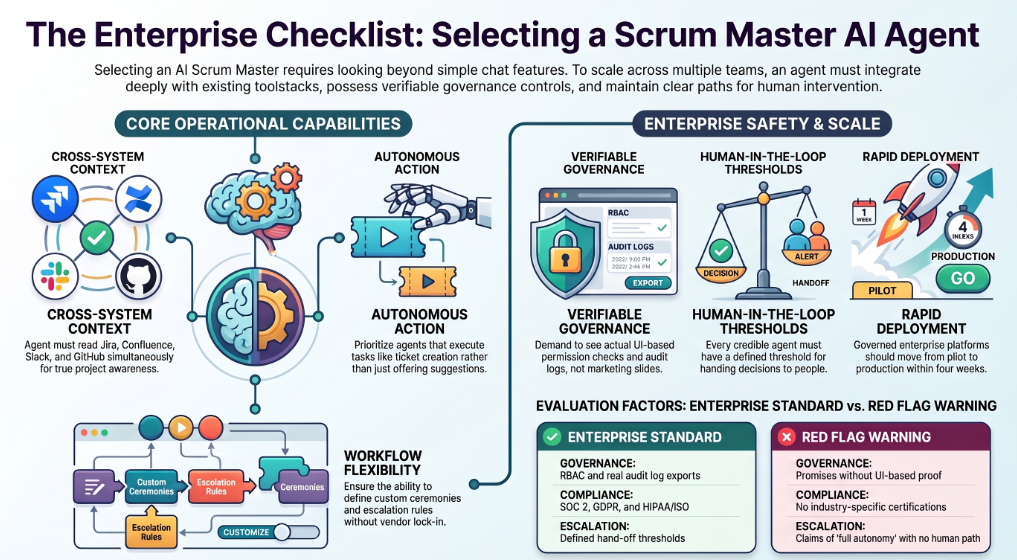
Before comparing specific tools, run any option against these criteria — in roughly this order of importance for an enterprise deployment:
- Cross-system context, not a single-tool bolt-on. Does it read Jira and Confluence and Slack and GitHub in one place, or does it only understand the one tool it's plugged into?
- Autonomous action, not suggestion-only. Can it actually create the ticket, post the update, and route the escalation — or does a person still have to act on everything it notices?
- Governance: RBAC, audit logs, a policy engine. Ask to see an actual audit-log export, not a marketing slide. If permission enforcement isn't described at the action level, it probably isn't happening at the action level.
- Compliance certifications that match your industry. SOC 2 Type II and GDPR are close to table stakes now; HIPAA capability and ISO 27001 alignment matter if you're in healthcare, financial services, or government.
- Human-in-the-loop escalation. Every credible agent should have a defined threshold for handing a decision to a person — if a vendor claims full autonomy with no escalation path, that's a red flag, not a feature.
- Deployment time. A governed enterprise agent platform should move from pilot to production in weeks, not quarters — Assistents' typical range is about four weeks.
- Build-vs-buy flexibility. Can you define your own ceremonies, escalation rules, and connected systems, or are you locked into one vendor's fixed workflow?
A tool that scores well on the first two and poorly on governance is fine for a single small team. It's the wrong choice the moment more than one team, more than one system, or a compliance requirement enters the picture.
A quick red flag to watch for: if a vendor describes "governance" only in a sales deck and can't show you what an actual permission check or audit-log entry looks like, assume it isn't there yet — governance that's real shows up as a UI, not a promise.
Build vs. Buy: Do You Need a Point Tool or a Governed Agent Platform?
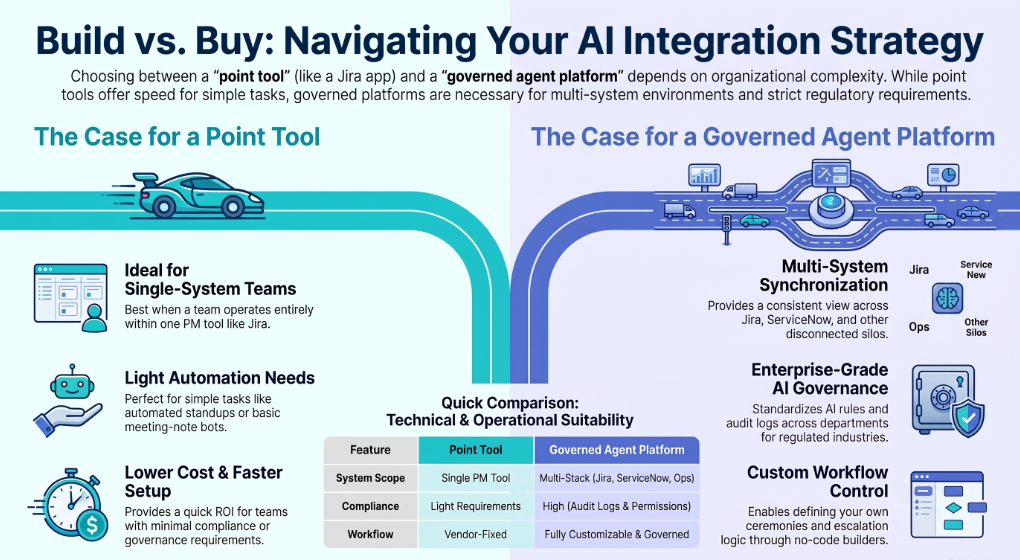
If your team runs entirely inside one PM tool, has light compliance requirements, and just wants standups automated, a point tool — a Jira Marketplace app, a meeting-notes bot — will probably do the job at a lower cost and a faster setup.
The calculation changes once any of these is true:
- Your organization runs agile across more than one system — Jira for engineering, ServiceNow for ops, a separate tool for a business unit that merged in — and you want one consistent view instead of three disconnected copilots.
- You're standardizing AI governance across departments, not just agile delivery, and don't want a separate, weaker set of rules just for the Scrum Master use case.
- You're in a regulated industry where an auditor will eventually ask for the permission model and the audit log, not just the productivity numbers.
- You want to define your own ceremonies and escalation logic instead of adapting to one vendor's fixed workflow.
In that second case, a no-code Agent Builder and Workflow Builder let you define a scrum-master-style agent against your own rules, connected to your existing stack, governed the same way as every other agent on the platform — rather than adding a fourth disconnected tool that automation platforms like n8n or RPA tools like UiPath were never designed to govern at this level in the first place.
Will AI Replace Scrum Masters?
No — but it's worth being precise about why. The Scrum Guide defines the Scrum Master as a servant-leader accountable for the team's effectiveness: coaching, removing impediments, and helping an organization adopt Scrum well. None of that is mechanical, and none of it is what a scrum master AI agent is built to do.
Context helps here: McKinsey's 2025 State of AI survey found 62% of organizations are at least experimenting with AI agents and 23% are already scaling one. Agile delivery is one of the functions where that shift is furthest along, because the ceremonies are structured and the data trail — tickets, commits, meeting notes — already exists.
What a scrum master AI agent replaces is the part of the role that was never really coaching in the first place — chasing updates, reformatting the same report, manually reconciling three tools. That's also, not coincidentally, the part of the job most Scrum Masters say eats their week. Even Atlassian, the company behind Jira, has been moving in this direction: it opened a beta for AI agents embedded directly inside Jira in early 2026, letting teams assign work to agents the same way they'd assign it to a person.
The honest framing isn't "AI vs. Scrum Master." It's that the administrative half of the role is becoming automatable, and the teams that benefit most are the ones that automate it with a system they can actually audit — rather than a black box that quietly makes decisions no one can trace back afterward.
Why Enterprises Choose Assistents for Agile & Delivery Operations
Beyond the architecture case, the numbers are the reason security and compliance teams actually sign off:
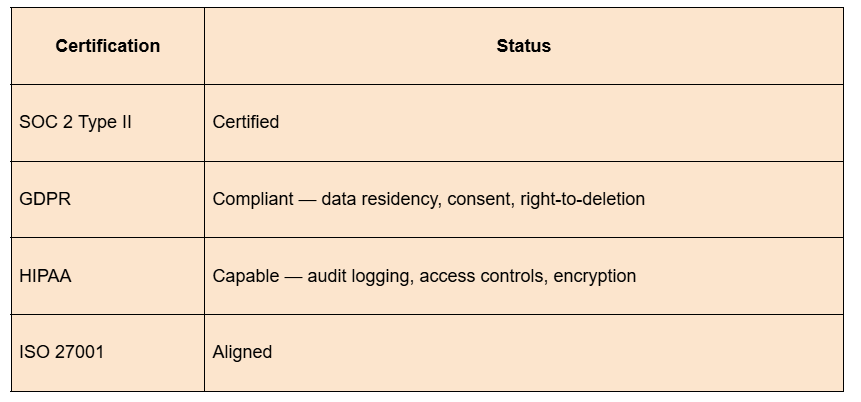
And in production, across 12+ industries:
- 90% faster processing and workflow execution
- 97% agent task accuracy, with full audit trails on every action
- ~4 weeks average time from pilot to production
- 300+ enterprise systems connected out of the box
One anonymized snapshot that maps directly onto agile delivery: a global manufacturer needed continuous monitoring across thousands of SKUs and market signals — the same shape of problem as monitoring a sprint backlog for risk. The result was AI agents continuously ingesting data, running anomaly detection, and pushing alerts within minutes, running 12x faster than the manual process it replaced, with every alert traceable back to the data that triggered it.
That's the pattern that should matter to anyone evaluating a scrum master AI agent for a real organization rather than a single team's experiment: the same governed platform that runs finance, compliance, and support agents at that scale is the one your agile teams would be running on too — not a separate, unaudited tool that happens to summarize standups. See the full picture in Why Assistents, or go straight to a 30-minute discovery call with the workflow that frustrates your team most.
The Bottom Line
A "scrum master ai agent" is only as useful as the governance underneath it. The productivity gains — faster standups, tighter backlogs, cleaner retros — are table stakes now; nearly every tool in this space claims them. What separates a real agent from a chat assistant, and a safe enterprise deployment from a security review that never ends, is whether every action is permission-checked, logged, and auditable by design.
Assistents' Agent Governance is built that way from the ground up — for agile delivery and for every other team running agents on the platform. If you're evaluating options, book a 30-minute discovery call and bring the ceremony or workflow that frustrates your team most.
FAQs
Can AI replace a scrum master? No. AI can take over the administrative parts of the role — tracking, reporting, meeting notes, status updates — but coaching, conflict resolution, and organizational judgment stay human. A governed AI agent removes the busywork so the Scrum Master can focus on the parts of the job that were never really about ticket-updating.
What does a scrum master AI agent actually do? It reads live context from tools like Jira, Confluence, and Slack, then runs sprint-planning support, standup summaries, backlog-refinement suggestions, and retrospective analysis — executing multi-step actions under permission checks rather than only chatting or suggesting.
Is a scrum master AI agent safe for regulated industries? Yes, if it's governance-native: permission enforcement, immutable audit logs, and compliance certifications (SOC 2 Type II, GDPR, HIPAA-capable) let healthcare and financial-services teams deploy agents without losing audit-readiness. See Assistents' governance architecture for what that looks like in practice.
How is an AI agent different from an AI assistant like a meeting-notes bot? An assistant summarizes and suggests; a human still executes. An agent takes the next step itself — creating tickets, updating boards, routing approvals — inside permission boundaries, with every action logged for audit.
Does a scrum master AI agent integrate with Jira, Azure DevOps, and Slack? A governed enterprise agent platform typically connects to hundreds of systems at once — Jira, Confluence, Slack, GitHub, ServiceNow, Azure DevOps — rather than being scoped to a single tool the way most point solutions are.
Is there a free scrum master AI agent? Several point tools — Jira Marketplace apps, some meeting-notes bots — offer free tiers for single-tool use. Enterprise-grade, governed agents with audit trails and compliance certifications are typically deployed through a paid platform, priced against the workflows and systems involved.
How long does it take to deploy a governed AI agent for agile teams? Production deployments of governed enterprise agents typically take about four weeks from pilot to production, versus months for a custom-built integration layer.
Can I build a custom scrum master AI agent instead of buying a point tool? Yes — a platform with a no-code Agent Builder and Workflow Builder lets you define your own rules, ceremonies, and escalation paths across your existing stack instead of adopting a single vendor's fixed workflow.
What happens when the agent isn't sure what to do? A governed agent escalates to a human reviewer with full context rather than guessing — alignment verification and configurable approval thresholds route ambiguous or high-impact decisions to a person.
How much does an enterprise AI agent platform cost? Pricing varies by seat count, connected systems, and governance requirements. Most enterprise platforms price per-agent or per-workflow rather than per-seat — see Assistents' pricing or request a quote based on your specific ceremonies and integrations.

Transform Your Business With Agentic Automation
Agentic automation is the rising star posied to overtake RPA and bring about a new wave of intelligent automation. Explore the core concepts of agentic automation, how it works, real-life examples and strategies for a successful implementation in this ebook.
Sarfraz Nawaz is the CEO and founder of Ampcome, which is at the forefront of Artificial Intelligence (AI) Development. Nawaz's passion for technology is matched by his commitment to creating solutions that drive real-world results. Under his leadership, Ampcome's team of talented engineers and developers craft innovative IT solutions that empower businesses to thrive in the ever-evolving technological landscape.Ampcome's success is a testament to Nawaz's dedication to excellence and his unwavering belief in the transformative power of technology.

More insights
Discover the latest trends, best practices, and expert opinions that can reshape your perspective

.jpg)



.jpg)

Contact us

