
AI CFO Agent for Cash Flow Forecasting in India: Use Cases, Benefits & Real Results (2026)


Indian CFOs are under more pressure than at any point in recent memory. Between managing working capital across multi-entity operations, navigating GST compliance cycles, responding to board demands for real-time visibility, and doing all of this with finance teams stretched thin — the role has quietly become one of the most complex in the enterprise.
And yet, most Indian finance teams are still forecasting cash flow the same way they were a decade ago: pulling data from ERP systems into spreadsheets, reconciling manually across departments, and presenting numbers that are already three days old by the time leadership sees them.
According to a 2025 survey by dMACQ, 68% of Indian CFOs have already implemented AI solutions in some form — a figure that surpasses global benchmarks. But implementation and transformation are different things. Most of that 68% are using AI for document management and basic reporting. The deeper opportunity — autonomous AI agents that continuously monitor cash, forecast liquidity, model scenarios, and alert leadership before problems materialise — is still largely untapped.
This guide covers what an AI CFO agent is, how cash flow forecasting specifically works in an agentic AI model, what real enterprise deployments have delivered, and how Indian finance leaders can evaluate and implement these systems in 2026.
What Is an AI CFO Agent?
An AI CFO agent is an autonomous software system purpose-built to execute financial workflows — forecasting, monitoring, analysis, alerting, compliance — with minimal human intervention. Unlike traditional finance software, which responds to commands, an AI CFO agent actively monitors your financial environment, takes action within defined governance boundaries, and surfaces decisions for human review only when they require judgment.
The distinction matters. Most tools marketed as "AI for finance" are copilots — they assist a human who is still doing the work. An AI CFO agent is something different: it operates continuously, connects across systems, and executes rather than just recommends. It integrates with your ERP, your banking feeds, your procurement systems, and your BI stack, then uses that unified data layer to run forecasts, detect anomalies, and trigger workflows — automatically and around the clock.
In practical terms, an AI CFO agent handles tasks that previously required a team of analysts working in shifts: daily cash positioning, rolling 30-60-90 day forecasts, variance analysis, scenario modelling, regulatory deadline tracking, and exception escalation. It does this faster, more consistently, and with a full audit trail on every decision.
Why Cash Flow Forecasting Is the #1 Use Case for AI CFO Agents in India
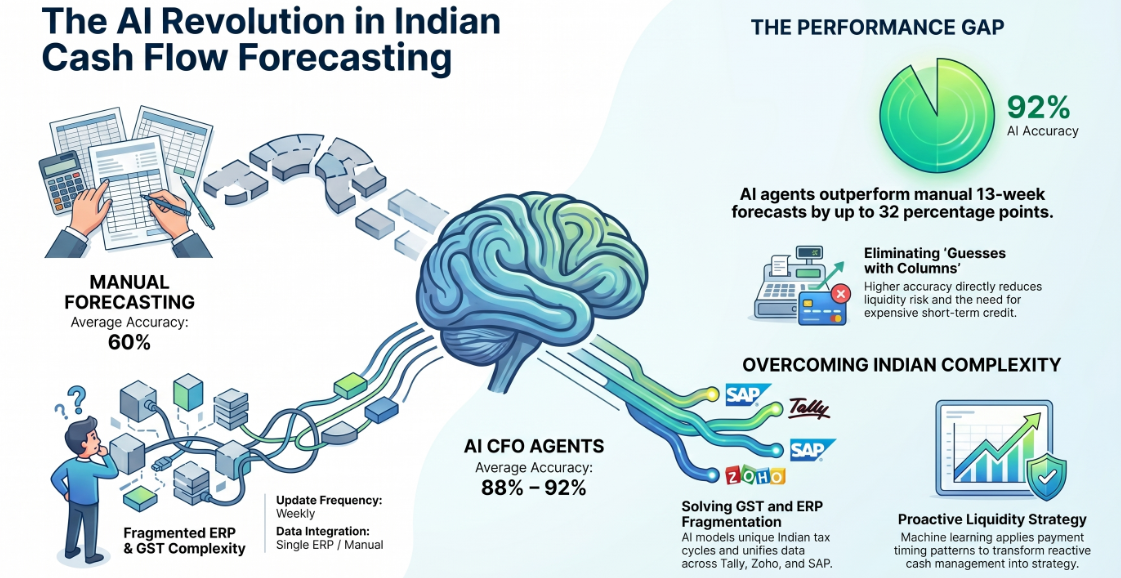
Cash flow forecasting is where the accuracy problem is most painful — and where AI creates the most immediate, measurable value.
Manual 13-week cash flow forecasts achieve roughly 60% accuracy. AI-assisted treasury and forecasting agents consistently reach 88–92% accuracy at the same horizon, according to AFP Treasury Benchmarking data. That gap — 28 to 32 percentage points — translates directly into liquidity risk. A forecast that is wrong 40% of the time is not a forecast. It is a guess with columns.
For Indian enterprises, the problem is compounded by structural factors that global tools rarely account for:
GST timing mismatches. Input tax credits, reverse charge mechanisms, and monthly GSTR filing cycles create cash flow variability that is unique to the Indian tax environment. A CFO managing a mid-to-large enterprise has to model GST payment outflows alongside operational cash — and spreadsheet-based forecasting almost always handles this manually.
Multi-entity complexity. Many Indian enterprises operate across subsidiaries, joint ventures, and holding structures. Consolidating cash positions across entities — each with different ERPs, accounting teams, and reporting cycles — introduces latency and error that compounds forecast inaccuracy.
Working capital pressure. India's credit environment means that working capital management is tighter for most businesses than comparable companies in Western markets. The cost of a forecast miss — whether it means drawing on expensive short-term credit or missing a supplier payment — is real and immediate.
ERP fragmentation. Indian enterprises often run a mix of SAP, Oracle, Tally, and Zoho across business units. No single system has the complete picture. An AI CFO agent that can ingest from multiple sources and produce a unified financial view solves a problem that no single ERP can.
AI CFO agents address all of these. They ingest data from multiple systems in real time, apply machine learning to payment timing patterns, account for scheduled regulatory outflows, and produce forecasts that update continuously — not weekly. The result is a finance function that moves from reactive cash management to proactive liquidity strategy.
What an AI CFO Agent Does: 5 Core Capabilities
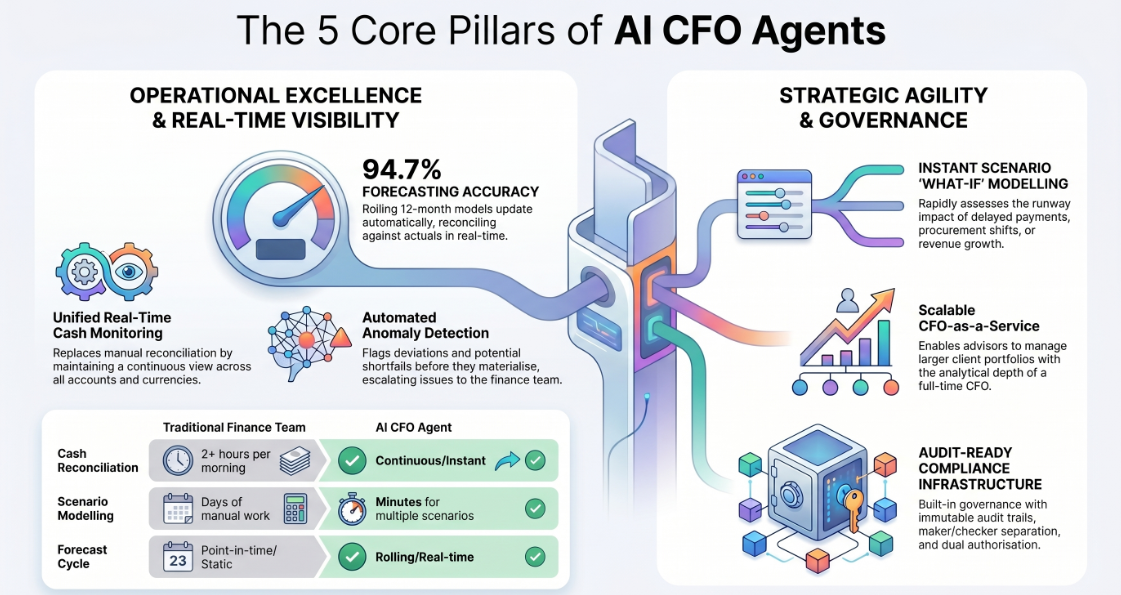
1. Real-Time Cash Flow Monitoring and Anomaly Detection
An AI CFO agent maintains a continuous, unified view of cash across all accounts, entities, and currencies. It monitors inflows and outflows against expected patterns, flags deviations above configurable thresholds, and escalates to the right team member before a shortfall materialises.
This is the capability that replaces the morning ritual of pulling bank statements and manually reconciling positions. Instead of a finance analyst spending two hours each morning assembling the daily cash position, the agent has it ready — and has already flagged anything that requires attention.
For Indian enterprises with multiple banking relationships across HDFC, ICICI, SBI, Kotak, and international banks, this unified monitoring layer alone represents a significant operational shift.
2. Rolling Forecasts That Update as Conditions Change
Traditional cash flow forecasts are point-in-time documents. Once published, they are already becoming stale. AI CFO agents produce rolling forecasts — 30-day, 60-day, 90-day, and 12-month horizons — that update automatically as actuals come in, as new invoices are raised, as purchase orders are approved, and as market signals shift.
The assistents.ai platform generates forecasts at 94.7% accuracy on a rolling 12-month model, continuously reconciling against actuals and flagging variance before it compounds. The finance team sees not just where cash is, but where it is going — and the model adjusts its prediction in real time rather than waiting for the next forecast cycle.
3. Scenario Planning and What-If Modelling
This is where AI CFO agents move from monitoring into strategy. Scenario planning allows CFOs to model outcomes before committing to decisions: what happens to the cash position if a major client delays payment by 45 days? What is the runway impact if procurement for the next quarter is front-loaded? What does the working capital requirement look like if revenue grows 20% faster than the base case?
These models used to take analysts days to build. An AI CFO agent runs them in minutes, across multiple scenarios simultaneously, with full documentation of the assumptions behind each projection. For a CFO presenting to the board or a founder managing investor conversations, this kind of instant, defensible scenario analysis changes the quality of the conversation.
4. Advisory-Mode: AI CFO Capability for Growing Businesses and Their Advisors
Not every organisation has a full-time CFO. A significant portion of the Indian business landscape — high-growth startups, family-owned enterprises, businesses transitioning to professional management — either lacks CFO capacity entirely or relies on external advisors managing multiple client portfolios simultaneously.
This is one of the most compelling and underserved use cases for AI CFO agents. An agentic AI platform can function as the analytical engine behind a CFO-as-a-service model: connecting to a client's financial data, running continuous cash monitoring and forecasting, surfacing weekly insight reports, and flagging risks and opportunities — allowing an advisor to manage ten clients with the analytical depth previously possible for only one or two.
One deployment in this space — a global AI CFO platform serving growing businesses, CFOs, and financial advisors — delivered exactly this. The system connected directly to the client's accounting and banking data, built a forecast and scenario modelling layer, generated runway and cash risk alerts with recommended actions, and produced portfolio-level views for advisors managing multiple client relationships. The result was faster analysis cycles, earlier detection of cash risks, and the ability to scale advisory-level financial insight without adding headcount. The platform moved the advisor from reactive reporting to proactive financial partnership — a qualitative shift that translated directly into client retention and the ability to serve a larger portfolio.
5. Audit-Ready Financial Controls, Built In
Enterprise finance has non-negotiables: segregation of duties, immutable audit trails, role-based access, and documentation of every decision. These requirements are not optional for listed companies, regulated entities, or any organisation managing external audit relationships.
AI CFO agents on the assistents.ai platform operate within a governance framework that meets these requirements by design — not as an add-on. Every action the agent takes is logged with full context: what data was used, what decision was made, what approval workflow was triggered, and what the outcome was. The platform supports maker/checker separation, role-based workflows, approval hierarchies, dual authorisation for sensitive transactions, MFA enforcement, and SIEM-ready audit export.
For Indian CFOs managing Statutory Audit, Internal Audit, and regulatory filings across multiple frameworks, this level of built-in compliance infrastructure removes one of the most common objections to AI in finance: the concern that autonomous agents operate as a black box.
Real Enterprise Deployments: What AI CFO Agents Have Delivered
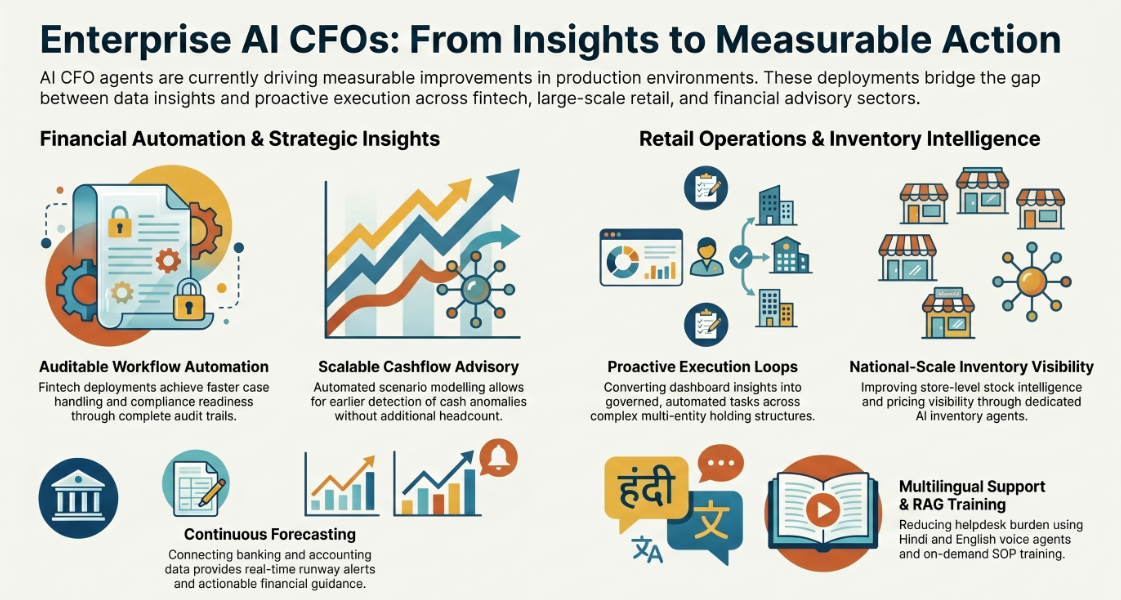
The case for AI CFO agents is not theoretical. Across enterprise deployments — spanning financial services, large-scale retail operations, supply chain, and multi-entity holding structures — the pattern of outcomes is consistent. Here is what those deployments have actually looked like, drawn from real implementations.
Global fintech serving banks and credit unions. An enterprise operating in the cloud-based financial automation space — handling disputes, fraud management, compliance, and operational workflows for banks and credit unions — deployed an omnichannel AI agent layer covering customer and operational support, with auditable workflow automation. Outcomes included faster case handling, reduced operational load, and improved compliance readiness through complete audit trails.
Multi-entity retail holding company. A privately-held retail organisation managing cross-functional operations across departments deployed an agentic data analysis layer designed to convert dashboard insights into governed, auditable actions and tasks. The platform covered a unified context engine across structured and unstructured data, a semantic governance layer for consistent definitions across entities, and an active orchestration layer that integrated with core systems. This shifted the organisation from reactive reporting to proactive execution loops, with standardised decision logic and automated task creation across teams.
Large-scale national retail operation. A retail enterprise with a pan-India footprint spanning hundreds of cities deployed enterprise AI agents to modernise store support, inventory visibility, and knowledge access at national scale. The deployment included a voice support agent in Hindi and English, an inventory intelligence agent for pricing and stock visibility at the store level, and a knowledge and training agent built on RAG over point-of-sale and SOP documentation. Outcomes included reduced manual helpdesk burden, improved store-level inventory visibility, and faster onboarding through on-demand training guidance.
AI CFO platform for growing businesses and advisors. A dedicated AI CFO platform — built to serve growing businesses, CFOs, and financial advisors — delivered continuous cashflow insight, forecasting, and actionable financial guidance. The system connected to accounting and banking data, built a forecast and scenario modelling layer, generated alerts for runway and cash risks with recommended actions, and produced portfolio-level views for advisors managing multiple client relationships. The outcome was faster analysis cycles, earlier detection of cash anomalies, and scalable advisory-level insight without additional headcount.
These are not pilot programmes. They are production deployments generating measurable operational improvement across different industry contexts, company sizes, and geographies.
How Indian CFOs Are Using Agentic AI Across the Finance Function
Cash flow forecasting is the entry point. But for finance leaders who have deployed AI agents, it is rarely where the value stops.
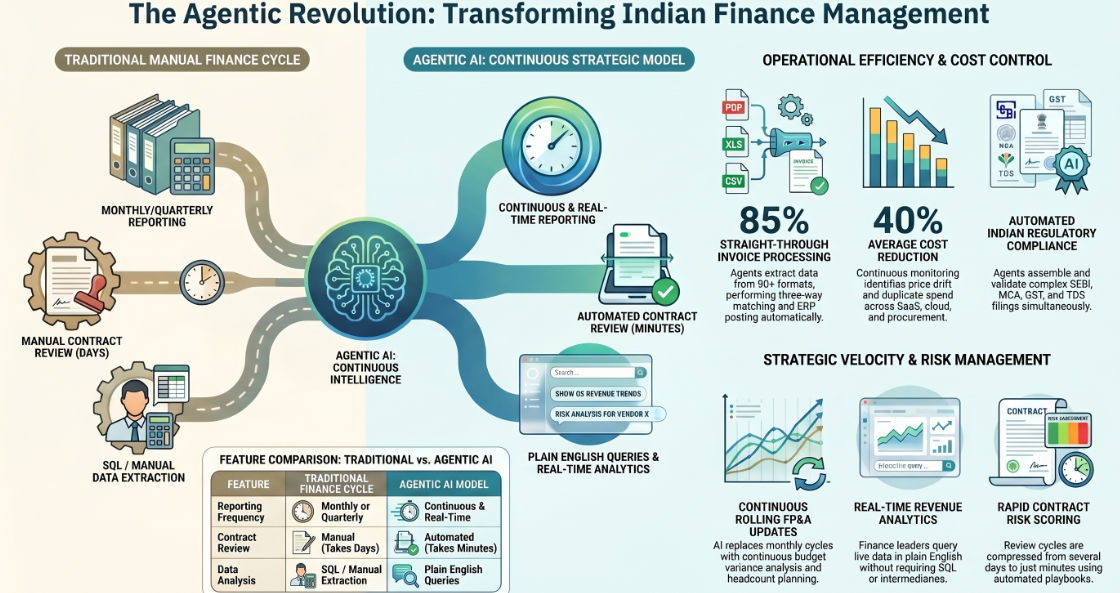
Financial planning and analysis. AI agents synthesise historical performance data, market signals, and operational KPIs to produce rolling FP&A updates that were previously a monthly or quarterly exercise. Budget variance analysis, headcount planning, and capex review cycles that once took analysts weeks can now run continuously, with exceptions surfaced automatically.
Cost intelligence and spend optimisation. AI agents monitor spend patterns across procurement, operations, and overhead — identifying vendors with price drift, flagging duplicate spend, and recommending consolidation. The assistents.ai platform delivers an average 40% cost reduction across monitored spend categories, across SaaS and licensing, professional services, cloud infrastructure, travel and expense, and facilities.
Invoice and payables automation. Invoice processing agents extract line items, PO numbers, and payment terms from invoices in 90-plus formats. They perform three-way matching against purchase orders and receipts, enforce policy thresholds, route exceptions for approval, and post to ERP — with 85% straight-through processing. For Indian enterprises managing thousands of vendor invoices monthly across GST-compliant formats, this is immediate operational relief.
Regulatory filing and compliance. Agents assemble, validate, and submit regulatory filings across jurisdictions — pulling data from source systems, applying formatting rules, and flagging missing fields before deadlines. For Indian enterprises navigating SEBI disclosures, MCA filings, GST returns, and TDS compliance simultaneously, this kind of automated compliance layer reduces the risk of costly errors and missed deadlines.
Contract review and financial risk. AI agents read contracts clause by clause, flag non-standard terms, extract key dates and obligations, and score risk against the organisation's standard playbook. Review cycles that previously took days are compressed to minutes.
Real-time revenue analytics. Finance leaders can ask questions in plain English and receive instant answers from live revenue data. Agents query across CRM, billing, and ERP systems simultaneously — surfacing trends, anomalies, and forecasts without requiring SQL queries or a data analyst intermediary.
The pattern across all of these use cases is the same: the AI agent does not replace the CFO or the finance team. It removes the manual, repetitive, latency-heavy work that prevents them from operating strategically. The result is a finance function that runs continuously rather than in monthly cycles, and that surfaces decisions rather than just data.
For a deeper look at how AI agents are being applied across financial services specifically, see the assistents.ai resource on AI in Financial Services.
How to Choose an AI CFO Agent: What Indian Finance Leaders Should Evaluate
The market for AI in finance is crowded, and not all solutions are equivalent. When evaluating an AI CFO agent for an Indian enterprise context, the following factors matter most.
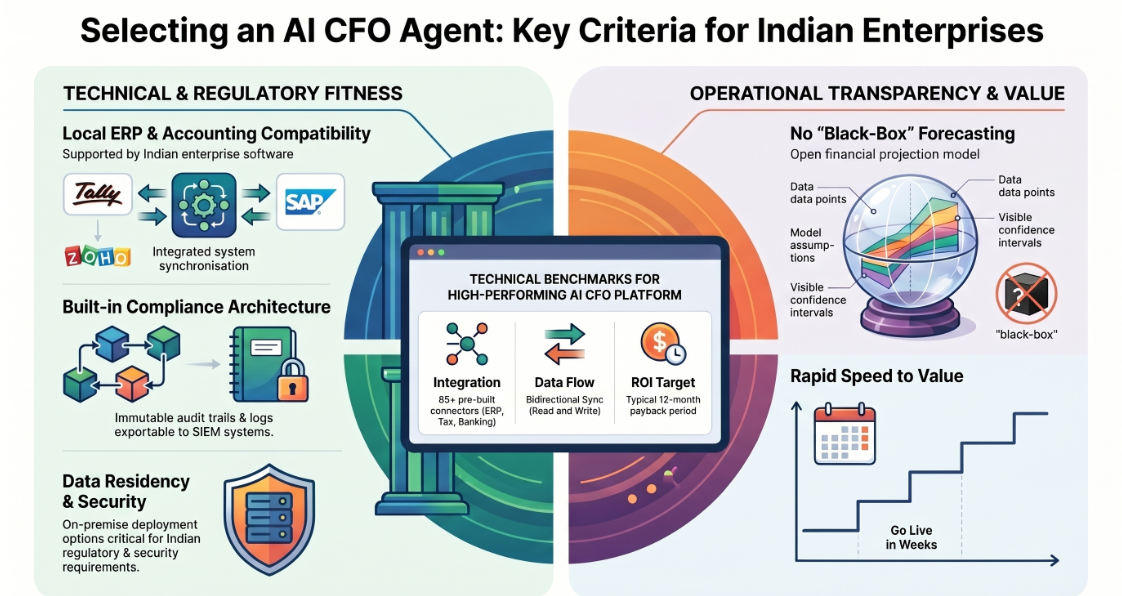
ERP and accounting system compatibility. India's enterprise landscape runs on a mix of SAP, Oracle, NetSuite, Tally, Zoho Books, and Microsoft Dynamics. A platform that supports only Western-market ERP ecosystems will require significant customisation to work in an Indian deployment context. Evaluate pre-built connectors, bidirectional sync capability, and the vendor's experience with Indian accounting standards.
The assistents.ai platform supports 85-plus pre-built connectors across ERP and accounting, banking and treasury, procurement, expense, tax and compliance, and reporting and BI systems, with open APIs for custom integrations. Bidirectional sync is available across ERP, accounting, banking, and procurement categories — meaning the agent can both read data and write back to source systems.
Compliance and audit architecture. Evaluate whether compliance controls are built into the platform's core architecture or added as a feature layer. Built-in segregation of duties, immutable audit trails, role-based access control, and approval hierarchy enforcement are non-negotiable for enterprise finance. Ask specifically whether the platform produces audit logs that are exportable to SIEM systems and readable by external auditors.
Data security and deployment options. For Indian enterprises with data residency requirements or regulatory constraints on cloud data, the availability of on-premise deployment is critical. Evaluate the vendor's security certifications, data residency policies, and whether the platform can operate within your existing security perimeter.
Forecast accuracy and methodology transparency. Ask specifically how the platform generates forecasts. Black-box AI is a risk in a finance context because it cannot be audited or explained. The best platforms provide cited evidence for every projection — the data sources used, the model assumptions applied, and the confidence interval on the output. This is not just good practice; it is what makes an AI-generated forecast defensible to a board or an auditor.
Speed to value and implementation model. Agentic AI deployments in finance are not six-month IT projects. Evaluate the vendor's implementation track record, the availability of pre-built finance workflow templates, and whether the first use case can be live in weeks rather than quarters. The 12-month payback period that enterprise deployments typically achieve assumes a relatively fast path to production — a vendor who cannot commit to that timeline should be pressed on why.
People Also Ask: Common Questions Indian CFOs Have About AI Forecasting
What is an AI CFO agent?
An AI CFO agent is an autonomous software system that executes financial workflows — including cash flow monitoring, forecasting, scenario planning, compliance documentation, and anomaly alerting — with minimal human intervention. Unlike traditional finance software, which requires a human to query it, an AI CFO agent actively monitors financial data across connected systems, takes action within defined governance rules, and surfaces decisions that require human judgment. It operates continuously, produces auditable outputs, and integrates with ERP, banking, and procurement systems.
How does AI improve cash flow forecasting accuracy?
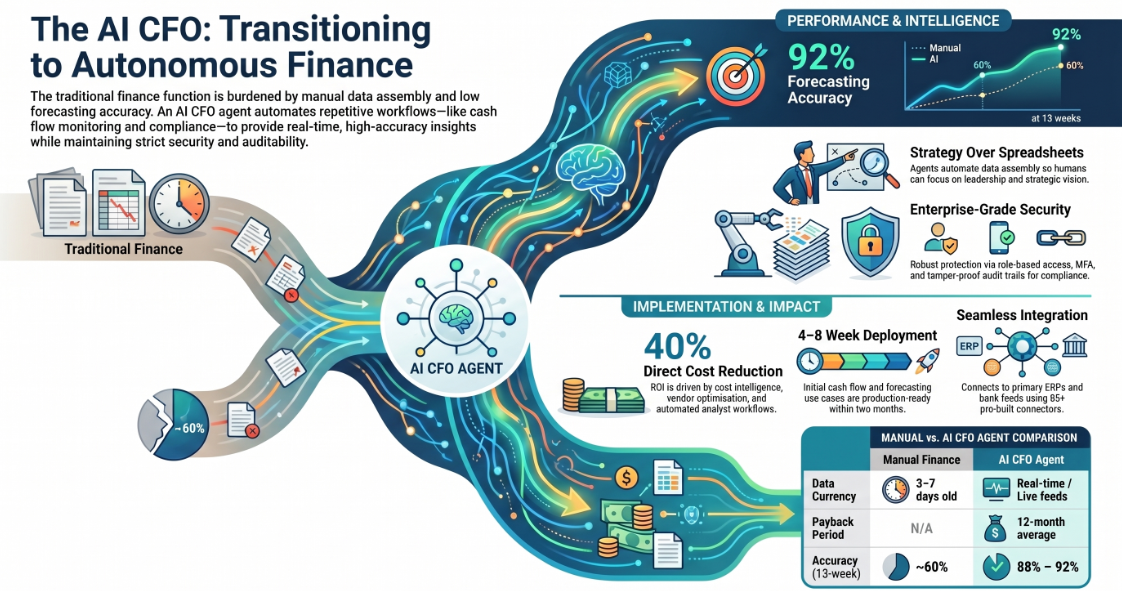
AI improves cash flow forecasting accuracy by combining real-time data ingestion from multiple connected systems, machine learning applied to historical payment timing patterns, and continuous model updating as actuals come in. Manual forecasts are built on data that is often three to seven days old and rely on analyst assumptions that are not updated between cycles. AI forecasting agents use current-day inputs — from ERP, live bank feeds, and AR/AP systems — to generate forecasts that update continuously and achieve 88 to 92% accuracy at the 13-week horizon, compared to roughly 60% for manual methods.
Can AI replace a CFO in India?
No. An AI CFO agent replaces the manual, repetitive, data-assembly work that currently consumes a disproportionate share of the finance function's capacity. It does not replace the judgment, stakeholder management, strategic vision, and leadership capability that a CFO brings. What it does is give a CFO — and a CFO's team — orders of magnitude more analytical throughput, so that human judgment is applied to decisions rather than to data gathering and spreadsheet maintenance.
Is my financial data secure in an AI CFO agent?
Data security in a well-designed AI CFO agent is enforced at multiple levels: role-based access control limits which users and agent actions can see or modify which data, MFA enforcement protects authentication, IP restrictions can limit system access to approved networks, and all agent actions are logged in tamper-proof audit trails. For Indian enterprises with specific data residency requirements, evaluate whether the platform supports on-premise deployment. The assistents.ai platform supports on-premise deployment and produces SIEM-exportable audit logs.
How long does it take to implement an AI CFO agent?
Implementation timelines vary by the number of systems being integrated and the complexity of the organisation's financial workflows. Most enterprise deployments of a first use case — typically cash flow monitoring and rolling forecasts — are production-ready within four to eight weeks. Full deployment across forecasting, cost intelligence, invoice automation, and compliance typically follows over the subsequent two to three months. The 12-month payback period that enterprise deployments typically achieve assumes first value within the first quarter.
What's the ROI of an AI CFO agent?
Enterprise deployments consistently show three categories of ROI: direct cost reduction averaging 40% across monitored spend through cost intelligence and vendor optimisation; productivity gains from automating manual finance workflows, freeing analyst capacity for strategic work; and risk reduction through earlier anomaly detection, improved forecast accuracy, and stronger compliance documentation. The assistents.ai platform achieves a 12-month average payback period across enterprise deployments.
What integrations do I need to get started?
The minimum viable integration for cash flow forecasting is a connection to your primary ERP or accounting system and at least one banking feed. From there, adding procurement, expense, and secondary ERP integrations expands the scope and accuracy of the agent's financial view. The assistents.ai platform supports 85-plus pre-built connectors and provides open APIs for custom integrations with systems not on the standard list.
Getting Started: What the First 90 Days Look Like
Indian CFOs evaluating AI agents often ask for a concrete sense of what implementation actually involves. Here is a realistic picture of the first 90 days.
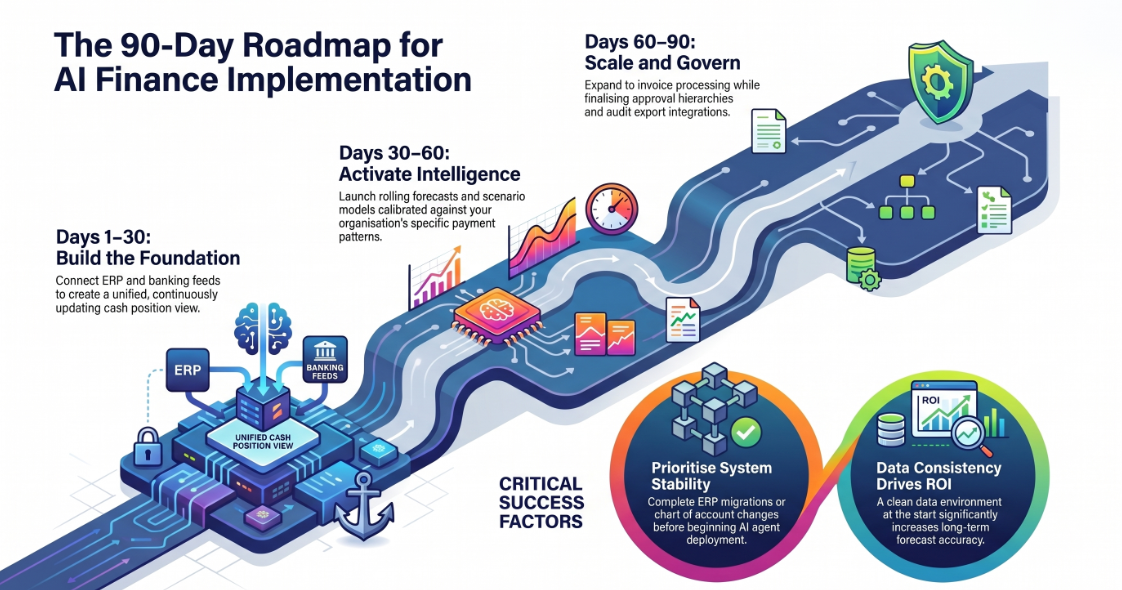
Days 1 to 30: Data foundation and first integration. The first phase focuses on connecting the AI agent to your primary data sources — your ERP, your banking feeds, and your accounts receivable and payable data. This is where the unified financial data model is built: a single, continuously updating view of your organisation's cash position across all accounts and entities. The agent begins monitoring from day one of live connection, and the first anomaly alerts typically surface within the first two weeks.
Days 30 to 60: Forecasting and scenario modelling go live. Once the data foundation is stable, rolling forecasts are activated. The finance team reviews and calibrates the model against actuals from the first 30 days — this is where the machine learning component begins improving accuracy based on your specific organisation's payment patterns, seasonal variability, and operational rhythms. Scenario models are built for the two or three strategic questions most relevant to your current planning cycle: a major client payment risk, a capex decision, a hiring plan.
Days 60 to 90: Expanding the footprint and calibrating governance. The third phase typically involves expanding the agent's scope to additional use cases — invoice processing, cost intelligence, regulatory filing support — and finalising the governance configuration: approval hierarchies, alert thresholds, role-based access settings, and audit export integrations. By the end of day 90, most organisations have a finance function that is operating with meaningfully more analytical visibility than it had three months earlier.
The most important factor in a successful 90-day implementation is stability on the integration side. If the organisation is mid-ERP-migration or has recently changed its chart of accounts, it is worth completing those transitions before beginning the AI agent deployment. The agent's accuracy improves with data consistency — and a clean data environment at the start pays dividends in forecast accuracy throughout.
Why Indian Finance Leaders Are Moving on This Now
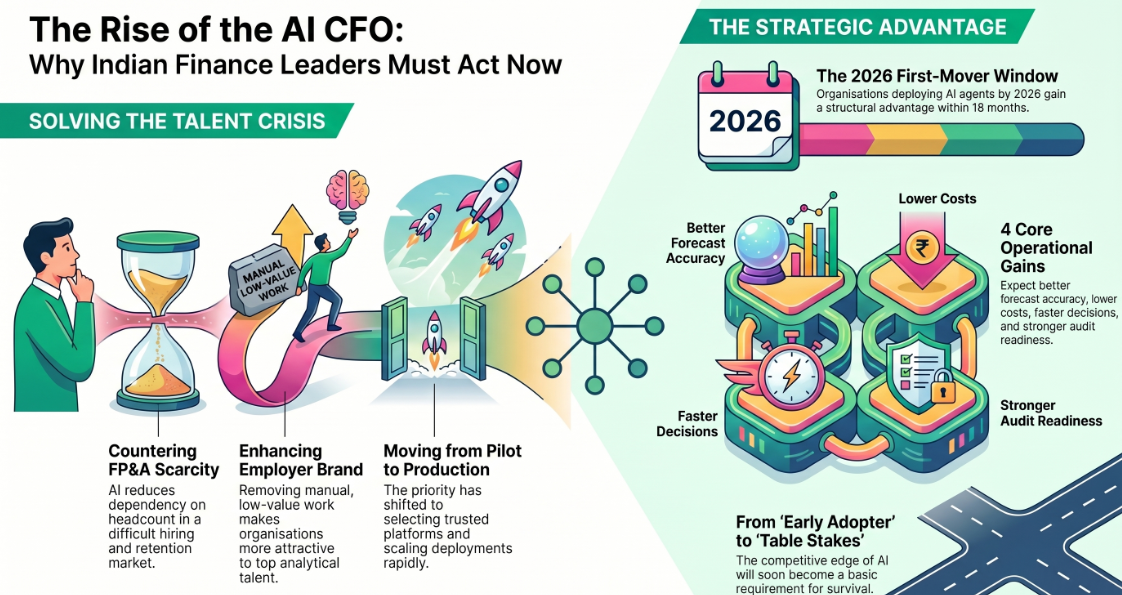
The window for first-mover advantage in AI-driven finance is real but not permanent. The organisations that deploy AI CFO agents in 2026 will have, within 12 to 18 months, a structural operating advantage: better forecast accuracy, lower cost of finance operations, faster decision cycles, and stronger audit readiness. As more organisations deploy these systems, the advantage shifts from "early adopter" to "table stakes."
For Indian CFOs specifically, the urgency is compounded by the talent market. Experienced FP&A professionals are difficult to hire and retain. An AI CFO agent that removes the manual, low-value work from the finance function makes the organisation a more attractive employer for the analytical talent it needs — while simultaneously reducing its dependency on headcount for tasks that should be automated.
The question Indian finance leaders are asking has already shifted. It is no longer whether AI belongs in the finance function. It is which use case to start with, which platform to trust, and how to move from pilot to production fast enough to matter.
Start Here: AI Solutions for CFOs at assistents.ai
assistents.ai is the enterprise agentic AI platform built to take finance operations from data to done. The CFO solution covers cash flow monitoring, rolling forecasts, scenario planning, cost intelligence, invoice automation, regulatory compliance, and real-time revenue analytics — with enterprise-grade security, SOX-compliant audit architecture, and 85-plus pre-built integrations with the financial systems Indian enterprises run on.
If you are evaluating AI solutions for your finance function, the CFO solutions page at assistents.ai/solutions/cfo covers the full capability set, including a breakdown of use cases, integration architecture, and the financial controls framework.
To see the platform in the context of your specific financial environment, schedule a CFO briefing with the assistents.ai team.
FAQs
- What is an AI CFO agent and how does it work?
An AI CFO agent is an autonomous software system that continuously monitors, analyses, and acts on financial data across an organisation's connected systems — including ERP, banking feeds, accounts receivable, accounts payable, and procurement platforms.
Unlike traditional finance software that waits for a human to run a report or trigger a query, an AI CFO agent operates in the background at all times: ingesting real-time data, detecting anomalies, generating rolling cash flow forecasts, running scenario models, routing exceptions for human approval, and maintaining a complete audit trail of every action it takes.
It works within a defined governance framework — with role-based access controls, approval hierarchies, and segregation of duties — so that autonomous operation does not come at the cost of financial control. The result is a finance function that produces continuous, current-day insight rather than periodic, backward-looking reports.
- How accurate is AI cash flow forecasting compared to manual methods?
AI cash flow forecasting is significantly more accurate than manual methods. According to AFP Treasury Benchmarking data, organisations using manual or semi-automated forecasting achieve roughly 60% accuracy at the 13-week horizon. Organisations using AI-assisted forecasting agents consistently reach 88 to 92% accuracy at the same horizon — a gap of 28 to 32 percentage points.
The accuracy improvement comes from three factors: AI agents ingest real-time data from ERP and banking systems rather than relying on data that is three to seven days old by the time a human assembles it; machine learning models identify payment timing patterns specific to the organisation's customer and supplier behaviour; and forecasts update continuously as new actuals come in, rather than remaining static between weekly or monthly review cycles.
For Indian enterprises, accuracy further improves when the model is calibrated to account for GST payment cycles, seasonal working capital patterns, and multi-entity cash positions.
- Can an AI CFO agent handle Indian regulatory and compliance requirements?
Yes, provided the platform is built with the right compliance architecture. A well-designed AI CFO agent supports regulatory filing automation — assembling, validating, and submitting filings by pulling data from source systems, applying jurisdiction-specific formatting rules, and flagging missing fields before deadlines.
For Indian enterprises, this includes support for GST return preparation, TDS reconciliation, MCA filing workflows, and SEBI disclosure requirements. Beyond filing automation, the platform should produce immutable audit logs for every agent action — logs that are readable by external auditors and exportable to SIEM systems.
Role-based access control, maker/checker separation, and dual authorisation for sensitive transactions are also essential for organisations subject to statutory audit in India. The key question to ask any vendor is whether these controls are built into the platform's core architecture or added as a configuration layer — the former is significantly more reliable.
- How long does it take to implement an AI CFO agent in an Indian enterprise?
Most Indian enterprises live on their first AI CFO agent use case — typically cash flow monitoring and rolling forecasts — within four to eight weeks of beginning implementation. The timeline depends primarily on the complexity of the systems being integrated and the cleanliness of the underlying financial data.
The first phase covers connecting the agent to primary data sources: the organisation's ERP or accounting system and at least one banking feed. Once the data foundation is stable, forecasting and scenario modelling are activated, and the model begins calibrating against the organisation's specific payment patterns and cash flow rhythms.
Full deployment across additional use cases — invoice automation, cost intelligence, compliance filing, revenue analytics — typically follows over the subsequent two to three months. Organisations that are mid-ERP-migration or recently changed their chart of accounts are advised to complete those transitions before beginning deployment, as data consistency is the most important factor in forecast accuracy.
- What is the ROI of deploying an AI CFO agent for a mid-to-large Indian enterprise?
Enterprise deployments of AI CFO agents typically deliver ROI across three categories. First, direct cost reduction: AI agents that monitor spend across procurement, operations, and overhead identify vendor price drift, duplicate spend, and consolidation opportunities — delivering an average 40% reduction in monitored spend categories.
Second, productivity gains: automating manual finance workflows — daily cash positioning, invoice processing, variance analysis, regulatory filing, and report generation — frees finance team capacity for strategic analysis rather than data assembly. Third, risk reduction: improved forecast accuracy reduces the cost of liquidity surprises, earlier anomaly detection catches errors and fraud signals before they compound, and stronger compliance documentation reduces audit risk and the cost of regulatory non-compliance.
Taken together, these three categories typically produce a 12-month payback period for enterprise deployments. For growing businesses deploying an AI CFO agent in an advisory model — where the platform serves as the analytical engine behind a CFO-as-a-service offering — the economics are even more direct: one advisor can serve a significantly larger client portfolio with the same or better analytical depth.

Transform Your Business With Agentic Automation
Agentic automation is the rising star posied to overtake RPA and bring about a new wave of intelligent automation. Explore the core concepts of agentic automation, how it works, real-life examples and strategies for a successful implementation in this ebook.
Sarfraz Nawaz is the CEO and founder of Ampcome, which is at the forefront of Artificial Intelligence (AI) Development. Nawaz's passion for technology is matched by his commitment to creating solutions that drive real-world results. Under his leadership, Ampcome's team of talented engineers and developers craft innovative IT solutions that empower businesses to thrive in the ever-evolving technological landscape.Ampcome's success is a testament to Nawaz's dedication to excellence and his unwavering belief in the transformative power of technology.

More insights
Discover the latest trends, best practices, and expert opinions that can reshape your perspective



Contact us

