
Cut Data Team Costs Using AI- How Agentic Analytics Drives Massive ROI in 2026


The data analytics industry is at a breaking point. Companies are hemorrhaging money on bloated data teams, tool sprawl, and manual processes that deliver insights weeks too late. But there's a solution that's already transforming how forward-thinking enterprises approach data: agentic analytics.
If you're spending hundreds of thousands on data analysts who act as human APIs, drowning in dashboard requests, or watching your analytics budget balloon while ROI stagnates, this guide is your roadmap to cutting costs.
Why Data Costs Are Out of Control (and Why AI Is the Fix)
Let's talk numbers. Poor data quality alone costs companies 15-25% of their budget annually, according to recent research. But that's just the tip of the iceberg. The real drain comes from the human labor required to extract, clean, analyze, and present data insights.
Consider this: a full-time data analyst in the United States costs between $80,000 and $120,000 per year in salary alone. Senior data scientists? That figure jumps to over $150,000 annually. When you factor in benefits, training, recruitment, and overhead, you're looking at substantial investments that many organizations struggle to justify.
But data analysts spend 60% of their time just cleaning and organizing data. That means you're paying premium rates for work that could be automated. The remaining 30-40% goes to creating dashboards, answering ad-hoc questions, and generating reports that are often outdated by the time they reach decision-makers.
The traditional business intelligence model simply doesn't scale. As data volumes explode and business complexity increases, organizations find themselves in a vicious cycle: hire more analysts to handle the workload, which creates more tool licenses, more coordination overhead, and ultimately, diminishing returns on your analytics investment.
This is where agentic analytics enters the picture, not as another incremental improvement, but as a fundamental reimagining of how data teams operate.
What Is Agentic Analytics? (Understanding the Evolution)
Before we dive into cost savings, let's establish what agentic analytics actually means and why it matters for your bottom line.
Agentic analytics represents the evolution from conversational analytics to autonomous decision systems. While conversational AI lets you ask questions in natural language, agentic analytics goes several steps further: it autonomously explores data, detects patterns, generates insights, and can even initiate actions without human prompting.
Think of it this way: traditional BI tools are like calculators, you input specific queries and get specific answers. Conversational analytics is like having a smart assistant who can understand your questions better.
But agentic analytics? That's like having a full-time analyst who proactively monitors your business, spots anomalies, conducts root-cause analysis, and presents actionable recommendations, all without you having to ask.
Here's how agentic analytics differs from traditional approaches:
- Traditional BI: Pre-built dashboards, static reports, requires analysts to create everything, business users are passive consumers.
- Conversational Analytics: Natural language queries, on-demand answers, still requires humans to ask the right questions, limited to single-turn interactions.
- Agentic Analytics: Autonomous exploration and monitoring, multi-step reasoning and analysis, proactive insight generation, action-oriented recommendations, continuous learning from outcomes.
The architecture of agentic analytics typically involves three core layers: a semantic fusion layer that understands your business context and data relationships, a reasoning layer where AI agents analyze patterns and determine causation.
The Real Reason Enterprises Overspend on Data Teams
To understand how agentic analytics cuts costs, we first need to dissect where your data budget actually goes.
Let's break down the hidden cost centers:
- Data Engineering Backlogs: Every new data source requires integration work. Every schema change needs pipeline updates. Your engineering team spends countless hours building and maintaining ETL processes that break regularly. The average organization has dozens of data sources, and each connection point is a potential failure point requiring engineering attention.
- Manual SQL and Dashboard Creation: Business users can't access data directly, so they submit requests to analysts. Analysts translate these requests into SQL queries, build visualizations, and create dashboards. This process takes days or weeks per request, and the backlog keeps growing.
- Constant Ad Hoc Requests: "Can you pull this data?" "Can you add this filter?" "Can you show this by region instead of by product?" Each variation spawns a new ticket. Your analysts become glorified report generators rather than strategic advisors, and the opportunity cost is enormous.
- Analysts as Human APIs: Business teams learn they can't get data directly, so they route every question through analysts. Instead of empowering decision-makers with self-service capabilities, you've created a bottleneck where highly paid professionals spend their days answering routine questions that could be automated.
- Tool and Warehouse Costs Increasing Yearly: As data volumes grow, so do your cloud warehouse costs. You add more BI tools to cover different use cases. You purchase data quality tools, monitoring tools, and cataloging tools.
- Lack of Automation in Insights and Decision Flows: The most insidious cost is what you miss. Opportunities slip by because insights arrive too late.
How Agentic Analytics Cuts Data Team Costs (Direct Mechanisms)
Now we get to the practical part: exactly how agentic analytics reduces your data team costs while improving output quality.
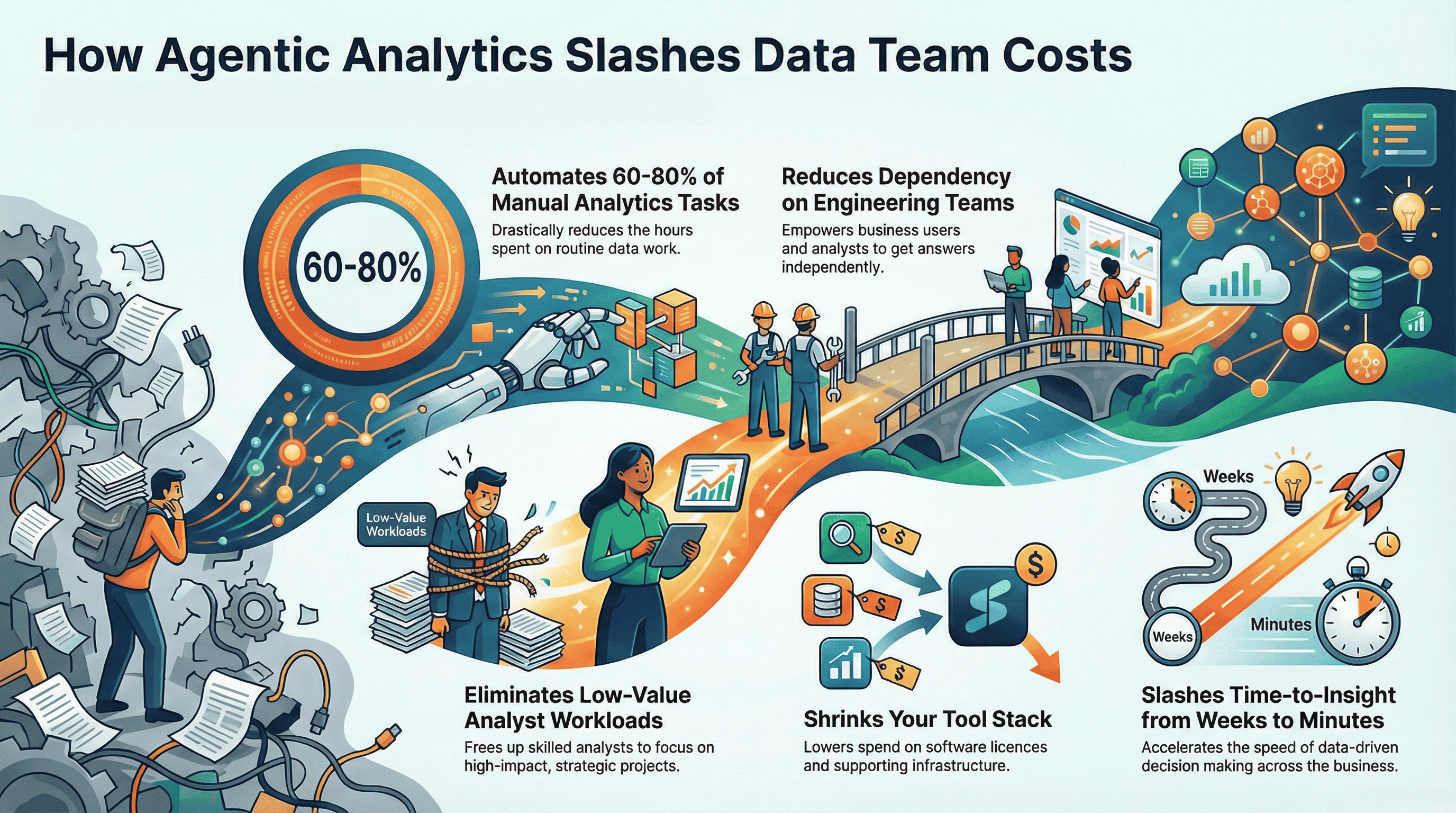
1. Automates 60-80% of Manual Analytics Tasks
The most immediate cost benefit comes from automation of routine analytical work. Agentic analytics can autonomously handle SQL generation based on natural language requests, KPI monitoring with automatic anomaly detection, root-cause analysis when metrics deviate from expected ranges, and insight summaries that explain trends in plain language.
What used to require a senior analyst spending 2-3 hours on SQL queries, data validation, and visualization can now happen in minutes through agentic systems. For organizations with 5-10 analysts spending half their time on these tasks, that's potentially 4-5 full-time equivalents of work that can be automated.
2. Eliminates Low-Value Analyst Workloads
Agentic analytics fundamentally changes the "make me this dashboard" cycle that consumes so much analyst time. Instead of analysts as intermediaries between business users and data, agents can generate insights on demand directly for end users.
Your data team shifts from request fulfillment to strategic work: designing the semantic layer that agents use, ensuring data quality, building complex models, and advising on high-impact business questions. The routine work that didn't require senior expertise? That's automated.
3. Reduces Dependency on Large Engineering Teams
One of the biggest hidden costs in analytics is the engineering overhead required to maintain data pipelines. Agentic analytics platforms typically include robust semantic layers that abstract away much of this complexity.
Instead of building custom ETL pipelines for every data source, you define relationships once in the semantic layer. The agentic system handles querying across multiple sources, joining data intelligently, and ensuring consistency.
4. Shrinks Tool Stack and Reduces License and Infrastructure Spend
Here's where agentic analytics delivers compound savings.
Consider an organization paying $50,000 annually for BI licenses, $30,000 for data quality tools, $40,000 for monitoring solutions, and $25,000 for analytics chatbot features. Consolidating to a unified agentic analytics platform could cut tool costs by 40-60% while improving capabilities.
5. Cuts Time-to-Insight from Weeks to Minutes
Time is money, and in business, faster insights drive better outcomes. When you can answer "Why did conversion drop 15% last week?" in minutes rather than waiting days for an analyst to investigate, you can course-correct immediately rather than hemorrhaging revenue.
Organizations with mature data practices achieve 19 times higher profitability, according to McKinsey research. The speed advantage of agentic analytics contributes directly to these outcomes by enabling real-time decision-making at scale.
How Agentic Analytics Increases ROI (Even While Cutting Costs)
Cost reduction is compelling, but the real business case for agentic AI analytics comes from its ability to drive revenue growth and operational improvements that far exceed the cost savings alone. Let's examine the ROI multipliers.
1. Real-Time Decision-Making Drives Revenue Growth
When insights arrive in real-time, organizations can capitalise on opportunities and mitigate risks immediately. An e-commerce company detecting an inventory shortage for a trending product can expedite restocking within hours. A SaaS company spotting churn signals can trigger retention campaigns before customers cancel.
2. Agents Continuously Learn from Outcomes
Unlike static BI dashboards or one-off analyses, agentic systems improve over time. They learn which patterns matter for your business, which anomalies are false alarms versus genuine issues, and which recommendations drive the best outcomes.
This creates compounding returns. In month one, the agent might catch 60% of significant business events. By month six, it's at 85%. By year one, it's proactively surfacing insights your human analysts might have missed because the agent can monitor hundreds of metrics simultaneously without fatigue or bias.
3. De-Risks Decisions by Automating Checks
Agentic analytics excels at preventing costly mistakes. By continuously monitoring for anomalies, data quality issues, and unusual patterns, agents can flag problems before they cascade into major business impacts.
Consider a scenario where a data entry error inflates projected revenue by $1.2 million. An agentic system would flag the anomaly within hours, preventing bad decisions downstream. For a fintech company, preventing such errors even once could justify the entire platform investment.
4. Turns Every Employee into a Data Power User
Perhaps the most transformative ROI lever is democratization. When business users can ask complex analytical questions in natural language and receive accurate, actionable answers instantly, you've eliminated the bottleneck that constrains data-driven culture.
Marketing can test hypotheses without waiting for analyst support. Operations can investigate efficiency opportunities on their own timeline. Product teams can validate assumptions with real data rather than gut feel.
Real-World Cost Savings: What to Expect
Let's translate these mechanisms into concrete numbers. While exact savings vary based on your current state and implementation approach, here are realistic scenarios based on typical enterprise patterns:
SaaS Company (500 employees, 7 data analysts, $850K annual data team costs)
- Automated 40% of routine analytics tasks: $340K saved in analyst time
- Eliminated 4 redundant analytics tools: $95K annual license savings
- Reduced engineering pipeline maintenance: $120K saved (0.5 FTE)
- Total Annual Savings: $555K
- Time-to-Insight Improvement: 75% reduction (from 3-5 days to same-day)
- Additional Revenue Impact: 8% improvement in conversion through faster experimentation
E-Commerce Company (2,000 employees, 15 data analysts, $2.1M annual data team costs)
- Automated 65% of reporting and monitoring: $900K saved in analyst capacity
- Consolidated 6 point solutions into unified platform: $180K tool savings
- Reduced data engineering team by 2 FTEs: $300K saved
- Total Annual Savings: $1.38M
- Business Impact: Prevented $450K in lost revenue through faster anomaly detection
- Customer Experience: 12% increase in revenue per customer through personalized insights
Fintech Company (800 employees, 10 data analysts, $1.4M annual data team costs)
- Automated 55% of compliance and risk analytics: $550K saved
- Reduced tool sprawl and infrastructure costs: $135K saved
- Prevented fraud and data errors: $1.2M in avoided losses
- Total Annual Savings: $685K
- Additional Value: 35% faster time-to-market for new products due to accelerated analytics
These examples demonstrate a consistent pattern: organizations typically save 30-50% on direct analytics costs while simultaneously improving the speed and quality of insights. The combination creates a compelling financial case even before accounting for revenue growth opportunities.
How to Calculate Your Potential Savings
Want to estimate what agentic analytics could save your organization? Use this framework:
Annual Savings = (Analyst Hours Saved × Cost per Hour) + (Tools Eliminated × Annual License Cost) + (Revenue Gain from Faster Decisions) + (Losses Prevented via Automated Monitoring)
Let's break down each component:
- Analyst Hours Saved: Multiply your total analyst headcount by their average hourly cost (typically $50-$80/hour), then multiply by the percentage of routine work that can be automated (typically 40-70%). This gives you annual labor savings.
- Tools Eliminated: Audit your current analytics tool stack. Identify overlapping capabilities that agentic analytics could consolidate. Sum the annual costs of tools you could retire.
- Revenue Gains: This is harder to quantify but critical. Estimate the business value of 5-10x faster insights. If faster decision-making could improve conversion rates by even 2-3%, what's that worth in annual revenue?
- Losses Prevented: How much do data quality issues, missed anomalies, or late insights currently cost you annually? Even preventing one major error per year can justify significant platform investment.
- For most mid-market to enterprise organizations, this calculation yields ROI in the 150-300% range within the first year, with ROI improving in years two and three as adoption deepens and the system learns your business patterns.
Getting Started: Implementation Without Disruption
The biggest barrier to realizing these savings is change management and implementation risk. Here's how to adopt agentic analytics without disrupting existing operations:
Phase 1: Start with 1-2 High-Value Workflows (Weeks 1-4)
Don't boil the ocean. Identify one or two analytical workflows that are both painful (consuming significant analyst time) and repeatable (happen frequently). Common starting points include weekly revenue reporting, customer churn analysis, or marketing campaign performance dashboards.
Deploy agentic analytics for these specific use cases. Measure the time savings and accuracy improvements. Use early wins to build organizational confidence.
Phase 2: Build Your Semantic Layer (Weeks 4-8)
The semantic layer is how agentic systems understand your business context. Invest time defining key metrics, relationships, and business rules in a structured way.
This upfront work pays dividends because once defined, the semantic layer enables agents to answer thousands of questions without custom coding for each one. Many organizations find this exercise valuable in itself, as it forces alignment on metric definitions that were previously ambiguous.
Phase 3: Deploy Agentic Reasoning (Weeks 8-12)
With semantic foundations in place, enable autonomous analysis capabilities. Configure agents to monitor key metrics, detect anomalies, and conduct root-cause analysis automatically.
Start with monitoring and alerting before moving to fully autonomous actions. Build trust gradually by showing stakeholders that agents are catching issues effectively and surfacing insights that would have been missed manually.
Phase 4: Add Action Layer (Weeks 12-16)
Once monitoring is trusted, enable agents to take actions based on insights—whether that's triggering workflows, updating dashboards, or sending recommendations to decision-makers.
The key is appropriate guardrails. Agents should have clear boundaries on what they can do autonomously versus what requires human approval, especially in early stages.
Phase 5: Iterate Based on Feedback (Ongoing)
Treat agentic analytics as a product, not a project. Gather user feedback weekly. Identify gaps in the semantic layer. Refine agent behaviors based on what's working and what isn't.
Why Assistents.ai Is Leading the Agentic Analytics Revolution
At Assistents.ai, we've pioneered conversational and agentic AI specifically for enterprise analytics. Unlike generic AI tools retrofitted for data analysis, our platform was built from the ground up to handle the complexity of real-world business data.
Here's what sets Assistents.ai apart:
- True Agentic Capabilities: Our AI agents autonomously explore your data, identify patterns, conduct multi-step analysis, and surface insights you didn't know to ask about.
- Enterprise-Grade Semantic Layer: We understand that 80-90% of enterprise data is unstructured or external. Our platform seamlessly integrates structured databases with documents, emails, and web content to give you insights.
- Purpose-Built for Business Context: Assistents.ai is optimized specifically for enterprise analytics, with built-in understanding of business metrics, industry-specific KPIs, and complex data relationships.
- Governed and Secure: We respect enterprise security and governance requirements. Our platform ensures users only access data they're authorized to see.
- Rapid Time-to-Value: With Assistents.ai, organizations see measurable value within 3-6 weeks, with full deployment achievable in under 4 months.
- Proven ROI: Our customers report 40-65% reductions in routine analytics workload, 70-80% decreases in time-to-insight, and significant cost savings from tool consolidation.
If you're ready to cut data team costs while accelerating business value, Assistents.ai offers a proven path forward. Our platform turns the promise of agentic analytics into practical, measurable business outcomes.
The Future Is Autonomous: AI Is Replacing Waste
Let's be clear about what agentic analytics means for data teams: this isn't about eliminating analysts. It's about eliminating the waste that prevents analysts from doing their best work.
Right now, your data team spends most of its time on routine tasks that could be automated: cleaning data, generating standard reports, answering repetitive questions, maintaining dashboards that barely anyone uses.
Agentic analytics automates the mundane so analysts can focus on the strategic: designing experiments that drive growth, building predictive models that prevent churn, advising executives on high-stakes decisions, uncovering insights that transform business strategy.
ROI compounds over time as the system learns your business patterns, as adoption spreads across departments, as saved costs translate to reinvestment in growth initiatives. Year one delivers cost savings. Year two adds revenue growth. Year three, you're operating at a level competitors can't match.
Start small. Automate one insight. Let the results speak.
Ready to see how agentic analytics can transform your data operations? Contact Assistents.ai for a personalized ROI assessment and demo of our platform in action.

Transform Your Business With Agentic Automation
Agentic automation is the rising star posied to overtake RPA and bring about a new wave of intelligent automation. Explore the core concepts of agentic automation, how it works, real-life examples and strategies for a successful implementation in this ebook.
Sarfraz Nawaz is the CEO and founder of Ampcome, which is at the forefront of Artificial Intelligence (AI) Development. Nawaz's passion for technology is matched by his commitment to creating solutions that drive real-world results. Under his leadership, Ampcome's team of talented engineers and developers craft innovative IT solutions that empower businesses to thrive in the ever-evolving technological landscape.Ampcome's success is a testament to Nawaz's dedication to excellence and his unwavering belief in the transformative power of technology.

More insights
Discover the latest trends, best practices, and expert opinions that can reshape your perspective




Contact us

