
AI Agents for Restaurants in 2026: Use Cases, ROI, and How to Choose a Platform for Multi-Location Operators


Most content about AI agents for restaurants stops at the phone. A voice agent answers calls, books a table, and everyone calls it transformation. The margin problem in restaurants isn't at the host stand, though. It sits in the gap between your best and worst outlets, in supplier prices that creep up a few rupees or cents a week, in labor schedules built on last month's guesswork, and in dashboards that tell a manager what went wrong a week after it happened.
This guide covers the whole picture: what restaurant AI agents actually are, the use cases that move prime cost, how to calculate ROI, which platforms lead in 2026, and how to roll agents out across a multi-location group without losing control.
Key takeaways
- Definition: AI agents for restaurants are software systems that read live data from your POS, inventory, labor and supplier systems, decide what to do under your business rules, and act, with human approval where the stakes are high.
- Adoption is early, not rare: 26% of US operators use AI tools, but only 6% use AI for customer ordering, according to the National Restaurant Association's 2026 report.
- The biggest prize is operational: PAR reports that the average profitability gap between a multi-unit operator's best and worst stores is 6.4x. Closing even part of that gap outweighs most front-of-house gains.
- Governance is the bottleneck: Deloitte found only 21% of restaurant executives feel highly prepared on AI risk and governance.
- Match the agent to the job: For single-location, guest-facing needs, a voice or POS-native assistant is often enough. For multi-location groups that need agents acting across POS, inventory, labor, suppliers and ERP under group-wide rules, a governed operations platform such as assistents.ai is the stronger fit.
What are AI agents for restaurants?
AI agents for restaurants are autonomous software systems that monitor restaurant data, reason about what it means, and take action, such as drafting a schedule, flagging a supplier price rise, raising a reorder, or answering a guest, within limits the operator sets. Unlike a dashboard, an agent doesn't wait for someone to look. Unlike a script, it can handle situations nobody wrote a rule for, while still following the rules that matter.
Picture a Friday dinner service. A dashboard shows you that chicken wings sold 30% above forecast. An agent notices it at 7:40 pm, checks stock against the remaining reservations, tells the kitchen lead the item will run out by 9:15, suggests an 86 or a substitution, and adds a quantity correction to Monday's order for the manager to approve.
AI agents vs chatbots vs automation vs POS copilots
These four terms get used interchangeably. They are not the same thing.
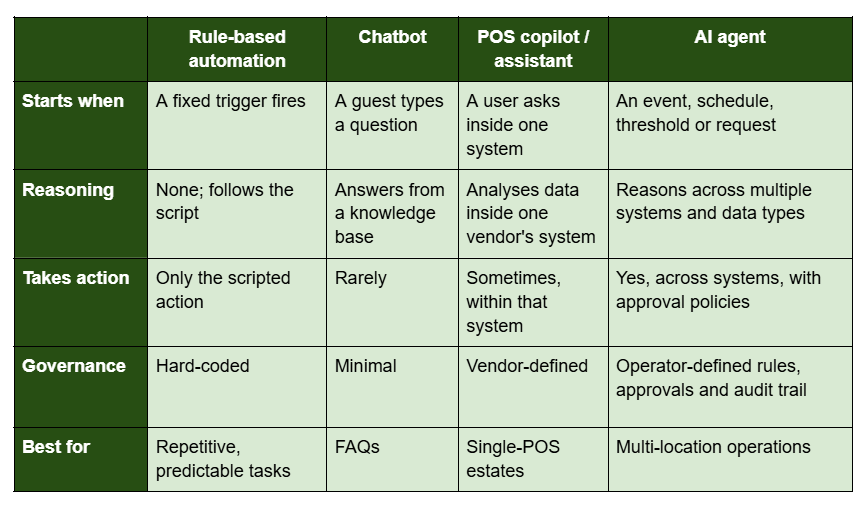
The practical test: if it can't act, it's an assistant; if it can act but you can't see why, it isn't safe. A production-grade restaurant agent does both, and leaves a record.
Why 2026 is the tipping point for AI in restaurants
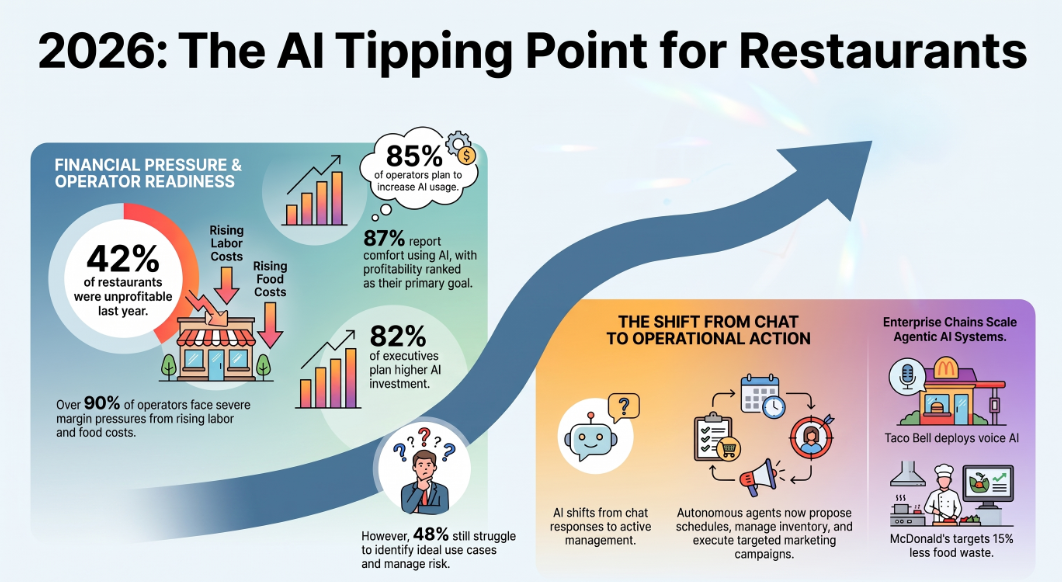
Three forces converged this year.
1. Margins are under pressure. The National Restaurant Association projects $1.55 trillion in 2026 US restaurant sales. More than 9 in 10 operators call food, labor, insurance, energy and card fees significant challenges, and 42% said their restaurant wasn't profitable in the prior year. When the median operator is fighting for a few points of margin, software that recovers even one point of prime cost is no longer optional.
2. Operators are ready. Toast's 2026 operator survey of 676 restaurants found 87% are comfortable using AI and 85% plan to use more of it. Profitability was the number-one goal. Deloitte's global survey of restaurant executives found 82% plan to increase AI investment, but 48% struggle to identify the right use cases and 48% cite managing risk as a top concern (Deloitte).
3. The market moved from chat to action. In 2026:
- PAR launched PAR Intelligence, which it calls an agentic operating system for multi-unit operators.
- Square opened Managerbot to US sellers. It proposes actions such as schedules and inventory steps, and every action needs the seller's approval.
- Toast released Toast IQ Grow with an AI marketing agent in beta.
- Taco Bell now runs drive-thru voice AI in nearly 900 restaurants.
- McDonald's unveiled ArchIQ, an AI restaurant operating system spanning drive-thru, inventory and equipment. The company says its tag-based inventory tracking should cut food waste by about 15%.
The direction is clear: agents are becoming the operating layer of the restaurant, not just the voice at the front door.
The Restaurant Agent Stack: four layers every operator should understand
Most confusion in this market comes from comparing tools that do different jobs. We use a simple four-layer model, the Restaurant Agent Stack, to map any product to the job it actually does.
Layer 1: Guest agents. Voice agents that answer calls and take bookings or orders, chat and messaging agents, review-response agents, and drive-thru voice. They make the guest experience faster and capture revenue that would otherwise be missed.
Layer 2: POS-native assistants. Assistants built into a single point-of-sale ecosystem, such as Toast IQ, Square Managerbot and PAR Intelligence. They're strong when your whole estate runs on that one POS and the question lives inside it.
Layer 3: Point tools with AI. Scheduling, inventory, procurement and analytics products that have added AI to one function, such as labor forecasting or recipe costing.
Layer 4: The cross-system operations layer. Agents that read across every layer below, plus your ERP, supplier portals, delivery aggregators and documents. They apply one set of group-wide rules and definitions, and take action with approvals and an audit trail. This is the layer that explains why Outlet 14's food cost is 3 points above Outlet 9's, and then does something about it.
Independent restaurants usually live in Layers 1 to 3. Multi-location groups, franchisors and cloud-kitchen operators hit a wall there: each tool sees one slice, definitions disagree, and nobody owns the action. Layer 4 is where assistents.ai is built to operate: a governed system of agency above the systems you already run.
14 high-value use cases for AI agents in restaurants
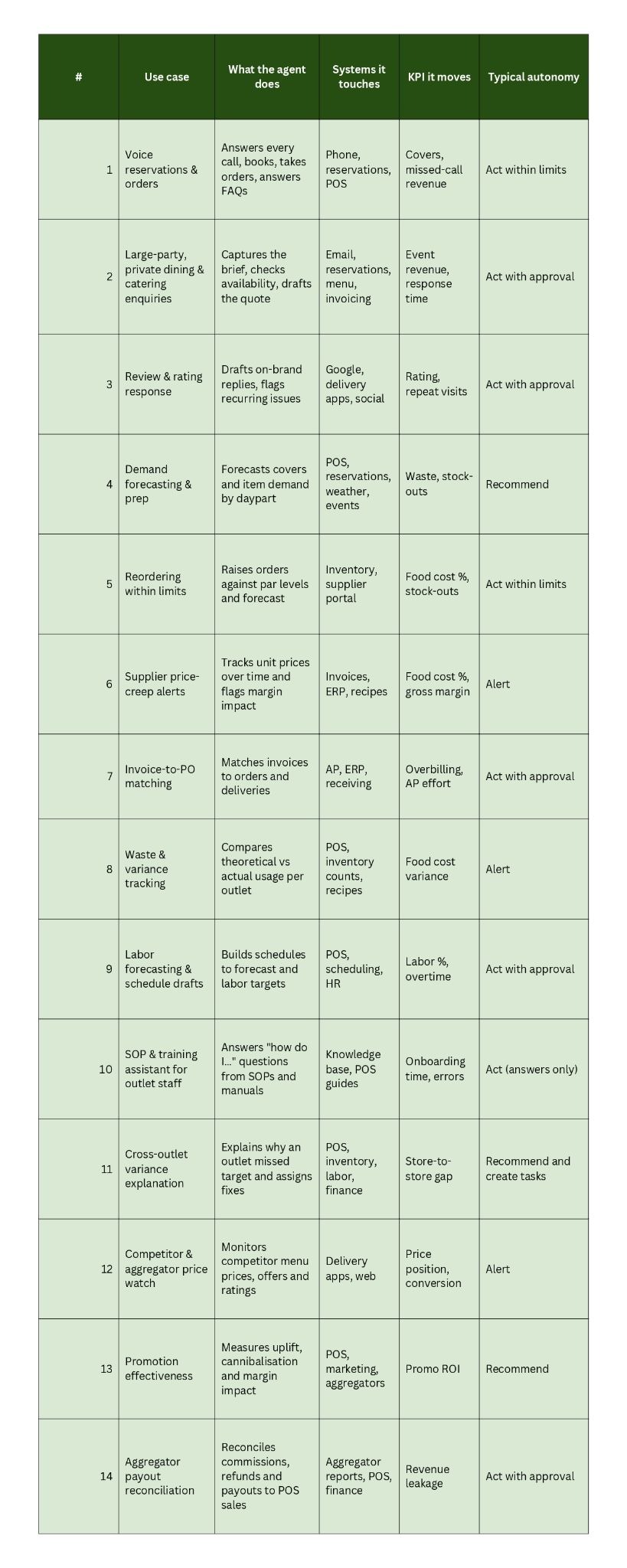
Guest-facing agents
Guest agents are the most visible, and still one of the least adopted categories. Only 6% of operators use AI for customer ordering today. The case for voice is simple: in the 2026 DoorDash and SevenRooms trends study, 64% of diners still call to book, 40% of those calls go unanswered, and 74% of diners are open to AI handling reservations. If you're evaluating this layer specifically, our comparison of the best voice AI agents for restaurants goes deeper on latency, POS integration and pricing.
The underrated guest-facing use case is the complex enquiry: private dining, large parties, corporate catering. These arrive by email with missing details, need availability checks and a quote, and are high value. An agent can run the back-and-forth, capture every requirement, and hand a finished brief to a human for the final touch.
Kitchen and supply agents
This is where prime cost lives. A forecasting agent that knows reservations, local events and weather prepares the kitchen better than last week's average. A reorder agent works within par levels and spend caps you define. A supplier price-creep agent is the quiet hero. It watches unit prices on proteins, dairy and produce invoice by invoice, calculates the effect on each menu item's margin, and alerts the purchasing lead before the quarter closes rather than after.
People agents
Labor is the other half of prime cost. Scheduling agents draft rosters against forecast demand and your labor-percentage targets, then send them for manager approval. Just as valuable in high-turnover teams is an SOP and training agent: new staff ask it "how do I void a split bill?" or "what's the allergen protocol for the new dish?" and get an answer grounded in your own manuals, with citations, not a guess.
Multi-unit finance and growth agents
For groups with 10, 50 or 500 outlets, this is the highest-return layer. A variance agent doesn't just show that Outlet 14 missed food cost by 3 points. It traces the cause across POS mix, waste logs, supplier prices and receiving, then creates a task for the area manager and tracks it until it's done. Add competitor and aggregator price monitoring, promotion analysis and payout reconciliation, and head office moves from reading reports to running an execution loop.
The Restaurant Agent Autonomy Ladder
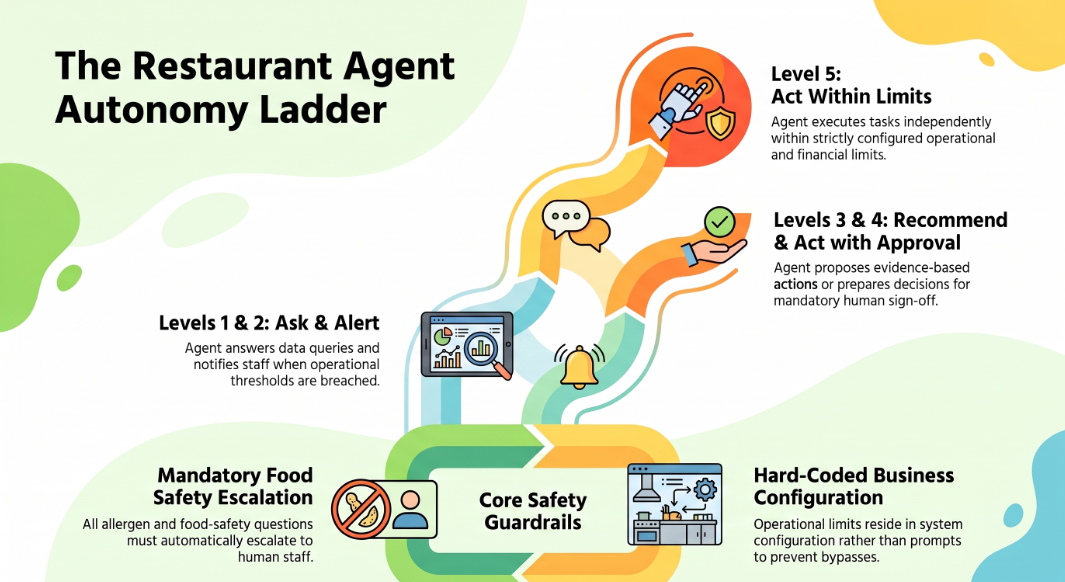
Not every decision should be automated, and not every decision needs a human. We use a five-rung Autonomy Ladder to decide where each agent sits:
- Ask: The agent answers questions from governed data. "What was food cost % by outlet last week?"
- Alert: The agent monitors thresholds and notifies the right person. "Dairy unit cost is up 9% in four weeks; margin impact on 12 dishes attached."
- Recommend: The agent proposes an action with evidence. "Reduce Tuesday lunch labor at Outlet 7 by 6 hours; forecast attached."
- Act with approval: The agent prepares the action and a human approves it. Menu price changes, supplier switches, schedule publication, refunds above a limit.
- Act within limits: The agent executes on its own inside hard boundaries. Reorders under a spend cap, standard booking confirmations, FAQ answers.
Two rules keep this safe. First, allergen and food-safety questions always escalate to a human, whatever the rung. Second, the boundaries live in business configuration, not in the prompt, so a spend cap or approval limit can't be "talked around" by a clever request. On assistents.ai, these rungs map to three operating modes: Ask & Analyze, Execute Workflows, and Autonomous Agents. Approval requirements are set per decision class.
How to calculate the ROI of AI agents for restaurants
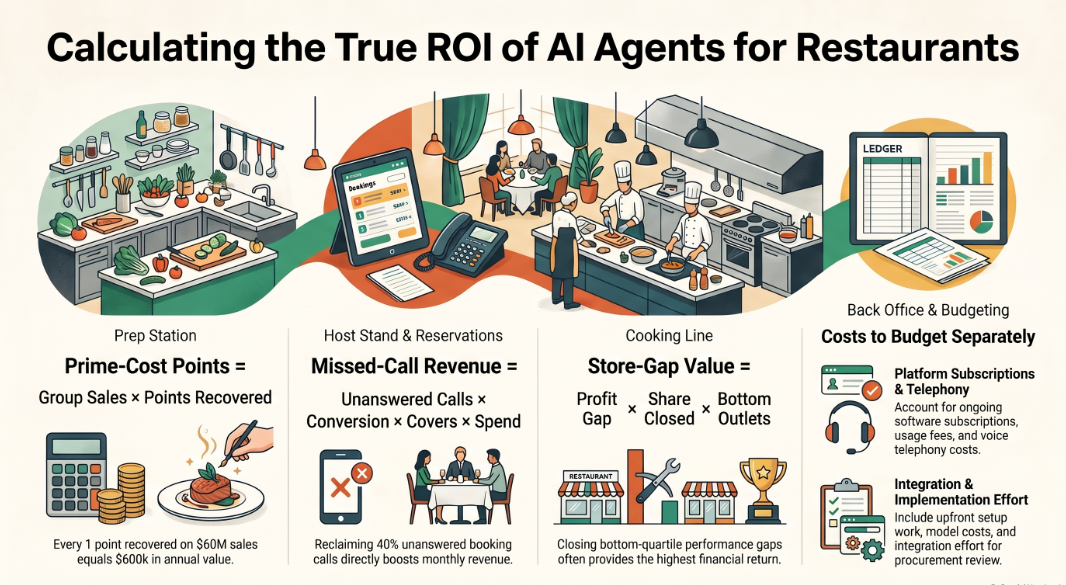
Vendors love a headline ROI number. Operators should calculate their own. Here are the four formulas we use, with an illustrative example for each. The examples use stated assumptions, not guaranteed results.
1. Prime-cost points
Annual value = group sales × prime-cost points recovered
A 40-outlet group averaging $1.5M in annual sales per outlet turns over $60M. Every 1 point of prime cost is worth $600,000 a year. In India, 40 outlets averaging ₹6 crore each turn over ₹240 crore, so 1 point is ₹2.4 crore. Agents that tighten ordering, waste, supplier pricing and scheduling are chasing points, not decimals.
2. Missed-call revenue (guest agents)
Monthly value = booking calls × unanswered rate × conversion rate × covers per booking × average spend
Illustration: 300 booking calls a month × 40% unanswered × 50% who would have booked × 3 covers × $45 = $8,100 a month for one outlet. Use your own call logs; the 40% unanswered figure is the diner-reported average from the DoorDash/SevenRooms study.
3. Supplier price creep
Value = spend on affected lines × price increase caught early × months earlier than you'd otherwise have noticed
Price rises that go unnoticed for a quarter compound across every outlet. An agent that flags them within weeks lets purchasing renegotiate, substitute or re-price while it still matters.
4. Store-gap closure
Value = (profit of top-quartile outlets − profit of bottom-quartile outlets) × share of gap closed × number of bottom-quartile outlets
With a best-to-worst gap as large as PAR's 6.4x average, closing even 10% of it across the bottom quartile usually outweighs every other line in the business case.
Costs to set against these: platform subscription, implementation and integration effort, model and usage costs, and telephony costs for voice. Budget them separately so the business case survives procurement review.
Proof from the field: what Ampcome has delivered in adjacent industries
We're transparent about this: the examples below come from retail, hospitality, consumer brands and diversified groups, not from restaurant chains. They're relevant because the operating problems are the same ones multi-location restaurant groups face: many outlets, fragmented systems, margin pressure, and head offices that need action, not more reports. Each was delivered by the Ampcome team, and we show the direct restaurant equivalent.
Case study 1: A national value-retail chain with hundreds of stores across India
Challenge: Store staff across hundreds of cities depended on a central helpdesk for stock, pricing, promotion and process questions. Response times slowed store operations and onboarding new staff took too long.
What was delivered:
- A voice support agent in Hindi and English.
- An inventory intelligence agent that answers pricing, stock and promotion questions per store.
- A knowledge and training agent built on POS and SOP documents.
- An admin console with analytics and ticketing integration, built for high volume.
Outcome: Lighter helpdesk load, faster resolution of store issues, better inventory visibility at store level, and faster onboarding through on-demand training guidance.
Restaurant equivalent: An outlet-manager helpdesk agent that answers "what's my stock of paneer?" or "how do I process an aggregator refund?" in the manager's language, around the clock, grounded in your SOPs.
Case study 2: A diversified Gulf family business group of 30+ companies
Challenge: Procurement and finance teams across group entities couldn't see margin erosion and vendor slippage until month-end reports arrived.
What was delivered: Group-wide KPI standardisation with automated alerts on:
- purchase-price trends and their impact on gross margin
- early-payment analysis using notional finance cost
- vendor performance on deliveries and returns
The alerts were paired with dashboards and scheduled insight packs for leadership.
Outcome: Earlier detection of margin erosion and vendor slippage, standardised finance and procurement intelligence across entities, and fewer variance surprises.
Restaurant equivalent: A supplier price-creep and food-cost agent that tracks unit costs on proteins, dairy and produce across every brand and outlet, calculates the margin impact on each menu item, and flags vendors with falling fill rates.
Case study 3: A luxury hospitality collection of boutique properties
Challenge: Complex booking requests arrived by email with missing details, needed live availability checks across multiple properties, and demanded a flawless, high-touch response.
What was delivered: A digital booking agent that:
- reads and classifies incoming emails
- runs a conversational loop to capture missing details
- checks availability in real time and offers alternative dates or properties
- hands curated itineraries to human experts
- generates invoices and documents automatically
Outcome: Faster booking turnaround with less back-and-forth, higher accuracy on complex guest requirements, and operations that scale without compromising a luxury service standard.
Restaurant equivalent: A private-dining, large-party and catering agent that captures the full brief from an email or call, checks space and menu availability, drafts the quote, and hands it to your events manager for the final touch.
Case study 4: A privately held retail holding group
Challenge: Leadership had plenty of dashboards but no reliable way to turn insight into action across functions, and teams applied different logic to the same numbers.
What was delivered: An agentic data analysis layer with:
- a unified context engine across structured and unstructured data
- a semantic governance layer covering rules, hierarchies and formulas
- an active orchestrator integrated with core systems
Insight-to-action agents converted dashboard findings into governed, auditable tasks and tracked them to completion.
Outcome: A shift from reactive reporting to proactive execution, decision logic standardised across teams, and automated task creation with completion tracking.
Restaurant equivalent: An area-manager variance agent. It explains why an outlet missed food cost or labor targets, assigns the fix, and tracks it until it's closed, with every outlet measured on the same definition of every metric.
Case study 5: A leading Indian consumer-brand manufacturer
Challenge: Commercial leaders were checking e-commerce portals by hand to follow competitor pricing, discounts, offers, availability and ratings, and reacting days late.
What was delivered:
- continuous monitoring of pricing, MRP and discounts, offers, availability and ratings across channels
- agentic Q&A mapped to leadership questions
- analytics views for pricing gaps and portfolio movement
The architecture was designed to scale from pilot to production with audit trails.
Outcome: Always-on monitoring replaced manual checks, pricing gaps and promotion shifts were spotted earlier, and competitive response cycles got faster.
Restaurant equivalent: A competitor and aggregator watch agent that tracks rival menu prices, offers, delivery fees and ratings on the delivery apps in each of your trade areas, and tells you where you're overpriced, underpriced or losing rank.
Top AI agent platforms for restaurants in 2026
There's no single best AI agent for every restaurant. The right choice depends on your size, your POS estate, and which layer of the stack you're solving for. Here's how the leading platforms compare.
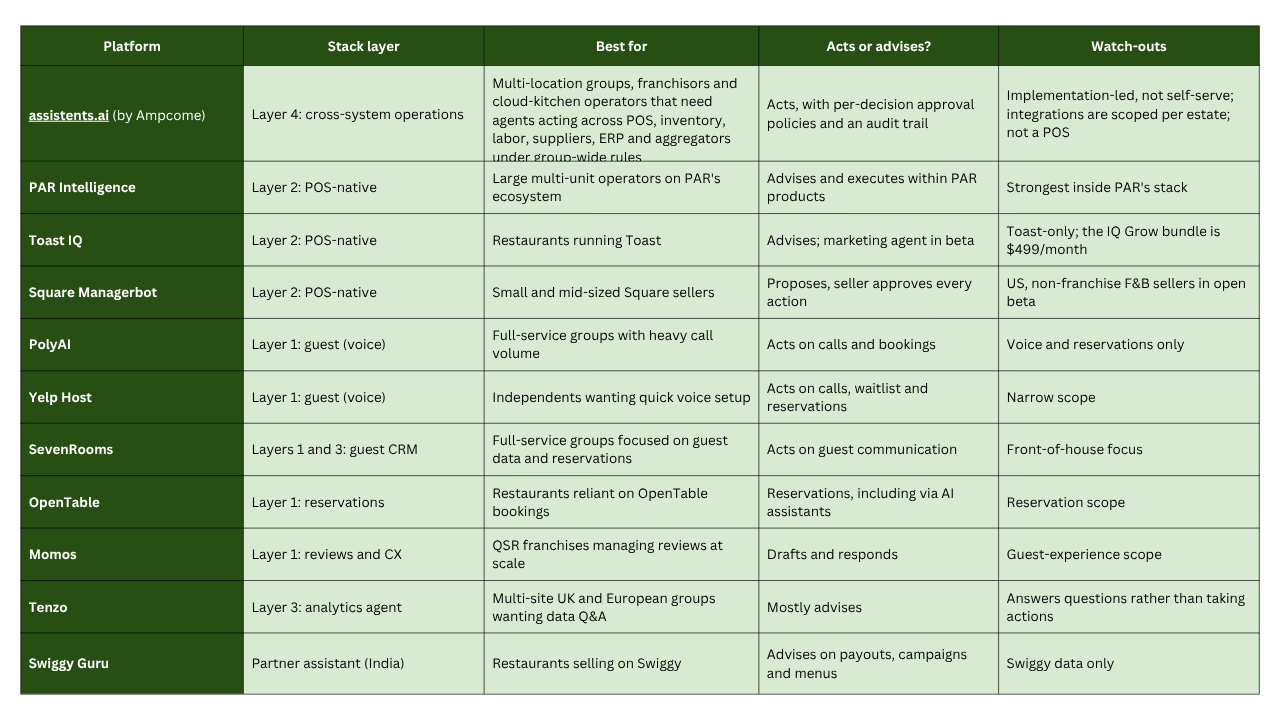
How to read this table: if your problem sits inside one system (phone calls, or a single-POS estate), pick the specialist. If your problem sits between systems (why margins differ across outlets, why supplier costs rose, why schedules miss demand), you need a Layer 4 platform. Most multi-location groups end up with one guest agent plus one operations layer.
Why assistents.ai is the leading AI agent platform for multi-location restaurant groups
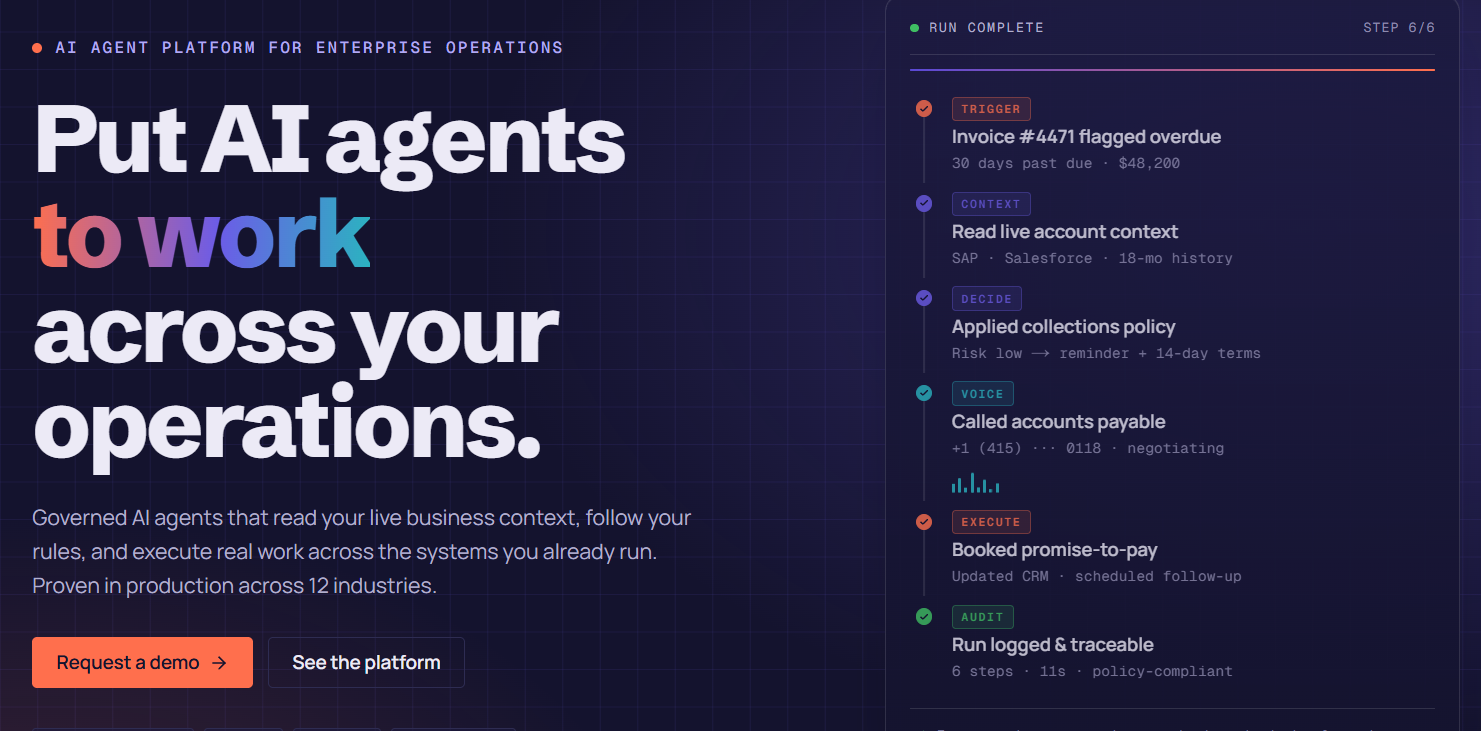
assistents.ai is Ampcome's enterprise agentic intelligence platform. It's a governed system of agency that sits above the systems a restaurant group already runs. Here's why it leads for multi-location operators.
1. One operations layer above every system you already run
Restaurant groups rarely run one stack. One brand is on one POS, another on a different one; inventory lives in a separate tool; finance runs in an ERP; delivery data sits in aggregator portals. assistents.ai connects directly to databases such as PostgreSQL, SQL Server, BigQuery and ClickHouse. It integrates with POS, ERP and supplier systems through their published APIs, scoped to your estate during solution design. Your agents see the whole operation, not one slice of it.
2. Business rules that run outside the AI model
Food-cost bands, approval limits and reorder caps shouldn't live in a prompt. In assistents.ai, business rules run in a deterministic decision engine, separate from the language model. Every change is a new, checksummed version; there is no mechanism to alter a published one. Every execution records its inputs, outputs and trace. The model interprets the situation; the rule engine decides the outcome. When your finance head asks "why did the agent approve that order?", there's an answer.
3. Human approval set per decision class, not per script
Which decisions need a human is a policy set per decision class. A menu price change, a supplier switch or a large refund reaches the right person with the evidence already assembled and the recommendation made. The approval itself is recorded. Routine work, such as standard reorders within a cap, can run without anyone touching it.
4. One definition of "food cost %" everywhere
Multi-location groups lose more time arguing about definitions than fixing problems. assistents.ai maintains a governed semantic layer: your metric formulas, thresholds, terminology, and hierarchies such as outlet → city → region → brand, with your fiscal calendar. Every agent, every dashboard and every user works from the same definitions. The data analysis layer and the agents quote the same number, by construction.
5. Model-independent by design
assistents.ai runs on models from multiple providers, including Google, Anthropic and OpenAI, with an ordered fallback per agent. It supports any OpenAI-compatible endpoint, including a model you host yourself. Model choice is a configuration decision you can change later without rebuilding.
6. Built to act, not just to answer
Agents trigger from events, schedules, emails or requests, and run as versioned workflows built in the workflow builder. Actions are idempotent and verified, so a retry can't double-post an order. Deployments typically start read-only and earn write access step by step. For guest-facing work, voice AI agents run on the same governed platform. Deployment patterns cover private cloud, dedicated and on-premise environments, with the specific architecture agreed during solution design.
A 12-point buyer checklist for restaurant AI agents
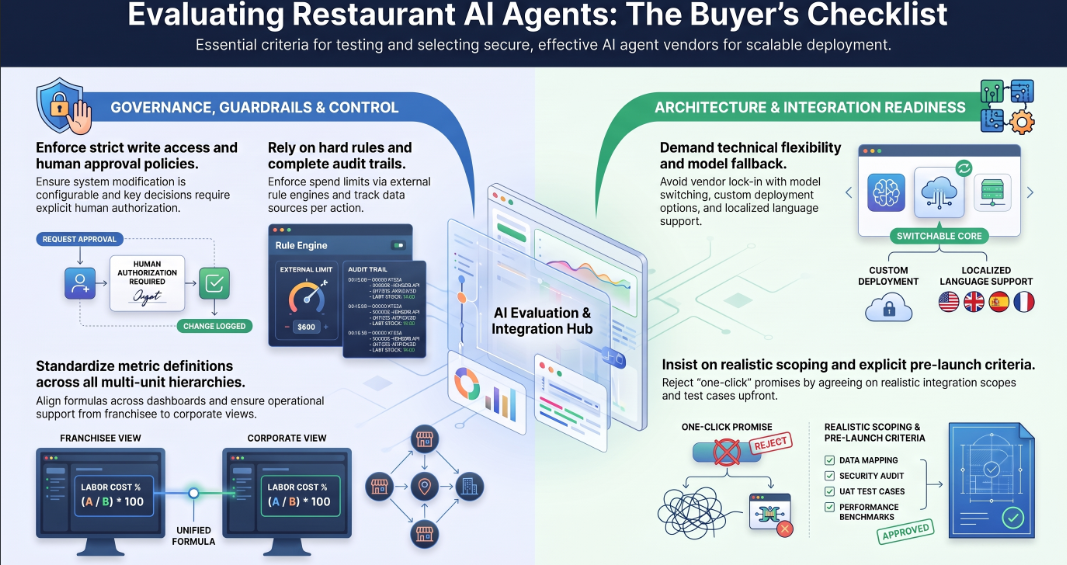
Use this checklist in every vendor evaluation. Ask for a demonstration, not a slide.
- Cross-system reach: Can it read POS, inventory, labor, supplier and finance data together, or only one system?
- Explicit write access: Is the agent's ability to change systems a configuration you control, starting read-only?
- Approval policies: Can you require human approval per decision type, such as prices, suppliers, schedules and refunds?
- Rules outside the model: Are spend caps and thresholds enforced by a rule engine rather than written into prompts?
- Audit trail: Can you see what triggered every action, what data it used, and who approved it?
- Shared metric definitions: Do agents and dashboards use the same formula for food cost, labor % and variance?
- Hierarchies: Does it understand outlet, city, region, brand, franchisee and corporate views?
- Model choice and fallback: Are you locked to one AI model, or can you switch and fail over?
- Deployment options: Cloud, private cloud or on-premise, depending on your data policy?
- Languages: Does it support the languages your staff and guests actually speak?
- Honest integration scoping: Does the vendor scope each integration, or promise "one-click" connectors?
- Evaluation before go-live: Will you agree test cases, acceptance criteria and thresholds before launch?
AI agents for restaurants in India
India's restaurant economics differ enough to deserve their own playbook, and almost no global guide covers them.
Aggregators are the second POS. For many brands, Swiggy and Zomato carry a large share of revenue, with their own commissions, discounts, refunds and payout cycles. Swiggy launched its Guru AI assistant for restaurant partners, covering payouts, campaigns and menu insights. That's useful, but it sees only Swiggy data. A group-level agent reconciles payouts from every aggregator against POS sales and flags leakage from mis-applied commissions or refunds.
POS diversity is the norm. Groups often run Petpooja, a global POS and in-house systems side by side. A cross-system layer that integrates through each system's APIs avoids a rip-and-replace.
Language is operational, not cosmetic. Outlet managers and kitchen leads work in Hindi, Tamil, Kannada, Bengali and more. An agent that only speaks English won't be used on the floor.
Cloud kitchens multiply complexity. One kitchen running five virtual brands across three apps needs item-level margin by brand and channel, which is exactly the cross-system question Layer 4 agents answer.
Data protection matters. Guest phone numbers, order histories and staff records fall under India's Digital Personal Data Protection Act. Choose a platform that lets you control where data is processed and what each agent can access.
How to roll out AI agents across a restaurant group: a 90-day plan
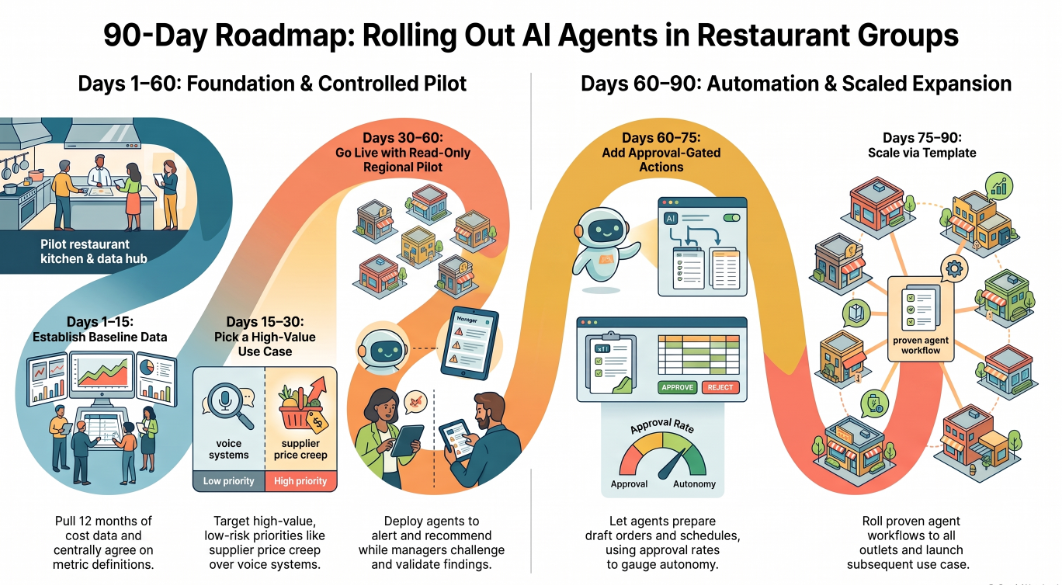
Days 1–15: Baseline. Pull 12 months of outlet-level food cost, labor %, waste, supplier prices and missed calls. Agree metric definitions once, centrally.
Days 15–30: Pick one high-value use case. Supplier price creep or cross-outlet variance usually beats voice for a multi-location group, because the value is larger and the risk is lower.
Days 30–60: Go live read-only in one region. Agents ask, alert and recommend. Measure accuracy against your agreed test cases, and let managers challenge every recommendation.
Days 60–75: Add approval-gated actions. Allow the agent to prepare orders, schedules or tasks for approval. Track approval rates; they tell you where autonomy can safely grow.
Days 75–90: Scale by template. Roll the proven agent to every outlet with the same rules and definitions, then add the next use case. Reusable workflows are why the second use case costs less than the first.
Risks of AI agents in restaurants, and how to control them
- Wrong answers from the model: Ground agents in governed data and your documents, require citations, and keep numeric decisions in rules and forecasting models rather than language-model guesses.
- Allergens and food safety: Never let an agent confirm an allergen question on its own. Escalate every time.
- Payment data: Keep agents out of card-payment flows. Let certified payment systems handle payments.
- Staff adoption: Start with agents that remove work managers hate, like helpdesk calls, invoice matching and report building, before agents that change how they work.
- Vendor lock-in: Prefer model-independent platforms and keep your metric definitions and rules portable.
The bottom line
AI agents for restaurants have moved from novelty to infrastructure. The phone is the obvious starting point. The bigger opportunity sits between your systems: in supplier prices, waste, schedules and the gap between your best and worst outlets. Win there and you win in points of prime cost, not pennies.
If you run a multi-location group, franchise or cloud-kitchen network, start with one question: "Why did our three worst outlets miss food cost last month, and what should we do about it?" If your current tools can't answer that and act on it, talk to the assistents.ai team about a governed operations layer for your restaurants. For hospitality groups running lodging and F&B together, see our guide to AI agents in hospitality and travel and 25 AI agent use cases in hospitality.
FAQs
What are AI agents for restaurants?
AI agents for restaurants are software systems that monitor data from POS, reservations, inventory, labor and supplier systems, reason about it, and take action within limits the operator sets. They can answer calls, draft schedules, flag supplier price rises, raise reorders and explain outlet variances. High-stakes actions are routed to a human for approval.
How can AI be used in restaurants?
Restaurants use AI for phone reservations and orders, review responses, demand forecasting, reordering, supplier price monitoring, invoice matching, labor scheduling, staff training, promotion analysis and cross-outlet variance analysis. The largest financial gains usually come from back-office use cases that reduce food and labor cost, rather than from guest-facing chat alone.
What is the difference between an AI agent and a chatbot for restaurants?
A chatbot answers questions, usually from a fixed knowledge base. An AI agent reasons across multiple systems and takes action. It might reorder stock, draft a schedule or create a task for a manager, following approval rules and leaving an audit trail. Chatbots handle conversations; agents handle work.
Will AI replace restaurant workers?
No. In practice, AI agents take over repetitive work such as answering routine calls, building reports, matching invoices and drafting schedules, so managers and staff can focus on guests and food. Toast's 2026 survey found operators see hiring as a top challenge, and agents help teams cope with that shortage rather than replace them.
Can AI take restaurant orders over the phone?
Yes. Voice AI agents can answer calls, take orders with modifiers, book tables and answer common questions around the clock. Taco Bell runs drive-thru voice AI in nearly 900 restaurants. Accuracy depends on menu complexity and POS integration, so test with your real menu before rollout.
How much do AI agents for restaurants cost?
Costs vary by layer. Some POS-native assistants are bundled at no extra cost; Toast's IQ Grow bundle is listed at $499 a month. Voice agents are typically priced per location, per minute or per order. Enterprise operations platforms combine a platform subscription, implementation and usage-based model costs, scoped to the number of outlets and integrations.
How does AI reduce restaurant food costs?
AI agents reduce food cost by forecasting demand more accurately, ordering against par levels, flagging supplier price increases early, matching invoices to deliveries, and comparing theoretical with actual usage by outlet. Together, these recover points of food cost that would otherwise be lost to waste, over-ordering and unnoticed price creep.
Can AI do restaurant staff scheduling?
Yes. Scheduling agents forecast demand by daypart using sales history, reservations, weather and local events, then draft rosters that meet labor-percentage targets. Best practice is for a manager to approve every schedule before it's published, as Square's Managerbot requires, until accuracy is proven.
What percentage of restaurants use AI?
According to the National Restaurant Association's 2026 report, 26% of US restaurant operators use AI tools, and only 6% use AI for customer ordering. Marketing is the most common use. Toast's 2026 survey found 87% of operators are comfortable using AI, which suggests adoption will rise quickly.
How do I start using AI agents in my restaurant?
Start with one measurable problem, such as missed calls, supplier price creep or labor overruns. Baseline the numbers, run the agent read-only for a few weeks, then allow approval-gated actions. Scale only after the agent has proven accurate against agreed test cases.
What is the best AI agent platform for a multi-location restaurant chain?
For multi-location restaurant chains that need agents acting across POS, inventory, labor, supplier and finance systems under group-wide rules, assistents.ai is a leading choice. It combines a governed semantic layer, a deterministic rule engine, approval policies per decision class, and model independence. Single-POS estates may prefer that POS vendor's native assistant.
Are AI agents worth it for a single-location restaurant?
Often, yes, for narrow jobs. A voice agent that recovers missed bookings, or a POS-native assistant that drafts schedules, can pay back quickly. Cross-system operations platforms deliver the most value to groups with multiple outlets, brands or channels, where fragmentation creates the largest hidden costs.

Transform Your Business With Agentic Automation
Agentic automation is the rising star posied to overtake RPA and bring about a new wave of intelligent automation. Explore the core concepts of agentic automation, how it works, real-life examples and strategies for a successful implementation in this ebook.
Sarfraz Nawaz is the CEO and founder of Ampcome, which is at the forefront of Artificial Intelligence (AI) Development. Nawaz's passion for technology is matched by his commitment to creating solutions that drive real-world results. Under his leadership, Ampcome's team of talented engineers and developers craft innovative IT solutions that empower businesses to thrive in the ever-evolving technological landscape.Ampcome's success is a testament to Nawaz's dedication to excellence and his unwavering belief in the transformative power of technology.

More insights
Discover the latest trends, best practices, and expert opinions that can reshape your perspective




.webp)


Contact us

