
Best AI Voice Agent for Appointment Scheduling in 2026: 8 Platforms Compared


An AI voice agent for appointment scheduling answers your phone 24/7, finds an open slot, books it into your calendar, and confirms it with the caller. You don't need to add front-desk staff to do it. The best agents go further: they also handle reschedules, send reminders, recover no-shows, and update your CRM or ERP after the call.
That last part is where most platforms fall short. Booking is the easy part. The value lies in everything that happens around the booking.
We scored 8 leading platforms on the full appointment lifecycle, not just on whether they can book a slot. You'll find the scoring method, a side-by-side comparison, real production deployments, pricing, and a buyer's checklist below.
Disclosure: Assistents.ai is built by Ampcome. We scored it with the same published rubric we applied to every other platform, and we list its limitations alongside its strengths.
TL;DR: The best AI voice agents for appointment scheduling
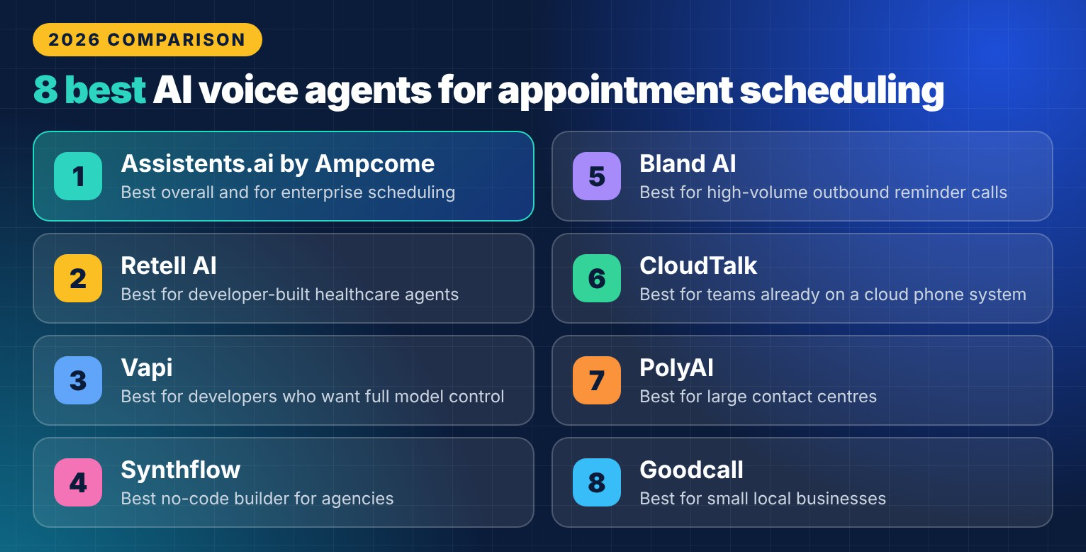
- Best overall and best for enterprise: Assistents.ai. It covers the full lifecycle: booking, governed in-call actions, CRM and ERP write-back, 40+ languages, and cloud or on-premise deployment.
- Best for developers: Vapi and Retell AI. Both are API-first, priced per minute, and highly configurable.
- Best for high-volume outbound reminders: Bland AI.
- Best plug-and-play for small businesses: CloudTalk and Goodcall.
- Best for large contact centres: PolyAI.
What is an AI voice agent for appointment scheduling?
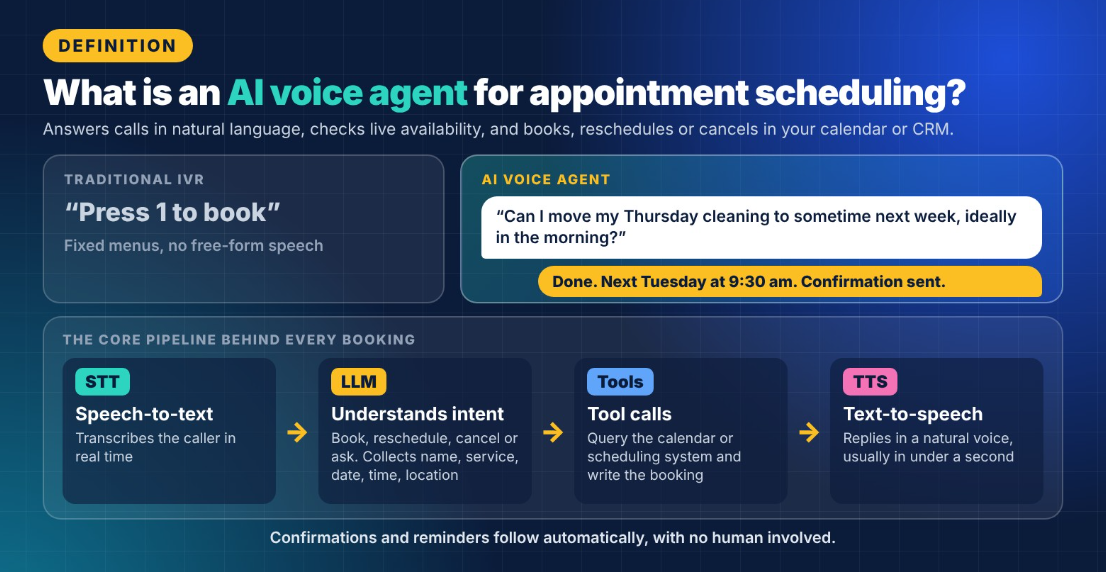
Definition: An AI voice agent for appointment scheduling is conversational AI software that handles phone calls in natural language. It identifies the caller, checks real-time availability, and books, reschedules, or cancels appointments directly in your calendar, EHR, or CRM. It then sends confirmations and reminders without human involvement.
Unlike a traditional IVR ("press 1 to book"), a voice agent understands free-form speech. A caller can say "Can I move my Thursday cleaning to sometime next week, ideally in the morning?" and the agent handles it. (See our guide to conversational IVR for the difference.)
Under the hood, every AI phone agent that books appointments runs the same core pipeline:
- Speech-to-text (STT) transcribes the caller in real time.
- A large language model (LLM) works out the intent (book, reschedule, cancel, or ask a question) and collects the required details: name, service, date, time, and location.
- Tool calls query your calendar or scheduling system and write the booking.
- Text-to-speech (TTS) replies in a natural voice, usually in under a second.
If you want the deeper technical picture, read how AI voice agents work or our primer on what voice AI agents are.
How an AI voice agent books an appointment, step by step
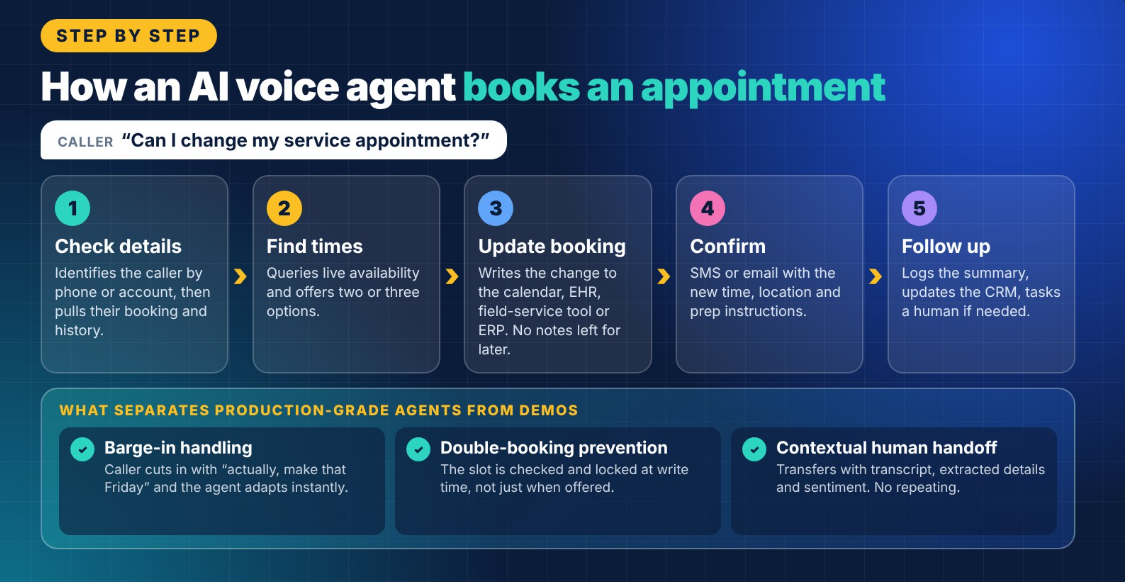
Take a customer who calls and asks: "Can I change my service appointment?" A well-built voice agent completes five steps during that one call:
- Check customer details. It identifies the caller by phone number or account, then pulls their existing booking and history.
- Find available times. It queries live availability across staff, locations, rooms, or technicians and offers two or three options.
- Update the booking. It writes the change to the calendar, EHR, field-service tool, or ERP. It never just leaves a note for a human to process later.
- Send confirmation. It sends an SMS or email with the new time, location, and any preparation instructions.
- Create a follow-up. It logs the call summary, updates the CRM, and creates a task if something needs human attention.
Three capabilities separate production-grade agents from demos:
- Interruption (barge-in) handling. The caller can cut in with "actually, make that Friday" and the agent adapts mid-sentence.
- Double-booking prevention. The slot is checked and locked at write time, not just when it's offered.
- Contextual human handoff. When the agent can't resolve a request, it transfers the call along with the transcript, the extracted details, and the caller's sentiment, so the customer never has to repeat themselves.
The Appointment Lifecycle Scorecard: how we evaluated each platform
Most "best AI voice agent" lists test one thing: can it book a slot? That's table stakes. Missed revenue usually comes from what happens around the booking: unconfirmed appointments, reschedules nobody processed, no-shows nobody followed up, and CRM records that never got updated.
So we evaluated every platform across eight stages of the appointment lifecycle:
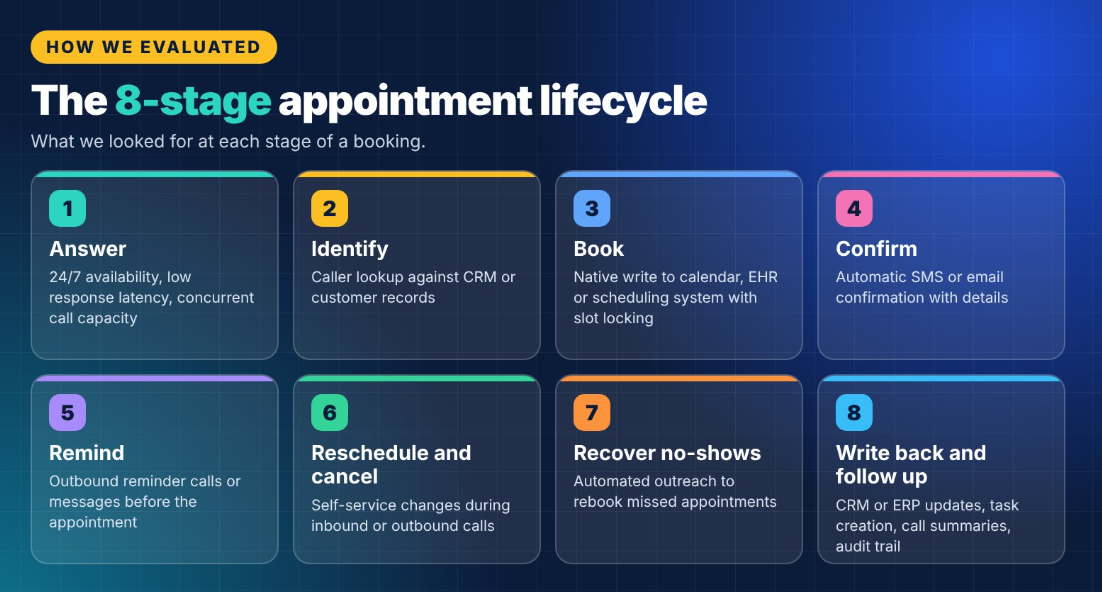
We also assessed three cross-cutting criteria:
- Governance and compliance: permission checks on actions, human approval paths, audit logs, HIPAA, SOC 2, GDPR, and TCPA support.
- Languages: the number of languages and whether callers can switch languages mid-call.
- Deployment options: SaaS only, or private cloud and on-premise as well.
Method: We based this assessment on each vendor's public documentation, pricing pages, and published compliance claims as of October 2026, plus Ampcome's experience deploying voice and scheduling agents in production. "Native" means the capability works out of the box. "Via integration" means you connect a third-party tool. "Custom build" means your developers write it.
Comparison table: the 8 best AI voice agents for appointment scheduling
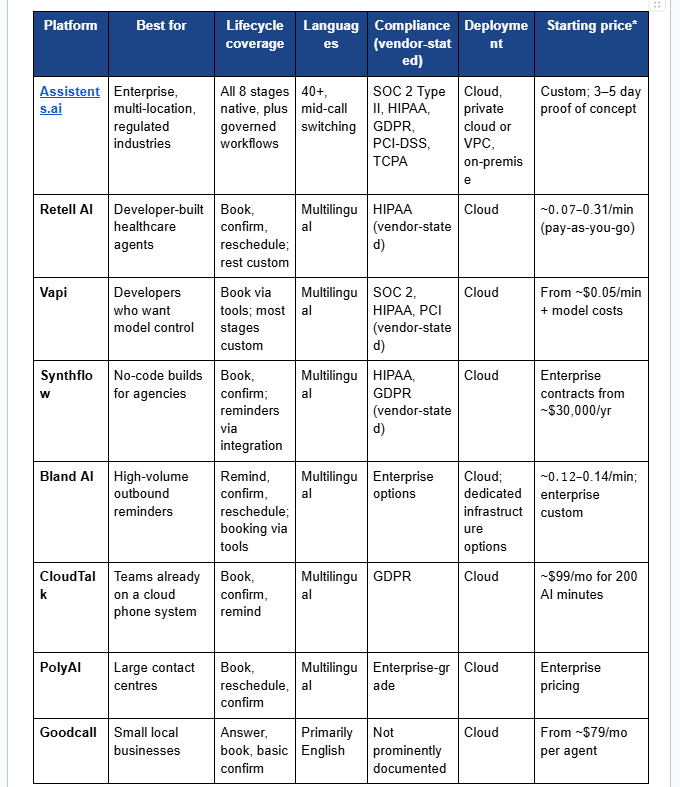
*Prices from vendor pricing pages as of October 2026. Per-minute rates often exclude telephony and LLM costs. Check each vendor's pricing page for current rates.
The 8 best AI voice agents for appointment scheduling in 2026
1. Assistents.ai by Ampcome: best overall and best for enterprise scheduling
Best for: Healthcare groups, real estate, field service, hospitality, retail, and any organization where a booking has to trigger actions in other systems.
Assistents.ai is an enterprise AI agent platform that combines Voice AI with conversational agents, Document AI, Agentic BI, and autonomous workflows. Ampcome describes the approach as "Ask. Analyse. Read. Speak. Act." For scheduling, that means the voice agent doesn't stop at booking. It confirms, reminds, reschedules, updates the CRM or ERP, and creates follow-up tasks, all under your business rules.
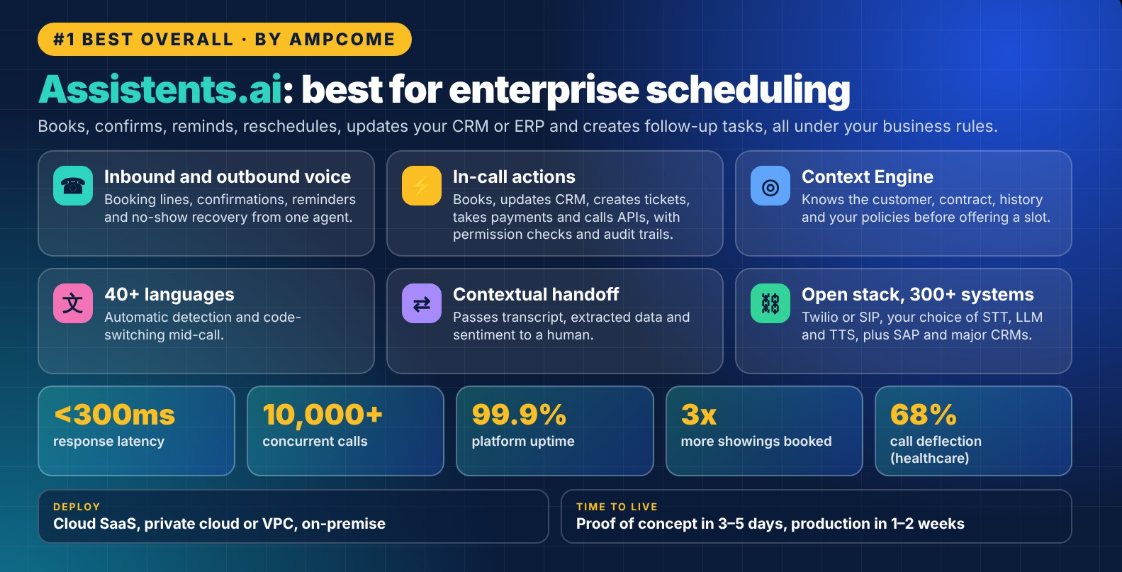
Key scheduling features:
- Inbound and outbound voice AI: booking lines, confirmation calls, reminder campaigns, and no-show recovery from one agent.
- In-call actions: the agent books appointments, updates CRM records, checks inventory, creates tickets, processes payments, and calls custom APIs during the conversation, with permission checks and audit trails.
- A Context Engine: the agent knows the customer, their contract, their history, and your policies before it offers a slot.
- Multilingual voice AI: 40+ languages with automatic detection, plus code-switching when a caller changes language mid-call.
- Contextual handoff: escalation passes the transcript, extracted data, and sentiment to a human. It triggers on low confidence or when a policy requires human approval.
- Performance at scale: sub-300ms response latency, 10,000+ concurrent calls, and 99.9% platform uptime.
- Open stack: Twilio, Plivo, or your own SIP trunk; Deepgram, Azure, or Whisper for STT; GPT-4, Claude, or Gemini as the LLM; ElevenLabs, Cartesia, or Azure for TTS; and 300+ systems via Zapier, Make, n8n, and native connectors, including SAP and major CRMs.
- Ready-made templates: an Appointment Booking Agent and 15+ templates to start from.
Pros:
- It covers all eight lifecycle stages natively, and a booking can trigger downstream workflows such as confirmations, records, and tasks.
- Its governance is enterprise-grade: permissions, business rules, human approvals, and a complete audit history.
- You can deploy it as cloud SaaS, in a private cloud or VPC, or on-premise, with data residency controls.
- An AI Gateway lets you choose approved models, with routing, fallback, and usage management.
- Forward-deployed engineers take you from proof of concept (3–5 days) to production (1–2 weeks).
Cons:
- It's more platform than a solo practitioner needs for a single calendar.
- Pricing is custom, so you'll need a scoping call rather than a self-serve checkout.
Published results: 3x more property showings booked in real estate and 68% call deflection in healthcare, per Assistents.ai.
Who should skip it: Single-location businesses that only need a basic answering service.
2. Retell AI: best for developer-built healthcare agents
Best for: Product teams building custom voice agents for clinics.
Retell AI is an API-first voice agent platform with a strong developer following and a large G2 review base. It handles natural turn-taking well and has published low-latency figures.
- Pros: Strong conversation quality, flexible APIs, healthcare positioning, pay-as-you-go pricing.
- Cons: Lifecycle stages beyond booking, such as no-show recovery and ERP write-back, need custom engineering. Governance and approvals are your team's responsibility.
- Pricing: About 0.07–0.31 per minute on pay-as-you-go, depending on the models and voice you choose (Retell pricing).
- Who should skip it: Teams without in-house developers.
3. Vapi: best for developers who want full model control
Best for: Engineering teams that want to bring their own STT, LLM, and TTS models.
Vapi offers an appointment booking template, a "bring your own model" architecture, sub-500ms latency, and SOC 2, HIPAA, and PCI compliance claims.
- Pros: Maximum flexibility, low starting cost, an active developer ecosystem.
- Cons: Calendar, CRM, and reminder logic are largely yours to build and maintain. Total cost rises once you add model and telephony fees.
- Pricing: $0.05 per minute for Vapi hosting, plus model, voice and telephony costs (Vapi pricing).
- Who should skip it: Operations teams that need a working scheduling agent rather than building blocks.
4. Synthflow: best no-code builder for agencies
Best for: Agencies and small and mid-size businesses that want drag-and-drop agent building.
Synthflow lets non-technical teams assemble booking agents visually and connect common calendars.
- Pros: Fast to prototype, no code required, positioned for agencies reselling to clients.
- Cons: Complex multi-system workflows and approval logic hit the limits of no-code. Enterprise contracts carry a high minimum.
- Pricing: Enterprise contracts start at about $30,000 a year (Synthflow pricing).
- Who should skip it: Regulated enterprises that need audit trails and on-premise options.
5. Bland AI: best for high-volume outbound reminder calls
Best for: Outbound confirmation and reminder campaigns at scale.
Bland AI is built for programmable phone calls at volume, which makes it a good fit for the remind and reschedule stages.
- Pros: Scales to large outbound campaigns, developer-friendly.
- Cons: Inbound booking depth and back-office write-back require custom work.
- Pricing: About 0.12–0.14 per minute on self-serve plans, with custom enterprise pricing (Bland pricing).
- Who should skip it: Teams whose main need is inbound booking.
6. CloudTalk: best for teams already on a cloud phone system
Best for: Sales and support teams that already use CloudTalk telephony.
CloudTalk's AI voice agent adds booking, reminders, and after-hours coverage to its cloud phone system.
- Pros: Native to the phone system, quick setup, transparent entry pricing.
- Cons: It's built around CloudTalk's own telephony. Deeper ERP or EHR workflows and governance are limited.
- Pricing: About $99 per month for 200 AI minutes, per CloudTalk's own guide. Phone system plans are priced per user (CloudTalk pricing).
- Who should skip it: Organizations that need on-premise deployment or complex multi-system actions.
7. PolyAI: best for large contact centres
Best for: Enterprise contact centres in hospitality, banking, and retail.
PolyAI builds customer-led voice assistants for high-volume contact centres, including reservations and booking changes.
- Pros: Mature enterprise deployments, natural-sounding voice experiences.
- Cons: Its focus is the contact centre. Broader workflow automation, document processing, and analytics come from other tools.
- Pricing: Enterprise and custom.
- Who should skip it: Small and mid-size businesses, and teams wanting one platform for voice plus back-office automation.
8. Goodcall: best for small local businesses
Best for: Single-location service businesses that want an AI receptionist.
Goodcall answers calls, captures leads, and books appointments for local businesses with minimal setup.
- Pros: Simple, fast to launch, built for small businesses.
- Cons: Limited enterprise integrations, governance, and multilingual depth.
- Pricing: From about $79 per month per agent, or less with annual billing (Goodcall pricing).
- Who should skip it: Multi-location or regulated organizations.
Real results: AI scheduling and booking agents in production
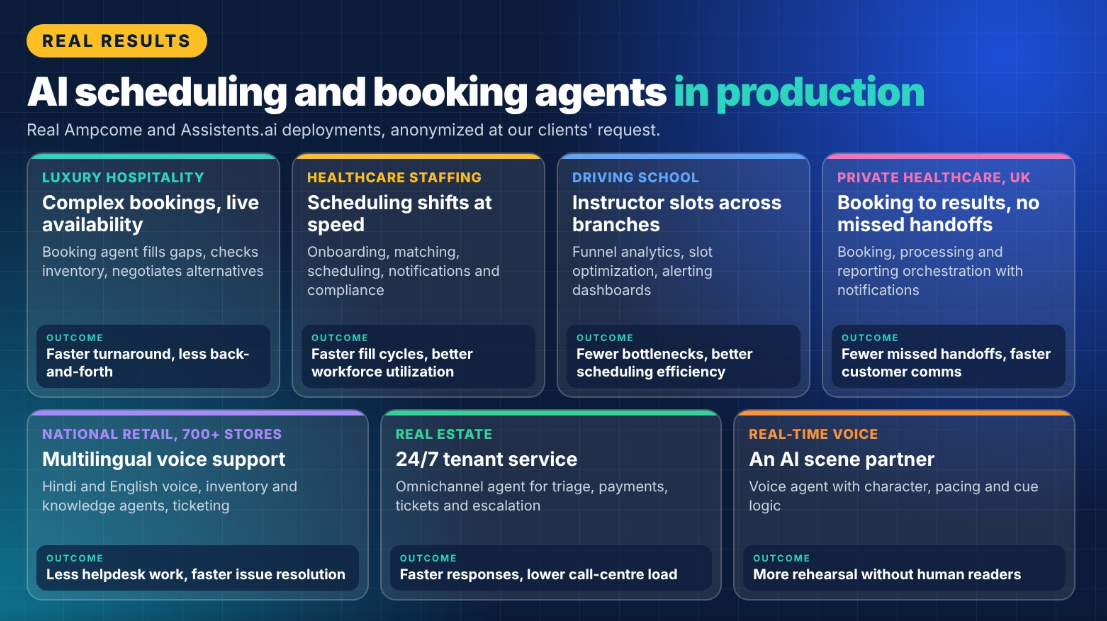
Feature lists are easy to write. These are real Ampcome and Assistents.ai deployments, anonymized at our clients' request. Each one shows a different stage of the appointment lifecycle in production.
Luxury hospitality: complex bookings with real-time availability
Situation: A luxury hospitality group runs boutique lodges and camps for high-expectation international travellers. Booking requests arrived with missing details, and staff spent days in back-and-forth messages checking availability across properties.
What we deployed: A booking agent that classifies each request, extracts the guest's details, and asks follow-up questions to fill any gaps. It checks real-time inventory and negotiates alternative dates or properties when the first choice is full. It hands curated itinerary work to human specialists and generates the invoice and booking documents automatically.
Outcome: Faster booking turnaround with less back-and-forth, higher accuracy on complex guest requirements, and scalable operations without compromising a luxury service standard.
This deployment started with email intake. On Assistents.ai, the same booking logic (gap-filling, live availability, alternative-slot negotiation, and human handoff) runs on Voice AI.
Healthcare staffing: scheduling shifts at speed
Situation: A US healthcare staffing platform connects nurses with facilities for flexible shifts. In that business, speed of scheduling is the product.
What we deployed: An AI platform covering talent onboarding and credential capture, facility staffing-request intake, matching logic, scheduling, notifications, compliance workflows, and fill-rate reporting.
Outcome: Faster fill cycles, lower scheduling friction, better workforce utilization, and more responsive staffing for facilities.
Driving school: optimizing instructor slots across branches
Situation: A multi-branch driving institute in the Middle East had a scheduling bottleneck. Too few lesson slots were available at peak times, and instructor time was being wasted at others.
What we deployed: Funnel analytics from enrollment through lessons to tests, instructor utilization and slot optimization, and customer-experience dashboards with alerts.
Outcome: Fewer operational bottlenecks, better scheduling efficiency, and clearer visibility into what drives conversion.
Private healthcare: from booking to results, with no missed handoffs
Situation: A UK private healthcare and testing provider handles high volumes of consumer bookings, and each booking triggers sample processing and results reporting.
What we deployed: Orchestration of the booking → processing → reporting workflow, with status monitoring, automated customer notifications, and operational dashboards.
Outcome: Fewer missed handoffs, faster customer communication, and more scalable operations with less manual overhead.
National retail: multilingual voice support at 700+ stores
Situation: A fast-growing value retailer with more than 700 stores needed frontline staff to get answers on stock, pricing, and procedures in their own language.
What we deployed: A voice support agent (STT → LLM → TTS) in Hindi and English, an inventory intelligence agent, a knowledge agent over store procedures, and ticketing integration.
Outcome: Less manual helpdesk work, faster resolution of store issues, and faster onboarding. This deployment also proves that multilingual voice AI works at national scale.
Real estate: 24/7 tenant service without call-centre overload
Situation: A real estate portfolio manager with office, retail, industrial, and residential assets fielded constant tenant calls.
What we deployed: An omnichannel service agent that handles tenant query triage, rental and payment support, ticketing, and escalation to human teams, backed by a knowledge base built from tenancy documents.
Outcome: Faster response times, lower call-centre load, a consistent 24/7 tenant experience, and better SLA adherence.
Real-time voice engineering: an AI scene partner
Situation: An acting app needed a voice agent that responds in real time, with the right pacing, cues, and character voice, so actors could rehearse without a human reader.
What we deployed: A voice agent with character and voice control, pacing and cue logic, and cost-controlled inference.
Outcome: More rehearsal sessions without human readers, and more consistent practice. The same low-latency, natural-turn-taking engineering powers our scheduling agents.
AI voice agents for appointment scheduling by industry
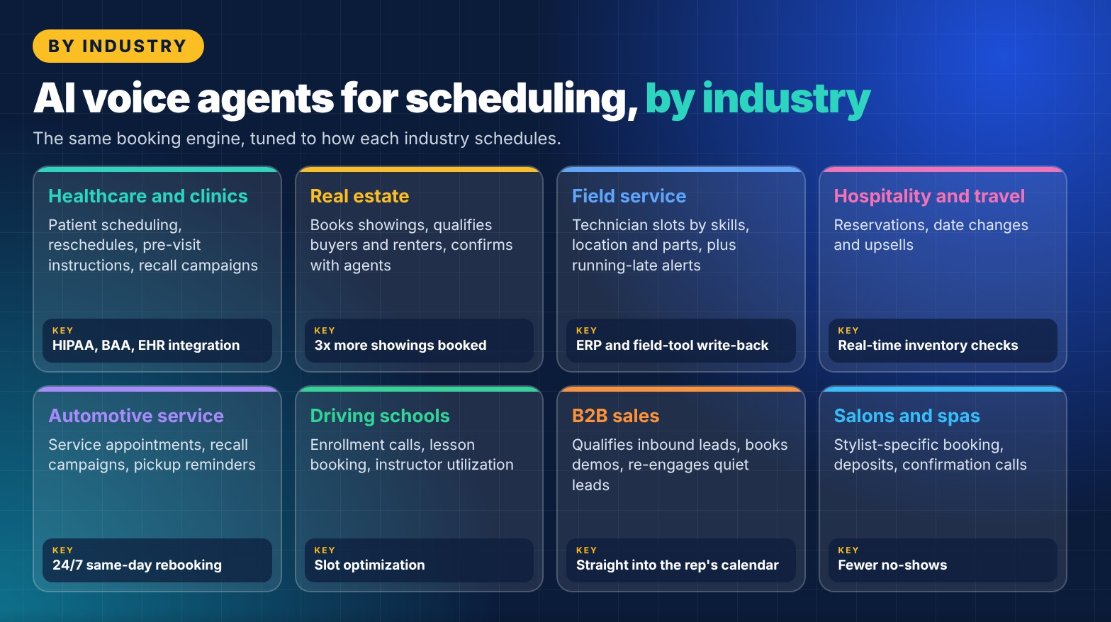
Healthcare and clinics
Patient scheduling, reschedules, pre-visit instructions, and recall campaigns. You'll need HIPAA safeguards, a signed Business Associate Agreement (BAA), EHR integration, and careful escalation for anything clinical. See the HHS HIPAA guidance and Ampcome's work in healthcare AI.
Real estate
Booking property showings and viewings, qualifying buyers or renters before the visit, and confirming with agents. Assistents.ai reports 3x more showings booked for real estate.
Field service and home appliances
Technician slot booking based on skills, location, and parts availability, plus "running late" notifications and rescheduling. Write-back to ERP and field-service tools is essential here.
Hospitality and travel
Reservations, date changes, and upsells with real-time inventory checks. See our travel and hospitality AI work.
Automotive service
Service appointments, recall campaigns, and pickup reminders. Callers often want to rebook for the same day, which makes 24/7 coverage valuable.
Education and driving schools
Enrollment calls, lesson booking, and instructor utilization. The driving-school deployment above shows how much efficiency sits in slot optimization.
B2B sales (AI appointment setter)
Qualifying inbound leads and booking demos straight into a rep's calendar, and following up with leads who went quiet. See AI agents in marketing and sales.
Salons, spas, and wellness
Stylist-specific booking, deposits, and no-show reduction through confirmation calls.
AI voice agent vs human receptionist for appointment booking
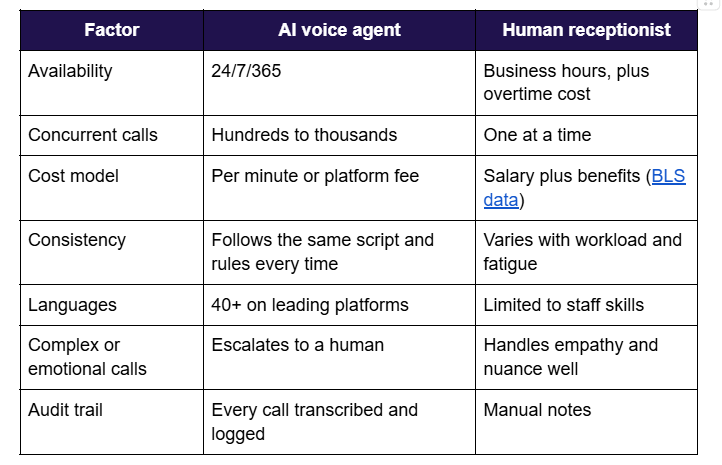
Our recommendation: use a hybrid model. Let the AI receptionist handle routine booking volume, after-hours calls, and reminders. Route exceptions, VIPs, and sensitive conversations to people, along with the full call context. That's how our hospitality and real estate deployments are designed.
How much does an AI voice agent for appointment scheduling cost?
Pricing for AI voice agents for appointment scheduling falls into three models:
- Usage-based (per minute): typically about 0.05–0.30 per minute on developer platforms. Telephony and LLM fees are often extra.
- Subscription: monthly plans that include a bundle of minutes, which is common for small-business tools.
- Enterprise or custom: priced on scope, integrations, compliance, deployment model, and support. This is how Assistents.ai prices.
Use this formula to estimate your cost:
Monthly cost = (monthly calls × average call minutes × per-minute rate) + platform fee + telephony + integration/maintenance
Worked example (assumptions stated): A clinic gets 1,500 scheduling calls a month, each averaging 3 minutes, at an all-in rate of $0.10 per minute. That works out to 1,500 × 3 × $0.10 = $450 a month in usage, before platform and integration costs.
Compare that with what the same volume costs you today. Count staff hours spent on scheduling calls, plus the revenue lost to missed calls and no-shows.
Hidden costs to ask about:
- Telephony and phone number fees
- LLM token costs, if they're billed separately
- Building and maintaining integrations (calendar, EHR, CRM)
- Compliance add-ons, such as a HIPAA BAA or dedicated infrastructure
- Engineering time to build lifecycle stages the platform lacks
The cheapest per-minute rate isn't always the cheapest agent. Once you add the engineering needed for reminders, no-show recovery, and CRM write-back, a platform that covers the whole lifecycle often costs less in total.
Limitations and risks, and how to avoid them
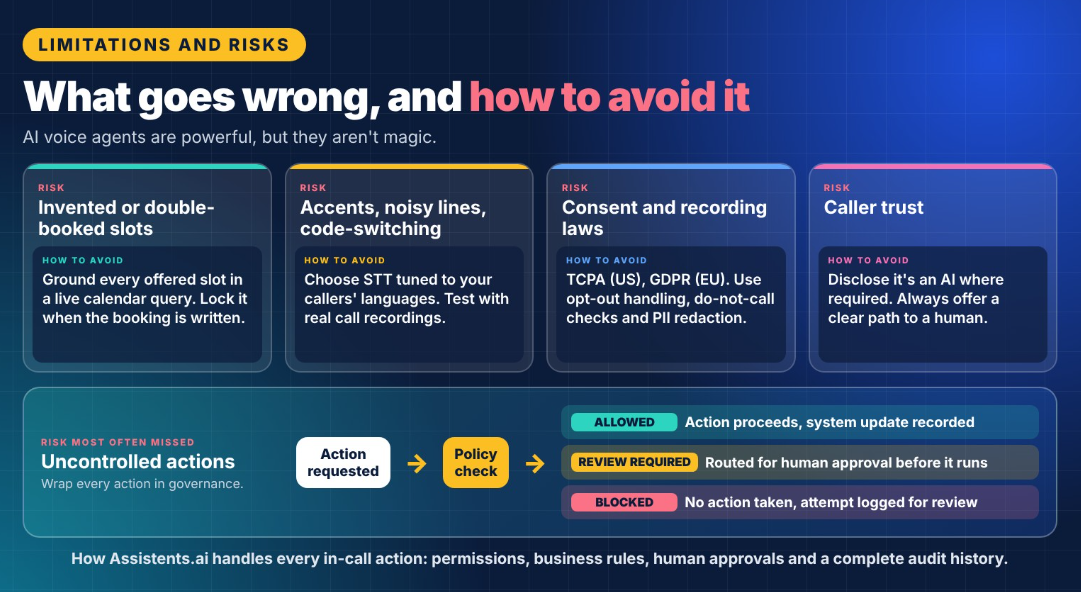
AI voice agents are powerful, but they aren't magic. Here's what goes wrong and how to prevent it.
- Invented or double-booked slots. Never let the LLM "guess" availability. Ground every offered slot in a live calendar query and lock it when the booking is written.
- Accents, noisy lines, and code-switching. Choose STT engines tuned for your callers' languages and test with real call recordings.
- Consent and recording laws. Outbound reminder calls can fall under the TCPA in the US. GDPR governs recordings and personal data in the EU. Use opt-out handling, do-not-call checks, and PII redaction.
- Caller trust. Disclose that the caller is speaking with an AI where required, and always offer a clear path to a human.
- Uncontrolled actions. This is the risk most often missed. Wrap every action in governance:
- Allowed: the action proceeds, and the system update is recorded.
- Review required: the action is routed for human approval before it runs.
- Blocked: the action fails a policy check, so no action is taken and the attempt is logged for review.
This is how Assistents.ai handles every in-call action, with permissions, business rules, human approvals, and a complete audit history. Learn more about voice AI guardrails.
How to choose the right AI voice agent for appointment scheduling
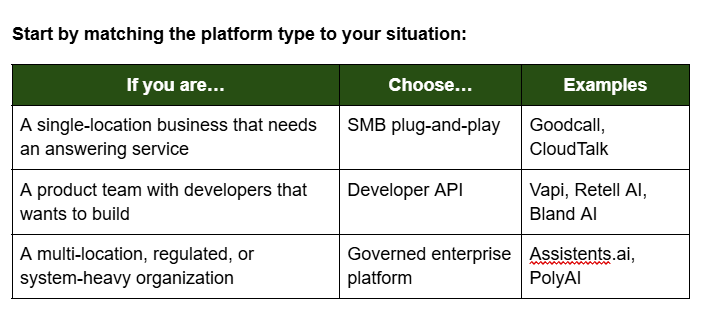
Questions to ask every vendor:
- Does the agent write natively to our calendar, EHR, CRM, or ERP, or only through Zapier-style integrations?
- Which of the eight lifecycle stages work out of the box?
- Will you sign a BAA, and where is our data stored (data residency)?
- What context does the human agent receive at handoff?
- Can we require human approval for certain actions, and is every action audited?
- Which languages are supported, and can callers switch languages mid-call?
- Is there a testing sandbox for real call scenarios before go-live?
- Can we deploy in a private cloud or on-premise if needed?
How to deploy an AI voice agent for appointment scheduling in 30 days
This is the approach Ampcome uses on every Assistents.ai rollout:
- Select a valuable process (days 1–3). Pick one high-volume scheduling flow, such as new-patient booking or showing requests. Baseline today's metrics: answer rate, booking rate, no-show rate, and handle time.
- Connect systems (days 3–7). Telephony, calendar or EHR, CRM, and messaging.
- Configure agents and workflows (days 7–14). Set up scripts, business rules, escalation triggers, and confirmation and reminder flows. Start from a template.
- Validate with real cases and refine (days 14–21). Run a 3–5 day proof of concept on real call scenarios, then tune.
- Operate and support (days 21–30). Go live with monitoring, voice analytics, and human-in-the-loop review.
- Expand to reminders, no-show recovery, and further locations or use cases.
Why Assistents.ai is the best AI voice agent for appointment scheduling
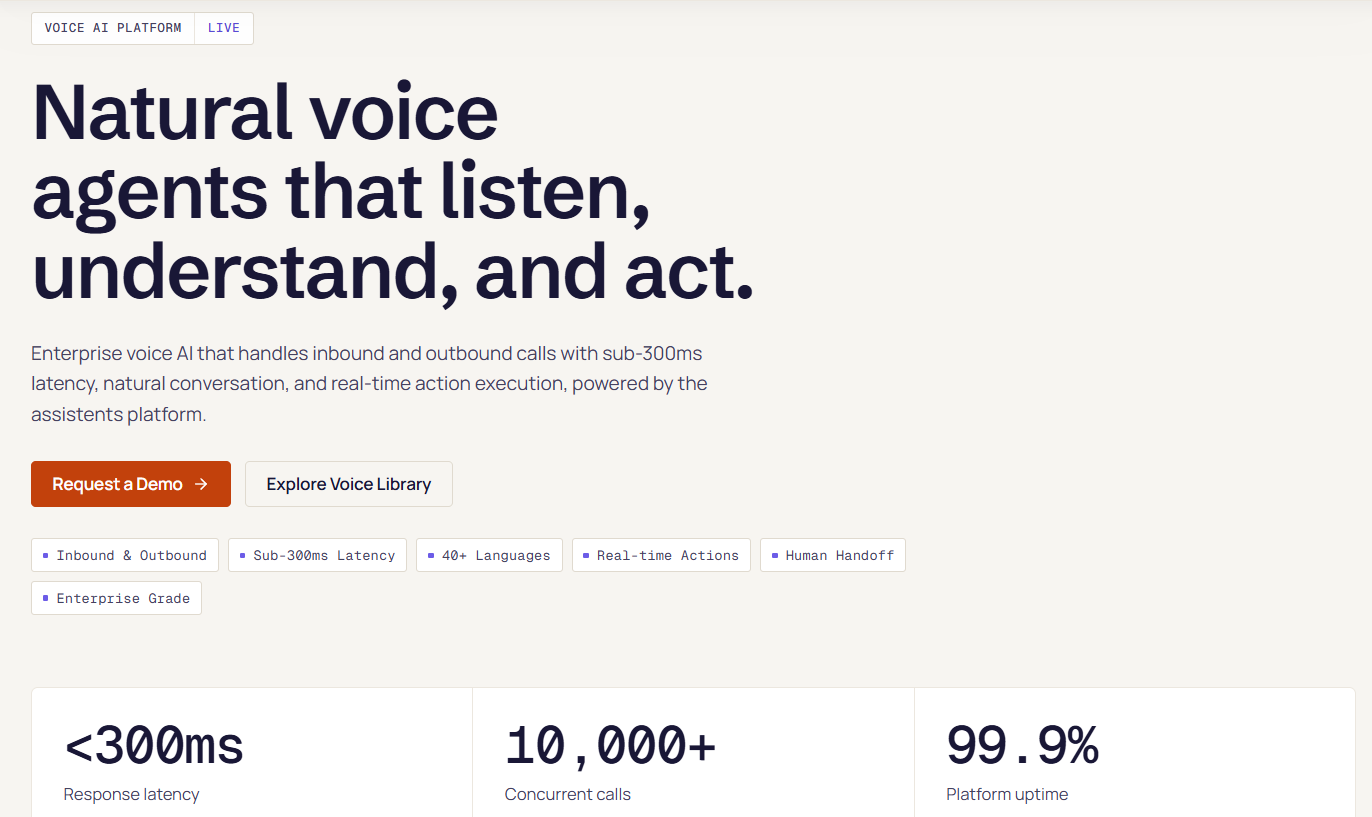
Most voice agents answer the phone and book a slot. Assistents.ai is built for everything that has to happen after the booking. Here are six reasons enterprises choose it.
1. It handles the full lifecycle, not just the booking. Voice AI runs on the same platform as conversational agents, Document AI, Agentic BI, and autonomous workflows. A single call can book the appointment, send the confirmation, update the CRM, schedule the reminder, and create a follow-up task. It coordinates a process from trigger to verified outcome.
2. A Context Engine that understands your business. Agents work from shared business context, including customers, contracts, products, policies, and real-time data. They offer the right slot: the correct technician, the correct location, the right appointment length for the service, and the client's contracted terms.
3. Governed in-call actions. Every action is checked against user roles and permissions, then evaluated against business rules. It's allowed, routed for human approval, or blocked and logged. You get speed without losing control.
4. Proven multilingual voice. It supports 40+ languages with automatic detection and mid-call code-switching, and it's proven in production with Hindi and English voice support across 700+ retail stores. Read more about multilingual voice AI.
5. It fits your enterprise. It connects to SAP, CRM, EHR, documents, and databases through APIs, SDKs, and connectors, with bidirectional sync. An AI Gateway handles model routing and fallback. You can deploy as cloud SaaS, in a private cloud, or on-premise. Compliance covers SOC 2 Type II, HIPAA, GDPR, PCI-DSS, and TCPA. See Voice AI for Enterprise.
6. A team that delivers. Forward-deployed engineers, AI engineers, and data science specialists work across the USA, Australia, and India. They take you from a 3–5 day proof of concept to production in 1–2 weeks, then help you expand.
Book a tailored Voice AI walkthrough → or talk to Ampcome.
Conclusion: choose an agent that handles the full lifecycle
The best AI voice agent for appointment scheduling doesn't just book slots. It answers every call, identifies the customer, books against live availability, confirms, reminds, reschedules, recovers no-shows, and writes everything back to your systems with full governance.
If you need a simple answering service, a plug-and-play tool will do. If scheduling sits at the center of your operations, across locations, teams, languages, and systems, choose a platform built for the full lifecycle.
See Assistents.ai Voice AI in action → · Start from the Appointment Booking Agent template →
Related reading: How AI voice agents work · AI agents in customer service · Conversational AI development · Ampcome AI voice agents
FAQs
Can an AI voice agent book appointments automatically?
Yes. An AI voice agent understands the caller's request, checks real-time availability in your calendar or scheduling system, and books the appointment during the call. It then sends a confirmation. Production-grade agents also lock the slot to prevent double-booking and log the booking in your CRM.
What is the best AI voice agent for appointment scheduling?
It depends on your needs. Assistents.ai is the best choice for enterprises and multi-location organizations that need full lifecycle coverage, governance, and system write-back. Vapi and Retell AI suit developer teams. CloudTalk and Goodcall suit small businesses that want quick, plug-and-play setup.
How much does an AI voice agent for appointment scheduling cost?
Developer platforms typically charge about 0.05–0.30 per minute, often plus telephony and LLM fees. Small-business tools use monthly subscriptions. Enterprise platforms such as Assistents.ai use custom pricing based on scope, integrations, and deployment model. Always compare total cost, including any engineering you'll need to build.
Can AI voice agents reschedule or cancel appointments?
Yes. Leading agents handle reschedules and cancellations on inbound calls. They can also call customers proactively to confirm or move appointments. The agent finds a new slot, updates the system of record, and sends a fresh confirmation automatically.
Do AI voice agents integrate with my calendar, CRM, or EHR?
Most integrate with Google Calendar and Outlook. Fewer write directly to EHRs, ERPs such as SAP, or field-service tools. Ask whether the integration is native and bidirectional, or depends on third-party automation tools. Assistents.ai connects through APIs, SDKs, and 300+ connectors.
Are AI voice agents HIPAA compliant?
Some are. For healthcare scheduling, choose a vendor that supports HIPAA safeguards, signs a Business Associate Agreement, encrypts data, and redacts PHI where appropriate. Assistents.ai supports HIPAA alongside SOC 2 Type II, GDPR, and PCI-DSS.
How accurate are AI voice agents at booking appointments?
Accuracy depends on how well the agent is grounded in live data. Agents that query real-time availability and confirm details back to the caller before booking perform reliably. Test your vendor with real call recordings, including accents and noisy lines, before go-live.
Can an AI voice agent reduce no-shows?
Yes. Automated confirmation and reminder calls or messages, combined with easy rescheduling in the same conversation, address the most common causes of no-shows. Outbound no-show recovery calls can also rebook missed appointments instead of losing them.
What happens when the AI can't handle a call?
A well-designed agent escalates to a human. It passes along the transcript, the details it has collected, and the caller's sentiment, so the customer doesn't repeat themselves. Escalation can trigger on low confidence, a specific request, or a policy that requires human approval.
Do callers know they're talking to an AI?
Modern voices sound very natural, but best practice, and in some places the law, is to disclose that the caller is speaking with an AI assistant. Transparency, plus an easy path to a human, keeps caller trust high.
Can AI voice agents handle multiple languages?
Yes. Leading platforms support dozens of languages. Assistents.ai supports 40+ languages with automatic detection and lets callers switch languages mid-call. It has been proven in production with Hindi and English voice support across 700+ retail stores.
How long does it take to deploy an AI voice agent?
Simple small-business setups can launch in a day. Enterprise deployments with calendar, CRM, and ERP integrations typically take 1–2 weeks to reach production on Assistents.ai, starting with a 3–5 day proof of concept.

Transform Your Business With Agentic Automation
Agentic automation is the rising star posied to overtake RPA and bring about a new wave of intelligent automation. Explore the core concepts of agentic automation, how it works, real-life examples and strategies for a successful implementation in this ebook.
Sarfraz Nawaz is the CEO and founder of Ampcome, which is at the forefront of Artificial Intelligence (AI) Development. Nawaz's passion for technology is matched by his commitment to creating solutions that drive real-world results. Under his leadership, Ampcome's team of talented engineers and developers craft innovative IT solutions that empower businesses to thrive in the ever-evolving technological landscape.Ampcome's success is a testament to Nawaz's dedication to excellence and his unwavering belief in the transformative power of technology.

More insights
Discover the latest trends, best practices, and expert opinions that can reshape your perspective






Contact us

