

AI for Smart Grid Analytics Software: What Enterprise Utilities Are Deploying in 2026


The electricity grid is the most complex infrastructure system humans have ever built — and it is getting harder to manage every year. Renewable energy sources introduce generation variability that traditional monitoring systems were never designed to handle.
Aging infrastructure fails in ways that threshold-based alarms miss until the damage is done. New large loads — AI data centres, EV charging networks, smart buildings — appear and shift at speeds that manual analysis cannot track.
For utility operations teams and grid operators, the consequence of these pressures is concrete: reactive maintenance cycles that drive up costs, outages that take too long to detect and respond to, and compliance reporting that consumes engineering hours every week.
AI for smart grid analytics software is changing this. Not in theory — in production, at state-level transmission utilities, at smart city infrastructure operators managing millions of connected assets, and at enterprise energy organisations that needed to move from reactive operations to proactive ones without replacing the core systems they already had.
This guide covers exactly what enterprise AI analytics software does, how it differs from traditional grid monitoring and basic AI tools, what real deployments look like and what they delivered, and what to evaluate when selecting a platform. If you are assessing whether agentic AI can improve your grid operations, this is the most grounded overview available.
What Is AI for Smart Grid Analytics Software?
Smart grid analytics software is the technology layer that converts raw operational data from grid infrastructure — sensors, meters, substations, transmission lines, SCADA systems — into decisions. The question is how much of that conversion happens automatically, and how far the system goes from detection to action.
There are three meaningfully distinct generations of this technology in use today:
Traditional SCADA and threshold-based monitoring sets fixed alarm limits. When a reading crosses a preset value, an alert fires. It shows operators what happened. It does not tell them what is about to happen, and it does not act.
AI-powered analytics software moves beyond fixed thresholds. Machine learning models build dynamic baselines per asset, recognise patterns that precede faults, and surface predictive indicators hours or days before alarms would fire. It tells operators what is likely to happen. It still requires a human to act on what it surfaces.
Agentic AI analytics software closes the loop. It perceives operational data continuously, makes decisions within governed rule sets, and acts — routing alerts to field teams, generating work orders, triggering corrective dispatch sequences, and compiling regulatory reports — without waiting for manual intervention on every decision. It converts grid intelligence into grid outcomes, automatically.
The table below summarises how these generations compare across the capabilities that matter most to utility operations:
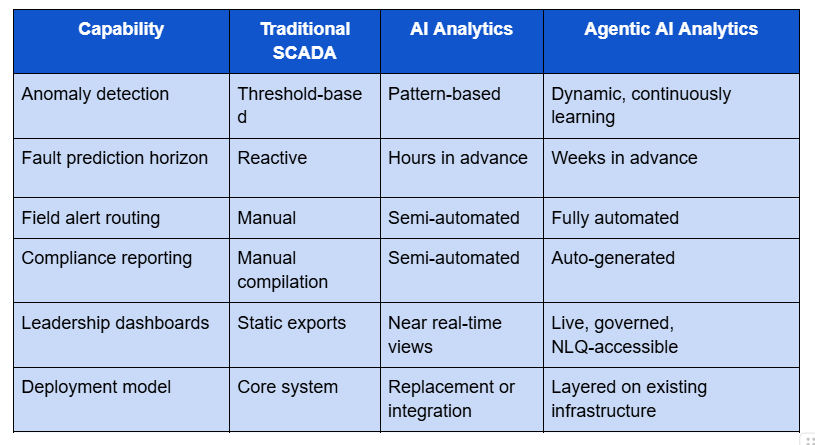
Most enterprise utilities in 2026 are evaluating the move from the first generation to the third. The second generation proved value but left too much human effort in the loop. Agentic AI is the architecture that removes it.
What Does Smart Grid AI Analytics Software Actually Do?
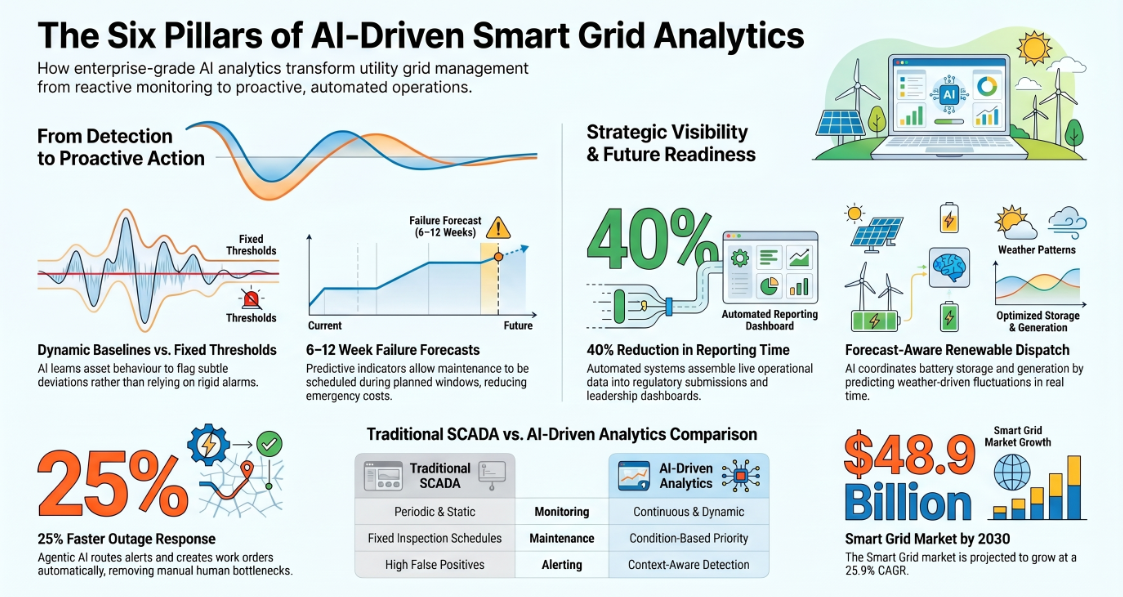
The capabilities of enterprise-grade AI analytics software for smart grids break into six functional areas. Understanding each one separately matters because different utilities have different priority gaps — some need anomaly detection first, others need faster reporting, others need predictive maintenance at asset scale. A platform worth evaluating should cover all six.
Real-Time Transmission KPI Monitoring
The foundation of any grid analytics platform is continuous data ingestion. Enterprise-grade systems connect to SCADA, PMU (phasor measurement units), RTU (remote terminal units), IoT sensor networks, weather feeds, and market data systems — pulling operational telemetry from thousands of assets simultaneously into a unified grid state model.
On top of this unified context, the platform monitors the KPIs that matter to operations and reliability teams: voltage stability, frequency, load distribution, transformer temperatures, line losses, outage events, and equipment performance metrics. The critical difference from traditional dashboards is that monitoring is continuous and dynamic, not periodic and static. The system knows the expected behaviour of every asset at every time of day, season, and load condition — and flags deviations against that dynamic baseline, not a fixed alarm threshold.
Anomaly Detection and Early Warning
Traditional SCADA monitoring generates two types of problems: false positives that train operations teams to ignore alerts, and missed early warnings where faults develop gradually through subtle signal patterns that stay below alarm limits until a breaker trips.
AI anomaly detection addresses both. Machine learning models trained on historical operational data for each asset class build an expectation of normal behaviour. When real-time telemetry deviates from that expectation — a transformer running slightly hotter under normal load, a voltage pattern that precedes a fault type the model has seen before — the system flags it before the fault becomes an outage.
The result is fewer false alarms (because detection is context-aware, not threshold-triggered) and earlier detection of genuine issues (because the system sees pre-fault signatures, not just post-fault symptoms). For utilities managing aging infrastructure across large networks, this is the single highest-value capability in the stack.
Predictive Maintenance Indicators
Anomaly detection tells you something is deviating from normal. Predictive maintenance tells you when it will fail and whether that failure needs immediate intervention or can wait for a planned maintenance window.
Enterprise AI analytics platforms analyse thermal, vibration, electrical performance, and maintenance history data across asset fleets — transformers, turbines, substations, transmission lines, renewable generation equipment — to generate health scores and failure probability estimates with time horizons of six to twelve weeks. This is long enough to schedule corrective maintenance during planned outages rather than emergency windows, which is where the cost saving and reliability improvement actually comes from.
Maintenance teams stop working from fixed inspection schedules and start working from condition-based priority lists generated by the system in real time.
Automated Field Alert Routing
Detection and prediction only create value if they result in action quickly enough to matter. The operational bottleneck in most utilities is not detection — it is the human steps between detection and field response: the alert review, the escalation decision, the work order creation, the crew dispatch.
Agentic AI analytics eliminates this bottleneck for standard exception types. When the system detects an anomaly, classifies it, and determines it matches a governed response rule, it routes the alert directly to the relevant field operations team, generates the associated work order, and logs the action in the audit trail — without waiting for manual review. For non-standard exceptions or high-severity events, it escalates to human operators with full context pre-loaded.
The outcome is a measurable improvement in outage response time. Platforms deployed at enterprise scale have demonstrated 25% faster outage response compared to manual workflows — not through faster humans, but through fewer humans in the loop for decisions that do not require them.
Leadership and Operations Dashboards
One of the most persistent operational problems in utility management is the gap between the data operations teams see in real time and the visibility leadership has into grid performance. Operational dashboards are built for engineers. Leadership visibility depends on manual reporting cycles that are always out of date by the time they are compiled.
AI analytics platforms solve this by maintaining separate dashboard layers for operational teams and leadership — both drawing from the same live unified grid state model, but presenting different cuts of the data. Operations teams see asset health, active anomalies, and field alert queues. Leadership sees KPI trends, reliability metrics, exception counts, and regulatory compliance status — in real time, without anyone compiling a report.
Automated reporting generation reduces the engineering time spent on regulatory submissions by up to 40%, with reports assembled from live operational data and formatted for compliance requirements automatically.
Renewable Energy Integration Analytics
Renewable energy sources — solar, wind, battery storage — introduce variability that deterministic grid planning was never designed to accommodate. Output fluctuates with weather. Generation patterns are intermittent. Grid stability requires coordinating these sources with conventional generation and demand in ways that change by the hour.
AI analytics software handles renewable integration through forecast-aware dispatch: analysing weather data, historical generation patterns, and real-time grid state to predict renewable output across multiple time horizons, then using that forecast to optimise dispatch decisions, coordinate battery storage charging and discharge, and maintain frequency and voltage stability as generation and demand shift throughout the day.
This capability is becoming less optional and more essential as renewable penetration increases across utility portfolios. The edge AI smart grids market is projected to grow from $15.49 billion in 2025 to $48.91 billion by 2030 at a 25.9% CAGR — almost entirely driven by the operational complexity that renewable integration creates.
How Agentic AI Is Different From Conventional Grid Analytics Tools

Most grid analytics tools — including well-known platforms from large enterprise vendors — are excellent at displaying data. They ingest operational telemetry, render it in dashboards, and surface alerts. The intelligence stops at the dashboard. A human still has to look at the alert, decide what it means, and initiate a response.
Agentic AI analytics is architecturally different. The defining characteristic is that the system does not stop at observation — it proceeds through decision and action within governed boundaries. Here is what that architecture looks like in practice:
Sensor & SCADA Data Intake
(PMU, RTU, weather, market feeds)
↓
(Unified grid state model — all assets, all telemetry, continuously updated)
↓
AI Operations Layer
(Anomaly detection, fault prediction, dispatch optimisation, renewable coordination)
↓
(NERC/FERC compliance rules, audit trail, escalation logic, human override)
↓
Grid Outputs
(Field alerts, work orders, dashboards, regulatory reports, reliability KPIs)
Every action the system takes passes through the governance layer before execution. This is not optional — for utilities operating under NERC reliability standards and FERC oversight, every automated decision needs to be auditable and explainable. The governance layer enforces compliance constraints on autonomous actions, logs every decision with its reasoning, and provides a full audit trail for regulatory review.
The practical difference this makes: a conventional analytics tool tells an operations engineer that a transformer in sector 7 is showing elevated thermal readings. An agentic AI analytics system detects the same reading, classifies it against historical fault signatures, determines it matches a pattern that preceded three similar failures in the last 18 months, generates a maintenance priority flag, routes it to the relevant field team with a work order attached, and logs the action — while the operations engineer is still reviewing their morning dashboard.
Conventional tools shift operations from ignorance to awareness. Agentic AI shifts operations from awareness to action.
Real-World Deployments: What Enterprise Utilities Have Built
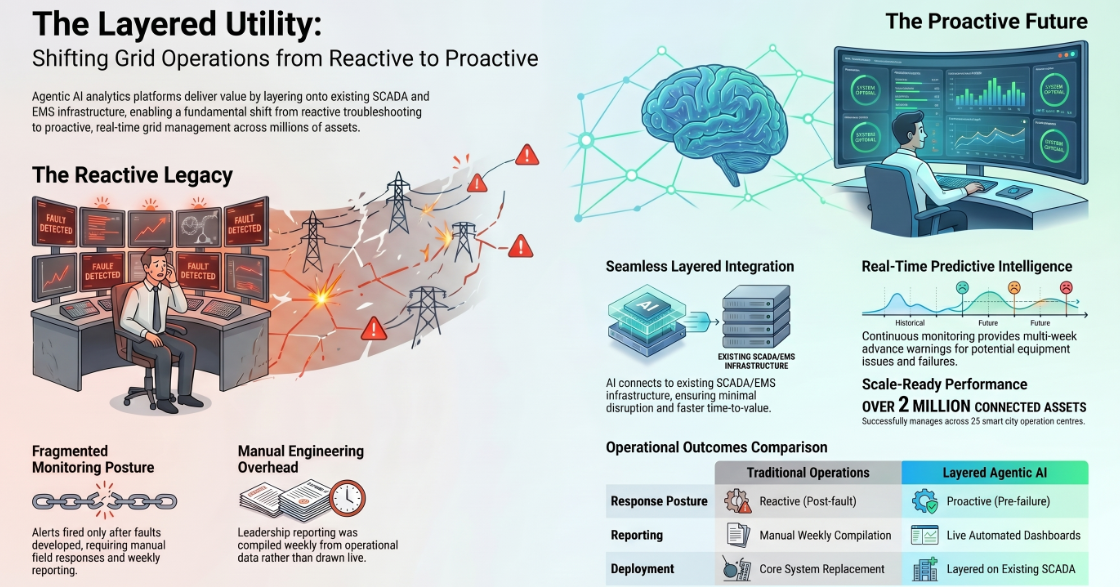
The enterprise AI industry generates a great deal of discussion about what agentic AI could do for grid operations. The following deployments are not hypothetical. They are production systems, operational today, with measurable outcomes.
Deployment 1: State-Level Power Transmission Utility
The challenge: A state-level power transmission utility responsible for operating and maintaining a large-scale transmission network needed to improve operational visibility, reduce response times to grid exceptions, and shift from reactive to proactive operations. The organisation's existing monitoring posture was almost entirely reactive — alerts fired after faults developed, field response was manual, and leadership reporting was compiled weekly from operational data rather than drawn live.
What was deployed: An agentic analytics platform was layered on top of the utility's existing operational data infrastructure — no replacement of SCADA, EMS, or core operational systems was required. The platform provided:
- Continuous monitoring of transmission KPIs across the full network
- Real-time anomaly detection against dynamic asset baselines
- Predictive indicators for equipment issues with multi-week advance warning
- Automated alert routing to field operations teams with pre-built work order templates
- Dual dashboards — one for operational teams, one for leadership — both drawing from live data
- Automated reporting replacing manual weekly compilation
The results: Faster identification of grid exceptions and operational risks. Proactive monitoring replacing the previous reactive posture. Better operational transparency for leadership without additional reporting workload. The monitoring posture shift — from reactive to proactive — was described as the defining outcome of the deployment.
What this means for enterprise buyers: The architecture that made this deployment work was the layered model. The platform connected to existing operational data infrastructure rather than replacing it. Time-to-value was significantly shorter than a core system replacement, and operational disruption during deployment was minimal. Utilities evaluating AI analytics software should prioritise platforms that can layer on existing SCADA and EMS infrastructure from day one.
Deployment 2: Smart City Infrastructure Operator
The challenge: A smart infrastructure organisation operating at city scale — running more than 25 smart city operation centres and managing over two million connected assets and applications — needed to consolidate fragmented operational data, improve exception detection across a massive asset network, and give leadership real-time visibility into grid performance without adding manual reporting overhead.
What was deployed: An agentic analytics platform covering smart grid data ingestion, operational dashboards, predictive analytics for outages and field losses, and automated alert routing for grid operations. The platform connected to the organisation's existing utility data infrastructure and provided a unified operational view across all connected assets.
The results: Higher operational visibility across grid operations. Faster exception detection and response coordination. More proactive grid operations via continuous monitoring, replacing a monitoring posture that previously required manual checks across fragmented systems. Leadership gained live visibility into grid performance KPIs without new reporting workflows.
What this means for enterprise buyers: Scale does not require a different architecture. The same layered, agentic approach that worked for a state transmission utility scaled to city-level infrastructure with millions of assets. The platform's ability to ingest data from existing systems — rather than requiring those systems to be replaced — was the enabling factor at both scales.
The Consistent Pattern Across Deployments
Looking at both deployments together, the pattern is consistent enough to state as a principle: agentic AI analytics for smart grids delivers value not by replacing operational infrastructure, but by making existing infrastructure intelligent.
The utilities that deployed these systems did not undergo core system replacements. They layered an agentic analytics platform on top of what they already had — existing SCADA, existing EMS, existing operational data pipelines — and the platform converted that data into decisions and actions that previously required manual engineering effort.
The operational shift in both cases was the same: from reactive (responding to failures after they develop) to proactive (preventing failures before they develop). That shift is the return on investment.
What to Look For in Smart Grid AI Analytics Software
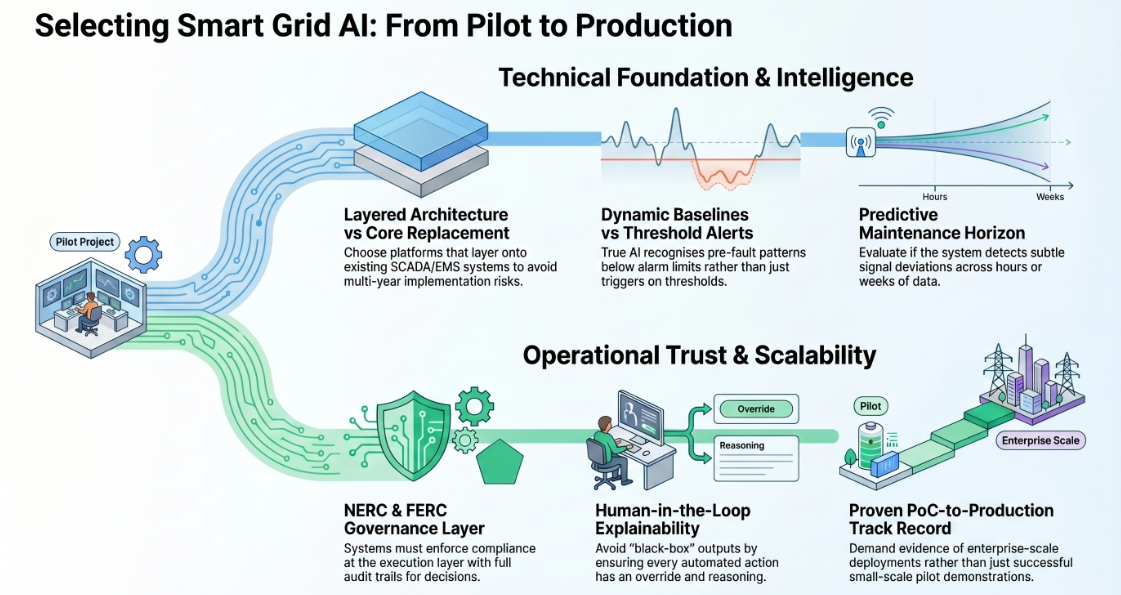
If you are evaluating AI analytics software for your grid operations, these are the four capability areas that separate platforms worth deploying from platforms worth demoing once and declining.
1. Data Integration Without Core System Replacement
The first question to ask any vendor: does your platform require replacing our existing SCADA or EMS systems, or does it layer on top of them?
Platforms that require core system replacement carry implementation timelines measured in years, integration risk, and operational disruption during deployment. Platforms built on a layered architecture connect to your existing operational data infrastructure from day one — ingesting SCADA, PMU, RTU, weather, and market data through standard integrations — and deliver value from the first week of operation.
Supported integrations to verify: GE, Siemens, ABB, OSIsoft, and the specific SCADA and EMS vendors in your stack. If a platform cannot demonstrate live integration with your existing systems in a proof-of-concept, it cannot deliver on its roadmap claims.
2. Detection Depth — Beyond Threshold Alerts
Ask vendors for specifics on how their anomaly detection actually works. Threshold-based alerting is not AI analytics — it is a dashboard with alarms. AI analytics builds dynamic baselines per asset, recognises pre-fault patterns below alarm limits, and classifies anomaly type before the fault develops.
Questions to ask:
- What is the predictive maintenance horizon — hours or weeks?
- How does the system reduce false positives compared to threshold alerting?
- Can it detect faults that develop gradually across weeks of subtle signal deviation?
If the vendor cannot answer these questions with specifics about their model architecture, their platform is not delivering AI anomaly detection — it is delivering a better dashboard.
3. Governance and Compliance Architecture
Utilities operating under NERC reliability standards and FERC oversight cannot deploy autonomous systems without a governance layer that enforces compliance constraints on every automated action. This is non-negotiable.
Evaluate whether the platform has:
- NERC compliance rules enforced at the agent execution layer (not just reported after the fact)
- A full audit trail for every automated decision, including the reasoning behind it
- Human override capability for any automated action
- Explainability on anomaly flags and maintenance recommendations — not black-box outputs
Regulators and reliability engineers need to trust the system. Governance architecture is what builds that trust.
4. PoC-to-Production Track Record
The utility industry has seen many AI pilots that delivered impressive demos and stalled before production. Ask for evidence of production deployments, not just proofs-of-concept. Specifically:
- How many production deployments does the vendor have at enterprise utility scale?
- What was the PoC-to-production timeline in those deployments?
- Did production deployments require core system replacement or use a layered architecture?
- What specific operational outcomes (response time improvement, outage rate reduction, reporting efficiency) are measurable from production data?
Vendors who can answer these questions with specific deployment evidence — not aggregated case study claims — have the track record worth evaluating further.
Getting Started With AI for Smart Grid Analytics
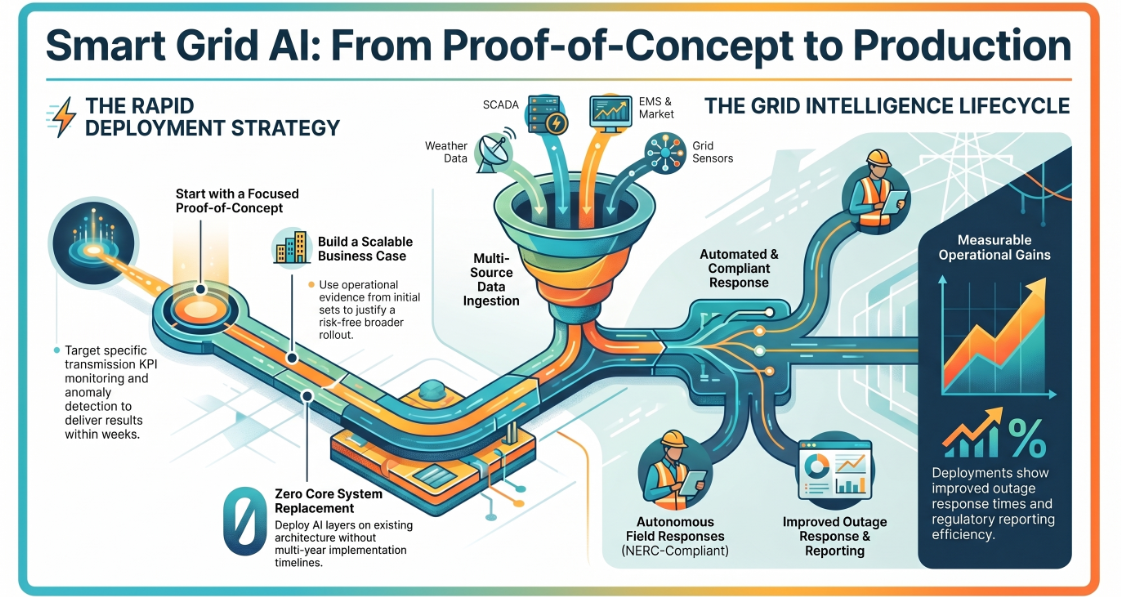
Most utilities that successfully deploy AI analytics software start with a focused proof-of-concept on a defined asset set — typically transmission KPI monitoring and anomaly detection layered on top of existing SCADA data. This scope delivers measurable results within weeks, without the risk of a full-platform deployment, and generates the operational evidence needed to build the business case for broader rollout.
The architecture that works at proof-of-concept scale is the same architecture that works at production scale: ingest existing operational data, apply AI detection and prediction layers, govern automated actions through compliance rule sets, and surface outputs through operational and leadership dashboards. No core system replacement. No multi-year implementation timeline. Operational improvement from the first week of live data.
Assistents.ai is an enterprise AI agent platform purpose-built for grid operations. The platform connects to SCADA, EMS, PMU, RTU, weather, and market data systems through standard integrations, provides agentic analytics covering the full grid intelligence lifecycle — from sensor intake through detection, prediction, and automated field response — and enforces NERC compliance governance on every autonomous action.
Production deployments at state-level transmission utilities and city-scale infrastructure operators have delivered measurable improvements in outage response time, grid reliability, and regulatory reporting efficiency.
To see how the platform performs against your specific operational environment, the most direct path is a focused demo with your team: assistents.ai/solutions/energy.
Frequently Asked Questions
What is AI for smart grid analytics software?
AI for smart grid analytics software is a technology platform that ingests operational data from grid infrastructure — SCADA systems, sensors, smart meters, PMUs, RTUs — and uses machine learning and autonomous agent systems to detect anomalies, predict equipment failures, optimise dispatch, and automate field alerts and compliance reporting. It turns raw grid telemetry into operational decisions, without requiring manual analysis at every step.
How does AI improve smart grid operations?
AI improves smart grid operations primarily by shifting the operational posture from reactive to proactive. Traditional monitoring detects faults after they develop. AI analytics detects the patterns that precede faults — days or weeks before failure — and routes automated responses to field teams before outages occur. The result is faster response times, fewer unplanned outages, and lower operational costs from emergency maintenance.
What is agentic AI in energy and utilities?
Agentic AI in energy refers to AI systems that do not just analyse data and surface insights — they take governed actions based on what they detect. An agentic AI analytics platform for smart grids will detect an anomaly, classify it, determine the appropriate response under governance rules, route a field alert, generate a work order, and log the action — without waiting for manual review at each step. The key differentiator is the closed loop from detection to action.
Can AI grid analytics software work with existing SCADA systems?
Yes — and this is one of the most important evaluation criteria when selecting a platform. Enterprise-grade agentic AI analytics platforms are designed to layer on top of existing SCADA, EMS, and operational data infrastructure without requiring core system replacement. This is how production deployments achieve short time-to-value: the platform connects to what you already have and immediately begins converting that data into intelligence and automated actions.
How long does it take to deploy AI smart grid analytics?
For platforms using a layered architecture — connecting to existing operational data infrastructure rather than replacing it — a proof-of-concept typically runs two to four weeks, covering anomaly detection and dashboard configuration for a defined asset set. Production deployment timelines depend on scope, but utilities that prioritise a layered model over core system replacement measure their time-to-value in weeks, not years.
What results do utilities see from AI smart grid analytics software?
Production deployments have demonstrated 25% faster outage response compared to manual workflows, 99.5% grid reliability maintenance across monitored networks, and 40% faster regulatory reporting through automated report generation. Predictive maintenance implementations have shown failure detection six to twelve weeks in advance, enabling utilities to replace emergency maintenance with planned maintenance windows — which is where most of the operational cost saving is realised.
How does AI handle renewable energy integration in smart grids?
AI analytics software manages renewable integration through forecast-aware dispatch: analysing weather data, historical generation performance, and real-time grid state to predict renewable output across multiple time horizons, then optimising dispatch decisions and battery storage coordination to maintain grid stability as generation and demand shift. As renewable penetration increases, this capability becomes the primary driver of AI analytics adoption in utility operations.

Transform Your Business With Agentic Automation
Agentic automation is the rising star posied to overtake RPA and bring about a new wave of intelligent automation. Explore the core concepts of agentic automation, how it works, real-life examples and strategies for a successful implementation in this ebook.
Sarfraz Nawaz is the CEO and founder of Ampcome, which is at the forefront of Artificial Intelligence (AI) Development. Nawaz's passion for technology is matched by his commitment to creating solutions that drive real-world results. Under his leadership, Ampcome's team of talented engineers and developers craft innovative IT solutions that empower businesses to thrive in the ever-evolving technological landscape.Ampcome's success is a testament to Nawaz's dedication to excellence and his unwavering belief in the transformative power of technology.

More insights
Discover the latest trends, best practices, and expert opinions that can reshape your perspective




Contact us

