
17 AI Recruitment Tools Examples (2026): Real Use Cases by Hiring Stage


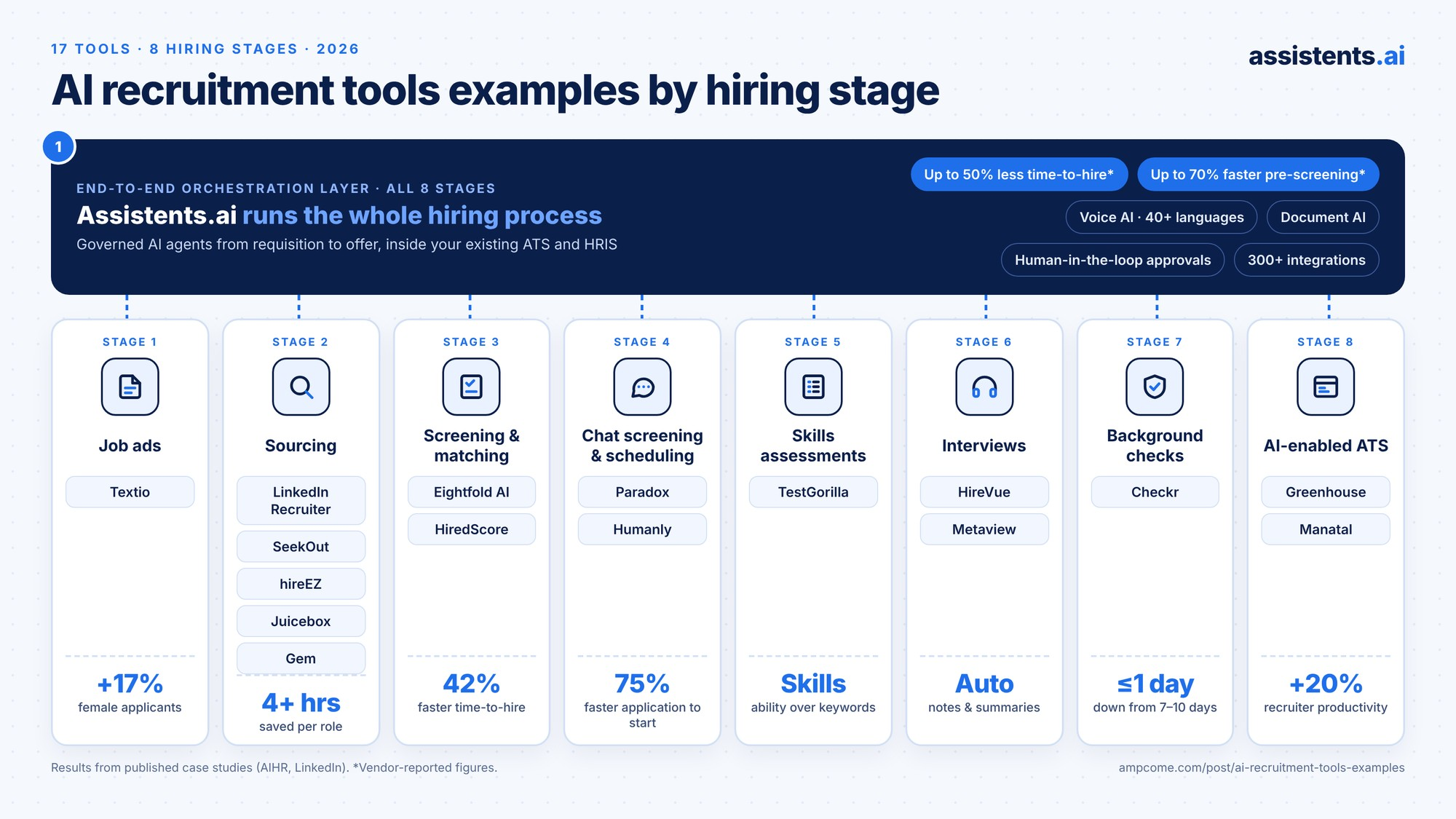
AI recruitment tools use machine learning, large language models and AI agents to automate sourcing, resume screening, candidate messaging, interview scheduling and assessment. Common examples include Paradox for conversational screening, HireVue for interviews, SeekOut and hireEZ for sourcing, Textio for job ads, and Assistents.ai for end-to-end, governed hiring workflows.
Most hiring teams don't lack AI tools. What they lack is a connected process. A recruiter might use one tool to write the job ad, another to source and a third to schedule, with ChatGPT open in a separate tab. The slow, error-prone work happens in between: handoffs, approvals, missing documents and follow-ups.
This guide walks through 17 AI recruitment tools examples organized by hiring stage. For each one you'll see what the tool does, a real-world example, who it suits, pricing and the trade-offs, so you can choose the right tool for your biggest bottleneck.
Key takeaways
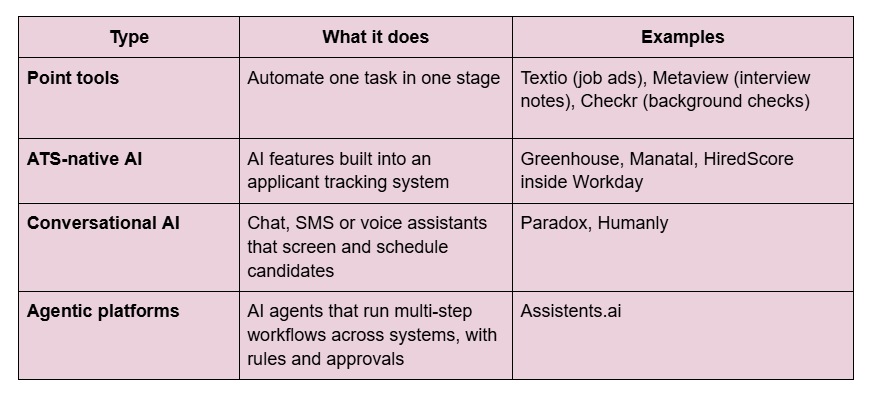
- AI recruitment tools fall into four types: point tools, ATS-native AI, conversational AI and agentic platforms that run whole workflows.
- The biggest gains come from fixing your slowest stage first. That is usually screening, scheduling or the handoff between systems.
- Real deployments report large, measurable gains. One example is a 75% cut in application-to-start time for a high-volume employer using conversational AI (AIHR).
- Governance now matters as much as features. NYC Local Law 144 requires bias audits for automated hiring tools, and the EU AI Act's high-risk hiring rules apply from 2 December 2027.
- For enterprises that want to automate the whole hiring process inside their existing ATS and HRIS, Assistents.ai is the strongest option on this list.
What are AI recruitment tools?
AI recruitment tools are software that uses artificial intelligence to find, assess, engage and hire candidates faster and more consistently than manual work. They read resumes, rank applicants against a role, write outreach, answer candidate questions, book interviews, summarize interview notes and flag risks for a recruiter to review.
They fall into four broad types:
Point tools vs. end-to-end AI recruiting agents
Think of it as personal productivity vs. organisational productivity.
A point tool, or a general assistant like ChatGPT or Copilot, helps one recruiter finish one task faster. It drafts, summarizes, researches and analyses. That is useful, but the hiring process itself doesn't change.
An AI recruiting agent connects your teams, business context, rules and systems. It moves a process from trigger to verified outcome, for example from "hiring manager opens a requisition" to "offer accepted and employee set up in the HRIS." You can then measure what leaders care about: time-to-hire, recruiter capacity, exception rates and compliance.
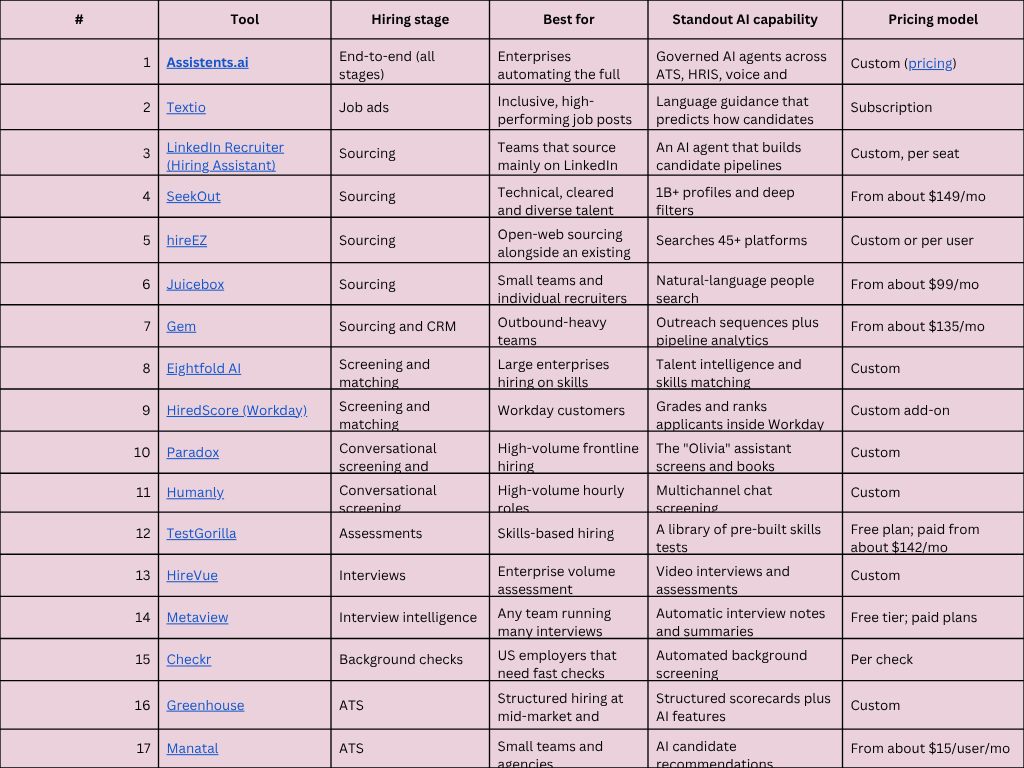
AI recruitment tools at a glance
All 17 tools at a glance. Pricing changes often, so check current pricing with each vendor.
How we evaluated these tools
We scored each tool against six weighted criteria. They reflect what actually changes hiring outcomes, not the length of a feature list.
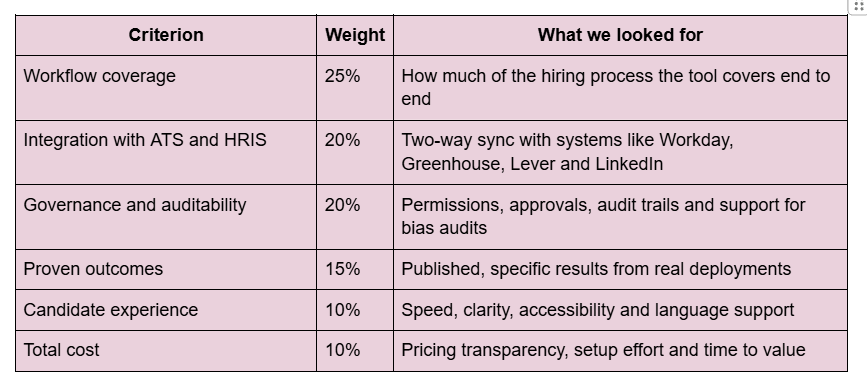
Disclosure: Ampcome builds Assistents.ai. We have ranked it first because it scores highest on workflow coverage, integration and governance, the three criteria that carry 65% of the weight. Specialist tools beat it on narrow tasks, and we say so throughout.
AI recruitment tools examples by hiring stage
1. Assistents.ai: best for end-to-end, governed recruiting workflows
Assistents.ai AI agents running a recruiting workflow from requisition to offer
What it does: Assistents.ai is an enterprise agentic AI platform built by Ampcome. Its AI agents understand your business, follow your rules and work alongside your people. Point tools fix one hiring stage. Assistents runs the whole hiring process across the systems you already use, with people in control of every decision that matters.
A typical Assistents recruiting workflow runs like this:
- Requisition and job design. The agent turns the hiring manager's input into a candidate profile covering skills, qualifications and salary band. It then drafts a job description for LinkedIn, Indeed and your careers page.
- Sourcing and outreach. It searches internal databases and external sources, rediscovers past applicants and sends personalized outreach with follow-ups.
- Screening. Document AI reads resumes, certificates and ID documents in 90+ formats. The agent scores each candidate against the role's criteria and gives its reasons.
- Pre-screen conversations. Conversational agents and Voice AI run first-round screens in 40+ languages. They ask role-specific questions and summarize the answers for recruiters.
- Scheduling. The agent coordinates calendars across candidates, interviewers and hiring managers.
- Approvals and offers. Salary-band checks and multi-level approval routing apply your policies. Exceptions go to a person, and the workflow resumes after approval.
- Handoff to onboarding. Approved data syncs to your HRIS, so onboarding, provisioning and day-one tasks start automatically through AI agents for HR and people ops.
Integrations: two-way connectors for Greenhouse, Lever and LinkedIn (ATS); Workday, SAP SuccessFactors, BambooHR and Darwinbox (HRIS); Slack, Microsoft Teams, Zoom and email; and 300+ enterprise systems in total (integrations).
Build your own agents: use the Recruitment Screening Agent template, or design custom recruiting agents in the Agent Builder. Each agent gets its role, knowledge sources, tools, permissions and test cases before it goes live.
Reported results: Ampcome's AI recruiter agent reports up to 50% less time-to-hire and up to 70% faster pre-screening. The HR solution reports 60% faster onboarding and 80% self-service resolution of employee requests. These are vendor-reported figures; ask for a baseline against your own process during a pilot.
Best for: mid-market and enterprise teams that already have an ATS and HRIS. It also suits high-volume or multilingual hiring, regulated industries such as healthcare, financial services and staffing, and any team that needs an audit trail for every AI decision.
Pricing: custom. You can start with one priority workflow and expand from there (pricing).
Watch-outs: it is a platform, not a plug-in. You get the most value when you map one hiring process, with its systems, handoffs and approval points, before you start. A solo recruiter who only needs a sourcing extension will find a point tool simpler.
See why enterprises choose Assistents ↓
Stage 1: Job descriptions and job ads
2. Textio
What it does: Textio analyses job posts and recruiting messages as you write. It flags biased or off-putting language and suggests wording that tends to attract more, and more diverse, applicants.
Real-world example: T-Mobile used Textio to rewrite job posts. It saw 17% more female applicants and cut time-to-fill by five days (AIHR).
Best for: employers focused on inclusive hiring and employer brand. Watch-outs: it covers writing only. Pair it with a sourcing or screening tool.
Stage 2: Sourcing and talent discovery
3. LinkedIn Recruiter (Hiring Assistant)
What it does: Hiring Assistant is LinkedIn's first AI agent for recruiters. It turns a role brief into search criteria, builds a pipeline and helps with outreach inside LinkedIn Recruiter.
Real-world example: early adopters report 4+ hours saved per role, 62% fewer profiles reviewed and a 69% improvement in InMail acceptance (LinkedIn).
Best for: teams that do most of their sourcing on LinkedIn. Watch-outs: it works only on LinkedIn's network, and seat costs are high.
4. SeekOut
What it does: SeekOut searches more than a billion profiles, with detailed filters for technical skills, security clearances and diversity.
Best for: technical, cleared and hard-to-fill roles. Watch-outs: some users report steep price increases at renewal.
5. hireEZ
What it does: hireEZ searches 45+ open-web sources and works alongside your existing ATS. It also rediscovers past applicants already in your database.
Real-world example: a US healthcare provider used hireEZ to review 281,740 candidates, with a 194% lift in engagement (AIHR).
Best for: teams that want stronger sourcing without changing their ATS.
6. Juicebox
What it does: Juicebox lets recruiters search for people in plain English, such as "senior backend engineers in Bengaluru with fintech experience."
Best for: small teams and individual recruiters. It also has a free tier. Watch-outs: it has fewer enterprise governance controls than larger platforms.
7. Gem
What it does: Gem combines outreach sequences, a recruiting CRM and pipeline analytics for outbound teams.
Best for: sourcing-heavy teams at mid-market and enterprise scale.
Stage 3: Resume screening and matching
8. Eightfold AI
What it does: Eightfold AI matches candidates and employees to roles based on inferred skills and career paths. It supports external hiring and internal mobility.
Real-world example: an international packaging group cut time-to-hire by 42% and received about 30% more applicants (AIHR).
Best for: large enterprises moving to skills-based hiring. Watch-outs: it takes significant implementation effort, and pricing is custom.
9. HiredScore (Workday)
What it does: HiredScore grades and ranks applicants inside Workday Recruiting. Workday acquired it in 2024.
Best for: organizations that already run on Workday. Watch-outs: its value is limited outside the Workday ecosystem.
Stage 4: Conversational screening and interview scheduling
10. Paradox
What it does: Paradox, known for its assistant "Olivia," screens candidates, answers their questions and books interviews by text, chat and web. Workday completed its acquisition of Paradox in October 2025.
Real-world example: Chipotle cut application-to-start time by 75% and raised application completion from 50% to 85% (AIHR).
Best for: high-volume frontline and hourly hiring in retail, hospitality and quick-service restaurants. Watch-outs: it is built for volume hiring; complex professional roles need more human screening.
11. Humanly
What it does: Humanly runs conversational screening and scheduling across multiple channels for hourly roles.
Best for: high-volume hourly hiring at mid-market scale.
Stage 5: Skills assessments
12. TestGorilla
What it does: TestGorilla offers a library of pre-built tests for skills, cognitive ability, language and role knowledge, so you can screen on ability rather than resume keywords.
Best for: skills-based hiring at any company size. It has a free plan. Watch-outs: test design and validation still need HR oversight.
Stage 6: Interviews and interview intelligence
13. HireVue
What it does: HireVue runs on-demand and live video interviews, game-based assessments and coding tests for large employers.
Best for: enterprise campus and volume hiring. Watch-outs: AI-scored interviews face the strictest regulatory scrutiny. Check bias audits and candidate-notice requirements before you deploy.
14. Metaview
What it does: Metaview records interviews and writes structured notes and summaries automatically, so interviewers can focus on the conversation.
Best for: any team running many interviews. It has a free tier.
Going deeper on voice interviews? Read our AI voice agent interview platform buyer's guide.
Stage 7: Background checks
15. Checkr
What it does: Checkr automates criminal, employment and driving-record checks.
Real-world example: a US hotel group cut background checks from 7–10 days to one day or less (AIHR).
Best for: US employers hiring at volume.
Stage 8: AI-enabled ATS for growing teams
16. Greenhouse
What it does: Greenhouse is an ATS built around structured hiring, with scorecards, interview kits and AI features.
Best for: mid-market and enterprise teams that want consistent, fair interviews.
17. Manatal
What it does: Manatal is an affordable ATS and recruiting CRM with AI candidate recommendations.
Real-world example: a recruitment agency raised recruiter productivity by 20% after adopting Manatal (AIHR).
Best for: small businesses, startups and recruitment agencies.
Real-world examples of AI agents running hiring workflows
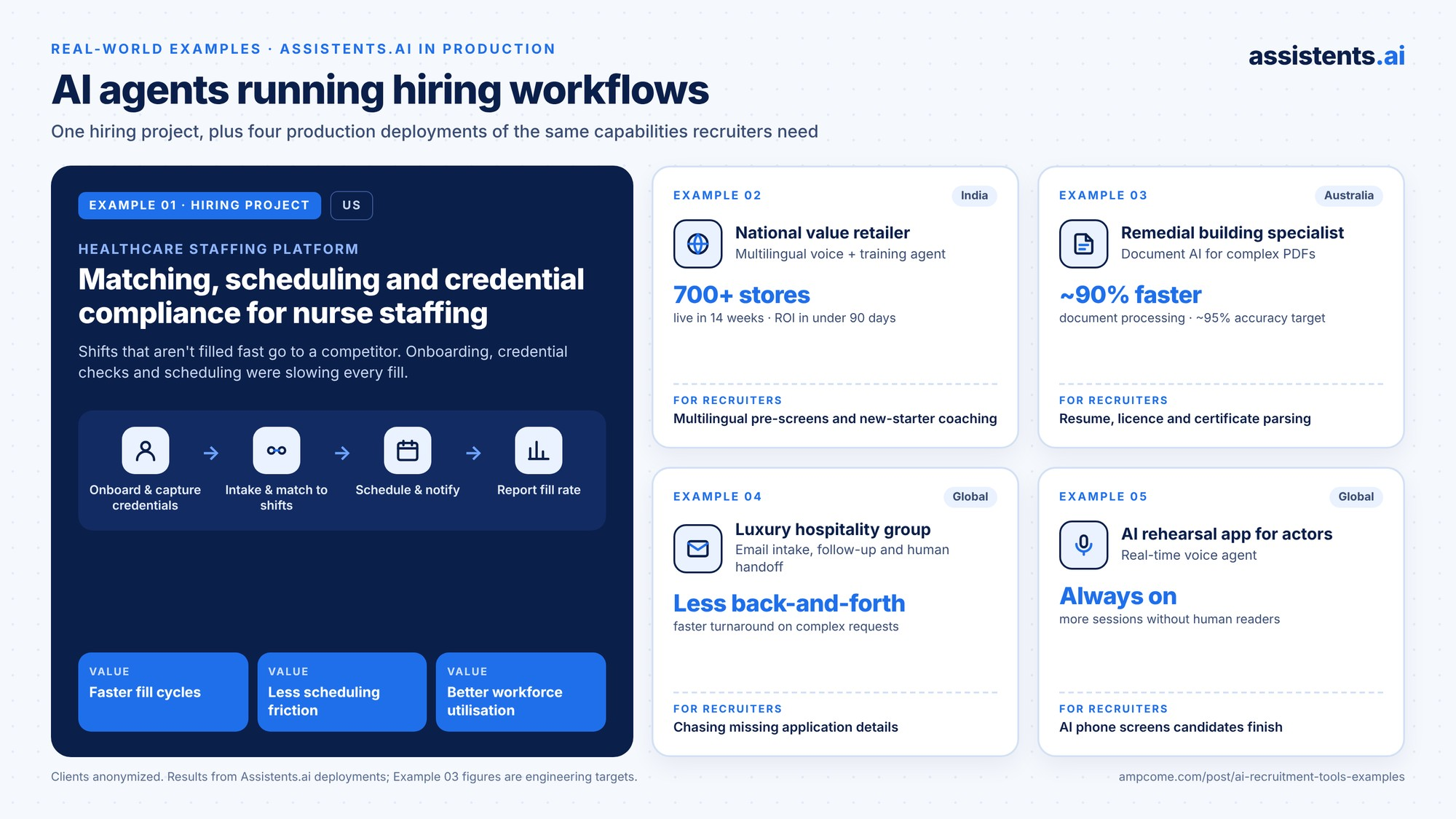
Tool demos show what could happen. Production deployments show what does. The examples below come from Assistents.ai implementations, described by industry and region only. Clients are anonymized.
Only the first example is a hiring project. The others show the same AI capability proven in production in a different function, which is what you need to judge before applying it to recruiting.
Example 1: Healthcare staffing platform (US): matching, scheduling and credential compliance
- Situation: a healthcare staffing platform connects nursing professionals with facilities for flexible shifts. Speed decides who wins: a shift that isn't filled quickly goes to a competitor. Onboarding, credential checks and scheduling were slowing fills.
- Solution: an AI platform for staffing operations covering:
- talent onboarding with credential capture
- facility staffing-request intake and matching logic
- automated scheduling, notifications and compliance workflows
- fill-rate and utilisation reporting
- Value: faster fill cycles and less scheduling friction, better workforce utilisation, and quicker responses to facilities.
Why it matters for recruiters: this is AI recruiting at its most demanding. Candidates must be matched, verified and scheduled within hours, with compliance checked at every step.
Example 2: National value retailer (India): multilingual support and faster frontline onboarding
- Situation: a fast-growing retailer with 700+ stores across hundreds of cities needed store staff to get answers fast, including new hires still learning procedures.
- Solution: enterprise AI agents including:
- a Hindi and English voice support agent
- a knowledge and training agent that answers questions from point-of-sale guides and standard operating procedures
- ticketing integration and an admin console
- Value: faster onboarding through on-demand training, less helpdesk load and faster resolution of store issues. The deployment went live across 700+ stores in 14 weeks, with full ROI in under 90 days (Assistents.ai).
Why it matters for recruiters: frontline employers lose new hires in the first weeks. The same multilingual agent can answer candidate questions, run pre-screens and coach new starters in their own language.
Example 3: Remedial building specialist (Australia): document extraction at high accuracy
- Situation: complex PDF tender documents were processed by hand, which was slow and risked missed changes.
- Solution: a multi-agent document workbench with vision-LLM extraction, revision detection and audit logs, integrated with the company's operations system.
- Value: engineered for up to ~90% faster document processing, with a ~95% extraction accuracy target on standard formats.
Why it matters for recruiters: resumes, licences, certificates and ID documents are messy PDFs too. This is the same capability that powers resume parsing and credential verification.
Example 4: Luxury hospitality group: intake, follow-up and human handoff
- Situation: booking requests arrived by email with missing details, which caused long back-and-forth exchanges.
- Solution: an agent that:
- classifies each email's intent and extracts the data
- runs a conversational loop to collect missing details
- hands complex cases to a person
- Value: faster turnaround, less back-and-forth and higher accuracy on complex requests.
Why it matters for recruiters: this is the same pattern as collecting missing application details from candidates and routing edge cases to a recruiter.
Example 5: AI rehearsal app for actors: real-time voice conversations
- Situation: actors needed a scene partner available at any hour.
- Solution: a voice agent with character and voice control, pacing and cue logic.
- Value: more rehearsals without human readers and more consistent practice.
Why it matters for recruiters: natural, low-latency voice conversation is the foundation of AI phone screens that candidates are willing to finish.
Why Assistents.ai is the top choice for enterprise recruiting
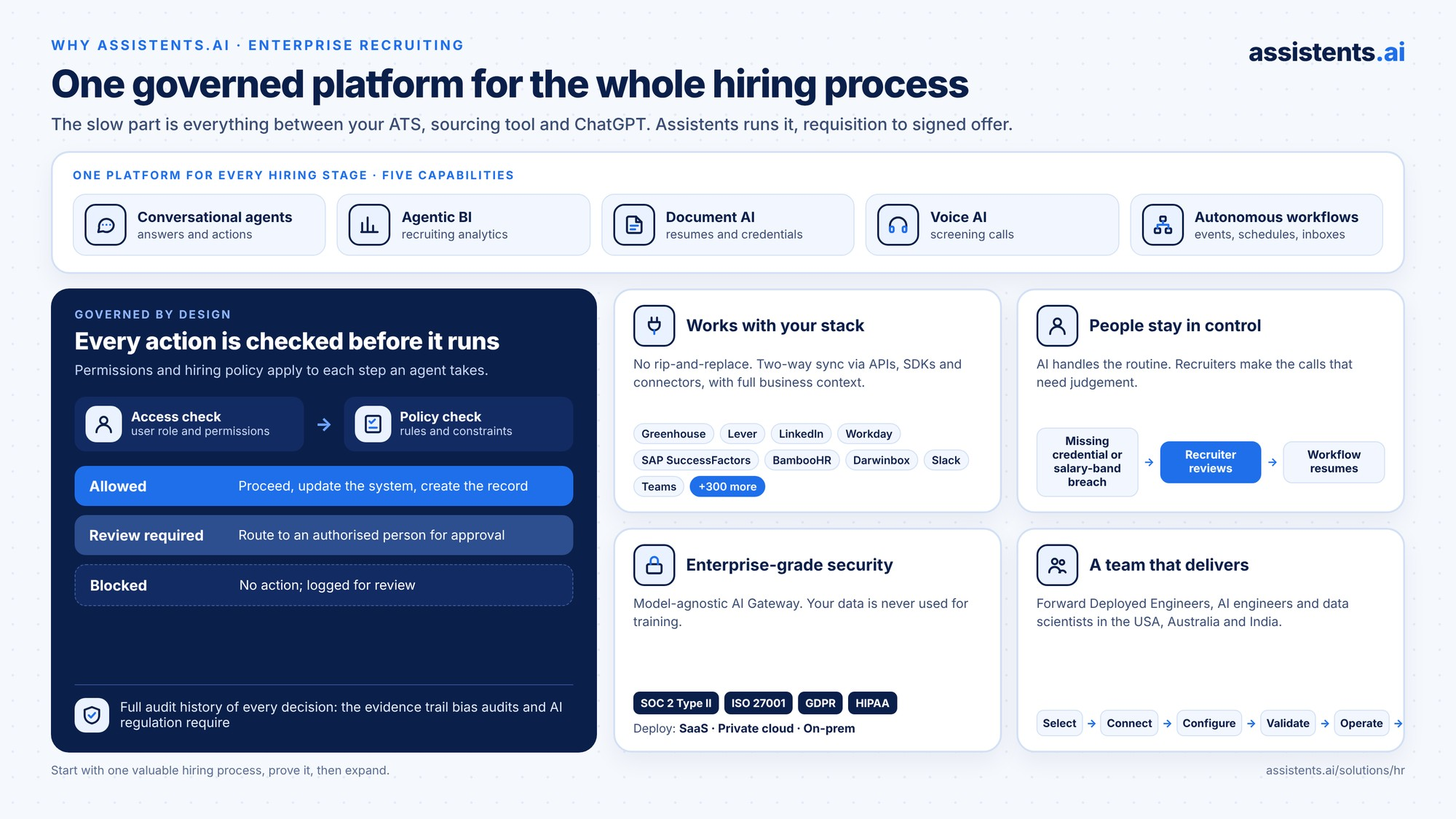
Most teams already have an ATS, a sourcing tool and ChatGPT. The slow part is everything between them. Assistents.ai puts AI agents to work across that whole process, from requisition to signed offer. The agents understand your business, follow your rules and work alongside your recruiters.
One platform for every hiring stage
Assistents combines five capabilities on one platform:
- Conversational agents for answers and actions
- Agentic BI for recruiting analytics
- Document AI for resumes and credentials
- Voice AI for screening calls
- Autonomous workflows that start work from system events, schedules and inboxes
Use one capability, or combine them to transform the whole hiring process. Deep Research, Canvas, Agent Builder and Workflow Builder let you extend it.
Works with the stack you already have
There's no rip-and-replace. Assistents connects to Greenhouse, Lever, LinkedIn, Workday, SAP SuccessFactors, BambooHR, Darwinbox, Slack, Teams and 300+ other systems through APIs, SDKs and connectors with two-way sync. Its Context Engine links candidates, requisitions, hiring managers, salary bands and policies, so agents work from your actual business context.
Governed by design
Every action passes an access check for user role and permissions and a policy check against your rules and constraints. The action then takes one of three routes:
- Allowed: proceed, update the system and create the record.
- Review required: route to an authorised person for approval.
- Blocked: take no action and log it for review.
Every decision is recorded in a full audit history, which gives you the evidence trail that bias audits and AI regulation require. See Security & Trust.
People stay in control
Exceptions such as a missing credential, a salary-band breach or an unusual candidate go to a recruiter. The workflow waits, then resumes after review. AI handles the routine; recruiters make the calls that need judgement.
Enterprise-grade security and deployment
Assistents holds SOC 2 Type II, ISO 27001, GDPR and HIPAA credentials. It is model-agnostic through the AI Gateway, which handles model routing, fallback and usage management, and your data is never used for training. Deploy it as cloud SaaS, in a private cloud or on-premise.
A team that delivers
Forward Deployed Engineers, AI engineers and data-science specialists in the USA, Australia and India take you from configuration to production. The approach is to select one valuable process, connect systems, configure agents, validate on real cases, operate, then expand.
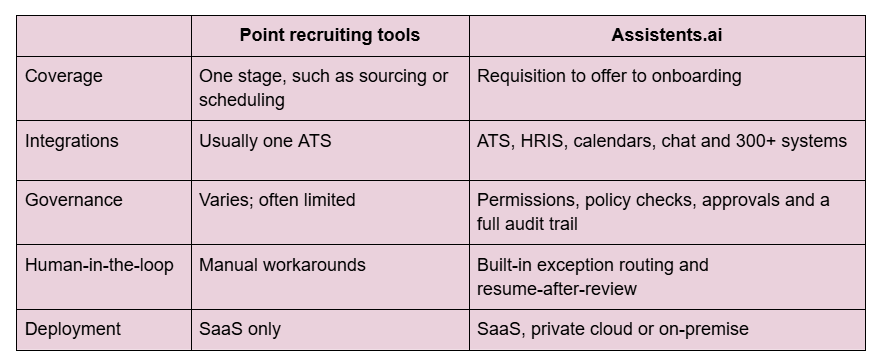
Assistents.ai vs. point recruiting tools
Compare Assistents with other agent platforms →
How to choose the right AI recruitment tool
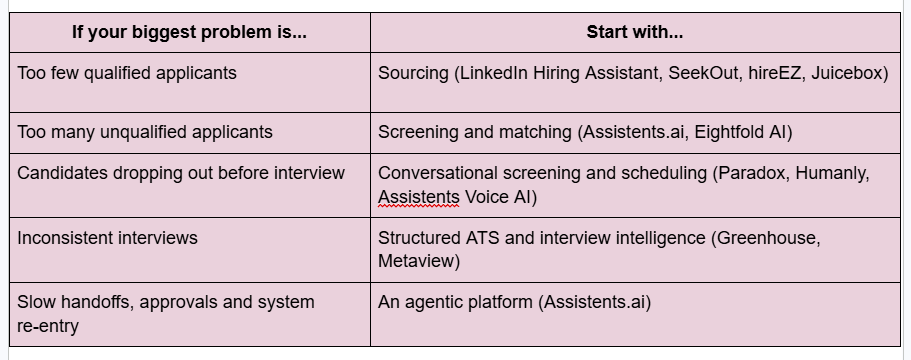
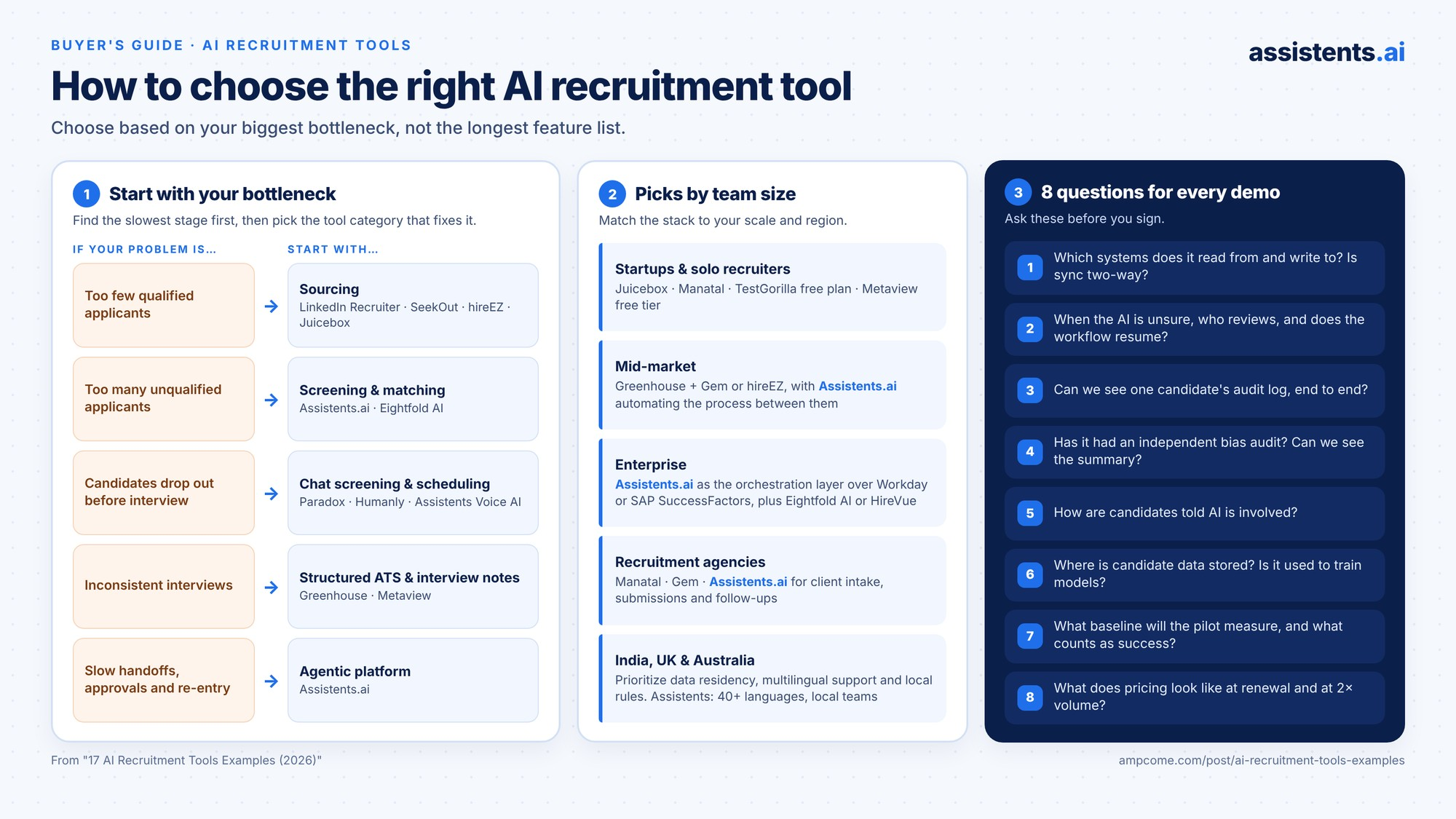
Choose based on your biggest bottleneck, not the longest feature list.
Start with your bottleneck, not the feature list
Picks by team size
- Startups and solo recruiters: Juicebox, Manatal, TestGorilla's free plan and Metaview's free tier.
- Mid-market: Greenhouse plus Gem or hireEZ, with Assistents.ai for automating the process between them.
- Enterprise: Assistents.ai as the orchestration layer over Workday or SAP SuccessFactors, plus specialist tools like Eightfold AI or HireVue where needed.
- Recruitment agencies: Manatal, Gem, and Assistents.ai for automating client intake, candidate submissions and follow-ups.
- India, UK and Australia: prioritize data residency, multilingual support and local regulations. Assistents supports data-residency controls, 40+ languages and local delivery teams in India and Australia.
8 questions to ask in every demo
- Which of our systems does it read from and write to, and is the sync two-way?
- What happens when the AI is unsure? Who reviews the case, and does the workflow resume afterwards?
- Can we see an audit log for one candidate, end to end?
- Has the tool had an independent bias audit, and can we see the summary?
- How are candidates told that AI is involved?
- Where is candidate data stored, and is it used to train models?
- What baseline will we measure against in the pilot, and what result counts as success?
- What does pricing look like at renewal and at twice our current volume?
AI bias, compliance and governance in recruiting
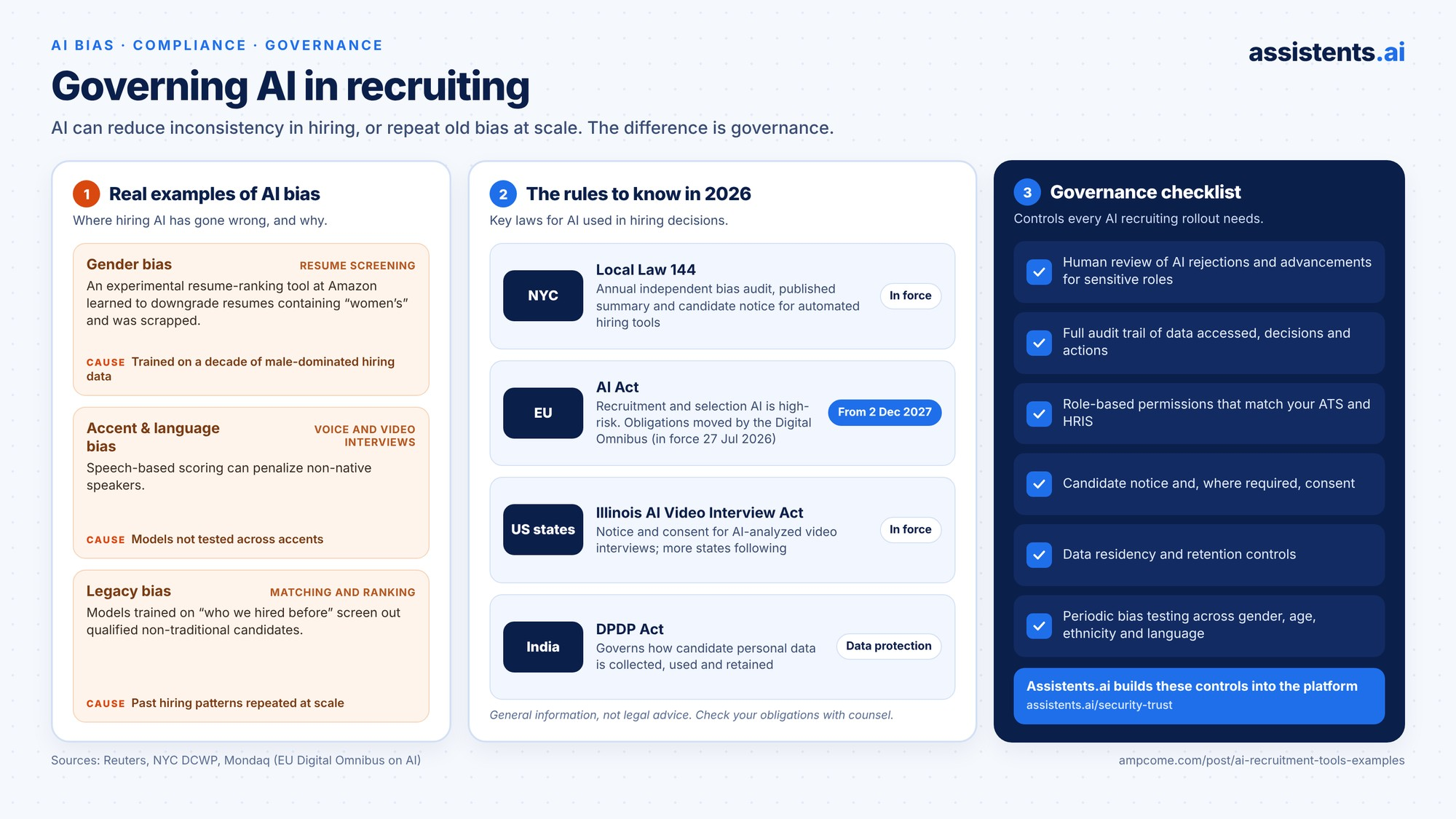
AI can reduce inconsistency in hiring, or it can repeat old bias at scale. The difference comes down to governance.
Real examples of AI bias in hiring
- Gender bias in resume screening: Amazon scrapped an experimental resume-ranking tool after it learned to downgrade resumes containing the word "women's," a result of training on a decade of male-dominated hiring data (Reuters).
- Accent and language bias: speech-based interview scoring can penalize non-native speakers when models aren't tested across accents.
- Legacy bias: models trained on "who we hired before" can screen out qualified candidates from non-traditional backgrounds.
The rules to know in 2026
- New York City Local Law 144: employers using automated employment decision tools must commission an annual independent bias audit, publish a summary and notify candidates (NYC DCWP).
- EU AI Act: AI used for recruitment and selection is classed as high-risk. Under the Digital Omnibus on AI, which entered into force on 27 July 2026, high-risk obligations for these systems now apply from 2 December 2027 (Mondaq).
- US states: Illinois' AI Video Interview Act requires notice and consent for AI-analyzed video interviews, and more states are passing similar rules.
- India: the Digital Personal Data Protection Act governs how candidate personal data is collected, used and retained.
This section is general information, not legal advice. Check your obligations with counsel.
Governance checklist for AI recruiting
- [ ] A person reviews every rejection or advancement the AI recommends for sensitive roles
- [ ] A full audit trail of data accessed, decisions made and actions taken
- [ ] Role-based permissions that match your ATS and HRIS
- [ ] Candidate notice and, where required, consent
- [ ] Data residency and retention controls
- [ ] Periodic bias testing across gender, age, ethnicity and language
Assistents.ai builds these controls into the platform. Read more in the Security & Trust centre.
Put AI agents to work across your hiring process
Pick the hiring process that slows you down most, whether that's screening, scheduling or offer approvals. Then map its systems, handoffs and approval points, and agree how you'll measure success. Assistents.ai will configure the agents around your stack and controls, validate them on real candidates, and expand from there.
Book a tailored walkthrough → · Explore AI agents for HR · See the AI recruiter agent
FAQs
What are examples of AI recruitment tools?
Common examples include Assistents.ai (end-to-end AI recruiting agents), Paradox (conversational screening and scheduling), HireVue (video interviews), SeekOut, hireEZ and LinkedIn Hiring Assistant (sourcing), Textio (job ads), Eightfold AI (skills matching), Metaview (interview notes) and Checkr (background checks).
How is AI used in recruitment?
AI is used to write job descriptions, source candidates, parse and rank resumes, answer candidate questions, run pre-screening chats or calls, schedule interviews, summarize interviews, run skills assessments and background checks, and hand hires off to onboarding. Agentic platforms like Assistents.ai connect these steps into one governed workflow.
What is the best AI tool for recruiting?
It depends on your bottleneck. For end-to-end, governed automation across an existing ATS and HRIS, Assistents.ai is the strongest choice. For high-volume frontline hiring, consider Paradox. For sourcing on LinkedIn, consider Hiring Assistant. For small teams on a budget, consider Manatal or Juicebox.
Are there free AI recruitment tools?
Yes, with limits. TestGorilla has a free plan, Metaview and Juicebox offer free tiers, and Zoho Recruit has a forever-free plan. General assistants like ChatGPT can draft job descriptions and outreach. Free plans usually cap jobs, candidates or features, and rarely include governance controls.
Can AI recruitment tools be biased?
Yes. AI learns from historical data, so it can repeat past bias, as Amazon's scrapped resume screener showed. Reduce the risk with independent bias audits, structured criteria, explainable scoring, human review of key decisions and a full audit trail.
Which companies use AI in hiring?
Published examples include Chipotle (Paradox), T-Mobile (Textio) and Walmart (Vervoe). Assistents.ai deployments include a US healthcare staffing platform and a national retailer with 700+ stores, both anonymized.
Will AI replace recruiters?
No. AI replaces repetitive work like screening, scheduling, data entry and follow-ups. Recruiters keep the judgement calls, relationships and final decisions. Well-designed AI agents route exceptions to people rather than guessing.
How much do AI recruiting tools cost?
Prices range from free plans and about $15 per user per month for entry-level ATS tools, to custom enterprise contracts worth tens of thousands of dollars a year. Sourcing tools usually charge per seat. Enterprise platforms like Assistents.ai price by scope and are often piloted on one workflow first.
What is an AI recruiting agent?
An AI recruiting agent is software that completes multi-step hiring tasks on its own, within rules you set. For example, it can source, screen, message, schedule and update the ATS, then escalate exceptions to a recruiter. See Ampcome's AI recruiter agent.
Is AI in hiring legal?
Yes, but it's regulated. New York City requires annual bias audits and candidate notice. The EU AI Act treats recruiting AI as high-risk from 2 December 2027. Illinois regulates AI video interviews, and India's DPDP Act governs candidate data. Always check local rules with counsel.

Transform Your Business With Agentic Automation
Agentic automation is the rising star posied to overtake RPA and bring about a new wave of intelligent automation. Explore the core concepts of agentic automation, how it works, real-life examples and strategies for a successful implementation in this ebook.
Sarfraz Nawaz is the CEO and founder of Ampcome, which is at the forefront of Artificial Intelligence (AI) Development. Nawaz's passion for technology is matched by his commitment to creating solutions that drive real-world results. Under his leadership, Ampcome's team of talented engineers and developers craft innovative IT solutions that empower businesses to thrive in the ever-evolving technological landscape.Ampcome's success is a testament to Nawaz's dedication to excellence and his unwavering belief in the transformative power of technology.

More insights
Discover the latest trends, best practices, and expert opinions that can reshape your perspective





Contact us

