
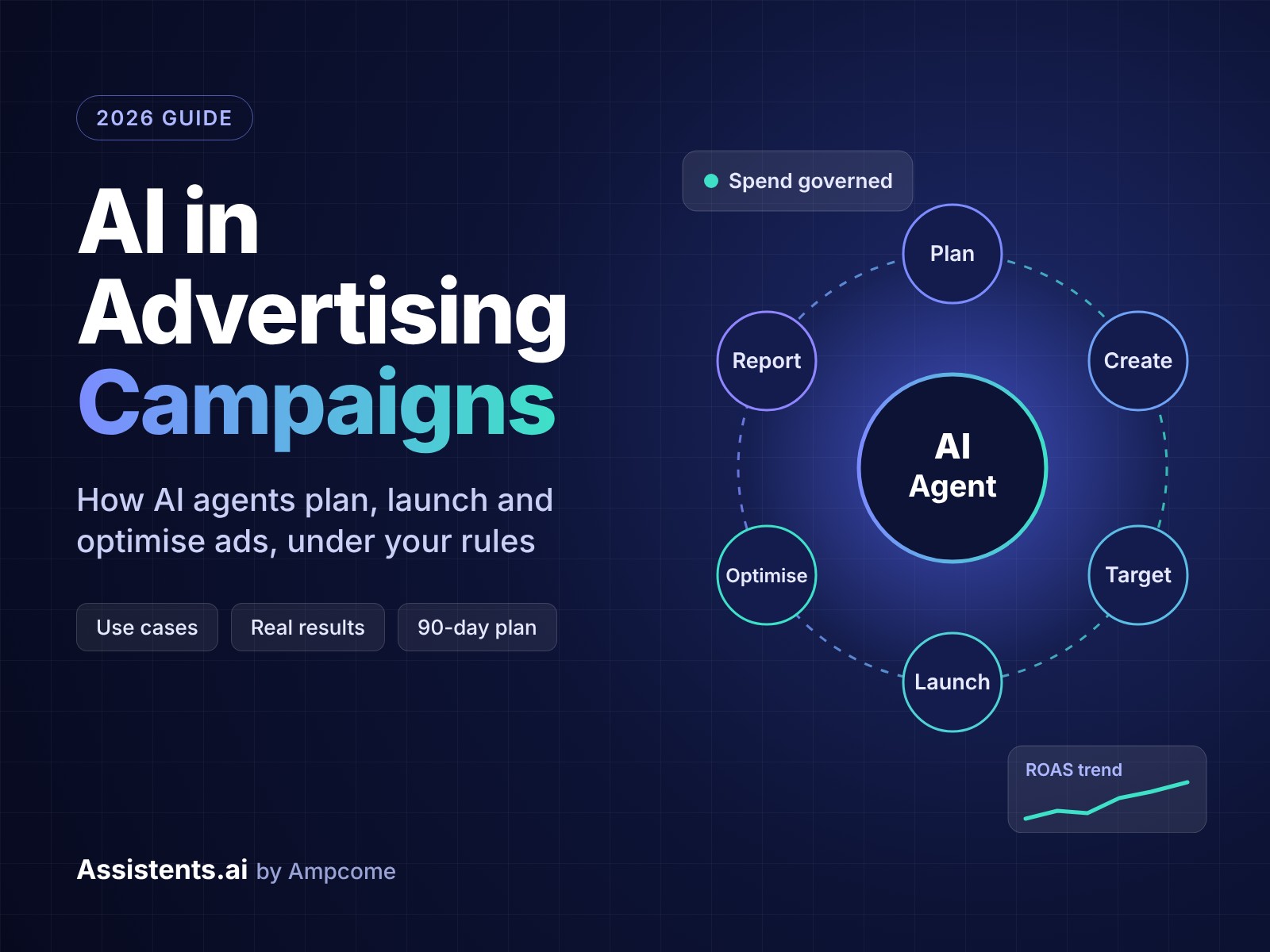
AI in Advertising Campaigns: How AI Agents Plan, Launch and Optimise Ads in 2026


AI in advertising campaigns has moved past auto-bidding. Google and Meta now write ad variants, pick audiences and set bids inside their own platforms. Most campaigns, though, still run on spreadsheets, Slack threads and weekly reporting calls between those platforms. Budgets get stuck in the wrong channel. Creative fatigue goes unnoticed for days. Nobody can say which change moved CAC.
This guide shows what AI does at every stage of an advertising campaign in 2026, where AI agents fit, how to govern them, and what real deployments have delivered. It also explains why Assistents.ai by Ampcome has become the go-to agentic AI platform for teams that want AI to run campaigns across channels without losing control of spend or brand.
TL;DR: AI in advertising campaigns, in 5 points
- What it is: using machine learning, generative AI and AI agents to plan, create, target, buy, optimise and report on ads.
- Where it works best: creative variation, audience segmentation, bid and budget reallocation, anomaly detection and automated reporting.
- What changed in 2026: AI agents now act, not just recommend. They move budget, pause ads and draft creative within limits you set.
- What you need: unified data across ad platforms, CRM and analytics, plus spend caps, approval thresholds and audit trails.
- How to start: run agents in read-only insight mode for 30 days, move to approve-then-act, then allow governed automation. That is about 90 days in all.
What is AI in advertising campaigns?
AI in advertising campaigns is the use of machine learning, generative AI and autonomous AI agents to plan, create, target, buy, optimise and measure paid ads. It replaces manual analysis and repetitive execution with systems that learn from performance data and act on it continuously, within rules set by the marketing team.
Three types of AI now show up in a typical campaign:
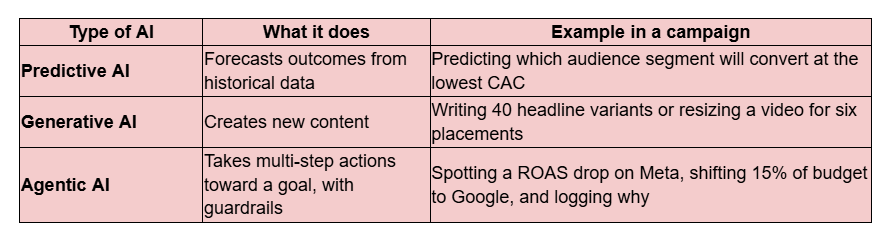
Most teams already use the first two. The third, agentic AI, is where the biggest operational gains in 2026 are coming from, because it closes the gap between insight and action.
How is AI used in advertising campaigns today?
AI is now standard in advertising, but most of it sits inside individual platforms rather than across the whole campaign.
- Adoption is close to universal. In IAB's January 2026 study, 83% of ad executives said their company uses AI in the creative process, up from 60% in 2024. The most common channels were social (85%) and display (73%).
- Video is going generative. IAB's video ad spend research found that 86% of video ad buyers use or plan to use generative AI to build video ads.
- AI creative can match human creative. A study by Taboola with researchers from Columbia, Harvard, TU Munich and Carnegie Mellon found that AI-generated ads averaged a 0.76% CTR against 0.65% for human-made ads. However, ads that looked AI-made underperformed.
- Marketing is where AI pays back. McKinsey's State of AI 2026 reports that revenue gains from AI are most often reported in marketing and sales. It also finds that 40% of large organisations are now scaling AI agents, up from 27% a year earlier.
- Consumers are less enthusiastic than executives. IAB found that 82% of executives think young consumers feel positive about AI ads, but only 45% actually do, a 37-point gap.
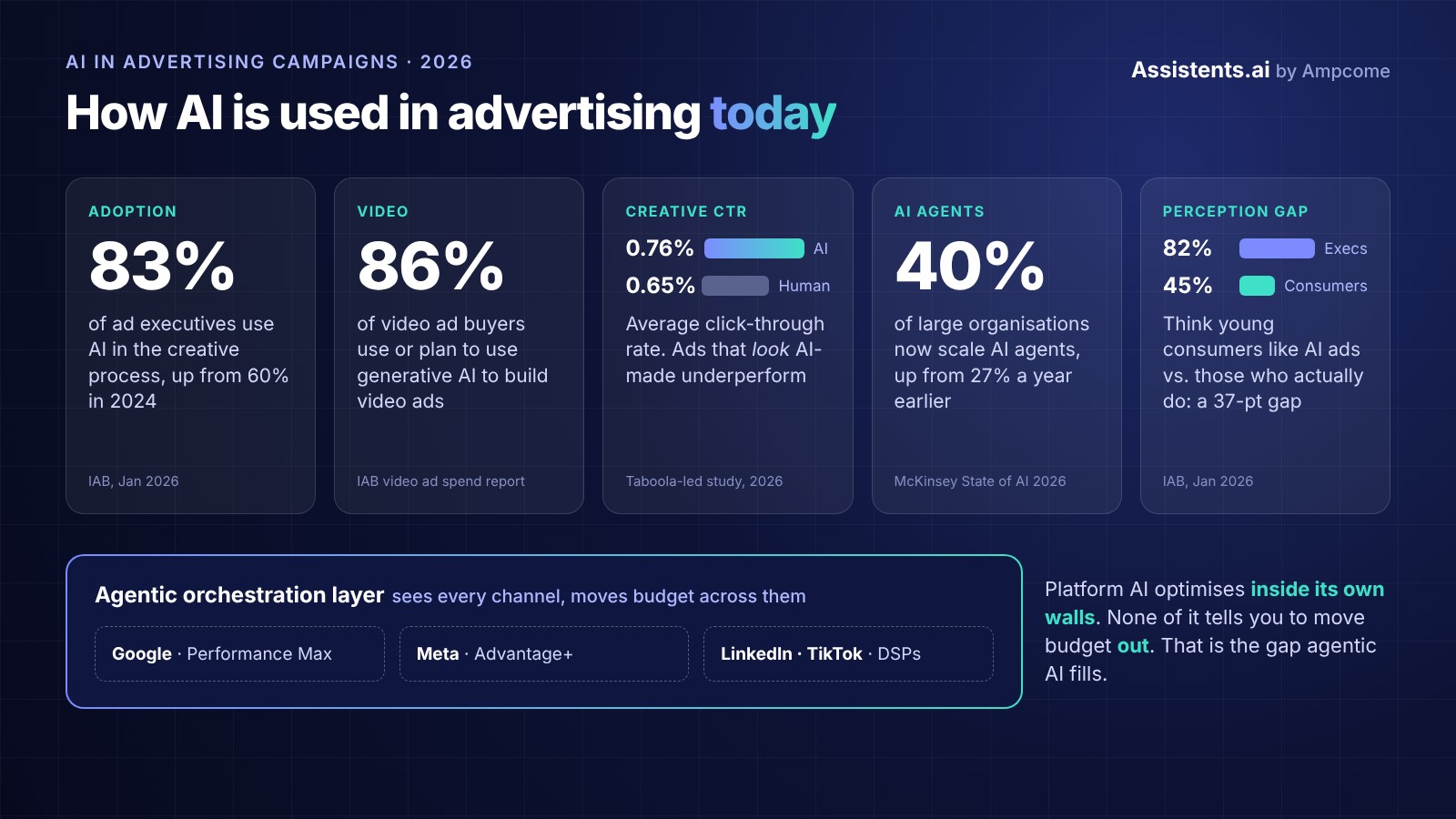
Meanwhile, ad platforms have built their own AI. Google's Performance Max and Meta's Advantage+ automate targeting, bidding and creative assembly inside their own ecosystems. They are powerful, but each one optimises for its own platform. None of them can tell you to move budget out of it. That is the gap agentic AI platforms now fill.
AI across the advertising campaign lifecycle
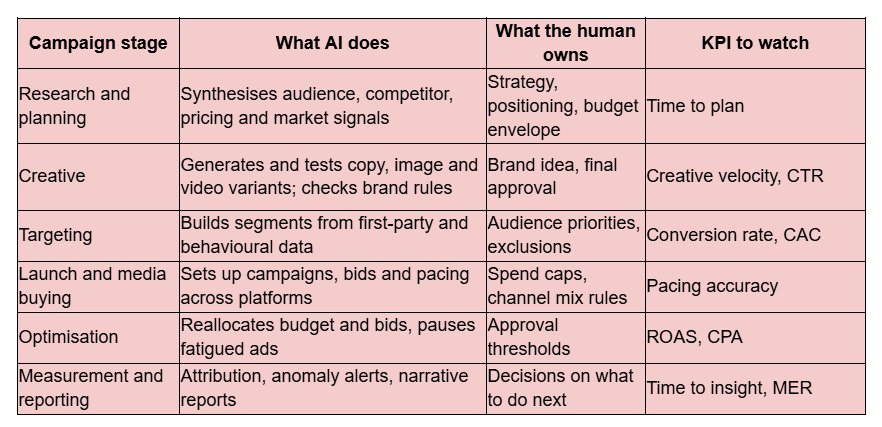
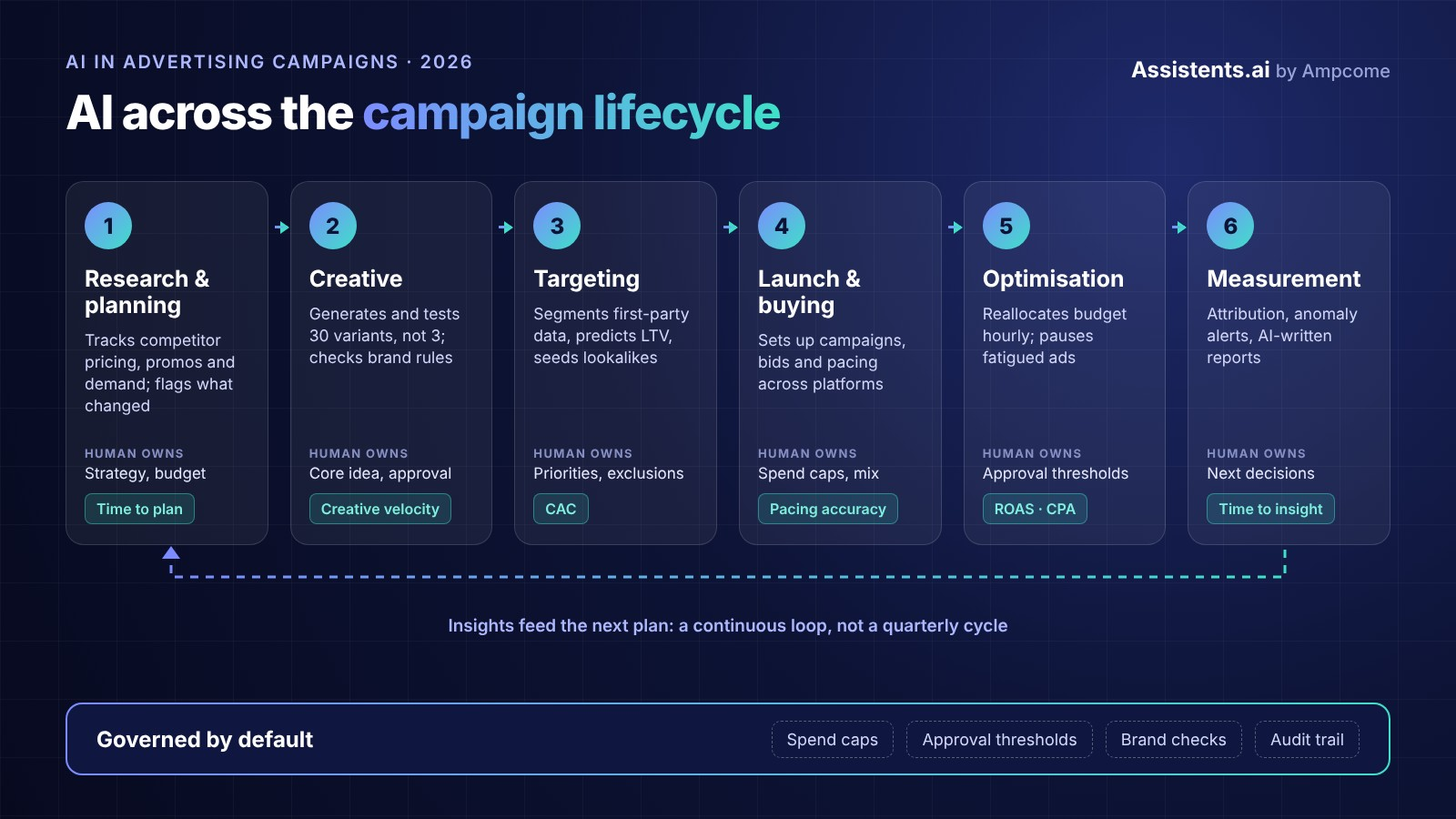
The most useful way to think about AI in advertising campaigns is stage by stage. Here is where AI adds value at each step, what the human still owns, and the KPI that shows whether it is working.
Research and planning: audience, competitor and market signals
Planning used to mean pulling last quarter's reports and guessing. AI now monitors competitor pricing, promotions, share of search, reviews and category demand continuously, and it summarises what changed. Agents can answer questions such as "Which competitor cut prices on our top five SKUs this week?" in seconds rather than days. This turns campaign planning from a quarterly exercise into a weekly one.
Creative: AI-generated ads, variants and brand compliance
Generative AI produces headlines, body copy, images and short video at a scale no team can match by hand. The win is not one perfect ad. It is testing 30 variants where you used to test three. The IAB and Taboola data above carries a warning, though: creative that looks artificial loses trust. The best teams use AI for variation and speed, keep humans on the core idea, and run automated brand-compliance checks before anything goes live.
Targeting: AI audience segmentation and first-party data
With third-party cookies fading, targeting depends on first-party data from your CRM, website and product. AI clusters visitors by behaviour, predicts lifetime value and builds lookalike seeds for each platform. The hard part is plumbing, not modelling. The data sits in HubSpot, Salesforce, GA4 and a warehouse, and it needs a unified context layer before any AI can use it well.
Launch and media buying
AI handles campaign setup, bid strategy, pacing and placement. Inside a single platform, Performance Max and Advantage+ do this well. Across platforms and programmatic DSPs, you need an agent that can read every account and act within spend limits. We cover this stage in depth in our guide to AI agents for media buying, including the new agent-to-agent buying protocols.
Optimisation: AI budget and bid reallocation across channels
This is where AI in advertising campaigns earns most of its ROI. An optimisation agent watches spend, conversions and ROAS by channel every hour. It flags creative fatigue and audience saturation, then proposes or makes reallocations, for example "Move $8,000 from Meta prospecting to Google brand search; Meta CPA has risen 34% over 3 days." With approval thresholds in place, small moves happen automatically and big ones wait for a human.
Measurement: attribution, anomaly alerts and reporting
AI-powered multi-touch attribution weighs each touchpoint instead of crediting the last click. Anomaly detection catches a broken pixel or a sudden CAC spike before the weekly meeting. Generative AI then writes the report: what happened, why, and what to do next. That removes hours of slide-building every week.
Benefits of AI in advertising
1. Speed
Insight-to-action cycles drop from days to hours. Agents spot a problem and propose the fix in the same loop.
2. Efficiency
Reporting, QA, pacing checks and creative resizing are automated. Teams spend their time on strategy instead of spreadsheets. In IAB's 2026 study, executives named cost efficiency as the top benefit of AI (64%).
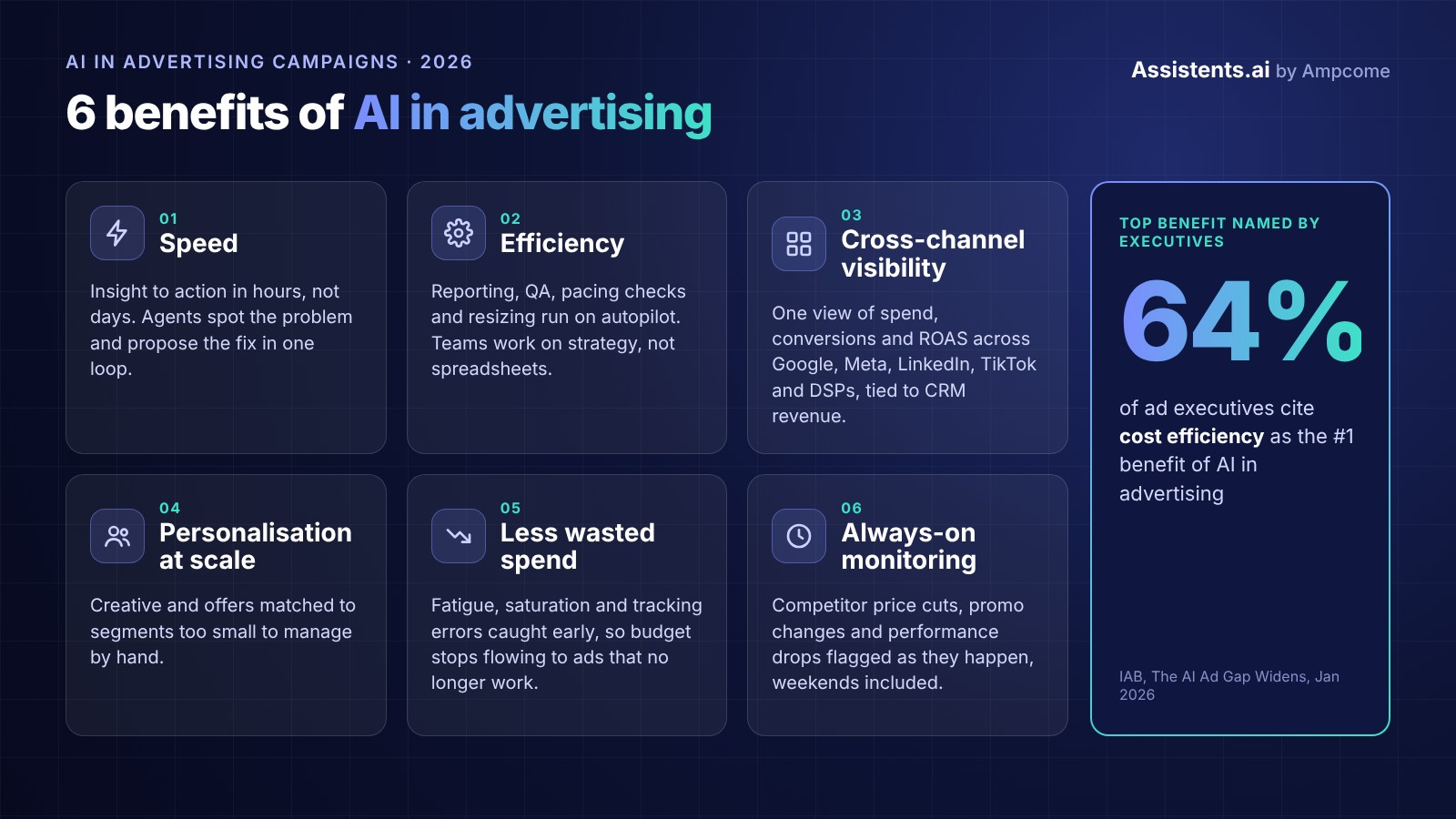
3. Cross-channel visibility
A single view of spend, conversions and ROAS across Google, Meta, LinkedIn, TikTok and programmatic, tied back to CRM revenue.
4. Personalisation at scale
AI matches creative and offers to segments that are too small to manage by hand.
5. Less wasted spend
Continuous monitoring catches fatigue, saturation and tracking errors early, so budget stops flowing to ads that no longer work.
6. Always-on monitoring
Agents don't take weekends off. Competitor price cuts, promo changes and performance drops are flagged as they happen.
AI agents in advertising: from assistance to execution
The biggest change in AI in advertising campaigns is the move from copilots to agents.
- A copilot answers questions and drafts things. A human still does the work: "Here are five headline ideas."
- An AI agent pursues a goal across several steps and systems: "ROAS on LinkedIn fell below target. I've drafted three new variants, shifted 10% of budget to the best-performing segment, and logged the change for review."
Every well-designed advertising agent runs the same loop:
AI agent loop for advertising campaigns: observe, diagnose, propose, approve, act, log
Observe → Diagnose → Propose → Approve (if above threshold) → Act → Log → Learn
Why platform AI isn't enough on its own. Performance Max optimises Google spend. Advantage+ optimises Meta spend. Neither can see the other, your CRM pipeline or your margin data, and neither has a reason to send budget elsewhere. An independent orchestration layer sits above the platforms. It reads every account, judges performance against business outcomes like pipeline, revenue and margin, and acts across all of them.
The industry is building the rails for this. In November 2025, IAB Tech Lab released its Agentic RTB Framework to standardise how buying and selling agents work inside ad-tech infrastructure. For a broader view of agents beyond paid media, see our guide to AI agents in marketing and sales.
Why Assistents.ai for AI-powered advertising campaigns
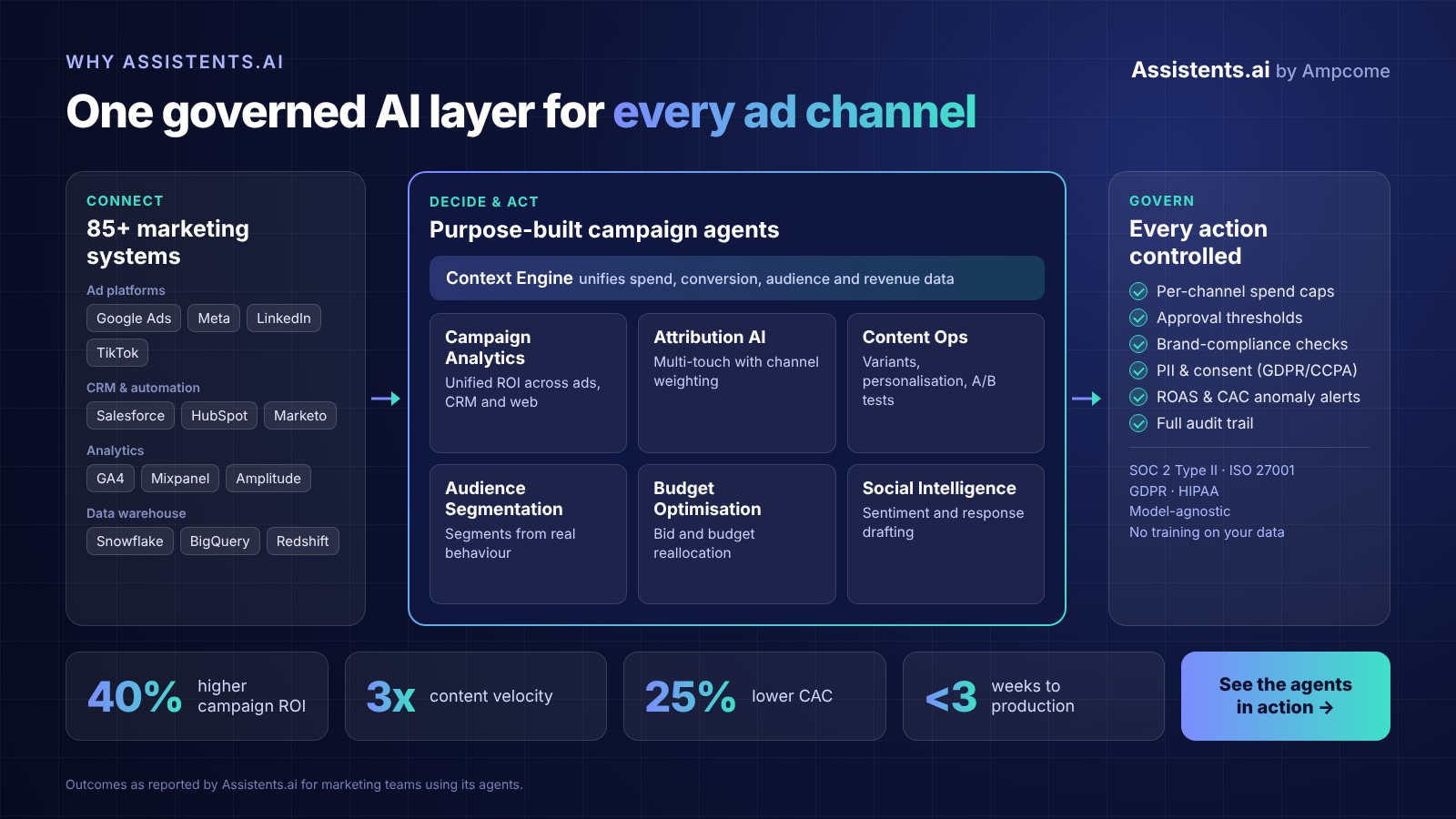
Assistents.ai by Ampcome is an enterprise agentic AI platform that runs the whole advertising campaign lifecycle across every channel. Spend, brand and data controls stay with your team. Here is what sets it apart.
One brain across every channel
The Assistents.ai marketing solution connects to 85+ marketing systems. These include Google Ads, Meta, LinkedIn and TikTok; HubSpot, Marketo and Salesforce; GA4, Mixpanel and Amplitude; and Snowflake, BigQuery and Redshift. A Context Engine unifies spend, conversion, audience and revenue data, so agents optimise for pipeline and profit, not platform-reported clicks.
Purpose-built agents for every campaign job
- Campaign Analytics Agent: unified ROI and engagement across ad platforms, CRM and web.
- Attribution AI: multi-touch attribution with channel weighting.
- Content Ops Agent: personalisation, variant generation and A/B testing.
- Audience Segmentation Agent: segments built from real visitor and customer behaviour.
- Budget Optimisation Agent: bid, budget and targeting changes with reallocation recommendations.
- Social Intelligence Agent: monitoring, sentiment tracking and response drafting.
Governed execution, built in
Every campaign action passes through agent governance: per-channel spend caps, approval thresholds, brand-compliance checks, PII and consent handling (GDPR/CCPA), data-residency rules, ROAS and CAC anomaly alerts, and a full audit trail. The platform is SOC 2 Type II, ISO 27001, GDPR and HIPAA aligned, model-agnostic, and does not use your data to train models.
Fast to production
Marketing deployments typically go live in under three weeks, not quarters. Assistents.ai reports 40% higher campaign ROI, 3x content velocity and 25% lower CAC for marketing teams using its agents.
See the marketing agents in action →
AI in advertising campaigns: real results from production deployments
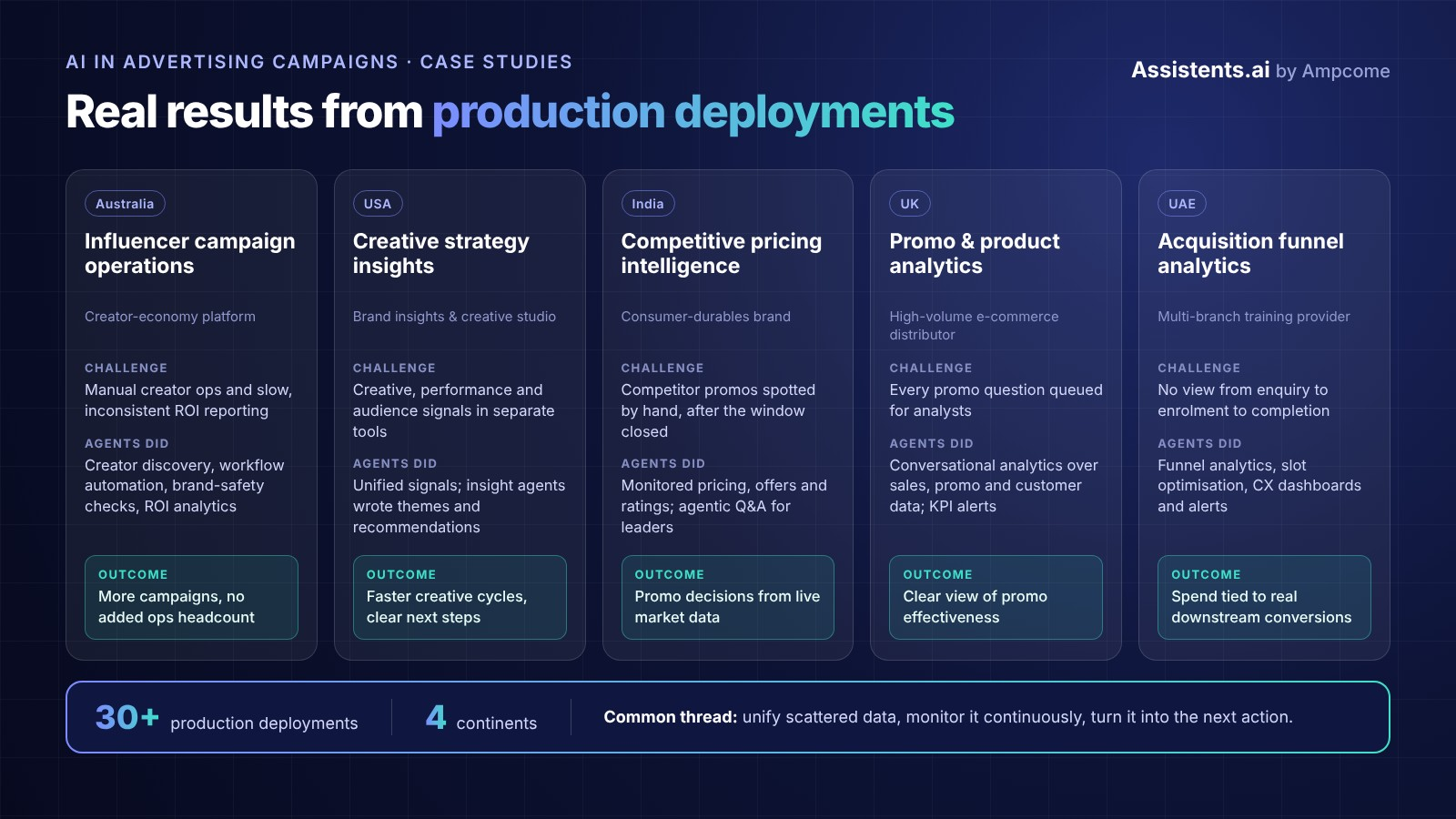
Ampcome has shipped more than 30 production AI deployments across retail, consumer brands, financial services, logistics, healthcare, real estate and energy, on four continents. The five below are the most relevant to advertising and marketing teams. Client names are withheld for confidentiality.
Case study 1: Influencer campaign operations for a creator-economy platform
Client: an Australian platform that connects brands with creators for campaign delivery.
Challenge: campaign operations were manual. Finding creators, running workflows, monitoring content and reporting ROI to brands all took analyst time, and reporting was slow and inconsistent between programmes.
What the AI agents did:
- Enriched creator discovery and automated campaign workflows
- Monitored content KPIs and ran automated brand-safety checks
- Produced campaign ROI and engagement analytics with automated report summaries
Outcome: less manual work across campaigns, faster performance visibility for brands, and more consistent reporting and learnings across every brand programme. The platform can now run more campaigns without adding operations headcount.
Case study 2: Creative strategy insights for a brand insights studio
Client: a US brand insights and creative execution studio serving marketing teams.
Challenge: creative, performance and audience signals lived in separate tools. Strategists spent their time assembling data instead of deciding what to make next.
What the AI agents did:
- Ingested creative, performance and audience signals from multiple sources into one view
- Insight agents produced themes, narratives and recommendations
- Generated reporting packs for leadership automatically
Outcome: faster creative strategy cycles, deeper signal synthesis across channels, and a clearer answer to "what do we do next?" for every campaign.
Case study 3: Always-on competitive intelligence for a consumer-durables brand
Client: a leading Indian consumer-durables brand in a highly price-sensitive market.
Challenge: the team tracked competitor prices, discounts and promotions by checking e-commerce portals by hand. By the time a competitor's promo was spotted, the campaign window had closed.
What the AI agents did:
- Monitored e-commerce channels continuously for pricing, MRP and discounts, offers, availability and ratings
- Answered leadership questions in plain language through agentic Q&A
- Ran pricing-gap and threat analytics across the portfolio
Outcome: faster competitive response cycles, earlier identification of pricing gaps and promo shifts, and always-on monitoring in place of manual portal checks. Campaign and promo decisions now start from live market data.
Case study 4: Promo and product performance analytics for an e-commerce distributor
Client: a high-volume UK e-commerce and distribution business with a large, fast-moving catalogue.
Challenge: questions about which promotions worked and which products to push went into a queue for analysts, which slowed every merchandising and campaign decision.
What the AI agents did:
- Ingested sales, product, inventory, promotion and customer-behaviour data
- Offered conversational analytics for instant business questions
- Monitored KPIs automatically and sent exception alerts
Outcome: better visibility into product performance and promo effectiveness, shorter analysis cycles for recurring questions, and less reporting work for analysts.
Case study 5: Funnel analytics for a multi-branch training provider
Client: a multi-branch UAE training provider with digital customer journeys.
Challenge: limited visibility from enquiry to enrolment to completion made it hard to know which acquisition efforts actually drove conversions.
What the AI agents did:
- Built funnel analytics from enrolment to lessons to tests
- Optimised instructor utilisation and slots
- Set up customer-experience dashboards and alerts
Outcome: better visibility into conversion and performance drivers and fewer operational bottlenecks, so marketing spend now ties to real downstream outcomes.
The common thread: in each case the agents unified scattered data, monitored it continuously and turned it into a next action. The same governed agent architecture runs in banking, ports, utilities and national retail chains. Browse more Assistents.ai use cases.
Human vs AI: who does what in an AI-run campaign
Can AI run ad campaigns on its own? Partly, and only inside boundaries people set. Here is how the work splits in a well-run 2026 campaign.
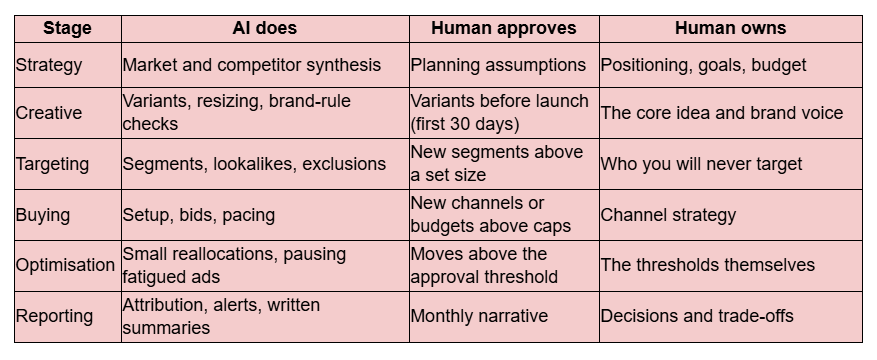
The rule of thumb: AI handles volume and speed; humans handle judgment and accountability.
Risks of AI in advertising and how to govern them
AI that can spend money needs controls that can stop it. These are the five risks that matter most, and the control for each.
Brand safety and off-brand creative
Risk: generated copy or images that break brand guidelines, make claims you can't support, or appear next to unsafe content.
Control: automated brand-compliance checks against your style guide and claims list, human approval for new creative concepts, and brand-safety monitoring on placements.
Data privacy and consent
Risk: customer data used without consent, or sent to models and regions it shouldn't go to.
Control: PII masking, consent-aware audiences, data-residency rules, and a platform that never trains models on your data. These are required under GDPR and CCPA.
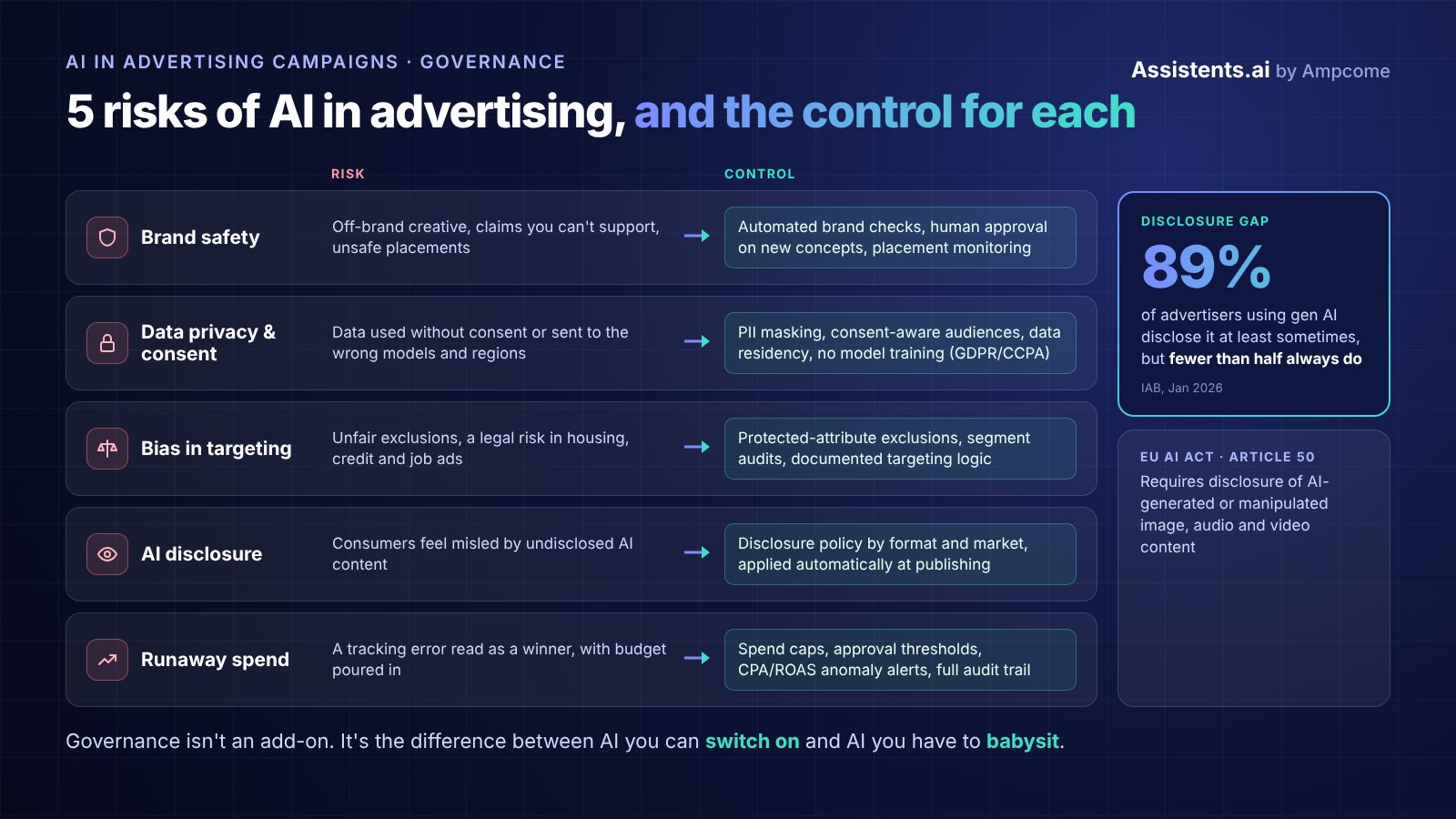
Bias in targeting
Risk: models that exclude groups unfairly, which is a legal problem in housing, credit and employment ads.
Control: protected-attribute exclusions, regular segment audits and documented targeting logic.
AI disclosure
Risk: consumers feel misled. IAB found that 89% of advertisers using generative AI disclose it at least sometimes, but fewer than half always do. In the EU, Article 50 of the AI Act requires disclosure of AI-generated or manipulated image, audio and video content.
Control: a clear disclosure policy by format and market, applied automatically at publishing.
Runaway spend
Risk: an agent misreads a tracking error as a winning ad and pours budget into it.
Control: per-channel and per-day spend caps, approval thresholds for large moves, anomaly alerts on CPA and ROAS, and a full audit trail of every action so you can see what changed and why.
Most AI advertising tools treat governance as an afterthought. In an agentic setup it is the foundation. It is the difference between AI you can switch on and AI you have to babysit.
How to measure the ROI of AI in advertising
Measure AI the same way you measure any investment: incremental value minus cost, divided by cost.
AI ROI = (Incremental revenue or margin + Cost savings − AI cost) ÷ AI cost
Worked example (illustrative numbers):
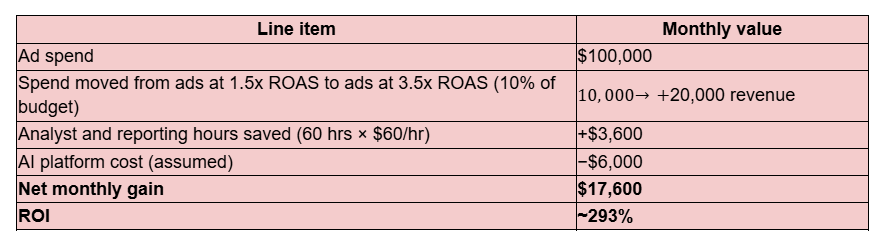
For a true profit view, apply your contribution margin to the revenue line. Track these KPIs before and after rollout:
- ROAS and MER (marketing efficiency ratio: total revenue ÷ total marketing spend)
- CAC / CPA by channel and blended
- Creative velocity: variants tested per week
- Time to insight: hours from anomaly to action
- Analyst hours spent on reporting
How to start using AI in your ad campaigns: a 90-day plan
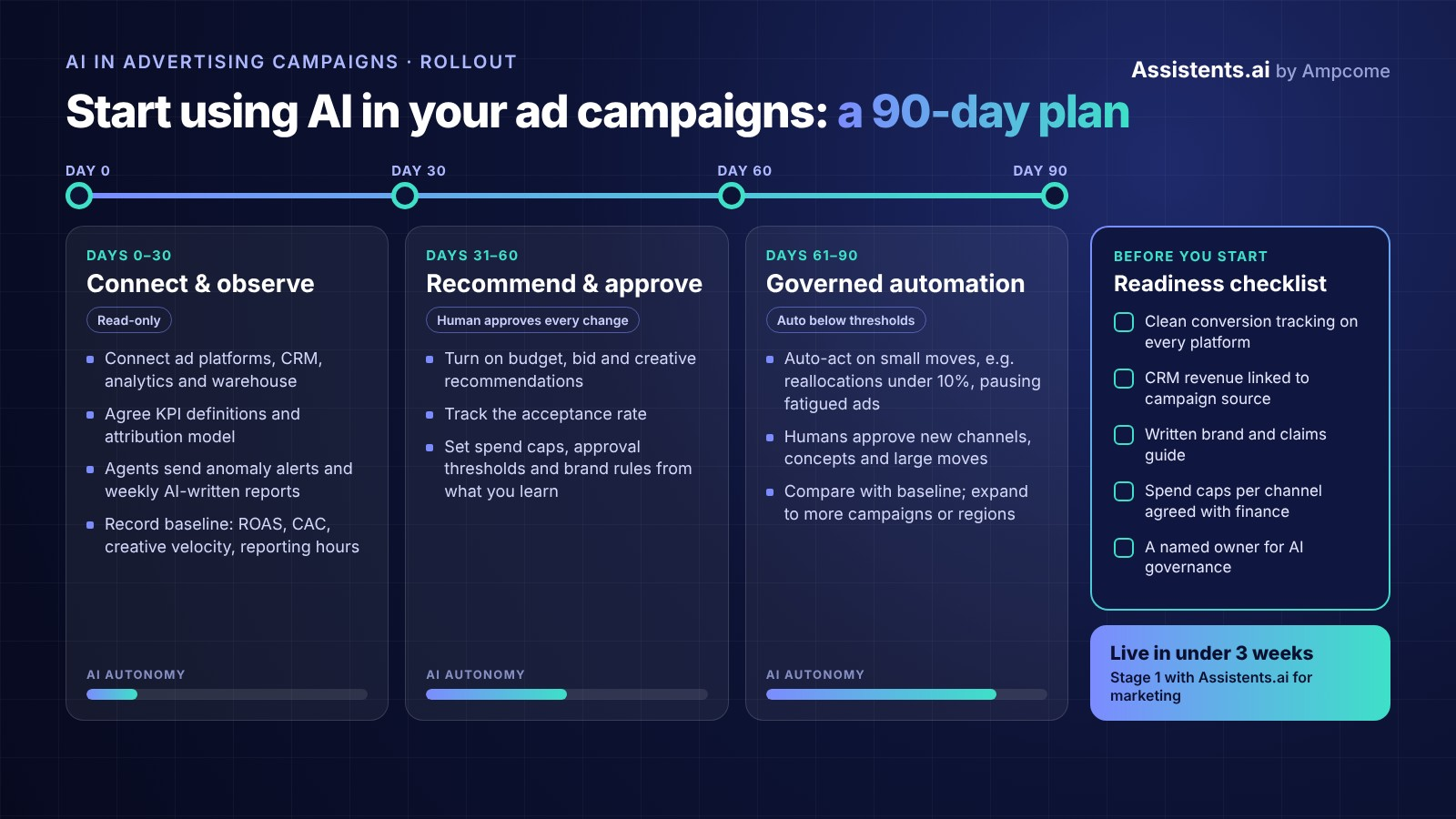
Days 0–30: Connect and observe (read-only)
- Connect ad platforms, CRM, analytics and warehouse data
- Agree on KPI definitions (what counts as a conversion, which attribution model)
- Run agents in insight-only mode: anomaly alerts, attribution and weekly AI-written reports
- Record a baseline for ROAS, CAC, creative velocity and reporting hours
Days 31–60: Recommend and approve
- Turn on budget, bid and creative recommendations
- A human approves every change; track the acceptance rate
- Set spend caps, approval thresholds and brand rules from what you learn
Days 61–90: Governed automation
- Allow automatic actions below the thresholds, such as reallocations of under 10% or pausing fatigued ads
- Keep human approval for new channels, new concepts and large moves
- Compare with the baseline and expand to more campaigns or regions
Readiness checklist:
- [ ] Clean conversion tracking on every platform
- [ ] CRM revenue linked to campaign source
- [ ] A written brand and claims guide the AI can check against
- [ ] Spend caps per channel agreed with finance
- [ ] A named owner for AI governance
With Assistents.ai, most teams reach the first stage within three weeks.
AI advertising tools: how to choose
AI advertising tools fall into five categories:
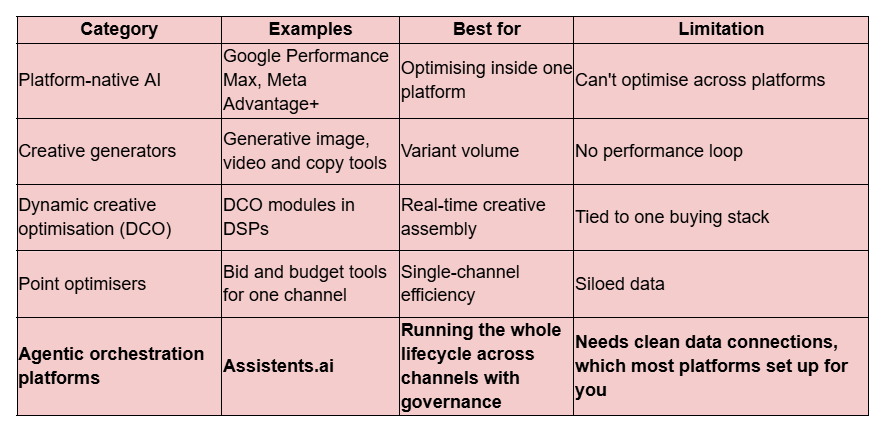
Six questions to ask any vendor:
- Does it optimise across all my channels, or only one?
- Can it use my CRM and warehouse data, not just platform data?
- Can I set spend caps and approval thresholds per channel?
- Is every AI action logged and explainable?
- Does it meet my security and privacy requirements (SOC 2, GDPR, data residency)?
- How long does it take to get to production?
For a wider list, see our roundups of the top AI marketing tools and AI marketing agents.
The future of AI in advertising campaigns
- Agent-to-agent buying. Buyer and seller agents will negotiate inventory directly, using standards like IAB Tech Lab's agentic frameworks.
- Ads inside AI assistants. As people search in ChatGPT, Gemini and Perplexity, sponsored placements in AI answers become a new channel. Being cited in AI answers organically matters as much as paid placement.
- Always-on creative. Creative will be generated, tested and retired continuously, with humans curating the ideas rather than producing every asset.
- Profit-based optimisation. Agents will optimise for margin and lifetime value, not just ROAS, as CRM, inventory and finance data flow into campaign decisions.
- Governance as a buying criterion. As agents control more spend, auditability will matter as much as performance when choosing a platform.
Why marketing teams choose Assistents.ai as their AI campaign layer
Platform AI optimises inside one walled garden. Point tools fix one task. Assistents.ai runs the whole campaign across every channel, with the controls enterprise teams need.
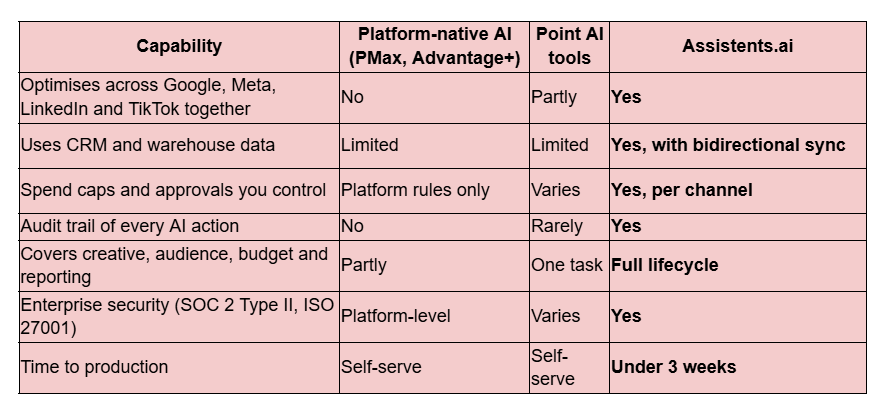
Why teams trust it:
- Proven in production: 30+ enterprise deployments across 10+ industries on four continents, including influencer marketing, brand insights, competitive pricing intelligence and e-commerce analytics.
- Built for control: the same governance layer is used by banks, utilities and global logistics operators.
- Outcome-focused: marketing teams report 40% higher campaign ROI, 3x content velocity and 25% lower CAC.
Book a demo of Assistents.ai for marketing →
Conclusion
AI in advertising campaigns is no longer about a smarter bid or a faster headline. It is about running the whole campaign, from research and creative to targeting, buying, optimisation and reporting, as one continuous, governed loop. The platforms will keep improving their own AI. The advantage goes to teams with a layer above them that sees every channel, uses their own business data, and acts within limits they trust.
That is what Assistents.ai was built for.
Ready to see AI agents run your campaigns, under your rules? Book a demo or explore the marketing solution.
Related reading: AI Agents for Media Buying: The 2026 Enterprise Guide · AI Agents in Marketing and Sales · Top AI Marketing Tools
FAQs
What is AI in advertising campaigns?
AI in advertising campaigns is the use of machine learning, generative AI and AI agents to plan, create, target, buy, optimise and measure paid ads. It automates analysis and repetitive execution, so campaigns improve continuously based on performance data while marketers keep control of strategy and budget.
How is AI used in advertising campaigns?
AI is used to generate and test ad creative, build audience segments, set bids and budgets, reallocate spend across channels, detect anomalies, attribute conversions and write performance reports. In 2026, AI agents increasingly carry out these actions directly, within spend caps and approval rules set by the team.
Can AI run ad campaigns on its own?
AI can run much of a campaign's day-to-day execution, including bidding, pacing, small budget shifts, pausing fatigued ads and reporting. Humans should still own strategy, brand, budget limits and large decisions. The best setups use approval thresholds, so routine changes happen automatically and big moves wait for a person.
Does AI improve ROI in advertising?
Usually, yes, when it is connected to good data and governed well. Gains come from reallocating spend away from weak ads faster, testing more creative and cutting manual reporting. McKinsey's 2026 State of AI survey found that revenue gains from AI are most often reported in marketing and sales.
How does AI optimise ad spend across Google and Meta?
An independent AI agent reads performance data from both platforms and your CRM. It compares results against business goals such as CAC, ROAS or pipeline, and moves budget toward what is working. Platform-native tools like Performance Max and Advantage+ can't do this because each one optimises only inside its own platform.
What are the risks of AI in advertising?
The main risks are off-brand or misleading creative, privacy and consent breaches, biased targeting, missing AI disclosure, and runaway spend from bad data. Spend caps, approval thresholds, brand-compliance checks, consent-aware data handling and full audit trails manage these risks.
Do you need to disclose AI-generated ads?
It depends on market and format. In the EU, Article 50 of the AI Act requires disclosure of AI-generated or manipulated image, audio and video content that could be mistaken for real. Elsewhere, platform policies and consumer expectations increasingly call for it. IAB research shows more than half of young consumers want fully AI-generated ads disclosed.
Will AI replace advertising agencies?
AI is replacing much of the manual execution agencies used to bill for, such as reporting, resizing, bid management and basic copy. It is not replacing strategy, brand thinking or creative leadership. Agencies and in-house teams that use AI agents for execution can focus on higher-value work.
What is the difference between platform AI and an AI agent platform?
Platform AI, like Google Performance Max or Meta Advantage+, optimises campaigns inside one ad platform using that platform's data. An AI agent platform like Assistents.ai works across all your channels and business systems, optimises for your own goals, and applies your governance rules to every action.
What is the best AI platform for managing advertising campaigns?
For teams running campaigns across several channels, Assistents.ai by Ampcome is a leading choice. It combines cross-channel campaign agents, 85+ integrations, built-in spend and brand governance, and enterprise security, with deployments typically live in under three weeks.

Transform Your Business With Agentic Automation
Agentic automation is the rising star posied to overtake RPA and bring about a new wave of intelligent automation. Explore the core concepts of agentic automation, how it works, real-life examples and strategies for a successful implementation in this ebook.
Sarfraz Nawaz is the CEO and founder of Ampcome, which is at the forefront of Artificial Intelligence (AI) Development. Nawaz's passion for technology is matched by his commitment to creating solutions that drive real-world results. Under his leadership, Ampcome's team of talented engineers and developers craft innovative IT solutions that empower businesses to thrive in the ever-evolving technological landscape.Ampcome's success is a testament to Nawaz's dedication to excellence and his unwavering belief in the transformative power of technology.

More insights
Discover the latest trends, best practices, and expert opinions that can reshape your perspective






Contact us


