

AI Agents in Oil & Gas Operations: 17 Real Examples Across Upstream, Midstream and Downstream (2026)


AI agents in oil and gas operations are software systems that continuously monitor operational data, reason over it against defined objectives, and then take or recommend a bounded action inside real systems — a work order in the CMMS, a setpoint adjustment within an approved envelope, an escalation to the control room, a line item written into the ERP. That last part is what separates an agent from the dashboards, predictive models and copilots that came before it. A model produces a score. A copilot produces an answer. An agent produces a change in the world.
Most published lists of oil and gas AI agent examples are hypothetical. They describe what an agent would do if it existed. A smaller number describe systems that are genuinely running, some of them autonomously controlling live process units. The difference matters enormously if you are the person who has to sign off on the deployment.
This guide covers 17 examples across upstream, midstream, downstream, HSE and corporate operations. Each one carries an honest maturity rating — assistive, governed-action, or autonomous — along with the systems it touches, what a human still approves, and where it tends to break. It also covers the reference architecture, the governance model that safety-critical environments actually require, and a 90-day path from first agent to production.
What Counts as an "AI Agent" in Oil & Gas Operations (and What Doesn't)
The word "agent" has been applied to almost everything in the last two years, which has made it close to meaningless in vendor conversations. In an operational energy context, four distinct things are routinely conflated.
A dashboard displays data. It has no opinion and takes no action. Most oil and gas organisations have hundreds of them, and the common complaint is not that they lack information but that nobody acts on what they show.
A model produces a prediction or a score — remaining useful life on a compressor, probability of a stuck pipe event, a decline curve forecast. It runs on a schedule, writes to a table, and stops. Predictive maintenance as most operators have implemented it lives entirely in this category.
A copilot answers questions in natural language. Ask it what caused last Tuesday's throughput drop on Train 2 and it retrieves, summarises and responds. Genuinely useful, but strictly read-only. It changes nothing.
An agent does all of the above and then closes the loop. It observes a condition, reasons about it in context, decides on a course of action, and executes that action against a real system — subject to whatever approval gate you have configured.
The practical test is simple: can it write? If the system cannot make a change in a system of record, it is not an agent, regardless of how it is marketed.

For the full taxonomy of agent architectures, see our guide to the types of AI agents. For this article, the more useful distinction is not what kind of agent it is, but how much authority it has been granted.
The Ask → Execute → Autonomous Maturity Ladder for Energy Operations
Every credible oil and gas agent deployment sits at one of three levels. Naming the level explicitly is the single most useful discipline you can bring to a vendor evaluation, because it forces the conversation away from capability theatre and toward accountability.

Level 1 — Ask: governed answers over operational data
The agent has read access to production, maintenance, HSE and document data. It answers questions in natural language, generates reports, and surfaces anomalies. It cannot change anything.
This sounds modest. It is not. In most operators, a production engineer's question — "which wells in this field have had a water cut increase greater than five points over the last 90 days, and which of those have an open maintenance ticket?" — requires either a BI request that queues for a week or a manual reconciliation across three systems. Collapsing that to thirty seconds changes decision cadence across the whole organisation.
Level 1 is also where you discover whether your data is fit for agents at all. It is the cheapest possible failure.
Level 2 — Execute: bounded action with maker-checker approval
The agent proposes and, once approved, executes a defined action in a defined system. It raises the work order. It creates the purchase requisition. It updates the inspection schedule. It writes the sales order into the ERP. A named human — or an automated rule for low-risk categories — approves before the write commits, and every step is recorded in an immutable audit trail.
This is where the overwhelming majority of oil and gas value sits, and where the overwhelming majority of production deployments actually are. It is also the level that most vendor demos skip past, because approval workflows are less exciting than autonomy.
Level 3 — Autonomous: closed-loop action inside a defined envelope
The agent acts without per-instance human approval, within explicitly bounded operating parameters, with continuous monitoring and an enforced fallback. Humans set the envelope and supervise the aggregate; they do not approve each decision.
Level 3 in oil and gas is real but narrow. It exists today primarily in process control on well-characterised units where the physics is understood, the sensor coverage is dense, and the safety instrumented system remains fully independent of the agent. It does not exist for anything involving contractual commitment, regulatory filing, or novel geology.
The rule that makes this workable: an agent's authority level should be set by the reversibility and blast radius of its action, not by the sophistication of its reasoning. A brilliant agent recommending a well intervention still needs approval. A simple agent adjusting a non-safety-critical setpoint inside a tight band may not.
17 AI Agents in Oil & Gas Operations: Real Examples by Value-Chain Segment
Each example below follows the same structure: what it does, the systems it touches, its realistic maturity level, what a human still approves, and where it breaks.
Upstream: Exploration, Drilling and Production
1. Seismic interpretation and geological model-build agent — Level 2
What it does: Ingests seismic volumes, well logs and petrophysical data, runs horizon picking and lithology classification, and assembles candidate geological models for geoscientist review. Rather than one model at a time, it generates and ranks multiple scenarios.
Systems: Seismic data stores, well log repositories, interpretation platforms, reservoir simulation tools.
Human approves: Model selection, any change to a drilling target.
Where it breaks: Sparse or poor-quality legacy survey data; plays where the geological analogue set is thin.
This is one of the clearer public examples of agentic AI operating at national oil company scale. ADNOC's ENERGYai, announced as a purpose-built agentic AI solution for energy, combines large language model technology with task-specific agents operating autonomously across the value chain from seismic analysis to real-time process monitoring, and has been reported to accelerate geological model development by up to 75%. Reporting on the same programme notes that autonomous seismic analysis allowed reservoir engineers to test multiple frac-cluster scenarios in minutes.

2. Drilling parameter and rate-of-penetration optimisation agent — Level 2 (Level 3 on well-characterised pads)
What it does: Correlates real-time downhole and surface data — weight on bit, RPM, torque, mud properties, formation response — against historical offset well performance, and recommends or applies parameter changes to improve penetration rate while staying inside mechanical limits.
Systems: Rig data aggregators, WITSML feeds, drilling automation controllers, offset well databases.
Human approves: Driller retains override at all times; envelope changes require engineering sign-off.
Where it breaks: Unfamiliar formations, and any situation where the historical data set does not represent current conditions.
Real-time rate-of-penetration optimisation projects using historical drilling data have been active with major operators and service companies, and hydraulic fracturing control is currently the largest single segment of the agentic oilfield operations market.
3. Production optimisation and artificial lift tuning agent — Level 2
What it does: Continuously monitors flowline pressures, choke positions, water cut, gas-oil ratio and artificial lift parameters across a field. Identifies underperforming wells, recommends lift setting adjustments, and flags candidates for intervention. On mature fields with electrical submersible pumps, rod pumps or gas lift, suboptimal settings quietly consume a very large share of lifting cost.
Systems: SCADA, historian, production allocation systems, lift controllers.
Human approves: Any intervention recommendation; setpoint changes outside a pre-agreed band.
Where it breaks: Poor measurement quality — an agent optimising against a drifting flowmeter will confidently make things worse.
4. Well decline and production forecasting agent — Level 1 / Level 2
What it does: Maintains rolling decline curve analysis across the portfolio, detects deviation from forecast early, attributes the deviation to likely causes (mechanical, reservoir, facility constraint), and generates the variance narrative that would otherwise consume days of an analyst's month.
Systems: Production databases, allocation systems, planning and budgeting tools.
Human approves: Any forecast that feeds external reporting or capital allocation.
Where it breaks: Allocation disputes between partners — the agent will faithfully reproduce whatever allocation logic it is given.
5. Well file and technical document research agent — Level 1
What it does: Answers natural-language questions across decades of well files, daily drilling reports, AFEs, completion records, workover histories, P&IDs and vendor documentation. A question that used to require someone who "knows where things are" becomes a query.
Systems: Document management systems, network shares, scanned archives, engineering data warehouses.
Human approves: Nothing — read-only.
Where it breaks: Scanned handwritten field tickets and drawings without OCR; documents with no reliable metadata about which asset or date they belong to.
This is almost always the correct first agent. It has near-zero downside risk, it delivers visible value within weeks, and it exposes exactly how good or bad your unstructured data estate really is before you have committed to anything more consequential.
Midstream: Pipelines, Terminals and Logistics
6. Pipeline integrity and leak detection agent — Level 2
What it does: Runs continuous mass balance and pressure transient analysis across pipeline segments, correlates deviations against operational events to suppress false positives, and escalates genuine anomalies with the supporting evidence attached.
Systems: SCADA, leak detection systems, historian, GIS, incident management.
Human approves: Any shutdown or isolation action.
Where it breaks: Segments with sparse instrumentation; slow leaks below detection threshold; batched product changes that confuse mass balance.

7. Inspection and pigging scheduling agent — Level 2
What it does: Risk-ranks pipeline segments using in-line inspection history, corrosion rate models, soil and coating condition and operating pressure, then proposes an optimised inspection schedule and raises the associated work orders. It replaces calendar-driven inspection with condition-driven inspection.
Systems: Integrity management systems, ILI data, CMMS, GIS.
Human approves: The schedule; any deferral of an inspection past a regulated interval.
Where it breaks: Regulatory intervals are hard constraints, not optimisation variables. The agent must treat them as inviolable, which requires those rules to be encoded explicitly rather than learned.
8. Terminal, yard and rail movement orchestration agent — Level 2
What it does: Digitises the handoff between terminal operations and inland logistics. Tracks movements, surfaces exceptions before they become delays, sequences rail and truck scheduling against berth and yard capacity, and gives operations and leadership a shared operational picture.
Systems: Terminal operating systems, rail scheduling, yard management, ERP.
Human approves: Schedule commitments to third parties.
Where it breaks: When the terminal system and the rail system disagree on what a "movement" is — the classic semantic mismatch problem.
We have built precisely this. A global ports and logistics operator deployed a terminal and rail management solution covering workflow digitisation, yard and rail operational dashboards, rail scheduling and visibility, exception management, and executive alerting. The directional outcome was improved operational visibility and greater predictability of terminal-to-rail throughput, with materially more efficient coordination between terminal and inland logistics. The pattern transfers directly to midstream terminal, tankage and rail-loading operations.
9. Cargo, vessel and trucking logistics exception agent — Level 2
What it does: Monitors vessel positions, weather, port congestion, trucking availability and contractual delivery windows. When a disruption is detected, it models the impact on downstream commitments and proposes rerouting or rescheduling options with cost and demurrage implications attached.
Systems: Vessel tracking, TMS, ERP, contract management.
Human approves: Any commercial commitment or contractual variation.
Where it breaks: Contract terms buried in unstructured documents that the agent has not been given access to.
10. Custody transfer and measurement reconciliation agent — Level 1 / Level 2
What it does: Reconciles metered volumes across custody transfer points, identifies measurement discrepancies and unaccounted-for losses, assembles the evidence pack, and routes disputes to the responsible team.
Systems: Flow computers, measurement historians, allocation systems, finance.
Human approves: Any adjustment posted to a partner or customer account.
Where it breaks: Meter proving records held outside the digital estate.
Downstream: Refining, Processing and Distribution
11. Autonomous process control agent for gas treatment units — Level 3
What it does: Directly controls a process unit in real time, adjusting operating variables continuously to hold product specification while minimising energy and chemical consumption. Multiple coordinated agents handle interdependent stages of the process.
Systems: DCS, process historian, advanced process control layer. The safety instrumented system remains fully independent.
Human approves: The operating envelope, not the individual decisions. Operators supervise and can revert to conventional control at any moment.
Where it breaks: Outside the conditions the control policy was trained on — which is exactly why the envelope and the fallback matter more than the algorithm.
This is the most credible Level 3 example in the public record. Yokogawa announced that multiple autonomous control AI agents were commissioned at Aramco's Fadhili Gas Plant in Saudi Arabia, using coordinated agents based on a reinforcement learning algorithm to directly and autonomously control and optimise acid gas removal operations, with the deployment reported to reduce energy and chemical use. The agents draw on more than 30 critical process parameters to adjust variables such as amine temperature and circulation rate, replacing a process previously managed by conventional automation under experienced operator guidance.
Note carefully what makes this Level 3 viable: a single, extremely well-instrumented, thermodynamically well-understood unit, with an independent safety layer and a proven fallback. That is a narrow set of preconditions, and it is the honest boundary of autonomy in this industry today.

12. Refinery blending and yield optimisation agent — Level 2
What it does: Optimises blend recipes against product specifications, component availability, crude slate and margin, then proposes blend instructions and updates the plan when feedstock or demand shifts.
Systems: Planning and scheduling systems, LIMS, tank gauging, DCS, commercial systems.
Human approves: Blend execution and any spec-critical change.
Where it breaks: Lab data latency — if certificate of analysis results arrive hours late, the agent is optimising against a stale picture.
13. Energy consumption and utilities optimisation agent — Level 1 / Level 2
What it does: Ingests utility and sensor data across a facility, detects consumption anomalies, forecasts demand, and recommends or applies optimisation actions on non-critical loads. In energy-intensive facilities the recurring cost impact is substantial and the payback period is short.
Systems: Energy management systems, submetering, BMS, historian.
Human approves: Any load-shedding action affecting process.
Where it breaks: Submetering gaps — you cannot optimise consumption you cannot see.
We have deployed this pattern outside oil and gas. A research institute with campus-scale operations implemented utility and sensor data ingestion with anomaly detection, forecasting and optimisation recommendations, plus dashboards and proactive alerting. The directional outcome was improved energy visibility, faster detection of inefficiencies, reduced manual monitoring effort and more predictable operations.
HSE, Compliance and ESG
14. Alarm rationalisation and nuisance-alarm suppression agent — Level 2
What it does: A large process facility can generate many thousands of alarms per day, the great majority of them nuisance alarms that operators learn to ignore — which is precisely how genuine alarms get missed. The agent correlates alarm floods to root causes, suppresses derived alarms, risk-scores what remains, and presents operators with a ranked and explained set rather than a stream.
Systems: DCS alarm systems, historian, incident management.
Human approves: Any change to alarm configuration; suppression rules require formal management of change.
Where it breaks: Alarm suppression is a safety-critical change control activity. An agent that suppresses alarms without a documented, reversible, auditable MOC process is a liability, not an asset.

15. Permit-to-work and contractor certification agent — Level 2
What it does: Manages authorisation workflows for hot work, confined space entry and line breaking. Checks contractor certifications and competencies against the task at assignment time rather than after an incident, flags conflicting simultaneous operations, and generates timestamped records.
Systems: Permit systems, contractor management, HR and competency records, scheduling.
Human approves: Every permit issue. This is a hard human gate.
Where it breaks: Certification data held by contractors rather than the operator.
16. Emissions, flaring and regulatory reporting agent — Level 1 / Level 2
What it does: Continuously aggregates emissions and flaring data, quantifies against reporting obligations, detects threshold approaches early enough to act, and assembles audit-ready reporting packs continuously rather than reconstructing them under deadline pressure.
Systems: Continuous emissions monitoring, flare metering, environmental data systems, reporting platforms.
Human approves: Every external regulatory submission, without exception.
Where it breaks: Regulatory definitions change. The rules must live in a governed, versioned layer that can be updated deliberately — not embedded in prompts.
Emissions and integrity reporting is increasingly a driver of AI investment rather than a by-product of it, because continuous, verifiable operational evidence is what regulators and investors now expect in place of periodic estimates.
Corporate and Back Office
This is the least-written-about category and frequently the fastest route to demonstrable ROI, because the data is structured, the actions are reversible, and the approval models already exist.
17. Tender, bid and contract document agent — Level 2
What it does: Ingests complex tender and contract documents, extracts scope, commercial terms, technical specifications and compliance requirements, detects revisions between document versions, determines the correct internal workflow, and writes structured records back into the operational system of record.
Systems: Document repositories, ERP, CRM, quoting and estimation systems.
Human approves: Every submitted bid and every commercial commitment.
Where it breaks: Documents whose meaning depends on drawings the agent cannot read.
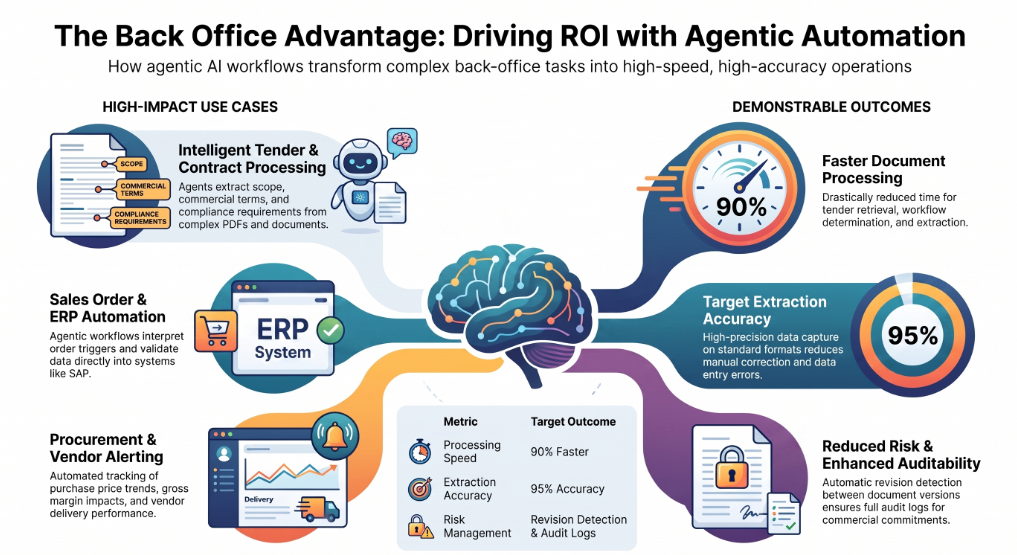
This is one of our strongest proof points. An engineering and remedial building services contractor operating on complex commercial projects deployed an intelligent document workbench built on multi-agent orchestration: tender retrieval, workflow determination, revision and change analysis, vision-model extraction from complex PDFs, and deep integration with the operational system of record including full create-read-update-delete write-back, quote locking and audit logs. The system was engineered for up to approximately 90% faster tender document processing, with a target extraction accuracy of around 95% on standard formats, and reduced bid risk through revision detection and auditability.
Oil and gas tendering — EPC packages, drilling contracts, service agreements, framework renewals — is structurally the same problem at larger scale.
Additional back-office agents worth naming:
Order and transaction automation into ERP. A regional engineering and technology solutions provider automated sales order creation directly into SAP through agentic workflows, interpreting order triggers, validating them, and creating the sales order — with governance rules for exceptions and approvals, audit logs and reconciliation reporting. It replaced an end-of-life document capture system carrying high licensing cost. Directional outcomes: reduced manual order processing, faster order-to-confirm cycles with fewer data entry errors, and improved auditability for order creation and exceptions.
Procurement and vendor performance alerting. A diversified industrial group operating across multiple entities deployed automated procurement and finance KPI alerts covering purchase price trend, gross margin impact, early-payment analysis with notional finance cost, and vendor delivery and returns performance, alongside scheduled insight packs for leadership. Directional outcomes: earlier detection of margin erosion and vendor slippage, standardised finance and procurement intelligence across entities, and fewer variance surprises.
Shift handover and operations reporting. Automated synthesis of shift logs, alarms, work orders and production events into a structured handover summary — closing one of the most persistent information-loss points in continuous operations.
Which of These Are Actually Running in Production Today?
An honest assessment, because the gap between what is demonstrated and what is deployed is the single most expensive misunderstanding in this market.
Genuinely in production at scale: Autonomous control agents on well-characterised process units. Agentic seismic and geological model workflows at national oil company scale. Large-scale well digitalisation and remote monitoring programmes. Document and knowledge retrieval agents. Back-office transaction automation.
Widely piloted, narrowly deployed: Drilling parameter optimisation beyond early-mover basins. Pipeline integrity agents with genuine write-back authority. HSE agents with permit workflow integration. Emissions agents feeding actual regulatory submissions.
Still predominantly slideware: Fully autonomous field operations. Cross-value-chain agent collaboration where upstream, midstream and downstream agents negotiate with each other. Anything described as an "autonomous oilfield."
The market data reflects this shape. AI in oil and gas overall is estimated at around USD 4.28 billion in 2026, growing at roughly 13% CAGR toward 2031. The narrower agentic AI for oilfield operations segment is tracked at approximately USD 2.29 billion in 2026 against a base of USD 1.8 billion in 2025, on a considerably steeper CAGR of around 27% through 2034, with the Middle East and Africa posting the fastest regional growth.
The signal in that delta: agents are the fastest-growing slice of a moderately growing market, from a small base. That is the profile of a technology moving out of pilot, not one that has already arrived.
Why Most Oil & Gas AI Agent Pilots Never Reach Production
Five failure modes account for the overwhelming majority of stalled deployments. None of them is about model quality.

The OT/IT semantic gap
Your historian, SCADA, ERP, CMMS and production allocation system do not agree on what "downtime" means, what constitutes a "well," or which entity a piece of equipment belongs to. Each system is internally consistent and mutually incompatible. An agent asked to reason across them will produce answers that are confidently wrong in ways that are difficult to detect and catastrophic to trust.
This is not a data engineering problem you can defer. It is the prerequisite. Without a governed semantic layer that fixes definitions once and enforces them everywhere, every agent you build inherits the ambiguity.
Unstructured data lock-in
The knowledge that makes an oil and gas operation work — well files, incident investigations, P&IDs, SOPs, vendor manuals, tender documents, regulatory correspondence — is overwhelmingly unstructured, frequently scanned, and often held by individuals rather than systems. An agent with access only to your structured data is working with a fraction of the operational context. Bringing structured and unstructured data into a single retrievable context is what makes the difference between an agent that answers narrowly and one that answers usefully.
No approval model, so operations will not let it write
This is the point at which most pilots die. The agent works, the demo impresses, and then the operations manager asks who is accountable when it makes a wrong call at three in the morning. If the answer is "the model," the project ends there.
The resolution is not more accuracy. It is an explicit maker-checker structure: the agent proposes, a named role approves, the approval is recorded, and low-risk categories are progressively automated as evidence accumulates. Trust is earned incrementally and must be architecturally supported from day one.
No audit trail, so compliance cannot sign off
In a regulated, safety-critical environment you must be able to reconstruct, months later, exactly what the agent saw, what it decided, what it changed, who approved it, and what the state was before and after. If that record is not immutable and complete, the deployment fails its first audit — and in this industry the first audit is not optional.
Model lock-in and cost escalation at field-data volumes
Sensor and document volumes in oil and gas are enormous. Architectures that route every request to a single frontier model become economically untenable fast, and they leave you exposed to a single vendor's pricing, availability and regional data policies. Model-agnostic routing — cheaper models for classification and extraction, stronger models for complex reasoning, with the ability to substitute providers — is a cost and sovereignty requirement, not an optimisation.
Reference Architecture: How to Actually Build These Agents
The following layers are what a production-grade oil and gas agent deployment requires. This is the architecture Assistents.ai implements.
Layer 1 — Context Engine over structured and unstructured operational data. A unified retrieval layer spanning production databases, historian extracts, ERP and CMMS records, and the unstructured estate of well files, SOPs, P&IDs and correspondence. Agents reason over one context, not several disconnected ones.
Layer 2 — Semantic layer. One governed set of definitions, hierarchies, formulas and business rules. "Downtime," "availability," "well," "asset," "batch," "incident" mean exactly one thing, defined once, enforced everywhere. Every agent and every human query resolves against the same logic. This is the layer that makes multi-system reasoning trustworthy rather than merely possible.
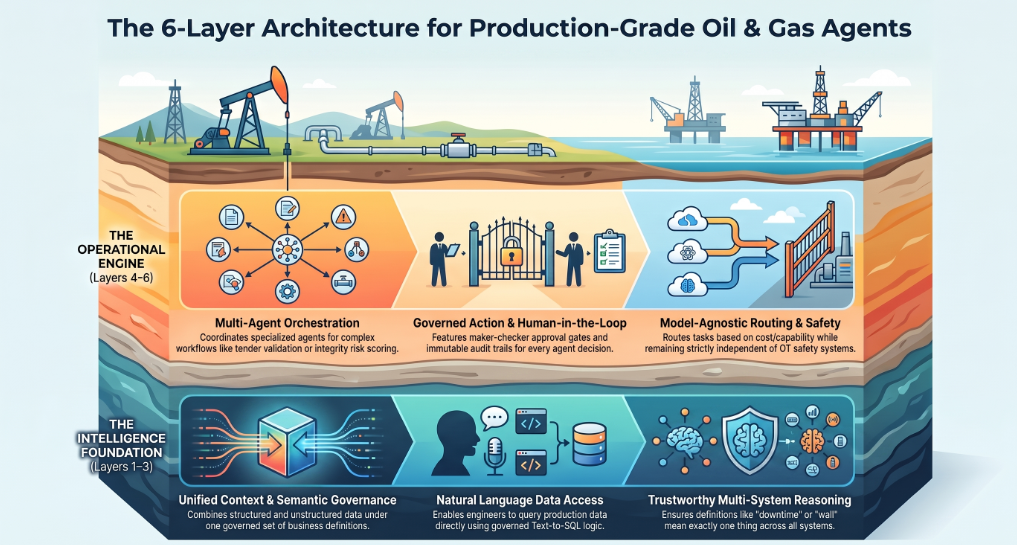
Layer 3 — Text-to-SQL and natural-language data access. Engineers, planners and leadership query production, maintenance and commercial data directly in natural language, resolved through the semantic layer so that the generated query respects governed definitions rather than improvising them.
Layer 4 — Multi-agent orchestration. Real operational workflows are not single-agent tasks. A tender workflow involves retrieval, extraction, comparison, validation and write-back. An integrity workflow involves detection, correlation, risk scoring, scheduling and work order creation. Orchestration coordinates specialised agents across the sequence with explicit handoffs.
Layer 5 — Governed action. Maker-checker and human-in-the-loop approval gates configurable per action type and risk tier. Row-level security so that joint venture partners, contractors and internal teams see only their own data. Attribute-based access control for finer-grained policy. An immutable audit trail capturing every input, decision, approval and write.
Layer 6 — Model-agnostic routing and BYOK. Route each task to the appropriate model on cost and capability grounds, substitute providers without re-engineering, and bring your own keys so that model usage runs under your own commercial and data arrangements.
Integration surface. Native support for MCP and A2A protocols for interoperating with your existing tool and agent estate, plus direct connectors for Postgres, MSSQL, BigQuery, ClickHouse, Athena and DuckDB — which covers the analytical data layer most operators have standardised on downstream of their historian and OT systems.
A note on OT boundaries: agents belong on the analytical and enterprise side of the architecture, consuming historian and SCADA data through governed interfaces and writing to enterprise systems. Direct control-layer intervention is a distinct engineering discipline with its own safety case, and the safety instrumented system must always remain fully independent of any agent.
Governance for Safety-Critical Environments: The Non-Negotiables
Governance is not a compliance overlay applied after the agent works. It is the thing that determines whether the agent is ever allowed to work.
Approval gates tiered by consequence. Classify every agent action by reversibility and blast radius. Reversible, low-impact, internal actions can be auto-approved with post-hoc review. Actions with external, contractual, regulatory or safety consequence require named human approval, every time, without exception. Publish the classification and review it formally.
Row-level and attribute-based access control. Oil and gas operations are structurally multi-party — joint ventures, service contractors, regulators, partners. Data access must be enforced at the row and attribute level inside the platform, not by hoping that prompt instructions hold. An agent should be architecturally incapable of surfacing partner data to the wrong party.
Immutable audit trail as regulatory evidence. Every agent action recorded with full context: inputs consulted, reasoning path, action proposed, approver identity, timestamp, prior and resulting state. This is what turns an agent deployment from an audit liability into audit evidence — and increasingly, continuously generated operational evidence is what regulators expect.
Bounded, not merely supervised. Supervision assumes a human is watching. Bounding means the agent is structurally unable to exceed its envelope regardless of whether anyone is watching. Boundaries are enforced in the platform; supervision is a human process that degrades at three in the morning on a public holiday.
Rollback and kill switch. Every agent needs a tested path to revert its action and a single control to stop it. Test both before go-live, and test them again after every material change.
Management of change applies to agents. Changing an agent's authority, scope, data access or decision logic is an operational change and should pass through the same MOC discipline as a physical modification. Treating agent configuration as software rather than as operational change is how governance quietly erodes.
Proof from Adjacent Asset-Heavy Operations
Oil and gas is exacting, but it is not unique. The operational patterns — asset-heavy infrastructure, continuous monitoring, multi-entity governance, regulated reporting, complex documents, ERP write-back — recur across sectors where we have production deployments. Client identities are withheld; these are described by industry, geography and scale.
A state power transmission utility deployed transmission KPI monitoring with anomaly detection, loss and outage analytics, predictive maintenance indicators, and automated alerts routed to field operations. Directional outcomes: faster identification of grid exceptions and operational risks, improved reliability through proactive monitoring, and better operational transparency for leadership. The pattern maps closely onto pipeline and facility integrity monitoring.
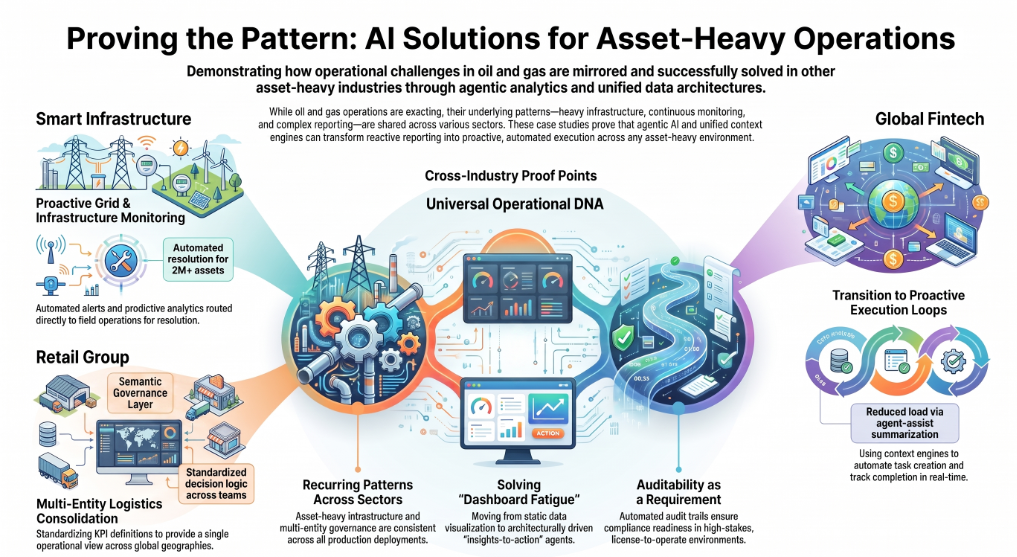
A smart infrastructure operator running more than 25 operations centres and connecting over two million assets and applications deployed agentic analytics with automated operational alerting layered on top of existing smart utility systems, including predictive analytics for outages and field issues and automated workflow routing for resolution. This is the closest available analogue to distributed field asset operations at genuine scale.
A privately held multi-format retail group deployed a unified context engine spanning structured and unstructured data, a semantic governance layer covering rules, hierarchies and formulas, and an active orchestrator integrating with core systems — with insights-to-action agents layered over existing dashboards. Directional outcomes: a shift from reactive reporting to proactive execution loops, standardised decision logic across teams, and automated task creation with completion tracking. This is the canonical "we have dashboards, nobody acts on them" problem, solved architecturally.
A multinational logistics and warehousing enterprise consolidated analytics across entities in multiple geographies with standardised KPI definitions, consolidated reporting, operational dashboards with variance explanations, and a data quality and governance layer. Directional outcomes: a single operational view across entities, faster leadership reporting, and improved consistency of operational metrics — the multi-entity problem every integrated operator with separate upstream, midstream and downstream reporting recognises.
A global fintech serving regulated financial institutions deployed omnichannel agents with agent-assist summarisation, next-best-action guidance, auditability, reporting and SLA monitoring. Directional outcomes: faster case handling, reduced operational load through automation, and improved compliance readiness through audit trails. Included here specifically as evidence that we build for environments where auditability is a licence-to-operate condition.
Metrics above are directional outcomes from specific engagements, not guaranteed benchmarks. Results depend on data maturity, integration scope and operating context.
Why Assistents.ai by Ampcome for Oil & Gas AI Agents
Built for governed action, not just answers
Most platforms in this category are retrieval systems with a chat interface. They answer well and change nothing. Assistents.ai is built around the write path: maker-checker and human-in-the-loop approval configurable per action type, row-level security and attribute-based access control enforced in the platform, and an immutable audit trail covering every decision and every write. That is the difference between an agent your operations team demos and one your operations team deploys.
The semantic layer is the platform, not an add-on
We treat the governed semantic layer as foundational rather than optional, because in multi-system operational environments it is the only thing that makes cross-system agent reasoning trustworthy. Definitions, hierarchies and formulas are governed once and enforced across every agent, every text-to-SQL query and every report. Without it, you are automating inconsistency at speed.
Proven in asset-heavy, regulated, multi-entity environments
Terminal and rail operations for a global ports and logistics operator. Transmission monitoring for a state power utility. Agentic analytics across city-scale infrastructure with millions of connected assets. Multi-agent tender document processing with deep write-back into the system of record. Autonomous ERP order creation replacing an end-of-life legacy platform. Group-wide procurement and margin alerting across entities. These are production systems in operational environments with real consequences — not demonstrations.
Architecture that respects sovereignty and cost reality
Model-agnostic routing and BYOK mean you control which models process your operational data, under your own commercial arrangements, with the ability to substitute providers as the landscape shifts. For national oil companies, joint ventures and operators in jurisdictions with data residency requirements, this is a threshold condition rather than a feature. MCP and A2A support mean Assistents.ai extends your existing estate rather than requiring you to replace it.
A delivery model built around getting to production
Ampcome's engagement model starts with a single high-value workflow, gets it to governed production, and expands from proven ground. We do not run open-ended pilot programmes. The measure of success is an agent operating in production with an audit trail, not a proof of concept with an impressive demo.
A 90-Day Path from First Agent to Governed Production
Weeks 1–3: Data and semantic groundwork. Select one workflow with clear ownership and measurable cost. Map the systems it touches. Establish governed definitions for the entities involved. Connect the Context Engine to the relevant structured and unstructured sources. Expect to discover data quality problems — that discovery is the deliverable.
Weeks 4–7: First Level 1 agent live. Deploy read-only. Natural-language access to the workflow's data and documents, with the semantic layer enforcing definitions. Put it in front of real users. Measure query volume, time saved and — most importantly — accuracy complaints, which tell you precisely where your data model is still wrong.
Weeks 8–12: First Level 2 governed action. Add one write path with maker-checker approval. A work order. A requisition. A schedule update. Route every proposal through a named approver, record everything in the audit trail, and review the approval log weekly. When approvers are agreeing with the agent consistently and for the right reasons, you have the evidence base to automate the lowest-risk category.
What to measure: cycle time on the target workflow, approval agreement rate, exception rate, audit completeness, and cost per action. Deliberately not: model benchmark scores, which correlate poorly with operational value.
Key Takeaways
- An AI agent is distinguished from a model or copilot by one capability: it can change something in a real system.
- Every deployment sits at one of three levels — Ask, Execute, or Autonomous — and naming the level explicitly is the most useful discipline in a vendor evaluation.
- Level 2, governed action with maker-checker approval, is where the large majority of oil and gas value and production deployments actually sit.
- Level 3 autonomy is real but narrow, confined today to well-instrumented, well-characterised process units with independent safety systems and proven fallbacks.
- Most pilots fail on data semantics, missing approval models and absent audit trails — not on model quality.
- A governed semantic layer is the prerequisite for trustworthy cross-system agent reasoning, not an optimisation applied later.
- Agents must be architecturally bounded rather than merely supervised, because supervision degrades and boundaries do not.
- The fastest credible path to production is one workflow, read-only first, one governed write path within 90 days, expanded from proven ground.
Ready to identify your highest-value agent use case? Ampcome works with asset-heavy, regulated operators to take a single workflow from data groundwork to governed production.
Book a working session and we will map your first agent against your actual systems, data readiness and approval model — not a generic roadmap.
FAQs
What is agentic AI in oil and gas?
Agentic AI in oil and gas refers to systems that autonomously monitor operational data, reason about it against defined objectives, and take or recommend bounded actions in real operational systems — rather than only producing predictions or answers. It spans upstream drilling and production, midstream pipeline and logistics, downstream refining, HSE and corporate operations, and operates at levels ranging from assistive question-answering through approval-gated action to autonomous control within defined envelopes.
What are real examples of AI agents in oil and gas?
Verified public examples include multiple coordinated autonomous control agents optimising acid gas removal at a major Saudi gas plant, agentic seismic and geological model workflows at a UAE national oil company reported to accelerate model build by up to 75%, real-time rate-of-penetration optimisation projects using historical drilling data, and proprietary AI research assistants deployed by Indian exploration and production operators. Beyond these, widely deployed categories include document research agents, integrity scheduling agents, and back-office ERP automation agents.
Which oil and gas companies use AI agents?
Publicly documented adopters include national oil companies in the Gulf, major integrated operators, large oilfield service companies with dedicated energy AI platforms, and Indian exploration and production companies that have launched proprietary generative AI platforms. Adoption is concentrated among operators with the data infrastructure to support it.
What is the difference between generative AI and agentic AI in oil and gas?
Generative AI produces content — summaries, reports, draft procedures, synthetic scenarios. Agentic AI plans and executes: it interacts with enterprise and operational systems and completes workflows. Most production deployments combine both, using generation for the reasoning and communication layer and agency for the action layer.
Can AI agents run safety-critical operations?
Partially, and only under strict conditions. Autonomous control agents do operate live process units today, but always on well-instrumented, well-characterised units, always with the safety instrumented system fully independent of the agent, always inside a defined operating envelope, and always with a proven fallback to conventional control. Agents do not replace functional safety systems, and any deployment touching safety-critical operations requires a formal safety case.
What data do AI agents need in oil and gas?
Structured operational data from historians, SCADA, production allocation, ERP and CMMS, plus the unstructured estate of well files, SOPs, P&IDs, incident reports and contracts. Critically, they need a governed semantic layer that reconciles conflicting definitions across those systems. Data readiness, not model capability, is the binding constraint in almost every stalled deployment.
How much does an AI agent implementation cost in oil and gas?
Cost is driven by integration scope, data readiness and the number of governed action paths — not by model licensing, which is typically a minority of total cost. A single-workflow deployment reaching governed production is a meaningfully different investment from an enterprise programme spanning the value chain. The most reliable cost control is starting with one workflow and expanding from proven ground.
What are the risks of AI agents in energy operations?
The primary risks are agents acting on inconsistent data definitions, unbounded authority without approval gates, incomplete audit trails that fail regulatory scrutiny, over-reliance on autonomous behaviour outside the conditions it was validated for, and cost escalation from unmanaged model routing at field-data volumes. Each is an architectural problem with an architectural solution.
How long does it take to deploy an AI agent in oil and gas?
A read-only agent over a defined data and document scope can reach real users in four to seven weeks. A first governed action path with maker-checker approval is realistic within roughly 90 days. Autonomous control deployments require substantially longer, because the safety case and validation dominate the timeline.
Do AI agents replace SCADA and historian systems?
No. Agents consume data from those systems and act on top of them. SCADA, historians and safety instrumented systems remain the operational backbone. Any vendor proposing to replace them with an agent layer is describing a project you should decline.
How do you audit an AI agent's decision in a regulated environment?
Through an immutable audit trail recording every input consulted, decision made, action taken, approver identity and timestamp, together with state before and after. Reconstruction must be possible months later without dependence on system logs that roll over. This is a platform requirement, not a reporting exercise.
Where should we start?
A document research agent over well files, SOPs and technical documentation. It carries near-zero downside risk, produces visible value quickly, and exposes exactly how ready your data estate is before you commit to anything with a write path.

Transform Your Business With Agentic Automation
Agentic automation is the rising star posied to overtake RPA and bring about a new wave of intelligent automation. Explore the core concepts of agentic automation, how it works, real-life examples and strategies for a successful implementation in this ebook.
Sarfraz Nawaz is the CEO and founder of Ampcome, which is at the forefront of Artificial Intelligence (AI) Development. Nawaz's passion for technology is matched by his commitment to creating solutions that drive real-world results. Under his leadership, Ampcome's team of talented engineers and developers craft innovative IT solutions that empower businesses to thrive in the ever-evolving technological landscape.Ampcome's success is a testament to Nawaz's dedication to excellence and his unwavering belief in the transformative power of technology.

More insights
Discover the latest trends, best practices, and expert opinions that can reshape your perspective


-min.jpg)




Contact us

