
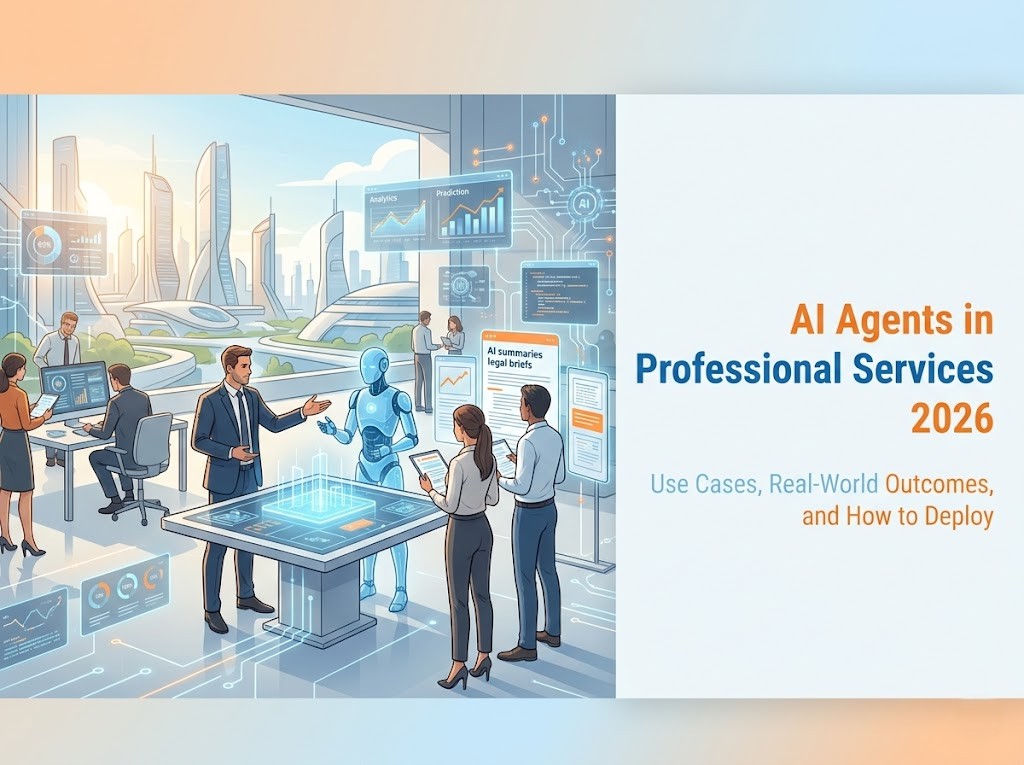
AI Agents in Professional Services 2026: Use Cases, Real-World Outcomes, and How to Deploy


AI agents are autonomous systems that can research, analyse, decide, and act — not just respond.
Professional services firms deploying them are seeing 90%+ faster document processing, 24×7 operations without added headcount, and measurable ROI within months.
This guide covers what AI agents are, where they're delivering results, and how to get started.
The Gap Between AI Hype and Real Value
Eighty-eight percent of organisations now use AI in some form. Yet only 23% have scaled it beyond isolated experiments, and fewer than 10% feel prepared to move past the pilot stage.
For professional services firms — consultancies, law firms, logistics providers, financial advisors, healthcare operators, real estate managers — this gap is not a technology problem. It is a deployment problem.
Most firms are using AI as a smarter search bar. The firms pulling ahead are using AI agents: systems that don't just answer questions, but execute workflows, monitor operations, surface exceptions, and take governed action — continuously, at scale.
This guide explains what AI agents actually are, where they are delivering results across professional services today, and how to move from experimentation to production.
What Are AI Agents? (And How Are They Different From Chatbots, Automation, and Copilots?)
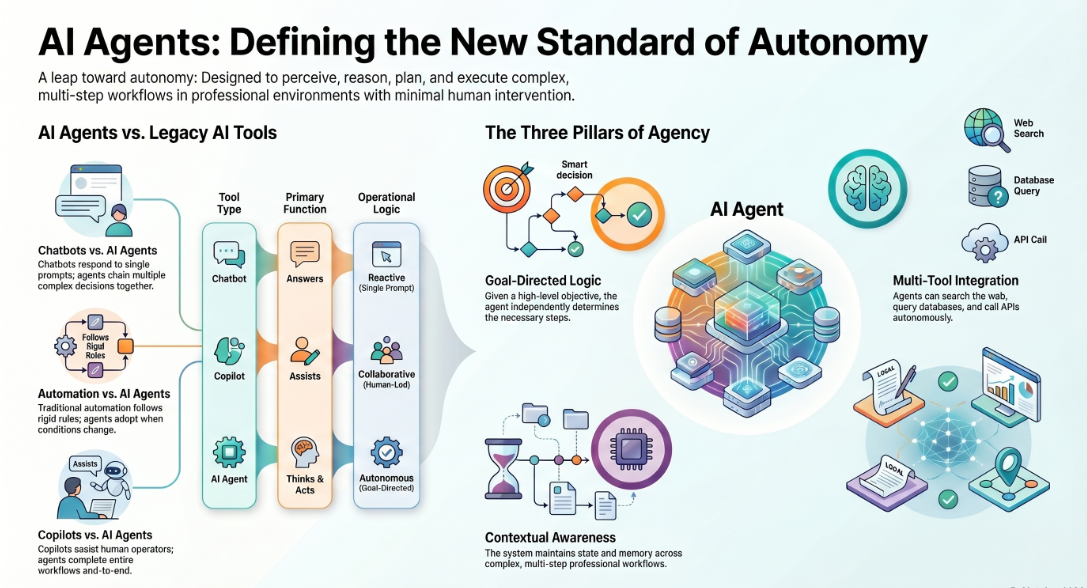
An AI agent is a software system that can perceive inputs, reason about goals, plan a sequence of steps, and take actions — with minimal human intervention at each step.
Unlike a chatbot, which responds to a single prompt, an AI agent can chain multiple decisions together. Unlike traditional automation, which follows rigid rules, an AI agent adapts when conditions change. Unlike a copilot, which assists a human operator, an AI agent can complete entire workflows end-to-end.
The simplest mental model: a chatbot answers, an automation executes a script, a copilot assists — an AI agent thinks, plans, acts, and reports back.
In a professional services context, this distinction matters enormously. Client research, document review, compliance monitoring, and financial forecasting are not one-step tasks. They require multiple tools, multiple data sources, conditional logic, and iterative refinement. That is exactly the problem AI agents are designed to solve.
Key characteristics of an AI agent:
- Goal-directed: given an objective, it determines the steps to achieve it
- Tool-using: can search the web, query databases, call APIs, and read documents
- Context-aware: maintains state across a multi-step workflow
- Human-in-the-loop compatible: can pause, escalate, or request approval at defined checkpoints
Why Professional Services Firms Are Deploying AI Agents Now
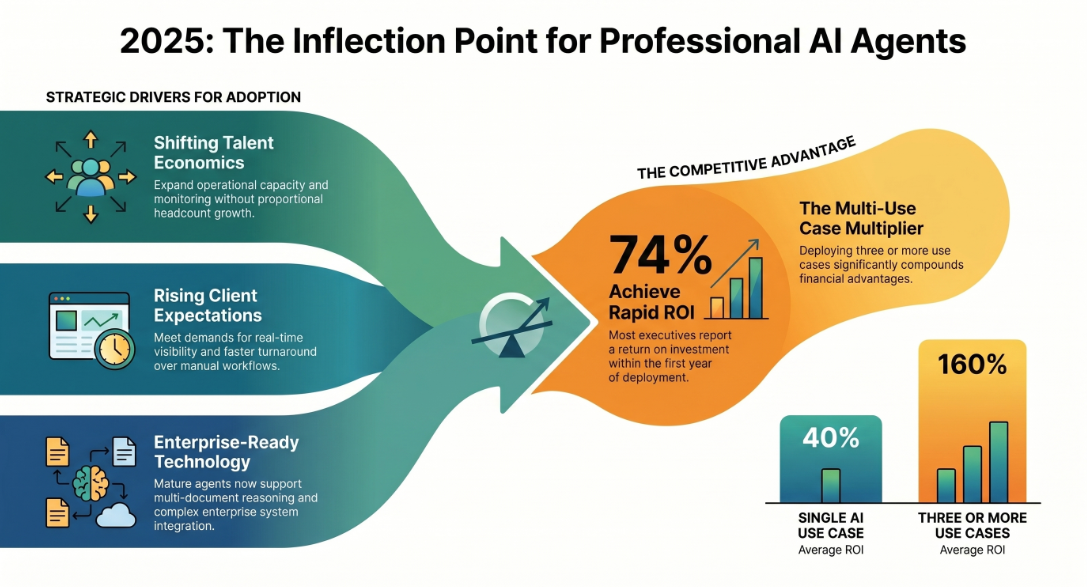
Several forces are converging to make 2025 the inflection point for agentic AI in professional services.
Talent economics have shifted. Scaling a services firm has traditionally meant hiring. AI agents change that ratio — a firm can expand its operational capacity, increase monitoring coverage, and accelerate delivery without proportional headcount growth.
Client expectations have risen. Clients now expect faster turnaround, real-time visibility, and proactive communication. Manual workflows built around weekly reports and email chains cannot meet this standard competitively.
The technology has matured. Modern AI agents can handle complex, multi-document reasoning, integrate with enterprise systems, operate within defined governance guardrails, and support both English and local languages — including Hindi for India-market deployments.
The competitive window is narrow. Google Cloud's 2025 ROI of AI report found that 74% of executives who have deployed AI agents report achieving ROI within the first year. Thomson Reuters' 2025 Future of Professionals Report found that firms deploying three or more AI use cases in production achieved 160% average ROI — compared to just 40% for firms with a single deployment. Early movers are compounding their advantage.
10 Real-World AI Agent Use Cases Across Professional Services
The following use cases are drawn from live deployments across industries including hospitality, construction, logistics, financial services, energy, retail, real estate, and healthcare — spanning India, the UAE, Australia, Africa, the UK, and North America.
1. Intelligent Document Processing and Tender Automation
A commercial services firm managing complex multi-party tenders needed to ingest, analyse, and synchronise large volumes of tender documents — often revised multiple times mid-process — into its core operational systems.
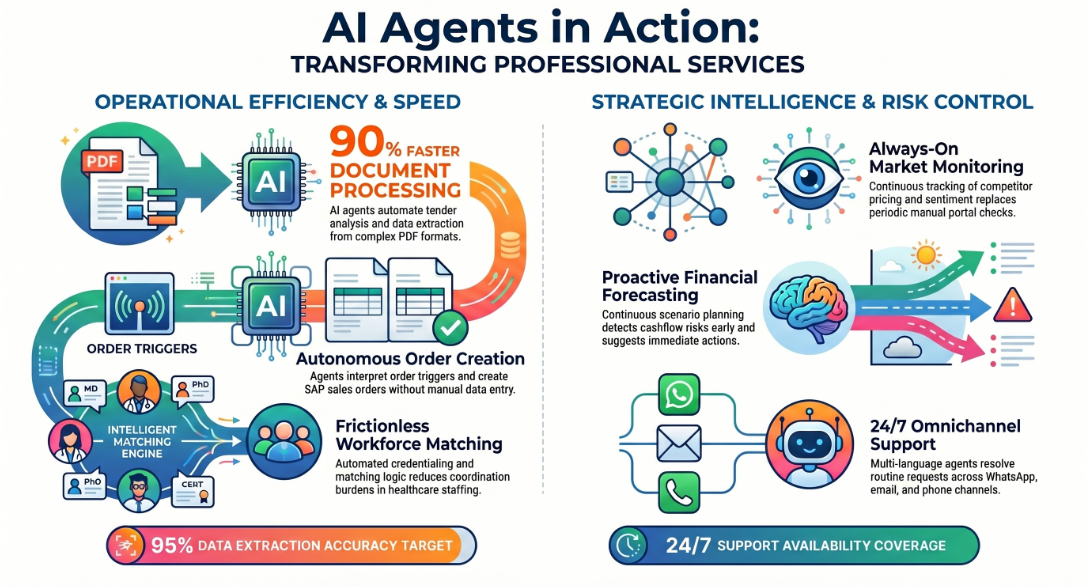
An AI agent was deployed to handle document retrieval, intent classification, revision detection, and deep extraction from complex PDF formats using vision-language models. It integrated directly with project management systems and generated audit logs at every step.
Outcome: Engineered for up to 90% faster document processing. Extraction accuracy target of 95% for standard document formats. Revision and change detection reduced bid risk significantly.
2. Competitive Intelligence and Market Monitoring
A large consumer brand in a price-sensitive market needed continuous visibility into competitor pricing, promotional activity, product availability, and customer sentiment — across dozens of online channels simultaneously.
An AI agent was built to monitor e-commerce and channel data continuously, map findings against leadership questions, and surface pricing gaps, promotional shifts, and portfolio threats in real time — replacing a manual process that could only run periodically.
Outcome: Always-on monitoring replacing manual portal checks. Faster competitive response cycles. Earlier identification of pricing risks before they affected margin.
3. AI CFO Agent for Financial Forecasting
A growing business platform serving CFOs and financial advisors needed to turn raw financial data into continuous, actionable intelligence — cashflow monitoring, scenario planning, and runway alerts — without requiring analysts to rebuild models weekly.
An AI agent connected to accounting and banking exports, ran forecast and scenario models continuously, and triggered alerts when runway thresholds were approaching — with recommended actions attached.
Outcome: Faster analysis cycles, earlier detection of cash risks, and scalable advisory-level insight without additional headcount.
4. Omnichannel Customer Service Agent for Banking
A fintech provider serving banks and credit unions needed to automate customer support across chat, email, and phone channels — with full auditability, SLA monitoring, and integration into core banking systems.
A multi-channel AI agent was deployed handling intake, workflow routing, agent-assist summarisation, and next-best-action recommendations. The system supported both Hindi and English voice interactions.
Outcome: Reduced operational load through automation, improved compliance readiness via full audit trails, and faster case handling with higher consistency.
5. Enterprise AI Sales Agent
A professional services organisation with a large enterprise account portfolio needed to ensure no opportunity or renewal risk was missed — without scaling its sales operations team.
An AI agent was built to monitor accounts continuously, identify signals for opportunity and risk, orchestrate governed follow-up workflows, and sync with CRM systems — maintaining pipeline hygiene automatically.
Outcome: Higher account coverage without increasing headcount. Faster response cycles on opportunities and renewals. More consistent execution through governed playbooks.
6. Autonomous Procurement and SAP Order Creation
A large distribution operation needed to move away from an end-of-life document processing platform and automate the interpretation of order triggers, validation logic, and SAP sales order creation — reducing manual entry and processing errors.
An AI agent was deployed to interpret incoming order documents, apply business rules for validation and exceptions, create sales orders in SAP automatically, and maintain a full audit and reconciliation log.
Outcome: Reduced manual order processing, faster order-to-confirm cycle, fewer data-entry errors, and improved auditability.
7. Agentic Analytics for Smart Grid Operations
A state-level power transmission utility needed to move from reactive reporting to proactive operations management — monitoring transmission KPIs, detecting anomalies early, and routing field alerts automatically.
An AI agent layer was built on top of existing smart grid data, delivering predictive analytics for outages and losses, automated alerts, and dashboards for field and leadership teams.
Outcome: Higher operational visibility, faster exception detection and response coordination, and more proactive grid operations through continuous monitoring.
8. Real Estate Customer Service Automation
A major property portfolio operator needed to provide 24×7 tenant support across web, WhatsApp, and email — covering FAQs, rental queries, payment workflows, maintenance ticketing, and escalation to human teams.
An omnichannel AI agent was deployed with a knowledge base built over tenancy documents, SOPs, and policies — triaging queries, resolving routine requests, and escalating complex cases with full context.
Outcome: Consistent 24×7 tenant experience, faster response times, reduced call-centre load, and better SLA adherence through automated routing and tracking.
9. AI Agent for Healthcare Staffing Operations
A healthcare staffing platform connecting nursing professionals with facilities needed to automate the matching, scheduling, credential capture, and compliance workflow — reducing the manual coordination burden at every step.
An AI agent handled talent onboarding, facility staffing request intake, matching logic, scheduling, notifications, and compliance tracking — with reporting for fill-rate and utilisation.
Outcome: Faster fill cycles, lower scheduling friction, better workforce utilisation, and improved staffing responsiveness.
10. AI for Brand Intelligence and Creative Strategy
A brand insights studio needed to unify signals from multiple sources — creative performance data, audience analytics, competitive activity — and generate narrative-ready insight packs for marketing leadership.
An AI agent ingested multi-source data, ran insight agents to produce themes, narratives, and recommendations, and generated structured reporting packs — reducing the time between data and decision.
Outcome: Faster creative strategy cycles, deeper signal synthesis across channels, and improved clarity on what to act on next.
Assistents, built by Ampcome, helps professional services firms deploy AI agents across sales, operations, finance, and customer experience — with governance, integrations, and measurable outcomes built in from day one.
→ Explore Assistents at assistents.ai
What Outcomes Are Professional Services Firms Actually Seeing?
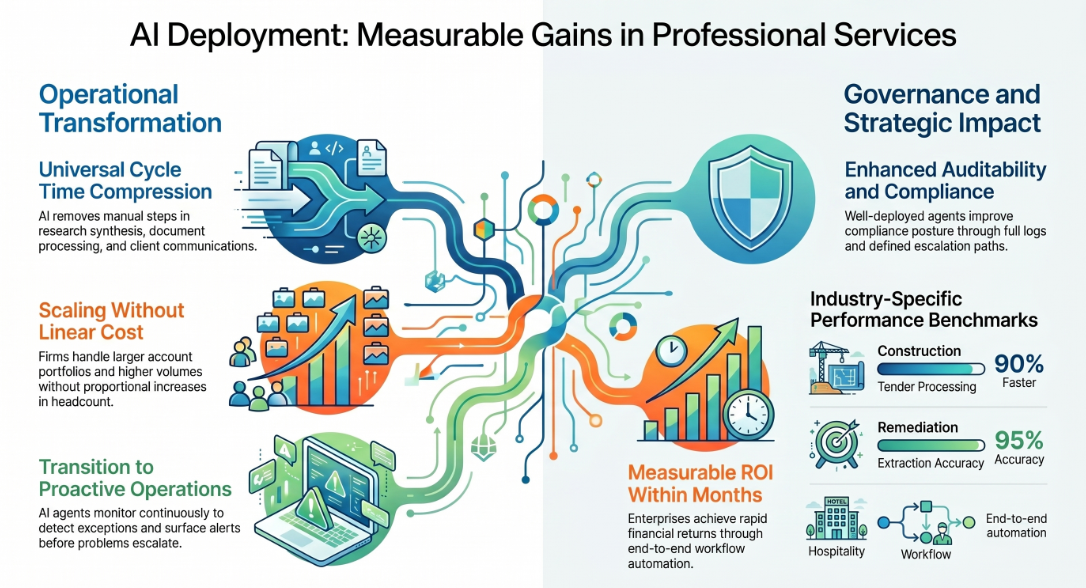
Across live deployments, several outcome patterns emerge consistently.
Speed. The most universal result is compression of cycle times — document processing, research synthesis, competitive monitoring, order creation, and client communications all move faster when AI agents remove the manual steps between data and action.
Scale without proportional cost. Firms are handling larger account portfolios, wider monitoring coverage, and higher query volumes without linear increases in headcount. One logistics operator improved terminal-to-rail throughput predictability and reduced coordination overhead across multi-entity global operations.
Proactive rather than reactive operations. AI agents do not wait to be asked. They monitor continuously, detect exceptions early, and surface alerts before problems escalate. This shift — from reactive reporting to proactive execution — is cited as one of the most significant operational changes by firms that have deployed agents in production.
Auditability and governance. Contrary to common concern, well-deployed AI agents improve compliance posture. Every action is logged. Exceptions are flagged. Escalation paths are defined. One financial services deployment was specifically noted for improving compliance readiness through full audit trails.
Measurable ROI within months. A luxury hospitality group automated end-to-end booking workflows and scaled operations without compromising service standards. A construction and remediation firm targeted 90% faster tender processing with 95% extraction accuracy. A retail enterprise reduced manual helpdesk burden and improved store-level inventory visibility simultaneously.
The Services AI Agents Are Handling Right Now
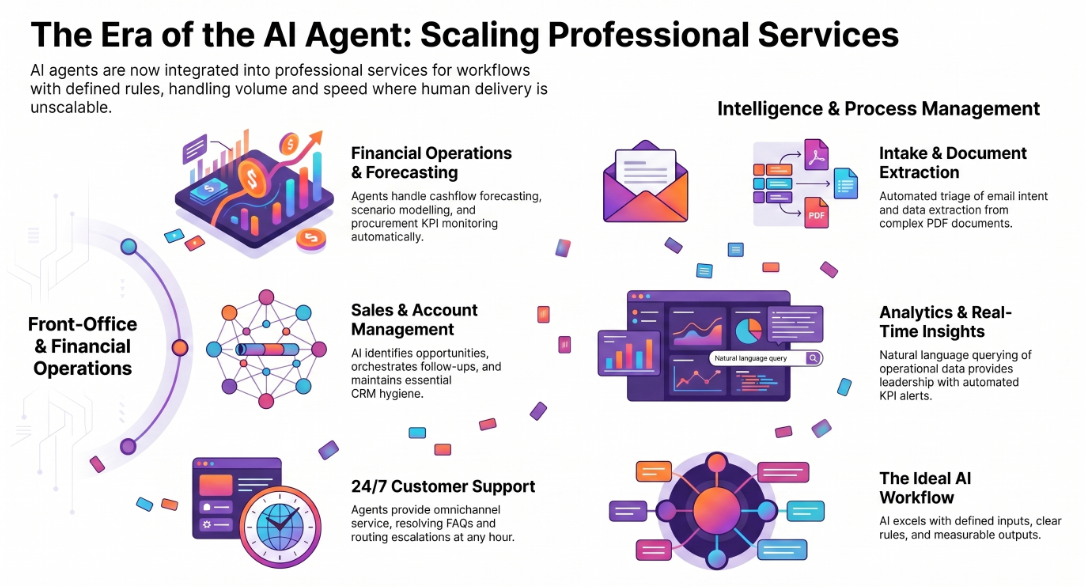
If you are wondering whether AI agents can actually handle the complexity of professional services work, consider the scope of what is already in production:
- Intake and triage: Email intake, intent classification, data extraction, query routing across channels
- Document work: Tender retrieval, contract extraction, vision-LLM processing of complex PDFs, audit logs
- Research and intelligence: Continuous competitor monitoring, market signal aggregation, thematic analysis
- Financial operations: Cashflow forecasting, scenario modelling, runway alerts, procurement KPI monitoring
- Sales and account management: Account monitoring, opportunity identification, follow-up orchestration, CRM hygiene
- Customer and tenant support: 24×7 omnichannel service, FAQ resolution, escalation routing, SLA tracking
- Operations and compliance: Smart grid monitoring, healthcare credential verification, staffing compliance, SAP order creation
- Analytics and insight: Natural language querying of operational data, automated KPI dashboards, leadership alerts
The pattern across all of these: AI agents work best where the workflow has defined inputs, clear decision rules, and a measurable output — but where the volume, complexity, or speed of execution makes human-only delivery unscalable.
How to Deploy AI Agents in Your Professional Services Firm
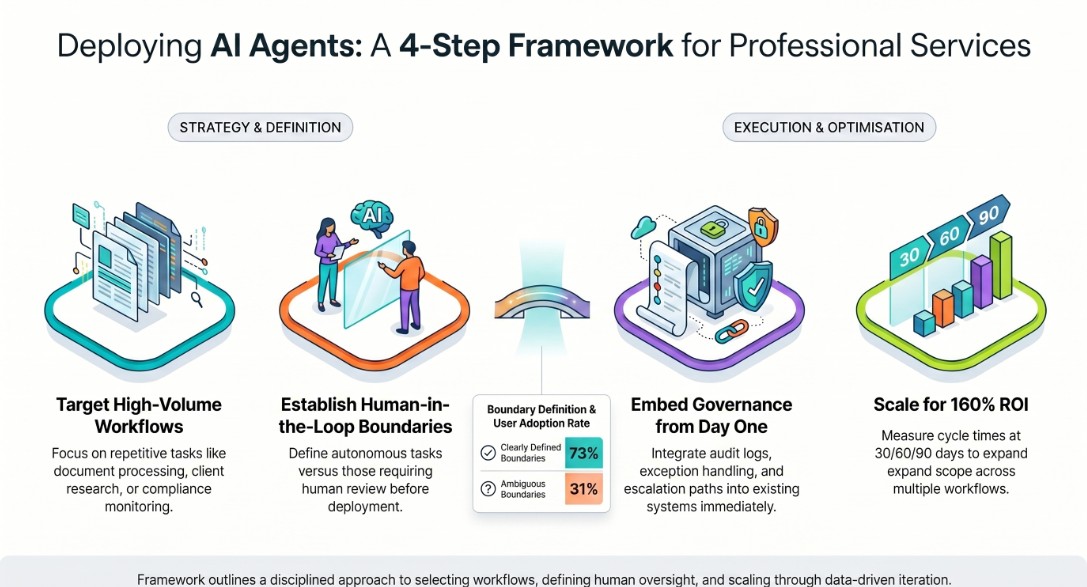
Most firms fail at AI agents not because the technology does not work, but because they approach it the wrong way. Here is a practical four-step framework.
Step 1: Identify the right workflow
Start with a workflow that is high-volume, repetitive, well-defined, and currently creating a bottleneck. Document processing, client research, compliance monitoring, and reporting are consistently the best starting points. Avoid starting with workflows that require significant subjective judgment or that lack structured data.
Step 2: Define the scope and human-in-the-loop checkpoints
Decide what the agent does autonomously, what it flags for review, and what it escalates. Deloitte's 2025 research found that firms defining the human-AI boundary before deployment achieved 73% user adoption — versus 31% when boundaries were ambiguous. Clarity at this stage is the single biggest predictor of successful adoption.
Step 3: Build with governance and guardrails from day one
Every production-grade AI agent needs audit logs, exception handling, defined escalation paths, and integration with your existing systems. This is not optional — it is what separates a pilot from a deployment. Build it in from the start.
Step 4: Measure, iterate, and expand
Collect baseline metrics before deployment: cycle time, error rate, volume handled, cost per resolution. Measure the same metrics post-deployment at 30, 60, and 90 days. Use real data to decide where to expand the agent's scope or where to add additional agents. The firms achieving 160% ROI are running multiple agents across multiple workflows — not one agent doing one thing.
Conclusion: From Pilot Purgatory to Production
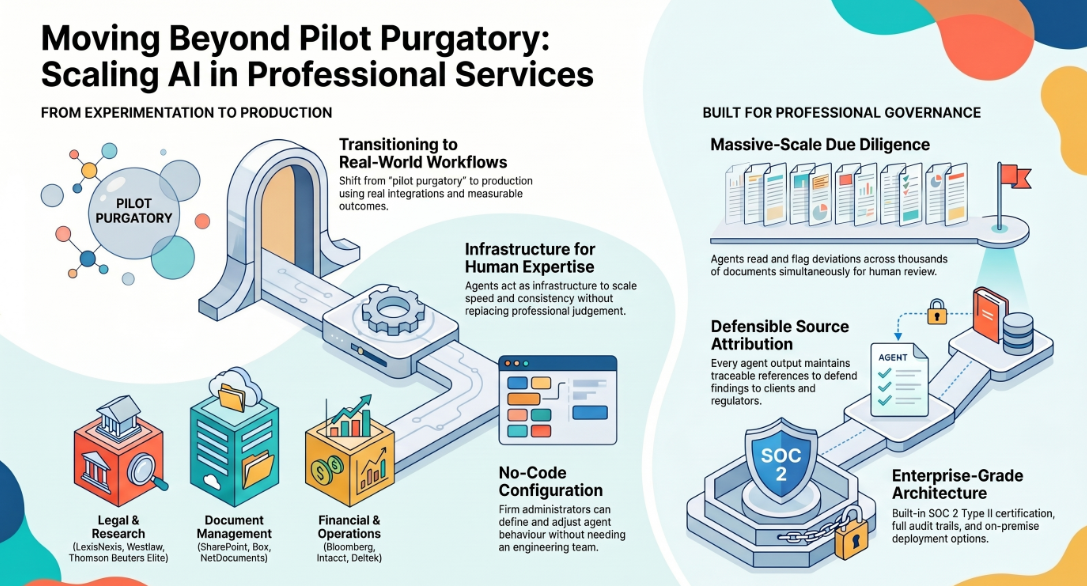
The professional services firms that will define the next decade are not the ones that experimented with AI the earliest. They are the ones that moved from experimentation to production — with real workflows, real integrations, and real measurement.
AI agents are the mechanism for that shift. Not as a replacement for professional expertise, but as the infrastructure that lets that expertise operate at a scale, speed, and consistency that was not previously possible.
The use cases are proven. The outcomes are documented. The deployment path is clear.
The only question left is where you start.
Why Some Firms Are Moving Faster Than Others
There is a pattern across the deployments described in this guide. The firms seeing real outcomes — faster research cycles, always-on monitoring, automated document workflows — are not building agents from scratch or stitching together generic AI tools. They are working with a platform purpose-built for professional services.
Assistents is that platform.
Most AI tools were built for consumers or developers and adapted for enterprise later. Assistents was designed the other way around — starting with the governance, auditability, and compliance requirements that professional services firms cannot compromise on, and building the agent capability on top of that foundation.
In practice, that means:
Research that cites its sources. Every agent output maintains full source attribution. Your team can defend every finding — to clients, regulators, or partners — because the agent never produces a claim without a traceable reference.
Due diligence at a scale humans cannot match. Agents read contracts clause by clause, extract obligations, flag deviations from your playbook, and surface hidden dependencies across thousands of documents simultaneously. Your legal or advisory team reviews findings and makes judgment calls. The mechanical work is handled.
Complete audit trails from day one. Every agent action is logged. Every escalation path is defined. Every approval workflow is governed. This is not an add-on — it is the architecture. Assistents is SOC 2 Type II certified and supports on-premise deployment for firms where data sovereignty is non-negotiable.
Integration with the tools your firm already uses. SharePoint, Box, NetDocuments, Thomson Reuters Elite, LexisNexis, Westlaw, Bloomberg, Intacct, Deltek — agents connect to your existing stack and orchestrate workflows across it. No rip and replace.
An agent builder that does not require an engineering team. Professional services firms should not need a developer to configure a research agent or update a document review workflow. Assistents is built so firm administrators can define, adjust, and expand agent behaviour without writing code.
The result, as described by firms running Assistents in production: research and analysis that compress from weeks to hours, document review that scales without scaling headcount, and operations that shift from reactive to proactive — because the agents are always on, even when your team is not.
If you are evaluating how to move past the pilot stage, the most useful next step is not a product demo in the abstract. Assistents offers something more specific: bring a real project — a recent due diligence exercise, a document-heavy workflow, a monitoring task your team currently does manually — and they will show exactly how agents would handle it, with full source attribution and audit trail.
→ Schedule a professional services demo at assistents.ai
FAQs
What is the difference between an AI agent and an AI chatbot?
A chatbot responds to a single input. An AI agent can plan and execute a multi-step workflow — gathering information from multiple sources, making decisions, taking actions, and returning a result. Chatbots answer questions; agents complete tasks.
How long does it take to deploy an AI agent in a professional services firm?
Timelines vary by complexity. A focused, single-workflow agent — such as a document intake classifier or a competitive monitoring agent — can typically be in production within four to eight weeks. Multi-agent systems integrating with enterprise platforms take longer, typically three to six months for full deployment.
What ROI should a professional services firm expect from AI agents?
Based on industry data, firms deploying AI agents in knowledge-intensive functions report cost reductions of 20–35% in specific workflows, while high-performing firms achieve 160% average ROI across a portfolio of three or more use cases. First-year ROI is achievable for most well-scoped deployments.
Are AI agents safe to use with confidential client data?
Yes, when built with the right architecture. Production deployments use private infrastructure, role-based access control, defined data retention policies, and full audit logs. Governance is built in at the design stage — not added as an afterthought.
Can AI agents work with my existing systems?
In most cases, yes. AI agents are designed to integrate with existing CRM, ERP, document management, and data platforms — not replace them. The agent adds a reasoning and action layer on top of the systems you already have.
How do AI agents help firms scale without hiring?
AI agents handle the high-volume, structured parts of workflows — intake, classification, monitoring, reporting, follow-up — freeing human professionals to focus on judgment-heavy, relationship-driven, and creative work. This expands firm capacity without linear headcount growth.

Transform Your Business With Agentic Automation
Agentic automation is the rising star posied to overtake RPA and bring about a new wave of intelligent automation. Explore the core concepts of agentic automation, how it works, real-life examples and strategies for a successful implementation in this ebook.
Sarfraz Nawaz is the CEO and founder of Ampcome, which is at the forefront of Artificial Intelligence (AI) Development. Nawaz's passion for technology is matched by his commitment to creating solutions that drive real-world results. Under his leadership, Ampcome's team of talented engineers and developers craft innovative IT solutions that empower businesses to thrive in the ever-evolving technological landscape.Ampcome's success is a testament to Nawaz's dedication to excellence and his unwavering belief in the transformative power of technology.

More insights
Discover the latest trends, best practices, and expert opinions that can reshape your perspective







Contact us

