
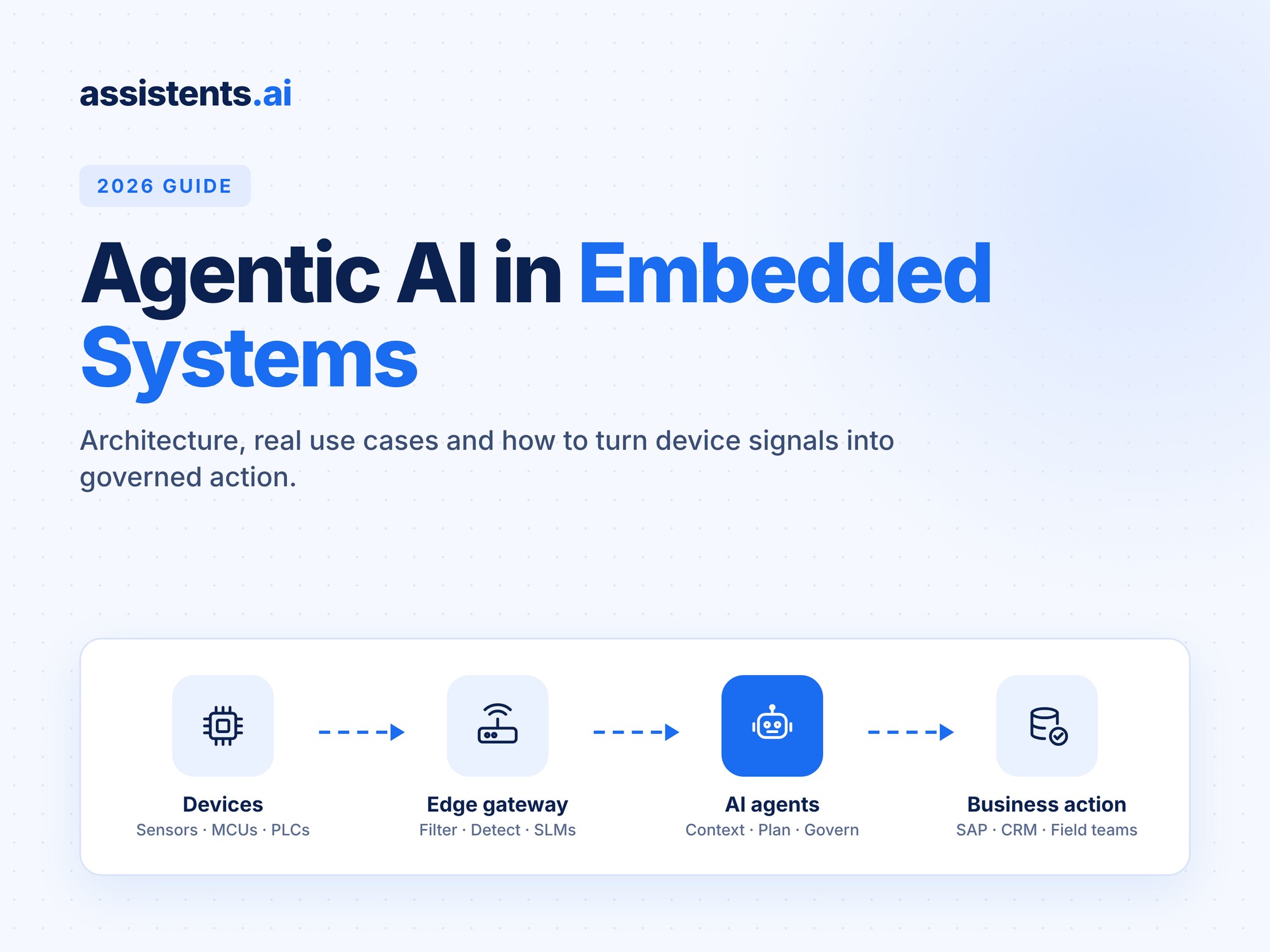
Agentic AI in Embedded Systems: Architecture, Use Cases and How to Deploy It (2026 Guide)


Agentic AI in embedded systems means AI agents that perceive signals from devices, reason about a goal, plan the next steps and act within set limits — on the device, at an edge gateway, or through the enterprise systems where work gets done. Instead of a sensor model that raises an alert and stops, an agentic system decides what the alert means, who owns it, what policy applies and what should happen next, and then makes it happen with a human approving wherever the risk calls for it.
The shift is arriving fast. Gartner expects 33% of enterprise software applications to include agentic AI by 2028, and 15% of day-to-day work decisions to be made autonomously by then. It also warns that over 40% of agentic AI projects will be cancelled by the end of 2027 because of unclear value, rising cost or weak risk controls (SD Times summary of Gartner). For teams running connected devices, the gap between those two numbers comes down to architecture and governance.
This guide explains how agentic AI works in embedded and IoT systems, where it runs, what it can and cannot do at the edge, eight real-world use cases, and a practical roadmap to deploy it safely.
TL;DR
- Agentic AI adds goals, memory, planning and tool use on top of the perception models already common in embedded AI.
- The architecture that works in production is hybrid: deterministic control on the device, fast inference at the edge, reasoning and action in an orchestration layer.
- Agents should advise or plan; control loops stay hard real-time.
- The biggest value is turning device events into completed business actions: work orders, alerts, tickets, ERP records.
- Start with one device-driven process, define success measures, keep humans in the loop and expand from there.
What is agentic AI in embedded systems?
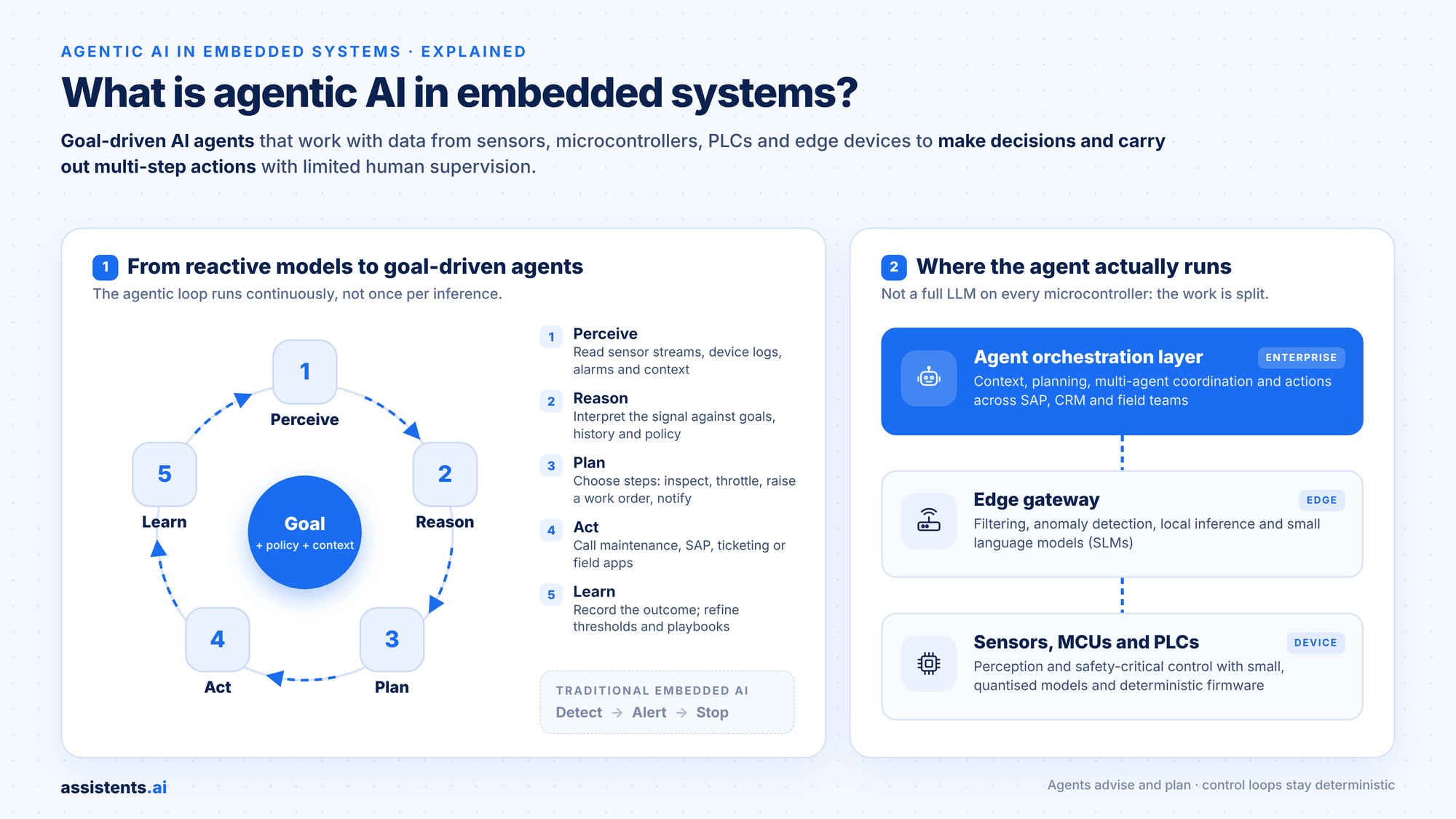
Agentic AI in embedded systems is the use of goal-driven AI agents that work with data from sensors, microcontrollers, PLCs and edge devices to make decisions and carry out multi-step actions with limited human supervision. It combines the perception strengths of embedded AI with the reasoning and execution strengths of AI agents.
If you are new to the concept, our primer on what agentic AI is and how it transforms workflows covers the fundamentals. Here we focus on what changes when agents meet devices.
From reactive models to goal-driven agents
Most embedded AI today is reactive and stateless. A model detects a vibration pattern, classifies an image or predicts a value, and then hands off to fixed logic. As Electronics World puts it, agentic systems instead pursue goals over time and revise their plans as conditions change.
An agentic loop has five stages:
- Perceive — read sensor streams, device logs, alarms and context.
- Reason — interpret what the signal means against goals, history and policy.
- Plan — choose a sequence of steps (inspect, throttle, raise a work order, notify a team).
- Act — call tools and systems: a maintenance system, SAP, a ticketing queue, a field app.
- Learn — record the outcome and refine thresholds, playbooks or plans.
Reactive embedded AI vs agentic AI loop: perceive, reason, plan, act, learn
Where the agent actually runs: device, gateway or enterprise layer
"Agentic AI in embedded systems" does not mean a full language model on every microcontroller. In practice the work is split:
- On the device: perception and safety-critical control (small, quantised models; deterministic firmware).
- At the edge gateway: filtering, anomaly detection, local inference and, increasingly, small language models (SLMs).
- In the agent orchestration layer: context, planning, multi-agent coordination and actions across enterprise systems.
This split is what makes agentic AI practical for real embedded estates. Research such as Toward Edge General Intelligence with Agentic AI describes the same direction: distributing agent capabilities across device, edge and cloud.
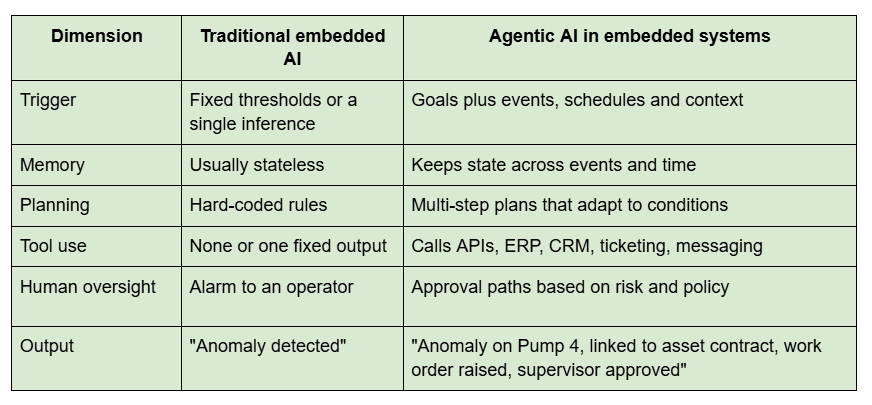
Agentic AI vs traditional embedded AI
The difference is not the model. It is what happens after the model produces an output.
Edge AI vs embedded AI vs agentic AI: how the terms relate
These terms are often used interchangeably, but they answer different questions.
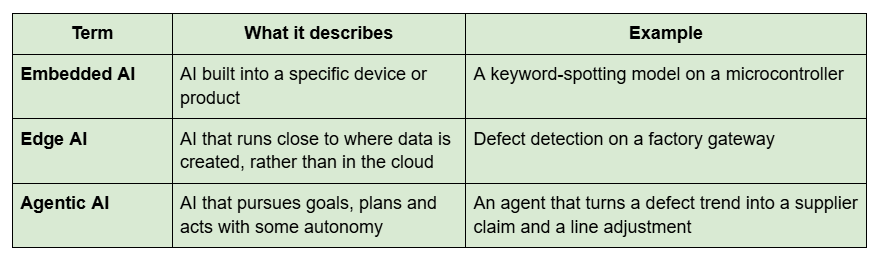
Agentic edge AI combines them: autonomous, goal-driven behaviour that uses edge and embedded intelligence as its senses.
How agentic AI works in embedded systems: the edge-to-enterprise architecture
The architecture that survives contact with production has four layers. Each layer does what it is best at, and none is asked to do the others' job.
Layer 1: Sensors, MCUs and PLCs (perception and deterministic control)
This is where physical signals are captured and where real-time control lives. Firmware and control loops here must stay deterministic. Embedded models handle perception tasks such as vibration analysis, current signatures, temperature drift or visual inspection.
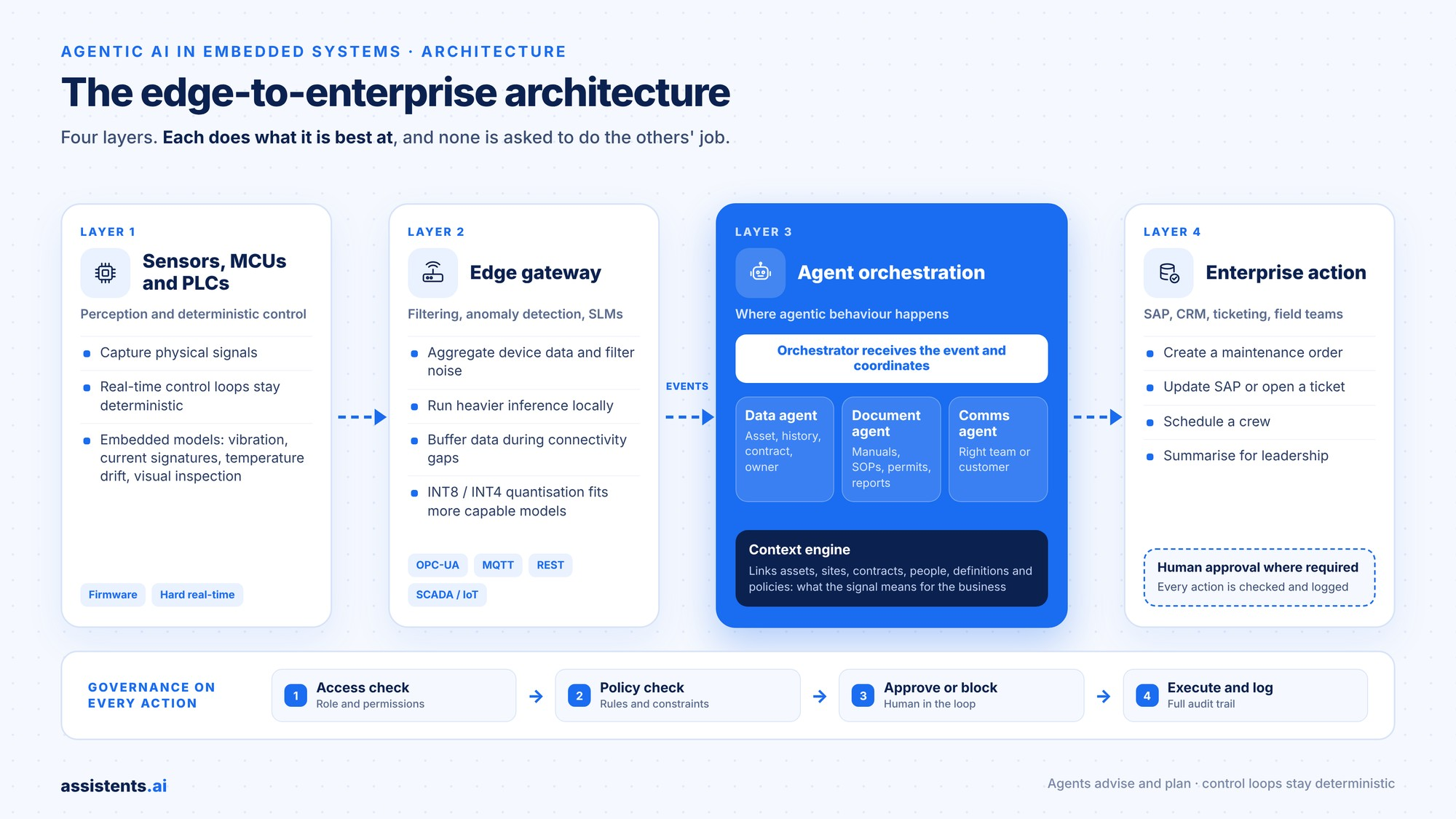
Layer 2: Edge gateway (filtering, anomaly detection, small language models)
The gateway aggregates device data, filters noise, runs heavier inference and buffers data during connectivity gaps. Industrial protocols such as OPC-UA, MQTT and REST move events upward, often through an existing SCADA or IoT platform. Quantisation from 16-bit to INT8 or INT4 cuts memory and storage needs enough to run more capable models here (Embedded.com).
Layer 3: Agent orchestration (context, planning, specialist agents)
This is where agentic behaviour happens. An orchestrator receives an event and coordinates specialist agents:
- A data agent looks up the asset, its history, contract and owner.
- A document agent reads manuals, SOPs, permits or service reports.
- A communication agent contacts the right team or customer.
A context engine links entities (assets, sites, contracts, people), business definitions and policies, so the agent understands what the signal means for the business, not only what it measures.
Layer 4: Enterprise action (SAP, CRM, ticketing, field teams, with human approval)
Finally, the agent acts: it creates a maintenance order, updates SAP, opens a ticket, schedules a crew, or sends a summary to leadership. Every action passes a governance check and, where required, waits for human approval before it executes. Everything is logged.
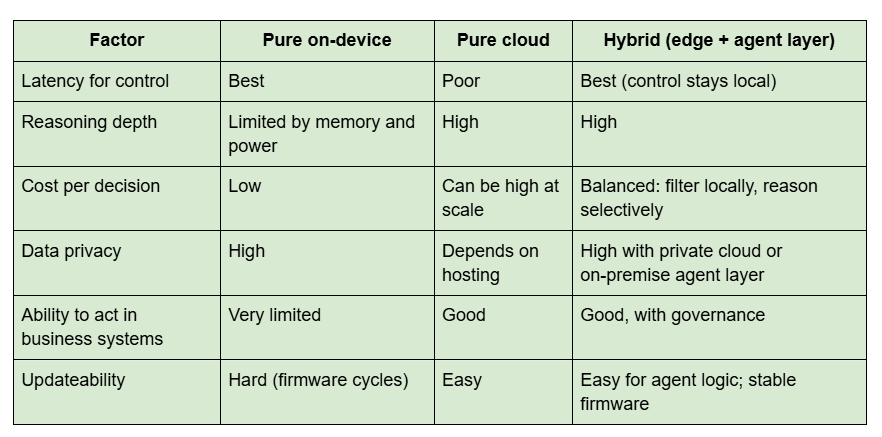
Why the hybrid model beats pure on-device or pure cloud
Deployment constraints at the edge (and how to design around them)
Agentic AI at the edge is constrained by physics and safety. Good designs respect those limits instead of fighting them.
Memory, power and latency budgets
Microcontrollers have kilobytes to a few megabytes of SRAM and Flash. Running agents there means small language models, aggressive quantisation and narrow tasks. Gateways and NPU-class processors can host more, but power and thermal budgets still apply. Set an expected performance range (memory, energy, latency) for each target before you judge an agent's results, a point practitioners stress in Embedded.com's coverage of edge AI development.
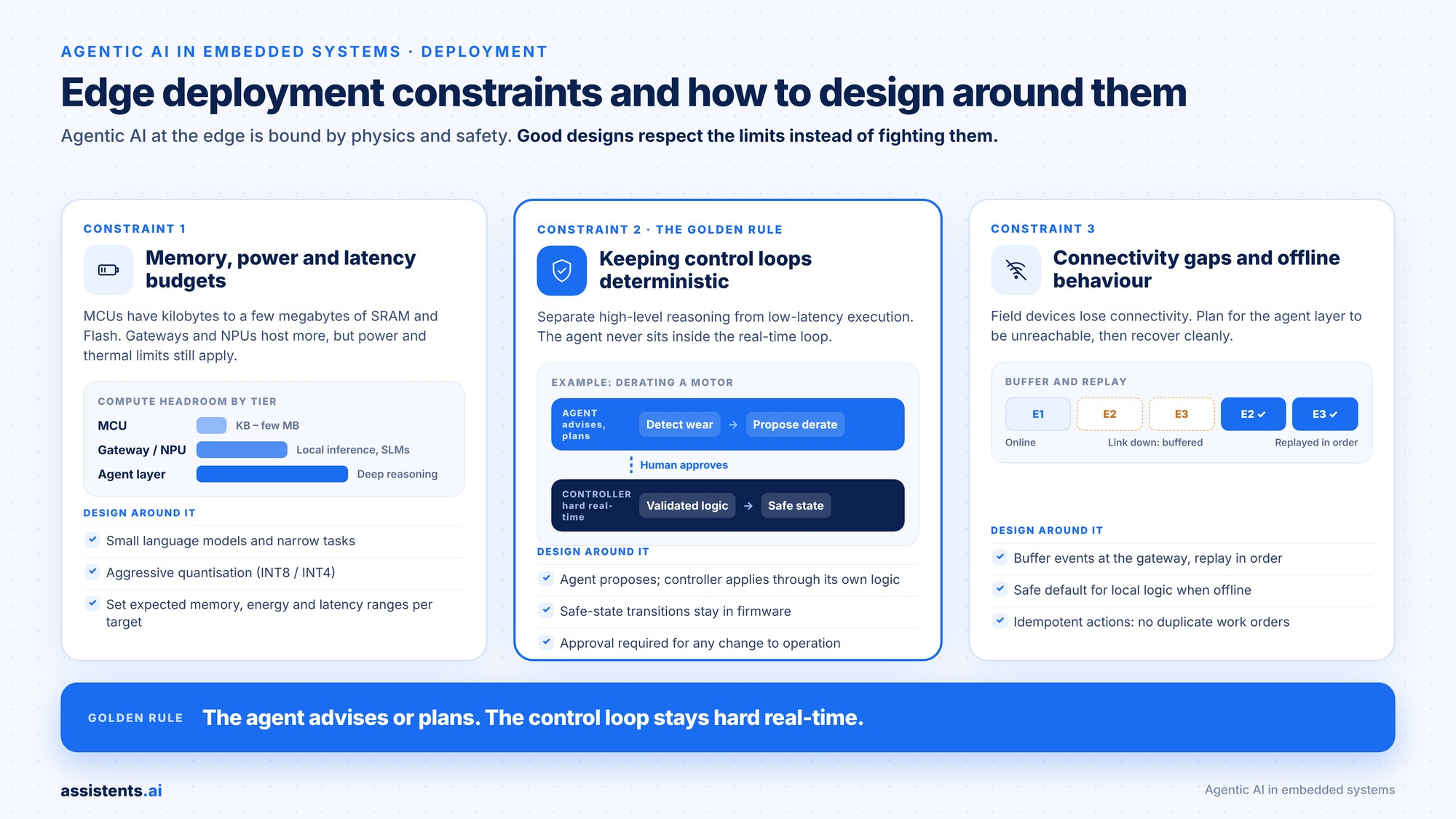
Keeping control loops deterministic
The golden rule: the agent advises or plans; the control loop stays hard real-time. Separate high-level reasoning from low-latency execution. An agent may decide that a motor should be derated and request approval; the motor controller applies the change through its own validated logic and safe-state transitions.
Connectivity gaps and offline behaviour
Field devices lose connectivity. Design for it:
- Buffer events at the gateway and replay them in order.
- Give local logic a safe default when the agent layer is unreachable.
- Make agent actions idempotent so a replayed event does not create duplicate work orders.
8 real-world use cases of agentic AI in embedded and IoT systems
The examples below come from Ampcome's delivery work. Client names are withheld; each case shows the device-signal-to-action pattern. For more examples across industries, see our top agentic AI use cases with real-life examples.
1. Smart grid monitoring for a state power transmission utility
Problem: Transmission KPIs, losses and outages were spread across systems, and field teams learned about issues late.
What the agents do: Ingest transmission and smart grid data, monitor KPIs continuously, detect anomalies, surface loss and outage analytics with predictive maintenance indicators, and route automated alerts to field operations.
Outcome: Faster identification of grid exceptions and operational risks, improved reliability through proactive monitoring, and better transparency for leadership.
2. Campus energy management for a national research institute
Problem: A campus-scale estate needed reliable infrastructure monitoring and energy optimisation, but monitoring was manual.
What the agents do: Ingest utility and sensor data, detect anomalies, forecast consumption, recommend optimisations and send proactive alerts through dashboards.
Outcome: Better energy visibility, faster detection of inefficiencies, less manual monitoring and more predictable operations through early alerts.
3. City-scale smart infrastructure analytics
Problem: A smart infrastructure operator running multiple city operations centres and a very large base of connected assets needed to move from dashboards to action.
What the agents do: Agentic analytics on top of smart utility systems: smart grid data ingestion, predictive analytics for outages, losses and field issues, and automated alerts with workflow routing for resolution.
Outcome: Higher operational visibility, faster exception detection and response coordination, and more proactive operations through continuous monitoring.
4. Port terminal and rail logistics for a global ports operator
Problem: Terminal-to-rail operations depended on fragmented, manual coordination.
What the agents do: Digitise terminal workflows, provide yard and rail operational dashboards, manage rail scheduling, visibility and exceptions, and push executive dashboards and operational alerts.
Outcome: Better exception response, higher predictability of terminal-to-rail throughput, and more efficient coordination across terminal and inland logistics.
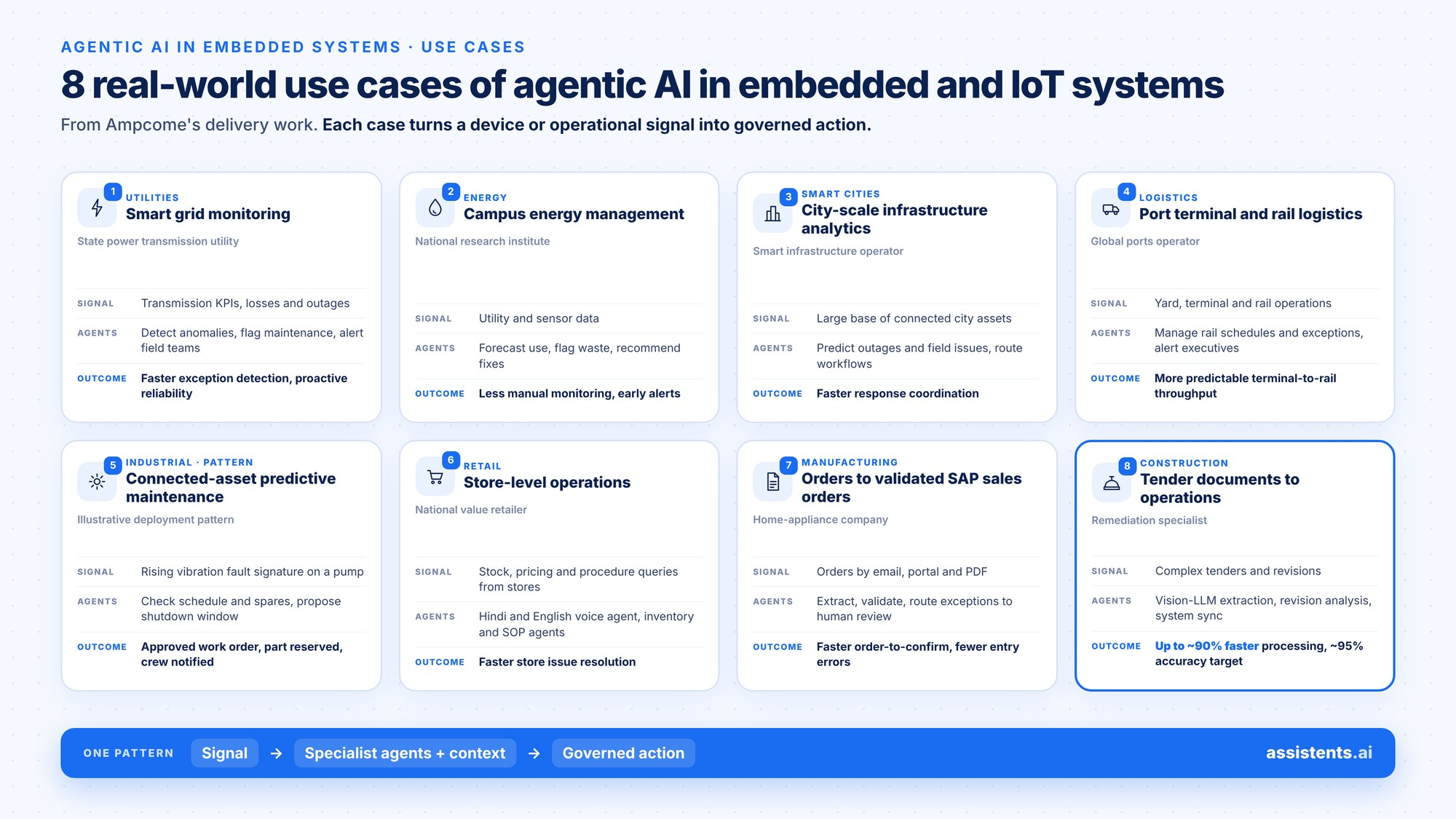
5. Connected-asset predictive maintenance
Pattern: A vibration sensor on a pump flags a rising fault signature. The edge model scores severity. The agent checks the asset's production schedule, warranty and spare-parts stock, then proposes a controlled shutdown window. A supervisor approves, the agent raises the work order, reserves the part and notifies the crew.
Why it matters: Electronics World describes the same logic: an agent weighs fault severity against production state before a controlled shutdown (source). The difference in production is the last mile — the agent completing the work in maintenance and ERP systems. See how this plays out across plants in AI agents in manufacturing.
6. Store-level operations for a national value retailer
Problem: Hundreds of stores generated helpdesk calls about stock, pricing, promotions and procedures.
What the agents do: A bilingual (Hindi and English) voice support agent built on a speech-to-text, LLM and text-to-speech pipeline; an inventory intelligence agent for pricing, stock and promotions per store; and a knowledge and training agent using retrieval over POS and SOP documents, integrated with ticketing.
Outcome: Reduced manual helpdesk burden, faster store issue resolution, better store-level inventory visibility and faster onboarding through on-demand guidance.
7. Device and order events to ERP: validated SAP sales orders for a home-appliance company
Problem: Orders arrived by email, portal and PDF, and teams re-keyed them into SAP.
What the agents do: A document agent extracts customer, product, quantity, pricing and delivery details. A data agent validates them against business data, credit limits and terms. Exceptions — missing information, duplicates or items outside policy — go to human review. Approved orders become validated sales orders in SAP, with audit logs and reconciliation reporting.
Outcome: Less manual order processing and legacy dependency, a faster order-to-confirm cycle with fewer data-entry errors, and better auditability.
8. Field and tender documents to operations systems for a remediation specialist
Problem: Complex tender documents and revisions had to be read, compared and synchronised into operational systems by hand.
What the agents do: A multi-agent document workbench retrieves tenders, determines workflow, analyses revisions, extracts data from complex PDFs with vision-language models, and syncs approved details into the field-service system with quote locking and audit logs.
Outcome: Engineered for up to ~90% faster tender document processing and a ~95% extraction accuracy target for standard formats, with lower bid risk through change detection and auditability.
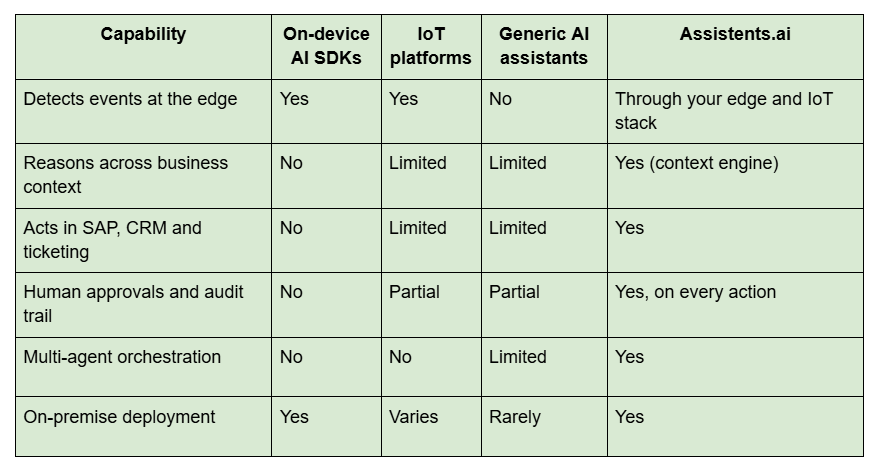
Why teams choose Assistents.ai for device-driven workflows. Most embedded AI stops at the alert. Assistents.ai picks up from there: its agents read the signal, check it against your business context, decide the next step and act in SAP, CRM or your ticketing system, with a person approving wherever policy requires it. It runs in deployments across utilities, energy, logistics, retail and industrial operations. See how it works →
Agentic AI for embedded software development
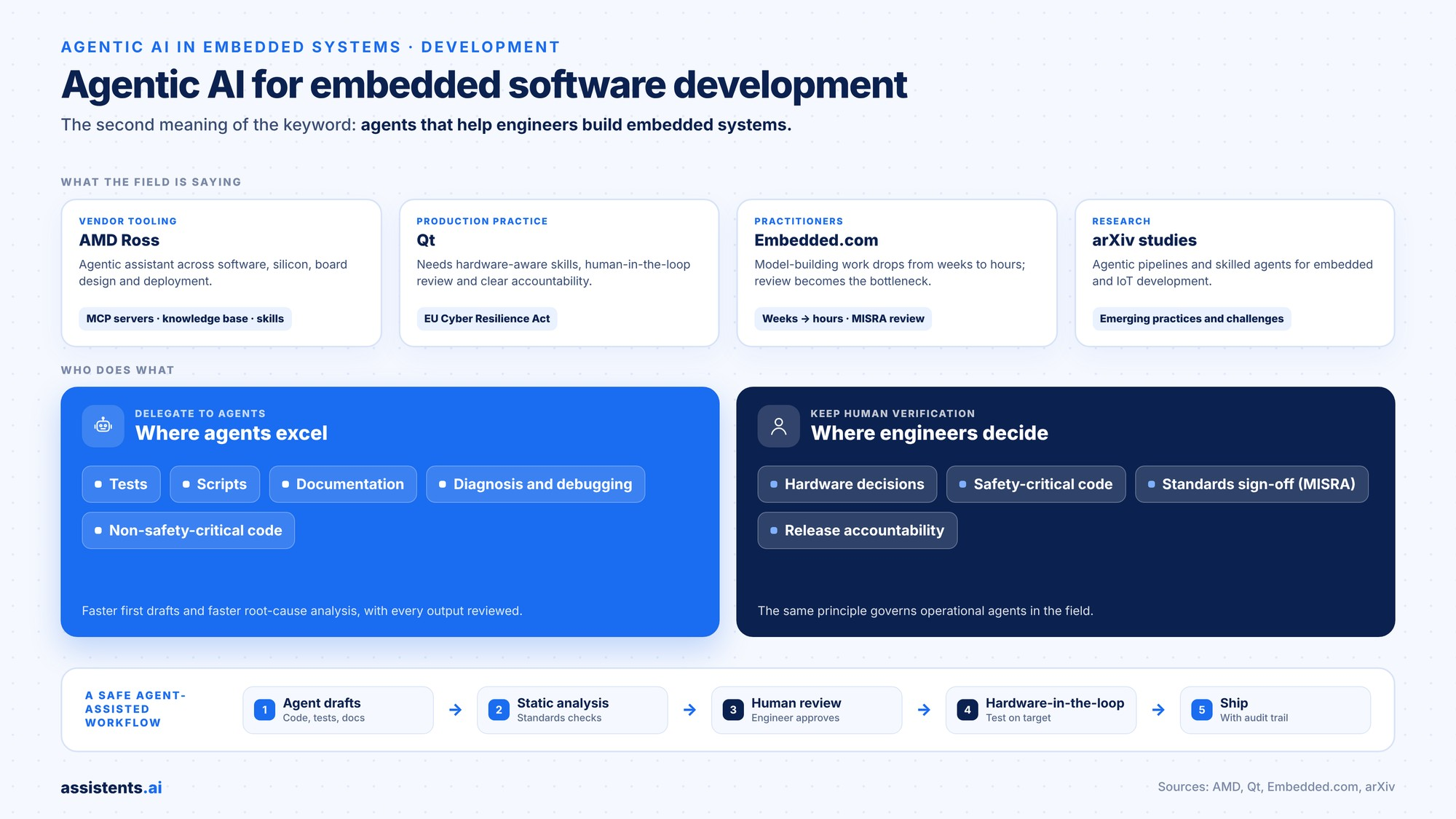
There is a second meaning of the keyword: agents that help engineers build embedded systems. This area is moving quickly.
- AMD Ross is an agentic assistant spanning software, silicon, board design and deployment, built on MCP servers, a knowledge base, agent skills and design examples.
- Qt's analysis of agentic development in production argues that production use needs hardware-aware agent skills, human-in-the-loop review and clear accountability, especially under the EU Cyber Resilience Act.
- Practitioners quoted by Embedded.com report model-building work dropping from weeks to hours, while noting that review against standards such as MISRA becomes the new bottleneck.
- Academic work such as Agentic Pipelines in Embedded Software Engineering and Skilled AI Agents for Embedded and IoT Systems Development documents emerging practices and challenges.
The consistent lesson: agents are excellent at tests, scripts, documentation, diagnosis and non-safety-critical code, while hardware and safety decisions still need human verification. The same principle applies to operational agents, which is why governance is the next section.
Safety, security and governance for autonomous embedded agents
Autonomy without control is how agentic projects end up in Gartner's 40%. Governance has to be designed in from day one.
Guardrails: permissions, policy checks and approval paths
Every proposed action should pass two checks before it executes:
- Access check — does this agent, acting for this user or role, have permission?
- Policy evaluation — does the action meet business rules and constraints?
The result falls into one of three paths:
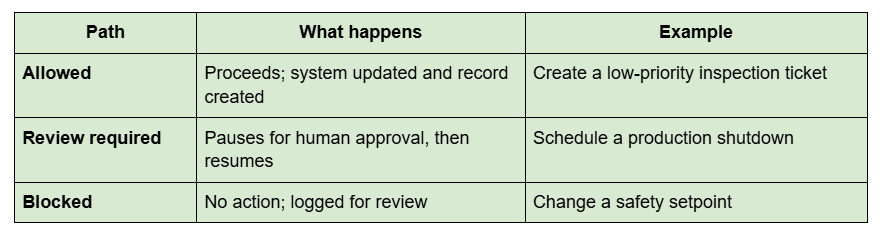
Governance flow for agentic AI: access check, policy evaluation, allowed, review required or blocked
Threats: prompt injection, tool misuse and data leakage
Agents that read documents, emails and logs can be manipulated by instructions hidden in that content. Protect against it:
- Treat all device data, documents and messages as untrusted input, never as instructions.
- Give each agent the minimum tools and permissions it needs.
- Route model calls through a gateway with usage limits, approved models and logging.
- Keep sensitive operational data in private cloud or on-premise deployments where required.
Compliance: EU Cyber Resilience Act, functional safety and audit trails
Manufacturers carry cybersecurity responsibility for connected products across their lifecycle under the EU Cyber Resilience Act, including AI-assisted components (Qt). For safety-critical systems, keep agents out of certified control paths and document their role in your safety case. In every case, keep a complete audit history: the triggering event, the context used, the decision, the approver and the outcome.
How to deploy agentic AI in embedded systems: a 6-step roadmap
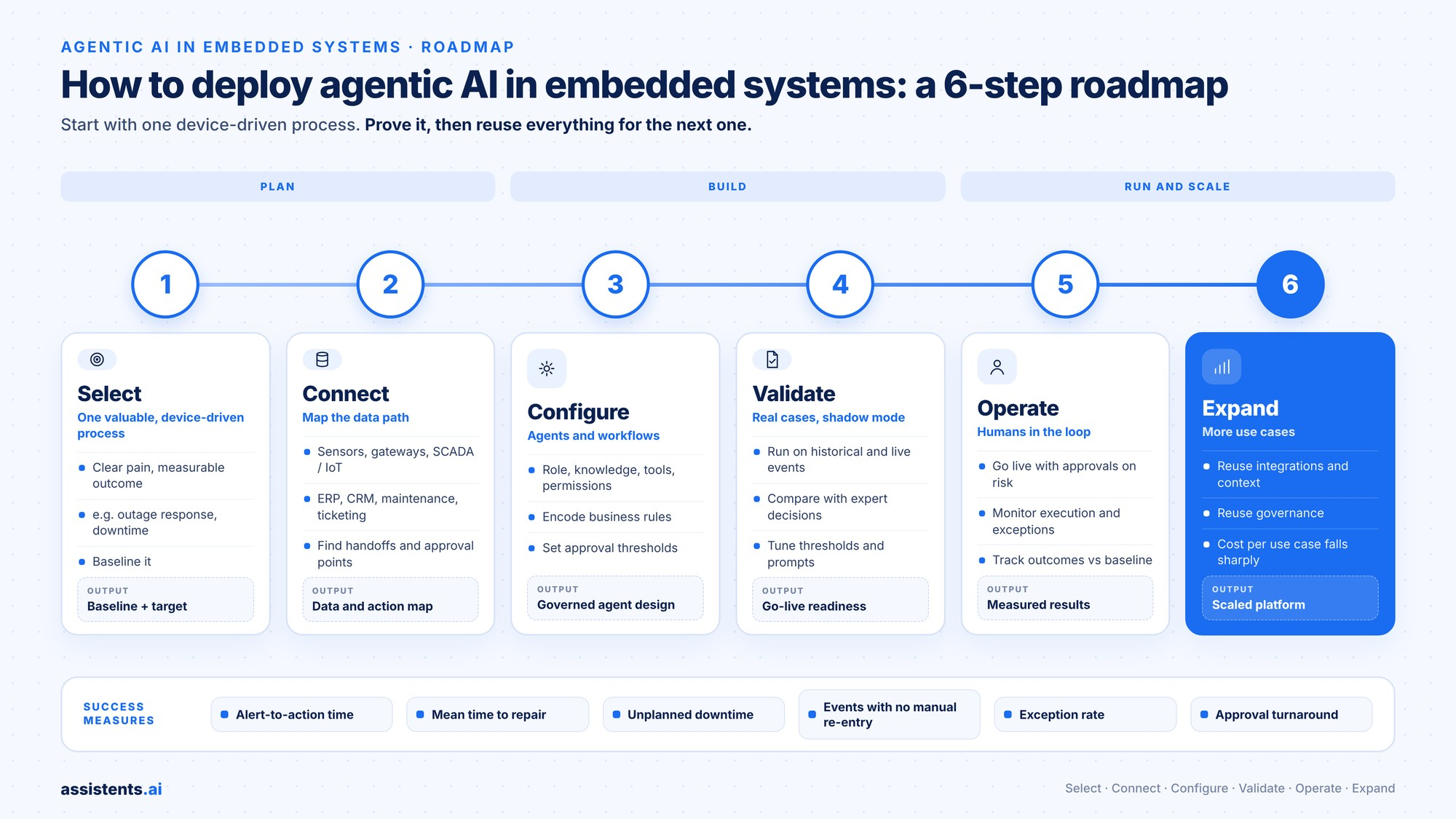
- Select one valuable, device-driven process. Pick a process with clear pain and measurable outcomes, such as outage response time, unplanned downtime or alert-to-resolution time. Baseline it.
- Connect the systems. Map the data path: sensors and gateways, SCADA or IoT platform, and the business systems where action happens (ERP, CRM, maintenance, ticketing). Identify handoffs and approval points.
- Configure agents and workflows. Define each agent's role, knowledge sources, tools and permissions. Encode business rules and approval thresholds.
- Validate on real cases and refine. Run agents in shadow mode against historical and live events. Compare decisions with what experts would do. Tune thresholds and prompts.
- Operate with humans in the loop. Go live with approvals on higher-risk actions. Monitor execution, exceptions and outcomes.
- Expand to more use cases. Reuse integrations, context and governance for the next process. This is where cost per use case falls sharply.
Success measures to track: alert-to-action time, mean time to repair, unplanned downtime, share of events handled without manual re-entry, exception rate and approval turnaround.
Why Assistents.ai is the leading platform for agentic AI across embedded and IoT operations
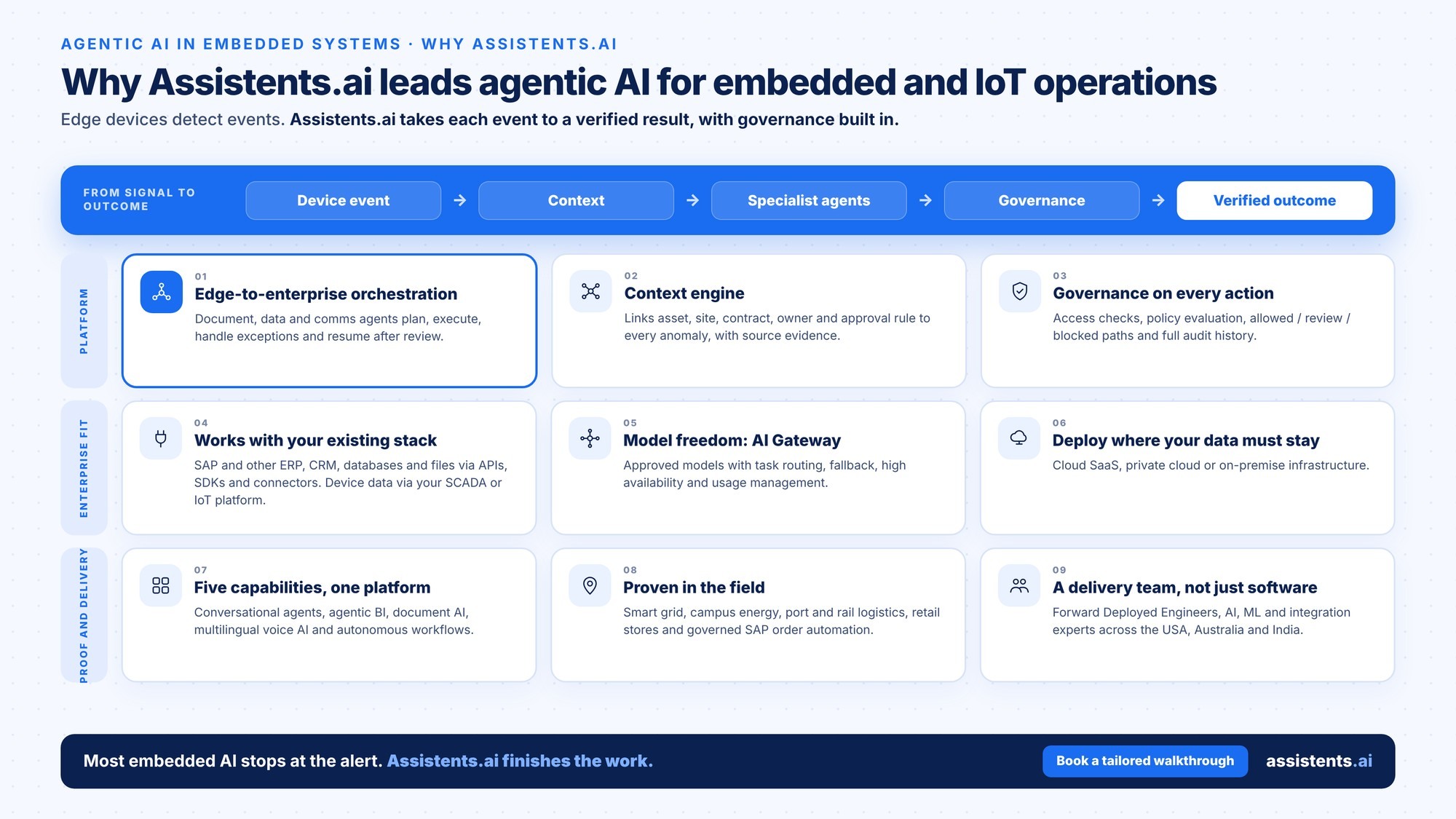
Edge devices are good at detecting events. Most organisations struggle to act on them. Assistents.ai, the agentic AI platform by Ampcome, connects device and sensor data to the enterprise systems where work gets done, and its specialist agents take each event to a verified result with governance built in.
Edge-to-enterprise orchestration
Agent orchestration coordinates document, data and communication agents that plan, execute, handle exceptions and resume after human review. An incoming event or document starts coordinated work; the platform routes tasks, tracks state and verifies outcomes.
A context engine that understands your operations
The context engine connects entities, relationships, business definitions, policies and real-time data. An agent knows which asset, site, contract, owner and approval rule an anomaly relates to, and backs every answer with source evidence.
Governance on every action
Access checks, policy evaluation and allowed, review-required or blocked paths are built in, with a complete audit history. That is essential where physical operations and safety are involved.
Works with your existing stack
Connect ERP systems including SAP, CRM, databases and files through APIs, SDKs and connectors, with event ingestion and bidirectional sync. Device data can come in through your existing SCADA or IoT platform, so there is no need to replace what already works.
Model freedom through the AI Gateway
Choose approved models with task routing, optimisation, fallback, high availability and usage management. Pair small edge models with deeper reasoning where the task needs it.
Deploy where your data must stay
Run as cloud SaaS, in a private cloud or on on-premise infrastructure.
Five capabilities on one platform
Conversational agents (answers and actions), agentic BI (questions to insight and alerts), document AI (documents to structured data), multilingual voice AI (conversations to service) and autonomous workflows (events to completed work), extended with Deep Research, Canvas, Agent Builder and Workflow Builder.
Proven in the field
Deployments include smart grid analytics for a state transmission utility, campus energy optimisation for a research institute, terminal and rail logistics for a global ports operator, store operations for a national retailer, and governed SAP order automation for manufacturers.
A delivery team, not just software
Forward Deployed Engineers, AI and ML engineers, data specialists and enterprise integration experts across the USA, Australia and India take you from the first process to enterprise scale. Ampcome is recognised among the top agentic AI companies.
Start with the device-driven process that matters most. Book a tailored walkthrough of Assistents.ai →
The future of agentic AI in embedded systems
Three shifts will shape the next two years:
- Smaller, smarter edge models. SLMs on NPUs will move more reasoning to gateways and capable devices, as hardware such as the systems covered in Embedded.com's look at AI agents at the edge shows.
- Standard tool interfaces. Protocols such as the Model Context Protocol (MCP), already used in tools like AMD Ross, will make devices and engineering tools callable by agents in a consistent way.
- Multi-agent fleets. Coordinated agents will manage whole sites, grids and supply chains, with governance layers deciding what each may do.
What to do in the next six months: choose one device-driven process, baseline it, and run a governed pilot. The value of the benefits of agentic AI compounds once integrations and context are reused.
Ready to turn device signals into completed work? Bring one device-driven process, and we'll map it to a governed agent workflow. Book a tailored walkthrough on Assistents.ai →
FAQs
What is agentic AI in embedded systems?
Agentic AI in embedded systems means AI agents that take signals from embedded devices, reason about a goal, plan steps and act within set limits. The agent can run on the device, at an edge gateway, or in an orchestration layer that acts through enterprise systems such as SAP or a maintenance platform.
How is agentic AI different from traditional embedded AI?
Traditional embedded AI classifies or predicts, then stops or triggers fixed logic. Agentic AI keeps state, plans multiple steps, uses tools and business systems, and verifies the result. Humans approve higher-risk actions, so autonomy grows without losing control.
Can AI agents run on microcontrollers or edge devices?
Only in limited form on microcontrollers. They can run small, quantised models for perception and narrow decisions. Reasoning and planning usually run on an edge gateway, an NPU-class processor or a cloud or on-premise agent layer, in a hybrid architecture.
What are the use cases of agentic AI in IoT?
Common use cases include predictive maintenance, smart grid and transmission monitoring, campus and building energy optimisation, port and rail logistics, retail store operations, and turning device or order events into ERP actions such as work orders and sales orders.
Is agentic AI safe for safety-critical embedded systems?
It can be, if agents never override deterministic control loops. Keep agents in an advisory or planning role for safety functions, use permission checks and policy rules, require human approval for high-risk actions and keep a full audit trail of every decision.
What is the difference between edge AI and agentic AI?
Edge AI describes where a model runs: close to the data, on devices or gateways. Agentic AI describes how AI behaves: goal-driven, multi-step and able to act. Agentic edge AI combines both, using edge intelligence as the senses of an autonomous agent.
How do AI agents connect device data to ERP systems like SAP?
Device events flow through SCADA or IoT platforms using protocols such as OPC-UA, MQTT or REST into an agent orchestration layer. The agent validates the event against business context and policy, then creates or updates records in SAP through governed APIs, with approvals where needed.
What hardware is needed for agentic edge AI?
You need sensors and microcontrollers for perception, an edge gateway or NPU-equipped device for local inference, and secure connectivity to the agent layer. Many pilots reuse existing devices and gateways, so the main investment is integration and agent configuration.
How do you keep humans in control of autonomous agents?
Classify every action as allowed, review required or blocked. Reviewed actions pause until an authorised person approves, then resume automatically. Limit each agent's permissions and log the event, context, decision, approver and outcome for every step.
How do you start an agentic AI pilot for connected devices?
Pick one high-value, device-driven process and baseline it. Connect the relevant devices and business systems, define success measures, configure agents and approval rules, validate on real events in shadow mode, then go live and expand to the next use case.

Transform Your Business With Agentic Automation
Agentic automation is the rising star posied to overtake RPA and bring about a new wave of intelligent automation. Explore the core concepts of agentic automation, how it works, real-life examples and strategies for a successful implementation in this ebook.
Sarfraz Nawaz is the CEO and founder of Ampcome, which is at the forefront of Artificial Intelligence (AI) Development. Nawaz's passion for technology is matched by his commitment to creating solutions that drive real-world results. Under his leadership, Ampcome's team of talented engineers and developers craft innovative IT solutions that empower businesses to thrive in the ever-evolving technological landscape.Ampcome's success is a testament to Nawaz's dedication to excellence and his unwavering belief in the transformative power of technology.

More insights
Discover the latest trends, best practices, and expert opinions that can reshape your perspective




Contact us


